


Philippians 3:20
Bible text: King James Version (1769 Blayney text) · Public domain
Bible text: Berean Standard Bible · Public domain
Bible text: American Standard Version (1901) · Public domain
Bible text: World English Bible, Messianic edition · Public domain
Bible text: Geneva Bible (1599) · Public domain
Bible text: Young's Literal Translation · Public domain
- ἡμῶνhēmōnOf usG3165P-1GPPersonal pronoun Genitive 1st Plural
- γὰρgarforG1063CONJConjunction
- τὸtotheG3588T-NSNDefinite article Nominative Singular Neuter
- πολίτευμαpoliteumacitizenshipG4175N-NSNNoun Nominative Singular Neuter
- ἐνeninG1722PREPPreposition
- οὐρανοῖςouranois[the] heavensG3772N-DPMNoun Dative Plural Masculine
- ὑπάρχειhuparcheiexistsG5225V-PAI-3SVerb Present Active Indicative 3rd Singular
- ἐξexfromG1537PREPPreposition
- οὗhouwhenceG3739R-GSMRelative pronoun Genitive Singular Masculine
- καὶkaialsoG2532CONJConjunction
- σωτῆραsōtēraa SaviorG4990N-ASMNoun Accusative Singular Masculine
- ἀπεκδεχόμεθαapekdechomethawe are awaitingG553V-PNI-1PVerb Present Middle Or Passive Deponent Indicative 1st Plural
- κύριονkurion[the] LordG2962N-ASM-TNoun Accusative Singular Masculine Title
- ἸησοῦνIēsounJesusG2424N-ASM-PNoun Accusative Singular Masculine Individual
- ΧριστόνChristonChristG5547N-ASM-TNoun Accusative Singular Masculine Title
English is a literal word-by-word gloss of the Greek, not the KJV's wording. Why?
This is the original text the KJV's translators worked from — each Greek word with its own literal English meaning in this verse, prepared by scholars at Tyndale House, Cambridge. The KJV translates whole sentences, not word by word, so its wording differs: one Greek word can become several English words, and the KJV may choose “charity” where the gloss reads “love”. Both are faithful — they answer different questions. For the KJV's own rendering, switch to the KJV text.
Details
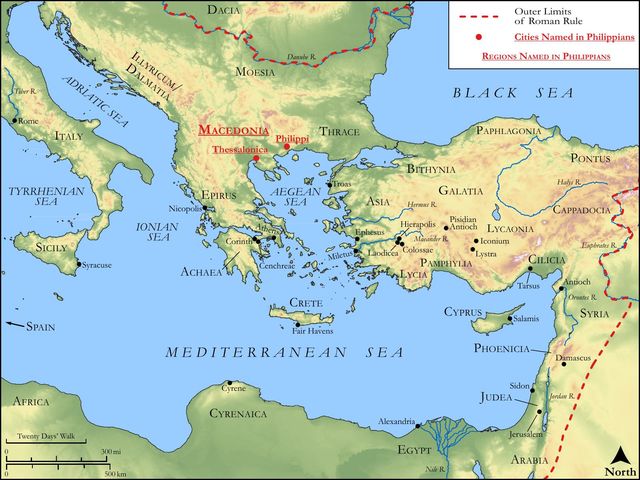
See on the biblical-era maps

Study this verse
Public-domain commentary
Matthew Henry
From his Commentary on the Whole Bible. Henry comments on passages, not single verses — this entry covers Philippians 3:17–21. His three-level outline is real structure in the source text, so it is rendered as structure.
He closes the chapter with warnings and exhortations.
I.He warns them against following the examples of seducers and evil teachers (Phi 3:18, Phi 3:19):
Many walk, of whom I have told you often, and now tell you weeping, that they are the enemies of the cross of Christ. Observe,
1.There are many called by Christ's name who are enemies to Christ's cross, and the design and intention of it. Their walk is a surer evidence what they are than their profession. By their fruits you shall know them, Mat 7:20. The apostle warns people against such,
(1.)Very frequently: I have told you often. We so little heed the warnings given us that we have need to have them repeated. To write the same things is safe, Phi 3:1.
(2.)Feelingly and affectionately: I now tell you weeping. Paul was upon proper occasions a weeping preacher, as Jeremiah was a weeping prophet. Observe, An old sermon may be preached with new affections; what we say often we may say again, if we say it affectionately, and are ourselves under the power of it.
2.He gives us the characters of those who were the enemies of the cross of Christ.
(1.)Whose God is their belly. They minded nothing but their sensual appetites. A wretched idol it is, and a scandal for any, but especially for Christians, to sacrifice the favour of God, the peace of their conscience, and their eternal happiness to it. Gluttons and drunkards make a god of their belly, and all their care is to please it and make provision for it. The same observance which good people give to God epicures give to their appetites. Of such he says, They serve not the Lord Jesus Christ, but their own bellies, Rom 16:18.
(2.)They glory in their shame. They not only sinned, but boasted of it and gloried in that of which they ought to have been ashamed. Sin is the sinner's shame, especially when it is gloried in. "They value themselves for what is their blemish and reproach." (3.) They mind earthly things. Christ came by his cross to crucify the world to us and us to the world; and those who mind earthly things act directly contrary to the cross of Christ, and this great design of it. They relish earthly things, and have no relish of the things which are spiritual and heavenly. They set their hearts and affections on earthly things; they love them, and even dote upon them, and have a confidence and complacency in them. He gives them this character, to show how absurd it would be for Christians to follow the example of such or be led away by them; and, to deter us all from so doing, he reads their doom. (4.) Whose end is destruction. Their way seems pleasant, but death and hell are at the end of it. What fruit had you then in those things whereof you are now ashamed? For the end of those things is death, Rom 6:21. It is dangerous following them, though it is going down the stream; for, if we choose their way, we have reason to fear their end. Perhaps he alludes to the total destruction of the Jewish nation.
II.He proposes himself and his brethren for an example, in opposition to these evil examples:
Brethren, be followers together of me, and mark those who walk as you have us for an example, Phi 3:17. Mark them out for your pattern. He explains himself (Phi 3:20) by their regard to Christ and heaven: For our conversation is in heaven. Observe, Good Christians, even while they are here on earth, have their conversation in heaven. Their citizenship is there, politeuma. As if he had said, We stand related the that world, and are citizens of the New Jerusalem. This world is not our home, but that is. There our greatest privileges and concerns lie. And, because our citizenship is there, our conversation is there; being related to that world, we keep up a correspondence with it. The life of a Christian is in heaven, where his head is, and his home is, and where he hopes to be shortly; he sets his affections upon things above; and where his heart is there will his conversation be. The apostle had pressed them to follow him and other ministers of Christ: "Why," might they say, "you are a company of poor, despised, persecuted people, who make no figure, and pretend to no advantages in the world; who will follow you?" "Nay," says he, "but our conversation is in heaven. We have a near relation and a great pretension to the other world, and are not so mean and despicable as we are represented." It is good having fellowship with those who have fellowship with Christ, and conversation with those whose conversation is in heaven.
1.Because we look for the Saviour from heaven (Phi 3:20): Whence also we look for the Saviour, the Lord Jesus Christ. He is not here, he has ascended, he has entered within the veil for us; and we expect his second coming thence, to gather in all the citizens of that New Jerusalem to himself.
2.Because at the second coming of Christ we expect to be happy and glorified there. There is good reason to have our conversation in heaven, not only because Christ is now there, but because we hope to be there shortly: Who shall change our vile bodies, that they may be fashioned like unto his glorious body, Phi 3:21. There is a glory reserved for the bodies of the saints, which they will be instated in at the resurrection. The body is now at the best a vile body, to sōma tēs tapeinōseōs hēmōn - the body of our humiliation: it has its rise and origin from the earth, it is supported out of the earth, and is subject to many diseases and to death at last. Besides, it is often the occasion and instrument of much sin, which is called the body of this death, Rom 7:24. Or it may be understood of its vileness when it lies in the grave; at the resurrection it will be found a vile body, resolved into rottenness and dust; the dust will return to the earth as it was, Ecc 12:7. But it will be made a glorious body; and not only raised again to life, but raised to great advantage. Observe,
(1.)The sample of this change, and that is, the glorious body of Christ; when he was transfigured upon the mount, his face did shine as the sun, and his raiment was white as the light, Mat 17:2. He went to heaven clothed with a body, that he might take possession of the inheritance in our nature, and be not only the first-born from the dead, but the first-born of the children of the resurrection. We shall be conformed to the image of his Son, that he may be the first-born among many brethren, Rom 8:29.
(2.)The power by which this change will be wrought: According to the working whereby he is able even to subdue all things unto himself. There is an efficacy of power, an exceeding greatness of power, and the working of mighty power, Eph 1:19. It is matter of comfort to us that he can subdue all things to himself, and sooner or later will bring over all into his interest. And the resurrection will be wrought by this power. I will raise him up at the last day, Joh 6:44. Let this confirm our faith of the resurrection, that we not only have the scriptures, which assure us it shall be, but we know the power of God, which can effect it, Mat 22:29. At Christ's resurrection was a glorious instance of the divine power, and therefore he is declared to be the Son of God with power, by the resurrection from the dead (Rom 1:4), so will our resurrection be: and his resurrection is a standing evidence, as well as pattern, of ours. And then all the enemies of the Redeemer's kingdom will be completely conquered. Not only he who had the power of death, that is, the devil (Heb 2:14), but the last enemy, shall be destroyed, that is, death, Co1 15:26, shall be swallowed up in victory, Co1 15:54.
Historical interpretation
Two Centuries of Reception
11 surviving comments on this verse. Each one is dated, so this reads as a timeline rather than a list.
Select a marker to jump to its quote. Markers stagger vertically where authors wrote within a few decades of each other.
His other daughter also, who passed her life
We know that this is well said, for we ought to live as strangers and expatriates in the world … not using the creation to satisfy our passions but high-mindedly and with thanksgiving.
But we do confess that a kingdom is promised to us upon the earth, although before heaven, only in another state of existence; inasmuch as it will be after the resurrection for a thousand years in the divinely-built city of Jerusalem, "let down from heaven," which the apostle also calls "our mother from above; " and, while declaring that our poli/teuma, or citizenship, is in heaven, he predicates of it that it is really a city in heaven.
For when (the apostle) says, "Not (the righteousness) which is of the law, but that which is through Him," he would not have used the phrase through Him of any other than Him to whom the law belonged. "Our conversation," says he, "is in heaven." I here recognise the Creator's ancient promise to Abraham: "I will multiply thy seed as the stars of heaven.
But as for you, you are a foreigner in this world, a citizen of Jerusalem, the city above. Our citizenship, the apostle says, is in heaven. You have your own registers, your own calendar; you have nothing to do with the joys of the world; nay, you are called to the very opposite, for "the world shall rejoice, but ye shall mourn.
In this way also "shall strength be made perfect in weakness," -saving what is lost, reviving what is dead, healing what is stricken, curing what is faint, redeeming what is lost, freeing what is enslaved, recalling what has strayed, raising what is fallen; and this from earth to heaven, where, as the apostle teaches the Philippians, "we have our citizenship, from whence also we look for our Saviour Jesus Christ, who shall change our body of humiliation, that it may be fashioned like unto His glorious body" -of course after the resurrection, because Christ Himself was not glorified before He suffered.
For when the apostle says, "As is the earthy," that is, man, "such also are they that are earthy"-men again, of course; "therefore as is the heavenly," meaning the Man, from heaven, "such are the men also that are heavenly." For he could not possibly have opposed to earthly men any heavenly beings that were not men also; his object being the more accurately to distinguish their state and expectation by using this name in common for them both.
If it should be the case that both the blessed and the impious have an end and that end is understood as annihilation, the end makes religion and impiety equal. The common end of both would consist simply in not being. And where is our “hope in heaven” if our end simply makes us nonexistent? If hope is said to be owed to the saints and an end to the impious, even then the end cannot be simply annihilation. For how could it be a punishment of impiety to have no awareness whatever of the punishments that avenge it? Would not one who is annihilated not know the cause of his suffering? Better to distinguish a continuing place reserved for the blessed and another prepared for the wicked.
We drag our body like a shadow along the ground, but we guard our soul as one that shares in the citizenship of heaven.
"For our citizenship is in heaven," there is the prize; seest thou the runners, how they live by rule, how they touch nothing that relaxes their strength, how they exercise themselves every day in the palaestra, under a master, and by rule? Imitate them, or rather exhibit even greater eagerness, for the prizes are not equal: many are those who would hinder you; live by rule: many are the things which relax your strength; make its feet agile: for it is possible so to do, it comes not naturally, but by our will. Let us bring it to lightness, lest our swiftness of foot be hindered by the weight of other things. Teach thy feet to be sure, for there are many slippery places, and if thou fallest, straightway thou losest much. But yet if thou fall, rise up again. Even thus mayst thou obtain the victory. Never attempt slippery things, and thou wilt not fall; walk upon firm ground, up with thy head, up with thine eyes; these commands the trainers give to those who run. Thus thy strength is supported; but if thou stoopest downward, thou fallest, thou art relaxed. Look upward, where the prize is; the sight of the prize increaseth the determination of our will. The hope of taking it suffereth not to perceive the toils, it maketh the distance appear short. And what is this prize? No palm branch; but what? The kingdom of heaven, everlasting rest, glory together with Christ, the inheritance, brotherhood, ten thousand good things, which it is impossible to name. It is impossible to describe the beauty of that prize; he who hath it alone knoweth it, and he who is about to receive it. It is not of gold, it is not set with jewels, it is far more precious. Gold is mire, in comparison with that prize, precious stones are mere bricks in comparison with its beauty. If thou hast this, and takest thy departure to heaven, thou wilt be able to walk there with great honor; the angels will reverence thee, when thou bearest this prize, with much confidence wilt thou approach them all.
"But our citizenship," says he, "is in Heaven." Let us not then seek for ease here; there do we shine, where also our citizenship is. "From whence also," saith he, "we wait for a Saviour," the Lord Jesus Christ. He saith, "From Heaven" and "Our Saviour," showing, from the place and from the Person, the dignity of the subject.
All we have, saith he, is in the heavens, our Saviour, our city, whatever a man can name: "whence," saith he, "we wait for a Saviour, the Lord Jesus Christ." And this is an act of His kindness and love toward man. He Himself again cometh to us, he doth not drag us thither, but takes us, and so departs with us. And this is a mark of great honor; for if He came to us when we were enemies, much rather doth He now when we are become friends. He doth not commit this to the Angels, nor to servants, but Himself cometh to call us to His royal mansion. See, we also "shall be caught up in the clouds," doing him honor.
Continue studying Philippians 3:20 across the web’s major study libraries — every link below opens this exact verse, chapter, or book on the destination site.
Read & Compare
 BibleGatewayThis verse in more than 200 translations and 70 languages.
 Bible.comThe YouVersion reader — hundreds of translations, reading plans, and highlights.
 ESV.orgCrossway's official English Standard Version reader.
 NET BibleThe NET translation with 60,000+ translators' notes on every rendering decision.
 STEP BibleTyndale House's free study tool — original text, vocabulary, and scholarly resources.
 BibliaLogos Bible Software's free web reader.
 USCCBThe New American Bible (Revised Edition) with the U.S. bishops' study notes.
Commentaries
 BibleHub CommentariesDozens of classic commentaries on this verse, gathered on one page.
 StudyLightMore than 100 commentary sets — the largest collection on the web.
 BibleRefPlain-English commentary on what this verse means, verse by verse.
 Enduring WordDavid Guzik's free commentary on this chapter, widely used by Bible teachers.
 Bible Study ToolsVerse commentary alongside Greek and Hebrew study aids.
Original Language & Research
- BibleHub InterlinearThe verse word by word — original language, transliteration, and English.
- BibleHub LexiconEvery word's original-language definition and Strong's entry.
 Blue Letter BibleDeep-study tools — Strong's numbers, concordance, and word studies.
 CNTR CollationThe earliest Greek manuscripts of this verse, collated letter by letter.
Sermons, Hymns & Audio


TrulyRandomVerse is not affiliated with these sites and doesn’t control their content. They’re linked because they’re genuinely useful.
Summary
Philippians 3:20 serves as a profound declaration of the believer's true identity and ultimate hope, contrasting the transient, earthly pursuits of those focused on temporal things with the enduring, heavenly orientation of genuine followers of Christ. This verse asserts that our true citizenship and allegiance reside in heaven, from which we eagerly await the return of our Savior, the Lord Jesus Christ, who will bring about our ultimate transformation and redemption. It is a clarion call to live with an eternal perspective, aligning our present conduct with our future destiny.
Context
ShowHideLiterary Context
Philippians 3:20 is situated within a crucial section of Paul's letter where he passionately contrasts two distinct ways of life: one rooted in human achievement and earthly pursuits, and the other in Christ-centered faith and heavenly anticipation. Immediately preceding this verse, Paul issues a stern warning against those he calls "enemies of the cross of Christ," whose "end is destruction, whose God is their belly, and whose glory is in their shame—who mind earthly things" (Philippians 3:18-19). Verse 20 directly follows this warning, presenting the antithetical reality for true believers. While others are consumed by the temporal, believers possess a divine citizenship, shifting the focus from earthly decay to heavenly glory. This sets the stage for the subsequent verse, Philippians 3:21, which elaborates on the future transformation of our bodies in light of this heavenly hope.
Historical & Cultural Context
The concept of "citizenship" (πολίτευμα, políteuma) held significant weight for the Philippian church. Philippi was a Roman colony, and its inhabitants took great pride in their Roman citizenship, which afforded them certain rights, privileges, and a distinct identity within the Roman Empire (as seen in Acts 16:21). Paul leverages this familiar concept to elevate the spiritual reality for believers. Just as Roman citizens in Philippi lived by Roman laws and looked to Rome as their homeland, so too should Christians live by heavenly principles, looking to heaven as their true home. This analogy would have resonated deeply with the Philippians, underscoring that their ultimate allegiance was not to Caesar or Rome, but to Christ and His heavenly kingdom.
Key Themes
ShowHideThis verse powerfully encapsulates several overarching themes found throughout Philippians and the broader New Testament. Firstly, it highlights the theme of Christian Identity and Allegiance, asserting that believers' primary identity is not earthly but heavenly, shaping their values and priorities. This contrasts sharply with the "earthly things" (Philippians 3:19) pursued by others. Secondly, it underscores the theme of Eschatological Hope and Expectation, as believers "look for the Saviour, the Lord Jesus Christ." This eager anticipation of Christ's return (the Parousia) is a foundational aspect of Christian hope, providing resilience amidst present suffering and motivation for holy living. Thirdly, it subtly introduces the theme of Future Transformation, which is explicitly developed in Philippians 3:21, where Christ is depicted as the one who will transform our humble bodies to be like His glorious body. These themes collectively call believers to live with an eternal perspective, grounded in their heavenly reality and future hope.
Exposition and Analysis
ShowHideKey Word Analysis
ShowHideMeaning "a community," "citizenship (figuratively)," or "body of citizens." In 17th-century English, "conversation" referred to one's conduct, manner of life, or even one's place of residence or citizenship. Paul's use of políteuma here is profoundly significant, emphasizing that believers are not merely residents on earth but are citizens of a heavenly commonwealth. Our true allegiance, our "constitution," and the laws that govern our lives originate from heaven, not from any earthly authority. This concept demands a life lived in accordance with heavenly principles and values, reflecting our true homeland.
Meaning "the sky; by extension, heaven (as the abode of God); by implication, happiness, power, eternity; specially, the Gospel (Christianity)." In this context, "heaven" signifies not just a distant place, but the very realm of God's sovereign rule and the ultimate dwelling of believers. It represents the source of our citizenship, our spiritual origin, and the destination of our hope. To have our políteuma in heaven means our life is governed by divine authority and our ultimate future is secure in God's presence.
Meaning "to expect fully." This compound verb conveys a strong sense of eager, earnest, and patient anticipation. It is not a passive waiting but an active, longing expectation for the arrival of someone significant. The preposition apo (away from) intensifies the verb ekdechomai (to wait for), suggesting a turning away from other distractions to focus intently on the coming event. This word highlights the active posture of Christian hope, characterized by a deep yearning for the return of Christ.
Verse Breakdown
ShowHide"For our conversation is in heaven;"
This clause establishes the foundational truth of the believer's identity. The conjunction "For" (G1063, gár) indicates that what follows provides the reason or explanation for the preceding warning against earthly-mindedness. "Our conversation" (G4175, políteuma) signifies our citizenship, our commonwealth, or our manner of life as governed by our true homeland. It is "in heaven" (G1722, en G3772, ouranós), meaning our ultimate allegiance, our governing principles, and our true home are not earthly but divine. This declaration reorients the believer's entire perspective, shifting their focus from the temporal to the eternal.
"from whence also we look for the Saviour, the Lord Jesus Christ:"
This second clause describes the practical outworking and hopeful consequence of our heavenly citizenship. "From whence" (G1537, ek G3739, hós) indicates the origin point of our expectation – from heaven itself. The phrase "we look for" (G553, apekdéchomai) conveys an eager, full, and patient anticipation. We are not merely waiting, but actively expecting the arrival of "the Saviour" (G4990, sōtḗr), who is explicitly identified as "the Lord Jesus Christ" (G2962, kýrios G2424, Iēsoûs G5547, Christós). This highlights the object of our hope: the personal return of Jesus, who is both our deliverer and our sovereign Master, the Anointed One. This expectation is central to the Christian life and provides the ultimate motivation for living as heavenly citizens on earth.
Literary Devices
ShowHidePaul employs several powerful literary devices in Philippians 3:20 to convey his profound message. The most prominent is Metaphor, where "conversation" (πολίτευμα, políteuma) is used metaphorically to represent "citizenship" or "commonwealth." This metaphor leverages the Philippians' pride in their Roman citizenship to illustrate a higher, spiritual reality: their true allegiance and identity are heavenly. This creates a strong Antithesis with the "enemies of the cross" mentioned in the preceding verse, whose focus is entirely earthly. The contrast between "earthly things" and "heaven" highlights the divergent destinies and values of the two groups. Furthermore, the phrase "we look for the Saviour" employs Eschatological Language, pointing to the future return of Christ and the ultimate consummation of God's redemptive plan. This language instills hope and provides a future orientation for the believer's present conduct.
Theological and Thematic Connections
ShowHidePhilippians 3:20 is a cornerstone verse for understanding Christian identity, eschatology, and the practical implications of our faith. It establishes that our primary allegiance is not to any earthly kingdom or system, but to the heavenly kingdom of God. This divine citizenship fundamentally reorients our values, priorities, and aspirations, calling us to live as ambassadors of heaven on earth. The eager expectation of Christ's return is not merely a theological doctrine but a living hope that shapes our present conduct, providing both comfort in suffering and motivation for holiness. Our heavenly citizenship and future hope are inextricably linked, reminding us that our ultimate destiny is with Christ in glory.
Reflection and Application
ShowHideUnderstanding that our citizenship is in heaven profoundly impacts how we live our daily lives. It calls us to a radical reorientation of our priorities, moving beyond the fleeting concerns of this world to embrace the eternal realities of God's kingdom. If our true home and allegiance are heavenly, then our values, ethics, and aspirations should reflect that divine origin. This means cultivating a mindset that prioritizes spiritual growth, righteous living, and the advancement of God's purposes on earth, rather than being consumed by material possessions, worldly status, or temporary pleasures. Our eager expectation of Christ's return provides immense hope and resilience, enabling us to endure trials with patience, knowing that our ultimate redemption is secure. It should motivate us to live as faithful ambassadors of our heavenly King, demonstrating His love and truth to a world that desperately needs it.
Questions for Reflection
ShowHideFAQ
ShowHideWhat does "our conversation is in heaven" mean in modern English?
ShowHideIn modern English, "our conversation is in heaven" means that our citizenship, our commonwealth, or our manner of life and allegiance is in heaven. The Greek word políteuma (πολίτευμα) refers to the body of citizens, the administration of a state, or the rights and duties of a citizen. So, Paul is declaring that believers' true home, their ultimate governing authority, and the source of their identity and values are not on earth but in the heavenly realm, where God reigns. It's a declaration of our spiritual nationality.
How does heavenly citizenship impact our responsibilities on earth?
ShowHideHeavenly citizenship does not negate our responsibilities on earth; rather, it redefines and elevates them. As citizens of heaven, we are called to live as ambassadors for Christ (2 Corinthians 5:20), representing our heavenly King and His kingdom values. This means living with integrity, love, justice, and holiness in all our earthly spheres – family, work, community, and nation. We are to be salt and light (Matthew 5:13-16), influencing the world for good while maintaining our distinct, heavenly orientation. Our earthly actions should reflect our heavenly allegiance, demonstrating the transformative power of the Gospel.
Christ-Centered Fulfillment
ShowHidePhilippians 3:20 finds its ultimate fulfillment in the person and work of Jesus Christ, who is both the King of this heavenly commonwealth and the eagerly awaited Savior. Our "conversation" or citizenship is "in heaven" precisely because Christ, our Head, is ascended and seated at the right hand of God there (Ephesians 1:20). He is the one who has secured our place in this heavenly realm through His atoning death and triumphant resurrection (Colossians 1:13-14). Furthermore, the verse explicitly states that we "look for the Saviour, the Lord Jesus Christ," emphasizing that the hope of our heavenly citizenship culminates in His glorious return. He is not just a distant ruler, but the one who will personally descend from heaven, transform our humble bodies to be like His glorious body (Philippians 3:21), and gather His citizens to Himself (1 Thessalonians 4:16-17). Thus, Christ is the Alpha and Omega of our heavenly citizenship – the one who established it, sustains it, and will ultimately bring it to its glorious consummation.