


2 Corinthians 5:1
- ΟἴδαμενOidamenWe knowG1492V-RAI-1PVerb Perfect Active Indicative 1st Plural
- γὰρgarforG1063CONJConjunction
- ὅτιhotithatG3754CONJConjunction
- ἐὰνeanifG1437CONDConjunction
- ἡhētheG3588T-NSFDefinite article Nominative Singular Feminine
- ἐπίγειοςepigeiosearthlyG1919A-NSFAdjective Nominative Singular Feminine
- ἡμῶνhēmōnof usG3165P-1GPPersonal pronoun Genitive 1st Plural
- οἰκίαoikiahouseG3614N-NSFNoun Nominative Singular Feminine
- τοῦtoutheG3588T-GSNDefinite article Genitive Singular Neuter
- σκήνουςskēnoustentG4636N-GSNNoun Genitive Singular Neuter
- καταλυθῇkataluthēashall be destroyedG2647V-APS-3SVerb Aorist Passive Subjunctive 3rd Singular
- οἰκοδομὴνoikodomēna buildingG3619N-ASFNoun Accusative Singular Feminine
- ἐκekfromG1537PREPPreposition
- θεοῦtheouGodG2316N-GSM-TNoun Genitive Singular Masculine Title
- ἔχομενechomenwe haveG2192V-PAI-1PVerb Present Active Indicative 1st Plural
- οἰκίανoikiana houseG3614N-ASFNoun Accusative Singular Feminine
- ἀχειροποίητονacheiropoiētonnot made with handsG886A-ASFAdjective Accusative Singular Feminine
- αἰώνιονaiōnioneternalG166A-ASFAdjective Accusative Singular Feminine
- ἐνeninG1722PREPPreposition
- τοῖςtoistheG3588T-DPMDefinite article Dative Plural Masculine
- οὐρανοῖςouranoisheavensG3772N-DPMNoun Dative Plural Masculine
English is a literal word-by-word gloss of the Greek, not the KJV's wording. Why?
This is the original text the KJV's translators worked from — each Greek word with its own literal English meaning in this verse, prepared by scholars at Tyndale House, Cambridge. The KJV translates whole sentences, not word by word, so its wording differs: one Greek word can become several English words, and the KJV may choose “charity” where the gloss reads “love”. Both are faithful — they answer different questions. For the KJV's own rendering, switch to the KJV text.
Details
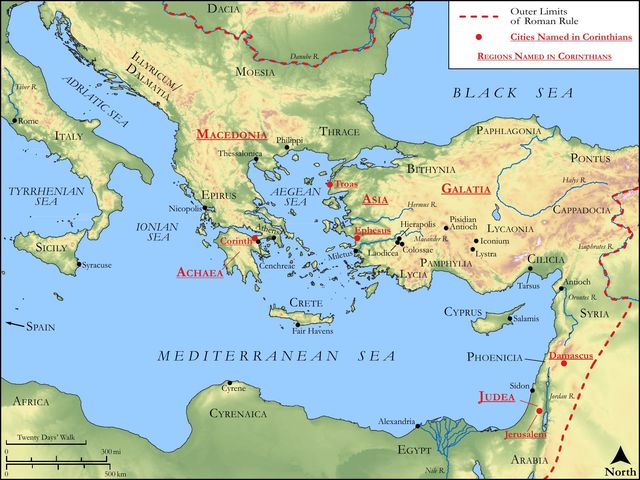
See on the biblical-era map

Study this verse
Public-domain commentary
Matthew Henry
From his Commentary on the Whole Bible. Henry comments on passages, not single verses — this entry covers 2 Corinthians 5:1–11. His four-level outline is real structure in the source text, so it is rendered as structure.
The apostle in these verses pursues the argument of the former chapter, concerning the grounds of their courage and patience under afflictions. And,
I.He mentions their expectation, and desire, and assurance, of eternal happiness after death, Co2 5:1-5. Observe particularly,
1.The believer's expectation of eternal happiness after death, Co2 5:1. He does not only know, or is well assured by faith of the truth and reality of the thing itself - that there is another and a happy life after this present life is ended, but he has good hope through grace of his interest in that everlasting blessedness of the unseen world: "We know that we have a building of God, we have a firm and well-grounded expectation of the future felicity." Let us take notice,
(1.)What heaven is in the eye and hope of a believer. He looks upon it as a house, or habitation, a dwelling-place, a resting-place, a hiding-place, our Father's house, where there are many mansions, and our everlasting home. It is a house in the heavens, in that high and holy place which as far excels all the palaces of this earth as the heavens are high above the earth. It is a building of God, whose builder and maker is God, and therefore is worthy of its author; the happiness of the future state is what God hath prepared for those that love him. It is eternal in the heavens, everlasting habitations, not like the earthly tabernacles, the poor cottages of clay in which our souls now dwell, which are mouldering and decaying, and whose foundations are in the dust.
(2.)When it is expected this happiness shall be enjoyed - immediately after death, so soon as our house of this earthly tabernacle is dissolved. Note,
[1.]That the body, this earthly house, is but a tabernacle, that must be dissolved shortly; the nails or pins will be drawn, and the cords be loosed, and then the body will return to dust as it was.
[2.]When this comes to pass, then comes the house not made with hands. The spirit returns to God who gave it; and such as have walked with God here shall dwell with God for ever.
2.The believer's earnest desire after this future blessedness, which is expressed by this word, stenazomen - we groan, which denotes,
(1.)A groaning of sorrow under a heavy load; so believers groan under the burden of life: In this we groan earnestly, Co2 5:2. We that are in this tabernacle groan, being burdened, Co2 5:4. The body of flesh is a heavy burden, the calamities of life are a heavy load. But believers groan because burdened with a body of sin, and the many corruptions that are still remaining and raging in them. This makes them complain, O wretched man that I am! Rom 7:24.
(2.)There is a groaning of desire after the happiness of another life; and thus believers groan: Earnestly desiring to be clothed upon with our house which is from heaven (Co2 5:2), to obtain a blessed immortality, that mortality might be swallowed up of life (Co2 5:4), that being found clothed, we may not be naked (Co2 5:3), that, if it were the will of God, we might not sleep, but be changed; for it is not desirable in itself to be unclothed. Death considered merely as a separation of soul and body is not to be desired, but rather dreaded; but, considered as a passage to glory, the believer is willing rather to die than live, to be absent from the body, that he may be present with the Lord (Co2 5:1), to leave this body that he may go to Christ, and to put off these rags of mortality that he may put on the robes of glory. Note,
[1.]Death will strip us of the clothing of flesh, and all the comforts of life, as well as put an end to all our troubles here below. Naked we came into this world, and naked shall we go out of it. But,
[2.]Gracious souls are not found naked in the other world; no, they are clothed with garments of praise, with robes of righteousness and glory. They shall be delivered out of all their troubles, and shall have washed their robes and made them white in the blood of the Lamb, Rev 7:14.
3.The believer's assurance of his interest in this future blessedness, on a double account: - (1.) From the experience of the grace of God, in preparing and making him meet for this blessedness. He that hath wrought us for the self-same thing is God, Co2 5:5. Note, All who are designed for heaven hereafter are wrought or prepared for heaven while they are here; the stones of that spiritual building and temple above are squared and fashioned here below. And he that hath wrought us for this is God, because nothing less than a divine power can make a soul partaker of a divine nature; no hand less than the hand of God can work us for this thing. A great deal is to be done to prepare our souls for heaven, and that preparation of the heart is from the Lord. (2.) The earnest of the Spirit gave them this assurance: for an earnest is part of payment, and secures the full payment. The present graces and comforts of the Spirit are earnests of everlasting grace and comfort.
II.The apostle deduces an inference for the comfort of believers in their present state and condition in this world, Co2 5:6-8. Here observe,
1.What their present state or condition is: they are absent from the Lord (Co2 5:6); they are pilgrims and strangers in this world; they do but sojourn here in their earthly home, or in this tabernacle; and though God is with us here, by his Spirit, and in his ordinances, yet we are not with him as we hope to be: we cannot see his face while we live: For we walk by faith, not by sight, Co2 5:7. We have not the vision and fruition of God, as of an object that is present with us, and as we hope for hereafter, when we shall see as we are seen. Note, Faith is for this world, and sight is reserved for the other world: and it is our duty, and will be our interest, to walk by faith, till we come to live by sight.
2.How comfortable and courageous we ought to be in all the troubles of life, and in the hour of death: Therefore we are, or ought to be, always confident (Co2 5:6), and again (Co2 5:8), We are confident, and willing rather to be absent from the body. True Christians, if they duly considered the prospect faith gives them of another world, and the good reasons of their hope of blessedness after death, would be comforted under the troubles of life, and supported in the hour of death: they should take courage, when they are encountering the last enemy, and be willing rather to die than live, when it is the will of God that they should put off this tabernacle. Note, As those who are born from above long to be there, so it is but being absent from the body, and we shall very soon be present with the Lord - but to die, and be with Christ - but to close our eyes to all things in this world, and we shall open them in a world of glory. Faith will be turned into sight.
III.He proceeds to deduce an inference to excite and quicken himself and others to duty, Co2 5:9-11.
So it is that well-grounded hopes of heaven will be far from giving the least encouragement to sloth and sinful security; on the contrary, they should stir us up to use the greatest care and diligence in religion: Wherefore, or because we hope to be present with the Lord, we labour and take pains, Co2 5:9. Philotimoumetha - We are ambitious, and labour as industriously as the most ambitious men do to obtain what they aim at. Here observe,
1.What it was that the apostle was thus ambitious of - acceptance with God. We labour that, living and dying, whether present in the body or absent from the body, we may be accepted of him, the Lord (Co2 5:9), that we may please him who hath chosen us, that our great Lord may say to us, Well done. This they coveted as the greatest favour and the highest honour: it was the summit of their ambition.
2.What further quickening motives they had to excite their diligence, from the consideration of the judgment to come, Co2 5:10, Co2 5:11. There are many things relating to this great matter that should awe the best of men into the utmost care and diligence in religion; for example, the certainty of this judgment, for we must appear; the universality of it, for we must all appear; the great Judge before whose judgment-seat we must appear, the Lord Jesus Christ, who himself will appear in flaming fire; the recompence to be then received, for things done in the body, which will be very particular (unto every one), and very just, according to what we have done, whether good or bad. The apostle calls this awful judgment the terror of the Lord (Co2 5:11), and, by the consideration thereof, was excited to persuade men to repent, and live a holy life, that, when Christ shall appear terribly, they may appear before him comfortably. And, concerning his fidelity and diligence, he comfortably appeals unto God, and the consciences of those he wrote to: We are made manifest unto God, and I trust also are made manifest in your consciences.
Historical interpretation
Two Centuries of Reception
9 surviving comments on this verse. Each one is dated, so this reads as a timeline rather than a list.
Select a marker to jump to its quote. Markers stagger vertically where authors wrote within a few decades of each other.
As to the house of this our earthly dwelling-place, when he says that "we have an eternal home in heaven, not made with hands," he by no means would imply that, because it was built by the Creator's hand, it must perish in a perpetual dissolution after death.
Here is a veritable eternity, in the (perennial) youth of your head! Here we have an "incorruptibility" to "put on," with a view to the new house of the Lord which the divine monarchy promises! Well do you speed toward the Lord; well do you hasten to be quit of this most iniquitous world, to whom it is unsightly to approach (your own) end!
It is still the same sentiment which he follows up in the passage in which he puts the recompense above the sufferings: "for we know; "he says, "that if our earthly house of this tabernacle were dissolved, we have a house not made with hands, eternal in the heavens; " in other words, owing to the fact that our flesh is undergoing dissolution through its sufferings, we shall be provided with a home in heaven.
In regard to our bodily nature we must understand that there is not one body which we now use in lowliness and corruption and weakness and a different one which we are to use hereafter in incorruption and power and glory, but that this same body, having cast off the weaknesses of its present existence, will be transformed into a thing of glory and made spiritual. The result is that what was a vessel of dishonor shall itself be purified and become a vessel of honor and a habitation of blessedness. And we must believe that our body remains in this condition forever unchangeably by the will of the Creator. We are made certain of this fact by the statement of the apostle Paul in which he says, “We have a house not made with hands, eternal in the heavens.”
Now the followers of Origen bring forward this passage, "For we know that if our earthly house of this tabernacle were dissolved"
Our present body is our earthly home. Our resurrection body is our heavenly one.
Paul is talking here about two different worlds. One is the earthly, made with hands and visible. The other is invisible, made without hands and heavenly. On earth, our soul is clothed in flesh and blood, which is the visible and organic body. But once this body is left behind, the soul will move to the heavenly realm, where it will receive its body back, but one that has been transformed into a heavenly body.
Again he arouses their zeal because many trials drew on. For it was likely that they, in consequence of his absence, were weaker in respect to this [need]. What then saith he? One ought not to wonder that we suffer affliction; nor to be confounded, for we even reap many gains thereby. And some of these he mentioned before; for instance, that we "bear about the dying of Jesus," and present the greatest proof of His power: for he says, "that the exceeding greatness of the power may be of God:" and we exhibit a clear proof of the Resurrection, for, says he, "that the life of Jesus may be manifested in our mortal flesh." But since along with these things he said that our inward man is thus made better also; for "though our outward man is decaying," saith he, "yet the inward man is renewed day by day;" showing again that this being scourged and persecuted is proportionately useful, he adds, that when this is done thoroughly, then the countless good things will spring up for those who have endured these things. For lest when thou hearest that thy outward man perishes, thou shouldest grieve; he says, that when this is completely effected, then most of all shalt thou rejoice and shalt come unto a better inheritance. So that not only ought not one to grieve at its perishing now in part, but even earnestly to seek for the completion of that destruction, for this most conducts thee to immortality. Wherefore also he added, "For we know, that if the earthly house of our tabernacle be dissolved: we have a building from God, a house not made with hands, eternal in the heavens." For since he is urging again the doctrine of the Resurrection in respect to which they were particularly unsound; he calls; in aid the judgment of his hearers also, and so establishes it; not however in the same way as before, but, as it were, arriving at it out of another subject: (for they had been already corrected:) and says, "We know that if the earthly house of our tabernacle be dissolved, we have a building from God, a house not made with hands, eternal in the heavens." Some indeed say that the 'earthly house' is this world; But I should maintain that he alludes rather to the body. But observe, I pray, how by the terms [he uses,] he shows the superiority of the future things to the present. For having said "earthly" he hath opposed to it "the heavenly;" having said, "house of tabernacle," thereby declaring both that it is easily taken to pieces and is temporary, he hath opposed to it the "eternal," for the name "tabernacle" often times denotes temporariness. Wherefore He saith, "In My Father's house are many abiding places." But if He anywhere also calls the resting places of the saints tabernacles; He calls them not tabernacles simply, but adds an epithet; for he said not, that "they may receive you" into their tabernacles, but "into the eternal tabernacles." Moreover also in that he said, "not made with hands," he alluded to that which was made with hands. What then? Is the body made with hands? By no means; but he either alludes to the houses here that are made with hands, or if not this, then he called the body which is not made with hands, 'a house of tabernacle.' For he has not used the term in antithesis and contradistinction to this, but to heighten those eulogies and swell those commendations.
Should anyone say that the cause of vices and evil habits lies in the flesh because when the soul is influenced by the flesh it lives in such a manner, he cannot have sufficiently considered human nature as a whole.… But notice that the apostle who, in discussing the corruptible body, had used the words “even though our outer man is decaying,” goes on, a little further, to declare: “For we know that if the earthly house in which we dwell be destroyed, we have a building from God, a house not made by human hands, eternal in the heavens.” … On the one hand, our corruptible body may be a burden on our soul; on the other hand, the cause of this encumbrance is not in the nature and substance of the body. Therefore, aware as we are of its corruption, we do not desire to be divested of the body but rather to be clothed with its immortality. In immortal life we shall have a body, but it will no longer be a burden since it will no longer be corruptible.
Continue studying 2 Corinthians 5:1 across the web’s major study libraries — every link below opens this exact verse, chapter, or book on the destination site.
Read & Compare
 BibleGatewayThis verse in more than 200 translations and 70 languages.
 Bible.comThe YouVersion reader — hundreds of translations, reading plans, and highlights.
 ESV.orgCrossway's official English Standard Version reader.
 NET BibleThe NET translation with 60,000+ translators' notes on every rendering decision.
 STEP BibleTyndale House's free study tool — original text, vocabulary, and scholarly resources.
 BibliaLogos Bible Software's free web reader.
 USCCBThe New American Bible (Revised Edition) with the U.S. bishops' study notes.
Commentaries
 BibleHub CommentariesDozens of classic commentaries on this verse, gathered on one page.
 StudyLightMore than 100 commentary sets — the largest collection on the web.
 BibleRefPlain-English commentary on what this verse means, verse by verse.
 Enduring WordDavid Guzik's free commentary on this chapter, widely used by Bible teachers.
 Bible Study ToolsVerse commentary alongside Greek and Hebrew study aids.
Original Language & Research
- BibleHub InterlinearThe verse word by word — original language, transliteration, and English.
- BibleHub LexiconEvery word's original-language definition and Strong's entry.
 Blue Letter BibleDeep-study tools — Strong's numbers, concordance, and word studies.
 CNTR CollationThe earliest Greek manuscripts of this verse, collated letter by letter.
Sermons, Hymns & Audio


TrulyRandomVerse is not affiliated with these sites and doesn’t control their content. They’re linked because they’re genuinely useful.
Summary
Second Corinthians 5:1 offers profound assurance to believers, asserting a foundational Christian truth: despite the temporary and fragile nature of our physical bodies, which Paul likens to a perishable tent, we possess a certain hope of an eternal, divinely constructed dwelling awaiting us in heaven. This verse introduces Paul's extended theological reflection on the believer's ultimate destiny, contrasting the transient suffering of earthly life with the permanent, glorious reality of life with God.
Context
ShowHideLiterary Context
This verse serves as a pivotal transition in Paul's second letter to the Corinthians, directly following his powerful declaration in 2 Corinthians 4:16-18. In that preceding passage, Paul encourages his readers to fix their gaze not on the "things which are seen," which are temporal, but on the "things which are not seen," which are eternal. 2 Corinthians 5:1 then immediately provides the concrete example of this eternal reality: the believer's future, imperishable dwelling. It initiates a sustained theological argument (extending through 2 Corinthians 5:10) about the nature of the resurrection body, the desire to be with Christ, and the anticipation of the judgment seat, all against the backdrop of present suffering and the certainty of future glory.
Historical & Cultural Context
The Corinthian church, to whom Paul writes, was experiencing significant hardship, including internal divisions, external persecution, and challenges to Paul's apostolic authority. Paul himself endured immense suffering for the gospel, as detailed in 2 Corinthians 11:23-27. In such a context of fragility and mortality, the imagery of a "tabernacle" (Greek: skēnos) would have resonated deeply. Tents were common temporary dwellings for travelers, soldiers, and nomads in the ancient world, signifying impermanence and vulnerability. This contrasts sharply with the concept of a permanent "building" (Greek: oikodomē), which would evoke images of solid, durable structures like homes or temples, providing security and stability. Paul's audience would have readily understood this stark contrast between their present, vulnerable existence and the secure, eternal future promised by God.
Key Themes
ShowHideThe central themes woven through 2 Corinthians 5:1 and the broader chapter include the mortality of the human body versus the certainty of an eternal, glorified body. It emphasizes the temporary nature of earthly existence in contrast to the permanence of heavenly reality. The passage underscores divine provision and authorship, highlighting that our future dwelling is "of God" and "not made with hands," thus superior to anything humanly constructed. This theme of eschatological hope provides comfort and perseverance in the face of present suffering, shifting the believer's focus from the seen and temporal to the unseen and eternal, echoing the broader message of hope and resurrection found in 1 Corinthians 15.
Exposition and Analysis
ShowHideKey Word Analysis
ShowHideThis word, often used in the perfect tense, signifies a settled, assured knowledge, not mere speculation or hope. It implies a deep, experiential understanding or a firm conviction. Paul is not expressing a wish or a possibility, but a certainty that is foundational to Christian belief, rooted in divine revelation and the promises of God.
Literally meaning a "tent" or "booth," this term vividly portrays the human body as a temporary, fragile, and easily dismantled dwelling. It emphasizes the transient nature of our earthly existence, much like a nomadic tent that can be quickly packed up or struck down, contrasting sharply with a permanent, solid structure.
This compound adjective emphasizes the divine origin and miraculous nature of the heavenly dwelling. It signifies something that is not humanly manufactured, built, or perishable. This term highlights God's exclusive authorship and the supernatural quality of the eternal house, setting it apart from any earthly construction and underscoring its perfection and permanence.
Derived from aiṓn (age), this word denotes a quality of existence that transcends time, implying perpetuity, everlastingness, and an enduring nature. When applied to the heavenly dwelling, it stresses its unending duration and immutable character, contrasting sharply with the temporal and decaying nature of the earthly body.
Verse Breakdown
ShowHide"For we know that if our earthly house of [this] tabernacle were dissolved,"
Paul begins with a declaration of certainty ("For we know"), indicating a shared, fundamental Christian conviction. The phrase "earthly house of this tabernacle" is a powerful metaphor for the human body, emphasizing its temporary, fragile, and mortal nature. The word "dissolved" (Greek: katalýō) implies being broken down, demolished, or unfastened, perfectly fitting the imagery of a tent being taken apart. This clause acknowledges the inevitability of physical death or the decay of the mortal body.
"we have a building of God,"
In stark contrast to the temporary, dissolving earthly dwelling, Paul asserts a present possession ("we have") of a future reality. This "building" (Greek: oikodomḗ) signifies a permanent, solid, and enduring structure. The crucial phrase "of God" immediately establishes its divine origin and nature, indicating that this dwelling is not a human achievement but a gift and creation of God Himself.
"an house not made with hands,"
This further elaborates on the divine origin and unique quality of the heavenly dwelling. The phrase "not made with hands" (Greek: acheiropoíētos) emphasizes that this house is entirely supernatural, not subject to human limitations, decay, or construction. It is a divine masterpiece, perfectly suited for eternal life in God's presence, highlighting its superiority and imperishability.
"eternal in the heavens."
This final phrase specifies the nature and location of this divine building. "Eternal" (Greek: aiṓnios) reiterates its unending duration and imperishable quality, standing in stark opposition to the temporal nature of the earthly body. "In the heavens" designates its celestial, spiritual realm, signifying its ultimate security, glory, and association with God's very presence.
Literary Devices
ShowHidePaul masterfully employs several literary devices in 2 Corinthians 5:1 to convey his profound theological message. The most prominent is Metaphor, where the human body is described as an "earthly house of this tabernacle." This vivid imagery of a fragile, temporary tent effectively communicates the transient and vulnerable nature of our physical existence. In direct Antithesis to this, he introduces the Metaphor of a "building of God, an house not made with hands, eternal in the heavens," representing the permanent, glorious, and divinely-sourced dwelling that awaits believers. This creates a powerful Contrast between the temporal and the eternal, the perishable and the imperishable, the humanly constructed and the divinely created. The certainty expressed by "For we know" functions as a Declaration of Assurance, grounding the hope in a firm, theological conviction rather than mere speculation.
Theological and Thematic Connections
ShowHideThis verse is foundational to Christian eschatology, offering a profound theological statement on the believer's destiny beyond physical death. It affirms the continuity of personal identity while emphasizing a radical transformation of our dwelling, moving from a perishable, earthly body to an imperishable, heavenly one. This is not a promise of disembodied existence, but rather a transformed, glorified body, perfectly suited for eternal life in God's presence. Paul's assurance underscores God's faithfulness to His promises, providing ultimate hope and comfort in the face of suffering and mortality. It points to a divine reality where God Himself provides the ultimate, secure, and eternal home for His children, surpassing any earthly provision.
Reflection and Application
ShowHideSecond Corinthians 5:1 offers immense comfort and a vital perspective for believers navigating the realities of life and death. In a world preoccupied with physical appearance, material possessions, and temporal achievements, this verse reorients our focus to the eternal. It reminds us that our true home and ultimate security are not found in this fleeting world, but in the permanent, divinely-prepared dwelling in the heavens. This eternal perspective empowers us to endure present sufferings with hope, knowing that our "light and momentary troubles are achieving for us an eternal glory that far outweighs them all" (2 Corinthians 4:17). It transforms our understanding of death from a terrifying end into a transition to a glorious, imperishable existence with God, fostering a deep sense of peace and confidence in His unfailing promises. Living with this awareness should shape our priorities, encouraging us to invest in what is eternal rather than what is temporal, and to live lives that reflect our heavenly citizenship.
Questions for Reflection
ShowHideFAQ
ShowHideWhat does Paul mean by "earthly house of this tabernacle"?
ShowHidePaul uses this vivid metaphor to describe the human body and our earthly existence. The "tabernacle" (Greek: skēnos) refers to a temporary tent or dwelling, much like the nomadic tents used in ancient times. This imagery emphasizes the fragile, perishable, and transient nature of our physical bodies and our mortal life on earth. Just as a tent is easily set up and taken down, our earthly bodies are temporary vessels, subject to decay and dissolution, not our permanent home.
Does the "building of God" refer to a disembodied spirit or a new body?
ShowHideThe "building of God, an house not made with hands, eternal in the heavens" refers to the believer's future, glorified, and imperishable resurrection body, not merely a disembodied spirit. While some interpretations might lean towards a spiritual dwelling, the broader context of Paul's theology, particularly in 1 Corinthians 15, clearly points to a transformed physical body. Paul contrasts the "earthly house" (our present mortal body) with this future "building," implying a continuity of personhood but a radical transformation of our physical form. This new body will be spiritual, powerful, and incorruptible, perfectly suited for eternal life in God's presence, as described in passages like 1 Corinthians 15:44.
How does this verse relate to the fear of death?
ShowHide2 Corinthians 5:1 offers a powerful antidote to the fear of death by transforming its meaning for the believer. Instead of being an ultimate end, death is presented as a transition from a temporary, perishable dwelling to an eternal, glorious one. The "dissolution" of the earthly tabernacle is not annihilation but a gateway to a superior, divinely-provided reality. The "we know" signifies a deep certainty and assurance, rooted in God's promises, that physical death leads directly to an eternal home with God. This perspective allows believers to face mortality with hope and confidence, knowing that "to be absent from the body, and to be present with the Lord" is the ultimate gain (2 Corinthians 5:8).
Christ-Centered Fulfillment
ShowHideThe profound assurance of 2 Corinthians 5:1 finds its ultimate fulfillment and guarantee in the person and work of Jesus Christ. It is through His resurrection that the promise of an "eternal building" becomes a tangible hope for believers. Christ's own resurrected body, glorified and imperishable, is the "firstfruits" of all who believe (1 Corinthians 15:20). He conquered death, not merely as an example, but as the one who "abolished death and brought life and immortality to light through the gospel" (2 Timothy 1:10). The "house not made with hands" is prepared for us by Christ Himself, who promised, "In my Father's house are many rooms... I go to prepare a place for you" (John 14:2). Furthermore, the Holy Spirit, whom God has given us as a "deposit, guaranteeing what is to come" (2 Corinthians 5:5), is the very power by which God "will also give life to your mortal bodies through his Spirit who lives in you" (Romans 8:11). Thus, our future, eternal dwelling is not a vague hope but a certain reality, secured by Christ's finished work on the cross, His triumphant resurrection, and His continuing intercession for us in the heavens.