


2 Timothy 1:10
Bible text: King James Version (1769 Blayney text) · Public domain
Bible text: King James Version with Strong's numbers · Public domain
Bible text: Berean Standard Bible · Public domain
Bible text: American Standard Version (1901) · Public domain
Bible text: World English Bible, Messianic edition · Public domain
Bible text: Geneva Bible (1599) · Public domain
Bible text: Young's Literal Translation · Public domain
- φανερωθεῖσανphanerōtheisanhaving been made manifestG5319V-APP-ASFVerb Aorist Passive Participle Accusative Singular Feminine
- δὲdealsoG1161CONJConjunction
- νῦνnunnowG3568ADVAdverb
- διὰdiathroughG1223PREPPreposition
- τῆςtēstheG3588T-GSFDefinite article Genitive Singular Feminine
- ἐπιφανείαςepiphaneiasappearingG2015N-GSFNoun Genitive Singular Feminine
- τοῦtouof theG3588T-GSMDefinite article Genitive Singular Masculine
- σωτῆροςsōtērosSaviorG4990N-GSMNoun Genitive Singular Masculine
- ἡμῶνhēmōnof usG3165P-1GPPersonal pronoun Genitive 1st Plural
- ΧριστοῦChristouChristG5547N-GSM-TNoun Genitive Singular Masculine Title
- ἸησοῦIēsouJesusG2424N-GSM-PNoun Genitive Singular Masculine Individual
- καταργήσαντοςkatargēsantoshaving abolishedG2673V-AAP-GSMVerb Aorist Active Participle Genitive Singular Masculine
- μὲνmenindeedG3303PRTParticle or Disjunctive
- τὸνton<the>G3588T-ASMDefinite article Accusative Singular Masculine
- θάνατονthanatondeathG2288N-ASMNoun Accusative Singular Masculine
- φωτίσαντοςphōtisantoshaving brought to lightG5461V-AAP-GSMVerb Aorist Active Participle Genitive Singular Masculine
- δὲdehoweverG1161CONJConjunction
- ζωὴνzōēnlifeG2222N-ASFNoun Accusative Singular Feminine
- καὶkaiandG2532CONJConjunction
- ἀφθαρσίανaphtharsianimmortalityG861N-ASFNoun Accusative Singular Feminine
- διὰdiathroughG1223PREPPreposition
- τοῦtoutheG3588T-GSNDefinite article Genitive Singular Neuter
- εὐαγγελίουeuangeliougospelG2098N-GSNNoun Genitive Singular Neuter
English is a literal word-by-word gloss of the Greek, not the KJV's wording. Why?
This is the original text the KJV's translators worked from — each Greek word with its own literal English meaning in this verse, prepared by scholars at Tyndale House, Cambridge. The KJV translates whole sentences, not word by word, so its wording differs: one Greek word can become several English words, and the KJV may choose “charity” where the gloss reads “love”. Both are faithful — they answer different questions. For the KJV's own rendering, switch to the KJV text.
Details
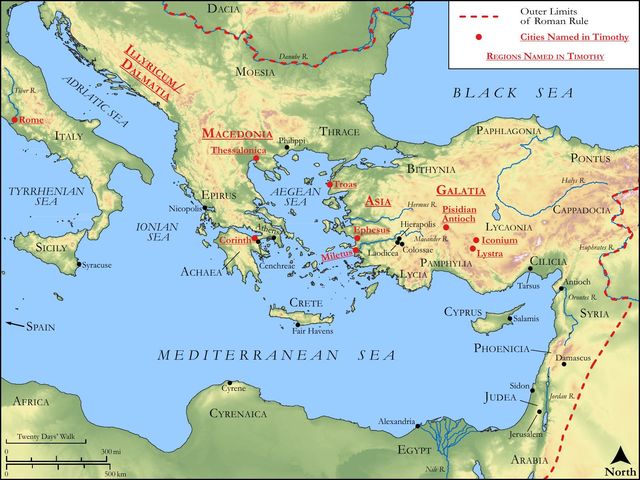
See on the biblical-era maps

Study this verse
Public-domain commentary
Matthew Henry
From his Commentary on the Whole Bible. Henry comments on passages, not single verses — this entry covers 2 Timothy 1:6–14. His four-level outline is real structure in the source text, so it is rendered as structure.
Here is an exhortation and excitation of Timothy to his duty (Ti2 1:6): I put thee in remembrance. The best men need remembrancers; what we know we should be reminded of. Pe2 3:1, I write this, to stir up your pure minds by way of remembrance.
I.He exhorts him to stir up the gift of God that was in him.
Stir it up as fire under the embers. It is meant of all the gifts and graces the God had given him, to qualify him for the work of an evangelist, the gifts of the Holy Ghost, the extraordinary gifts that were conferred by the imposition of the apostle's hands. These he must stir up; he must exercise them and so increase them: use gifts and have gifts. To him that hath shall be given, Mat 25:29. He must take all opportunities to use these gifts, and so stir them up, for that is the best way of increasing them. Whether the gift of God in Timothy was ordinary or extraordinary (though I incline to the latter), he must stir it up, otherwise it would decay. Further, you see that this gift was in him by the putting on of the apostle's hands, which I take to be distinct from his ordination, for that was performed by the hands of the presbytery, Ti1 4:14. It is probable that Timothy had the Holy Ghost, in his extraordinary gifts and graces, conferred on him by the laying on of the apostle's hands (for I reckon that none but the apostles had the power of giving the Holy Ghost), and afterwards, being thus richly furnished for the work of the ministry, was ordained by the presbytery. Observe,
1.The great hindrance of usefulness in the increase of our gifts is slavish fear. Paul therefore warns Timothy against this: God hath not given us the spirit of fear, Ti2 1:7. It was through base fear that the evil servant buried his talent, and did not trade with it, Mat 25:25. Now God hath therefore armed us against the spirit of fear, by often bidding us fear not. "Fear not the face of man; fear not the dangers you may meet with in the way of your duty." God hath delivered us from the spirit of fear, and hath given us the spirit of power, and of love, and of a sound mind. The spirit of power, or of courage and resolution to encounter difficulties and dangers; - the spirit of love to God, which will carry us through the opposition we may meet with, as Jacob made nothing of the hard service he was to endure for Rachel: the spirit of love to God will set us above the fear of man, and all the hurt that a man can do us; - and the spirit of a sound mind, or quietness of mind, a peaceable enjoyment of ourselves, for we are oftentimes discouraged in our way and work by the creatures o our own fancy and imagination, which a sober, solid, thinking mind would obviate, and would easily answer.
2.The spirit God gives to his ministers is not a fearful, but a courageous spirit; it is a spirit of power, for they speak in his name who has all power, both in heaven and earth; and it is a spirit of love, for love to God and the souls of men must inflame ministers in all their service; and it is a spirit of a sound mind, for they speak the words of truth and soberness.
II.He exhorts him to count upon afflictions, and get ready for them:
"Be not thou therefore ashamed of the testimony of our Lord, nor of me his prisoner. Be not thou ashamed of the gospel, of the testimony thou hast borne to it." Observe,
1.The gospel of Christ is what we have none of us reason to be ashamed of. We must not be ashamed of those who are suffering for the gospel of Christ. Timothy must not be ashamed of good old Paul, though he was now in bonds. As he must not himself be afraid of suffering, so he must not be afraid of owning those who were sufferers for the cause of Christ.
(1.)The gospel is the testimony of our Lord; in and by this he bears testimony of himself to us, and by professing our adherence to it we bear testimony of him and for him.
(2.)Paul was the Lord's prisoner, his prisoner, Eph 4:1. For his sake he was bound with a chain.
(3.)We have no reason to be ashamed either of the testimony of our Lord or of his prisoners; if we are ashamed of either now, Christ will be ashamed of us hereafter. "But be thou partaker of the afflictions of the gospel, according to the power of God, that is, expect afflictions for the gospel's sake, prepare for them, count upon them, be willing to take thy lot with the suffering saints in this world. Be partaker of the afflictions of the gospel;" or, as it may be read, Do thou suffer with the gospel; "not only sympathize with those who suffer for it, but be ready to suffer with them and suffer like them." If at any time the gospel be in distress, he who hopes for life and salvation by it will be content to suffer with it. Observe,
[1.]Then we are likely to bear afflictions as well, when we fetch strength and power from God to enable us to bear them: Be thou partaker of the afflictions of the gospel, according to the power of God.
[2.]All Christians, but especially ministers, must expect afflictions and persecutions for the sake of the gospel.
[3.]These shall be proportioned, according to the power of God (Co1 10:13) resting upon us.
2.Mentioning God and the gospel, he takes notice what great things God has done for us by the gospel, Ti2 1:9, Ti2 1:10. To encourage him to suffer, he urges two considerations: -
(1.)The nature of that gospel which he was called to suffer for, and the glorious and gracious designs and purposes of it. It is usual with Paul, when he mentions Christ, and the gospel of Christ, to digress from his subject, and enlarge upon them; so full was he of that which is all our salvation, and ought to be all our desire. Observe,
[1.]The gospel aims at our salvation: He has saved us, and we must not think much to suffer for that which we hope to be saved by. He has begun to save us, and will complete it in due time; for God calls those things that are not (that are not yet completed) as though they were (Rom 4:17); therefore he says, who has saved us.
[2.]It is designed for our sanctification: And called us with a holy calling, called us to holiness. Christianity is a calling, a holy calling; it is the calling wherewith we are called, the calling to which we are called, to labour in it. Observe, All who shall be saved hereafter are sanctified now. Wherever the call of the gospel is an effectual call, it is found to be a holy call, making those holy who are effectually called.
[3.]The origin of it is the free grace and eternal purpose of God in Christ Jesus. If we had merited it, it had been hard to suffer for it; but our salvation by it is of free grace, and not according to our works, and therefore we must not think much to suffer for it. This grace is said to be given us before the world began, that is, in the purpose and designs of God from all eternity; in Christ Jesus, for all the gifts that come from God to sinful man come in and through Christ Jesus.
[4.]The gospel is the manifestation of this purpose and grace: By the appearing of our Saviour Jesus Christ, who had lain in the bosom of the Father from eternity, and was perfectly apprised of all his gracious purposes. By his appearing this gracious purpose was made manifest to us. Did Jesus Christ suffer for it, and shall we think much to suffer for it?
[5.]By the gospel of Christ death is abolished: He has abolished death, not only weakened it, but taken it out of the way, has broken the power of death over us; by taking away sin he has abolished death (for the sting of death is sin, Co1 15:56), in altering the property of it, and breaking the power of it. Death now of an enemy has become a friend; it is the gate by which we pass out of a troublesome, vexatious, sinful world, into a world of perfect peace and purity; and the power thereof is broken, for death does not triumph over those who believe the gospel, but they triumph over it. O death! where is thy sting? O grave! where is thy victory? Co1 15:55.
[6.]He has brought life and immortality to light by the gospel; he has shown us another world more clearly than it was before discovered under any former dispensation, and the happiness of that world, the certain recompence of our obedience by faith: we all with open face, as in a glass, behold the glory of God. He has brought it to light, not only set it before us, but offered it to us, by the gospel. Let us value the gospel more than ever, as it is that whereby life and immortality are brought to light, for herein it has the pre-eminence above all former discoveries; so that it is the gospel of life and immortality, as it discovers them to us, and directs us in the ready way that leads thereto, as well as proposes the most weighty motives to excite our endeavours in seeking after glory, honour, and immortality.
(2.)Consider the example of blessed Paul, Ti2 1:11, Ti2 1:12. He was appointed to preach the gospel, and particularly appointed to teach the Gentiles. He though it a cause worth suffering for, and why should not Timothy think so too? No man needs to be afraid nor ashamed to suffer for the cause of the gospel: I am not ashamed, says Paul, for I know whom I have believed, and am persuaded that he is able to keep that which I have committed unto him against that day. Observe, [1.] Good men often suffer many things for the best cause in the world: For which cause I suffer these things; that is, "for my preaching, and adhering to the gospel." [2.] They need not be ashamed, the cause will bear them out; but those who oppose it shall be clothed with shame. [3.] Those who trust in Christ know whom they have trusted. The apostle speaks with a holy triumph and exultation, as much as to say, "I stand on firm ground. I know I have lodged the great trust in the hands of the best trustee." And am persuaded, etc. What must we commit to Christ? The salvation of our souls, and their preservation to the heavenly kingdom; and what we so commit to him he will keep. There is a day coming when our souls will be enquired after: "Man! Woman! thou hadst a soul committed to thee, what hast thou done with it? To whom it was offered, to God or Satan? How was it employed, in the service of sin or in the service of Christ?" There is a day coming, and it will be a very solemn and awful day, when we must give an account of our stewardship (Luk 16:2), give an account of our souls: now, if by an active obedient faith we commit it to Jesus Christ, we may be sure he is able to keep it, and it shall be forthcoming to our comfort in that day.
III.He exhorts him to hold fast the form of sound words, Ti2 1:13.
1. "Have a form of sound words" (so it may be read), "a short form, a catechism, an abstract of the first principles of religion, according to the scriptures, a scheme of sound words, a brief summary of the Christian faith, in a proper method, drawn out by thyself from the holy scriptures for thy own use;" or, rather, by the form of sound words I understand the holy scriptures themselves. 2. "Having it, hold it fast, remember it, retain it, adhere to it. Adhere to it in opposition to all heresies and false doctrine, which corrupt the Christian faith. Hold that fast which thou hast heard of me." Paul was divinely inspired. It is good to adhere to those forms of sound words which we have in the scriptures; for these, we are sure, were divinely inspired. That is sound speech, which cannot be condemned, Tit 2:8. But how must it be held fast? In faith and love; that is, we must assent to it as a faithful saying, and bid it welcome as worthy of all acceptation. Hold it fast in a good heart, this is the ark of the covenant, in which the tables both of law and gospel are most safely and profitably deposited, Psa 119:11. Faith and love must go together; it is not enough to believe the sound words, and to give an assent to them, but we must love them, believe their truth and love their goodness, and we must propagate the form of sound words in love; speaking the truth in love, Eph 4:15. Faith and love which are in Christ Jesus; it must be Christian faith and love, faith and love fastening upon Jesus Christ, in and by whom God speaks to us and we to him. Timothy, as a minister, must hold fast the form of sound words, for the benefit of others. Of healing words, so it may read; there is healing virtue in the word of God; he sent his word, and healed them. To the same purport is that (Ti2 1:14), That good thing which was committed unto thee keep by the Holy Ghost, which dwelleth in us. That good thing was the form of sound words, the Christian doctrine, which was committed to Timothy in his baptism and education as he was a Christian, and in his ordination as he was a minister. Observe, (1.) The Christian doctrine is a trust committed to us. It is committed to Christians in general, but to ministers in particular. It is a good thing, of unspeakable value in itself, and which will be of unspeakable advantage to us; it is a good thing indeed, it is an inestimable jewel, for it discovers to us the unsearchable riches of Christ, Eph 3:8. It is committed to us to be preserved pure and entire, and to be transmitted to those who shall come after us, and we must keep it, and not contribute any thing to the corrupting of its purity, the weakening of its power, or the diminishing of its perfection: Keep it by the Holy Ghost that dwelleth in us. Observe, Even those who are ever so well taught cannot keep what they have learned, any more than they could at first learn it, without the assistance of the Holy Spirit. We must not think to keep it by our own strength, but keep it by the Holy Ghost. (2.) The Holy Ghost dwells in all good ministers and Christians; they are his temples, and he enables them to keep the gospel pure and uncorrupt; and yet they must use their best endeavours to keep this good thing, for the assistance and indwelling of the Holy Ghost do not exclude men's endeavours, but they very well consist together.
Historical interpretation
Nine Centuries of Reception
7 surviving comments on this verse. Each one is dated, so this reads as a timeline rather than a list.
Select a marker to jump to its quote. Markers stagger vertically where authors wrote within a few decades of each other.
For the beloved prophets announced Him, but the Gospel is the perfection of immortality. All these things are good together, if ye believe in love.
“From Adam to Moses death reigned”; but the presence of the Word abolished death. No longer in Adam are we all dying. In Christ we are all reviving.
"But is now made manifest by the appearing of our Saviour Jesus Christ, Who hath abolished death, and hath brought life and immortality to light by the Gospel." Thou seest the power, thou seest the gift bestowed not by works, but through the Gospel. These are objects of hope: for both were wrought in His Body. And how will they be wrought in ours? "By the Gospel."
The gospel is ancient in the will of the Giver, even if new in the chain of events. God has demonstrated his eternal will in Christ.
Is he not at the same time a lamb and a lion in both his suffering and his resurrection? Let us discern the lamb in the suffering. “He was,” as we just reminded you, “mute as a lamb before its shearer, and he opened not his mouth.” Let us discern the lion in the suffering. Jacob has said, “Thou hast risen: resting thou hast slept as a lion. Let us discern the lamb in the resurrection. When the Apocalypse is speaking of the everlasting glory of virgins, it says, “They follow the lamb wherever he goes.” Let us discern the lion in the resurrection. The Apocalypse also says, “The lion of the tribe of Judah has overcome to open the scroll.” Why is he a lamb in his suffering? Because, although he was innocent, he suffered death. Why is he a lion in his suffering? Because he slew death when he himself was slain. Why is he a lamb in his resurrection? Because his innocence is everlasting. Why is he a lion in his resurrection? Because his power is everlasting.
Indeed, the God of all pre-formed these things from the beginning and before the ages. Now he has brought about a conclusion to all that was decreed. The incarnation is that in which the eternity of the Son is finally manifested.
Now revealed through the appearing of our Savior Jesus Christ, who abolished death and brought life and immortality to light through the Gospel, for which I was appointed a preacher and an apostle and a teacher of the Gentiles.
Already long ago it was prefigured that we would be saved, but now it has been revealed through the incarnation of our Savior God. For such is the will of God, that the world should be saved through faith, now and not at another time, it has now been revealed.
who abolished death. To the one who forgives sin, and granted resurrection.
life and immortality to light. That is, revealing. The word is worthy of life.
Paul says, through the Gospel. For through it, both eternal life and resurrection have been made clear.
for which I was appointed. First, he says what is, then he also implies this: You must also go to the Gentiles. Moreover, he also makes the statement more credible.
Continue studying 2 Timothy 1:10 across the web’s major study libraries — every link below opens this exact verse, chapter, or book on the destination site.
Read & Compare
 BibleGatewayThis verse in more than 200 translations and 70 languages.
 Bible.comThe YouVersion reader — hundreds of translations, reading plans, and highlights.
 ESV.orgCrossway's official English Standard Version reader.
 NET BibleThe NET translation with 60,000+ translators' notes on every rendering decision.
 STEP BibleTyndale House's free study tool — original text, vocabulary, and scholarly resources.
 BibliaLogos Bible Software's free web reader.
 USCCBThe New American Bible (Revised Edition) with the U.S. bishops' study notes.
Commentaries
 BibleHub CommentariesDozens of classic commentaries on this verse, gathered on one page.
 StudyLightMore than 100 commentary sets — the largest collection on the web.
 BibleRefPlain-English commentary on what this verse means, verse by verse.
 Enduring WordDavid Guzik's free commentary on this chapter, widely used by Bible teachers.
 Bible Study ToolsVerse commentary alongside Greek and Hebrew study aids.
Original Language & Research
- BibleHub InterlinearThe verse word by word — original language, transliteration, and English.
- BibleHub LexiconEvery word's original-language definition and Strong's entry.
 Blue Letter BibleDeep-study tools — Strong's numbers, concordance, and word studies.
 CNTR CollationThe earliest Greek manuscripts of this verse, collated letter by letter.
Sermons, Hymns & Audio


TrulyRandomVerse is not affiliated with these sites and doesn’t control their content. They’re linked because they’re genuinely useful.
Summary
This profound verse articulates the definitive revelation of God's eternal purpose and grace through the advent of Jesus Christ. It declares that Christ's "appearing" has decisively overcome the power of death, rendering it inoperative, and has simultaneously illuminated the path to true spiritual life and an imperishable, eternal existence, all made accessible and understood through the good news of the gospel.
Context
ShowHideLiterary Context
This verse builds directly upon the preceding declaration in 2 Timothy 1:9, where Paul reminds Timothy that God "hath saved us, and called us with an holy calling, not according to our works, but according to his own purpose and grace, which was given us in Christ Jesus before the world began." Verse 10 then elaborates on how this ancient, divine purpose and grace, previously hidden or only dimly perceived, has now been brought into full clarity and accessibility. It transitions from God's eternal decree to its historical manifestation in the person and work of Jesus Christ, providing the foundational truth for Paul's subsequent exhortations to Timothy regarding faithfulness, suffering, and sound doctrine in 2 Timothy.
Historical & Cultural Context
Paul wrote 2 Timothy from prison, likely facing imminent death, to his young protégé Timothy, who was leading the church in Ephesus. Timothy himself faced challenges, including potential timidity, opposition from false teachers, and the pressures of pastoral ministry in a pagan, often hostile, environment. The Greeks and Romans were steeped in various philosophical and religious ideas about death, the afterlife, and the nature of existence, many of which offered only vague hope or fatalistic resignation. The Christian proclamation of a definitive victory over death and the promise of a glorious, incorruptible future, revealed through a specific historical figure, Jesus Christ, stood in stark contrast to these prevailing worldviews, offering a radical and certain hope.
Key Themes
ShowHideThis verse powerfully encapsulates several core themes central to Paul's theology and the broader New Testament message. It highlights the divine initiative in salvation, emphasizing that God's grace and purpose were established "before the world began" and are now unveiled. It underscores the supremacy and centrality of Jesus Christ as the "Saviour" and the agent of this revelation, whose "appearing" is the pivotal event in salvation history. The verse also champions the triumph over death, presenting Christ's work as the decisive conquest of humanity's greatest enemy. Finally, it elevates the gospel as the vehicle through which spiritual life and eternal imperishability are brought "to light," making these profound realities comprehensible and attainable for all who believe, a theme echoed throughout Paul's letters, such as in Romans 1:16.
Exposition and Analysis
ShowHideKey Word Analysis
ShowHideThis term (G2015) denotes a manifestation or advent, specifically referring to the first coming of Christ, encompassing His incarnation, earthly ministry, death, resurrection, and ascension. It signifies a decisive and public display of divine power and truth, contrasting with what was previously hidden or obscured. It is not merely a historical event but the definitive revelation of God's redemptive plan.
The Greek word (G2673) means to render entirely idle, useless, inoperative, or to deprive of force. It does not imply annihilation but rather that death's power, its sting, and its ultimate authority over believers have been nullified and broken by Christ's work. Death no longer holds the power of eternal separation or condemnation for those in Christ.
This term (G861) signifies incorruptibility, imperishability, or unending existence. It speaks to a state free from decay, dissolution, and the effects of sin and death. In the context of the verse, it refers to the glorious, eternal, and incorruptible life that believers receive through Christ, culminating in the resurrection of the body.
Verse Breakdown
ShowHide"But is now made manifest"
This phrase signals a profound shift from the hidden, eternal purpose of God (mentioned in 2 Timothy 1:9) to its open and observable revelation in history. What was once a divine mystery is now unveiled.
"by the appearing of our Saviour Jesus Christ"
The means by which God's purpose is made manifest is the historical advent and redemptive work of Jesus Christ. His entire life, death, and resurrection constitute this "appearing," serving as the definitive revelation of God's character, plan, and power to save.
"who hath abolished death"
Through His own death and resurrection, Jesus Christ has decisively conquered death. He has rendered its power inoperative for believers, stripping it of its ultimate victory and its ability to condemn or eternally separate from God. This is the central triumph of Christ's work.
"and hath brought life and immortality to light"
Christ's work not only defeats death but also illuminates what was previously obscure: the nature of true spiritual life (a vibrant, eternal relationship with God) and the promise of an incorruptible, imperishable existence beyond physical death. These realities are no longer vague hopes but revealed truths.
"through the gospel"
The good news of Jesus Christ is the divine instrument or channel through which all these profound realities—the manifestation of Christ, the abolition of death, and the illumination of life and immortality—are communicated, understood, and made accessible to humanity. It is the message that brings these spiritual truths into clear focus.
Literary Devices
ShowHideThe verse employs several powerful literary devices to convey its profound theological truths. Contrast is evident in the phrase "But is now made manifest," implicitly contrasting the prior state of obscurity or hiddenness of God's purpose with its present, clear revelation. Personification is used for "death," which is depicted as an entity that Christ "hath abolished," treating it as a defeated enemy rather than a mere biological process. This emphasizes the active, conquering power of Christ. Furthermore, the phrase "hath brought life and immortality to light" utilizes Metaphor, portraying truth and understanding as "light" that dispels "darkness" (ignorance or spiritual obscurity). This metaphor highlights the illuminating and clarifying power of the gospel in revealing spiritual realities.
Theological and Thematic Connections
ShowHideThis verse stands as a cornerstone of Christian theology, asserting the absolute supremacy of Christ's redemptive work. It underscores that God's eternal plan of salvation, conceived before time, finds its complete and public fulfillment in the historical person of Jesus Christ. His "appearing" is not merely an event but the very act of God revealing His deepest nature and His ultimate solution to humanity's greatest problems: sin and death. Christ's victory over death is foundational, transforming death from a final, fearful end into a conquered foe for believers, opening the way to genuine, eternal life and an imperishable future. This truth forms the bedrock of Christian hope and the power of the gospel message.
Reflection and Application
ShowHideThis verse offers profound comfort and calls for courageous living in light of Christ's definitive victory. For the believer, the fear of death, humanity's oldest and most universal dread, is fundamentally disarmed. We are reminded that physical death, though still a reality, no longer holds the power of eternal separation or condemnation. Our hope is not based on uncertain philosophy or human effort, but on the accomplished work of our "Saviour Jesus Christ," who has already abolished death's ultimate sting. This truth should empower us to live boldly, free from the tyranny of fear, and to proclaim the "light" of the gospel with conviction. It invites us to embrace the "life and immortality" Christ has brought to light, living with an eternal perspective that shapes our daily choices, priorities, and our witness to a world still shrouded in the shadow of death.
Questions for Reflection
ShowHideFAQ
ShowHideDoes "abolished death" mean Christians will not experience physical death?
ShowHideNo, "abolished death" (Greek: katargéō) does not mean believers will avoid physical death. Instead, it signifies that Christ has rendered death inoperative, nullified its power, and stripped it of its ultimate victory and sting for those who are in Him. For believers, physical death is no longer a final separation from God or a pathway to eternal condemnation, but a transition to eternal life with Christ. The power of death, which once held humanity in bondage, has been broken by Christ's resurrection. As 1 Corinthians 15:54-57 explains, death is "swallowed up in victory" through Jesus Christ, meaning its power to condemn and eternally separate has been defeated, even though its physical manifestation may still occur for a time.
What is the significance of "immortality" being brought "to light" through the gospel?
ShowHideThe term "immortality" (Greek: aphtharsía) here refers to incorruptibility or imperishability, a state free from decay, dissolution, and the effects of sin. Before Christ, humanity lived largely in spiritual darkness concerning the true nature of eternal life and an incorruptible existence beyond the grave. Various philosophies and religions offered speculative or incomplete ideas. However, through the gospel, Christ has definitively revealed and made accessible the promise of a genuine, eternal spiritual life and a future, incorruptible bodily existence for believers. It signifies that our future is not one of decay and oblivion, but of glorious, unending life in God's presence, culminating in the resurrection of a glorified body, as described in 1 Corinthians 15. The gospel makes this profound truth clear and attainable.
Christ-Centered Fulfillment
ShowHideThis verse is a profound declaration of Christ's ultimate fulfillment of God's redemptive plan. Jesus Christ is the very "appearing" (Greek: epipháneia) of God's eternal purpose and grace, making manifest what was previously hidden. His incarnation, life, death, and resurrection are the singular, decisive events through which God's ancient promise is brought to fruition. He is the one who, by His sacrificial death and glorious resurrection, has definitively "abolished death," rendering its power inert and its sting removed for all who believe, thereby fulfilling the Old Testament prophecies of a conqueror over sin and death (e.g., Hosea 13:14). Furthermore, Christ is the source and embodiment of the "life and immortality" that is now brought "to light." As the Word who was "life" from the beginning (John 1:4), and the one who proclaimed Himself "the resurrection, and the life" (John 11:25), Jesus perfectly illuminates the path to an imperishable existence. His victory over the grave ensures that believers will share in His incorruptible life, transforming our mortal bodies into immortal ones (1 Corinthians 15:53). Thus, the gospel, which proclaims these truths, is entirely Christ-centered, revealing Him as the sole means by which humanity can overcome death and inherit eternal life.