


Hosea 13:14
- מִיַּדmi·Yadfrom [the] hand ofH3027Prep-m ¦ N-cscNoun Singular common gender Constructמִfromיַּד[the] hand of
- שְׁאוֹלshe·'OlSheolH7585N-csNoun Singular common gender Absolute
- אֶפְדֵּם'ef·Demwill I ransom? themH6299V-Qal-Imperf-1cs ¦ 3mpVerb Qal Imperfect 1st Singular common genderאֶפְדֵּwill I ransom?םthem
- מִמָּוֶתmi·Ma·vetfrom deathH4194Prep-m ¦ N-msNoun Singular Masculine Absoluteמִfromמָּוֶתdeath
- אֶגְאָלֵם'eg·'a·Lemwill I redeem? themH1350V-Qal-Imperf-1cs ¦ 3mpVerb Qal Imperfect 1st Singular common genderאֶגְאָלֵwill I redeem?םthem
- אֱהִי'e·Hiwhere?H165InterrogParticle Interrogative
- דְבָרֶיךָde·va·rei·Kha[are] your thornsH1698N-mpc ¦ 2msNoun Plural Masculine Constructדְבָרֶי[are] thornsךָyour
- מָוֶתMa·vetO deathH4194N-msNoun Singular Masculine Absolute
- אֱהִי'e·Hiwhere?H165InterrogParticle Interrogative
- קָטָבְךָka·ta·ve·Cha[is] your destructionH6987N-msc ¦ 2msNoun Singular Masculine Constructקָטָבְ[is] destructionךָyour
- שְׁאוֹלshe·'olO SheolH7585N-csNoun Singular common gender Absolute
- נֹחַםNo·chamcompassionH5164N-msNoun Singular Masculine Absolute
- יִסָּתֵרyi·sa·Terit will be hiddenH5641V-Niphal-Imperf-3msVerb Niphal Imperfect 3rd Singular Masculine
- מֵעֵינָיme·'ei·Naifrom my eyesH5869Prep-m ¦ N-fdc ¦ 1csNoun Dual Feminine Constructמֵfromעֵינָeyesיmy
English is a literal word-by-word gloss of the Hebrew, not the KJV's wording. Why?
This is the original text the KJV's translators worked from — each Hebrew word with its own literal English meaning in this verse, prepared by scholars at Tyndale House, Cambridge. The KJV translates whole sentences, not word by word, so its wording differs: one Hebrew word can become several English words, and the KJV may choose “the LORD” where the gloss reads “Yahweh”. Both are faithful — they answer different questions. For the KJV's own rendering, switch to the KJV text.
Details
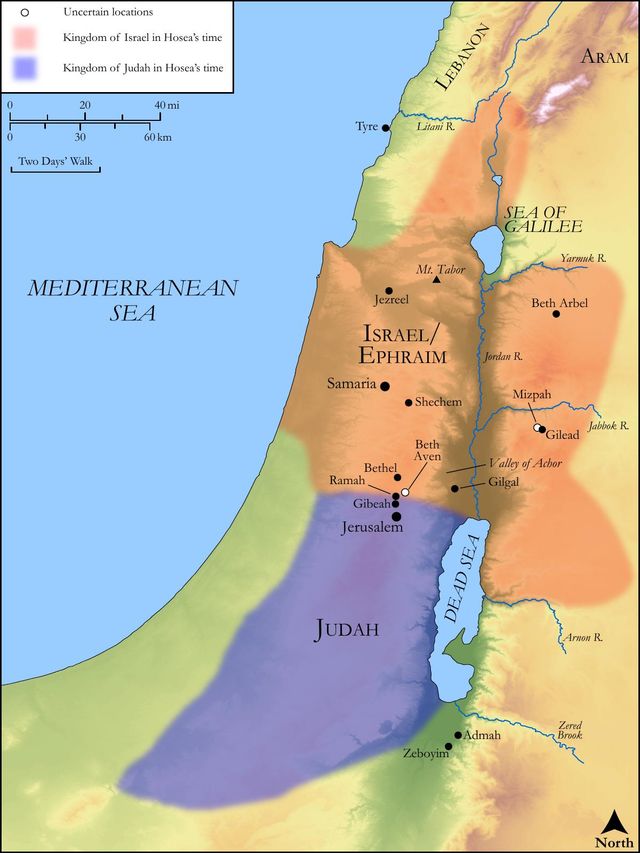
See on the biblical-era map
Study this verse
Public-domain commentary
Matthew Henry
From his Commentary on the Whole Bible. Henry comments on passages, not single verses — this entry covers Hosea 13:9–16. His four-level outline is real structure in the source text, so it is rendered as structure.
The first of these verses is the summary, or contents, of all the rest (Hos 13:9), where we have, 1. All the blame of Israel's ruin laid upon themselves: O Israel! thy perdition is thence; it is of and from thyself; or, "It has destroyed thee, O Israel! that is, all that sin and folly of thine which thou art before charged with. As thy own wickedness has many a time corrected thee, so that has now at length destroyed thee." Note, Wilful sinners are self-destroyers. Obstinate impenitence is the grossest self-murder. Those that are destroyed of the destroyer have their blood upon their own head; they have destroyed themselves. 2. All the glory of Israel's relief ascribed to God: But in me is thy help. That is, (1.) It might have been: "I would have helped thee and healed thee, but thou wouldst not be healed and helped, but wast resolutely set upon thy own destruction." This will aggravate the condemnation of sinners, not only that they did that which tended to their own ruin, but that they opposed the offers God made them and the methods he took with them to prevent it: I would have gathered them, and they would not. They might have been easily and effectually helped, but they put the help away from them. Nay, (2.) It may be: "Thy case is bad, but it is not desperate. Thou hast destroyed thyself; but come to me, and I will help thee." This is a plank thrown out after shipwreck, and greatly magnifies not only the power of God, that he can help when things are at the worst, can help those that cannot help themselves, but the riches of his grace, that he will help those that have destroyed themselves and therefore might justly be left to perish, that he will help those that have long refused his help. Dr. Pocock gives a different reading and sense of this verse: "O Israel! this has destroyed thee, that in me is thy help. Presuming upon God and his favour has emboldened thee in those wicked ways which have been thy ruin."
Now, in the rest of these verses, we may see,
I.How Israel destroyed themselves.
It is said (Hos 13:16), They rebelled against God, revolted from their allegiance to him, entered into a confederacy with his enemies, and took up arms against him; and this was the thing that ruined them, for never any hardened themselves against God and prospered. Note, Those that rebel against their God destroy themselves, for they make him their enemy for whom they are an unequal match.
1.They treasure up wrath against the day of wrath, and so they destroy themselves. They are doing that, every day, which will be remembered against them another day (Hos 13:12): The iniquity of Ephraim is bound up, and his sin is hid; God took notice of it, kept it upon record, and will produce it against him and reckon with him for it afterwards. Their former sins contributed to their present destruction; for they were laid up in store with God, Deu 32:34, Deu 32:35; Job 14:17. It is laid up in safety, and will not be forgotten, nor the evidence against him lost; but it is laid up in secret; it is hid; the sinner himself is not aware of it. It is bound up in God's omniscience, in the sinner's own conscience. Note, The sin of sinners is not forgotten till it is pardoned, but an exact account is kept of it, which will be opened in proper time.
2.They make no haste to repent and help themselves when they are under divine rebukes; they are their own ruin because they will not do what they should do towards their own salvation, Hos 13:13.
(1.)They are brought into trouble and distress by sin: The sorrows of a travailing woman shall come upon him. They shall smart for sin, and so be made sensible of it; they shall be thrown into pangs and agonies by it, very sharp and severe, and yet, like the pains of a woman in labour, hopeful and promising, and in order to deliverance; and by these, though God corrects them, yet he designs their good. They are chastened, that they may not be destroyed. But,
(2.)They are not by these forwarded as they ought to be towards repentance and reformation, which would cause their sorrows to issue in true joy: He is an unwise son, for he should not stay long, as he does, in the place of the breaking forth of children, but, being brought to the birth, should struggle to get forth, lest he be stifled and still-born at last. Were the child which the mother is in travail of capable of understanding its own case, we should reckon it an unwise child that would choose to stay long in the birth; for the captive exile hasteth to be loosed, lest he die in the pit, Isa 51:14. Note, Those may justly be reckoned their own destroyers who defer and put off their repentance, by which alone they might help themselves. Those are in danger of miscarrying in conversion who delay it, and will not put forth themselves to speed the work and bring it to an issue.
3.Therefore they are destroyed because they have done that which will be their certain ruin and neglected that which would have been their only relief. Here is a sad description of the desolation they are doomed to, Hos 13:15, Hos 13:16. It is here taken for granted that Ephraim is fruitful among his children; his name signifies fruitfulness. He is fruitful in respect of the plentiful products of his country and the great numbers of its inhabitants; it was both a rich and a populous tribe, as was foretold concerning it; but sin turns this fruitful tribe into barrenness. Joseph was a fruitful bough, but for sin it was blasted. The instrument is an east wind, representing a foreign enemy that should invade it. It is called the wind of the Lord, not only because it shall be a very great and strong wind, but because it shall be sent by divine direction; it shall come from the Lord, and do whatever he appoints; and see what effect it shall have upon that flourishing tribe, what desolations war shall make.
(1.)Was it a rich tribe? The foreign enemy shall make it poor enough. This wind of the Lord shall come up from the wilderness, a freezing blasting wind, and shall dry up the springs and fountains with which this tree is watered, shall exhaust the sources of its wealth. The invader shall waste the country and so impoverish the husbandman, shall intercept trade and commerce and so impoverish the merchant; and let not the great men, whose wealth lies in their rich furniture, think that they shall be exempted from the judgment, for he shall spoil the treasure of all pleasant vessels. See the folly of those that lay up their treasure on earth, that lay it up in pleasant vessels (vessels of desire, so the word is), on which they set their affections, and in which they place their comfort and satisfaction. This is treasure that may be spoiled and that they may be spoiled of; it is what either moth or rust may corrupt, or what thieves and soldiers may steal and carry away. But wise and happy are those who have laid up their treasures in heaven, and in the pleasant things of that world, which cannot be spoiled, which they cannot be stripped of; ever happy are they, and therefore truly wise.
(2.)Was it a populous tribe, and numerous? The enemy shall depopulate it and make its men few: Samaria shall become desolate, without inhabitants.
[1.]Those shall be cut off who are the guard and joy of the present generation; the men who bear arms shall bear them to no purpose, for they shall fall by the sword, so that there shall be none to make head against the fury of the conqueror nor to take care of the concerns either of the public or of private families.
[2.]Those shall be cut off who are the seed and hope of the next generation, who should rise up in the places of those who fell by the sword; the whole nation must be rooted out, and therefore the infants shall be dashed to pieces, in the most cruel and barbarous manner, and, which is if possible yet more inhuman, the women with child shall be ripped up. Thus shall the glory of Samaria flee away from the birth, and from the womb, Hos 9:11; Hos 10:14. See instances of this cruelty, Kg2 8:12; Kg2 15:16; Amo 1:13.
II.Let us now see how God was the help of this self-destroying people, how he was their only help (Hos 13:10):
I will be thy King, to rule and save thee. Though they had refused to be his subjects and had rebelled against him, yet he would still be their King and would not abandon them. The business and care of a good king is to keep his people, not only from ruined by foreign enemies, but from ruining themselves and one another. Thus will God yet be Israel's King, as he was their King of old. Note, Our case would be sad indeed if God were not better to us than we are to ourselves.
1.God will be their King when they have no other king; he will protect and save them when those are cut off and gone who should have been their protectors and saviours: I will be he (so Hos 13:10 may be read), he that shall help thee. "Where is the king that may save thee in all thy cities, that may go in and out before thee, and fight thy battles, when thy cities are invaded by a foreign power, and suppress the more dangerous quarrels of thy citizens among themselves? Where are thy judges, who by administering public justice should preserve the public peace? For it is righteousness and peace that kiss each other. Where are thy judges that thou hadst such a desire of and such a dependence upon, of whom thou saidst, Give me a king and princes? This refers,
(1.)To the foolish wicked desire which the whole nation had of a kingly government, being weary of the theocracy, or divine government, which they had been under during the time of the Judges, because it looked too mean for them. They rejected Samuel, and in him the Lord, when they said, Give us a king like the nations, whereas the Lord was their King.
(2.)To the desire which the ten tribes had of a kingly government different from that of the house of David, because they thought that was too absolute and bore too hard upon them, and they hoped to better themselves by setting up Jeroboam. Both these are instances,
[1.]Of men's improvidence for themselves. When they are uneasy with their present lot they are fond of novelty, and think to better themselves by a change; but they are commonly disappointed, and do not find that advantage in the alteration which they promised themselves.
[2.]Of men's impiety towards God, in thinking to refine upon his appointments and amend them. God gave Israel judges and prophets for their guidance; but they were weary of them, and cried, Give us a king and princes. God gave them the house of David, established it by a covenant of royalty; but they were soon weary of that too, and cried, We have no part in David. Those destroy themselves who are not pleased with what God does for them, but think they can do better for themselves. Well, in both these requests, Providence humoured them, gave them Saul first, and afterwards Jeroboam. And what the better were they for them? Saul was given in anger (given in thunder, Sa1 12:18, Sa1 12:19) and soon after was taken away in wrath, upon Mount Gilboa. The kingly government of the ten tribes was given in anger, not only against Solomon for his defection, but against the ten tribes that desired it, for their discontent and disaffection to the house of David; and God was now about to take that away in wrath by the power of the king of Assyria. And then, where is thy King? He is gone, and thou shalt abide many days without a king, and without a prince (Hos 3:4), shalt have none to save thee, none to rule thee. Note, First, God often gives in anger what we sinfully and inordinately desire, gives it with a curse, and with it gives us up to our own hearts' lusts. Thus he gave Israel quails. Secondly, What we inordinately desire we are commonly disappointed in, and it cannot save us, as we expected it should. Thirdly, What God gives in anger he takes away in wrath; what he gives because we did not desire it well he takes away because we did not use it well. It is the happiness of the saints that, whether God gives or takes, it is all in love, and furnishes them with matter for praise. To the pure all things are pure. It is the misery of the wicked that, whether God gives or takes, it is all in wrath; to them nothing is pure, nothing is comfortable.
2.God will do that for them which no other king could do if they had one (Hos 13:14): I will ransom them from the power of the grave. Though Israel, according to the flesh, be abandoned to destruction, God has mercy in store for his spiritual Israel, in whom all the promises were to have their accomplishment, and this among the rest, for to them the apostle applies it (Co1 15:55), and particularly to the blessed resurrection of believers at the great day, yet not excluding their spiritual resurrection from the death of sin to a holy, heavenly, spiritual, and divine life. It is promised,
(1.)That the captives shall be delivered, shall be ransomed, from the power of the grave. Their deliverance shall be by ransom; and we know who it was that paid their ransom, and what the ransom was, for it was the Son of man that gave his life a ransom for many, Mat 20:28. It is he that thus redeemed them. Those who, upon their repenting and believing, are, for the sake of Christ's righteousness, acquitted from the guilt of sin and saved from death and hell, which are the wages of sin, are those ransomed of the Lord that shall, in the great day, be brought out of the grave in triumph, and it shall be as impossible for the banks of death to hold them as it was to hold their Master.
(2.)That the conqueror shall be destroyed: O death! I will be thy plagues. Jesus Christ was the plague and destruction of death and the grave when by death he destroyed him that had the power of death, and when in his own resurrection he triumphed over the grave. But the complete destruction of them will be in the resurrection of believers at the great day, when death shall for ever be swallowed up in victory, and it is the last enemy that shall be destroyed. But the word which we translate I will may as well be rendered Ubi nunc - Where now are thy plagues? And so the apostle took it: 'O death! where is thy plague, or sting, with which thou hast so long pestered the world? O grave! where is thy victory, or thy destruction, wherewith thou has destroyed mankind?" Christ has abolished death, has broken the power of it and altered the property of it, and so enabled us to triumph over it. This promise he has made, and it shall be made good to all that are his; for repentance shall be hidden from his eyes; he will never recall this sentence passed on death and the grave, for he is not a man that he should repent. Thanks be to God therefore who gives us the victory.
Historical interpretation
Twelve Centuries of Reception
10 surviving comments on this verse. Each one is dated, so this reads as a timeline rather than a list.
Select a marker to jump to its quote. Markers stagger vertically where authors wrote within a few decades of each other.
But some man will say, How are the dead raised up? and with what body do they come? Thou fool, that which thou sowest is not quickened, except it die: And that which thou sowest, thou sowest not that body that shall be, but bare grain, it may chance of wheat, or of some other grain: But God giveth it a body as it hath pleased him, and to every seed his own body. All flesh is not the same flesh: but there is one kind of flesh of men, another flesh of beasts, another of fishes, and another of birds. There are also celestial bodies, and bodies terrestrial: but the glory of the celestial is one, and the glory of the terrestrial is another. There is one glory of the sun, and another glory of the moon, and another glory of the stars: for one star differeth from another star in glory. So also is the resurrection of the dead. It is sown in corruption; it is raised in incorruption: It is sown in dishonour; it is raised in glory: it is sown in weakness; it is raised in power: It is sown a natural body; it is raised a spiritual body. There is a natural body, and there is a spiritual body. And so it is written, The first man Adam was made a living soul; the last Adam was made a quickening spirit. Howbeit that was not first which is spiritual, but that which is natural; and afterward that which is spiritual. The first man is of the earth, earthy: the second man is the Lord from heaven. As is the earthy, such are they also that are earthy: and as is the heavenly, such are they also that are heavenly. And as we have borne the image of the earthy, we shall also bear the image of the heavenly. Now this I say, brethren, that flesh and blood cannot inherit the kingdom of God; neither doth corruption inherit incorruption. Behold, I show you a mystery; We shall not all sleep, but we shall all be changed, In a moment, in the twinkling of an eye, at the last trump: for the trumpet shall sound, and the dead shall be raised incorruptible, and we shall be changed. For this corruptible must put on incorruption, and this mortal must put on immortality. So when this corruptible shall have put on incorruption, and this mortal shall have put on immortality, then shall be brought to pass the saying that is written, Death is swallowed up in victory. O death, where is thy sting? O grave, where is thy victory? [Hosea 13:14] The sting of death is sin; and the strength of sin is the law. But thanks be to God, which giveth us the victory through our Lord Jesus Christ. Therefore, my beloved brethren, be ye stedfast, unmoveable, always abounding in the work of the Lord, forasmuch as ye know that your labour is not in vain in the Lord.
But that brazen serpent was hung up as a remedy for the biting serpents, not as a type of him that suffered for us but as a contrast. And [the brazen serpent] saved those that looked upon it, not because they believed it to live but because it was killed, and killed with it were the powers that were subject to it, being destroyed as it deserved. And what is the fitting epitaph for it from us? “O death, where is your sting? O grave, where is your victory?” You are overthrown by the cross; you are slain by him who is the giver of life; you are without breath, dead, without motion, even though you keep the form of a serpent lifted up on a pole.
No one could know Wisdom; for no one knows the Son except the Father, and no one knows the Father except the Son, and those to whom the Son chooses to reveal Him. Therefore, He Himself revealed to John with whom Wisdom was; and for this reason, he said, not as his own, but what Wisdom had infused in him: In the beginning was the Word, and the Word was with God. Wisdom does not know destruction, it does not know wickedness. For destruction could not hold it, who said: Where, O death, is your victory? Where, O death, is your sting?
I will free them from the hand of death; I will redeem them from death. O death, I will be your death; O underworld, I will be your sting. Comfort is hidden from my eyes because He will Himself divide among brothers. According to both the understanding of Ephraim, that is, the ten tribes, and the heretics, who will not be able to bear the pain of their sons' contrition, when pains come upon them like those of a woman in labor, the Lord promises to liberate them from the hand of death and to redeem them from death. However, the hand of death refers to the works by which it kills, according to that which is written: "Death and life are in the power of the tongue" (Prov. XVIII, 21). But the Lord freed all, and redeemed in the passion of the cross and the shedding of His blood: when His soul descended into hell, and His flesh did not see corruption, and even to death and hell He spoke: "I will be thy death, O death." Therefore, I died, so that by my death thou might die. "I will be thy biting, O hell," who devourest everyone in thy jaws. And seeing the harsh necessity of death, and that there is no man who lives and does not see death (Psalm LXXXVIII), the most merciful Father remembers the ancient sentence: that in Adam we all die (1 Corinthians XV). Having understood his own weakness and the frailty of human flesh, the prophet said: 'Consolation,' he said, 'is hidden from my eyes,' with the meaning: I cannot console myself, whatever I conceive in my mind, my pain cannot be mitigated, seeing ('Al.' seeing) the dearest names separated by death: For hell ('Al.' he said) itself divides brothers. Therefore, whatever separates brothers should be called hell: especially the harlot woman, who calls the foolish man to her, saying in the wealth of her wisdom: Touch willingly hidden breads and drink the sweetness of stolen waters; and the foolish man does not know that those who are of the earth die with her, and fall into the depths of hell. For whatever is not allowed, is desired more, and what is sweet through rarity, turns bitter through frequent indulgence. And honey drips from the lips of a harlot who, for a time, fattens up the throat of the fool; but in the end, it is found more bitter than gall, and sharper than a double-edged sword. Whoever is an earthborn and does not come from heaven, falls into their embraces; they are bound with the chains of their couches, and their feet walk towards foolishness, leading those who use them to death and to hell. Between death and the underworld, there is this difference: death is when the soul is separated from the body; the underworld is the place where the souls are either held in cold storage or punished, depending on the quality of their merits. We have said this to show that death does what a harlot does. For death divides brothers, just as a woman does. In the case of brothers, understand that any brotherly love is divided: a mother is divided from her daughter, and a father from his son, and a brother from his brother. But what is death, and what is hell, the psalmist shows, saying: "There is no one in death who remembers you: in hell, who will confess you" (Ps. VI, 6)? And in another place: "Let death come upon them, and let them go down alive into hell" (Ps. LIV, 16). Because we have translated: "I will be your death, O death: I will be your bite, O hell," the LXX (Septuagint) translated: "Where is your cause, O death? Where is your stimulus, O hell?" For which reason the Apostle placed: "Death has been swallowed up in" "contention; where is your contentio, death? Where is your sting, O death" (1 Co. XV, 54 et seqq)? And explaining the power of the testimony, he said: "But the sting of death is sin, and the power of sin is the law; but thanks be to God, who has given us victory through our Lord Jesus Christ." Therefore, what he interpreted as the resurrection of the Lord, we cannot nor dare interpret differently. Death, hell, and the devil may be understood, who was killed by the death of Christ, about whom Isaiah also speaks: "Death has been swallowed up by victory" (Isaiah 25:8, LXX translation). And afterwards it follows: "The Lord hath taken away every tear from every face." Now, however, some understand that the two brothers who were separated by death, according to the history of that time, are Israel and Judah, so that what was then prefigured partly may now be felt in its entirety, and that with every human race Israel and Judah must be liberated and redeemed. In the place where the LXX have translated, "Where is thy cause?" and we have said, "Thy death shall be," Symmachus has interpreted, "Thy plague will be," the fifth edition and Aquila: "Where are thy words?" which is written in Hebrew Dabarach: reading Dabar, which means "word," for Deber, which is interpreted as "death;" according to what we read in Isaiah: "The Lord hath sent death upon Jacob, and it is come into Israel" (Isaiah 9), that is, "deber," for which we have interpreted: "The Lord sent the Word into Jacob, and it came into Israel," that is, "dabar." Also for the sting which we translated as "bite," Symmachus translated ἀπάντημα, that is, "encounter:" Theodotion and the fifth edition have interpreted as "plague, and conclusion."
Thus, if the glory of incorruptibility has been hidden from all people in this time, how do you, in this very same age, boast that you are able to be clothed with that very same incorruptibility? For just as sinking into sin has become for humans the beginning of corruption, so not having sin will be the beginning of incorruption. Who, therefore, concealed this prior to the judgment of God or removed it from the bosom of Christ and handed it over to you? Or do you perhaps think that a person would not merit this in the future from the hand of the Lord? That most distinguished man, Paul, teaches this and says, “But when this mortal thing has put on immortality, then shall come to pass the saying which is written, ‘Death has been swallowed up in victory. Where, O death, is your victory? Where, O death is your sting?’ Now the sting of death is sin.” Through this the apostle shows that by no means can anyone so scoff at death and sin, until immortality follows mortality, and incorruption, corruption, and when, with the destruction of weakness, perfect virtue succeeds it; when there will not be male and female, but when all will be similar to the angels of God.
What is it the chaste person would like? That no lust at all should stir in the members against chastity. [The chaste person] wants peace but hasn’t yet got it. I mean, when we get to the stage where no lusts at all rise up to be opposed, there won’t be any more enemy for us to wrestle with; nor is there in that state any expectation of victory, because the triumph is being celebrated over the enemy already conquered. Listen to the apostle telling you about that victory: “The perishable must put on imperishability, and the mortal put on immortality; then will come about the saying that is written: ‘Death has been swallowed up in victory.’ ” Now listen to the song of triumph: “Where, O death, is your striving? Where, O death, is your sting?” You have stabbed, you have wounded, you have knocked down; but the one who made me was wounded for me. O death, death! The one who made me was wounded for me, and by his death he conquered you. And that’s when those who triumph over you are going to say, “Where, O death, is your striving? Where, O death, is your sting?”
By this solemnity the elect who, protected though they were in undisturbed rest, were yet being held within the bounds of the lower world, have been brought back to the pleasant places of paradise. By his resurrection the Lord fulfilled what he said before his passion, "If I am lifted up from the earth, I shall draw all things to myself." He who left none of his elect in the lower world did indeed draw all things to himself. He took from them all the predestinate. The Lord by his rising did not restore to pardon any unbelievers or those whose wickedness had caused them to be given over to eternal punishment; he snatched away from the confines of the lower world those whom he recognized as his own as a result of their faith and deeds. Hence he says truly by the mouth of Hosea: "O death, I will be your death; O lower world, I will be your bite." What we slay we cause almost to pass out of existence, but we take some from what we bite and leave the rest. Because he completely conquered death in his elect, he became death for death; but because he took away a portion of the lower world and left part of it, he did not completely slay it but took a bite from it. Therefore he said, "O death, I will be your death," as if to say, because I am completely destroying you in my elect, "I will be your death; O lower world, I will be your bite," because by taking some away I am partially piercing through you.
Whence rightly also He says through Hosea: "I will be your death, O death; I will be your sting, O hell." For what we kill, we cause to exist no more entirely. But from what we bite, we take away a part and leave a part behind. Therefore, because in His elect He utterly killed death, He became the death of death. But because He took away a part from hell and left a part behind, He did not utterly kill but bit hell. Therefore He says: "I will be your death, O death." As if He were saying openly: Because in my elect I utterly destroy you, I will be your death; I will be your sting, O hell, because when they have been taken away, I pierce you in part. What then is this solemnity which destroyed the confines of hell and opened to us the gates of the heavenly kingdom?
In spite of these words, we are so deeply affected that we fall into tears and the longing of desire crushes the beliefs of the mind. How miserable is the human lot! How vain is all our life without Christ! O death, that separates those who were joined, cruel and harsh in forcing apart those who were tied by friendship! Now, now your strength is destroyed. Now is that wicked yoke of yours broken by him who sternly threatened you in the words of Hosea: “O death, I will be your bite!” So let us with the apostle voice our taunt: “O death, where is your victory? O death, where is your sting?” He who conquered you has redeemed us—he who betrayed his beloved soul into the hands of the wicked, that those who were once wicked he might make his beloved.
Since it was fitting for Christ to die in order to deliver us from death, so it was fitting for Him to descend into hell in order to deliver us also from going down into hell. Hence it is written (Hosea 13:14): "O death, I will be thy death; O hell, I will be thy bite." Secondly, because it was fitting when the devil was overthrown by the Passion that Christ should deliver the captives detained in hell, according to Zechariah 9:11: "Thou also by the blood of Thy Testament hast sent forth Thy prisoners out of the pit."
Continue studying Hosea 13:14 across the web’s major study libraries — every link below opens this exact verse, chapter, or book on the destination site.
Read & Compare
 BibleGatewayThis verse in more than 200 translations and 70 languages.
 Bible.comThe YouVersion reader — hundreds of translations, reading plans, and highlights.
 ESV.orgCrossway's official English Standard Version reader.
 NET BibleThe NET translation with 60,000+ translators' notes on every rendering decision.
 STEP BibleTyndale House's free study tool — original text, vocabulary, and scholarly resources.
 BibliaLogos Bible Software's free web reader.
 USCCBThe New American Bible (Revised Edition) with the U.S. bishops' study notes.
Commentaries
 BibleHub CommentariesDozens of classic commentaries on this verse, gathered on one page.
 StudyLightMore than 100 commentary sets — the largest collection on the web.
 BibleRefPlain-English commentary on what this verse means, verse by verse.
 Enduring WordDavid Guzik's free commentary on this chapter, widely used by Bible teachers.
 Bible Study ToolsVerse commentary alongside Greek and Hebrew study aids.
Original Language & Research
- BibleHub InterlinearThe verse word by word — original language, transliteration, and English.
- BibleHub LexiconEvery word's original-language definition and Strong's entry.
 Blue Letter BibleDeep-study tools — Strong's numbers, concordance, and word studies.
 SefariaThe Hebrew text with Rashi and centuries of Jewish commentary.
Sermons, Hymns & Audio


TrulyRandomVerse is not affiliated with these sites and doesn’t control their content. They’re linked because they’re genuinely useful.
Summary
Hosea 13:14 stands as a profound declaration of divine sovereignty and redemptive power, appearing amidst a chapter primarily focused on God's severe judgment against unfaithful Israel. This verse unveils God's unwavering promise to ransom and redeem His people from the ultimate enemies: death and the grave. It climaxes with a triumphant challenge to these forces, proclaiming their utter destruction, and concludes with an emphatic statement of God's irrevocable commitment to this ultimate act of salvation, underscoring His steadfast faithfulness despite humanity's rebellion.
Context
ShowHideLiterary Context
Hosea 13 is part of the final section of the book (chapters 11-14), which transitions from lament over Israel's unfaithfulness to a final call for repentance and promises of restoration. Chapter 13 specifically details Ephraim's (the northern kingdom of Israel) escalating sin, particularly their idolatry, pride, and rejection of God. The preceding verses paint a grim picture of God's wrath and impending judgment, likening Him to a destructive lion or a devouring beast, signaling imminent desolation and exile. Verse 14, however, introduces a dramatic and sudden shift, offering a startling glimpse of future hope and ultimate victory over death, an unexpected interlude of grace within a pronouncement of severe judgment. This juxtaposition highlights the depth of God's redemptive purpose that extends beyond immediate punishment.
Historical & Cultural Context
The prophet Hosea ministered during a tumultuous period in Israel's history, just before the fall of the Northern Kingdom (Israel) to Assyria in 722 BC. The people had consistently broken their covenant with Yahweh, engaging in widespread idolatry (especially Baal worship) and political alliances that denied God's sovereignty. The concepts of "grave" (Sheol) and "death" were deeply ingrained in ancient Near Eastern thought as powerful, inescapable realms. "Ransom" and "redeem" (Hebrew: padah and ga'al) carried significant cultural weight, referring to the act of buying back a slave, reclaiming lost property, or fulfilling the duty of a kinsman-redeemer (goel) to protect family interests, including avenging blood or securing freedom. God's declaration here reappropriates these human concepts to describe His divine, ultimate intervention to liberate His people from the dominion of death, a power far greater than any earthly oppressor.
Key Themes
ShowHideThis verse powerfully contributes to several overarching themes in Hosea and the broader biblical narrative. Firstly, it underscores God's absolute sovereignty over all creation, including the seemingly unconquerable realms of death and the grave, providing a profound counterpoint to Israel's reliance on idols and foreign powers. Secondly, it highlights the theme of divine redemption and restoration, demonstrating that even in the midst of severe judgment, God's ultimate plan for His people is one of salvation and life. This foreshadows the ultimate triumph over sin and death. Thirdly, the concluding phrase, "repentance shall be hid from mine eyes," emphasizes God's unchanging faithfulness to His ultimate redemptive purposes. Despite Israel's persistent unfaithfulness and the impending judgment described throughout Hosea, God's ultimate promise of victory over death remains firm and irrevocable, reflecting His covenant commitment that extends beyond immediate consequences, as seen in His promises to Abraham and David.
Exposition and Analysis
ShowHideKey Word Analysis
ShowHideThis primitive root signifies "to redeem (according to the Oriental law of kinship), i.e.; to be the next of kin (and as such to buy back a relative's property, marry his widow, etc.)." It implies a costly and active intervention by a responsible party to reclaim or liberate something or someone from bondage or loss. In Hosea 13:14, God assumes the role of the ultimate Kinsman-Redeemer, stepping in to buy back His people from the ultimate captivity of death.
This term refers to "Hades or the world of the dead (as if a subterranean retreat), including its accessories and inmates." It is the common abode of departed spirits, a place of no return in ancient Israelite understanding. God's promise to ransom from Sheol is a direct challenge to the perceived finality and power of this realm, indicating His intention to invade and conquer its dominion.
Derived from a root meaning "to sigh, breathe strongly," this word here means "ruefulness, i.e. desistance; repentance." In the context of God, it refers to a change of mind or purpose, often implying regret or relenting. The phrase "repentance shall be hid from mine eyes" emphatically means that God will not change His mind about this promise of ultimate deliverance. His commitment to bringing about this victory over death is absolute and unalterable.
Verse Breakdown
ShowHide"I will ransom them from the power of the grave;"
God declares His active intention to liberate His people from the dominion and grip of Sheol, the realm of the dead. The "power" (Hebrew: yad, literally "hand") signifies the control or authority that the grave holds over humanity. God promises to break this hold through a decisive act of liberation, akin to paying a price for freedom.
"I will redeem them from death:"
This clause parallels and reinforces the first, emphasizing God's determination to reclaim His people from the ultimate enemy, death itself. The use of "redeem" (Hebrew: gâʼal) highlights God's role as the kinsman-redeemer, undertaking a costly act to restore what was lost to death's grasp. It speaks to a comprehensive act of salvation.
"O death, I will be thy plagues;"
In a dramatic personification, God directly addresses Death, declaring His intention to bring about its utter destruction. "Plagues" (Hebrew: deber) refers to pestilence or destructive forces. This is not merely a rescue from death, but an aggressive, decisive offensive against death, promising its complete undoing and defeat.
"O grave, I will be thy destruction:"
Similarly, God addresses the Grave (Sheol), promising its "destruction" (Hebrew: qôṭeb, meaning extermination). This reinforces the previous declaration, indicating that the realm of the dead will be utterly abolished and rendered powerless. The imagery is one of absolute conquest, where death and the grave are not just overcome, but annihilated.
"repentance shall be hid from mine eyes."
This concluding statement underscores the absolute certainty and irrevocability of God's promise. It means God will not change His mind, relent, or turn back from His declared purpose of ransoming and redeeming His people from death and the grave. Despite Israel's unfaithfulness, God's ultimate redemptive plan remains fixed and unalterable.
Literary Devices
ShowHideHosea 13:14 is rich with literary artistry that amplifies its powerful message. The most prominent device is Personification, where "Death" and the "Grave" (Sheol) are addressed as if they are sentient beings ("O death," "O grave"). This gives them a tangible, adversarial quality, making God's declaration of victory over them all the more dramatic and impactful. The direct address to these entities is also an example of Apostrophe, a rhetorical device used to create a sense of direct confrontation and emphasize the speaker's authority. The terms "plagues" and "destruction" used against Death and the Grave employ Hyperbole, exaggerating the extent of their defeat to convey the absolute and decisive nature of God's triumph. This is not a partial victory but a complete annihilation of their power. Furthermore, the verse presents a profound Paradox: amidst a context of severe judgment and impending destruction for Israel, God suddenly declares a promise of ultimate life and victory over death. This unexpected shift highlights the depth of God's mercy and His sovereign ability to bring life out of death, and hope out of despair.
Theological and Thematic Connections
ShowHideHosea 13:14 is a pivotal Old Testament prophecy that beautifully encapsulates God's ultimate victory over the powers of sin and death. It reveals a God who is not merely a judge but also a relentless Redeemer, whose love and covenant faithfulness extend beyond immediate human failure. This verse speaks to the very heart of biblical theology: the promise of resurrection and eternal life, demonstrating that death is not the final word for God's people. It lays a foundational stone for the New Testament's understanding of Christ's triumph, showing that God's plan for overcoming mortality was established long before its ultimate fulfillment. It assures us that God's redemptive purpose is unwavering, a truth that provides profound comfort and hope.
Reflection and Application
ShowHideHosea 13:14 offers immense comfort and profound assurance to believers across all generations. In a world where death remains the ultimate human fear and the final enemy, this verse declares God's absolute sovereignty over it. It reminds us that our hope is not in the fleeting promises of this life, but in the unchanging character and redemptive power of God. For those who trust in Him, death is not an end but a conquered foe, its sting removed by divine intervention. This truth empowers us to live without fear of mortality, knowing that our future is secured by a God who does not change His mind about His promises. It calls us to place our ultimate trust in the One who has already declared victory over the grave, transforming our perspective on suffering, loss, and the ultimate destiny of humanity.
Questions for Reflection
ShowHideFAQ
ShowHideHow does Hosea 13:14 relate to the New Testament, especially Paul's writings?
ShowHideHosea 13:14 is one of the most direct Old Testament prophecies regarding the defeat of death and the grave, and it finds its ultimate fulfillment and explicit quotation in the New Testament. The Apostle Paul famously quotes parts of this verse in his triumphant discourse on the resurrection in 1 Corinthians 15:55, proclaiming, "O death, where is thy sting? O grave, where is thy victory?" Paul uses Hosea's prophecy to underscore the reality and certainty of Christ's resurrection and the future resurrection of believers, demonstrating that Christ's victory over death is the fulfillment of God's ancient promise. This connection shows a seamless continuity in God's redemptive plan from the Old Testament prophets to the New Testament's revelation in Jesus Christ.
What is the significance of the phrase "repentance shall be hid from mine eyes"?
ShowHideThis phrase is a powerful declaration of God's unwavering commitment and the irrevocable nature of His promise. It means that God will not change His mind, relent, or turn back from His declared purpose of ransoming and redeeming His people from death and the grave. Despite Israel's persistent unfaithfulness and the severe judgments pronounced throughout Hosea, God's ultimate redemptive plan for His people remains fixed and unalterable. It emphasizes God's faithfulness to His covenant and His ultimate design for salvation, providing a profound assurance that His promises of victory over death are absolutely certain and will be accomplished.
Christ-Centered Fulfillment
ShowHideHosea 13:14 finds its ultimate and glorious fulfillment in the person and work of Jesus Christ. The prophetic declaration, "I will ransom them from the power of the grave; I will redeem them from death: O death, I will be thy plagues; O grave, I will be thy destruction," is precisely what Jesus accomplished through His crucifixion and resurrection. He is the divine Kinsman-Redeemer who paid the ultimate price, His own life, to ransom humanity from the bondage of sin and the dominion of death. His resurrection from the dead was God's decisive act of invading the grave and stripping death of its power, fulfilling the ancient promise. As John 11:25 proclaims, Jesus is "the resurrection and the life," embodying the very victory over death that Hosea foretold. His triumph ensures that those who believe in Him will also experience resurrection, as He has conquered the last enemy (1 Corinthians 15:26). Jesus now holds "the keys of death and Hades" (Revelation 1:18), demonstrating His absolute authority over these realms. Thus, Hosea's ancient prophecy is not merely a promise of future deliverance, but a testament to the finished work of Christ, who, by His death, "destroyed him who has the power of death, that is, the devil, and delivered all those who through fear of death were subject to lifelong slavery" (Hebrews 2:14-15).