


1 Corinthians 15:57
- ΤῷTō<the>G3588T-DSMDefinite article Dative Singular Masculine
- δὲdehoweverG1161CONJConjunction
- θεῷtheōto GodG2316N-DSM-TNoun Dative Singular Masculine Title
- χάριςcharis[be] thanksG5485N-NSFNoun Nominative Singular Feminine
- τῷtōwhoG3588T-DSMDefinite article Dative Singular Masculine
- διδόντιdidontiis givingG1325V-PAP-DSMVerb Present Active Participle Dative Singular Masculine
- ἡμῖνhēminusG3165P-1DPPersonal pronoun Dative 1st Plural
- τὸtotheG3588T-ASNDefinite article Accusative Singular Neuter
- νῖκοςnikosvictoryG3534N-ASNNoun Accusative Singular Neuter
- διὰdiathroughG1223PREPPreposition
- τοῦtoutheG3588T-GSMDefinite article Genitive Singular Masculine
- κυρίουkuriouLordG2962N-GSM-TNoun Genitive Singular Masculine Title
- ἡμῶνhēmōnof usG3165P-1GPPersonal pronoun Genitive 1st Plural
- ἸησοῦIēsouJesusG2424N-GSM-PNoun Genitive Singular Masculine Individual
- ΧριστοῦChristouChristG5547N-GSM-TNoun Genitive Singular Masculine Title
English is a literal word-by-word gloss of the Greek, not the KJV's wording. Why?
This is the original text the KJV's translators worked from — each Greek word with its own literal English meaning in this verse, prepared by scholars at Tyndale House, Cambridge. The KJV translates whole sentences, not word by word, so its wording differs: one Greek word can become several English words, and the KJV may choose “charity” where the gloss reads “love”. Both are faithful — they answer different questions. For the KJV's own rendering, switch to the KJV text.
Details
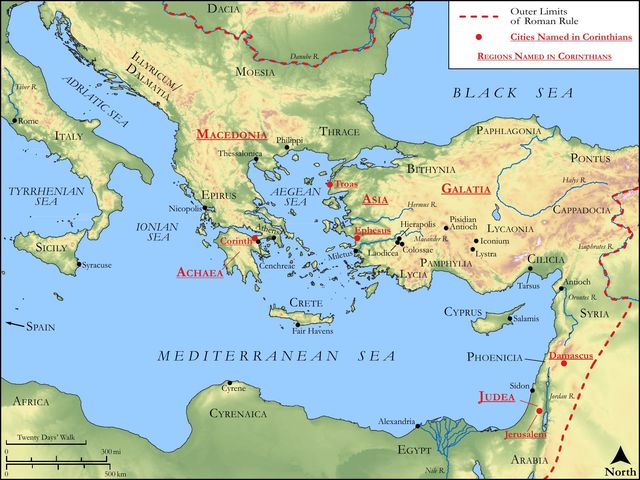
See on the biblical-era map

Study this verse
Public-domain commentary
Matthew Henry
From his Commentary on the Whole Bible. Henry comments on passages, not single verses — this entry covers 1 Corinthians 15:51–57. His three-level outline is real structure in the source text, so it is rendered as structure.
To confirm what he had said of this change,
I.He here tells them what had been concealed from or unknown to them till then - that all the saints would not die, but all would be changed.
Those that are alive at our Lord's coming will be caught up into the clouds, without dying, Th1 4:11. But it is plain from this passage that it will not be without changing from corruption to incorruption. The frame of their living bodies shall be thus altered, as well as those that are dead; and this in a moment, in the twinkling of an eye, Co1 15:52. What cannot almighty power effect? That power that calls the dead into life can surely thus soon and suddenly change the living; for changed they must be as well as the dead, because flesh and blood cannot inherit the kingdom of God. This is the mystery which the apostle shows the Corinthians: Behold, I show you a mystery; or bring into open light a truth dark and unknown before. Note, There are many mysteries shown to us in the gospel; many truths that before were utterly unknown are there made known; many truths that were but dark and obscure before are there brought into open day, and plainly revealed; and many things are in part revealed that will never be fully known, nor perhaps clearly understood. The apostle here makes known a truth unknown before, which is that the saints living at our Lord's second coming will not die, but be changed, that this change will be made in a moment, in the twinkling of an eye, and at the sound of the last trump; for, as he tells us elsewhere, the Lord himself shall descend with a shout, with a voice of the archangel, and with the trump of God (Th1 4:16), so here, the trumpet must sound. It is the loud summons of all the living and all the dead, to come and appear at the tribunal of Christ. At this summons the graves shall open, the dead saints shall rise incorruptible, and the living saints be changed to the same incorruptible state, Co1 15:52.
II.He assigns the reason of this change (Co1 15:53):
For this corruptible must put on incorruption, and this mortal must put on immortality. How otherwise could the man be a fit inhabitant of the incorruptible regions, or be fitted to possess the eternal inheritance? How can that which is corruptible and mortal enjoy what is incorruptible, permanent, and immortal? This corruptible body must be made incorruptible, this mortal body must be changed into immortal, that the man may be capable of enjoying the happiness designed for him. Note, It is this corruptible that must put on incorruption; the demolished fabric that must be reared again. What is sown must be quickened. Saints will come in their own bodies (Co1 15:38), not in other bodies.
III.He lets us know what will follow upon this change of the living and dead in Christ:
Then shall be brought to pass that saying, Death is swallowed up in victory; or, He will swallow up death in victory. Isa 25:8. For mortality shall be then swallowed up of life (Co2 5:4), and death perfectly subdued and conquered, and saints for ever delivered from its power. Such a conquest shall be obtained over it that it shall for ever disappear in those regions to which our Lord will bear his risen saints. And therefore will the saints hereupon sing their epinikion, their song of triumph. Then, when this mortal shall have put on immortality, will death be swallowed up, for ever swallowed up, eis nikos. Christ hinders it from swallowing his saints when they die; but, when they rise again, death shall, as to them, be swallowed for ever. And upon this destruction of death will they break out into a song of triumph.
1.They will glory over death as a vanquished enemy, and insult this great and terrible destroyer: "O death! where is thy sting? Where is now thy sting, thy power to hurt? What mischief hast thou done us? We are dead; but behold we live again, and shall die no more. Thou art vanquished and disarmed, and we are out of the reach of thy deadly dart. Where now is thy fatal artillery? Where are thy stores of death? We fear no further mischiefs from thee, nor heed thy weapons, but defy thy power, and despise thy wrath. And, O grave! where is thy victory? Where now is thy victory? What has become of it? Where are the spoils and trophies of it? Once we were thy prisoners, but the prison-doors are burst open, the locks and bolts have been forced to give way, our shackles are knocked off, and we are for ever released. Captivity is taken captive. The imaginary victor is conquered, and forced to resign his conquest and release his captives. Thy triumphs, grave, are at an end. The bonds of death are loosed, and we are at liberty, and are never more to be hurt by death, nor imprisoned in the grave." In a moment, the power of death, and the conquests and spoils of the grave, are gone; and, as to the saints, the very signs of them will not remain. Where are they? Thus will they raise themselves, when they become immortal, to the honour of their Saviour and the praise of divine grace: they shall glory over vanquished death.
2.The foundation for this triumph is here intimated,
(1.)In the account given whence death had its power to hurt: The sting of death is sin. This gives venom to his dart: this alone puts it into the power of death to hurt and kill. Sin unpardoned, and nothing else, can keep any under his power. And the strength of sin is the law; it is the divine threatening against the transgressors of the law, the curse there denounced, that gives power to sin. Note, Sin is the parent of death, and gives it all its hurtful power. By one man sin entered into the world, and death by sin, Rom 5:12. It is its cursed progeny and offspring.
(2.)In the account given of the victory saints obtain over it through Jesus Christ, Co1 15:56. The sting of death is sin; but Christ, by dying, has taken out this sting. He has made atonement for sin; he has obtained remission of it. It may hiss therefore, but it cannot hurt. The strength of sin is the law; but the curse of the law is removed by our Redeemer's becoming a curse for us. So that sin is deprived of its strength and sting, through Christ, that is, by his incarnation, suffering, and death. Death may seize a believer, but cannot sting him, cannot hold him in his power. There is a day coming when the grave shall open, the bands of death be loosed, the dead saints revive, and become incorruptible and immortal, and put out of the reach of death for ever. And then will it plainly appear that, as to them, death will have lost its strength and sting; and all by the mediation of Christ, by his dying in their room. By dying, he conquered death, and spoiled the grave; and, through faith in him, believers become sharers in his conquests. They often rejoice beforehand, in the hope of this victory; and, when they arise glorious from the grave, they will boldly triumph over death. Note, It is altogether owing to the grace of God in Christ that sin is pardoned and death disarmed. The law puts arms into the hand of death, to destroy the sinner; but pardon of sin takes away this power from the law, and deprives death of its strength and sting. It is by the grace of God, through the redemption which is in Christ Jesus, that we are freely justified, Rom 3:24. It is no wonder, therefore,
(3.)If this triumph of the saints over death should issue in thanksgiving to God: Thanks be to God, who giveth us the victory through Christ Jesus, our Lord, Co1 15:57. The way to sanctify all our joy is to make it tributary to the praise of God. Then only do we enjoy our blessings and honours in a holy manner when God has his revenue of glory out of it, and we are free to pay it to him. And this really improves and exalts our satisfaction. We are conscious at once of having done our duty and enjoyed our pleasure. And what can be more joyous in itself than the saints' triumph over death, when they shall rise again? And shall they not then rejoice in the Lord, and be glad in the God of their salvation? Shall not their souls magnify the Lord? When he shows such wonders to the dead, shall they not arise and praise him? Psa 88:10. Those who remain under the power of death can have no heart to praise; but such conquests and triumphs will certainly tune the tongues of the saints to thankfulness and praise - praise for the victory (it is great and glorious in itself), and for the means whereby it is obtained (it is given of God through Christ Jesus), a victory obtained not by our power, but the power of God; not given because we are worthy, but because Christ is so, and has by dying obtained this conquest for us. Must not this circumstance endear the victory to us, and heighten our praise to God? Note, How many springs of joy to the saints and thanksgiving to God are opened by the death and resurrection, the sufferings and conquests, of our Redeemer! With what acclamations will saints rising from the dead applaud him! How will the heaven of heavens resound his praises for ever! Thanks be to God will be the burden of their song; and angels will join the chorus, and declare their consent with a loud Amen, Hallelujah.
Historical interpretation
Historical reception
3 surviving comments on this verse. Each one is dated, so this reads as a timeline rather than a list.
Select a marker to jump to its quote. Markers stagger vertically where authors wrote within a few decades of each other.
Christ did not win the victory for himself but for our benefit. For when he became a man, he remained God, and by overcoming the devil, he who never sinned gained the victory for us, who were bound in death because of sin. The death of Christ defeated the devil, who was forced to surrender all those who had died because of sin.
"But thanks be to God, which giveth us the victory through our Lord Jesus Christ."
For the trophy He Himself erected, but the crowns He hath caused us also to partake of. And this not of debt, but of mere mercy.
The crown could not have been given to one who was worthy of it, unless grace had been given to him when still unworthy.
Continue studying 1 Corinthians 15:57 across the web’s major study libraries — every link below opens this exact verse, chapter, or book on the destination site.
Read & Compare
 BibleGatewayThis verse in more than 200 translations and 70 languages.
 Bible.comThe YouVersion reader — hundreds of translations, reading plans, and highlights.
 ESV.orgCrossway's official English Standard Version reader.
 NET BibleThe NET translation with 60,000+ translators' notes on every rendering decision.
 STEP BibleTyndale House's free study tool — original text, vocabulary, and scholarly resources.
 BibliaLogos Bible Software's free web reader.
 USCCBThe New American Bible (Revised Edition) with the U.S. bishops' study notes.
Commentaries
 BibleHub CommentariesDozens of classic commentaries on this verse, gathered on one page.
 StudyLightMore than 100 commentary sets — the largest collection on the web.
 BibleRefPlain-English commentary on what this verse means, verse by verse.
 Enduring WordDavid Guzik's free commentary on this chapter, widely used by Bible teachers.
 Bible Study ToolsVerse commentary alongside Greek and Hebrew study aids.
Original Language & Research
- BibleHub InterlinearThe verse word by word — original language, transliteration, and English.
- BibleHub LexiconEvery word's original-language definition and Strong's entry.
 Blue Letter BibleDeep-study tools — Strong's numbers, concordance, and word studies.
 CNTR CollationThe earliest Greek manuscripts of this verse, collated letter by letter.
Sermons, Hymns & Audio


TrulyRandomVerse is not affiliated with these sites and doesn’t control their content. They’re linked because they’re genuinely useful.
Summary
First Corinthians 15:57 serves as a triumphant doxology, concluding Paul's extensive discourse on the resurrection. It declares that the ultimate victory over death and sin is not achieved through human effort or merit but is a gracious gift from God, bestowed upon believers solely through the person and finished work of Jesus Christ, our Lord. This verse encapsulates the profound gratitude and assured hope that characterize the Christian faith in the face of mortality.
Context
ShowHideLiterary Context
This verse stands as the climactic exclamation point of 1 Corinthians 15, which is arguably the most comprehensive biblical treatment of the resurrection. Paul has meticulously built his argument from the historical reality of Christ's resurrection (vv. 1-11), to its necessity for Christian faith (vv. 12-19), the order of resurrection (vv. 20-28), the nature of the resurrected body (vv. 35-49), and the transformation of believers at Christ's return (vv. 50-53). Immediately preceding verse 57, Paul issues a defiant challenge to death, personifying it and mocking its power in light of Christ's triumph, asking, "O death, where is thy sting? O grave, where is thy victory?" and explaining that "the sting of death is sin; and the strength of sin is the law". Thus, 1 Corinthians 15:57 serves as the resounding answer and a declaration of profound gratitude for the victory just proclaimed.
Historical & Cultural Context
The Corinthian church was a diverse community, grappling with various theological and ethical issues. Among them were doubts or misunderstandings regarding the resurrection of the dead, possibly influenced by Greek philosophical thought which often disdained the idea of bodily resurrection. Some Gnostic-leaning ideas, which emphasized the spiritual over the material, may have also contributed to skepticism about a physical resurrection. Paul's extensive argument in 1 Corinthians 15 directly confronts these challenges, asserting the historical and theological necessity of Christ's bodily resurrection as the foundation and guarantee for the future resurrection of believers. The concept of "victory" (Greek: nikē) would have resonated strongly in a culture familiar with athletic contests, military conquests, and the worship of deities associated with triumph. Paul redefines this "victory" in a spiritual and eschatological sense, attributing it solely to God through Christ, rather than to human prowess or pagan gods.
Key Themes
ShowHideFirst Corinthians 15 is dominated by the theme of the resurrection, specifically the resurrection of Christ as the "firstfruits" and the subsequent resurrection of believers. This chapter also highlights the sovereignty of God in orchestrating salvation and the defeat of humanity's greatest enemies: sin and death. The centrality of Jesus Christ is paramount, as He is presented as the sole means by which this ultimate victory is secured. Furthermore, the chapter underscores the transformative power of the Gospel, which not only offers future hope but also impacts present living, leading to steadfastness and fruitful labor for the Lord, as encouraged in 1 Corinthians 15:58. Verse 57 beautifully summarizes these themes, shifting from theological exposition to heartfelt doxology.
Exposition and Analysis
ShowHideKey Word Analysis
ShowHideThis word, often translated as "grace," carries the meaning of graciousness, favor, or a gift. In this context, it specifically denotes gratitude or thanksgiving. Paul's use of cháris here emphasizes that the victory is entirely an unmerited favor, a divine gift that elicits profound appreciation and praise from the recipient. It underscores the idea that this triumph is not earned but freely bestowed by God.
This verb means "to give," "bestow," or "grant." It highlights God's active role as the benevolent giver of this victory. The present tense implies a continuous or ongoing reality—God is perpetually the source of this triumph. It reinforces the concept of the victory being a divine provision, originating from God's power and will, rather than a human achievement.
Derived from nikē, this term signifies a conquest or triumph. In the biblical context, it denotes a decisive and complete defeat of an enemy. Here, nîkos refers specifically to the ultimate triumph over death and sin, which Paul has just personified and mocked in the preceding verses. It conveys the absolute and irreversible nature of Christ's conquest, ensuring a definitive and eternal triumph for believers.
Verse Breakdown
ShowHide"But thanks be to God"
This opening phrase functions as a powerful doxology, a spontaneous outburst of gratitude and praise. The conjunction "But" (G1161, dé) serves as a strong adversative, contrasting the preceding rhetorical questions about death's defeat with the glorious reality of God's provision. It shifts the focus from the vanquished enemies (death and sin) to the Divine Victor, acknowledging God as the ultimate source of this triumph. It is an expression of profound relief and worship for the immense gift received.
"which giveth us the victory"
This clause identifies God as the active agent and giver of the victory. The "victory" (G3534, nîkos) refers primarily to the conquest over death and sin, which are presented as the ultimate enemies of humanity. The use of "us" signifies that this victory is not merely a theoretical concept but a personal reality for believers, shared by grace. The present tense of "giveth" (G1325, dídōmi) suggests that God is continually bestowing this triumph, implying both a past decisive event (Christ's resurrection) and an ongoing spiritual reality for believers.
"through our Lord Jesus Christ"
This final phrase specifies the indispensable means by which God grants this victory. Jesus Christ is not merely an instrument but the very channel and embodiment of this triumph. His sacrificial death conquered sin, and His glorious resurrection conquered death. The title "Lord Jesus Christ" emphasizes His divine authority, His saving work, and His messianic identity, underscoring that the entire redemptive plan, culminating in this victory, is centered on Him. It is through His finished work that believers are united to His triumph.
Literary Devices
ShowHidePaul employs several powerful literary devices in 1 Corinthians 15:57. The most prominent is Doxology, an expression of praise and glory to God, which serves as the very structure of the verse, beginning with "But thanks be to God." This immediate shift from a triumphant challenge to death to an outpouring of gratitude underscores the divine source of the victory. There is also strong Antithesis at play, as the verse stands in stark contrast to the preceding rhetorical questions that mock death's power, providing the definitive answer to those challenges. The phrase "giveth us the victory" demonstrates Divine Agency, highlighting God's active role as the ultimate bestower of triumph, rather than human effort. Finally, the verse is an example of Climax, serving as the triumphant conclusion to Paul's extensive theological argument on the resurrection in 1 Corinthians 15, bringing the entire discourse to a glorious and worshipful peak.
Theological and Thematic Connections
ShowHideThis verse profoundly connects to the core of Christian theology, affirming God's sovereign power and benevolent character in securing humanity's ultimate salvation. It underscores the finished work of Jesus Christ as the singular means of victory over sin and death, which are presented as humanity's greatest adversaries. Theologically, it highlights the concept of imputed righteousness and union with Christ, where believers participate in Christ's triumph not by their own merit but by grace through faith. The victory is not merely a future hope but a present reality, transforming the believer's perspective on mortality and suffering. It is a powerful affirmation of the Gospel's power to overcome the most formidable obstacles.
Reflection and Application
ShowHide1 Corinthians 15:57 offers profound comfort and an unshakeable foundation for Christian hope. In a world constantly confronting loss, suffering, and the inevitability of death, this verse reminds us that the final word is not despair but divine triumph. It calls believers to live with a posture of profound gratitude, recognizing that our greatest battles—those against sin's dominion and death's finality—have already been decisively won for us by Christ. This assurance should empower us to face daily challenges with courage, knowing that the God who conquered death is also at work in our lives, enabling us to overcome lesser struggles. It motivates us to live lives worthy of this immense gift, pursuing holiness and steadfastness, as the very next verse encourages. Our thanksgiving should not be a fleeting emotion but a deep-seated conviction that shapes our worship, our witness, and our daily walk.
Questions for Reflection
ShowHideFAQ
ShowHideWhat does Paul mean by "the victory" in this verse?
ShowHideIn 1 Corinthians 15:57, "the victory" (Greek: nîkos) refers primarily to the decisive and ultimate triumph over death and sin. Paul has just declared in 1 Corinthians 15:56 that "the sting of death is sin; and the strength of sin is the law." Therefore, the victory encompasses both the breaking of sin's condemning power and the conquest of death's finality. It is the complete and irreversible defeat of humanity's greatest enemies, secured by Christ's resurrection. This victory ensures that death is not the end for believers but a conquered foe, leading to eternal life and resurrection.
Christ-Centered Fulfillment
ShowHide1 Corinthians 15:57 finds its complete and glorious fulfillment in Jesus Christ. He is not merely the channel of victory, but the very embodiment of it. His incarnation, sinless life, atoning death on the cross, and glorious resurrection constitute the definitive triumph over sin and death. As the "last Adam," Christ reversed the curse brought by the first Adam, securing life where there was only death (1 Corinthians 15:21-22). His resurrection is the "firstfruits" of all who are to be raised (1 Corinthians 15:20), guaranteeing the future resurrection of believers. Through His death, He "destroyed him that had the power of death, that is, the devil" (Hebrews 2:14). Believers, united with Christ by faith, are co-crucified and co-resurrected with Him (Romans 6:4-11), participating in His victory. Thus, the "victory" spoken of in 1 Corinthians 15:57 is entirely a Christ-secured, Christ-centered, and Christ-imparted reality, making Him the ultimate object of our thanks and praise.