


Revelation 12:11
Bible text: King James Version (1769 Blayney text) · Public domain
Bible text: King James Version with Strong's numbers · Public domain
Bible text: Berean Standard Bible · Public domain
Bible text: American Standard Version (1901) · Public domain
Bible text: World English Bible, Messianic edition · Public domain
Bible text: Geneva Bible (1599) · Public domain
Bible text: Young's Literal Translation · Public domain
- καὶkaiAndG2532CONJConjunction
- αὐτοὶautoithey themselvesG846P-NPMPersonal pronoun Nominative Plural Masculine
- ἐνίκησανenikēsanovercameG3528V-AAI-3PVerb Aorist Active Indicative 3rd Plural
- αὐτὸνautonhimG846P-ASMPersonal pronoun Accusative Singular Masculine
- διὰdiathroughG1223PREPPreposition
- τὸtotheG3588T-ASNDefinite article Accusative Singular Neuter
- αἷμαhaimabloodG129N-ASNNoun Accusative Singular Neuter
- τοῦtouof theG3588T-GSNDefinite article Genitive Singular Neuter
- ἀρνίουarniouLambG721N-GSNNoun Genitive Singular Neuter
- καὶkaiandG2532CONJConjunction
- διὰdiathroughG1223PREPPreposition
- τὸνtontheG3588T-ASMDefinite article Accusative Singular Masculine
- λόγονlogonwordG3056N-ASMNoun Accusative Singular Masculine
- τῆςtēsof theG3588T-GSFDefinite article Genitive Singular Feminine
- μαρτυρίαςmarturiastestimonyG3141N-GSFNoun Genitive Singular Feminine
- αὐτῶνautōnof themG846P-GPMPersonal pronoun Genitive Plural Masculine
- καὶkaiandG2532CONJConjunction
- οὐκouknotG3756PRT-NNegative Particle Negative
- ἠγάπησανēgapēsanthey have lovedG25V-AAI-3PVerb Aorist Active Indicative 3rd Plural
- τὴνtēntheG3588T-ASFDefinite article Accusative Singular Feminine
- ψυχὴνpsuchēnlifeG5590N-ASFNoun Accusative Singular Feminine
- αὐτῶνautōnof themG846P-GPMPersonal pronoun Genitive Plural Masculine
- ἄχριachriuntoG891PREPPreposition
- θανάτουthanatoudeathG2288N-GSMNoun Genitive Singular Masculine
English is a literal word-by-word gloss of the Greek, not the KJV's wording. Why?
This is the original text the KJV's translators worked from — each Greek word with its own literal English meaning in this verse, prepared by scholars at Tyndale House, Cambridge. The KJV translates whole sentences, not word by word, so its wording differs: one Greek word can become several English words, and the KJV may choose “charity” where the gloss reads “love”. Both are faithful — they answer different questions. For the KJV's own rendering, switch to the KJV text.
Details
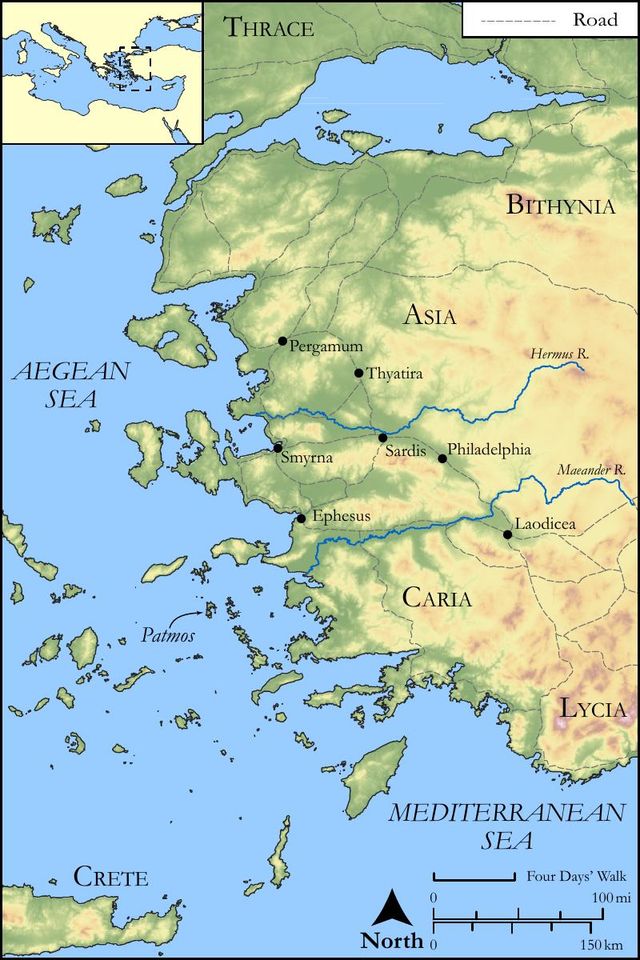
See on the biblical-era maps

Study this verse
Public-domain commentary
Matthew Henry
From his Commentary on the Whole Bible. Henry comments on passages, not single verses — this entry covers Revelation 12:1–11. His four-level outline is real structure in the source text, so it is rendered as structure.
Here we see that early prophecy eminently fulfilled in which God said he would put enmity between the seed of the woman and the seed of the serpent, Gen 3:15. You will observe,
I.The attempts of Satan and his agents to prevent the increase of the church, by devouring her offspring as soon as it was born; of this we have a very lively description in the most proper images.
1.We see how the church is represented in this vision.
(1.)As a woman, the weaker part of the world, but the spouse of Christ, and the mother of the saints.
(2.)As clothed with the sun, the imputed righteousness of the Lord Jesus Christ. Having put on Christ, who is the Sun of righteousness, she, by her relation to Christ, is invested with honourable rights and privileges, and shines in his rays.
(3.)As having the moon under her feet (that is, the world); she stands upon it, but lives above it; her heart and hope are not set upon sublunary things, but on the things that are in heaven, where her head is.
(4.)As having on her head a crown of twelve stars, that is, the doctrine of the gospel preached by the twelve apostles, which is a crown of glory to all true believers.
(5.)As in travail, crying out, and pained to be delivered. She was pregnant, and now in pain to bring forth a holy progeny to Christ, desirous that what was begun in the conviction of sinners might end in their conversion, that when the children were brought to the birth there might be strength to bring forth, and that she might see of the travail of her soul.
2.How the grand enemy of the church is represented.
(1.)As a great red dragon - a dragon for strength and terror - a red dragon for fierceness and cruelty.
(2.)As having seven heads, that is, placed on seven hills, as Rome was; and therefore it is probable that pagan Rome is here meant.
(3.)As having ten horns, divided into ten provinces, as the Roman empire was by Augustus Caesar.
(4.)As having seven crowns upon his head, which is afterwards expounded to be seven kings, Rev 17:10.
(5.)As drawing with his tail a third part of the stars in heaven, and casting them down to the earth, turning the ministers and professors of the Christian religion out of their places and privileges and making them as weak and useless as he could.
(6.)As standing before the woman, to devour her child as soon as it should be born, very vigilant to crush the Christian religion in its birth and entirely to prevent the growth and continuance of it in the world.
II.The unsuccessfulness of these attempts against the church; for,
1.She was safely delivered of a man-child (Rev 12:5), by which some understand Christ, others Constantine, but others, with greater propriety, a race of true believers, strong and united, resembling Christ, and designed, under him, to rule the nations with a rod of iron; that is, to judge the world by their doctrine and lives now, and as assessors with Christ at the great day.
2.Care was taken of this child: it was caught up to God, and to his throne; that is, taken into his special, powerful, and immediate protection. The Christian religion has been from its infancy the special care of the great God and our Saviour Jesus Christ.
3.Care was taken of the mother as well as of the child, Rev 12:6. She fled into the wilderness, a place prepared both for her safety and her sustenance. The church was in an obscure state, dispersed; and this proved her security, through the care of divine Providence. This her obscure and private state was for a limited time, not to continue always.
III.The attempts of the dragon not only proved unsuccessful against the church, but fatal to his own interests; for, upon his endeavour to devour the man-child, he engaged all the powers of heaven against him (Rev 12:7): There was war in heaven. Heaven will espouse the quarrel of the church. Here observe,
1.The seat of this war - in heaven, in the church, which is the kingdom of heaven on earth, under the care of heaven and in the same interest.
2.The parties - Michael and his angels on one side, and the dragon and his angels on the other: Christ, the great Angel of the covenant, and his faithful followers; and Satan and all his instruments. This latter party would be much superior in number and outward strength to the other; but the strength of the church lies in having the Lord Jesus for the captain of their salvation.
3.The success of the battle: The dragon and his angels fought and prevailed not; there was a great struggle on both sides, but the victory fell to Christ and his church, and the dragon and his angels were not only conquered, but cast out; the pagan idolatry, which was a worshipping of devils, was extirpated out of the empire in the time of Constantine.
4.The triumphant song that was composed and used on this occasion, Rev 12:10, Rev 12:11. Here observe,
(1.)How the conqueror is adored: Now have come salvation, strength, and the kingdom of our God, and the power of his Christ. Now God has shown himself to be a mighty God; now Christ has shown himself to be a strong and mighty Saviour; his own arm has brought salvation, and now his kingdom will be greatly enlarged and established. The salvation and strength of the church are all to be ascribed to the king and head of the church.
(2.)How the conquered enemy is described.
[1.]By his malice; he was the accuser of the brethren, and accused them before their God night and day; he appeared before God as an adversary to the church, continually bringing in indictments and accusations against them, whether true or false; thus he accused Job, and thus he accused Joshua the high priest, Zac 3:1. Though he hates the presence of God, yet he is willing to appear there to accuse the people of God. Let us therefore take heed that we give him no cause of accusation against us; and that, when we have sinned, we presently go in before the Lord, and accuse and condemn ourselves, and commit our cause to Christ as our Advocate.
[2.]By his disappointment and defeat: he and all his accusations are cast out, the indictments quashed, and the accuser turned out of the court with just indignation.
(3.)How the victory was gained. The servants of God overcame Satan,
[1.]By the blood of the Lamb, as the meritorious cause. Christ by dying destroyed him that hath the power of death, that is, the devil.
[2.]By the word of their testimony, as the great instrument of war, the sword of the Spirit, which is the word of God, - by a resolute powerful preaching of the everlasting gospel, which is mighty, through God, to pull down strongholds, - and by their courage and patience in sufferings; they loved not their lives unto the death, when the love of life stood in competition with their loyalty to Christ; they loved not their lives so well but they could give them up to death, could lay them down in Christ's cause; their love to their own lives was overcome by stronger affections of another nature; and this their courage and zeal helped to confound their enemies, to convince many of the spectators, to confirm the souls of the faithful, and so contributed greatly to this victory.
Historical interpretation
Four Centuries of Reception
5 surviving comments on this verse. Each one is dated, so this reads as a timeline rather than a list.
Select a marker to jump to its quote. Markers stagger vertically where authors wrote within a few decades of each other.
Quite clearly he is showing in which heaven we are to understand that these things occur. For in the church we know that salvation is accomplished by the victory of Christ. Through this she has also received that authority to bind what is loose and to loose what is bound, since by way of a universal sign all in the one Peter heard, “Whatever you bind on earth shall be bound in heaven, and whatever you loose on earth shall be loosed [in heaven].” And about this the Lord says, “All authority in heaven and on earth has been given to me.” He is not speaking of that authority that he always possessed but of that authority in the church that [Jesus] began to have from the time he wished to be the Head among the members.… Using a manner of speech he speaks from the person of the angels and says “the accuser of our brothers.” That is, he speaks of those who in the future will be fellow citizens [of the angels] but who now are sojourners [on the earth]. For, to be sure, the faithful now are wending their way to that city, the celestial Jerusalem, in which the angels now dwell in happiness. However, since [the devil] has been thrown out of heaven and sent to the earth, they are depicted as joyful and as rejoicing together for the redemption of those whom the Lord had deigned to prepare to inhabit as a temple for himself. For the souls of the righteous are the seat of wisdom. And the angels also give praise concerning the earthly into whom [the devil] is said to have descended, for the angels peer into the depths of the divine justice and the blessed always sing to him of his mercy and judgment, for in the redeemed they recognize his goodness and in the lost they behold his equity. Since they conquered through the blood of the Lamb, they are said to have been able to overcome the devil. And there follows,”For they loved not their lives even unto death.” We must believe that they received that love that “is poured out into our hearts,” to be sure, not from ourselves but “through the Holy Spirit which has been given to us.”
Because of his accusations and calumny against people, he has been called “accuser,” which he is. The angels rejoice at his downfall, for faith has nothing to do with faithlessness. And although the saints have been accused and slandered by him, as was also Job, yet by their sufferings for the sake of Christ they have conquered him as well as all those who trusted in him.
And they did not love their lives unto death. They rightly despise their lives for Christ, who by the blood of Christ have so greatly conquered the adversary.
And they overcame him by the blood of the Lamb, and by the word of their testimony. They overcome him by the blood of the Lamb because they follow the example of the sufferings of Christ, and by the word of their testimony because they keep the rightness of faith. It is then added concerning them, and they loved not their lives unto death, which means that they put themselves to death so as not to love their lives wickedly.
And they say that they resisted him on equal terms, having overcome the one who seemed invincible, as if daring even against God. They triumphed by employing a collaborator and helper in the precious blood of Christ, and by the word of the testimony given for Him, which they preferred over their own lives. Having therefore prevailed, all the angels of God rejoice, having been freed from the bitter region of Satan.
Continue studying Revelation 12:11 across the web’s major study libraries — every link below opens this exact verse, chapter, or book on the destination site.
Read & Compare
 BibleGatewayThis verse in more than 200 translations and 70 languages.
 Bible.comThe YouVersion reader — hundreds of translations, reading plans, and highlights.
 ESV.orgCrossway's official English Standard Version reader.
 NET BibleThe NET translation with 60,000+ translators' notes on every rendering decision.
 STEP BibleTyndale House's free study tool — original text, vocabulary, and scholarly resources.
 BibliaLogos Bible Software's free web reader.
 USCCBThe New American Bible (Revised Edition) with the U.S. bishops' study notes.
Commentaries
 BibleHub CommentariesDozens of classic commentaries on this verse, gathered on one page.
 StudyLightMore than 100 commentary sets — the largest collection on the web.
 BibleRefPlain-English commentary on what this verse means, verse by verse.
 Enduring WordDavid Guzik's free commentary on this chapter, widely used by Bible teachers.
 Bible Study ToolsVerse commentary alongside Greek and Hebrew study aids.
Original Language & Research
- BibleHub InterlinearThe verse word by word — original language, transliteration, and English.
- BibleHub LexiconEvery word's original-language definition and Strong's entry.
 Blue Letter BibleDeep-study tools — Strong's numbers, concordance, and word studies.
 CNTR CollationThe earliest Greek manuscripts of this verse, collated letter by letter.
Sermons, Hymns & Audio


TrulyRandomVerse is not affiliated with these sites and doesn’t control their content. They’re linked because they’re genuinely useful.
Summary
Revelation 12:11 stands as a powerful declaration of the victory achieved by God's faithful people over the spiritual adversary, Satan. This verse succinctly encapsulates the tri-fold means of their triumph: through the atoning sacrifice of Jesus Christ, symbolized by "the blood of the Lamb"; by their unwavering proclamation of the Gospel and their personal experience of God's truth, termed "the word of their testimony"; and crucially, by their radical commitment that prioritized Christ above even their own physical lives, demonstrating a willingness to suffer martyrdom rather than compromise their faith. It is a profound affirmation of ultimate triumph for those who remain steadfast in Christ amidst spiritual conflict.
Context
ShowHideLiterary Context
Revelation 12:11 is situated within a highly symbolic and dramatic chapter that depicts the war in heaven between God's forces and Satan. The preceding verses introduce the "great dragon, that old serpent, called the Devil, and Satan" who is cast out of heaven to earth Revelation 12:9. Immediately before our verse, a loud voice in heaven proclaims Satan as "the accuser of our brethren" who "accused them before our God day and night" Revelation 12:10. This sets the stage for Revelation 12:11, which then reveals the decisive means by which believers overcome this formidable accuser and spiritual enemy, providing the victorious response to his accusations and schemes. The chapter then continues to describe Satan's persecution of the woman (representing God's people) on earth Revelation 12:13-17.
Historical & Cultural Context
The book of Revelation was written during a period of intense persecution for early Christians, likely under the Roman Emperor Domitian in the late first century AD. Believers faced immense pressure to conform to Roman imperial cult worship, which demanded allegiance to the emperor as a divine figure. Refusal often resulted in social ostracism, economic hardship, imprisonment, and even martyrdom. In this context, the message of Revelation 12:11 would have been profoundly encouraging, assuring suffering Christians that their endurance and sacrifice were not in vain but were, in fact, the very means of their victory over the oppressive powers of the world and the spiritual forces behind them. The "testimony" they gave was often a public confession of faith that directly challenged the prevailing pagan worldview, frequently leading to fatal consequences.
Key Themes
ShowHideRevelation 12:11 contributes significantly to several overarching themes in Revelation and the broader biblical narrative. Firstly, it underscores the theme of Victory over Evil, demonstrating that despite Satan's power and accusations, believers are ultimately triumphant through divine means. Secondly, it highlights the Supremacy of Christ's Sacrifice, emphasizing that the "blood of the Lamb" is the foundational basis for all spiritual victory and redemption, a theme central to Revelation's portrayal of Jesus as the slain yet victorious Lamb Revelation 5:6. Thirdly, the verse champions the theme of Faithful Witness and Testimony, asserting the power of believers' verbal and lived proclamation of Christ's truth, even unto death. Finally, it powerfully conveys the theme of Martyrdom and Self-Sacrifice, presenting the willingness to "love not their lives unto the death" as the ultimate expression of loyalty and a crucial component of overcoming the spiritual adversary, echoing Christ's own teachings on losing one's life for His sake Matthew 10:39.
Exposition and Analysis
ShowHideKey Word Analysis
ShowHideThis verb signifies to conquer, to prevail, or to get the victory. It is a recurring theme in Revelation, often used to describe Christ's triumph and the victory granted to believers through Him. Here, it asserts the definitive and complete triumph of the saints over Satan, not merely a struggle or a temporary reprieve, but a decisive conquest.
This word denotes evidence given, a record, or a witness. It is closely related to the Greek word martys, from which our English word "martyr" derives. This connection is highly significant in Revelation 12:11, implying that the "word of their testimony" often involved a public confession of faith that could lead to suffering and even death, yet this very witness, even in martyrdom, was a powerful act of overcoming.
This term refers to breath, the animal sentient principle, or the soul. In this context, it signifies one's physical life, self-preservation, or earthly existence. The phrase "loved not their lives unto the death" indicates a radical renunciation of self-preservation and a profound prioritizing of fidelity to Christ over the desire to cling to earthly life, even when facing mortal danger.
Verse Breakdown
ShowHide"And they overcame him"
This opening clause immediately declares the victorious status of the believers. The "him" refers directly to Satan, the "accuser of our brethren" mentioned in the preceding verse. The victory is not merely defensive but an active overcoming, a decisive conquest over the spiritual forces of evil.
"by the blood of the Lamb"
This is presented as the primary and foundational means of victory. "The Lamb" is a consistent designation for Jesus Christ in Revelation, emphasizing His sacrificial, atoning death. His "blood" signifies His perfect, substitutionary sacrifice on the cross, which cleanses from sin, redeems humanity, and disarms the powers of darkness. This victory is therefore not earned by human merit but is a gift secured by Christ's finished work.
"and by the word of their testimony"
This second means of overcoming refers to the active, verbal, and lived witness of believers. It encompasses their proclamation of the Gospel, their steadfast adherence to God's truth, and their personal declaration of faith in Christ, even under duress. This testimony stands in direct opposition to Satan's lies and accusations, serving as a powerful weapon in spiritual warfare.
"and they loved not their lives unto the death"
This final clause highlights the ultimate expression of commitment and the cost of such victory. It signifies a radical willingness to suffer persecution, torture, and even martyrdom rather than deny Christ or compromise their faith. Their allegiance to Christ superseded their desire for self-preservation, demonstrating the depth of their faith and the completeness of their victory, even in physical death.
Literary Devices
ShowHideRevelation 12:11 employs several powerful literary devices. Symbolism is paramount, with "the Lamb" representing Jesus Christ and His atoning sacrifice, and "blood" symbolizing the redemptive power of His death. "Him" is a direct referent to Satan, the "great dragon" of the chapter, personifying evil. The phrase "loved not their lives unto the death" is a form of hyperbole or litotes (an ironic understatement where an affirmative is expressed by the negative of its contrary), emphasizing the extreme degree of their commitment and willingness to sacrifice everything, including life itself. This also contains a profound paradox: by "loving not their lives," they paradoxically found ultimate victory and true life, echoing Christ's teachings about losing one's life to gain it. The verse's structure, presenting three distinct means of overcoming, also exhibits a form of triadic structure, building to the climactic expression of sacrificial love.
Theological and Thematic Connections
ShowHideRevelation 12:11 profoundly connects to core Christian theology, emphasizing that the victory of believers is fundamentally rooted in the finished work of Jesus Christ. The "blood of the Lamb" points directly to the doctrine of atonement and redemption, asserting that Christ's sacrifice is the sole basis for overcoming sin, death, and the devil. This victory is then manifested through the faithful witness of believers, who, empowered by Christ's triumph, boldly proclaim His truth even in the face of persecution. Their willingness to "love not their lives unto the death" underscores the radical call to discipleship and the potential for martyrdom, demonstrating that true spiritual victory often involves profound self-sacrifice and unwavering commitment, mirroring Christ's own path of suffering and triumph. This verse assures believers that their suffering for Christ's sake is not futile but is an integral part of God's plan for ultimate victory over evil.
Reflection and Application
ShowHideRevelation 12:11 offers timeless encouragement and a challenging call to contemporary believers. In a world that often prioritizes self-preservation, comfort, and personal gain, this verse reminds us that true victory in the spiritual realm is achieved through radical self-denial and unwavering commitment to Christ. It calls us to reflect on the depth of our reliance on Christ's atoning work, recognizing that our standing before God and our power against spiritual adversaries stem entirely from the "blood of the Lamb." Furthermore, it challenges us to consider the authenticity and boldness of our "testimony"—are we actively proclaiming God's truth and sharing our personal experience of His transforming power, even when it is unpopular or costly? Finally, the phrase "loved not their lives unto the death" serves as a powerful reminder that our ultimate allegiance must be to Christ alone, willing to surrender every earthly attachment, even life itself, for the sake of His kingdom. This does not necessarily mean physical martyrdom for all, but a daily dying to self, prioritizing God's will above our own desires, fears, and worldly comforts, thereby living a life that truly overcomes.
Questions for Reflection
ShowHideFAQ
ShowHideWhat does "the blood of the Lamb" signify in this verse?
ShowHide"The blood of the Lamb" is a powerful symbol referring to the atoning sacrifice of Jesus Christ on the cross. In Revelation, Jesus is frequently depicted as "the Lamb" Revelation 5:6, signifying His purity, humility, and His role as the ultimate Passover sacrifice who takes away the sin of the world. His blood represents His shed life, which cleanses believers from sin, redeems them from condemnation, and disarms the power of Satan. Therefore, overcoming "by the blood of the Lamb" means that believers' victory is not earned by their own merit or strength, but is a gift secured by Christ's completed work of redemption. It is the basis for their forgiveness, their righteousness, and their authority over the accuser.
How does "the word of their testimony" contribute to overcoming Satan?
ShowHide"The word of their testimony" refers to the believers' active proclamation of the Gospel, their steadfast adherence to God's truth, and their personal witness to what God has done in their lives through Christ. This testimony is a powerful weapon against Satan because it directly contradicts his lies and accusations. Satan is the "accuser of our brethren" Revelation 12:10, seeking to condemn and discourage. When believers boldly declare the truth of Christ, confess their faith, and live in accordance with God's word, they expose Satan's deception and nullify his accusations. Their faithful witness, even in the face of persecution, demonstrates the transforming power of God and the reality of Christ's victory, thereby overcoming the enemy's influence.
What does it mean to "love not their lives unto the death"?
ShowHideThis phrase signifies a radical and unwavering commitment to Christ that transcends the natural human instinct for self-preservation. It means prioritizing loyalty to Jesus above one's own physical life, comfort, or safety. In the context of Revelation, this often referred to a willingness to suffer persecution, torture, or even martyrdom rather than renounce their faith or compromise their witness. It is the ultimate demonstration that their allegiance to Christ was absolute, proving their faith genuine and their victory complete. While not all believers are called to physical martyrdom, the principle applies to a daily "dying to self," where one's desires, ambitions, and fears are surrendered to Christ's will, trusting Him with their very existence Luke 9:23-24.
Christ-Centered Fulfillment
ShowHideRevelation 12:11 finds its ultimate Christ-centered fulfillment in the person and work of Jesus, who is Himself the victorious Lamb and the source of all overcoming power for His followers. The "blood of the Lamb" directly points to Christ's atoning sacrifice on the cross, where He decisively defeated sin, death, and the devil Colossians 2:15. His shed blood is the very foundation of salvation and the means by which believers are redeemed and empowered to overcome. Furthermore, Jesus is the ultimate "word of testimony" – He is the Living Word, the perfect witness to God's truth, who "testified to the truth" before Pilate John 18:37. Believers' testimony is merely an echo and extension of His own. Finally, Christ Himself "loved not His life unto the death," willingly laying down His life on the cross as the supreme act of obedience and self-sacrifice Philippians 2:8. His resurrection then validated this ultimate sacrifice as the path to victory over death itself. Thus, the victory described in Revelation 12:11 is not achieved by human strength or merit, but is entirely derivative of and empowered by Christ's finished work, His perfect witness, and His sacrificial love, making Him the ultimate Overcomer and the enabler of all who overcome in Him 1 John 5:4-5.