


Revelation 12:12
Bible text: King James Version (1769 Blayney text) · Public domain
Bible text: King James Version with Strong's numbers · Public domain
Bible text: Berean Standard Bible · Public domain
Bible text: American Standard Version (1901) · Public domain
Bible text: World English Bible, Messianic edition · Public domain
Bible text: Geneva Bible (1599) · Public domain
Bible text: Young's Literal Translation · Public domain
- διὰdiaBecause ofG1223PREPPreposition
- τοῦτοtoutothisG3778D-ASNDemonstrative pronoun Accusative Singular Neuter
- εὐφραίνεσθεeuphrainesthedo rejoiceG2165V-PPM-2PVerb Present Passive Imperative 2nd Plural
- οἱhoiOG3588T-VPMDefinite article Vocative Plural Masculine
- οὐρανοὶouranoiheavensG3772N-VPMNoun Vocative Plural Masculine
- καὶkaiandG2532CONJConjunction
- οἱhoiyou who [are]G3588T-VPMDefinite article Vocative Plural Masculine
- ἐνeninG1722PREPPreposition
- αὐτοῖςautoisthemG846P-DPMPersonal pronoun Dative Plural Masculine
- σκηνοῦντεςskēnountesdwelling!G4637V-PAP-VPMVerb Present Active Participle Vocative Plural Masculine
- οὐαὶouaiWoeG3759INJInterjection
- τοῖςtoisto thoseG3588T-DPMDefinite article Dative Plural Masculine
- κατοικοῦσινkatoikousindwelling [in]G2730V-PAP-DPMVerb Present Active Participle Dative Plural Masculine
- τὴνtēntheG3588T-ASFDefinite article Accusative Singular Feminine
- γῆνgēnlandG1093N-ASFNoun Accusative Singular Feminine
- καὶkaiandG2532CONJConjunction
- τὴνtēntheG3588T-ASFDefinite article Accusative Singular Feminine
- θάλασσανthalassanseaG2281N-ASFNoun Accusative Singular Feminine
- ὅτιhotibecauseG3754CONJConjunction
- κατέβηkatebēhas come downG2597V-2AAI-3SVerb 2nd Aorist Active Indicative 3rd Singular
- ὁhotheG3588T-NSMDefinite article Nominative Singular Masculine
- διάβολοςdiabolosdevilG1228A-NSMAdjective Nominative Singular Masculine
- πρὸςprostoG4314PREPPreposition
- ὑμᾶςhumasyouG4771P-2APPersonal pronoun Accusative 2nd Plural
- ἔχωνechōnhavingG2192V-PAP-NSMVerb Present Active Participle Nominative Singular Masculine
- θυμὸνthumonfuryG2372N-ASMNoun Accusative Singular Masculine
- μέγανmegangreatG3173A-ASMAdjective Accusative Singular Masculine
- εἰδὼςeidōsknowingG1492V-RAP-NSMVerb Perfect Active Participle Nominative Singular Masculine
- ὅτιhotithatG3754CONJConjunction
- ὀλίγονoligona shortG3641A-ASMAdjective Accusative Singular Masculine
- καιρὸνkairontimeG2540N-ASMNoun Accusative Singular Masculine
- ἔχειecheihe hasG2192V-PAI-3SVerb Present Active Indicative 3rd Singular
English is a literal word-by-word gloss of the Greek, not the KJV's wording. Why?
This is the original text the KJV's translators worked from — each Greek word with its own literal English meaning in this verse, prepared by scholars at Tyndale House, Cambridge. The KJV translates whole sentences, not word by word, so its wording differs: one Greek word can become several English words, and the KJV may choose “charity” where the gloss reads “love”. Both are faithful — they answer different questions. For the KJV's own rendering, switch to the KJV text.
Details
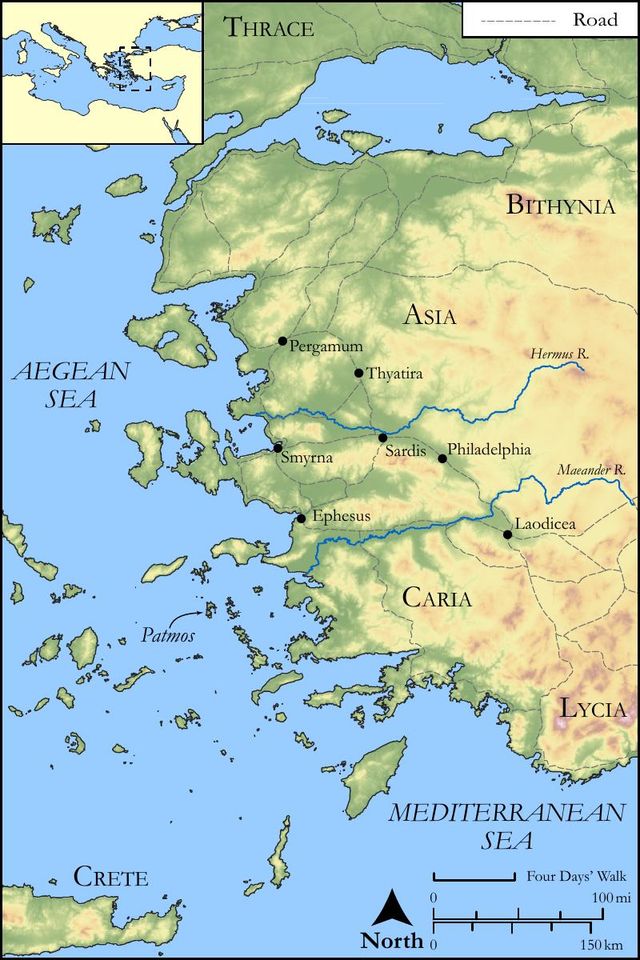
See on the biblical-era maps

Study this verse
Public-domain commentary
Matthew Henry
From his Commentary on the Whole Bible. Henry comments on passages, not single verses — this entry covers Revelation 12:12–17. His two-level outline is real structure in the source text, so it is rendered as structure.
We have here an account of this war, so happily finished in heaven, or in the church, as it was again renewed and carried on in the wilderness, the place to which the church had fled, and where she had been for some time secured by the special care of her God and Saviour. Observe,
I.The warning given of the distress and calamity that should fall upon the inhabitants of the world in general, through the wrath and rage of the devil. For, though his malice is chiefly bent against the servants of God, yet he is an enemy and hater of mankind as such; and, being defeated in his designs against the church, he is resolved to give all the disturbance he can to the world in general: Woe to the inhabitants of the earth, and the sea, Rev 12:12. The rage of Satan grows so much the greater as he is limited both in place and time; when he was confined to the wilderness, and had but a short time to reign there, he comes with the greater wrath.
II.His second attempt upon the church now in the wilderness: He persecuted the woman who brought forth the man-child, Rev 12:13. Observe,
1.The care that God had taken of his church. He had conveyed her as on eagles' wings, into a place of safety provided for her, where she was to continue for a certain space of time, couched in prophetic characters, taken from Dan 7:25.
2.The continual malice of the dragon against the church. Her obscurity could not altogether protect her; the old subtle serpent, which at first lurked in paradise, now follows the church into the wilderness, and casts out a flood of water after her, to carry her away. This is thought to be meant of a flood of error and heresy, which was breathed by Arius, Nestorius, Pelagius, and many more, by which the church of God was in danger of being overwhelmed and carried away. The church of God is in more danger from heretics than from persecutors; and heresies are as certainly from the devil as open force and violence.
3.The seasonable help provided for the church in this dangerous juncture: The earth helped the woman, and opened her mouth, and swallowed up the flood, Rev 12:16. Some think we are to understand the swarms of Goths and Vandals that invaded the Roman empire, and found work for the Arian rulers, who otherwise would have been as furious persecutors as the pagan had been, and had exercised great cruelties already; but God opened a breach of war, and the flood was in a manner swallowed up thereby, and the church enjoyed some respite. God often sends the sword to avenge the quarrel of his covenant; and, when men choose new gods, then there is danger of war in the gates; intestine broils and contentions often end in the invasions of a common enemy.
4.The devil, being thus defeated in his designs upon the universal church, now turns his rage against particular persons and places; his malice against the woman pushes him on to make war with the remnant of her seed. Some think hereby are meant the Albigenses, who were first by Dioclesian driven up into barren and mountainous places, and afterwards cruelly murdered by popish rage and power, for several generations; and for no other reason than because they kept the commandments of God and held the testimony of Jesus Christ. Their fidelity to God and Christ, in doctrine, worship, and practice, was that which exposed them to the rage of Satan and his instruments; and such fidelity will expose men still, less or more, to the end of the world, when the last enemy shall be destroyed.
Historical interpretation
Four Centuries of Reception
7 surviving comments on this verse. Each one is dated, so this reads as a timeline rather than a list.
Select a marker to jump to its quote. Markers stagger vertically where authors wrote within a few decades of each other.
It says “come down” to preserve the allegory. As all are in “heaven,” that is, in the church, which is rightly called heaven, when the devil is thrown out of the saints, he “comes down” to his followers who are the “earth” because of their earthly affection. He is said to be thrown out of heaven, not so that he might come to those who have already been made heaven but because of those who have not become what they might be. For the saints cannot become heaven, unless the devil has been expelled.
As above, in angels the church is recognized to be “heaven,” and it is proper to both to rejoice harmoniously in the Lord, for people are said to be the associates of angels and in Christ the angels serve the human nature. But there follows, “Woe to you, O earth and sea.” Just as there was exultation for those who are redeemed, there is lamentation for those who are perishing. Therefore, Ezekiel said that he saw a book having written within a lament, a song and a woe. In the lament he refers to the wailing of the penitent; in the song he refers to the joyfulness of the saints; in the woe he properly manifests the condemnation of the wicked. It is to these last that here [John] alludes when he says, “Woe to you, earth and sea and the rest, for he knows that there is little time left to him.” And so, moved by an unconquered power he confesses to the Lord and says, “Have you come to destroy us before the time.”
In imitation of God, it follows that the powers above rejoice at his downfall but grieve over those who by his plot cling to earthly things. But woe to those who dwell upon the earth, that is, clearly to those who have no citizenship in heaven but only on earth. For many upon the earth do defeat the enemy and will continue to do so, although because of the nearness of his punishment he now is especially enraged against those who fight him. And so it is necessary to think that those are unhappy who have an earthly mind and are buffeted about by the sea of life.
Woe to the earth and the sea, because the devil has come down, etc. Just as he taught joy to the redeemed, so he taught those perishing to expect lamentation. And a great woe awaits those whom the most wicked enemy possesses in his wrath.
Therefore rejoice, O heavens, and you who dwell in them. Here, the inhabitants of heaven must be understood as both angels and holy men, and it is fitting for both to rejoice together in the Lord, as men are united with angels, and angels minister to the human nature in Christ.
Therefore rejoice, O heavens, and you that dwell therein. He invites the heavens in the plural to rejoice, because he is here indicating the numerousness of the churches, which all make up one. By those who dwell in heaven he means angels or holy men, for whom it is right to rejoice together in harmony in the Lord when, the enemy vanquished, men come back to the fellowship of angels. There is nothing more here that needs explaining, except that, with this joy remaining, this book should come to its due end. The exposition of the remaining chapters is missing from the manuscript, whether Alcuin wrote it or not — though in verse 3 of this last chapter he does promise that he will write more.
Woe, he says, to the earth and the sea, because the Devil has come down to you with great wrath, knowing that he has little time. And if the descent of Satan were harmful to the earth and the sea, who would say why he came down? For to those who are sober and have hope in God, it has not only resulted in no harm but also in benefit, training them like a trainer [παιδοτρίβης] and making them more tested through trials, tempering them as iron is tempered. But he harms the sluggish and lazy, who perhaps even without the frustration of the one stirring them up, were by nature evil toward themselves, changing their passions.
And they say woe to the earth and the sea; they do not mean this, but woe to those who inhabit the earth and sail the sea among men, but to those who are of the earth and dust according to what is written (see Gen. 18:27), and who have earthly minds (see Rom. 8:7). Moreover, to those who are fickle, wavering, and unstable in their understanding. For against these, the common enemy wages war and enslaves the weak, those who are willing, bowing to his tyranny.
He says that he knows that he has little time. For the time from the fall of the Devil until his judgment and repayment to the eternal ages is indeed short.
For this reason, even Jacob the patriarch, although he lived one hundred and thirty years, said when asking Pharaoh, "The days of the years of my life have been few and evil." (Gen. 47:9)
Continue studying Revelation 12:12 across the web’s major study libraries — every link below opens this exact verse, chapter, or book on the destination site.
Read & Compare
 BibleGatewayThis verse in more than 200 translations and 70 languages.
 Bible.comThe YouVersion reader — hundreds of translations, reading plans, and highlights.
 ESV.orgCrossway's official English Standard Version reader.
 NET BibleThe NET translation with 60,000+ translators' notes on every rendering decision.
 STEP BibleTyndale House's free study tool — original text, vocabulary, and scholarly resources.
 BibliaLogos Bible Software's free web reader.
 USCCBThe New American Bible (Revised Edition) with the U.S. bishops' study notes.
Commentaries
 BibleHub CommentariesDozens of classic commentaries on this verse, gathered on one page.
 StudyLightMore than 100 commentary sets — the largest collection on the web.
 BibleRefPlain-English commentary on what this verse means, verse by verse.
 Enduring WordDavid Guzik's free commentary on this chapter, widely used by Bible teachers.
 Bible Study ToolsVerse commentary alongside Greek and Hebrew study aids.
Original Language & Research
- BibleHub InterlinearThe verse word by word — original language, transliteration, and English.
- BibleHub LexiconEvery word's original-language definition and Strong's entry.
 Blue Letter BibleDeep-study tools — Strong's numbers, concordance, and word studies.
 CNTR CollationThe earliest Greek manuscripts of this verse, collated letter by letter.
Sermons, Hymns & Audio


TrulyRandomVerse is not affiliated with these sites and doesn’t control their content. They’re linked because they’re genuinely useful.
Summary
Revelation 12:12 presents a stark contrast, announcing jubilant celebration in the heavens alongside a severe pronouncement of "woe" upon the earth and sea. This dramatic contrast immediately follows the decisive expulsion of Satan, the great red dragon, from the celestial realm. The verse reveals that the devil, now confined to the earthly sphere, unleashes intensified wrath upon its inhabitants, driven by the desperate and infuriating knowledge that his time for malevolent activity and persecution is divinely limited and rapidly drawing to a close.
Context
ShowHideLiterary Context
Revelation 12:12 functions as a pivotal declaration within a highly symbolic chapter that depicts the struggle between God's people and Satan. The preceding verses, Revelation 12:7-9, describe a decisive heavenly battle where Michael and his angels cast the dragon and his demonic forces out of heaven, ending their access to God's presence. This victory is immediately celebrated in Revelation 12:10-11, which proclaims the downfall of "the accuser of our brethren." Verse 12 then serves as a direct consequence and prophetic announcement of the shift in the spiritual battlefield: while heaven rejoices in its liberation, earth is warned of intensified tribulation as Satan's fury is redirected and concentrated.
Historical & Cultural Context
The book of Revelation was written during a period of intense persecution for early Christians, likely under the Roman Emperor Domitian, who demanded worship as a deity. The imagery of war in heaven and the "dragon" would have resonated deeply with both Jewish apocalyptic traditions and the oppressive power of the Roman Empire. The concept of a spiritual adversary, "the devil," was a well-established figure in both Jewish and early Christian thought, representing the ultimate source of evil and opposition to God's divine plan. The "heavens" and "earth and sea" represent distinct realms of existence, with the "sea" often symbolizing chaos or the gentile nations in biblical prophecy. The "woe" pronouncement is a common prophetic lament, signaling impending judgment or severe distress.
Key Themes
ShowHideThis verse powerfully contributes to several overarching themes in Revelation and the broader biblical narrative. It underscores the theme of spiritual conflict, revealing that earthly struggles are often manifestations of a larger spiritual war. It highlights God's sovereignty over all creation, even over the forces of evil, by demonstrating that Satan's power and time are strictly limited by divine decree, as seen in the ultimate triumph of God's kingdom described in Revelation 11:15. The verse also emphasizes the nature of evil, portraying Satan not merely as an abstract force but as a malicious, intelligent being driven by intense "wrath" and desperation. Finally, it sets the stage for the intensified persecution of God's people on earth, a recurring theme throughout Revelation, as the devil, knowing his end is near, redoubles his efforts against those who bear witness to Christ.
Exposition and Analysis
ShowHideKey Word Analysis
ShowHideDerived from "eu" (well) and "phrēn" (mind), this verb signifies a state of being in a good frame of mind, to make glad, or to be merry. In this context, it conveys a profound, celebratory joy experienced by the heavenly inhabitants, standing in stark contrast to the "woe" pronounced on earth. This joy is a direct consequence of the decisive victory over Satan and his expulsion from the divine presence, signifying liberation and vindication.
This term originates from "diaballō," meaning "to throw across," "to slander," or "to accuse." It precisely defines Satan's character and primary activity as the "traducer" or "false accuser." His expulsion from heaven in Revelation 12:9 directly correlates with his role as the "accuser of our brethren" in Revelation 12:10, emphasizing his malicious intent and deceptive nature.
This word denotes a fierce, passionate outburst of anger, often described as a boiling indignation or rage. Unlike orgē (a more settled, deep-seated anger), thymós points to a violent, unrestrained fury. Here, it characterizes the devil's desperate and intense malice, which is unleashed because he recognizes the brevity of his remaining time and the certainty of his ultimate defeat. It is a volatile, destructive rage.
Verse Breakdown
ShowHide"Therefore rejoice, ye heavens, and ye that dwell in them."
This opening clause issues a triumphant call to celebration. "The heavens" (ouranós) refers to the celestial realm, the abode of God and His angels, now cleansed of Satan's defiling presence. "Ye that dwell in them" includes the angelic hosts and possibly the redeemed saints who have been taken up to heaven. Their rejoicing is a direct, exuberant response to the decisive victory over the dragon, signifying profound relief, vindication of God's righteous rule, and the purification of the divine court.
"Woe to the inhabiters of the earth and of the sea!"
In stark contrast to the heavenly jubilation, this pronouncement delivers a solemn warning of impending doom and intensified suffering for those on earth. "Earth" (gē) and "sea" (thálassa) together represent the totality of the earthly sphere and its inhabitants, often symbolizing the ungodly world system or humanity apart from God. The "woe" (ouaí) is a prophetic lament, signaling severe tribulation and judgment that will now be unleashed upon this realm.
"for the devil is come down unto you, having great wrath,"
This clause explains the reason for the "woe." The "devil" (diábolos), having been cast out of heaven, has now descended to the earthly plane. His descent is not a sign of weakness but of a concentrated, desperate assault. He comes "having great wrath" (thymós), indicating an overwhelming, furious indignation. This wrath is not merely anger but a violent, destructive rage, intensified by his recent defeat and expulsion from the presence of God.
"because he knoweth that he hath but a short time."
This final clause reveals the precise motivation behind the devil's intensified wrath: his acute awareness of his divinely appointed, limited time. "Short time" (olígos kairós) emphasizes the brevity and specific, appointed nature of the remaining period of his influence. This knowledge fuels his desperation, driving him to inflict maximum damage and persecution before his ultimate and inevitable demise. It underscores God's sovereign control, even over the timeline of evil's activity.
Literary Devices
ShowHideRevelation 12:12 is rich in Symbolism and Contrast. The "heavens" symbolize the realm of divine order, purity, and ultimate victory, while "earth and sea" represent the fallen, chaotic human realm, now the primary battleground for spiritual conflict. The "devil" is a symbolic representation of ultimate evil, rebellion against God, and the source of all accusation. The most striking device is Antithesis or Juxtaposition, as the verse sharply contrasts the "rejoice" in heaven with the "woe" on earth. This stark opposition amplifies the eternal stakes of the spiritual war and the immediate, divergent consequences for different realms of existence. The phrase "great wrath" is an example of Hyperbole, emphasizing the extreme, unrestrained intensity of Satan's fury, while "short time" employs Litotes (an ironic understatement) or simply a statement of divinely imposed limitation, which paradoxically fuels the devil's urgency and destructive power. The entire verse functions as a Prophetic Announcement, delivering a divine decree about future events and their profound spiritual implications for humanity.
Theological and Thematic Connections
ShowHideRevelation 12:12 profoundly articulates the ongoing struggle between good and evil, revealing that the spiritual realm has direct and tangible consequences for the physical world. The expulsion of Satan from heaven marks a pivotal shift, intensifying the spiritual warfare on earth. This verse assures believers that while evil may seem overwhelming, its power is not absolute; it is constrained by divine decree. The devil's "great wrath" is a sign of his desperation and impending doom, not his ultimate strength, as he knows his time is limited. This truth offers both a sober warning about the reality of spiritual opposition and a powerful encouragement that God's sovereign plan is unfolding towards the ultimate triumph of Christ and the complete vanquishing of evil.
Reflection and Application
ShowHideRevelation 12:12 calls us to a profound awareness of the spiritual realities that underpin our world. It reminds us that the struggles and tribulations we face are often not merely human conflicts but manifestations of an unseen spiritual war. Knowing that the devil has been cast down and operates with "great wrath" because his time is short should not induce fear, but rather a sober vigilance and a renewed commitment to spiritual disciplines. This verse encourages us to recognize the enemy's desperation and to stand firm in the victory already secured by Christ. It challenges us to live with an eternal perspective, understanding that earthly hardships are temporary and serve a divine purpose in refining our faith and testifying to God's ultimate sovereignty. Our response to the devil's fury should be rooted in faith, perseverance, and reliance on God's power, knowing that his final defeat is certain and glorious, and that our ultimate destiny is with the rejoicing heavens, not the groaning earth.
Questions for Reflection
ShowHideFAQ
ShowHideWhat does "woe to the inhabiters of the earth and of the sea" mean in this context?
ShowHideThis phrase is a prophetic lament and warning, signifying severe distress, tribulation, and judgment that will come upon those who dwell on the earth and the sea. In Revelation, "earth and sea" often represent the ungodly world system and humanity apart from God, particularly those who align with the beast and reject God's authority. The "woe" is a direct consequence of the devil's expulsion from heaven, as he redirects his furious malice and destructive efforts toward the earthly realm, intensifying persecution and deception against humanity. It signals a period of unprecedented hardship for those who are not under God's protection, as the spiritual battle intensifies on their ground.
Why does the devil have "great wrath" because he knows he has "but a short time"?
ShowHideThe devil's "great wrath" (Greek: thymós, a fierce, boiling rage) is fueled by his desperate awareness that his time for active opposition to God and persecution of His people is divinely limited and rapidly diminishing. His expulsion from heaven, as described in Revelation 12:9, signifies a decisive defeat and the curtailment of his access to God's presence. Knowing that his ultimate doom is sealed and his window of opportunity to deceive and destroy is closing, he unleashes a concentrated, furious assault. This desperation makes him more dangerous, as he seeks to inflict maximum damage before his final judgment, which is ultimately described in Revelation 20:10. His wrath is the rage of a defeated foe, not a triumphant one.
Christ-Centered Fulfillment
ShowHideRevelation 12:12, while focusing on the devil's expulsion and wrath, implicitly points to the ultimate victory of Christ, without whom this heavenly triumph would be impossible. The "war in heaven" and Satan's defeat are a direct consequence of the redemptive work accomplished by the "Lamb of God" on the cross, as foreshadowed in Genesis 3:15 and definitively achieved through Jesus' death and resurrection. It is by the "blood of the Lamb" and the "word of their testimony" that the saints overcome the accuser (Revelation 12:11). The devil's "short time" is a testament to Christ's sovereign authority, who has "all authority in heaven and on earth" (Matthew 28:18). His descent with "great wrath" signifies the final, desperate struggle against a kingdom that has already been decisively conquered by the King of Kings. Believers are called to rejoice not only because Satan is cast down, but because Christ's victory ensures his ultimate and eternal defeat, culminating in the establishment of God's eternal kingdom where "God will wipe away every tear from their eyes" (Revelation 21:4) and His people will reign with Him forever (Revelation 22:5).