


Revelation 10:6
- καὶkaiandG2532CONJConjunction
- ὤμοσενōmosenhe sworeG3660V-AAI-3SVerb Aorist Active Indicative 3rd Singular
- ἐνenbyG1722PREPPreposition
- τῷtōthe [One]G3588T-DSMDefinite article Dative Singular Masculine
- ζῶντιzōntilivingG2198V-PAP-DSMVerb Present Active Participle Dative Singular Masculine
- εἰςeistoG1519PREPPreposition
- τοὺςtoustheG3588T-APMDefinite article Accusative Plural Masculine
- αἰῶναςaiōnasagesG165N-APMNoun Accusative Plural Masculine
- τῶνtōnof theG3588T-GPMDefinite article Genitive Plural Masculine
- αἰώνωνaiōnōnagesG165N-GPMNoun Genitive Plural Masculine
- ὃςhoswhoG3739R-NSMRelative pronoun Nominative Singular Masculine
- ἔκτισενektisencreatedG2936V-AAI-3SVerb Aorist Active Indicative 3rd Singular
- τὸνton<the>G3588T-ASMDefinite article Accusative Singular Masculine
- οὐρανὸνouranonheavenG3772N-ASMNoun Accusative Singular Masculine
- καὶkaiandG2532CONJConjunction
- τὰtathe [things]G3588T-APNDefinite article Accusative Plural Neuter
- ἐνeninG1722PREPPreposition
- αὐτῷautōitG846P-DSMPersonal pronoun Dative Singular Masculine
- καὶkaiandG2532CONJConjunction
- τὴνtēntheG3588T-ASFDefinite article Accusative Singular Feminine
- γῆνgēnearthG1093N-ASFNoun Accusative Singular Feminine
- καὶkaiandG2532CONJConjunction
- τὰtathe [things]G3588T-APNDefinite article Accusative Plural Neuter
- ἐνeninG1722PREPPreposition
- αὐτῇautēaitG846P-DSFPersonal pronoun Dative Singular Feminine
- καὶkaiandG2532CONJConjunction
- τὴνtēntheG3588T-ASFDefinite article Accusative Singular Feminine
- θάλασσανthalassanseaG2281N-ASFNoun Accusative Singular Feminine
- καὶkaiandG2532CONJConjunction
- τὰtathe [things]G3588T-APNDefinite article Accusative Plural Neuter
- ἐνeninG1722PREPPreposition
- αὐτῇautēaitG846P-DSFPersonal pronoun Dative Singular Feminine
- ὅτιhotithatG3754CONJConjunction
- χρόνοςchronosDelayG5550N-NSMNoun Nominative Singular Masculine
- οὐκέτιouketino longerG2089PRT-N + G2089=ADV
- ἔσταιestaiwill there be!G1510V-FDI-3SVerb Future Middle Deponent Indicative 3rd Singular
English is a literal word-by-word gloss of the Greek, not the KJV's wording. Why?
This is the original text the KJV's translators worked from — each Greek word with its own literal English meaning in this verse, prepared by scholars at Tyndale House, Cambridge. The KJV translates whole sentences, not word by word, so its wording differs: one Greek word can become several English words, and the KJV may choose “charity” where the gloss reads “love”. Both are faithful — they answer different questions. For the KJV's own rendering, switch to the KJV text.
Details
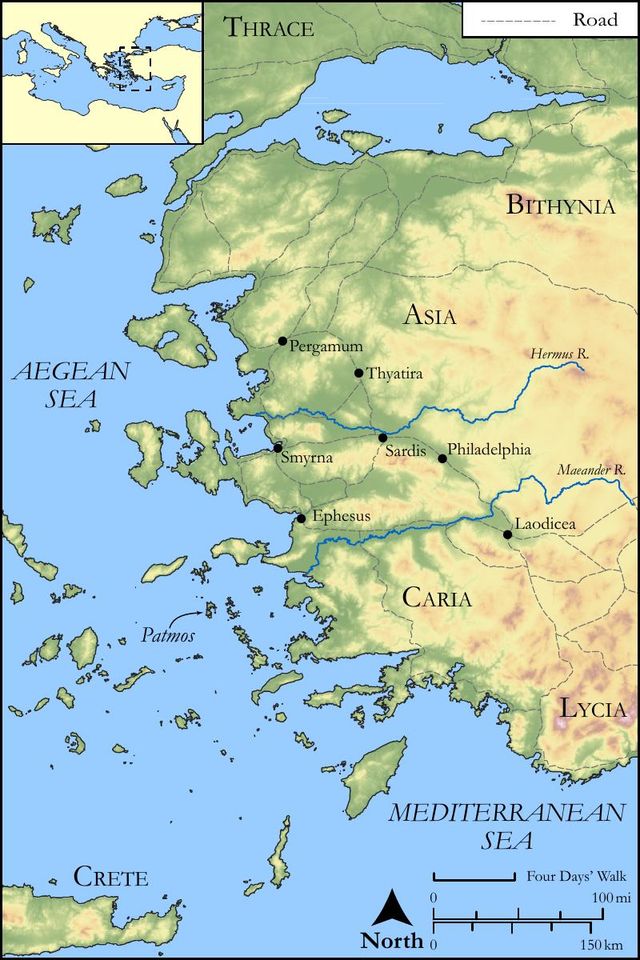
See on the biblical-era map

Study this verse
Public-domain commentary
Matthew Henry
From his Commentary on the Whole Bible. Henry comments on passages, not single verses — this entry covers Revelation 10:1–7. His three-level outline is real structure in the source text, so it is rendered as structure.
Here we have an account of another vision the apostle was favoured with, between the sounding of the sixth trumpet and that of the seventh. And we observe,
I.The person who was principally concerned in communicating this discovery to John - an angel from heaven, another mighty angel, who is so set forth as would induce one to think it could be no other than our Lord and Saviour Jesus Christ!
1.He was clothed with a cloud: he veils his glory, which is too great for mortality to behold; and he throws a veil upon his dispensations. Clouds and darkness are round about him.
2.A rainbow was upon his head; he is always mindful of his covenant, and, when his conduct is most mysterious, yet it is perfectly just and faithful.
3.His face was as the sun, all bright, and full of lustre and majesty, Rev 1:16.
4.His feet were as pillars of fire; all his ways, both of grace and providence, are pure and steady.
II.His station and posture:
He set his right foot upon the sea and his left foot upon the earth, to show the absolute power and dominion he had over the world. And he held in his hand a little book opened, probably the same that was before sealed, but was now opened, and gradually fulfilled by him.
III.His awful voice:
He cried aloud, as when a lion roareth (Rev 10:3), and his awful voice was echoed by seven thunders, seven solemn and terrible ways of discovering the mind of God.
IV.The prohibition given to the apostle, that he should not publish, but conceal what he had learned from the seven thunders, Rev 10:4.
The apostle was for preserving and publishing every thing he saw and heard in these visions, but the time had not yet come.
V.The solemn oath taken by this mighty angel.
1.The manner of his swearing: He lifted up his hand to heaven, and swore by him that liveth for ever, by himself, as God often has done, or by God as God, to whom he, as Lord, Redeemer, and ruler of the world, now appeals.
2.The matter of the oath: that there shall be time no longer; either,
(1.)That there shall be now no longer delay in fulfilling the predictions of this book than till the last angel should sound; then every thing should be put into speedy execution: the mystery of God shall be finished, Rev 10:7. Or,
(2.)That when this mystery of God is finished time itself shall be no more, as being the measure of things that are in a mutable changing state; but all things shall be at length for ever fixed, and so time itself swallowed up in eternity.
Historical interpretation
Five Centuries of Reception
6 surviving comments on this verse. Each one is dated, so this reads as a timeline rather than a list.
Select a marker to jump to its quote. Markers stagger vertically where authors wrote within a few decades of each other.
"Seven thunders uttered their voices." The seven thunders uttering their voices signify, the Holy Spirit of sevenfold power, who through the prophets announced all things to come, and by His voice John gave his testimony in the world; but because he says that he was about to write the things which the thunders had uttered, that is, whatever things had been obscure in the announcements of the Old Testament; he is forbidden to write them, but he was charged to leave them sealed, because he is an apostle, nor was it fitting that the grace of the subsequent stage should be given in the first. "The time," says he, "is at hand."45 For the apostles, by powers, by signs, by portents, and by mighty works, have overcome unbelief. After them there is now given to the same completed Churches the comfort of having the prophetic Scriptures subsequently interpreted, for I said that after the apostles there would be interpreting prophets.
For the apostle says: "And he placed in the Church indeed, first, apostles; secondly, prophets; thirdly, teachers,"46 and the rest. And in another place he says: "Let the prophets speak two or three, and let the others judge."47 And he says: "Every woman that prayeth or prophesieth with her head uncovered, dishonoureth her head"48 And when he says, "Let the prophets speak two or three, and let the others judge," he is not speaking in respect of the Catholic prophecy of things unheard and unknown, but of things both announced and known. But let them judge whether or not the interpretation is consistent with the testimonies of the prophetic utterance.49 It is plain, therefore, that to John, armed as he was with superior virtue, this was not necessary, although the body of Christ, which is the Church, adorned with His members, ought to respond to its position.
God swears by himself, since there is none greater than he. But the angels, being creatures, swear by the Creator, for due to our untrustworthiness, they are the guarantors of what is said by them. They swear either that in the coming age there will no longer be time which is measured by the sun, since eternal life is transcendent to temporal measure, or they swear that there is not much time after the six voices of the angel before the prophecies are fulfilled.
And the angel whom I saw standing on the sea and on the land lifted up his hand to heaven, and swore, etc. The angel swears by the one who lives forever, as Christ, coming in the name of the Father, confirms his words with his unchangeable truth: Heaven and earth will pass away, but my words will not pass away (Matthew XXIV).
Because time shall be no more. Indeed, as the psalm says, there will be a time for the wicked forever (Psalm LXXX), but the mutable variety of secular times will cease at the last trumpet. For the trumpet will sound, and the dead will rise incorruptible, and their inheritance will be forever (1 Corinthians XV).
Who created heaven and the things that are in it, etc. Standing on the sea and land, and reaching up to heaven, he fittingly swears by the Creator of heaven, earth, and sea.
And the angel, whom I saw standing upon the sea and upon the earth, lifted up his hand to heaven, and he swore by him that liveth for ever and ever. When the Lord forbids swearing, what does it mean that he himself swears, if not that men are often mistaken in swearing, whereas he, who is the truth, is never mistaken? So, the angel lifting up his hand to heaven was our Redeemer carrying his humanity up to the Father's seat by his own power. His swearing by him that lives for ever and ever means that he shows that he, who is the Father's Word, and his flesh, which indicates the whole man, who consists of flesh and soul, are one person of God and the true God of man; or if it is not this, then certainly he swears by the Father because he attributes him everything. In what is said after that, who created heaven, and the things which are therein; and the earth, and the things which are in it; and the sea, and the things which are therein, he refutes the error of the heretics who are not afraid to claim that some things were made by the good prince and others by the prince of darkness. Now let us hear what he swore: That time shall be no longer, but in the days of the seventh angel, when he shall begin to sound the trumpet, the mystery of God shall be finished, as he hath declared by his servants the prophets. The seventh angel and the seventh trumpet are the end of the Church's preaching, with the completion of which the second coming of the Lord is expected to take place. However, if time shall be no longer when holy preaching has come to an end, how can the Psalmist say, Their time shall be forever? [Ps. 80:16] One should know then that for the just, whom the eternity of immortality will receive, no time of changeableness will come after that; whereas the unjust, whom an eternal decline will take possession of, will be as if they were confronted with times of mutability: for, since time declines moment by moment, it is fitting for the decline of the wicked to be called by the name of time. Therefore the Psalmist affirms concerning the unjust what the Lord denies concerning the just. Finally, when he says that the mystery of God shall be finished, it is not meant in the sense of destruction, but in the sense of completion. He says that it was foretold by the prophets because nearly all their focus was on the Lord's first and second coming and the end of the world.
Continue studying Revelation 10:6 across the web’s major study libraries — every link below opens this exact verse, chapter, or book on the destination site.
Read & Compare
 BibleGatewayThis verse in more than 200 translations and 70 languages.
 Bible.comThe YouVersion reader — hundreds of translations, reading plans, and highlights.
 ESV.orgCrossway's official English Standard Version reader.
 NET BibleThe NET translation with 60,000+ translators' notes on every rendering decision.
 STEP BibleTyndale House's free study tool — original text, vocabulary, and scholarly resources.
 BibliaLogos Bible Software's free web reader.
 USCCBThe New American Bible (Revised Edition) with the U.S. bishops' study notes.
Commentaries
 BibleHub CommentariesDozens of classic commentaries on this verse, gathered on one page.
 StudyLightMore than 100 commentary sets — the largest collection on the web.
 BibleRefPlain-English commentary on what this verse means, verse by verse.
 Enduring WordDavid Guzik's free commentary on this chapter, widely used by Bible teachers.
 Bible Study ToolsVerse commentary alongside Greek and Hebrew study aids.
Original Language & Research
- BibleHub InterlinearThe verse word by word — original language, transliteration, and English.
- BibleHub LexiconEvery word's original-language definition and Strong's entry.
 Blue Letter BibleDeep-study tools — Strong's numbers, concordance, and word studies.
 CNTR CollationThe earliest Greek manuscripts of this verse, collated letter by letter.
Sermons, Hymns & Audio


TrulyRandomVerse is not affiliated with these sites and doesn’t control their content. They’re linked because they’re genuinely useful.
Summary
Revelation 10:6 presents a profound declaration by a mighty angel, who, standing with one foot on the sea and one on the land, swears a solemn oath by the eternal and sovereign Creator of all things—heaven, earth, and sea—that there will be "time no longer." This pivotal pronouncement signals the imminent cessation of God's period of forbearance and delay, marking a definitive shift in the divine timetable towards the final consummation of His redemptive and judgmental purposes, setting the stage for the swift unfolding of the remaining eschatological events.
Context
ShowHideLiterary Context
This verse is situated within a significant interlude (Revelation 10:1-11:13) between the sounding of the sixth and seventh trumpet judgments. The preceding chapters detail the initial six trumpet judgments, which unleash widespread destruction upon the earth. The appearance of the mighty angel in Revelation 10:1-3 introduces a pause in the sequence of judgments, providing a moment of divine revelation and prophetic commissioning for John. The angel's oath in Revelation 10:6 serves as a divine affirmation of the certainty and immediacy of the events that are about to transpire, particularly the final trumpet and the establishment of God's kingdom. It precedes John's instruction to eat the small scroll, symbolizing his renewed prophetic commission to proclaim further prophecies concerning "many peoples, and nations, and tongues, and kings" (Revelation 10:9-11). This interlude emphasizes that the unfolding of God's plan is not haphazard but proceeds according to a fixed, divine decree, now entering its conclusive phase.
Historical & Cultural Context
The act of swearing an oath by a higher power was a common and deeply significant practice in both ancient Near Eastern and Greco-Roman cultures, as well as within Jewish tradition. Such an oath invoked the authority and integrity of the one by whom it was sworn, guaranteeing the truthfulness and certainty of the declaration. In this context, the angel's oath "by him that liveth for ever and ever, who created heaven... earth... and the sea" (Revelation 10:6) draws upon the foundational Israelite understanding of Yahweh as the sole, eternal, and sovereign Creator God. This resonates with Old Testament affirmations of God's unique power and authority over all creation, as seen in passages like Genesis 1:1 and Psalm 146:6. The angel's stance, with one foot on the sea and one on the land, symbolically asserts universal dominion, underscoring the cosmic scope and undeniable authority of the oath he pronounces. This imagery would have conveyed to John's original audience the absolute finality and divine backing of the angel's declaration.
Key Themes
ShowHideThis verse powerfully contributes to several overarching themes within Revelation and biblical theology. Firstly, it underscores God's Absolute Sovereignty and Eternality. The oath is sworn by the one who "liveth for ever and ever" and "created heaven... earth... and the sea," emphasizing God's timeless existence and supreme authority as the ultimate Creator of all things. This reiterates that the unfolding of prophetic events is under His complete control and not subject to human will or unforeseen circumstances. Secondly, the phrase "that there should be time no longer" introduces the crucial theme of The End of Delay. While the Greek word for 'time' here is chronos (χρόνος), in this context, it signifies the cessation of a specific period of divine patience or postponement, not necessarily the end of all chronological existence. It means "no more delay" or "no more postponement" for the final judgments and the establishment of God's kingdom. This theme highlights God's patience reaching its appointed limit, signaling the imminent and irreversible progression toward the consummation of history. Finally, the solemnity of the oath reinforces the Certainty of Prophetic Fulfillment. The divine timetable for the consummation of all things is fixed and will be executed precisely as foretold, ensuring that the prophecies concerning the end times are not subject to change or indefinite suspension, but will culminate in God's ultimate victory and the establishment of His eternal kingdom.
Exposition and Analysis
ShowHideKey Word Analysis
ShowHideThis word, translated as "ever" (in "for ever and ever"), properly means "an age" or "a period of time," but by extension, it signifies "perpetuity" or "eternity." When used in the phrase "for ever and ever" (εἰς τοὺς αἰῶνας τῶν αἰώνων, literally "unto the ages of the ages"), it emphasizes the absolute, unending, and eternal nature of God's existence. It highlights His timelessness, distinguishing Him from all created beings who exist within the confines of time. The angel swears by the one who transcends all temporal limitations, affirming the unchangeable and eternal nature of the divine decree.
Translated as "created," this verb means "to fabricate," "to found," or "to form originally." It denotes the act of bringing something into existence from nothing or establishing it as a foundational reality. In this verse, it underscores God's unique role as the Creator of the entire cosmos—heaven, earth, and sea, and all that is within them. This attribute of God as the sole originator and sustainer of the universe provides the ultimate basis for the authority and infallibility of the oath sworn by the angel. His creative power guarantees His sovereign right to bring history to its appointed end.
This term, translated as "time," refers to a general "space of time" or "interval." It is distinct from kairos (which denotes a fixed or opportune occasion) and aiṓn (which denotes an age or eternity). In the context of "that there should be time no longer," the use of chrónos combined with the negative particle ou (no) and eti (longer/still) strongly implies "no more delay" or "no more postponement." It signifies the cessation of the period during which God has patiently awaited the culmination of events, indicating that the final sequence of judgments and the establishment of His kingdom will now proceed without further deferral or interruption.
Verse Breakdown
ShowHide"And sware by him that liveth for ever and ever,"
This clause establishes the supreme authority behind the angel's declaration. The act of swearing by "him that liveth for ever and ever" invokes the eternal, self-existent, and unchangeable God. It is an appeal to the highest possible authority, guaranteeing the absolute truth and certainty of what is about to be declared. This solemn oath underscores that the pronouncement is not merely an angelic statement but a divine decree, rooted in God's very nature as the Alpha and Omega, the beginning and the end.
"who created heaven, and the things that therein are, and the earth, and the things that therein are, and the sea, and the things which are therein,"
This expansive description identifies the one by whom the oath is sworn as the sovereign Creator of the entire cosmos. By explicitly listing "heaven," "earth," and "sea," along with "the things that therein are," the text employs a figure of speech to encompass all of creation. This emphasizes God's comprehensive dominion and ownership over all existence. The Creator's authority is absolute, extending to every realm and every creature, thus validating His right to determine the course and end of history. This serves as a powerful reminder that the one making the declaration is the ultimate power in the universe.
"that there should be time no longer:"
This is the core declaration of the oath. The phrase "time no longer" (Greek: chronos ouketi estai) signifies the cessation of a specific period of delay or postponement. It does not mean the end of all chronology or the dissolution of time itself, but rather that God's patience and the period of waiting for the final judgments and the establishment of His kingdom have reached their appointed end. The divine forbearance that has characterized the unfolding of history is now over, and the final, decisive events of God's plan will unfold rapidly and without further interruption. This marks a critical turning point in Revelation's prophetic narrative, signaling the imminent consummation of all things.
Literary Devices
ShowHideRevelation 10:6 employs several powerful literary devices to convey its profound message. Oath-taking is central, lending immense gravity and divine authority to the angel's pronouncement. In biblical and ancient contexts, an oath sworn by God was the highest form of guarantee, signifying absolute truth and certainty. The angel's posture, with one foot on the sea and one on the land, is a form of Symbolism, representing universal dominion and the cosmic scope of the declaration. This visual metaphor conveys that the authority behind the oath extends over all creation. Furthermore, the comprehensive listing of "heaven, and the things that therein are, and the earth, and the things that therein are, and the sea, and the things which are therein" is an example of Merism. This rhetorical device uses two or more contrasting or complementary parts to represent a whole (e.g., heaven and earth representing the entire cosmos). Here, it emphasizes the totality of God's creative power and sovereign ownership over all existence, reinforcing the unchallengeable foundation of the oath.
Theological and Thematic Connections
ShowHideRevelation 10:6 powerfully affirms God's absolute sovereignty and the certainty of His prophetic Word. The angel's oath, sworn by the eternal Creator of all things, underscores that the divine plan for history is meticulously ordered and will culminate precisely as decreed. This declaration that "there should be time no longer" is not an arbitrary end to chronology but a definitive cessation of God's period of patience or delay, signaling the imminent and irreversible unfolding of final judgments and the establishment of His kingdom. It highlights the divine prerogative to bring history to its appointed climax, demonstrating that all human events, though seemingly chaotic, are ultimately subservient to God's overarching purpose. This theological truth provides immense comfort and assurance to believers, knowing that God is actively working all things according to the counsel of His will, bringing about His promised new heavens and new earth.
Reflection and Application
ShowHideRevelation 10:6 calls believers to a profound posture of watchful expectation and faithful urgency. The declaration that "there should be time no longer" serves as a powerful reminder that God's patience, though vast, is not infinite, and His divine timetable is progressing towards its certain consummation. This truth should ignite within us a renewed sense of purpose, compelling us to live intentionally in light of eternity. It challenges any complacency, urging us to prioritize what truly matters—our relationship with God, the spread of His Gospel, and acts of love and justice in a world awaiting His return. Knowing that the period of delay is finite, we are called to be vigilant, to redeem the time, and to faithfully steward the opportunities God has given us, recognizing that every moment is precious in the grand narrative of His unfolding plan. This verse encourages us to anchor our hope not in the fleeting circumstances of this world, but in the unshakeable promises of the eternal God, whose Word will surely come to pass.
Questions for Reflection
ShowHideFAQ
ShowHideDoes "time no longer" mean that time itself will cease to exist?
ShowHideNo, the phrase "time no longer" (Greek: chronos ouketi estai) in Revelation 10:6 does not mean that chronological time will cease to exist entirely. Instead, the Greek word chronos here refers to a general period or interval. When combined with "no longer," it signifies the cessation of a specific period of divine delay or postponement. It means "no more delay" for the final judgments and the establishment of God's kingdom. God's patience has reached its limit, and the remaining prophecies will now unfold rapidly and without further deferral. This is distinct from the concept of eternity, which is often conveyed by other Greek terms like aiōn (age, eternity), which is actually used earlier in the same verse to describe God's eternal nature ("liveth for ever and ever"). So, it's the end of a specific kind of time—a time of waiting—not the end of all existence within a temporal framework.
Christ-Centered Fulfillment
ShowHideRevelation 10:6, with its solemn oath sworn by the eternal Creator, powerfully points to Christ in multiple dimensions. The one "who created heaven, and the things that therein are, and the earth, and the things that therein are, and the sea, and the things which are therein" is none other than the Triune God, in whom the Son, Jesus Christ, is intimately involved. The New Testament unequivocally declares that all things were created through Him and for Him, and that without Him was not anything made that was made. Therefore, the authority of the oath rests upon Christ as the co-Creator and sustainer of the universe. Furthermore, the declaration "that there should be time no longer" finds its ultimate fulfillment in Christ's eschatological work. It is He who, at His first coming, inaugurated the "last days" (Hebrews 1:2) and who, at His second coming, will bring about the final consummation of all things. The "no more delay" signifies the swift approach of the day when Christ will return in glory to execute judgment and establish His eternal kingdom, fulfilling all the prophecies that have been delayed for a season. Thus, the angel's oath underscores that the end of time's delay is inextricably linked to the sovereign will and redemptive plan of the Creator God, fully embodied and brought to fruition in Jesus Christ, the Alpha and the Omega, who is both the beginning and the end of all things (Revelation 22:13).