


Revelation 16:17
Bible text: King James Version (1769 Blayney text) · Public domain
Bible text: King James Version with Strong's numbers · Public domain
Bible text: Berean Standard Bible · Public domain
Bible text: American Standard Version (1901) · Public domain
Bible text: World English Bible, Messianic edition · Public domain
Bible text: Geneva Bible (1599) · Public domain
Bible text: Young's Literal Translation · Public domain
- ΚαὶKaiAndG2532CONJConjunction
- ὁhotheG3588T-NSMDefinite article Nominative Singular Masculine
- ἕβδομοςhebdomosseventhG1442A-NSMAdjective Nominative Singular Masculine
- ἄγγελοςangelosangelG32N-NSMNoun Nominative Singular Masculine
- ἐξέχεενexecheenpoured outG1632V-AAI-3SVerb Aorist Active Indicative 3rd Singular
- τὴνtēntheG3588T-ASFDefinite article Accusative Singular Feminine
- φιάληνphialēnbowlG5357N-ASFNoun Accusative Singular Feminine
- αὐτοῦautouof himG846P-GSMPersonal pronoun Genitive Singular Masculine
- ἐπὶepiuponG1909PREPPreposition
- τὸνtontheG3588T-ASMDefinite article Accusative Singular Masculine
- ἀέραaeraairG109N-ASMNoun Accusative Singular Masculine
- καὶkaiandG2532CONJConjunction
- ἐξῆλθενexēlthencame outG1831V-2AAI-3SVerb 2nd Aorist Active Indicative 3rd Singular
- φωνὴphōnēa voiceG5456N-NSFNoun Nominative Singular Feminine
- μεγάληmegalēloudG3173A-NSFAdjective Nominative Singular Feminine
- ἐκekfromG1537PREPPreposition
- τοῦtoutheG3588T-GSMDefinite article Genitive Singular Masculine
- ναοῦnaoutempleG3485N-GSMNoun Genitive Singular Masculine
- τοῦtouof theG3588T-GSMDefinite article Genitive Singular Masculine
- οὐρανοῦouranouheavenG3772N-GSMNoun Genitive Singular Masculine
- ἀπὸapofromG575PREPPreposition
- τοῦtoutheG3588T-GSMDefinite article Genitive Singular Masculine
- θρόνουthronouthroneG2362N-GSMNoun Genitive Singular Masculine
- λέγουσα·legousasayingG3004V-PAP-NSFVerb Present Active Participle Nominative Singular Feminine
- γέγονενgegonenIt has been done!G1096V-2RAI-3SVerb 2nd Perfect Active Indicative 3rd Singular
English is a literal word-by-word gloss of the Greek, not the KJV's wording. Why?
This is the original text the KJV's translators worked from — each Greek word with its own literal English meaning in this verse, prepared by scholars at Tyndale House, Cambridge. The KJV translates whole sentences, not word by word, so its wording differs: one Greek word can become several English words, and the KJV may choose “charity” where the gloss reads “love”. Both are faithful — they answer different questions. For the KJV's own rendering, switch to the KJV text.
Details
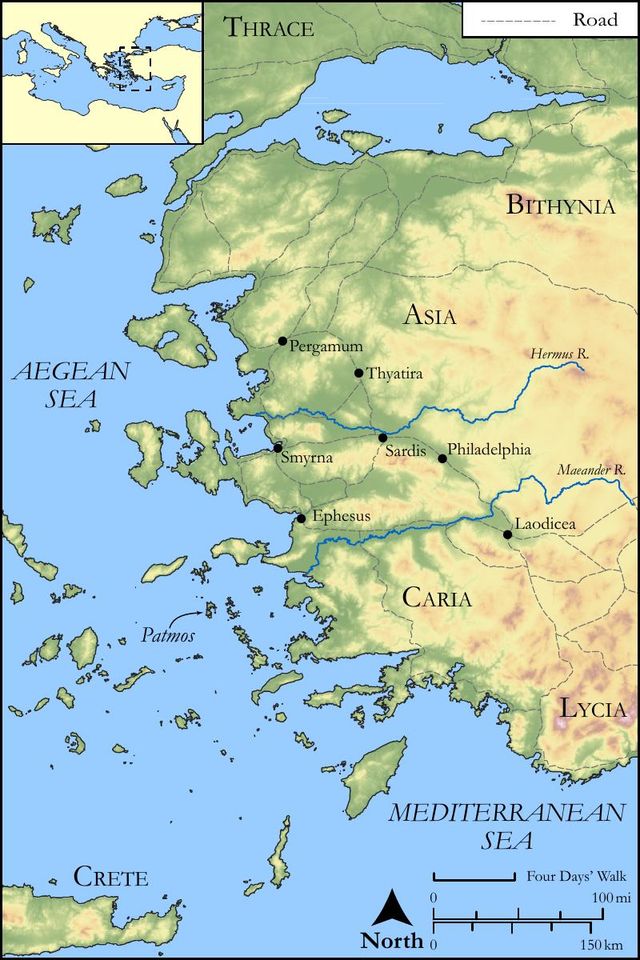
See on the biblical-era maps

Study this verse
Public-domain commentary
Matthew Henry
From his Commentary on the Whole Bible. Henry comments on passages, not single verses — this entry covers Revelation 16:17–21. His two-level outline is real structure in the source text, so it is rendered as structure.
Here we have an account of the seventh and last angel pouring forth his vial, contributing his part towards the accomplishment of the downfall of Babylon, which was the finishing stroke. And here, as before, observe,
I.Where this plague fell - on the air, upon the prince of the power of the air, that is, the devil.
His powers were restrained, his policies confounded; he was bound in God's chain: the sword of God was upon his eye and upon his arm; for he, as well as the powers of the earth, is subject to the almighty power of God. He had used all possible means to preserve the antichristian interest, and to prevent the fall of Babylon - all the influence that he has upon the minds of men, blinding their judgments and perverting them, hardening their hearts, raising their enmity to the gospel as high as could be. But now here is a vial poured out upon his kingdom, and he is not able to support his tottering cause and interest any longer.
II.What it produced,
1.A thankful voice from heaven, pronouncing that now the work was done. The church triumphant in heaven saw it, and rejoiced; the church militant on earth saw it, and became triumphant. It is finished.
2.A mighty commotion on the earth - an earthquake, so great as never was before, shaking the very centre, and this ushered in by the usual concomitants of thunder and lightnings.
3.The fall of Babylon, which was divided into three parts, called the cities of the nations (Rev 16:19); having had rule over the nations, and taken in the idolatry of the nations, incorporating into her religion something of the Jewish, something of the pagan, and something of the Christian religion, she was as three cities in one. God now remembered this great and wicked city. Though for some time he seemed to have forgotten her idolatry and cruelty, yet now he gives unto her the cup of the wine of the fierceness of his wrath. And this downfall extended further than to the seat of antichrist; it reached from the centre to the circumference; and every island and every mountain, that seemed by nature and situation the most secured, were carried away in the deluge of this ruin.
III.How the antichristian party were affected with it.
Though it fell upon them as a dreadful storm, as if the stones of the city, tossed up into the air, came down upon their heads, like hailstones of a talent weight each, yet they were so far from repenting that they blasphemed that God who thus punished them. Here was a dreadful plague of the heart, a spiritual judgment more dreadful and destructive than all the rest. Observe,
1.The greatest calamities that can befall men will not bring them to repentance without the grace of God working with them.
2.Those that are not made better by the judgments of God are always the worse for them.
3.To be hardened in sin and enmity against God by his righteous judgments is a certain token of utter destruction.
Historical interpretation
Four Centuries of Reception
3 surviving comments on this verse. Each one is dated, so this reads as a timeline rather than a list.
Select a marker to jump to its quote. Markers stagger vertically where authors wrote within a few decades of each other.
The angelic voice from heaven said, “It is done!” That is, the commandment of God has been accomplished. The flashes of lightning and the voices and the thunders are symbolic of the terrifying nature of these occurrences and of the future coming of Christ, just as long ago they announced the descent of God upon Mount Sinai. The earthquake signifies the transformation of that which exists, as the apostle explained: “Yet once more I will shake not only the earth but also the heaven.”
And the seventh poured out his vial into the air, etc. Just as above the blood of vengeance up to the horse bridles, namely the unclean spirits went out, so also here when the same aerial powers are drenched with the final vengeance, it is said to have happened, that is, the end is at hand, when (as the Apostle says) the last enemy, death, will be destroyed (1 Cor. 15). Thus far under the name of plagues is described the final persecution, which Tyconius wants to be understood all oppositely. A plague, he says, is incurable, and a great wrath to receive the power of sinning especially against the saints, and not yet to be chastised by a greater wrath of God. For the outcome of the blessedness of the wicked is death, just as conversely the torments and humiliation of the Church is its glory. For at that time all the impious people will be unharmed by any bodily plague, as if they had received the full power of raging. Nor will there be a need then for the fulfillment of sins and the completion of wrath for any of the wicked to be scourged, and to be restrained from fury. He summarizes from the same persecution, describing the ruin of the impious city.
Into the air indeed he poured out his bowl; and the voice said It is done. What has been done? The decree, that is, of God and His plan.
Continue studying Revelation 16:17 across the web’s major study libraries — every link below opens this exact verse, chapter, or book on the destination site.
Read & Compare
 BibleGatewayThis verse in more than 200 translations and 70 languages.
 Bible.comThe YouVersion reader — hundreds of translations, reading plans, and highlights.
 ESV.orgCrossway's official English Standard Version reader.
 NET BibleThe NET translation with 60,000+ translators' notes on every rendering decision.
 STEP BibleTyndale House's free study tool — original text, vocabulary, and scholarly resources.
 BibliaLogos Bible Software's free web reader.
 USCCBThe New American Bible (Revised Edition) with the U.S. bishops' study notes.
Commentaries
 BibleHub CommentariesDozens of classic commentaries on this verse, gathered on one page.
 StudyLightMore than 100 commentary sets — the largest collection on the web.
 BibleRefPlain-English commentary on what this verse means, verse by verse.
 Enduring WordDavid Guzik's free commentary on this chapter, widely used by Bible teachers.
 Bible Study ToolsVerse commentary alongside Greek and Hebrew study aids.
Original Language & Research
- BibleHub InterlinearThe verse word by word — original language, transliteration, and English.
- BibleHub LexiconEvery word's original-language definition and Strong's entry.
 Blue Letter BibleDeep-study tools — Strong's numbers, concordance, and word studies.
 CNTR CollationThe earliest Greek manuscripts of this verse, collated letter by letter.
Sermons, Hymns & Audio


TrulyRandomVerse is not affiliated with these sites and doesn’t control their content. They’re linked because they’re genuinely useful.
Summary
Revelation 16:17 marks the climactic moment of the seven bowl judgments, depicting the seventh angel pouring out his vial into the atmosphere, followed by a thunderous declaration from the very throne of God in heaven: "It is done." This pronouncement signifies the absolute finality and completion of God's wrathful judgments upon the earth, paving the way for the consummation of His divine plan and the establishment of His righteous kingdom.
Context
ShowHideLiterary Context
Revelation 16:17 serves as the dramatic culmination of the seven bowl judgments, detailed throughout Revelation 16. Preceding this verse, the earth has endured a series of increasingly severe plagues: grievous sores (Rev 16:2), seas and rivers turning to blood (Rev 16:3-4), scorching sun (Rev 16:8-9), and profound darkness (Rev 16:10-11). The sixth bowl judgment specifically prepared the way for the gathering of the kings of the earth for the great battle of Armageddon (Rev 16:12-16). The pouring of the seventh vial "into the air" and the subsequent declaration "It is done" immediately precede cataclysmic events like the great earthquake, the division of the great city, and the fall of Babylon, as described in Revelation 16:18-21, indicating that this declaration marks the decisive end of this specific phase of divine retribution.
Historical & Cultural Context
The book of Revelation was written to early Christians facing intense persecution under the Roman Empire, offering them hope and assurance of God's ultimate victory and justice. The imagery of divine judgment, a heavenly temple, and a throne from which pronouncements are made, draws heavily from Old Testament prophetic traditions (e.g., Isaiah 6 or Ezekiel 1). The concept of a "vial" or "bowl" (Greek: phiálē) as a vessel for pouring out wrath is a vivid metaphor for divine indignation being fully discharged. The "air" (Greek: aḗr) was often considered the realm of spiritual powers (as seen in Ephesians 2:2), suggesting that this judgment affects not only the physical world but also the unseen spiritual forces that influence it, making the judgment truly universal.
Key Themes
ShowHideThis verse powerfully reinforces several major theological and narrative themes central to Revelation. It underscores God's absolute sovereignty and control over all events, demonstrating that the unfolding judgments are not random but part of a divinely orchestrated plan emanating directly from His throne, a consistent symbol of His supreme authority throughout the book (e.g., Revelation 4:2). The declaration "It is done" emphasizes the finality and irreversibility of divine judgment, signaling the completion of God's righteous wrath against sin and rebellion. The pouring of the vial "into the air" highlights the universal scope of this judgment, indicating that no part of creation or human existence will be untouched by the consequences of God's justice. Furthermore, it marks the climax of God's wrath, serving as a decisive turning point that leads directly into the ultimate consummation of His redemptive and judicial purposes.
Exposition and Analysis
ShowHideKey Word Analysis
ShowHideTranslated "poured out," this verb signifies a forceful and complete discharge. In the context of the bowls of wrath, it vividly conveys the unreserved and overwhelming nature of God's judgment. It is not a sprinkling or a partial release, but a full, unmitigated outpouring of divine indignation, emphasizing the totality of the wrath being administered.
Meaning "air" or "atmosphere," the pouring of the vial into this realm suggests a judgment that is pervasive and inescapable. Unlike previous judgments that targeted specific elements like the sea, rivers, or the sun, a judgment "into the air" implies a universal reach, affecting the very breath of life and the environment that sustains all living things. It may also symbolically touch upon the spiritual realm, as the air was sometimes associated with the domain of evil spiritual forces.
Translated "It is done," this verb in its perfect active indicative form (γεγονεν, gegonen) signifies an action that has been completed in the past with ongoing, permanent results. It is a declaration of absolute finality, not merely that something will happen or is happening, but that it has already come into being and remains so. This pronouncement from the divine throne underscores the irreversible nature of this phase of God's judgments.
Verse Breakdown
ShowHide"And the seventh angel poured out his vial into the air"
This clause introduces the final angelic agent in the series of bowl judgments. The "seventh angel" signifies the culmination of this specific sequence of divine retribution. The act of "pouring out his vial" symbolizes the full and complete discharge of God's wrath, held within a shallow bowl or phial. The target, "into the air," is highly significant, indicating a judgment that is universal, affecting the entire atmosphere and, by extension, all life and possibly even the spiritual forces that operate within the unseen realm. It suggests an all-encompassing judgment from which there is no escape.
"and there came a great voice out of the temple of heaven, from the throne, saying"
This phrase identifies the source and nature of the authoritative declaration. The "great voice" denotes immense power, authority, and undeniable significance. Its origin "out of the temple of heaven" points to God's holy dwelling place, emphasizing the sacred and righteous nature of the judgment. Furthermore, its emanation "from the throne" unequivocally identifies the voice as God's own, or a direct utterance from His seat of supreme sovereignty and judicial authority, underscoring that these cataclysmic events are divinely orchestrated and controlled.
"It is done"
This succinct yet profoundly powerful declaration serves as the ultimate pronouncement of finality. In the context of the bowl judgments, it signifies that this particular series of God's wrathful decrees has reached its appointed completion. It is not merely a statement of future intent or ongoing process, but a definitive assertion of accomplished fact, with permanent and irreversible consequences. This declaration sets the stage for the subsequent events in Revelation, confirming that a major phase of God's eschatological plan has been brought to its decisive close.
Literary Devices
ShowHideRevelation 16:17 employs several potent literary devices to convey its profound message. Symbolism is paramount, with the "vial" representing God's contained wrath, ready to be unleashed. The act of pouring "into the air" is symbolic of a judgment that is universal and pervasive, affecting every corner of existence and perhaps even the spiritual atmosphere. The "temple of heaven" and "throne" are powerful symbols of God's holy presence, His ultimate authority, and His judicial power, reinforcing that these events are divinely ordained. The "great voice" is an instance of anthropomorphism or theophany, attributing a human-like vocalization to God or His direct manifestation, emphasizing His direct involvement and the undeniable impact of His pronouncement. The declaration "It is done" functions as a dramatic climax for the bowl judgments, providing a sense of finality and closure to this specific series of plagues. It also serves as a form of foreshadowing, indicating that while this phase of judgment is complete, it immediately precedes further, equally dramatic events, creating a sense of escalating tension and anticipation for the ultimate consummation of God's plan.
Theological and Thematic Connections
ShowHideRevelation 16:17 stands as a stark reminder of God's unwavering justice and His absolute sovereignty over all creation and history. The declaration "It is done" from the divine throne underscores that God's purposes, including His judgments against sin and rebellion, will be fully and irrevocably accomplished. This provides profound assurance for believers that evil will not ultimately prevail, and that God will bring all things to their appointed end, vindicating His righteousness and establishing His perfect kingdom. For those who reject Him, it serves as a solemn warning of the certainty and finality of divine accountability, demonstrating that no one can escape the consequences of defying the Creator.
Reflection and Application
ShowHideRevelation 16:17 offers a powerful lens through which to view God's character and our place in His grand narrative. For the believer, the resounding "It is done" from the throne of heaven provides immense comfort and certainty. It assures us that God is actively working out His purposes, that His justice will prevail, and that the chaos and suffering of this world are not without end or meaning. This should inspire a deep trust in His sovereignty and a confident hope in His ultimate victory. For all humanity, this verse serves as a solemn call to reflection: if God's judgment is so final and comprehensive, how ought we to live? It compels us to consider our standing before a holy God, urging humility, repentance, and a turning to Christ for salvation. It reminds us that our time on earth is finite, and our choices have eternal consequences. This understanding should motivate us to live lives that honor God, to share the good news of His salvation with urgency, and to persevere in faith, knowing that our God is faithful to complete all His promises, both of judgment and of redemption.
Questions for Reflection
ShowHideFAQ
ShowHideWhat does "It is done" mean in the context of Revelation 16:17?
ShowHideIn this context, "It is done" (Greek: Gegonen) signifies the absolute completion and finality of the seven bowl judgments, which are a specific series of God's wrath poured out upon the earth. It does not mean the end of all things or the entire prophetic timeline, but rather the decisive conclusion of this particular phase of divine retribution. It's a declaration from God's throne, indicating that His decreed wrath for this period has been fully discharged, setting the stage for the subsequent dramatic events, such as the great earthquake and the fall of Babylon described in Revelation 16:18-21.
Why is the vial poured "into the air" rather than on a specific part of the earth?
ShowHideThe pouring of the vial "into the air" (Greek: eis ton aéra) signifies the universal and pervasive nature of this final judgment. Unlike previous bowls that targeted specific elements like the sea, rivers, or the sun, the air is ubiquitous, affecting all life and representing the entire global environment. It suggests that no one and nothing will escape its effects, as the very atmosphere that sustains life is impacted. Furthermore, in biblical thought, the "air" can sometimes represent the realm of spiritual powers (e.g., Ephesians 2:2), implying that this judgment also extends to the unseen spiritual forces of evil that influence the world, making the judgment truly comprehensive.
Christ-Centered Fulfillment
ShowHideWhile Revelation 16:17 describes a moment of intense divine judgment, its ultimate significance is deeply rooted in the person and work of Jesus Christ. The "great voice" from the "throne" declaring "It is done" finds its echo and indeed its ultimate authority in Christ, who is the Lamb on the throne (e.g., Revelation 5:6-7). The wrath poured out in the bowls is God's righteous response to human sin and rebellion, a wrath that Christ Himself bore on the cross. His triumphant cry, "It is finished!" (Greek: Tetelestai) in John 19:30, signifies the complete and perfect work of salvation, through which He fully satisfied God's just demands against sin. Thus, for those who are "in Christ" by faith, the "It is done" of judgment in Revelation 16:17 is not a threat, but a confirmation that the justice that must fall upon sin has already been met in their Substitute. Christ, as the righteous Judge (e.g., John 5:22), is the one through whom these final judgments are executed, ensuring that God's holiness is upheld and His kingdom is established in perfect righteousness, leading to a new heaven and new earth where righteousness dwells (e.g., 2 Peter 3:13).