


Revelation 16:18
- καὶkaiAndG2532CONJConjunction
- ἐγένοντοegenontothere wereG1096V-2ADI-3PVerb 2nd Aorist Middle Deponent Indicative 3rd Plural
- ἀστραπαὶastrapaiflashes of lightningG796N-NPFNoun Nominative Plural Feminine
- καὶkaiandG2532CONJConjunction
- φωναὶphōnaivoicesG5456N-NPFNoun Nominative Plural Feminine
- καὶkaiandG2532CONJConjunction
- βρονταίbrontaithundersG1027N-NPFNoun Nominative Plural Feminine
- καὶkaiandG2532CONJConjunction
- σεισμὸςseismosan earthquakeG4578N-NSMNoun Nominative Singular Masculine
- ἐγένετοegenetothere wasG1096V-2ADI-3SVerb 2nd Aorist Middle Deponent Indicative 3rd Singular
- μέγαςmegasgreatG3173A-NSMAdjective Nominative Singular Masculine
- οἷοςhoiossuch asG3634K-NSMCorrelative pronoun Nominative Singular Masculine
- οὐκouknotG3756PRT-NNegative Particle Negative
- ἐγένετοegenetohad there beenG1096V-2ADI-3SVerb 2nd Aorist Middle Deponent Indicative 3rd Singular
- ἀφ᾽aph᾽sinceG575PREPPreposition
- οὗhouwhenG3739R-GSMRelative pronoun Genitive Singular Masculine
- οἱhoi<the>G3588T-NPMDefinite article Nominative Plural Masculine
- ἄνθρωποςanthrōposmanG444N-NSMNoun Nominative Singular Masculine
- ἐγένετοegenetowasG1096V-2ADI-3SVerb 2nd Aorist Middle Deponent Indicative 3rd Singular
- ἐπὶepiuponG1909PREPPreposition
- τῆςtēstheG3588T-GSFDefinite article Genitive Singular Feminine
- γῆςgēsearthG1093N-GSFNoun Genitive Singular Feminine
- τηλικοῦτοςtēlikoutosso greatG5082D-NSMDemonstrative pronoun Nominative Singular Masculine
- σεισμὸςseismos[was the] earthquakeG4578N-NSMNoun Nominative Singular Masculine
- οὕτωhoutōsoG3779ADVAdverb
- μέγαςmegasmightyG3173A-NSMAdjective Nominative Singular Masculine
English is a literal word-by-word gloss of the Greek, not the KJV's wording. Why?
This is the original text the KJV's translators worked from — each Greek word with its own literal English meaning in this verse, prepared by scholars at Tyndale House, Cambridge. The KJV translates whole sentences, not word by word, so its wording differs: one Greek word can become several English words, and the KJV may choose “charity” where the gloss reads “love”. Both are faithful — they answer different questions. For the KJV's own rendering, switch to the KJV text.
Details
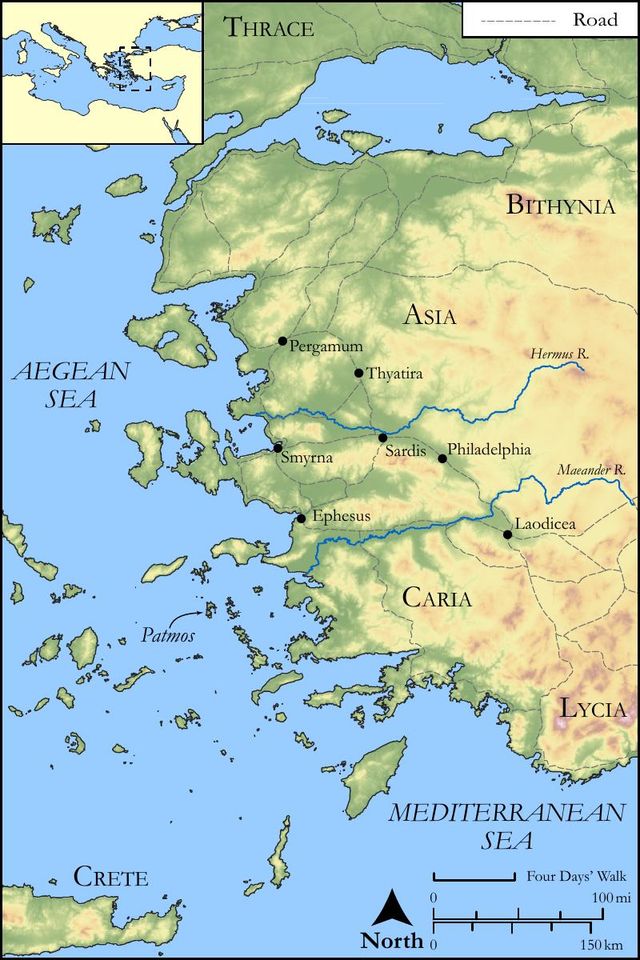
See on the biblical-era map

Study this verse
Public-domain commentary
Matthew Henry
From his Commentary on the Whole Bible. Henry comments on passages, not single verses — this entry covers Revelation 16:17–21. His two-level outline is real structure in the source text, so it is rendered as structure.
Here we have an account of the seventh and last angel pouring forth his vial, contributing his part towards the accomplishment of the downfall of Babylon, which was the finishing stroke. And here, as before, observe,
I.Where this plague fell - on the air, upon the prince of the power of the air, that is, the devil.
His powers were restrained, his policies confounded; he was bound in God's chain: the sword of God was upon his eye and upon his arm; for he, as well as the powers of the earth, is subject to the almighty power of God. He had used all possible means to preserve the antichristian interest, and to prevent the fall of Babylon - all the influence that he has upon the minds of men, blinding their judgments and perverting them, hardening their hearts, raising their enmity to the gospel as high as could be. But now here is a vial poured out upon his kingdom, and he is not able to support his tottering cause and interest any longer.
II.What it produced,
1.A thankful voice from heaven, pronouncing that now the work was done. The church triumphant in heaven saw it, and rejoiced; the church militant on earth saw it, and became triumphant. It is finished.
2.A mighty commotion on the earth - an earthquake, so great as never was before, shaking the very centre, and this ushered in by the usual concomitants of thunder and lightnings.
3.The fall of Babylon, which was divided into three parts, called the cities of the nations (Rev 16:19); having had rule over the nations, and taken in the idolatry of the nations, incorporating into her religion something of the Jewish, something of the pagan, and something of the Christian religion, she was as three cities in one. God now remembered this great and wicked city. Though for some time he seemed to have forgotten her idolatry and cruelty, yet now he gives unto her the cup of the wine of the fierceness of his wrath. And this downfall extended further than to the seat of antichrist; it reached from the centre to the circumference; and every island and every mountain, that seemed by nature and situation the most secured, were carried away in the deluge of this ruin.
III.How the antichristian party were affected with it.
Though it fell upon them as a dreadful storm, as if the stones of the city, tossed up into the air, came down upon their heads, like hailstones of a talent weight each, yet they were so far from repenting that they blasphemed that God who thus punished them. Here was a dreadful plague of the heart, a spiritual judgment more dreadful and destructive than all the rest. Observe,
1.The greatest calamities that can befall men will not bring them to repentance without the grace of God working with them.
2.Those that are not made better by the judgments of God are always the worse for them.
3.To be hardened in sin and enmity against God by his righteous judgments is a certain token of utter destruction.
Historical interpretation
Four Centuries of Reception
3 surviving comments on this verse. Each one is dated, so this reads as a timeline rather than a list.
Select a marker to jump to its quote. Markers stagger vertically where authors wrote within a few decades of each other.
The angelic voice from heaven said, “It is done!” That is, the commandment of God has been accomplished. The flashes of lightning and the voices and the thunders are symbolic of the terrifying nature of these occurrences and of the future coming of Christ, just as long ago they announced the descent of God upon Mount Sinai. The earthquake signifies the transformation of that which exists, as the apostle explained: “Yet once more I will shake not only the earth but also the heaven.”
And there were lightnings and voices, etc. When at the end of the world there will be such tribulation as has not been from the beginning (Matt. 24), very great signs will also clearly appear. But whether from the side of the good, or from the side of the wicked, or from both sides converging towards each other, it is not made sufficiently clear here. As it was done with Moses and Pharaoh's magicians.
When this was spoken, there were flashes of lightning and voices: the flashes from the heights, the voices on the earth from the awe of the flashes.
And thunders and an earthquake. Either he calls an earthquake the shaking of the earth, since this too is contained among the signs of the end (Luke 21:11), or he calls an earthquake the transformation of things seen, according to what is said to the Haggai: "once more I will shake not only the heaven but also the earth and the sea and the dry land, and I will shake all the nations." (Hag. 2:6-7) Therefore it is also emphasized, as he says, that there had never been such an earthquake like it before.
Continue studying Revelation 16:18 across the web’s major study libraries — every link below opens this exact verse, chapter, or book on the destination site.
Read & Compare
 BibleGatewayThis verse in more than 200 translations and 70 languages.
 Bible.comThe YouVersion reader — hundreds of translations, reading plans, and highlights.
 ESV.orgCrossway's official English Standard Version reader.
 NET BibleThe NET translation with 60,000+ translators' notes on every rendering decision.
 STEP BibleTyndale House's free study tool — original text, vocabulary, and scholarly resources.
 BibliaLogos Bible Software's free web reader.
 USCCBThe New American Bible (Revised Edition) with the U.S. bishops' study notes.
Commentaries
 BibleHub CommentariesDozens of classic commentaries on this verse, gathered on one page.
 StudyLightMore than 100 commentary sets — the largest collection on the web.
 BibleRefPlain-English commentary on what this verse means, verse by verse.
 Enduring WordDavid Guzik's free commentary on this chapter, widely used by Bible teachers.
 Bible Study ToolsVerse commentary alongside Greek and Hebrew study aids.
Original Language & Research
- BibleHub InterlinearThe verse word by word — original language, transliteration, and English.
- BibleHub LexiconEvery word's original-language definition and Strong's entry.
 Blue Letter BibleDeep-study tools — Strong's numbers, concordance, and word studies.
 CNTR CollationThe earliest Greek manuscripts of this verse, collated letter by letter.
Sermons, Hymns & Audio


TrulyRandomVerse is not affiliated with these sites and doesn’t control their content. They’re linked because they’re genuinely useful.
Summary
Revelation 16:18 powerfully depicts the cataclysmic events immediately following the outpouring of the seventh bowl of God's wrath. This verse describes an unprecedented cosmic and terrestrial upheaval, marked by overwhelming voices, thunders, lightnings, and a global earthquake of such magnitude that nothing comparable has occurred since humanity's inception. It signifies the culmination of divine judgment, underscoring God's absolute sovereignty and the finality of His righteous anger against a rebellious world.
Context
ShowHideLiterary Context
Revelation 16:18 is the direct consequence of the seventh and final bowl judgment, announced in Revelation 16:17 with the declaration, "It is done!" This pronouncement signals the consummation of God's wrath upon the earth, bringing to a climax the series of judgments initiated by the seals and trumpets. Unlike the preceding six bowls, which targeted specific aspects of creation or humanity, the seventh bowl unleashes a comprehensive global cataclysm affecting the very fabric of the earth and sky. The events described in this verse—the voices, thunders, lightnings, and the unparalleled earthquake—serve as the immediate prelude to the splitting of the great city Babylon and the subsequent hailstorm, as detailed in Revelation 16:19-21. This sequence underscores the escalating intensity and finality of God's judgment, leading directly to the ultimate confrontation between God and His enemies.
Historical & Cultural Context
The imagery of "voices, and thunders, and lightnings" is deeply rooted in Old Testament theophanies, divine manifestations where God reveals Himself in power and judgment. This imagery is strongly reminiscent of God's descent upon Mount Sinai, where thunder, lightning, and a thick cloud accompanied His presence and the giving of the Law. Such phenomena were understood by ancient audiences as direct signs of divine power, authority, and often, judgment. Earthquakes, too, were recognized as powerful natural disasters, often interpreted as divine displeasure or precursors to significant historical shifts, as seen in prophetic literature like Isaiah 29:6 or Zechariah 14:5. The specific emphasis on an earthquake "such as was not since men were upon the earth" would have conveyed to John's original audience a sense of unprecedented, cosmic-scale judgment, far surpassing any natural disaster they could conceive, directly orchestrated by God.
Key Themes
ShowHideRevelation 16:18 contributes significantly to several overarching themes within the book of Revelation. Foremost is the theme of Divine Judgment and Sovereignty, demonstrating God's absolute control over creation and His righteous response to human rebellion. The cosmic signs—voices, thunders, and lightnings—are classic biblical imagery associated with God's powerful presence and the manifestation of His judgment, echoing the awe-inspiring scene at Mount Sinai. This reinforces that these events are not random but direct, deliberate acts of divine wrath. Another key theme is Unprecedented Cataclysm, highlighted by the description of the earthquake as "such as was not since men were upon the earth." This hyperbole emphasizes the unparalleled magnitude and destructive power of this seismic event, signifying a complete disruption of the established order and a final, overwhelming display of God's wrath against persistent sin. This earthquake surpasses all previous seismic events mentioned in Revelation, including the one in Revelation 11:13. Finally, the verse underscores the Finality of God's Wrath, marking a critical turning point in the end-time prophecies, leading directly to the ultimate destruction of "Babylon the Great" (Revelation 16:19) and setting the stage for the climactic return of Christ.
Exposition and Analysis
ShowHideKey Word Analysis
ShowHideThis word signifies a deep, rumbling sound, often associated with storms and, in biblical contexts, with the powerful, awe-inspiring voice or presence of God. Its inclusion here, alongside voices and lightnings, immediately evokes imagery of a theophany, a visible manifestation of God, emphasizing the divine origin and overwhelming power behind the unfolding judgments. It is a sound that commands attention and instills fear, signaling the direct intervention of the Almighty.
Used twice in relation to the earthquake ("a great earthquake," "so great"), and implicitly describes the magnitude of the voices, thunders, and lightnings, this adjective denotes something of immense size, intensity, or importance. Its repetition serves to underscore the unparalleled scale and severity of the earthquake, distinguishing it from all previous seismic events. It emphasizes that this is not merely a large earthquake, but one of unprecedented, cosmic significance, unmatched in human history.
This term refers to a commotion or shaking, specifically used for an earthquake or a tempest. In Revelation 16:18, it denotes a literal seismic event, but one of such extraordinary magnitude that it transcends natural phenomena. The description "such as was not since men were upon the earth" elevates it beyond any historical or geological occurrence, portraying it as a unique, divinely orchestrated cataclysm designed to bring about the final stages of judgment and the transformation of the created order.
Verse Breakdown
ShowHide"And there were voices, and thunders, and lightnings;"
This phrase sets the scene with a display of overwhelming atmospheric phenomena. "Voices" (phōnḗ) can refer to literal sounds, perhaps angelic pronouncements or the very voice of God, while "thunders" (brontḗ) and "lightnings" (astrapḗ) are classic biblical imagery for the powerful, awe-inspiring presence of God, often accompanying divine judgment or revelation, as seen at Mount Sinai (Exodus 19:16). These elements signify the direct, active involvement of God in the unfolding events, underscoring the divine origin and terrifying nature of the impending judgment.
"and there was a great earthquake,"
Following the atmospheric display, the verse introduces the central catastrophic event: an earthquake of immense proportions. The Greek word for "great" (mégas) emphasizes its extraordinary size and impact, setting it apart from any ordinary seismic activity. This earthquake is not merely a natural disaster but a divinely orchestrated act, a physical manifestation of God's wrath shaking the very foundations of the earth.
"such as was not since men were upon the earth,"
This clause highlights the unprecedented nature of the earthquake. The phrase "such as was not" (hoîos ou) combined with "since men were upon the earth" (aph' hoú ánthrōpoi egénonto epì tēs gēs) functions as a superlative, indicating that this earthquake is the most severe and destructive in all of human history. It surpasses all previous earthquakes, both natural and those mentioned elsewhere in Revelation (Revelation 6:12, Revelation 11:13), underscoring its unique and ultimate significance in God's plan of judgment.
"so mighty an earthquake, [and] so great."
This concluding phrase provides a powerful and emphatic reiteration of the earthquake's magnitude. The repetition of "earthquake" (seismós) and the use of "so mighty" (tēlikoûtos) and "so great" (hoútō mégas) serve to reinforce the unparalleled scale and destructive power of the event. This literary device ensures that the reader grasps the absolute and overwhelming nature of this final, global cataclysm, leaving no doubt as to its unique severity in the annals of time.
Literary Devices
ShowHideRevelation 16:18 employs several powerful literary devices to convey the overwhelming nature of God's final judgment. Hyperbole is prominently used in the description of the earthquake: "such as was not since men were upon the earth." This exaggerated statement emphasizes the unparalleled magnitude of the event, signaling that it transcends any historical or natural disaster, making it truly unique in human experience. The verse also utilizes Repetition and Emphasis through the phrase "so mighty an earthquake, and so great." The reiteration of "earthquake" and the double emphasis on its immense size ("mighty" and "great") serve to underscore its unprecedented power and destructive force, ensuring the reader fully grasps its ultimate significance. Furthermore, the opening phrase, "And there were voices, and thunders, and lightnings," functions as Theophany Imagery. These elements are classic biblical motifs associated with the direct manifestation of God's presence and power, particularly in judgment, reminiscent of the scene at Mount Sinai. This imagery signifies that the ensuing cataclysm is not random but a direct, deliberate, and terrifying act of divine intervention.
Theological and Thematic Connections
ShowHideRevelation 16:18 serves as a stark theological declaration of God's ultimate sovereignty and the certainty of His final, righteous judgment. The unprecedented nature of the earthquake, coupled with the divine manifestations of voices, thunders, and lightnings, powerfully communicates that God is actively bringing history to its appointed climax. This is not merely a natural disaster but a cosmic shaking, a divine act that will dismantle all human systems and rebellion, preparing the way for the establishment of God's eternal kingdom. It underscores the biblical truth that all creation is subject to its Creator and will ultimately bear witness to His justice and power. The severity of this judgment highlights the gravity of human sin and the necessity of repentance before the full outpouring of God's wrath.
Reflection and Application
ShowHideRevelation 16:18 offers a profound opportunity for reflection on God's character and the trajectory of human history. For believers, this verse should instill a deep sense of awe and reverence for the Lord, reminding us of His absolute power and the certainty of His justice. It reinforces the urgency of living faithfully, knowing that our ultimate hope rests in Christ, who delivers us from the wrath to come. This passage calls us to examine our own lives: are we living in alignment with God's will, or are we clinging to the temporary systems of this world that are destined for destruction? For those who have not yet submitted to Christ, Revelation 16:18 serves as a stark and sobering warning. It presents a vivid picture of the profound and irreversible consequences of rejecting God's grace and persistent rebellion against His authority. It is a clarion call to sincere repentance and to embrace the salvation offered through Jesus Christ before these final, overwhelming judgments are fully unleashed. The cosmic implications of human choices are laid bare, underscoring the absolute sovereignty of God over all creation and history, and the futility of resisting His divine purposes.
Questions for Reflection
ShowHideFAQ
ShowHideWhat is the significance of the "voices, and thunders, and lightnings" in Revelation 16:18?
ShowHideThe "voices, and thunders, and lightnings" are highly symbolic and significant. In biblical literature, particularly the Old Testament, these phenomena are classic imagery associated with a theophany, a visible manifestation of God's presence and power. They often accompany divine revelation or judgment, as famously seen at Mount Sinai when God gave the Law to Moses. In Revelation 16:18, their presence signals that the cataclysmic events, especially the great earthquake, are not random natural occurrences but are direct, deliberate, and terrifying acts of God's judgment. They underscore the divine origin and overwhelming authority behind the outpouring of the seventh bowl of wrath, ensuring that all understand these events are orchestrated by the Almighty.
Why is the earthquake described as "such as was not since men were upon the earth"?
ShowHideThis phrase emphasizes the unparalleled and unprecedented magnitude of the earthquake. It is a hyperbole, a deliberate exaggeration, to convey that this seismic event is the most severe and destructive in all of human history. It surpasses any natural disaster or even previous earthquakes mentioned in Revelation, such as the one during the sixth seal (Revelation 6:12) or the earthquake associated with the two witnesses (Revelation 11:13). The purpose of this description is to highlight the finality and comprehensiveness of God's judgment, indicating a complete shaking and dismantling of the existing world order as history moves towards its ultimate climax.
Christ-Centered Fulfillment
ShowHideRevelation 16:18, while depicting a terrifying scene of divine judgment, finds its ultimate Christ-centered fulfillment in the person and work of Jesus. The cosmic shaking described here, with its unparalleled earthquake and accompanying divine manifestations, speaks to the absolute sovereignty of God, a sovereignty fully embodied in Christ. As the one through whom "all things were created, in heaven and on earth, visible and invisible" (Colossians 1:16), Jesus is also the one who holds all creation together and who will ultimately bring it to its consummation. The judgment unleashed in this verse is a manifestation of the righteous wrath of God, which is ultimately executed by Christ, for "the Father judges no one, but has given all judgment to the Son" (John 5:22). This cataclysmic event foreshadows the ultimate shaking of all that can be shaken, preparing the way for the unshakable kingdom of God, which believers receive through Christ (Hebrews 12:26-28). Furthermore, while this verse describes wrath, it simultaneously highlights the glorious deliverance offered in Christ: those who are "in Christ Jesus" are "delivered from the wrath to come" (1 Thessalonians 1:10). Thus, this passage, even in its severity, points to the necessity and glory of Christ as both the righteous Judge and the merciful Savior, who offers refuge from the very judgments He orchestrates.