


Revelation 16:19
Bible text: King James Version (1769 Blayney text) · Public domain
Bible text: King James Version with Strong's numbers · Public domain
Bible text: Berean Standard Bible · Public domain
Bible text: American Standard Version (1901) · Public domain
Bible text: World English Bible, Messianic edition · Public domain
Bible text: Geneva Bible (1599) · Public domain
Bible text: Young's Literal Translation · Public domain
- καὶkaiAndG2532CONJConjunction
- ἐγένετοegenetowas [split]G1096V-2ADI-3SVerb 2nd Aorist Middle Deponent Indicative 3rd Singular
- ἡhētheG3588T-NSFDefinite article Nominative Singular Feminine
- πόλιςpoliscityG4172N-NSFNoun Nominative Singular Feminine
- ἡhē<the>G3588T-NSFDefinite article Nominative Singular Feminine
- μεγάληmegalēgreatG3173A-NSFAdjective Nominative Singular Feminine
- εἰςeisintoG1519PREPPreposition
- τρίαtriathreeG5140A-APNAdjective Accusative Plural Neuter
- μέρηmerēpartsG3313N-APNNoun Accusative Plural Neuter
- καὶkaiandG2532CONJConjunction
- αἱhaitheG3588T-NPFDefinite article Nominative Plural Feminine
- πόλειςpoleiscitiesG4172N-NPFNoun Nominative Plural Feminine
- τῶνtōnof theG3588T-GPNDefinite article Genitive Plural Neuter
- ἐθνῶνethnōnnationsG1484N-GPNNoun Genitive Plural Neuter
- ἔπεσανepesanfellG4098V-2AAI-3PVerb 2nd Aorist Active Indicative 3rd Plural
- καὶkaiandG2532CONJConjunction
- ΒαβυλὼνBabulōnBabylonG897N-NSF-LNoun Nominative Singular Feminine Location
- ἡhētheG3588T-NSFDefinite article Nominative Singular Feminine
- μεγάληmegalēgreatG3173A-NSFAdjective Nominative Singular Feminine
- ἐμνήσθηemnēsthēwas rememberedG3403V-API-3SVerb Aorist Passive Indicative 3rd Singular
- ἐνώπιονenōpionbeforeG1799PREPPreposition
- τοῦtou<the>G3588T-GSMDefinite article Genitive Singular Masculine
- θεοῦtheouGodG2316N-GSM-TNoun Genitive Singular Masculine Title
- δοῦναιdounaito giveG1325V-2AANVerb 2nd Aorist Active Infinitive
- αὐτῇautēato herG846P-DSFPersonal pronoun Dative Singular Feminine
- τὸtotheG3588T-ASNDefinite article Accusative Singular Neuter
- ποτήριονpotērioncupG4221N-ASNNoun Accusative Singular Neuter
- τοῦtouof theG3588T-GSMDefinite article Genitive Singular Masculine
- οἴνουoinouwineG3631N-GSMNoun Genitive Singular Masculine
- τοῦtouof theG3588T-GSMDefinite article Genitive Singular Masculine
- θυμοῦthumoufuryG2372N-GSMNoun Genitive Singular Masculine
- τῆςtēstheG3588T-GSFDefinite article Genitive Singular Feminine
- ὀργῆςorgēswrathG3709N-GSFNoun Genitive Singular Feminine
- αὐτοῦautouof HimG846P-GSMPersonal pronoun Genitive Singular Masculine
English is a literal word-by-word gloss of the Greek, not the KJV's wording. Why?
This is the original text the KJV's translators worked from — each Greek word with its own literal English meaning in this verse, prepared by scholars at Tyndale House, Cambridge. The KJV translates whole sentences, not word by word, so its wording differs: one Greek word can become several English words, and the KJV may choose “charity” where the gloss reads “love”. Both are faithful — they answer different questions. For the KJV's own rendering, switch to the KJV text.
Details
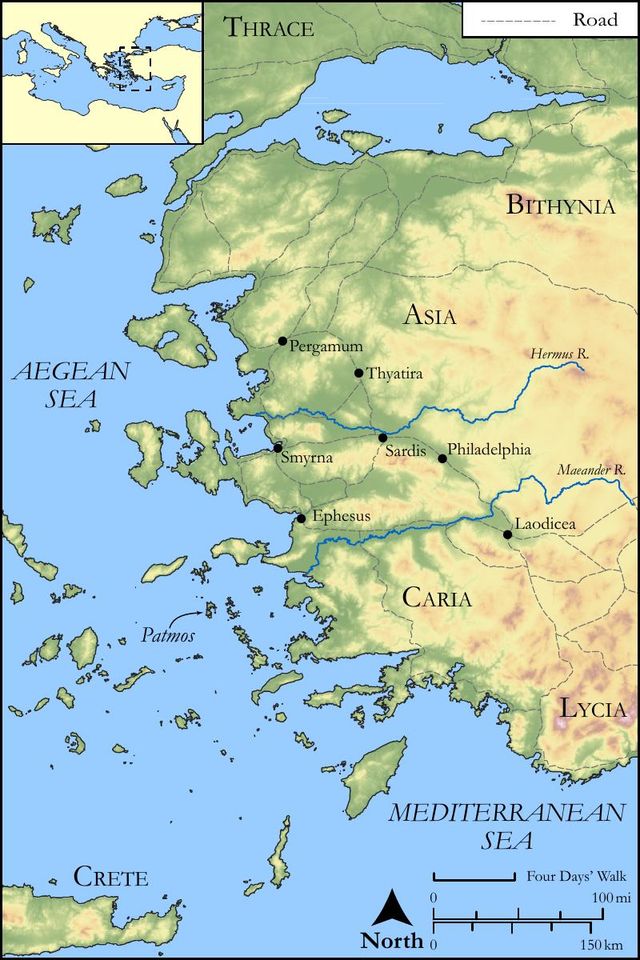
See on the biblical-era maps

Study this verse
Public-domain commentary
Matthew Henry
From his Commentary on the Whole Bible. Henry comments on passages, not single verses — this entry covers Revelation 16:17–21. His two-level outline is real structure in the source text, so it is rendered as structure.
Here we have an account of the seventh and last angel pouring forth his vial, contributing his part towards the accomplishment of the downfall of Babylon, which was the finishing stroke. And here, as before, observe,
I.Where this plague fell - on the air, upon the prince of the power of the air, that is, the devil.
His powers were restrained, his policies confounded; he was bound in God's chain: the sword of God was upon his eye and upon his arm; for he, as well as the powers of the earth, is subject to the almighty power of God. He had used all possible means to preserve the antichristian interest, and to prevent the fall of Babylon - all the influence that he has upon the minds of men, blinding their judgments and perverting them, hardening their hearts, raising their enmity to the gospel as high as could be. But now here is a vial poured out upon his kingdom, and he is not able to support his tottering cause and interest any longer.
II.What it produced,
1.A thankful voice from heaven, pronouncing that now the work was done. The church triumphant in heaven saw it, and rejoiced; the church militant on earth saw it, and became triumphant. It is finished.
2.A mighty commotion on the earth - an earthquake, so great as never was before, shaking the very centre, and this ushered in by the usual concomitants of thunder and lightnings.
3.The fall of Babylon, which was divided into three parts, called the cities of the nations (Rev 16:19); having had rule over the nations, and taken in the idolatry of the nations, incorporating into her religion something of the Jewish, something of the pagan, and something of the Christian religion, she was as three cities in one. God now remembered this great and wicked city. Though for some time he seemed to have forgotten her idolatry and cruelty, yet now he gives unto her the cup of the wine of the fierceness of his wrath. And this downfall extended further than to the seat of antichrist; it reached from the centre to the circumference; and every island and every mountain, that seemed by nature and situation the most secured, were carried away in the deluge of this ruin.
III.How the antichristian party were affected with it.
Though it fell upon them as a dreadful storm, as if the stones of the city, tossed up into the air, came down upon their heads, like hailstones of a talent weight each, yet they were so far from repenting that they blasphemed that God who thus punished them. Here was a dreadful plague of the heart, a spiritual judgment more dreadful and destructive than all the rest. Observe,
1.The greatest calamities that can befall men will not bring them to repentance without the grace of God working with them.
2.Those that are not made better by the judgments of God are always the worse for them.
3.To be hardened in sin and enmity against God by his righteous judgments is a certain token of utter destruction.
Historical interpretation
Four Centuries of Reception
7 surviving comments on this verse. Each one is dated, so this reads as a timeline rather than a list.
Select a marker to jump to its quote. Markers stagger vertically where authors wrote within a few decades of each other.
This great city is to be understood as in general every people that is under heaven and that is seen to be in three parts when the church is divided [into three parts]. And so, the Gentiles are considered to be one part, the heretics and false Christians [are] another part, and the catholic church [is] the third part.
The city that was great because of the size of its population and that was haughty and arrogant because of its immodest enterprises shall fall into three parts. One part will be of the Gentiles, another of the heretics and the Jews, and the third part which is of the false brothers is rejected, for they “confess to know God, but they deny him by their deeds; they are detestable, disobedient, unfit for any good deed.” The passage continues, “The cities of the nations fell,” that is, all the strength and confidence of the nations fell. “And that great Babylon was remembered and came under the sight of God.” This indicates that the multitude of all of the damned were confused. “And he gave to her from the wine of the fury of his wrath.” It describes the wicked receiving the retribution of that revenge that they merited.
We understand Jerusalem to be a “great city” not because of the number and size of its buildings but as that which is the most ancient and greatest in regard to godliness, in as much as it was made great by the sufferings of Christ and is to be distinguished from the cities of the nations. We think that the division of this city into three parts suggests the division between the Christians and the Jews and the Samaritans who live in it. Or the division is of those who are steadfast in faith and those who have defiled their baptism with filthy works and the Jews who have in no way received the proclamation.… For at the present time the Jews and Samaritans hide their real intentions out of fear of our pious rulers, and they seem to be associated with us, not daring to separate themselves with their own people. It is similar to the fact that those who are truly Christians are intermingled with those who possess the name [of Christian] alone. But when the cleansing fire of temptations will unmask them, then there will occur the division of these people into the three groups of the impious, the pious and the sinners, and these will gather together with those of like habits and be associated with their own kind. The falling of the cities of the nations indicates either their destruction or the cessation of the pagan manner of life at the coming of the kingdom of God, which, according to Daniel, the saints will possess. “And God remembered great Babylon, to make her drain the cup of the wine of the fury of his wrath.” The thronging multitude, confounded by the meaningless distractions of life and made great by the wealth of their injustices, will drink the cup of the wrath of God. It is as though they went from a merciful forgetfulness [of God] to a remembrance and now faced the retribution for their trampling of the righteous One and for the impiety of their words and deeds.
And great Babylon came into remembrance before God, etc. Then Babylon falls, or drinks the wrath of God, when it receives power against Jerusalem, especially in the final days. Therefore he said that it fell by the earthquake that affects the Church. But if you refer this to the day of judgment, then the impious will come into remembrance before God, who now says in his heart: God has forgotten.
And the cities of the nations fell. That is, all the strength and confidence of the nations. For the joy of the wicked is a great ruin, and the joy of the unrighteous is destruction.
And the great city was divided into three parts. The impious city inflicts a threefold war upon the Church of Christ. Which the Gentiles and Jews openly with combat, heretics with deceitful defection, false brethren with corrupt examples assail. Which was also figured above in the three bad horses, the red, black, and pale.
And he says the great city was divided into three parts, and the cities of the nations fell. Concerning Jerusalem he says the great city, and it is clear from what he contrasts with it the cities of the nations; for in the divine Scripture, it is customary to call Israel, apart from the other peoples, a nation. And he calls it great, as infamous.
And all the cities fell; for when the land was being transformed and made new, how could the cities standing in it remain untouched, defiled by the dwelling of sinners?
And Babylon, he says, the Great, was remembered before God to be given the cup of the wine of the fury of his wrath. In what it said previously, And another angel followed, saying, "Babylon the great has fallen;" (Rev. 14:8) but in the present passage he wants us to understand that he does not mean that Babylon, but signifies another. And I think he means Rome and those who will then occupy it, as the discourse to follow will teach.
Therefore he says that great Babylon was remembered before God. That is, the memory of her former sins, when they persecuted and killed the saints, came before God; and the cup of the wine of the wrath of God is already interpreted; therefore there is no need to speak at length.
Continue studying Revelation 16:19 across the web’s major study libraries — every link below opens this exact verse, chapter, or book on the destination site.
Read & Compare
 BibleGatewayThis verse in more than 200 translations and 70 languages.
 Bible.comThe YouVersion reader — hundreds of translations, reading plans, and highlights.
 ESV.orgCrossway's official English Standard Version reader.
 NET BibleThe NET translation with 60,000+ translators' notes on every rendering decision.
 STEP BibleTyndale House's free study tool — original text, vocabulary, and scholarly resources.
 BibliaLogos Bible Software's free web reader.
 USCCBThe New American Bible (Revised Edition) with the U.S. bishops' study notes.
Commentaries
 BibleHub CommentariesDozens of classic commentaries on this verse, gathered on one page.
 StudyLightMore than 100 commentary sets — the largest collection on the web.
 BibleRefPlain-English commentary on what this verse means, verse by verse.
 Enduring WordDavid Guzik's free commentary on this chapter, widely used by Bible teachers.
 Bible Study ToolsVerse commentary alongside Greek and Hebrew study aids.
Original Language & Research
- BibleHub InterlinearThe verse word by word — original language, transliteration, and English.
- BibleHub LexiconEvery word's original-language definition and Strong's entry.
 Blue Letter BibleDeep-study tools — Strong's numbers, concordance, and word studies.
 CNTR CollationThe earliest Greek manuscripts of this verse, collated letter by letter.
Sermons, Hymns & Audio


TrulyRandomVerse is not affiliated with these sites and doesn’t control their content. They’re linked because they’re genuinely useful.
Summary
Revelation 16:19 vividly portrays the catastrophic climax of God's judgment upon the rebellious world, focusing on the symbolic "great city" identified as Babylon. Following an unprecedented earthquake, this verse describes the fragmentation of the world's dominant anti-God system and the collapse of all nations' cities, culminating in God's definitive remembrance of Babylon's accumulated sins and the pouring out of the full measure of His fierce wrath upon her. It marks the decisive end of human rebellion and the triumph of divine justice.
Context
ShowHideLiterary Context
This verse immediately follows the pouring out of the seventh and final bowl judgment, which is announced by a voice from the temple proclaiming, "It is done!" (Revelation 16:17). This judgment unleashes an unparalleled, global earthquake, described as "such a mighty earthquake, and so great, as was not since men were upon the earth" (Revelation 16:18). Revelation 16:19 details the immediate, devastating consequences of this seismic event, particularly on the urban centers of the world and, most prominently, on "great Babylon." It serves as the narrative culmination of the bowl judgments, setting the stage for the detailed exposition of Babylon's identity and destruction in subsequent chapters (Revelation 17 and Revelation 18).
Historical & Cultural Context
The imagery of a "great city" and "Babylon" carries significant historical and cultural weight. Historically, Babylon was the powerful capital of the Neo-Babylonian Empire, known for its immense wealth, idolatry, and its role in the destruction of Jerusalem and the exile of Judah. In the context of Revelation, "Babylon" is widely understood as a symbolic representation. While some interpret it as a literal city, many scholars view it as a cipher for Rome, the dominant imperial power of John's day, or more broadly, as the embodiment of all human systems that oppose God, characterized by arrogance, economic exploitation, spiritual harlotry, and persecution of the saints. The "cities of the nations" falling signifies the collapse of all human-constructed power structures and economies that have defied divine authority, reflecting a universal judgment on human civilization in rebellion against God.
Key Themes
ShowHideRevelation 16:19 powerfully contributes to several overarching themes within the book of Revelation. First, it underscores the theme of Universal Judgment and Destruction, illustrating that God's wrath is comprehensive, affecting not just a single entity but all nations and their established systems. The division of the "great city" and the fall of "cities of the nations" signify a complete and utter collapse of human power. Second, the verse highlights the Remembrance and Fall of Babylon. This symbolic entity, representing the culmination of human rebellion and opposition to God, reaches its appointed time for divine reckoning. Her sins, accumulated over history, are brought "in remembrance before God," echoing Old Testament prophecies of judgment against wicked empires and affirming God's perfect justice. Finally, the imagery of "the cup of the wine of the fierceness of his wrath" reinforces the theme of Divine Retribution, a potent biblical metaphor for the full, undiluted measure of God's righteous anger poured out on those who have defied Him, ensuring that justice is fully served, as seen in passages like Isaiah 51:17 and Jeremiah 25:15-16.
Exposition and Analysis
ShowHideKey Word Analysis
ShowHideThis verb, meaning "to cause to be" or "to become," indicates a radical transformation or occurrence. Here, in the passive voice, it signifies that the "great city" did not merely break apart but was actively caused to be divided into three parts by an external force—God's judgment—demonstrating the divine agency behind its destruction.
This term means "to bear in mind" or "to recollect," but it carries the implication of remembering with a view to action, specifically reward or punishment. When "great Babylon came in remembrance before God," it is not merely that God recalled her existence, but that her accumulated deeds, particularly her sins and persecution of His people, had reached their full measure, prompting Him to execute the long-awaited judgment.
This word describes a passionate outburst, a strong emotion, often associated with indignation or hot anger. When combined with "wrath" (orgē), it emphasizes the intense, unbridled, and righteous indignation of God against sin and rebellion, indicating that the judgment administered is not merely corrective but a full expression of His holy fury.
Verse Breakdown
ShowHide"And the great city was divided into three parts"
This phrase describes the immediate and devastating impact of the great earthquake on "the great city," which is universally understood to be symbolic Babylon. The division "into three parts" signifies a complete and utter fragmentation, perhaps indicating total destruction, a comprehensive breakdown of its political, economic, and spiritual power, or even a symbolic representation of a tri-partite structure (e.g., political, commercial, religious) that collapses entirely. It implies a precise, divinely orchestrated dismantling rather than random chaos.
"and the cities of the nations fell"
This clause broadens the scope of the judgment beyond just "the great city." It signifies that the divine wrath is not confined to one symbolic entity but extends to all human cities and nations that have aligned themselves with the anti-God system represented by Babylon. The "falling" indicates their collapse, ruin, and utter destruction, demonstrating the universal and comprehensive nature of God's final judgment on all rebellious human structures.
"and great Babylon came in remembrance before God"
This is a pivotal statement, revealing the reason for the judgment. "Babylon" here is personified as an entity whose actions have been meticulously recorded by God. Her "coming in remembrance" signifies that the full measure of her iniquity—her idolatry, immorality, persecution of saints, and opposition to God—has been completed, and the time for divine reckoning has finally arrived. It underscores God's perfect justice and His unfailing memory of all deeds, both good and evil.
"to give unto her the cup of the wine of the fierceness of his wrath"
This powerful metaphor, drawn from Old Testament prophetic imagery (e.g., Isaiah 51:17), illustrates the nature and intensity of the judgment. The "cup" represents the full portion of suffering and punishment appointed by God. The "wine" signifies the intoxicating and overwhelming nature of this judgment. The "fierceness of his wrath" emphasizes the undiluted, intense, and righteous anger of God being poured out without mercy, ensuring that Babylon receives the full, just recompense for her rebellion and wickedness.
Literary Devices
ShowHideRevelation 16:19 is rich with Symbolism. "The great city" and "Babylon" are not merely geographical locations but powerful symbols representing the totality of human rebellion against God, encompassing political, economic, and spiritual systems that have opposed His kingdom. The "three parts" into which the city is divided is also symbolic, likely signifying complete and utter destruction or a comprehensive breakdown of its various facets. The "cities of the nations" symbolize all human power structures and civilizations that have rejected divine authority. The most prominent Metaphor is "the cup of the wine of the fierceness of his wrath," which vividly portrays divine judgment as a bitter draught that must be fully consumed, signifying the full measure of God's righteous indignation. The phrase "came in remembrance before God" employs Anthropomorphism, attributing human-like memory and judicial action to God, emphasizing His active engagement in bringing justice. The scale of destruction, with the "great city" divided and "cities of the nations" falling, also employs Hyperbole to convey the unparalleled and comprehensive nature of this final, cataclysmic judgment.
Theological and Thematic Connections
ShowHideRevelation 16:19 powerfully articulates the biblical truth of God's ultimate sovereignty and His unwavering commitment to justice. It demonstrates that no human system, no matter how powerful or entrenched, can ultimately defy the divine will. The "remembrance" of Babylon's sins before God underscores the principle that God is a righteous judge who sees and records every act of injustice, oppression, and rebellion, and that there will be a day of reckoning for all who have rejected His authority and persecuted His people. This verse serves as a profound theological statement that evil will not triumph indefinitely; rather, it will meet its just and decisive end at the hand of a holy and righteous God. It affirms the certainty of divine retribution and the ultimate vindication of God's people.
Reflection and Application
ShowHideRevelation 16:19 offers both a stark warning and a profound comfort. For those who align themselves with systems of rebellion, injustice, and self-sufficiency apart from God, it serves as a solemn reminder that all such human constructs, no matter how grand or seemingly invincible, are ultimately fragile and destined for collapse under the weight of divine judgment. This should prompt a serious examination of where our loyalties lie and what foundations we are building our lives upon. For believers, this verse provides immense comfort and assurance. It reaffirms God's perfect justice and His unwavering commitment to right all wrongs. In a world often marked by apparent injustice and the triumph of evil, Revelation 16:19 declares that God is not passive; He remembers, He sees, and He will act decisively to bring about His righteous kingdom. This truth should inspire patience, perseverance in faith, and renewed confidence in the ultimate victory of Christ. It calls us to live with an eternal perspective, investing in God's kingdom rather than in the transient systems of this world, and to share the urgent message of repentance and salvation.
Questions for Reflection
ShowHideFAQ
ShowHideWhat is the "great city" mentioned in this verse?
ShowHideWhile the "great city" is not explicitly named in this specific verse, the broader context of Revelation, particularly Revelation 17:18 and Revelation 18, clearly identifies it with "Babylon." This "Babylon" is widely understood not as a literal historical city but as a powerful symbol. It represents the totality of human rebellion against God, encompassing all anti-God political, economic, and religious systems throughout history, often seen as a symbolic representation of imperial Rome in John's day, but also applicable to any global system that opposes God and persecutes His people.
Why is God described as "remembering" Babylon? Does God forget?
ShowHideThe phrase "came in remembrance before God" does not imply that God literally forgot Babylon and then suddenly recalled her. Instead, it is an anthropomorphic expression, attributing human characteristics to God to convey a profound theological truth. In biblical terms, for God to "remember" often means that He is now acting decisively based on what He has observed and recorded. In Babylon's case, it signifies that her accumulated sins, injustices, and acts of rebellion have reached their full measure, and the appointed time for divine judgment and retribution has arrived. It emphasizes God's perfect knowledge, His unwavering justice, and His active intervention in history to bring about His purposes.
Christ-Centered Fulfillment
ShowHideRevelation 16:19, with its depiction of the ultimate judgment upon rebellious human systems, finds its profound Christ-centered fulfillment in the person and work of Jesus Christ. He is the one through whom all things were created, and by whom all things will be judged (John 1:3; John 5:22). The "fierceness of his wrath" poured out upon Babylon is not arbitrary but is the righteous indignation of God against sin, which Jesus Himself bore on the cross for those who believe (Romans 5:9). His sacrifice on Calvary absorbed the full "cup of wrath" that humanity deserved, offering a path to salvation from this very judgment for all who trust in Him (Isaiah 53:5-6). Ultimately, this judgment on Babylon foreshadows Christ's final victory as the King of kings and Lord of lords, who will utterly defeat all opposing powers and establish His eternal kingdom, where righteousness dwells and there is no more rebellion (Revelation 19:11-16; Revelation 21:1-4). Thus, the destruction of Babylon highlights the necessity and glory of Christ's redemptive work and His ultimate reign.