


Revelation 18:5
Bible text: King James Version (1769 Blayney text) · Public domain
Bible text: Berean Standard Bible · Public domain
Bible text: American Standard Version (1901) · Public domain
Bible text: World English Bible, Messianic edition · Public domain
Bible text: Geneva Bible (1599) · Public domain
Bible text: Young's Literal Translation · Public domain
- ὅτιhotiForG3754CONJConjunction
- ἐκολλήθησανekollēthēsanthey were heapedG2853V-API-3PVerb Aorist Passive Indicative 3rd Plural
- αὐτῆςautēsin herG846P-GSFPersonal pronoun Genitive Singular Feminine
- αἱhai<the>G3588T-NPFDefinite article Nominative Plural Feminine
- ἁμαρτίαιhamartiaisinsG266N-NPFNoun Nominative Plural Feminine
- ἄχριachrias high asG891PREPPreposition
- τοῦtou<the>G3588T-GSMDefinite article Genitive Singular Masculine
- οὐρανοῦouranouheavenG3772N-GSMNoun Genitive Singular Masculine
- καὶkaiandG2532CONJConjunction
- ἐμνημόνευσενemnēmoneusenhas rememberedG3421V-AAI-3SVerb Aorist Active Indicative 3rd Singular
- ὁho<the>G3588T-NSMDefinite article Nominative Singular Masculine
- θεὸςtheosGodG2316N-NSM-TNoun Nominative Singular Masculine Title
- τὰtatheG3588T-APNDefinite article Accusative Plural Neuter
- ἀδικήματαadikēmatainiquitiesG92N-APNNoun Accusative Plural Neuter
- αὐτῆςautēsof herG846P-GSFPersonal pronoun Genitive Singular Feminine
English is a literal word-by-word gloss of the Greek, not the KJV's wording. Why?
This is the original text the KJV's translators worked from — each Greek word with its own literal English meaning in this verse, prepared by scholars at Tyndale House, Cambridge. The KJV translates whole sentences, not word by word, so its wording differs: one Greek word can become several English words, and the KJV may choose “charity” where the gloss reads “love”. Both are faithful — they answer different questions. For the KJV's own rendering, switch to the KJV text.
Details
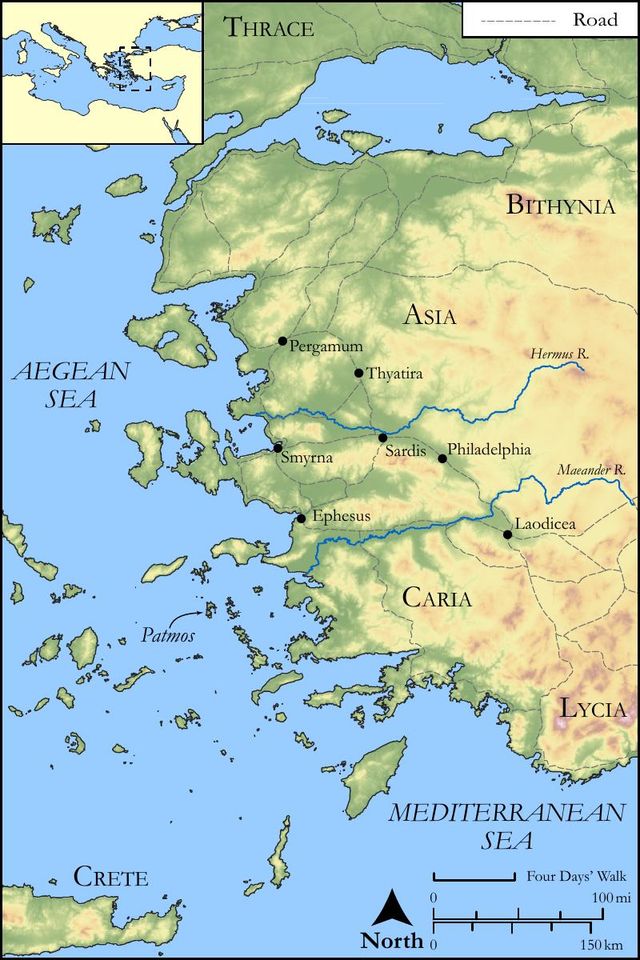
See on the biblical-era maps

Study this verse
Public-domain commentary
Matthew Henry
From his Commentary on the Whole Bible. Henry comments on passages, not single verses — this entry covers Revelation 18:1–8.
The downfall and destruction of Babylon form an event so fully determined in the counsels of God, and of such consequence to his interests and glory, that the visions and predictions concerning it are repeated. 1. Here is another angel sent from heaven, attended with great power and lustre, Rev 18:1. He had not only light in himself, to discern the truth of his own prediction, but to inform and enlighten the world about that great event; and not only light to discern it, but power to accomplish it. 2. This angel publishes the fall of Babylon, as a thing already come to pass; and this he does with a mighty strong voice, that all might hear the cry, and might see how well this angel was pleased to be the messenger of such tidings. Here seems to be an allusion to the prediction of the fall of pagan Babylon (Isa 21:9), where the word is repeated as it is here: has fallen, has fallen. Some have thought a double fall is hereby intended, first her apostasy, and then her ruin; and they think the words immediately following favour their opinion; She has become the habitation of devils, and the hold of every foul spirit, and the cage of every unclean and hateful bird, Rev 18:2. But this is also borrowed from Isa 21:9, and seems to describe not so much her sin of entertaining idols (which are truly called devils) as her punishment, it being a common notion that unclean spirits, as well as ominous and hateful birds, used to haunt a city or house that lay in its ruins. 3. The reason of this ruin is declared (Rev 18:3); for, though God is not obliged to give any account of his matters, yet he is pleased to do so, especially in those dispensations of providence that are most awful and tremendous. The wickedness of Babylon had been very great; for she had not only forsaken the true God herself, and set up idols, but had with great art and industry drawn all sorts of men into the spiritual adultery, and by her wealth and luxury had retained them in her interest. 4. Fair warning is given to all that expect mercy from God, that they should not only come out of her, but be assisting in her destruction, Rev 18:4, Rev 18:5. Here observe, (1.) God may have a people even in Babylon, some who belong to the election of grace. (2.) God's people shall be called out of Babylon, and called effectually. (3.) Those that are resolved to partake with wicked men in their sins must receive of their plagues. (4.) When the sins of a people reach up to heaven, the wrath of God will reach down to the earth. (5.) Though private revenge is forbidden, yet God will have his people act under him, when called to it, in pulling down his and their inveterate and implacable enemies, Rev 18:6. (6.) God will proportion the punishment of sinners to the measure of their wickedness, pride, and security, Rev 18:7. (7.) When destruction comes on a people suddenly, the surprise is a great aggravation of their misery, Rev 18:8.
Historical interpretation
Six Centuries of Reception
4 surviving comments on this verse. Each one is dated, so this reads as a timeline rather than a list.
Select a marker to jump to its quote. Markers stagger vertically where authors wrote within a few decades of each other.
Of all the ornaments of the church our company of monks and virgins is one of the finest.… Let us pass now to the cottage inn that sheltered Christ and Mary.… The stall where he cried as a babe can best be honored by silence, for words are inadequate to speak its praise. Where are the spacious porticoes? Where are the gilded ceilings?… Behold, in this poor crevice of the earth the Creator of the heavens was born; here he was wrapped in swaddling clothes; here he was seen by the shepherds; here he was pointed out by the star; here he was adored by the wise men.… Read the Apocalypse of John, and consider what is sung therein of the woman arrayed in purple and of the blasphemy written upon her brow.… “Come out of her, my people,” so the Lord says, “that you be not partakers of her sins and that you receive not of her plagues.” … It is true that Rome has a holy church, trophies of apostles and martyrs, a true confession of Christ. The faith has been preached there by an apostle, heathenism has been trodden down, the name of Christian is daily exalted higher and higher. But the display, power and size of the city, the seeing and being seen, the paying and the receiving of visits, the alternate flattery and detraction, talking and listening, as well as the necessity of facing so great a throng even when one is least in the mood to do so—all these things are alike foreign to the principles and fatal to the repose of the monastic life.… But in the cottage of Christ all is simple and rustic, except for the chanting of psalms everything is completely silent.
We see from this passage that Babylon is divided into two parts. For as long as God allows, the wicked are converted to the good, so that Babylon is divided, and that part that departs from it is the making of Jerusalem. For as long as some are moved from Babylon to Jerusalem and others are seduced from Jerusalem to Babylon, so long are the wicked converted to the good and those who seem through hypocrisy to be good are openly revealed to be wicked. And, therefore, through Isaiah Scripture speaks to the good, “Go out from their midst and touch no unclean thing; go out from their midst and be separated from them, you who bear the vessels of the Lord.” The apostle also mentions this separation, saying, “The firm foundation of the Lord remains; and the Lord knows those who are his, and let every one who names the name of the Lord depart from iniquity.” “Lest you take part in her sins,” it says, “and lest you share in her plagues.” Although it is written, “Whatever righteous man shall be taken by death, he will be at rest,” how can a righteous person, whom the fall of the city affects along with the impious, partake of sin? Except perhaps in this way. When the good leave the city of the devil, that is, abandon a profligate and impious life, should any one of them choose to remain and to enjoy the pleasures of Babylon, such a one would certainly share in its plagues. But whenever it says “Come out,” do not understand this in a bodily sense but in a spiritual sense. For one comes out of Babylon whenever one abandons an evil manner of life. Babylonians are with Jerusalemites in each house and in the one church and in each city. Nonetheless, as long as the good do not consent with the wicked and the wicked do not convert to the good, Jerusalem is recognized in the good and Babylon is recognized in the wicked. Although they live together in the body, they are far from each other in the heart, for the life of the wicked is always in the things of the earth, for they love the earth and they place their entire hope and the entire intention of their soul in the earth. But according to the apostle, the mind of the good is always in the heavens, since they are wise in that which is on high.
What the heavenly voice said was this, “Those whom he foreknew he also predestined to be conformed to the image of his Son,” and, “The Lord knows those who are his,” or something similar to this. There follows, “Come out of her, my people, lest you take part in her sins.” To this point I think that [the narrative] has been of the first coming, when until the end of the world the good [people] allow the wicked to be intermingled with them, so that [the wicked] do not think that the good are to be abandoned on their behalf or that they are to be followed by a noxious imitation. For the prophecy, “Go out from her, my people, lest you touch any unclean thing,” is fulfilled in this way—when the righteous no longer commingle with the sinful, not so much by the separation of the body but by the difference of their fully sound will.
For he says her sins have reached to heaven; as if to say that they even defiled the intervening air with their sins.
Continue studying Revelation 18:5 across the web’s major study libraries — every link below opens this exact verse, chapter, or book on the destination site.
Read & Compare
 BibleGatewayThis verse in more than 200 translations and 70 languages.
 Bible.comThe YouVersion reader — hundreds of translations, reading plans, and highlights.
 ESV.orgCrossway's official English Standard Version reader.
 NET BibleThe NET translation with 60,000+ translators' notes on every rendering decision.
 STEP BibleTyndale House's free study tool — original text, vocabulary, and scholarly resources.
 BibliaLogos Bible Software's free web reader.
 USCCBThe New American Bible (Revised Edition) with the U.S. bishops' study notes.
Commentaries
 BibleHub CommentariesDozens of classic commentaries on this verse, gathered on one page.
 StudyLightMore than 100 commentary sets — the largest collection on the web.
 BibleRefPlain-English commentary on what this verse means, verse by verse.
 Enduring WordDavid Guzik's free commentary on this chapter, widely used by Bible teachers.
 Bible Study ToolsVerse commentary alongside Greek and Hebrew study aids.
Original Language & Research
- BibleHub InterlinearThe verse word by word — original language, transliteration, and English.
- BibleHub LexiconEvery word's original-language definition and Strong's entry.
 Blue Letter BibleDeep-study tools — Strong's numbers, concordance, and word studies.
 CNTR CollationThe earliest Greek manuscripts of this verse, collated letter by letter.
Sermons, Hymns & Audio


TrulyRandomVerse is not affiliated with these sites and doesn’t control their content. They’re linked because they’re genuinely useful.
Summary
Revelation 18:5 delivers a stark divine declaration concerning "Babylon the Great," revealing the ultimate justification for her catastrophic downfall: her accumulated sins have ascended to heaven, and God has decisively brought her iniquities to remembrance. This verse underscores the immutable principle of divine justice, where prolonged and pervasive wickedness reaches a tipping point, necessitating God's active intervention and righteous judgment upon a system that has defiantly opposed His will and oppressed His people.
Context
ShowHideLiterary Context
Revelation 18:5 is embedded within a pivotal section of John's apocalyptic vision, specifically detailing the fall of "Babylon the Great." This chapter immediately follows the pronouncement of judgment in Revelation 17, which identifies Babylon as the "mother of prostitutes and of the abominations of the earth," riding the scarlet beast. Chapter 18 then elaborates on her destruction, portraying it as a sudden, complete, and irreversible event. Verses Revelation 18:1-3 announce her desolation and the pervasive nature of her corrupting influence on the nations through her illicit wealth and spiritual depravity. Verse 5 serves as the divine rationale, explaining why such a severe judgment is warranted, linking her downfall directly to the enormity and cumulative weight of her transgressions in God's sight. The subsequent verses (Revelation 18:6-8) then outline the specific nature of this retribution, emphasizing a "double" repayment for her deeds.
Historical & Cultural Context
While "Babylon the Great" is primarily symbolic, it draws heavily on the historical archetype of ancient Babylon, the oppressive empire that conquered Judah and exiled its people. This historical Babylon, renowned for its idolatry, luxury, and imperial dominance, became a biblical symbol of any worldly power that stands in opposition to God and His people. In John's day, this symbolism would have resonated with the Roman Empire, which was persecuting Christians and embodying similar characteristics of economic power, political tyranny, and idolatrous practices. The imagery of sins "reaching unto heaven" echoes Old Testament accounts of overwhelming wickedness that provoked divine judgment, such as the "outcry" against Sodom and Gomorrah in Genesis 18:20-21 or the building of the Tower of Babel in Genesis 11:4, where human ambition sought to reach heaven. The concept of God "remembering" iniquities signifies a divine reckoning, a time when His patience has run out, and the full measure of justice is to be executed, a theme found in passages like Genesis 15:16.
Key Themes
ShowHideThis verse powerfully contributes to several overarching themes within Revelation and biblical theology. Firstly, it highlights Divine Justice and Accountability, affirming God's absolute sovereignty and His unwavering commitment to righteous judgment. No sin, whether individual or pervasive, goes unnoticed or unpunished indefinitely. Secondly, it emphasizes the Cumulative Nature of Sin, illustrating that persistent rebellion and corruption accumulate to a point where they demand divine intervention. The imagery of sins "reaching unto heaven" vividly portrays this unbearable weight. Thirdly, the phrase "God hath remembered her iniquities" speaks to God's Active Remembrance and Retribution, signifying not a sudden recall from forgetfulness, but a decisive act of bringing past offenses to account, marking the end of divine patience and the commencement of judgment. This is a recurring theme, as seen in God's remembrance of the covenant with Noah in Genesis 8:1 or His people in Exodus 2:24. Finally, the verse underscores the Consequences of Widespread Evil, demonstrating that entire corrupt systems and institutions, not just individuals, are subject to God's ultimate judgment when their wickedness becomes pervasive and defiant.
Exposition and Analysis
ShowHideKey Word Analysis
ShowHideFrom hamartanō, meaning "to miss the mark." This term denotes a moral failure, a deviation from God's standard, or an offense against divine law. In this context, hamartía refers to the collective, pervasive moral transgressions and spiritual idolatry of "Babylon," which have accumulated to an overwhelming degree.
From a root meaning "glue." This verb signifies "to glue, to stick, to cleave, to join." When used with "unto heaven," it vividly portrays the sins as having piled up, adhered, or become so numerous and weighty that they have literally "stuck" or "cleaved" to the very heavens, making them undeniably visible and offensive to God. It conveys a sense of saturation and accumulation.
From a derivative of mnēmē (memory). This word means "to exercise memory, recollect," but in a theological sense, especially when God is the subject, it signifies more than mere recall. It implies an active bringing to mind with the intent to act, to bring to account, or to fulfill a promise or judgment. Here, it means God is now actively responding to and judging the iniquities He has long observed.
Verse Breakdown
ShowHide"For her sins have reached unto heaven"
This clause provides the primary justification for Babylon's judgment. The imagery is powerful, suggesting that the quantity and gravity of her transgressions have become so immense that they have metaphorically ascended to the divine realm, becoming fully apparent and intolerable in God's sight. It speaks to a culmination of wickedness, a point of no return where the cup of iniquity is full. This is not just about individual acts but the widespread, pervasive evil inherent in "Babylon's" nature and actions.
"and God hath remembered her iniquities"
This parallel clause reinforces the first, emphasizing God's active role in the impending judgment. The divine "remembrance" is not a sudden recollection but a declaration that the time for patience and forbearance has ceased. God, who is omniscient and never forgets, is now bringing to mind all the wrongs committed by Babylon, signifying that the moment for decisive, righteous retribution has arrived. "Iniquities" (Greek: adíkēma) refers to specific acts of wrongdoing, injustice, or unrighteousness, complementing "sins" (hamartía) by focusing on the active perpetration of wrong.
Literary Devices
ShowHideRevelation 18:5 employs potent Imagery to convey its message. The phrase "sins have reached unto heaven" is a vivid Hyperbole, exaggerating the height and visibility of Babylon's accumulated wickedness to emphasize its enormity and God's undeniable awareness of it. This imagery also functions as Personification, as sins are depicted as having the capacity to "reach" or ascend. The verse also utilizes Parallelism through its two clauses: "For her sins have reached unto heaven" and "and God hath remembered her iniquities." These two statements, while distinct, reinforce each other, providing a comprehensive reason for divine judgment. The first clause describes the extent of Babylon's sin, and the second describes God's response to it, creating a cause-and-effect relationship that highlights the inevitability of divine justice.
Theological and Thematic Connections
ShowHideRevelation 18:5 profoundly underscores the biblical truth of God's unwavering justice and the ultimate accountability of all powers, systems, and individuals before Him. It reveals that there is a limit to divine patience, and persistent, unrepentant rebellion will inevitably lead to a righteous reckoning. The "reaching unto heaven" signifies not only the magnitude of sin but also its direct affront to God's holiness and sovereignty, demanding a divine response. God's "remembrance" is an active, judicial act, signifying that the time for judgment has arrived, and the full weight of accumulated iniquity will be brought to bear. This provides immense comfort to those who suffer under oppressive practices, assuring them that God sees and will act, while also serving as a solemn warning to those who defy Him.
Reflection and Application
ShowHideRevelation 18:5 serves as a powerful and sobering reminder of God's perfect justice and the ultimate consequences of unrepentant sin, both individual and pervasive. For believers, it offers profound comfort and assurance that no injustice, no oppression, and no act of defiance against God goes unnoticed. Even when evil seems to flourish unchecked, this verse reminds us that there is a divine ledger, and a day of reckoning will surely come. This should inspire us to live with integrity, to stand against injustice, and to separate ourselves from systems or ideologies that are fundamentally opposed to God's righteousness. It also calls us to a deeper understanding of repentance, recognizing that our own sins, if unconfessed and unrepented of, also "reach unto heaven" in their offense to a holy God. Ultimately, it strengthens our hope in God's sovereign control and the certainty of His kingdom, where righteousness will prevail.
Questions for Reflection
ShowHideFAQ
ShowHideWhat does "sins have reached unto heaven" mean literally?
ShowHideWhile not a literal physical ascent, the phrase "sins have reached unto heaven" is a powerful metaphor indicating the immense quantity, gravity, and audacity of Babylon's transgressions. It signifies that her wickedness has become so pervasive, flagrant, and accumulated that it has ascended to the very presence of God, making it undeniably visible and offensive to Him. It implies that the measure of her iniquity is full, demanding divine intervention. This imagery echoes similar expressions in the Old Testament, such as the "outcry" of Sodom and Gomorrah reaching God in Genesis 18:20-21, signifying that their wickedness had become intolerable.
Does "God hath remembered her iniquities" imply that God ever forgets?
ShowHideNo, this phrase does not imply that God forgets and then suddenly recalls. God is omniscient and never forgets anything. In biblical language, when God "remembers" it signifies an active, decisive, and often judicial act. It means that the time for His patience and forbearance has ended, and the moment for righteous judgment and retribution has arrived. It is a declaration that He is now bringing to account all the wrongs that have been committed, as seen in His "remembering" His covenant with Noah in Genesis 8:1, which led to the receding of the flood, or His "remembering" His covenant with Israel, leading to their deliverance from Egypt in Exodus 2:24.
Christ-Centered Fulfillment
ShowHideRevelation 18:5, while a declaration of judgment against a rebellious system, finds its ultimate Christ-centered fulfillment in the broader narrative of God's unwavering justice and the establishment of His righteous kingdom through Jesus Christ. The "sins reaching unto heaven" highlight humanity's profound need for a Savior, for only through Christ's perfect sacrifice could the "record of our sins" be blotted out, as described in Colossians 2:14. Jesus, as the Lamb of God who takes away the sin of the world, bore the full weight of humanity's accumulated iniquities on the cross, satisfying divine justice. Furthermore, the "remembrance" of iniquities by God in judgment foreshadows Christ's role as the righteous Judge, who will ultimately execute all judgment, as John 5:22 declares. The fall of Babylon, orchestrated by God's remembrance of her sins, points to the ultimate triumph of Christ's kingdom, where all evil and injustice will be vanquished, and He will reign in perfect righteousness, bringing about a new heaven and a new earth where righteousness dwells. Thus, this verse, even in its severity, magnifies the necessity and glory of Christ's redemptive work and His final, victorious reign.