


Revelation 18:4
- ΚαὶKaiAndG2532CONJConjunction
- ἤκουσαēkousaI heardG191V-AAI-1SVerb Aorist Active Indicative 1st Singular
- ἄλληνallēnanotherG243A-ASFAdjective Accusative Singular Feminine
- φωνὴνphōnēnvoiceG5456N-ASFNoun Accusative Singular Feminine
- ἐκekfromG1537PREPPreposition
- τοῦtou<the>G3588T-GSMDefinite article Genitive Singular Masculine
- οὐρανοῦouranouheavenG3772N-GSMNoun Genitive Singular Masculine
- λέγουσαν·legousansayingG3004V-PAP-ASFVerb Present Active Participle Accusative Singular Feminine
- ἐξέλθατεexelthatedo comeG1831V-2AAM-2PVerb 2nd Aorist Active Imperative 2nd Plural
- ὁhoyou who [are]G3588T-VSMDefinite article Vocative Singular Masculine
- λαόςlaospeopleG2992N-VSMNoun Vocative Singular Masculine
- μουmouof mineG3165P-1GSPersonal pronoun Genitive 1st Singular
- ἐξexfromG1537PREPPreposition
- αὐτῆςautēsherG846P-GSFPersonal pronoun Genitive Singular Feminine
- ἵναinaso thatG2443CONJConjunction
- μὴmēnotG3361PRT-NNegative Particle Negative
- συγκοινωνήσητεsugkoinōnēsēteyou may have fellowshipG4790V-AAS-2PVerb Aorist Active Subjunctive 2nd Plural
- ταῖςtaisin theG3588T-DPFDefinite article Dative Plural Feminine
- ἁμαρτίαιςhamartiaissinsG266N-DPFNoun Dative Plural Feminine
- αὐτῆςautēsof herG846P-GSFPersonal pronoun Genitive Singular Feminine
- καὶkaiandG2532CONJConjunction
- ἐκekofG1537PREPPreposition
- τῶνtōntheG3588T-GPFDefinite article Genitive Plural Feminine
- πληγῶνplēgōnplaguesG4127N-GPFNoun Genitive Plural Feminine
- αὐτῆςautēsof herG846P-GSFPersonal pronoun Genitive Singular Feminine
- ἵναinaso thatG2443CONJConjunction
- μὴmēnotG3361PRT-NNegative Particle Negative
- λάβητε·labēteyou may receiveG2983V-2AAS-2PVerb 2nd Aorist Active Subjunctive 2nd Plural
English is a literal word-by-word gloss of the Greek, not the KJV's wording. Why?
This is the original text the KJV's translators worked from — each Greek word with its own literal English meaning in this verse, prepared by scholars at Tyndale House, Cambridge. The KJV translates whole sentences, not word by word, so its wording differs: one Greek word can become several English words, and the KJV may choose “charity” where the gloss reads “love”. Both are faithful — they answer different questions. For the KJV's own rendering, switch to the KJV text.
Details
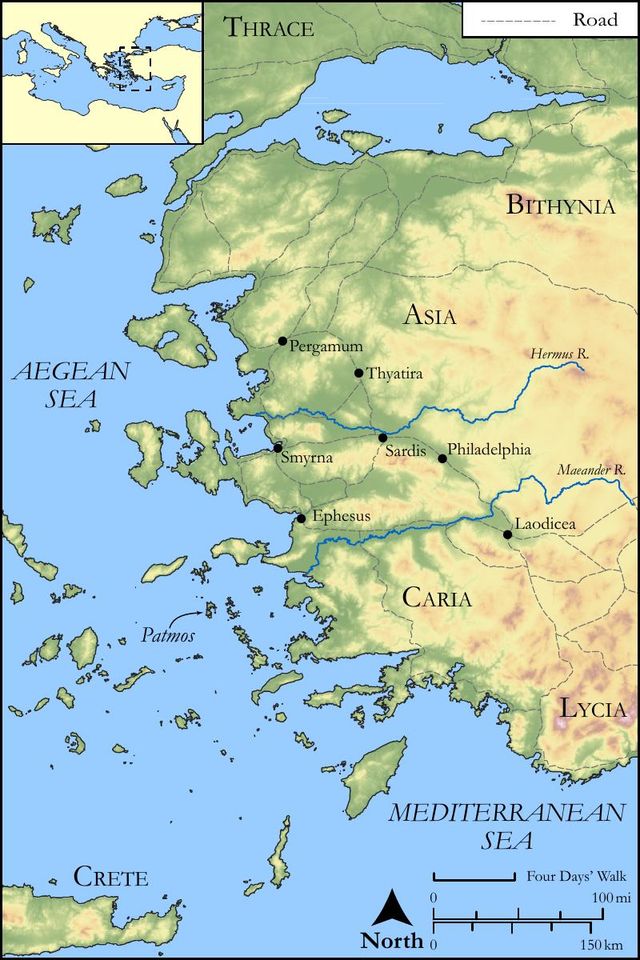
See on the biblical-era map

Study this verse
Public-domain commentary
Matthew Henry
From his Commentary on the Whole Bible. Henry comments on passages, not single verses — this entry covers Revelation 18:1–8.
The downfall and destruction of Babylon form an event so fully determined in the counsels of God, and of such consequence to his interests and glory, that the visions and predictions concerning it are repeated. 1. Here is another angel sent from heaven, attended with great power and lustre, Rev 18:1. He had not only light in himself, to discern the truth of his own prediction, but to inform and enlighten the world about that great event; and not only light to discern it, but power to accomplish it. 2. This angel publishes the fall of Babylon, as a thing already come to pass; and this he does with a mighty strong voice, that all might hear the cry, and might see how well this angel was pleased to be the messenger of such tidings. Here seems to be an allusion to the prediction of the fall of pagan Babylon (Isa 21:9), where the word is repeated as it is here: has fallen, has fallen. Some have thought a double fall is hereby intended, first her apostasy, and then her ruin; and they think the words immediately following favour their opinion; She has become the habitation of devils, and the hold of every foul spirit, and the cage of every unclean and hateful bird, Rev 18:2. But this is also borrowed from Isa 21:9, and seems to describe not so much her sin of entertaining idols (which are truly called devils) as her punishment, it being a common notion that unclean spirits, as well as ominous and hateful birds, used to haunt a city or house that lay in its ruins. 3. The reason of this ruin is declared (Rev 18:3); for, though God is not obliged to give any account of his matters, yet he is pleased to do so, especially in those dispensations of providence that are most awful and tremendous. The wickedness of Babylon had been very great; for she had not only forsaken the true God herself, and set up idols, but had with great art and industry drawn all sorts of men into the spiritual adultery, and by her wealth and luxury had retained them in her interest. 4. Fair warning is given to all that expect mercy from God, that they should not only come out of her, but be assisting in her destruction, Rev 18:4, Rev 18:5. Here observe, (1.) God may have a people even in Babylon, some who belong to the election of grace. (2.) God's people shall be called out of Babylon, and called effectually. (3.) Those that are resolved to partake with wicked men in their sins must receive of their plagues. (4.) When the sins of a people reach up to heaven, the wrath of God will reach down to the earth. (5.) Though private revenge is forbidden, yet God will have his people act under him, when called to it, in pulling down his and their inveterate and implacable enemies, Rev 18:6. (6.) God will proportion the punishment of sinners to the measure of their wickedness, pride, and security, Rev 18:7. (7.) When destruction comes on a people suddenly, the surprise is a great aggravation of their misery, Rev 18:8.
Historical interpretation
Eight Centuries of Reception
7 surviving comments on this verse. Each one is dated, so this reads as a timeline rather than a list.
Select a marker to jump to its quote. Markers stagger vertically where authors wrote within a few decades of each other.
From so much as a dwelling in that Babylon of John's Revelation we are called away; much more then from its pomp.
That the believer ought not to live like the Gentile. In Jeremiah: "Thus saith the Lord, Walk ye not according to the way of the Gentiles." Of this same thing, that one ought to separate himself from the Gentiles, lest he should be a companion of their sin, and become a partaker of their penalty, in the Apocalypse: "And I heard another voice from heaven, saying, Go forth from her, my people, lest thou be partaker of her crimes, and lest thou be stricken with her plagues; because her crimes have reached even to heaven, and the Lord God hath remembered her iniquities. Therefore He hath returned unto her double, and in the cup which she hath mixed double is mingled for her; and in how much she hath glorified herself and possessed of delights, in so much is given unto her both torment and grief. For in her heart she says, I am a queen, and cannot be a widow, nor shah I see sorrow. Therefore in one hour her plagues shall come on her, death, grief, and famine; and she shall be burned with fire, because the Lord God is strong who shall judge her. And the kings of the earth shall weep and lament themselves for her, who have committed fornication with her, and have been conversant in her sins." Also in Isaiah: "Go forth from the midst of them, ye who bear the vessels of the Lord."
Of all the ornaments of the church our company of monks and virgins is one of the finest.… Let us pass now to the cottage inn that sheltered Christ and Mary.… The stall where he cried as a babe can best be honored by silence, for words are inadequate to speak its praise. Where are the spacious porticoes? Where are the gilded ceilings?… Behold, in this poor crevice of the earth the Creator of the heavens was born; here he was wrapped in swaddling clothes; here he was seen by the shepherds; here he was pointed out by the star; here he was adored by the wise men.… Read the Apocalypse of John, and consider what is sung therein of the woman arrayed in purple and of the blasphemy written upon her brow.… “Come out of her, my people,” so the Lord says, “that you be not partakers of her sins and that you receive not of her plagues.” … It is true that Rome has a holy church, trophies of apostles and martyrs, a true confession of Christ. The faith has been preached there by an apostle, heathenism has been trodden down, the name of Christian is daily exalted higher and higher. But the display, power and size of the city, the seeing and being seen, the paying and the receiving of visits, the alternate flattery and detraction, talking and listening, as well as the necessity of facing so great a throng even when one is least in the mood to do so—all these things are alike foreign to the principles and fatal to the repose of the monastic life.… But in the cottage of Christ all is simple and rustic, except for the chanting of psalms everything is completely silent.
We see from this passage that Babylon is divided into two parts. For as long as God allows, the wicked are converted to the good, so that Babylon is divided, and that part that departs from it is the making of Jerusalem. For as long as some are moved from Babylon to Jerusalem and others are seduced from Jerusalem to Babylon, so long are the wicked converted to the good and those who seem through hypocrisy to be good are openly revealed to be wicked. And, therefore, through Isaiah Scripture speaks to the good, “Go out from their midst and touch no unclean thing; go out from their midst and be separated from them, you who bear the vessels of the Lord.” The apostle also mentions this separation, saying, “The firm foundation of the Lord remains; and the Lord knows those who are his, and let every one who names the name of the Lord depart from iniquity.” “Lest you take part in her sins,” it says, “and lest you share in her plagues.” Although it is written, “Whatever righteous man shall be taken by death, he will be at rest,” how can a righteous person, whom the fall of the city affects along with the impious, partake of sin? Except perhaps in this way. When the good leave the city of the devil, that is, abandon a profligate and impious life, should any one of them choose to remain and to enjoy the pleasures of Babylon, such a one would certainly share in its plagues. But whenever it says “Come out,” do not understand this in a bodily sense but in a spiritual sense. For one comes out of Babylon whenever one abandons an evil manner of life. Babylonians are with Jerusalemites in each house and in the one church and in each city. Nonetheless, as long as the good do not consent with the wicked and the wicked do not convert to the good, Jerusalem is recognized in the good and Babylon is recognized in the wicked. Although they live together in the body, they are far from each other in the heart, for the life of the wicked is always in the things of the earth, for they love the earth and they place their entire hope and the entire intention of their soul in the earth. But according to the apostle, the mind of the good is always in the heavens, since they are wise in that which is on high.
What the heavenly voice said was this, “Those whom he foreknew he also predestined to be conformed to the image of his Son,” and, “The Lord knows those who are his,” or something similar to this. There follows, “Come out of her, my people, lest you take part in her sins.” To this point I think that [the narrative] has been of the first coming, when until the end of the world the good [people] allow the wicked to be intermingled with them, so that [the wicked] do not think that the good are to be abandoned on their behalf or that they are to be followed by a noxious imitation. For the prophecy, “Go out from her, my people, lest you touch any unclean thing,” is fulfilled in this way—when the righteous no longer commingle with the sinful, not so much by the separation of the body but by the difference of their fully sound will.
Come out of her, my people, etc. Likewise Isaiah: Depart from the midst of them, and touch no unclean thing. Be clean, you who bear the vessels of the Lord (Isa. 52). After predicting the fall of Babylon, he introduces the departure, which is the ruin of Babylon. For when Lot departed from Sodom, it was utterly destroyed.
When the divine angels seized the city of the Sodomites to execute judgment upon its inhabitants and the neighboring towns, and more precisely, as seems in the writings of the holy Cyril, when the Son of God and the Holy Spirit moved there, "since the Father judges no one" according to the Scripture, "but has given all judgment to the Son," (Jn. 5:22) the Holy Spirit being present with him, clearly and essentially as the vivifying spirit, then they say to the godly Lot: "Save yourself, preserve your own soul; do not look back nor remain anywhere in the plain; flee to the mountain, in case you be taken up with them." (Gen. 19:7)
This is also what the Revelation now teaches us: since it is not possible in so great and populous a city as Rome that there should not also be slaves of Christ in it, he says to them, "Come out of her, my people, in case you take part in her sins and lest you receive of her plagues." For to share in her sins and plagues is to share with them; for the plagues are because of them.
Continue studying Revelation 18:4 across the web’s major study libraries — every link below opens this exact verse, chapter, or book on the destination site.
Read & Compare
 BibleGatewayThis verse in more than 200 translations and 70 languages.
 Bible.comThe YouVersion reader — hundreds of translations, reading plans, and highlights.
 ESV.orgCrossway's official English Standard Version reader.
 NET BibleThe NET translation with 60,000+ translators' notes on every rendering decision.
 STEP BibleTyndale House's free study tool — original text, vocabulary, and scholarly resources.
 BibliaLogos Bible Software's free web reader.
 USCCBThe New American Bible (Revised Edition) with the U.S. bishops' study notes.
Commentaries
 BibleHub CommentariesDozens of classic commentaries on this verse, gathered on one page.
 StudyLightMore than 100 commentary sets — the largest collection on the web.
 BibleRefPlain-English commentary on what this verse means, verse by verse.
 Enduring WordDavid Guzik's free commentary on this chapter, widely used by Bible teachers.
 Bible Study ToolsVerse commentary alongside Greek and Hebrew study aids.
Original Language & Research
- BibleHub InterlinearThe verse word by word — original language, transliteration, and English.
- BibleHub LexiconEvery word's original-language definition and Strong's entry.
 Blue Letter BibleDeep-study tools — Strong's numbers, concordance, and word studies.
 CNTR CollationThe earliest Greek manuscripts of this verse, collated letter by letter.
Sermons, Hymns & Audio


TrulyRandomVerse is not affiliated with these sites and doesn’t control their content. They’re linked because they’re genuinely useful.
Summary
Revelation 18:4 delivers a profound and urgent divine summons from heaven, calling God's faithful people to separate themselves distinctly from "Babylon the Great." This command is issued with a dual purpose: to prevent their complicity in Babylon's pervasive sins and to shield them from the devastating judgments, or "plagues," that are destined to be poured out upon this corrupt system. It underscores a timeless biblical principle of spiritual purity and divine protection for those who heed God's call to holiness amidst a fallen world.
Context
ShowHideLiterary Context
Revelation 18:4 is situated within the climactic prophetic narrative detailing the fall and destruction of "Babylon the Great," a central antagonist in the book of Revelation. Chapter 17 vividly portrays Babylon as a "great harlot" seated on many waters, symbolizing its widespread influence and corrupting power, in league with the beast and its kings. Chapter 18 then shifts to announcing her utter destruction, lamentations from those who benefited from her wealth, and rejoicing in heaven over God's righteous judgment. The voice in Revelation 18:4 serves as a crucial interjection, a merciful warning embedded within the pronouncements of judgment, specifically addressing God's people before the final cataclysm unfolds. It provides a divine rationale for separation, emphasizing the consequences of remaining entangled with a system marked for divine wrath.
Historical & Cultural Context
The symbolic "Babylon" in Revelation would have resonated deeply with its original audience, who understood it as a coded reference to Rome, the dominant imperial power of their day. Rome, like ancient Babylon, was a center of immense wealth, political power, and pervasive idolatry, often persecuting Christians. The call to "come out" echoes Old Testament prophetic warnings for Israel to separate from literal Babylon (Jeremiah 50:8 and Jeremiah 51:6), which was a historical oppressor and a symbol of spiritual corruption. This historical precedent established a pattern of divine expectation for God's people to maintain distinctiveness from pagan cultures and their idolatrous practices. For early Christians, this meant resisting the pervasive pressures of Roman imperial cult worship, economic entanglement, and moral decay, often at great personal cost.
Key Themes
ShowHideThis verse powerfully contributes to several overarching themes within Revelation and the broader biblical narrative. The most prominent is Divine Separation, emphasizing God's imperative for His people to maintain holiness and distinctiveness from worldly systems that oppose Him. This separation is not merely physical but deeply spiritual and moral, reflecting God's desire for a pure bride. It also highlights the theme of God's Justice and Judgment, as Babylon's fall demonstrates that sin and rebellion will ultimately face divine reckoning. Simultaneously, it underscores God's Mercy and Protection for His faithful, offering a way of escape from the impending wrath. The verse also touches on Corporate Responsibility and Individual Accountability, as entanglement with a corrupt system leads to shared culpability, while separation ensures individual deliverance from its consequences. The call to "come out" is a foundational principle for believers navigating a fallen world, echoing the sentiment found in 2 Corinthians 6:17.
Exposition and Analysis
ShowHideKey Word Analysis
ShowHideThis word denotes a sound, tone, or articulate utterance. Here, it signifies a divine communication, a clear and authoritative declaration from heaven. The source of this voice is "another" (G243, állos), implying it is distinct from previous angelic announcements or laments, lending it particular weight and urgency as a direct message to God's people.
A compound verb formed from ek (out of) and érchomai (to come/go), this is a strong imperative, a direct command for immediate and decisive action. It implies a physical, moral, and spiritual exodus, a complete disassociation from the entity of "Babylon." This is not an invitation but a divine mandate for separation.
Derived from syn (with) and koinōnéō (to share, have fellowship), this verb means "to share in company with" or "to co-participate in." The warning is against becoming complicit in Babylon's "sins" (G266, hamartía), indicating that continued association or involvement would lead to a shared guilt and moral defilement, making one liable for the consequences.
Verse Breakdown
ShowHide"And I heard another voice from heaven, saying,"
John, the revelator, hears a distinct, authoritative voice originating from heaven, signifying its divine origin and absolute authority. This voice is "another," emphasizing its unique message and importance, separate from previous angelic proclamations concerning Babylon's fall. The heavenly source underscores the urgency and divine imperative of the message that follows.
"Come out of her, my people,"
This is the core command, a direct and urgent call from God to His "people" (G2992, laós), those who belong to Him. The imperative "Come out" (G1831, exérchomai) demands a decisive and complete separation from "her," referring to Babylon the Great. This is a call to spiritual and moral exodus, to disengage from any system, ideology, or lifestyle that aligns with Babylon's corrupt nature.
"that ye be not partakers of her sins,"
This clause reveals the first crucial reason for the divine command to separate. God's desire is to prevent His people from becoming "partakers" (G4790, synkoinōnéō), or co-participants, in Babylon's extensive sins (G266, hamartía). This implies that remaining within or associated with the corrupt system inevitably leads to complicity in its unrighteousness, whether through active participation, passive acceptance, or benefiting from its illicit gains.
"and that ye receive not of her plagues."
The second reason for separation is to protect God's people from the impending divine judgments. "Plagues" (G4127, plēgḗ) refer to the devastating calamities and punishments that God will pour out upon Babylon. By "coming out," believers are spared from suffering the consequences of Babylon's sin, demonstrating God's mercy and His desire to deliver His faithful from the wrath justly meted out upon the ungodly system.
Literary Devices
ShowHideRevelation 18:4 employs several potent literary devices. Symbolism is central, with "Babylon" serving as a multifaceted symbol not only for historical Rome but also for any worldly system characterized by idolatry, materialism, and opposition to God. The "voice from heaven" symbolizes divine authority and intervention, a direct communication from God Himself. The "plagues" symbolize God's righteous and comprehensive judgment. The use of the Imperative Mood in "Come out" (ἐξέλθετε) conveys the urgency and non-negotiable nature of the divine command, demanding immediate and decisive action. Furthermore, there is an inherent Antithesis presented: the choice between being "partakers of her sins" and thereby receiving "her plagues," versus separating and thus avoiding both. This stark contrast highlights the critical nature of the decision and the profound consequences of spiritual allegiance.
Theological and Thematic Connections
ShowHideRevelation 18:4 encapsulates a fundamental theological truth woven throughout Scripture: God's call for His people to be distinct and separate from the world's corrupting influences. This divine imperative stems from God's holy character and His desire for His people to reflect that holiness. The "Babylon" of Revelation represents the culmination of all human systems that rebel against God, prioritize earthly gain over divine truth, and persecute the righteous. The warning to "come out" is a demonstration of God's protective love and mercy, offering a path to avoid both moral complicity and the just retribution that awaits such systems. It underscores the principle that fellowship with darkness inevitably leads to sharing in its condemnation, while obedience to God's call for separation ensures divine preservation and purity.
Reflection and Application
ShowHideRevelation 18:4 remains profoundly relevant for believers today, serving as a timeless call to spiritual discernment and non-conformity. While "Babylon" may no longer be a literal city, its spirit—characterized by materialism, consumerism, moral relativism, and any ideology that diminishes God's sovereignty—is ever-present in the world. The command to "come out" challenges us to critically examine our allegiances and ensure that our lives are not entangled with systems or values that oppose God's kingdom. This involves a conscious decision to prioritize God's truth over cultural trends, eternal values over temporal gains, and spiritual purity over worldly acceptance. It calls for a lifestyle of intentional holiness, where our choices in media, finances, relationships, and aspirations reflect our commitment to Christ rather than the patterns of this fallen world. Ultimately, it is a call to live distinctly, demonstrating the transformative power of the Gospel and preparing ourselves for God's coming kingdom.
Questions for Reflection
ShowHideFAQ
ShowHideWhat does "Babylon" symbolize in Revelation 18:4?
ShowHideIn Revelation, "Babylon" is a rich and complex symbol. Historically, it refers to the oppressive empire of ancient Babylon, which enslaved God's people, and by extension, it is a coded reference to Rome, the imperial power persecuting Christians in John's day. Theologically and prophetically, "Babylon the Great" symbolizes any and all human systems, whether political, economic, religious, or cultural, that are characterized by rebellion against God, idolatry, materialism, moral corruption, and the persecution of God's people. It represents the antithesis of God's kingdom, a global system that seeks to draw humanity away from the true God and into its own self-serving and ultimately destructive embrace. The call to "come out of her" is therefore a call to separate from any pervasive worldly influence that stands in opposition to God's truth and righteousness, as described throughout Revelation chapters 17 and 18.
Christ-Centered Fulfillment
ShowHideRevelation 18:4, while a call to separation from a corrupt world system, finds its ultimate fulfillment and deepest meaning in the person and work of Jesus Christ. The "voice from heaven" that commands God's people to "come out" is a divine echo of the ultimate separation Christ accomplished for us. He, the Lamb of God, came out of the very system of sin and death by His perfect obedience and sacrificial death, offering Himself as the atoning sacrifice for our sins. Through faith in Him, believers are supernaturally "called out" of darkness into His marvelous light (1 Peter 2:9). We are no longer "partakers of her sins" because Christ bore the full weight of sin and its judgment on the cross, freeing us from its dominion (Romans 6:6-7). Moreover, by being "in Christ," we are delivered from the "plagues" of divine wrath, for there is now no condemnation for those who are in Christ Jesus. Our separation from the world is not merely an act of human will but a spiritual reality made possible by our union with Christ, who is our righteousness, sanctification, and redemption (1 Corinthians 1:30). He is the ultimate Deliverer, enabling His people to live a life set apart for God's glory, awaiting the establishment of His new heavens and new earth where Babylon's corruption will be no more.