


Jeremiah 50:8
Bible text: King James Version (1769 Blayney text) · Public domain
Bible text: Berean Standard Bible · Public domain
Bible text: American Standard Version (1901) · Public domain
Bible text: World English Bible, Messianic edition · Public domain
Bible text: Geneva Bible (1599) · Public domain
Bible text: Young's Literal Translation · Public domain
- נֻדוּNu·dutake flightH5110V-Qal-Imp-2mpVerb Qal Imperative 2nd Plural Masculine
- מִתּוֹךְmi·Tokhfrom [the] midst ofH8432Prep-m ¦ N-mscNoun Singular Masculine Constructמִfromתּוֹךְ[the] midst of
- בָּבֶלba·VelBabylonH894N-properNoun Proper Location
- וּמֵאֶרֶץu·me·'E·retzand from [the] land ofH776Conj-w ¦ Prep-m ¦ N-fscNoun Singular Feminine Constructוּandמֵfromאֶרֶץ[the] land of
- כַּשְׂדִּיםkas·Dim[the] ChaldeansH3778N-properNoun Proper Location
- צֵאוּya·tze·'ugo forthH3318V-Qal-Imp-2mpVerb Qal Imperative 2nd Plural Masculine
- וִהְיוּvih·Yuand beH1961Conj-w ¦ V-Qal-Imp-2mpVerb Qal Imperative 2nd Plural Masculineוִandהְיוּbe
- כְּעַתּוּדִיםke·'a·tu·Dimlike male goatsH6260Prep-k ¦ N-mpNoun Plural Masculine Absoluteכְּlikeעַתּוּדִיםmale goats
- לִפְנֵיlif·nei<to> beforeH6440Prep-l ¦ N-mpcNoun Plural Masculine Constructלִ<to>פְנֵיbefore
- צֹאןTzon[the] flockH6629N-csNoun Singular common gender Absolute
English is a literal word-by-word gloss of the Hebrew, not the KJV's wording. Why?
This is the original text the KJV's translators worked from — each Hebrew word with its own literal English meaning in this verse, prepared by scholars at Tyndale House, Cambridge. The KJV translates whole sentences, not word by word, so its wording differs: one Hebrew word can become several English words, and the KJV may choose “the LORD” where the gloss reads “Yahweh”. Both are faithful — they answer different questions. For the KJV's own rendering, switch to the KJV text.
Details
See on the biblical-era map
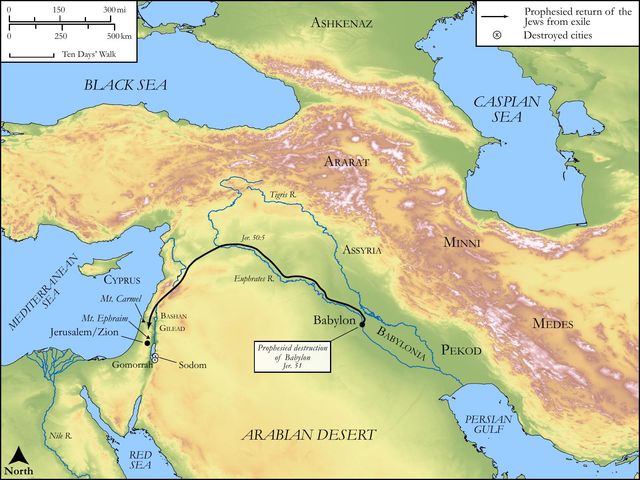
Study this verse
Public-domain commentary
Matthew Henry
From his Commentary on the Whole Bible. Henry comments on passages, not single verses — this entry covers Jeremiah 50:1–8. His three-level outline is real structure in the source text, so it is rendered as structure.
I.Here is a word spoken against Babylon by him whose works all agree with his word and none of whose words fall to the ground.
The king of Babylon had been very kind of Jeremiah, and yet he must foretel the ruin of that kingdom; for God's prophets must not be governed by favour or affection. Whoever are our friends, if, notwithstanding, they are God's enemies, we dare not speak peace to them.
1.The destruction of Babylon is here spoken of as a thing done, Jer 50:2. let it be published to the nations as a piece of news, true news, and great news, and news they are all concerned in; let them hang out the flag, as is usual on days of triumph, to give notice of it; let all the world take notice of it: Babylon is taken. Let God have the honour of it, let his people have the comfort of it, and therefore do not conceal it. Take care that it be known, that the Lord may be known by those judgments which he executes, Psa 9:16.
2.It is spoken of as a thing done thoroughly. For,
(1.)The very idols of Babylon, which the people would protect with all possible care, and from which they expected protection, shall be destroyed. Bel and Merodach were their two principal deities; they shall be confounded, and the images of them broken to pieces.
(2.)The country shall be laid waste (Jer 50:3) out of the north, from Media, which lay north of Babylon, and from Assyria, through which Cyrus made his descent upon Babylon; thence the nation shall come that shall make her land desolate. Their land was north of the countries that they destroyed, who were therefore threatened with evil from the north (Omne malum ab aquilone - Every evil comes from the north); but God will find out nations yet further north to come upon them. The pomp and power of old Rome were brought down by northern nations, the Goths and Vandals.
II.Here is a word spoken for the people of God, and for their comfort, both the children of Israel and of Judah; for many there were of the ten tribes that associated with those of the two tribes in their return out of Babylon. Now here,
1.It is promised that they shall return to their God first and then to their own land; and the promise of their conversion and reformation is that which makes way for all the other promises, Jer 50:4, Jer 50:5.
(1.)They shall lament after the Lord (as the whole house of Israel did in Samuel's time, Sa1 7:2); they shall go weeping. These tears flow not from the sorrow of the world as those when they went into captivity, but from godly sorrow; they are tears of repentance for sin, tears of joy for the goodness of God, in the dawning of the day of their deliverance, which, for aught that appears, does more towards the bringing of them to mourn for sin than all the calamities of their captivity; that prevails to lead them to repentance when the other did not prevail to drive them to it. Note, It is a good sign that God is coming towards a people in ways of mercy when they begin to be tenderly affected under his hand.
(2.)They shall enquire after the Lord; they shall not sink under their sorrows, but bestir themselves to find out comfort where it is to be had: They shall go weeping to seek the Lord their God. Those that seek the Lord must seek him sorrowing, as Christ's parents sought him, Luk 2:48. And those that sorrow must seek the Lord, and then their sorrow shall soon be turned into joy, for he will be found of those that so seek him. They shall seek the Lord as their God, and shall now have no more to do with idols. When they shall hear that the idols of Babylon are confounded and broken it will be seasonable for them to enquire after their own God and to return to him who lives for ever. Therefore men are deceived in false gods, that they may depend on the true God only.
(3.)They shall think of returning to their own country again; they shall think of it not only as a mercy, but as a duty, because there only is the holy hill of Zion, on which once stood the house of the Lord their God (Jer 50:5): They shall ask the way to Zion with their faces thitherward. Zion was the city of their solemnities; they often thought of it in the depth of their captivity (Psa 137:1); but, now that the ruin of Babylon gave them some hopes of a release, they talk of nothing else but of going back to Zion. Their hearts were upon it before, and now they set their faces thitherward. They long to be there; they set out for Zion, and resolve not to take up short of it. The journey is long and they know not the road, but they will ask the way, for they will press forward till they come to Zion; and, as they are determined not to turn back, so they are in care not to miss the way. This represents the return of poor souls to God. Heaven is the Zion they aim at as their end; on this they have set their hearts; towards this they have set their faces, and therefore they ask the way thither. They do not ask the way to heaven and set their faces towards the world; nor set their faces towards heaven and go on at a venture without asking the way. But in all true converts there are both a sincere desire to attain the end and a constant care to keep in the way; and a blessed sight it is to see people thus asking the way to heaven with their faces thitherward.
(4.)They shall renew their covenant to walk with God more closely for the future: Come, and let us join ourselves to the Lord in a perpetual covenant. They had broken covenant with God, had in effect separated themselves from him, but now they resolve to join themselves to him again, by engaging themselves afresh to be his. Thus, when backsliders return, they must do their first works, must renew the covenant they first made; and it must be a perpetual covenant, that must never be broken; and, in order to that, must never be forgotten; for a due remembrance of it will be the means of a due observance of it.
2.Their present case is lamented as very sad, and as having been long so: "My people" (for he owns them as his now that they are returning to him) "have been lost sheep (Jer 50:6); they have gone from mountain to hill, have been hurried from place to place, and could find no pasture; they have forgotten their resting-place in their own country and cannot find their way to it." And that which aggravated their misery was,
(1.)That they were led astray by their own shepherds, their own princes and priests; they turned them from their duty, and so provoked God to turn them out of their own land. It is bad with a people when their leaders cause them to err, when those that should direct them, and when those that should secure and advance their interests are the betrayers of them.
(2.)That in their wanderings they lay exposed to the beasts of prey, who thought they were entitled to them, as waifs and strays that had no owner (Jer 50:7); it is with them as with wandering sheep, all that found them have devoured them and made a prey of them; and when they did them the greatest injuries they laughed at them, telling them it was what their own prophets had many a time told them they deserved; that was far from justifying those who did them wrong, yet they bantered them with this excuse, We offend not, because they have sinned against the Lord; but they could not pretend that they had sinned against them. And see what notion they had of the Lord they had sinned against, not as the only true and living God, but only as the habitation of justice and the hope of their fathers; they had put a contempt upon the temple and upon the tradition of their ancestors, and therefore deserved to suffer these hard things. And yet it was indeed an aggravation of their sin, and justified God, though it did not justify their adversaries in what was done to them, that they had forsaken the habitation of justice and him that was the hope of their fathers.
3.They are called upon to hasten away, as soon as ever the door of liberty was opened to them (Jer 50:8): "Remove, not only out of the borders, but out of the midst of Babylon; though you be ever so well seated there, think not to settle there, but hasten to Zion, and be as the he-goats before the flocks; strive which shall be foremost, which shall lead in so good a work:" a he-goat is comely in going (Pro 30:31) because he goes first. It is a graceful thing to be forward in a good work and to set others a good example.
Continue studying Jeremiah 50:8 across the web’s major study libraries — every link below opens this exact verse, chapter, or book on the destination site.
Read & Compare
 BibleGatewayThis verse in more than 200 translations and 70 languages.
 Bible.comThe YouVersion reader — hundreds of translations, reading plans, and highlights.
 ESV.orgCrossway's official English Standard Version reader.
 NET BibleThe NET translation with 60,000+ translators' notes on every rendering decision.
 STEP BibleTyndale House's free study tool — original text, vocabulary, and scholarly resources.
 BibliaLogos Bible Software's free web reader.
 USCCBThe New American Bible (Revised Edition) with the U.S. bishops' study notes.
Commentaries
 BibleHub CommentariesDozens of classic commentaries on this verse, gathered on one page.
 StudyLightMore than 100 commentary sets — the largest collection on the web.
 BibleRefPlain-English commentary on what this verse means, verse by verse.
 Enduring WordDavid Guzik's free commentary on this chapter, widely used by Bible teachers.
 Bible Study ToolsVerse commentary alongside Greek and Hebrew study aids.
Original Language & Research
- BibleHub InterlinearThe verse word by word — original language, transliteration, and English.
- BibleHub LexiconEvery word's original-language definition and Strong's entry.
 Blue Letter BibleDeep-study tools — Strong's numbers, concordance, and word studies.
 SefariaThe Hebrew text with Rashi and centuries of Jewish commentary.
Sermons, Hymns & Audio


TrulyRandomVerse is not affiliated with these sites and doesn’t control their content. They’re linked because they’re genuinely useful.
Summary
Jeremiah 50:8 delivers a powerful divine imperative to the exiled people of Judah, commanding their swift and decisive departure from Babylon, the land of their captivity, before God's impending and comprehensive judgment falls upon the oppressive empire. This prophetic instruction not only calls for a physical exodus but also an active, courageous, and unified leadership in their return, likening them to he-goats boldly leading a flock, thereby emphasizing a proactive and determined movement away from the doomed city and its corrupting influence.
Context
ShowHideLiterary Context
Jeremiah 50:8 is situated within a monumental prophetic oracle against Babylon, encompassing chapters 50 and 51. This extensive denunciation, one of the longest in the Old Testament, meticulously details Babylon's inevitable destruction as divine retribution for its profound arrogance against God and its cruel subjugation of Judah. Amidst these pronouncements of judgment, the prophet Jeremiah interjects a direct and urgent command to the exiled Israelites. This verse serves as a crucial transition, shifting the focus from the declaration of Babylon's doom to a specific, actionable instruction for Judah's deliverance, underscoring God's protective care for His covenant people even as He executes justice on their oppressors.
Historical & Cultural Context
The historical backdrop for this prophecy is the Babylonian Exile, a period of profound national trauma for Judah that commenced with the siege of Jerusalem in 597 BC and culminated in the city's and Temple's destruction in 586 BC. The Chaldeans, specifically the Neo-Babylonian Empire, were the dominant power that had conquered Judah and deported its inhabitants. Babylon itself was a city of unparalleled magnificence, power, and idolatry, representing the zenith of the kingdoms of that day. For the exiles, it was both a place of captivity and a potential source of cultural and spiritual assimilation. The divine command to "remove out of the midst of Babylon" was a call not only for physical escape from an impending catastrophe but also for a profound cultural and spiritual disengagement from its pagan influences, echoing earlier divine calls for separation, such as Abraham's departure from Ur of the Chaldees or the Exodus from Egypt.
Key Themes
ShowHideThis verse significantly contributes to several profound themes within the book of Jeremiah and the broader prophetic corpus. Firstly, it powerfully underscores the theme of Divine Judgment and Sovereignty, illustrating that God, while using nations like Babylon as instruments of His will, ultimately holds them accountable for their pride and cruelty, leading to their inevitable downfall. Secondly, it highlights God's Faithfulness and Restoration of His covenant people; even in the depths of exile, God orchestrates a way for their return and renewal. Thirdly, the imperative to "remove" and "go forth" emphasizes Separation and Purity, urging God's people to distinguish themselves from the corrupting influences of the world. Finally, the vivid imagery of "he goats before the flocks" introduces the theme of Courageous Leadership and Initiative in response to God's call, contrasting sharply with passive resignation or fear, and foreshadowing the eventual return to Zion, as seen in passages like Isaiah 48:20.
Exposition and Analysis
ShowHideKey Word Analysis
ShowHideThis primitive root signifies "to nod, i.e. waver; figuratively, to wander, flee, disappear." While it can denote a gentle movement, in the context of this urgent imperative, it conveys a decisive and complete departure, a shaking off or a fleeing from a place. It implies a total disassociation and movement away from the impending disaster, demanding a swift and unhesitating exit.
A highly common and versatile primitive root, meaning "to go (causatively, bring) out." It denotes an active, outward movement or exit, often with purpose. Paired with "remove," it powerfully reinforces the imperative for a clear and unambiguous departure from Babylon, emphasizing not just the act of leaving, but actively stepping out and away from the oppressive domain.
Derived from a root meaning "prepared" or "full grown," this term specifically refers to mature male goats or rams. Figuratively, it is consistently used to describe leaders of the people. These animals are renowned for their strength, their inherent tendency to lead the flock, and their decisive, often fearless, movement. This metaphor powerfully conveys the expected manner of departure for the exiles: not timidly or hesitantly, but with strength, confidence, and a spirit of leadership.
Verse Breakdown
ShowHide"Remove out of the midst of Babylon"
This clause issues a direct and urgent command for the exiles to physically evacuate the city of Babylon. The term "midst" (H8432, tâvek) implies leaving the very heart and center of the empire, suggesting a complete break from its influence and impending doom. It is a clarion call to disentangle themselves from the system, society, and spiritual corruption of their captors.
"and go forth out of the land of the Chaldeans"
This clause powerfully reinforces and expands upon the previous command, broadening the scope from the city itself to the entire territory controlled by the Chaldeans (H3778, Kasdîy). The repetition emphasizes the comprehensive nature of the required departure – not just from the city, but from the entire dominion of the Babylonian empire, signifying a total and unequivocal separation from their oppressive rule and its pervasive idolatry.
"and be as the he goats before the flocks"
This profound metaphorical command instructs the exiles on how they are to depart. Instead of behaving like timid or scattered sheep, they are to act like strong, leading he-goats (H6260, ʻattûwd), who confidently lead the way for the rest of the flock (H6629, tsôʼn). This imagery implies a swift, organized, and courageous exodus, with the exiles taking initiative and demonstrating bold leadership rather than passively waiting, hesitating, or being driven by fear.
Literary Devices
ShowHideJeremiah 50:8 masterfully employs several potent literary devices to convey its urgent and layered message. The most prominent device is Metaphor, vividly expressed in the phrase "be as the he goats before the flocks." This imagery immediately conjures a picture of strong, decisive, and pioneering leadership, standing in stark contrast to the more common biblical portrayal of sheep as vulnerable and dependent. It transforms the exiles from passive captives into active, courageous agents of their own divinely ordained deliverance. The verse also heavily utilizes Imperative Mood throughout ("Remove," "go forth," "be"), which creates an undeniable sense of direct command and urgency, demanding immediate and resolute action rather than contemplation or delay. Furthermore, a degree of Parallelism is evident in the repeated calls to depart ("Remove out of the midst of Babylon, and go forth out of the land of the Chaldeans"), which serves to emphasize the comprehensive and unavoidable nature of the required exodus, reinforcing the totality of the separation.
Theological and Thematic Connections
ShowHideJeremiah 50:8 resonates profoundly with the overarching biblical narrative of God's redemptive plan, particularly His consistent call for His people to separate from worldly systems and to anticipate His ultimate judgment. This command to depart from Babylon is not merely a historical instruction for ancient Israel but serves as a powerful prophetic archetype for divine separation and the urgency of responding to God's call for deliverance in every age. It underscores God's absolute sovereignty over all nations, demonstrating His power to raise up empires and to bring them down, always with the ultimate purpose of preserving, purifying, and restoring His covenant people. The call to be "as the he goats" also highlights God's expectation for His people to act with courage, initiative, and spiritual maturity in their faith journey, not passively awaiting deliverance but actively participating in their spiritual and physical liberation, trusting in His leading.
Reflection and Application
ShowHideJeremiah 50:8 offers a timeless and profound spiritual principle for believers across all generations. While the literal command was for ancient Israel to flee a geographical Babylon, its deeper meaning calls us to discern and courageously separate from any "Babylon" in our contemporary lives – any system, ideology, cultural norm, or lifestyle that stands in opposition to God's kingdom and threatens to entangle us in its impending judgment. This separation is not merely physical but primarily spiritual and ethical, demanding that we actively disengage from worldly values, sinful practices, and corrupting influences that seek to hold us captive. Furthermore, the vivid imagery of the "he goats" challenges us to move with courage, initiative, and leadership in our faith journey. We are not called to be timid or passive followers, but to be bold in our convictions, leading the way in righteousness and actively pursuing God's will, even when it means going against the current of popular culture, personal comfort, or societal pressure. This verse urgently prompts us to live with a profound awareness of God's ultimate judgment on all unrighteousness and to align ourselves fully with His redemptive purposes, actively pursuing holiness and leading others towards the path of liberation found in Christ.
Questions for Reflection
ShowHideFAQ
ShowHideWhy was it so important for the exiles to leave Babylon?
ShowHideIt was crucial for the exiles to leave Babylon for several compelling reasons. Primarily, God had declared impending and devastating judgment upon Babylon for its idolatry, arrogance, and particularly its cruel treatment of His covenant people. Remaining in Babylon would mean being caught in the comprehensive destruction that God had prophesied. Secondly, their departure was essential for the fulfillment of God's covenant promises regarding their return to the land of Judah and the rebuilding of Jerusalem and the Temple. This exodus marked a necessary physical and spiritual separation from a pagan empire, allowing them to reconstitute themselves as God's distinct and holy people, preparing for the spiritual renewal and national restoration that God had promised. This call to "go forth out of the land of the Chaldeans" was therefore a divine act of rescue, a command for obedience, and a foundational step towards ensuring their safety and the continuation of their unique national and religious identity.
What does "be as the he goats before the flocks" mean for believers today?
ShowHideFor believers today, the command to "be as the he goats before the flocks" is a powerful and enduring metaphor for courageous, proactive, and discerning spiritual leadership. He-goats are known for their strength, determination, and their natural tendency to lead the flock. This vivid imagery encourages us not to be timid, hesitant, or merely passive followers in our faith journey. Instead, it calls us to be bold in our convictions, to take initiative in obedience to God's commands, to lead by example in righteousness, and to actively move forward in faith, even when facing challenges, uncertainty, or opposition. It signifies a call to spiritual maturity and a willingness to step out in faith, guiding others through our steadfast commitment to Christ, much like Jesus Himself leads His flock as the Good Shepherd. It implies a proactive stance against the currents of the world, demonstrating a clear direction and purpose.
Christ-Centered Fulfillment
ShowHideJeremiah 50:8 finds its ultimate and profound Christ-centered fulfillment in the person and redemptive work of Jesus, who is the true and ultimate Leader of God's people in a new and greater exodus. Just as ancient Israel was called to depart from physical Babylon, believers in Christ are called to "come out" of spiritual Babylon—the world system alienated from God, characterized by sin, idolatry, and rebellion, as powerfully depicted in Revelation 18:4. Jesus Himself decisively leads this spiritual exodus, not merely from a geographic location but from the dominion of sin and death. He is the "he goat" par excellence, the Lamb of God who takes away the sin of the world, who, through His atoning sacrifice and triumphant resurrection, decisively leads His flock, paving the way for our liberation. Through His life, death, and resurrection, Christ provides the means for us to "remove" ourselves from the "midst" of spiritual bondage and "go forth" into the glorious freedom of His kingdom. He is our Shepherd who goes before us, guiding us into truth and righteousness, enabling us to live as a distinct people, separated unto God, and anticipating the glorious consummation of His eternal kingdom, where there will be no more "Babylon" to flee from, only the New Jerusalem where God dwells eternally with His redeemed people.