


Revelation 21:2
Bible text: King James Version (1769 Blayney text) · Public domain
Bible text: King James Version with Strong's numbers · Public domain
Bible text: Berean Standard Bible · Public domain
Bible text: American Standard Version (1901) · Public domain
Bible text: World English Bible, Messianic edition · Public domain
Bible text: Geneva Bible (1599) · Public domain
Bible text: Young's Literal Translation · Public domain
- καὶkaiAndG2532CONJConjunction
- ἐγὼegōI myselfG1473P-1NSPersonal pronoun Nominative 1st Singular
- ἸωάννηςIōannēsJohnG2491N-NSM-PNoun Nominative Singular Masculine Individual
- τὴνtēntheG3588T-ASFDefinite article Accusative Singular Feminine
- πόλινpolincityG4172N-ASFNoun Accusative Singular Feminine
- τὴνtēn<the>G3588T-ASFDefinite article Accusative Singular Feminine
- ἁγίανhagianholyG40A-ASFAdjective Accusative Singular Feminine
- ἸερουσαλὴμIerousalēmJerusalemG2419N-ASF-LNoun Accusative Singular Feminine Location
- καινὴνkainēnnewG2537A-ASFAdjective Accusative Singular Feminine
- εἶδονeidonI sawG1492V-2AAI-1SVerb 2nd Aorist Active Indicative 1st Singular
- καταβαίνουσανkatabainousancoming downG2597V-PAP-ASFVerb Present Active Participle Accusative Singular Feminine
- ἐκekout ofG1537PREPPreposition
- τοῦtou<the>G3588T-GSMDefinite article Genitive Singular Masculine
- οὐρανοῦouranouheavenG3772N-GSMNoun Genitive Singular Masculine
- ἀπὸapofromG575PREPPreposition
- τοῦtou<the>G3588T-GSMDefinite article Genitive Singular Masculine
- θεοῦtheouGodG2316N-GSM-TNoun Genitive Singular Masculine Title
- ἡτοιμασμένηνhētoimasmenēnpreparedG2090V-RPP-ASFVerb Perfect Passive Participle Accusative Singular Feminine
- ὡςhōsasG5613PRTParticle or Disjunctive
- νύμφηνnumphēna brideG3565N-ASFNoun Accusative Singular Feminine
- κεκοσμημένηνkekosmēmenēnadornedG2885V-RPP-ASFVerb Perfect Passive Participle Accusative Singular Feminine
- τῷtōfor theG3588T-DSMDefinite article Dative Singular Masculine
- ἀνδρὶandrihusbandG435N-DSMNoun Dative Singular Masculine
- αὐτῆςautēsof herG846P-GSFPersonal pronoun Genitive Singular Feminine
English is a literal word-by-word gloss of the Greek, not the KJV's wording. Why?
This is the original text the KJV's translators worked from — each Greek word with its own literal English meaning in this verse, prepared by scholars at Tyndale House, Cambridge. The KJV translates whole sentences, not word by word, so its wording differs: one Greek word can become several English words, and the KJV may choose “charity” where the gloss reads “love”. Both are faithful — they answer different questions. For the KJV's own rendering, switch to the KJV text.
Details
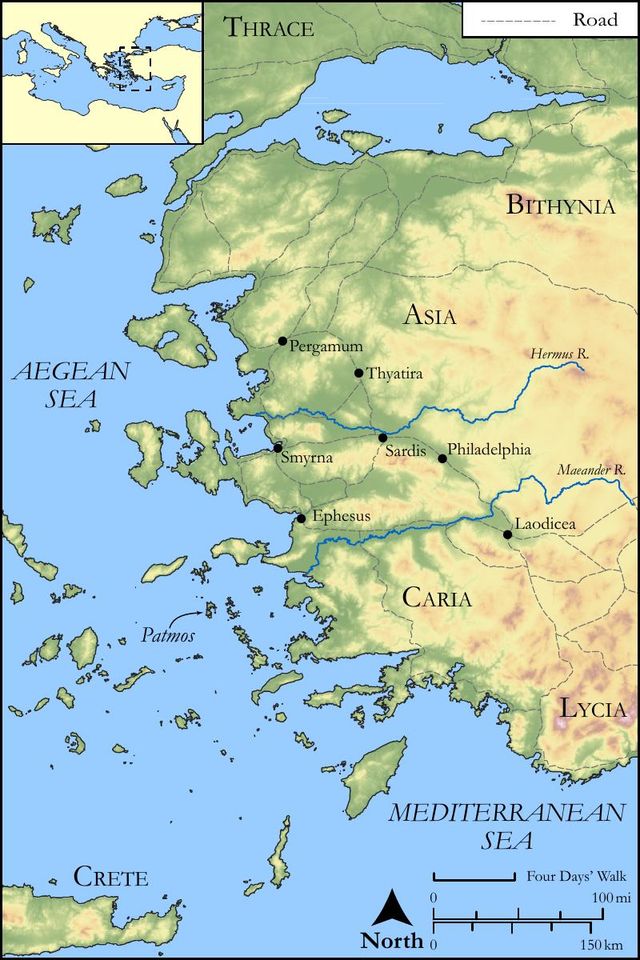
See on the biblical-era maps

Study this verse
Public-domain commentary
Matthew Henry
From his Commentary on the Whole Bible. Henry comments on passages, not single verses — this entry covers Revelation 21:1–8. His four-level outline is real structure in the source text, so it is rendered as structure.
We have here a more general account of the happiness of the church of God in the future state, by which it seems most safe to understand the heavenly state.
I.A new world now opens to our view (Rev 21:1):
I saw a new heaven and a new earth; that is, a new universe; for we suppose the world to be made up of heaven and earth. By the new earth we may understand a new state for the bodies of men, as well as a heaven for their souls. This world is not now newly created, but newly opened, and filled with all those who were the heirs of it. The new heaven and the new earth will not then be distinct; the very earth of the saints, their glorified bodies, will now be spiritual and heavenly, and suited to those pure and bright mansions. To make way for the commencement of this new world, the old world, with all its troubles and commotions, passed away.
II.In this new world the apostle saw the holy city, the new Jerusalem, coming down from heaven, not locally, but as to its original:
this new Jerusalem is the church of God in its new and perfect state, prepared as a bride adorned for her husband, beautified with all perfection of wisdom and holiness, meet for the full fruition of the Lord Jesus Christ in glory.
III.The blessed presence of God with his people is here proclaimed and admired:
I heard a great voice out of heaven, saying, Behold, the tabernacle of God is with men, etc., Rev 21:3. Observe,
1.The presence of God with his church is the glory of the church.
2.It is matter of wonder that a holy God should ever dwell with any of the children of men.
3.The presence of God with his people in heaven will not be interrupted as it is on earth, but he will dwell with them continually.
4.The covenant, interest, and relation, that there are now between God and his people, will be filled up and perfected in heaven. They shall be his people; their souls shall be assimilated to him, filled with all the love, honour, and delight in God which their relation to him requires, and this will constitute their perfect holiness; and he will be their God: God himself will be their God; his immediate presence with them, his love fully manifested to them, and his glory put upon them, will be their perfect happiness; then he will fully answer the character of the relation on his part, as they shall do on their part.
IV.This new and blessed state will be free from all trouble and sorrow; for,
1.All the effects of former trouble shall be done away. They have been often before in tears, by reason of sin, of affliction, of the calamities of the church; but now all tears shall be wiped away; no signs, no remembrance of former sorrows shall remain, any further than to make their present felicity the greater. God himself, as their tender Father, with his own kind hand, shall wipe away the tears of his children; and they would not have been without those tears when God shall come and wipe them away.
2.All the causes of future sorrow shall be for ever removed: There shall be neither death nor pain; and therefore no sorrow nor crying; these are things incident to that state in which they were before, but now all former things have passed away.
V.The truth and certainty of this blessed state are ratified by the word and promise of God, and ordered to be committed to writing, as matter of perpetual record, Rev 21:5, Rev 21:6. The subject-matter of this vision is so great, and of such great importance to the church and people of God, that they have need of the fullest assurances of it; and God therefore from heaven repeats and ratifies the truth thereof. Besides, many ages must pass between the time when this vision was given forth and the accomplishment of it, and many great trials must intervene; and therefore God would have it committed to writing, for perpetual memory, and continual use to his people. Observe,
1.The certainty of the promise averred: These words are faithful and true; and it follows, It is done, is as sure as if it were done already. We may and ought to take God's promise as present payment; if he has said that he makes all things new, it is done.
2.He gives us his titles of honour as a pledge or surety of the full performance, even those titles of Alpha and Omega, the beginning and the end. As it was his glory that he gave the rise and beginning to the world and to his church, it will be his glory to finish the work begin, and not to leave it imperfect. As his power and will were the first cause of all things, his pleasure and glory are the last end, and he will not lose his design; for then he would no longer be the Alpha and Omega. Men may begin designs which they can never bring to perfection; but the counsel of God shall stand, and he will do all his pleasure.
3.The desires of his people towards this blessed state furnish another evidence of the truth and certainty of it. They thirst after a state of sinless perfection and the uninterrupted enjoyment of God, and God has wrought in them these longing desires, which cannot be satisfied with any thing else, and therefore would be the torment of the soul if they were disappointed but it would be inconsistent with the goodness of God, and his love to his people, to create in them holy and heavenly desires, and then deny them their proper satisfaction; and therefore they may be assured that, when they have overcome their present difficulties, he will give them of the fountain of the water of life freely.
VI.The greatness of this future felicity is declared and illustrated,
1.By the freeness of it - it is the free gift of God: He gives of the water of life freely; this will not make it less but more grateful to his people.
2.The fulness of it. The people of God then lie at the fountain-head of all blessedness: they inherit all things (Rev 21:7); enjoying God, they enjoy all things. He is all in all.
3.By the tenure and title by which they enjoy this blessedness - by right of inheritance, as the sons of God, a title of all others the most honourable, as resulting from so near and endeared a relation to God himself, and the most sure and indefeasible, that can no more cease than the relation from which it results.
4.By the vastly different state of the wicked. Their misery helps to illustrate the glory and blessedness of the saints, and the distinguishing goodness of God towards them, Rev 21:8. Here observe,
(1.)The sins of those who perish, among which are first mentioned their cowardliness and unbelief. The fearful lead the van in this black list. They durst not encounter the difficulties of religion, and their slavish fear proceeded from their unbelief; but those who were so dastardly as not to dare to take up the cross of Christ, and discharge their duty to him, were yet so desperate as to run into all manner of abominable wickedness - murder, adultery, sorcery, idolatry, and lying.
(2.)Their punishment: They have their part in the lake that burns with fire and brimstone, which is the second death.
[1.]They could not burn at a stake for Christ, but they must burn in hell for sin.
[2.]They must die another death after their natural death; the agonies and terrors of the first death will consign them over to the far greater terrors and agonies of eternal death, to die and to be always dying.
[3.]This misery will be their proper part and portion, what they have justly deserved, what they have in effect chosen, and what they have prepared themselves for by their sins. Thus the misery of the damned will illustrate the blessedness of those that are saved, and the blessedness of the saved will aggravate the misery of those that are damned.
Historical interpretation
Eight Centuries of Reception
8 surviving comments on this verse. Each one is dated, so this reads as a timeline rather than a list.
Select a marker to jump to its quote. Markers stagger vertically where authors wrote within a few decades of each other.
He does not say this with any thought of an erratic Aeon, or of any other power which departed from the Pleroma, or of Prunicus, but of the Jerusalem which has been delineated on
Of this Jerusalem the former one is an image—that Jerusalem of the former earth in which the righteous are disciplined beforehand for incorruption and prepared for salvation. And of this tabernacle Moses received the pattern in the mount; and nothing is capable of being allegorized, but all things are steadfast and true and substantial, having been made by God for righteous people’s enjoyment. For as it is God truly who raises up humankind, so also does humankind truly rise from the dead, and not allegorically.… And as he rises actually, so also shall he be actually disciplined beforehand for incorruption and shall go forward and flourish in the times of the kingdom, in order that he may be capable of receiving the glory of the Father.
But we do confess that a kingdom is promised to us upon the earth, although before heaven, only in another state of existence; inasmuch as it will be after the resurrection for a thousand years in the divinely-built city of Jerusalem, "let down from heaven," [Revelation 21:2] which the apostle also calls "our mother from above;" [Galatians 4:26] and, while declaring that our πολίτευμα, or citizenship, is in heaven, he predicates of it that it is really a city in heaven. This both Ezekiel had knowledge of [Ezekiel 48:30-35] and the Apostle John beheld. [Revelation 21:10-23] And the word of the new prophecy which is a part of our belief, attests how it foretold that there would be for a sign a picture of this very city exhibited to view previous to its manifestation. This prophecy, indeed, has been very lately fulfilled in an expedition to the East. For it is evident from the testimony of even heathen witnesses, that in Judæa there was suspended in the sky a city early every morning for forty days. As the day advanced, the entire figure of its walls would wane gradually, and sometimes it would vanish instantly. We say that this city has been provided by God for receiving the saints on their resurrection, and refreshing them with the abundance of all really spiritual blessings, as a recompense for those which in the world we have either despised or lost; since it is both just and God-worthy that His servants should have their joy in the place where they have also suffered affliction for His name's sake. Of the heavenly kingdom this is the process. After its thousand years are over, within which period is completed the resurrection of the saints, who rise sooner or later according to their deserts there will ensue the destruction of the world and the conflagration of all things at the judgment: we shall then be changed in a moment into the substance of angels, even by the investiture of an incorruptible nature, and so be removed to that kingdom in heaven of which we have now been treating, just as if it had not been predicted by the Creator, and as if it were proving Christ to belong to the other god and as if he were the first and sole revealer of it.
This city is said to come down out of heaven in the sense that God created it by means of heavenly grace, as he told it through Isaiah: “I am the Lord creating thee.” Indeed, its descent from heaven began with the beginning of time, since it is by God’s grace coming down from above through the “laver of regeneration” in the Holy Spirit sent from heaven that its citizenship has continuously grown up on earth. Yet only after God’s last judgment, the one he has deputed to Jesus Christ his Son, will his tremendous gift of grace be revealed so brightly in [Jerusalem] that in this new brightness there will remain no traces of its earthly blemishes. For then its members’ bodies will pass over from mortal corruptibility to the new immortality of incorruption.
The heavenly Jerusalem is the multitude of the saints who will come with the Lord, even as Zechariah said: “Behold, my Lord God will come, and all his saints with him.” These are being prepared for God as a fine dwelling, namely, those who will live with him. “As a bride adorned for her husband.” Adorned with holiness and righteousness, they go to be united with their Lord and shall remain with him forever.
This passage shows the renewal and transformation to a more brilliant appearance that the Jerusalem above will acquire when it comes down from the incorporeal powers above to humankind, since Christ, our God, has become the common Head of both. This city is constructed of the saints concerning whom it is written, “Holy stones are rolled upon the land,” and it has Christ as its cornerstone. It is called a “city,” since it is the dwelling place of the kingly Trinity—for [the Trinity] dwells in it and walks in it, as he promised—and it is called “bride,” since it is joined to the Lord and is united with him in the highest, inseparable conjunction. It is “adorned,” since within, as the psalm says, it has glory and youth in its manifold virtues.
And the holy city, new Jerusalem, etc. This city is said to descend from heaven because it is made by the grace of God, which is heavenly. It is prepared as a bride adorned for her husband; for there is another Jerusalem that is not adorned for her husband, but for an adulterer.
And he says: And I saw the holy city, the new Jerusalem, descending out of heaven from God, prepared as a bride adorned for her husband. By Jerusalem he associates the blessed end and dwelling of the saints, which having called Jerusalem figuratively both now and in the times to come he has adorned magnificently and fittingly, that from sensible things we may send our mind to the intelligible blessedness and conduct of the saints.
Was I not right in the above when I said that the vision calls the end of the holy ones and the dwelling there a figurative Jerusalem?
Continue studying Revelation 21:2 across the web’s major study libraries — every link below opens this exact verse, chapter, or book on the destination site.
Read & Compare
 BibleGatewayThis verse in more than 200 translations and 70 languages.
 Bible.comThe YouVersion reader — hundreds of translations, reading plans, and highlights.
 ESV.orgCrossway's official English Standard Version reader.
 NET BibleThe NET translation with 60,000+ translators' notes on every rendering decision.
 STEP BibleTyndale House's free study tool — original text, vocabulary, and scholarly resources.
 BibliaLogos Bible Software's free web reader.
 USCCBThe New American Bible (Revised Edition) with the U.S. bishops' study notes.
Commentaries
 BibleHub CommentariesDozens of classic commentaries on this verse, gathered on one page.
 StudyLightMore than 100 commentary sets — the largest collection on the web.
 BibleRefPlain-English commentary on what this verse means, verse by verse.
 Enduring WordDavid Guzik's free commentary on this chapter, widely used by Bible teachers.
 Bible Study ToolsVerse commentary alongside Greek and Hebrew study aids.
Original Language & Research
- BibleHub InterlinearThe verse word by word — original language, transliteration, and English.
- BibleHub LexiconEvery word's original-language definition and Strong's entry.
 Blue Letter BibleDeep-study tools — Strong's numbers, concordance, and word studies.
 CNTR CollationThe earliest Greek manuscripts of this verse, collated letter by letter.
Sermons, Hymns & Audio


TrulyRandomVerse is not affiliated with these sites and doesn’t control their content. They’re linked because they’re genuinely useful.
Summary
Revelation 21:2 presents the apostle John's vision of the "holy city, new Jerusalem," descending from God out of heaven. This celestial city is depicted with the tender and beautiful imagery of a bride meticulously prepared and adorned for her husband, symbolizing the ultimate culmination of God's redemptive plan and the eternal dwelling place for His people, characterized by divine purity, beauty, and intimate communion with the Creator.
Context
ShowHideLiterary Context
Revelation 21 inaugurates the final, glorious phase of John's apocalyptic vision, following the defeat of all evil, the Great White Throne Judgment, and the passing away of the old heaven and earth described in Revelation 20 and Revelation 21:1. This chapter shifts dramatically from conflict and judgment to the establishment of God's eternal dwelling with humanity. Verse 2 introduces the central image of this new creation—the New Jerusalem—setting the stage for the detailed descriptions of its glory, its inhabitants, and the direct presence of God that follow in subsequent verses, particularly Revelation 21:3-8.
Historical & Cultural Context
The imagery of a city, particularly Jerusalem, held profound significance for John's original Jewish-Christian audience. The earthly Jerusalem was the spiritual and political center, but also a city that had faced destruction and corruption. The concept of a "new" or "heavenly" Jerusalem was not entirely novel, appearing in intertestamental Jewish thought and early Christian writings (e.g., Hebrews 11:10 and Galatians 4:26). The metaphor of a "bride adorned for her husband" was a powerful symbol of purity, beauty, readiness, and covenantal union in Israel, often used in the Old Testament to describe God's relationship with Israel (e.g., Isaiah 61:10) and in the New Testament to depict the Church's relationship with Christ (e.g., Ephesians 5:25-27).
Key Themes
ShowHideThis verse contributes significantly to several overarching themes in Revelation and the broader biblical narrative. It highlights the theme of Divine Initiative and Sovereignty, as the city descends "from God out of heaven," emphasizing that humanity's ultimate destiny is a gift from God, not a human achievement. The depiction of the city as "holy" and "new" underscores the theme of Purity and Perfection, signifying a creation entirely free from sin and decay, a stark contrast to the fallen world. Most prominently, the "bride" imagery powerfully develops the theme of Covenantal Union and Intimacy between God/Christ and His redeemed people, fulfilling the long-held desire for God to dwell among humanity, as foreshadowed in the tabernacle and temple traditions, and ultimately realized in the new creation. This anticipates the explicit declaration in Revelation 21:3.
Exposition and Analysis
ShowHideKey Word Analysis
ShowHideThis verb, used here in the perfect tense, signifies John's direct, experiential apprehension of this vision. It implies not merely a casual glance but a profound, revelatory perception, emphasizing the reality and certainty of what he is witnessing. John is not speculating; he is beholding a divinely revealed truth.
The Greek word kainós denotes newness in quality, character, and kind, rather than merely newness in time (neos). This "new Jerusalem" is not a renovated or restored version of the old, earthly city, but a qualitatively superior, unprecedented, and fresh creation. It signifies a complete transformation and a new order of existence, perfectly aligned with God's holy nature.
This word implies to put in proper order, to decorate, or to arrange beautifully. When applied to a bride, it evokes images of exquisite preparation, meticulous attention to detail, and a radiant beauty achieved through careful arrangement. It suggests that the "bride" (the New Jerusalem, symbolizing the Church) is made perfectly ready and beautiful for her divine union, reflecting the sanctifying work of God.
Verse Breakdown
ShowHide"And I John saw the holy city, new Jerusalem,"
This clause establishes the subject of John's vision: a magnificent urban entity, identified as "the holy city" and "new Jerusalem." The term "holy city" immediately signifies its consecrated nature, set apart for God's purposes and free from defilement. The designation "new Jerusalem" distinguishes it from its earthly counterpart, emphasizing its qualitative superiority and eschatological significance.
"coming down from God out of heaven,"
This phrase clarifies the origin and nature of the city. It is not built by human hands or earthly efforts but is a divine creation, originating "from God" and descending "out of heaven." This emphasizes its supernatural, pure, and perfect character, underscoring God's initiative in establishing the eternal dwelling place for His people. Its descent signifies the culmination of God's plan to dwell intimately with humanity.
"prepared as a bride adorned for her husband."
This powerful simile provides the primary interpretive key for understanding the city's essence. The New Jerusalem is likened to a bride, meticulously "prepared" and "adorned" for her wedding day. This imagery speaks to beauty, purity, readiness, and the anticipation of an intimate, covenantal union. In the context of Revelation, the "bride" often symbolizes the Church, the collective body of believers, suggesting that the city embodies the perfected, glorified people of God in their ultimate union with Christ.
Literary Devices
ShowHideRevelation 21:2 is rich in Symbolism and Metaphor. The "new Jerusalem" is a profound symbol, representing not merely a physical city, but the ultimate dwelling place of God with His redeemed people, embodying divine presence, peace, and perfection. The most striking device is the Metaphor of the city as "a bride adorned for her husband." This metaphor is deeply significant, drawing on biblical traditions where Israel and later the Church are portrayed as the bride of God or Christ. It conveys purity, beauty, readiness, and the intimate, covenantal relationship between God and His people. The phrase also employs Personification, as the city is described with attributes typically ascribed to a person—being "prepared" and "adorned"—thereby enhancing the vividness and emotional resonance of the imagery.
Theological and Thematic Connections
ShowHideRevelation 21:2 beautifully encapsulates the eschatological hope of the believer, portraying the ultimate realization of God's redemptive purpose: to dwell eternally and intimately with His people. This vision of the New Jerusalem as a divinely prepared, holy city, descending from heaven, signifies the culmination of salvation history, where the separation between God and humanity, caused by sin, is finally and completely overcome. The imagery of the "bride adorned for her husband" powerfully conveys the Church's perfected state, purified and glorified through Christ's work, ready for eternal communion with Him. It speaks to the beauty of holiness, the joy of union, and the security of a permanent, divine dwelling. This verse assures believers that their ultimate destiny is not merely an abstract spiritual state, but a tangible, glorious reality where God's presence is fully manifest among His redeemed.
Reflection and Application
ShowHideRevelation 21:2 offers a profound source of hope, comfort, and motivation for believers navigating the complexities and trials of the present age. This vivid portrayal of the New Jerusalem—holy, new, and divinely prepared—reminds us that our ultimate home is not of this world, but a glorious, eternal reality established by God Himself. It encourages us to live with an eternal perspective, understanding that our present sufferings are temporary and incomparable to the glory that awaits. The imagery of the Church as a "bride adorned" calls us to pursue purity and holiness in our lives, recognizing that we are being prepared for an intimate and eternal union with Christ. This vision inspires us to live in a manner worthy of our future inheritance, actively participating in God's redemptive work, and eagerly anticipating the day when we will dwell in perfect communion with Him in the New Jerusalem. It assures us that God's plan for His creation and His people culminates in unparalleled beauty, peace, and joy.
Questions for Reflection
ShowHideFAQ
ShowHideIs the New Jerusalem a literal city or purely symbolic?
ShowHideWhile the book of Revelation is rich in symbolism, biblical scholars hold varying views on the literalness of the New Jerusalem. Many interpret it as a literal, physical city that will descend to the new earth, given the detailed architectural descriptions that follow in Revelation 21:9-27. However, even if literal, it also carries profound symbolic meaning. It represents the perfected dwelling place of God with His people, the culmination of salvation history, and the ultimate expression of divine presence and communion. It embodies the Church in its glorified state, pure and ready for eternal union with Christ. Thus, it is both a tangible reality and a powerful symbol of God's eternal kingdom.
Christ-Centered Fulfillment
ShowHideRevelation 21:2 finds its ultimate fulfillment and profound significance in the person and work of Jesus Christ. The "holy city, new Jerusalem," descending from God, is the direct result of Christ's redemptive mission. It is through His perfect life, atoning death as the Lamb of God who takes away the sin of the world, and triumphant resurrection that humanity can be reconciled to God and enter into this eternal dwelling. The imagery of the city "prepared as a bride adorned for her husband" points directly to Christ as the Bridegroom, who "loved the church and gave himself up for her, that he might sanctify her, having cleansed her by the washing of water with the word, so that he might present the church to himself in splendor, without spot or wrinkle or any such thing, that she might be holy and blameless" (Ephesians 5:25-27). Jesus Himself promised to "go and prepare a place for you" (John 14:2-3), and the New Jerusalem is the glorious manifestation of that promise. It is the place where the curse is no more, and the throne of God and the Lamb will be in it (Revelation 22:3). Thus, the New Jerusalem is not merely a destination, but the eternal home where Christ's redemptive work is fully realized, and His people dwell in perfect, unbroken communion with Him.