


Revelation 3:12
- ὁhoThe [one]G3588T-NSMDefinite article Nominative Singular Masculine
- νικῶνnikōnovercomingG3528V-PAP-NSMVerb Present Active Participle Nominative Singular Masculine
- ποιήσωpoiēsōI will makeG4160V-FAI-1SVerb Future Active Indicative 1st Singular
- αὐτὸνautonhimG846P-ASMPersonal pronoun Accusative Singular Masculine
- στῦλονstulona pillarG4769N-ASMNoun Accusative Singular Masculine
- ἐνeninG1722PREPPreposition
- τῷtōtheG3588T-DSMDefinite article Dative Singular Masculine
- ναῷnaōtempleG3485N-DSMNoun Dative Singular Masculine
- τοῦtouof theG3588T-GSMDefinite article Genitive Singular Masculine
- θεοῦtheouGodG2316N-GSM-TNoun Genitive Singular Masculine Title
- μουmouof MineG3165P-1GSPersonal pronoun Genitive 1st Singular
- καὶkaiandG2532CONJConjunction
- ἔξωexōoutG1854PREPPreposition
- οὐoucertainlyG3756PRT-NNegative Particle Negative
- μὴmēnotG3361PRT-NNegative Particle Negative
- ἐξέλθῃexelthēshall he goG1831V-2AAS-3SVerb 2nd Aorist Active Subjunctive 3rd Singular
- ἔτιetianymoreG2089ADVAdverb
- καὶkaiAndG2532CONJConjunction
- γράψωgrapsōI will writeG1125V-FAI-1SVerb Future Active Indicative 1st Singular
- ἐπ᾽ep᾽uponG1909PREPPreposition
- αὐτὸνautonhimG846P-ASMPersonal pronoun Accusative Singular Masculine
- τὸtotheG3588T-ASNDefinite article Accusative Singular Neuter
- ὄνομαonomanameG3686N-ASNNoun Accusative Singular Neuter
- τοῦtouof theG3588T-GSMDefinite article Genitive Singular Masculine
- θεοῦtheouGodG2316N-GSM-TNoun Genitive Singular Masculine Title
- μουmouof MineG3165P-1GSPersonal pronoun Genitive 1st Singular
- καὶkaiandG2532CONJConjunction
- τὸtotheG3588T-ASNDefinite article Accusative Singular Neuter
- ὄνομαonomanameG3686N-ASNNoun Accusative Singular Neuter
- τῆςtēsof theG3588T-GSFDefinite article Genitive Singular Feminine
- πόλεωςpoleōscityG4172N-GSFNoun Genitive Singular Feminine
- τοῦtouof theG3588T-GSMDefinite article Genitive Singular Masculine
- θεοῦtheouGodG2316N-GSM-TNoun Genitive Singular Masculine Title
- μουmouof MineG3165P-1GSPersonal pronoun Genitive 1st Singular
- τῆςtēstheG3588T-GSFDefinite article Genitive Singular Feminine
- καινῆςkainēsnewG2537A-GSFAdjective Genitive Singular Feminine
- ἸερουσαλήμIerousalēmJerusalemG2419N-GSF-LNoun Genitive Singular Feminine Location
- ἡhēwhichG3588T-NSFDefinite article Nominative Singular Feminine
- καταβαίνουσαkatabainousais descendingG2597V-PAP-NSFVerb Present Active Participle Nominative Singular Feminine
- ἐκekout ofG1537PREPPreposition
- τοῦtou<the>G3588T-GSMDefinite article Genitive Singular Masculine
- οὐρανοῦouranouheavenG3772N-GSMNoun Genitive Singular Masculine
- ἀπὸapofromG575PREPPreposition
- τοῦtoutheG3588T-GSMDefinite article Genitive Singular Masculine
- θεοῦtheouGodG2316N-GSM-TNoun Genitive Singular Masculine Title
- μουmouof MineG3165P-1GSPersonal pronoun Genitive 1st Singular
- καὶkaiandG2532CONJConjunction
- τὸtotheG3588T-ASNDefinite article Accusative Singular Neuter
- ὄνομάonomanameG3686N-ASNNoun Accusative Singular Neuter
- μουmouof MeG3165P-1GSPersonal pronoun Genitive 1st Singular
- τὸto<the>G3588T-ASNDefinite article Accusative Singular Neuter
- καινόνkainonnewG2537A-ASNAdjective Accusative Singular Neuter
English is a literal word-by-word gloss of the Greek, not the KJV's wording. Why?
This is the original text the KJV's translators worked from — each Greek word with its own literal English meaning in this verse, prepared by scholars at Tyndale House, Cambridge. The KJV translates whole sentences, not word by word, so its wording differs: one Greek word can become several English words, and the KJV may choose “charity” where the gloss reads “love”. Both are faithful — they answer different questions. For the KJV's own rendering, switch to the KJV text.
Details
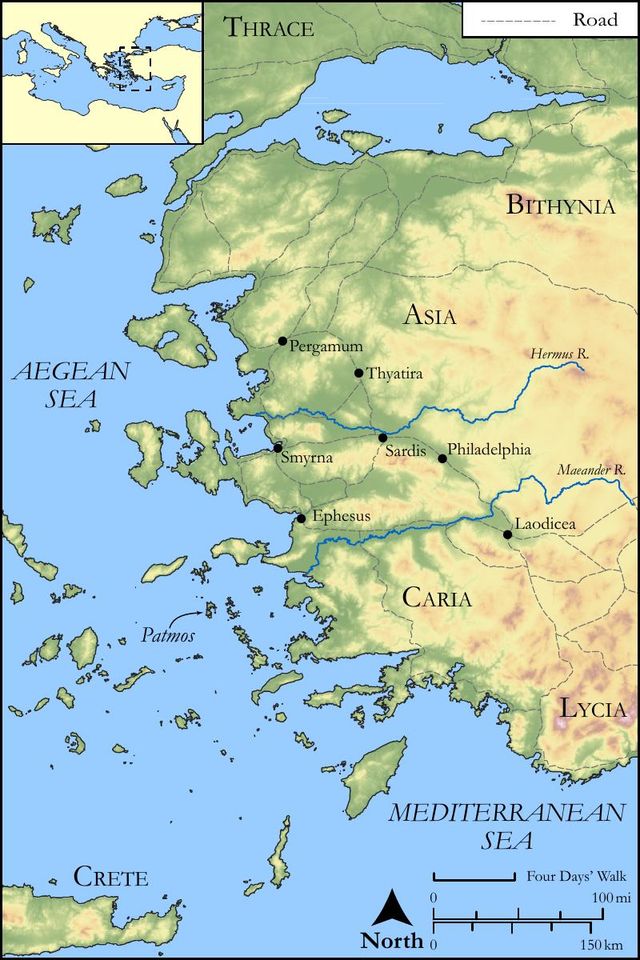
See on the biblical-era map

Study this verse
Public-domain commentary
Matthew Henry
From his Commentary on the Whole Bible. Henry comments on passages, not single verses — this entry covers Revelation 3:7–13. His four-level outline is real structure in the source text, so it is rendered as structure.
We have now come to the sixth letter, sent to one of the Asian churches, where observe,
I.The inscription, showing,
1.For whom it was more immediately designed: The angel of the church of Philadelphia; this also was a city in Asia Minor, seated upon the borders of Mysia and Lydia, and had its name from that brotherly love for which it was eminent. We can hardly suppose that this name was given to it after it received the Christian religion, and that it was so called from that Christian affection that all believers have, and should have, one for another, as the children of one Father and the brethren of Christ; but rather that it was its ancient name, on account of the love and kindness which the citizens had and showed to each other as a civil fraternity. This was an excellent spirit, and, when sanctified by the grace of the gospel, would render them an excellent church, as indeed they were, for here is no one fault found with this church, and yet, doubtless, there were faults in it of common infirmity; but love covers such faults.
2.By whom this letter was signed; even by the same Jesus who is alone the universal head of all the churches; and here observe by what title he chooses to represent himself to this church: He that is holy, he that is true, he that hath the key of David, etc. You have his personal character: He that is holy and he that is true, holy in his nature, and therefore he cannot but be true to his word, for he hath spoken in his holiness; and you have also his political character: He hath the key of David, he openeth, and no man shutteth; he hath the key of the house of David, the key of government and authority in and over the church. Observe,
(1.)The acts of his government.
[1.]He opens. He opens a door of opportunity to his churches; he opens a door of utterance to his ministers; he opens a door of entrance, opens the heart; he opens a door of admission into the visible church, laying down the terms of communion; and he opens the door of admission into the church triumphant, according to the terms of salvation fixed by him.
[2.]He shuts the door. When he pleases, he shuts the door of opportunity and the door of utterance, and leaves obstinate sinners shut up in the hardness of their hearts; he shuts the door of church-fellowship against unbelievers and profane persons; and he shuts the door of heaven against the foolish virgins who have slept away their day of grace, and against the workers of iniquity, how vain and confident soever they may be.
(2.)The way and manner in which he performs these acts, and that is absolute sovereignty, independent upon the will of men, and irresistible by the power of men: He openeth, and no man shutteth; he shutteth, and no man openeth; he works to will and to do, and, when he works, none can hinder. These were proper characters for him, when speaking to a church that had endeavoured to be conformed to Christ in holiness and truth, and that had enjoyed a wide door of liberty and opportunity under his care and government.
II.The subject-matter of this epistle, where,
1.Christ puts them in mind of what he had done for them: I have set before thee an open door, and no man can shut it, Rev 3:8. I have set it open, and kept it open, though there be many adversaries. Learn here,
(1.)Christ is to be acknowledged as the author of all the liberty and opportunity his churches enjoy.
(2.)He takes notice and keeps account, how long he has preserved their spiritual liberties and privileges for them.
(3.)Wicked men envy the people of God their door of liberty, and would be glad to shut it against them.
(4.)If we do not provoke Christ to shut this door against us, men cannot do it.
2.This church is commended: Thou hast a little strength, and hast kept my word, and hast not denied my name, Rev 3:8. In this there seems to be couched a gentle reproof: "Thou hast a little strength, a little grace, which, though it be not proportionate to the wide door of opportunity which I have opened to thee, yet is true grace, and has kept thee faithful." True grace, though weak, has the divine approbation; but, though Christ accepts a little strength, yet believers should not rest satisfied in a little, but should strive to grow in grace, to be strong in faith, giving glory to God. True grace, though weak, will do more than the greatest gifts or highest degrees of common grace, for it will enable the Christian to keep the word of Christ, and not to deny his name. Obedience, fidelity, and a free confession of the name of Christ, are the fruits of true grace, and are pleasing to Christ as such.
3.Here is a promise of the great favour God would bestow on this church, Rev 3:9, Rev 3:10. This favour consists in two things: -
(1.)Christ would make this church's enemies subject to her.
[1.]Those enemies are described to be such as said they were Jews, but lied in saying so - pretended to be the only and peculiar people of God, but were really the synagogue of Satan. Assemblies that worship God in spirit and in truth are the Israel of God; assemblies that either worship false gods, or the true God in a false manner, are the synagogues of Satan: though they may profess to be the only people of God, their profession is a lie.
[2.]Their subjection to the church is described: They shall worship at thy feet; not pay a religious and divine honour to the church itself, nor to the ministry of it, but shall be convinced that they have been in the wrong, that this church is in the right and is beloved of Christ, and they shall desire to be taken into communion with her and that they may worship the same God after the same manner. How shall this great change be wrought? By the power of God upon the hearts of his enemies, and by signal discoveries of his peculiar favour to his church: They shall know that I have loved thee. Observe, First, The greatest honour and happiness any church can enjoy consist in the peculiar love and favour of Christ. Secondly, Christ can discover this his favour to his people in such a manner that their very enemies shall see it, and be forced to acknowledge it. Thirdly, This will, by the grace of Christ, soften the hearts of their enemies, and make them desirous to be admitted into communion with them.
(2.)Another instance of favour that Christ promises to this church is persevering grace in the most trying times (Rev 3:10), and this as the reward of their past fidelity. To him that hath shall be given. Here observe,
[1.]The gospel of Christ is the word of his patience. It is the fruit of the patience of God to a sinful world; it sets before men the exemplary patience of Christ in all his sufferings for men; it calls those that receive it to the exercise of patience in conformity to Christ.
[2.]This gospel should be carefully kept by all that enjoy it; they must keep up to the faith, and practice, and worship prescribed in the gospel.
[3.]After a day of patience we must expect an hour of temptation; a day of gospel peace and liberty is a day of God's patience, and it is seldom so well improved as it should be and therefore it is often followed by an hour of trial and temptation.
[4.]Sometimes the trial is more general and universal; it comes upon all the world, and, when it is so general, it is usually the shorter.
[5.]Those who keep the gospel in a time of peace shall be kept by Christ in an hour of temptation. By keeping the gospel they are prepared for the trial; and the same divine grace that has made them fruitful in times of peace will make them faithful in times of persecution.
4.Christ calls the church to that duty which he before promised he would enable her to do, and that is, to persevere, to hold fast that which she had. (1.) The duty itself: "Hold fast that which thou hast, that faith, that truth, that strength of grace, that zeal, that love to the brethren; thou hast been possessed of this excellent treasure, hold it fast." (2.) The motives, taken from the speedy appearance of Christ: "Behold, I come quickly. See, I am just a coming to relieve them under the trial, to reward their fidelity, and to punish those who fall away; they shall lose that crown which they once seemed to have a right to, which they hoped for, and pleased themselves with the thoughts of. The persevering Christian shall win the prize from backsliding professors, who once stood fair for it."
III.The conclusion of this epistle, Rev 3:12, Rev 3:13. Here,
1.After his usual manner, our Saviour promises a glorious reward to the victorious believer, in two things: - (1.) He shall be a monumental pillar in the temple of God; not a pillar to support the temple (heaven needs no such props), but a monument of the free and powerful grace of God, a monument that shall never be defaced nor removed, as many stately pillars erected in honour to the Roman emperors and generals have been. (2.) On this monumental pillar there shall be an honourable inscription, as in those cases is usual. [1.] The name of God, in whose cause he engaged, whom he served, and for whom he suffered in this warfare; and the name of the city of God, the church of God, the new Jerusalem, which came down from heaven. On this pillar shall be recorded all the services the believer did to the church of God, how he asserted her rights, enlarged her borders, maintained her purity and honour; this will be a greater name than Asiaticus, or Africanus; a soldier under God in the wars of the church. And then another part of the inscription is, [2.] The new name of Christ, the Mediator, the Redeemer, the captain of our salvation; by this it will appear under whose banner this conquering believer had enlisted, under whose conduct he acted, by whose example he was encouraged, and under whose influence he fought the good fight, and came off victorious.
2.The epistle is closed up with the demand of attention: He that hath an ear, let him hear what the Spirit saith unto the churches, how Christ loves and values his faithful people, how he commends, and how he will crown their fidelity.
Historical interpretation
Seven Centuries of Reception
10 surviving comments on this verse. Each one is dated, so this reads as a timeline rather than a list.
Select a marker to jump to its quote. Markers stagger vertically where authors wrote within a few decades of each other.
The sixth class is the mode of life of the best election. The habit of saints is set forth; of those, to wit, who are lowly in the world, and unskilled in the Scriptures, and who hold the faith immoveably, and are not at all broken down by any chance, or withdrawn from the faith by any fear. Therefore He says to them:-
"I have set before thee an open door, because thou hast kept the word of my patience." In such little strength.
"And I will keep thee from the hour of temptation." That they may know His glory to be of this kind, that they are not indeed permitted to be given over to temptation.
"He that overcometh shall be made a pillar in the temple of God." For even as a pillar is an ornament of the building, so he who perseveres shall obtain a nobility in the Church.
“And he shall never go out of it.” The nations went out from God, and they gave to idols that worship which they owed to God alone. But “all the families of the nations will remember and turn to the Lord and shall worship before him.” This refers to those whom he foretold would come “from the synagogue of Satan.” For having broken the bond of charity, the schismatics have gone out of the house of God. They are those who have separated themselves from the body of the whole church which is throughout the world and who vainly glory in themselves and firmly believe that they are the whole church, even though they themselves are not everywhere. For when he says that “he shall never go out of it,” he shows that at the end of time there will be a struggle. For it will happen that after unity there will be a final struggle in which there will be another separation. And wherever anyone will have been freed, he shall certainly not go out, and he shall remain in the house, not as a slave but as a son. And therefore God allowed those who were saved from the flood in the ark to go out, because until that time there was still time for returning from one’s sins. However, at the end of time it will not be allowed one any longer to come out, for whoever at that time will go out, will have not occasion for repentance.
“And I will write on him the name of my God.” That is, we are signed with the name of Christian. “And the name of the city of the new Jerusalem which comes down from my God out of heaven.” The name of the church that daily comes down from God out of heaven, that is, from the church that is reborn by the Lord. He speaks of it as new because of the newness of the Son of man who is the new Jerusalem.… “Indeed, the name which is above every name.” However, this name is not new because it refers to the Son of God, who existed before the world and possessed this glory with the Father. Rather, this name is new in regard to the Son of man who died and on the third day rose again and, ascending to the heavens, sits at the right hand of the Father. For it is the Son of man who said “my new name,” whom [John] saw “in the midst of the seven lampstands.” This Son of man is God “at whose name every knee bows, in heaven and on earth and under the earth.”
[I will write on him the name of my God] so that he might be signed with the divine name and be adorned with the glory of immortality and might receive the name of the divine city of Jerusalem, which is the vision of peace, and so fully enjoy the society of perpetual quiet and security. This is that city which descends out of heaven from God, so that the saints might dwell and repose within it “And my new name.” In God nothing is old, because he does grow old with age. But the name of the Lord is always new, always fresh. And if any is named by this name, having been changed by the eternal power, he will obtain eternal life.
And I will write on him the name of my God. Because indeed by adoption we are called sons of God.
And the name of the city of my God, the New Jerusalem. He will be associated with the unity of the Church, which by heavenly grace is regenerated into a new life.
And my new name. This is the Christian name, not because it is new to the Son of God, who had this glory before the world was made, but new to the Son of Man who was dead and has risen, and sits at the right hand of God.
He who overcomes, I will make him a pillar in the temple of my God, etc. He who overcomes adversities for my sake will gloriously fear no further loss of adversity in the temple of the Church. These pillars, that is, holy men, now strengthen the Church by supporting it, then will adorn it by standing out, just as those two in the doors of Solomon's temple.
He that shall overcome, I will make him a pillar in the temple of my God. God's temple is the Church, according to this: The temple of God is holy, which you are. [1 Cor. 3:17] Since not only the preachers, but also the good listeners triumph over the old enemy, and in this verse everyone who overcomes is said to become a pillar in God's temple, we are forced to confess that a pillar is the same as the temple, that is the universal Church. In what follows, and he shall go out no more, it is openly shown that the Church, in the younger brother, had once passed from the unity of faith and work it kept in the prophets under the law to the error of perfidy and perverse work; but it was recovered through the killing of the fatted calf. [Luke 15:11-31] Alternatively, all of us, Jews as well as Gentiles, went out in Adam; but after we have been brought in victorious to the second Adam, we are made into a pillar of God's temple, because, overcoming the temptations of the old enemy through the blood of that same Mediator of ours, we are established in the heavenly glory of the saints by that steadfastness in the commandments which we are demonstrated to have lost in the first Adam. But we shall never go out again, because no incitements of the enemy shall tear us away from that common happiness of the heavenly fatherland. Note also that he says he has a God as he speaks according to his humanity. And I will write upon him the name of my God, and the name of the city of my God, the new Jerusalem, which cometh down out of heaven from my God, and my new name. He that hath ears, let him hear what the Spirit saith to the churches. The name of the Father being written on the one who overcomes means that he becomes his Son by adoption of the Spirit. Indeed, with what pen is it written, if not with the grace of the Spirit of both? Whence the apostle: The Spirit himself giveth testimony to our spirit, that we are the sons of God. [Rom. 8:16] As for Jerusalem, it translates to “sight of peace.” It is said to come down out of heaven from God because the Church of the elect, which directs its course towards the sight of heavenly peace with the steps of love, went down, as it was predestined to, into the womb of the Virgin together with the Lord, whose body it is; or it is because its number increases every day through heavenly grace. It is called new because, through baptism and love, it is stripped of the oldness of the earthly man and clothed in heavenly newness; whence this: The old things are passed away, and behold all things are made new. [2 Cor. 5:17] So the name of Jerusalem is written on the victor when he joins the number of the saints. As for where we get all this from, it is revealed when it is added and my new name (implying I will write) namely the one that was given in time to the same Mediator, that is “Christ.” This is where our dignity and high position comes from, this is the cause of our being called sons of God, New Jerusalem, and Christians. Therefore, where we hear the sum of all salvation, let us at last put a due end to this book.
And he who overcomes, he says, that he will make them to sit with him always in the sight of God; for this is to become the pillar of the divine temple. For the pillar could never go out for any good reason from the place in which it is fixed.
I will write on him the name of My God, and the name of the city of My God, the New Jerusalem, and My new name. Through all this, the enjoyment of God and dwelling in goodness and blessedness are fully revealed, whatever they will possess in the age to come. And he says that the name is new, one that has perhaps not yet been heard, which the saints reigning with Christ receive, being called friends (Jn. 15:15), brothers (Heb. 2:11), and servants (1 Cor. 4:1). And indeed, he also receives a new name beyond these things. For some have been recorded in the divine Scripture and have come to the hearing of men; but the new name is nowhere named.
And it is not unworthy for him to be called My God, nor are the measures of emptiness or the humility of human nature to be despised. For if he were unworthy, who compelled him to be united with flesh in hypostasis, and thus to weave our salvation? To Him be glory forever and ever.
Continue studying Revelation 3:12 across the web’s major study libraries — every link below opens this exact verse, chapter, or book on the destination site.
Read & Compare
 BibleGatewayThis verse in more than 200 translations and 70 languages.
 Bible.comThe YouVersion reader — hundreds of translations, reading plans, and highlights.
 ESV.orgCrossway's official English Standard Version reader.
 NET BibleThe NET translation with 60,000+ translators' notes on every rendering decision.
 STEP BibleTyndale House's free study tool — original text, vocabulary, and scholarly resources.
 BibliaLogos Bible Software's free web reader.
 USCCBThe New American Bible (Revised Edition) with the U.S. bishops' study notes.
Commentaries
 BibleHub CommentariesDozens of classic commentaries on this verse, gathered on one page.
 StudyLightMore than 100 commentary sets — the largest collection on the web.
 BibleRefPlain-English commentary on what this verse means, verse by verse.
 Enduring WordDavid Guzik's free commentary on this chapter, widely used by Bible teachers.
 Bible Study ToolsVerse commentary alongside Greek and Hebrew study aids.
Original Language & Research
- BibleHub InterlinearThe verse word by word — original language, transliteration, and English.
- BibleHub LexiconEvery word's original-language definition and Strong's entry.
 Blue Letter BibleDeep-study tools — Strong's numbers, concordance, and word studies.
 CNTR CollationThe earliest Greek manuscripts of this verse, collated letter by letter.
Sermons, Hymns & Audio


TrulyRandomVerse is not affiliated with these sites and doesn’t control their content. They’re linked because they’re genuinely useful.
Summary
Revelation 3:12 conveys a profound promise from Jesus Christ to those who overcome spiritual challenges and remain faithful. This verse, addressed to the steadfast church in Philadelphia, assures believers of an eternal, secure, and intimate relationship with God, characterized by an unshakeable place in His presence, divine identification, and a transformative union with Christ Himself. It speaks to the ultimate reward for perseverance: permanent belonging and an unveiled intimacy with the Triune God in the New Creation.
Context
ShowHideLiterary Context
This verse is part of the letter to the church in Philadelphia, one of the seven churches of Asia Minor addressed in Revelation chapters 2 and 3. Unlike several other churches that received strong rebukes, Philadelphia is unique in receiving virtually no criticism, only commendation. Jesus praises their faithfulness despite having "little strength," for keeping His word, and for not denying His name (Revelation 3:8). The promise in verse 12 serves as a direct and magnificent reward for their steadfastness, offering a vision of eternal security and divine intimacy that stands in stark contrast to the transient struggles of their earthly existence. It is the culmination of the promises given to overcomers throughout the letters, emphasizing the ultimate triumph of those who endure.
Historical & Cultural Context
Philadelphia was a city prone to frequent and devastating earthquakes, which often necessitated rebuilding and led to a pervasive sense of instability. Its inhabitants often had to "go out" of their homes for safety. The imagery of being made "a pillar in the temple" would have resonated deeply with a people familiar with architectural instability and the importance of strong foundations. Furthermore, in the ancient world, it was common practice to erect pillars or monuments to honor significant individuals or events, often with names or inscriptions carved upon them. To have the names of God, the New Jerusalem, and Christ's new name inscribed upon them would signify ultimate honor, ownership, and an unchangeable status, contrasting sharply with the shifting allegiances and pagan cults prevalent in the Roman Empire. The "temple" (Greek: naos) refers specifically to the inner sanctuary, the dwelling place of the deity, underscoring the intimate and sacred nature of the promised presence.
Key Themes
ShowHideThe overarching theme in this verse is the Reward for Overcoming. The condition "Him that overcometh" (Greek: nikao) is central, echoing similar promises made to the other churches, such as the right to eat from the tree of life or not being hurt by the second death. This emphasizes the necessity of spiritual endurance and faithfulness in the face of trials and opposition. Another significant theme is Permanence and Security. To be made "a pillar in the temple of my God, and he shall go no more out" directly addresses the human longing for stability and an eternal home, providing assurance of an unbreakable bond with God, far surpassing any earthly security. Finally, Divine Identification and Ownership is powerfully conveyed through the writing of names. The inscription of "the name of my God," "the name of the city of my God, new Jerusalem," and "my new name" signifies ultimate belonging, protection, and a profound, intimate relationship with the Triune God, marking the believer as eternally consecrated and uniquely identified with the divine, as also seen in Revelation 22:4.
Exposition and Analysis
ShowHideKey Word Analysis
ShowHideThis primary verb means "to subdue, conquer, prevail, or get the victory." In Revelation, it signifies spiritual victory achieved through faithfulness to Christ, even unto death, in the face of worldly pressures, persecution, and the deceptive influences of evil. It is not a victory earned by human strength, but by enduring in Christ.
Derived from a root meaning "to stiffen," this noun refers to a post or column. Figuratively, it denotes support, strength, and stability. In ancient architecture, pillars were essential structural elements and were often erected as monuments to signify honor, permanence, and importance. To be made a pillar in God's temple implies an honored, secure, and permanent position within the very presence of God.
This adjective describes something "new" especially in freshness, quality, or kind, as opposed to neos which refers to something new in age. When applied to "new Jerusalem" or "my new name," it signifies a fresh, unprecedented, and superior reality—a new creation that is qualitatively different and superior to the old.
Verse Breakdown
ShowHide"Him that overcometh will I make a pillar in the temple of my God,"
This clause establishes the condition for the promise and the first aspect of the reward. The "overcomer" is the one who perseveres in faith despite trials, remaining loyal to Christ. The reward is to be made a "pillar" (a symbol of strength, stability, and honor) within the "temple of my God" (the innermost sanctuary, signifying an intimate and permanent dwelling in God's direct presence).
"and he shall go no more out:"
This phrase emphasizes the eternal security and permanence of the overcomer's position. Unlike the instability of earthly life or the temporary nature of human dwellings, this promise guarantees an unshakeable, eternal dwelling with God, free from any expulsion or departure.
"and I will write upon him the name of my God,"
This signifies divine ownership, protection, and identification. To have God's name written upon someone indicates that they belong to God, are His possession, and are under His authority and care, much like a seal or brand.
"and the name of the city of my God, [which is] new Jerusalem, which cometh down out of heaven from my God:"
This inscription links the overcomer to God's ultimate, eternal dwelling place for His people. The "new Jerusalem" is not an earthly city but a heavenly, perfected city, symbolizing the consummation of God's redemptive plan and the eternal home of the redeemed. To have its name written signifies citizenship and belonging to this divine, eternal community.
"and [I will write upon him] my new name."
This final inscription signifies a unique, deep, and personal intimacy with Christ. "My new name" likely refers to a name that fully encapsulates Christ's post-resurrection glory, authority, and redemptive work, a name fully known only in the eschatological reality. To bear this name implies a profound, transformative union and identification with the glorified Christ.
Literary Devices
ShowHideRevelation 3:12 is rich with Symbolism and Metaphor. The image of a "pillar in the temple" is a powerful metaphor for strength, stability, and an honored, permanent position within God's sacred presence. It contrasts with the literal instability of the earthquake-prone city of Philadelphia, offering a spiritual reality of unshakeable security. The act of "writing names" upon the overcomer is highly symbolic, representing divine ownership, intimate identification, and a transformative change in status and identity. The "name of my God" symbolizes belonging and protection; the "name of the city of my God, new Jerusalem" symbolizes eternal citizenship and participation in the perfected divine community; and "my new name" symbolizes a deeper, more personal revelation and union with the glorified Christ. The phrase "he shall go no more out" serves as a contrast to the temporary nature of earthly existence and the historical experience of the Philadelphians, emphasizing the eternal permanence of the overcomer's dwelling.
Theological and Thematic Connections
ShowHideRevelation 3:12 encapsulates profound theological truths regarding God's faithfulness, the nature of salvation, and the believer's eternal destiny. It underscores the concept of eternal security, not as a license for complacency, but as a promised outcome for those who persevere in faith, reflecting God's unwavering commitment to His covenant people. The multiple names written upon the overcomer signify a multi-faceted divine ownership and identification, establishing the believer's identity firmly within the Triune Godhead and His eternal kingdom. This promise speaks to the ultimate fulfillment of God's dwelling with humanity, where believers are not merely guests but integral, permanent fixtures in His glorious presence, experiencing an unparalleled intimacy and belonging that transcends all earthly limitations.
Reflection and Application
ShowHideRevelation 3:12 offers immense encouragement and a powerful call to spiritual perseverance for believers today. The promise to "him that overcometh" reminds us that the Christian life is not passive but an active journey of faith, often involving spiritual warfare and the need for steadfast endurance against worldly pressures, temptations, and opposition. Our eternal reward and secure place in God's kingdom are intrinsically linked to our faithfulness and perseverance in Christ. This verse provides deep comfort and assurance, emphasizing that our identity in Christ is permanent and secure; we are not temporary residents but eternal "pillars" in God's dwelling, firmly established by His grace. Understanding that God's name, the New Jerusalem's name, and Christ's new name will be written upon us profoundly shapes our identity, giving us purpose, confidence, and a sense of ultimate belonging. This divine branding transforms our perspective, directing our gaze toward the glorious future hope of the New Jerusalem—a perfect, eternal home with God, free from all sorrow, suffering, and evil, as promised in Revelation 21:4.
Questions for Reflection
ShowHideFAQ
ShowHideWhat does "overcometh" mean in the context of Revelation?
ShowHideIn Revelation, "overcometh" (Greek: nikáō) refers to those who conquer or prevail spiritually. This victory is not achieved through human strength or merit, but through steadfast faith in Jesus Christ, enduring persecution, resisting false teachings, and remaining loyal to His name even unto death. It signifies a life lived in fidelity to Christ despite intense opposition, trusting in His ultimate victory. This theme is central to the letters to the Revelation 2:1-29 and Revelation 3:1-22, where promises are consistently given to those who overcome.
What is the significance of being a "pillar in the temple of my God"?
ShowHideThe imagery of a "pillar in the temple" conveys several profound meanings. Historically, pillars symbolized strength, stability, and honor, often erected as monuments to significant individuals or events. In the context of Philadelphia, a city prone to earthquakes, the promise of an unshakeable pillar would have been especially comforting, signifying permanence and security. The "temple" (Greek: naós) refers to the inner sanctuary, the most holy place where God dwells. Therefore, to be a pillar in God's temple means to have an honored, secure, and permanent place in the very presence of God, never to "go no more out." This contrasts sharply with the temporary and often unstable nature of earthly existence.
Why are three names written on the overcomer in this verse?
ShowHideThe inscription of three names—"the name of my God," "the name of the city of my God, new Jerusalem," and "my new name" (Christ's)—signifies a complete and multi-faceted divine identification and ownership.
Christ-Centered Fulfillment
ShowHideRevelation 3:12 finds its ultimate fulfillment and deepest meaning in Jesus Christ. He is the supreme Overcomer, who "has overcome the world" (John 16:33) and through His death and resurrection, has triumphed over sin, death, and the powers of darkness (Colossians 2:15). It is His victory that enables believers to overcome; we are made overcomers only "through him who loved us" (Romans 8:37). Christ Himself is the true "pillar" and foundation of God's eternal temple, the Church, built upon Him as the chief cornerstone (Ephesians 2:20). Our secure and permanent place in God's presence is not earned but gifted through our union with Him. Furthermore, the names written upon the overcomer are ultimately derived from Christ: the name of God is revealed through Him (John 17:6), the New Jerusalem is His bride and dwelling place where He is the temple (Revelation 21:22), and "His new name" signifies the full revelation of His glorious identity as the Lamb who was slain and is now King of kings and Lord of lords (Revelation 19:12-16). Thus, the promises of Revelation 3:12 are not merely abstract rewards, but an invitation to share in Christ's own victory, glory, and eternal intimacy with the Father.