


Galatians 2:9
Bible text: King James Version (1769 Blayney text) · Public domain
Bible text: King James Version with Strong's numbers · Public domain
Bible text: Berean Standard Bible · Public domain
Bible text: American Standard Version (1901) · Public domain
Bible text: World English Bible, Messianic edition · Public domain
Bible text: Geneva Bible (1599) · Public domain
Bible text: Young's Literal Translation · Public domain
- καὶkaiandG2532CONJConjunction
- γνόντεςgnonteshaving knownG1097V-2AAP-NPMVerb 2nd Aorist Active Participle Nominative Plural Masculine
- τὴνtēntheG3588T-ASFDefinite article Accusative Singular Feminine
- χάρινcharingraceG5485N-ASFNoun Accusative Singular Feminine
- τὴνtēnwhichG3588T-ASFDefinite article Accusative Singular Feminine
- δοθεῖσάνdotheisanhaving been givenG1325V-APP-ASFVerb Aorist Passive Participle Accusative Singular Feminine
- μοιmoito meG3165P-1DSPersonal pronoun Dative 1st Singular
- ἸάκωβοςIakōbosJamesG2385N-NSM-PNoun Nominative Singular Masculine Individual
- καὶkaiandG2532CONJConjunction
- ΚηφᾶςKēphasCephasG2786N-NSM-PNoun Nominative Singular Masculine Individual
- καὶkaiandG2532CONJConjunction
- ἸωάννηςIōannēsJohnG2491N-NSM-PNoun Nominative Singular Masculine Individual
- οἱhoithoseG3588T-NPMDefinite article Nominative Plural Masculine
- δοκοῦντεςdokountesesteemedG1380V-PAP-NPMVerb Present Active Participle Nominative Plural Masculine
- στῦλοιstuloipillarsG4769N-NPMNoun Nominative Plural Masculine
- εἶναιeinaito beG1511V-PANVerb Present Active Infinitive
- δεξιὰςdexias[the] right handsG1188A-APFAdjective Accusative Plural Feminine
- ἔδωκανedōkangaveG1325V-AAI-3PVerb Aorist Active Indicative 3rd Plural
- ἐμοὶemoito me myselfG1473P-1DSPersonal pronoun Dative 1st Singular
- καὶkaiandG2532CONJConjunction
- ΒαρναβᾷBarnabato BarnabasG921N-DSM-PNoun Dative Singular Masculine Individual
- κοινωνίαςkoinōniasof fellowshipG2842N-GSFNoun Genitive Singular Feminine
- ἵναinathatG2443CONJConjunction
- ἡμεῖςhēmeiswe ourselves [should go]G3165P-1NPPersonal pronoun Nominative 1st Plural
- εἰςeistoG1519PREPPreposition
- τὰtatheG3588T-APNDefinite article Accusative Plural Neuter
- ἔθνηethnēGentilesG1484N-APNNoun Accusative Plural Neuter
- αὐτοὶautoitheyG846P-NPMPersonal pronoun Nominative Plural Masculine
- δὲdehoweverG1161CONJConjunction
- εἰςeistoG1519PREPPreposition
- τὴνtēntheG3588T-ASFDefinite article Accusative Singular Feminine
- περιτομήνperitomēncircumcisionG4061N-ASFNoun Accusative Singular Feminine
English is a literal word-by-word gloss of the Greek, not the KJV's wording. Why?
This is the original text the KJV's translators worked from — each Greek word with its own literal English meaning in this verse, prepared by scholars at Tyndale House, Cambridge. The KJV translates whole sentences, not word by word, so its wording differs: one Greek word can become several English words, and the KJV may choose “charity” where the gloss reads “love”. Both are faithful — they answer different questions. For the KJV's own rendering, switch to the KJV text.
Details
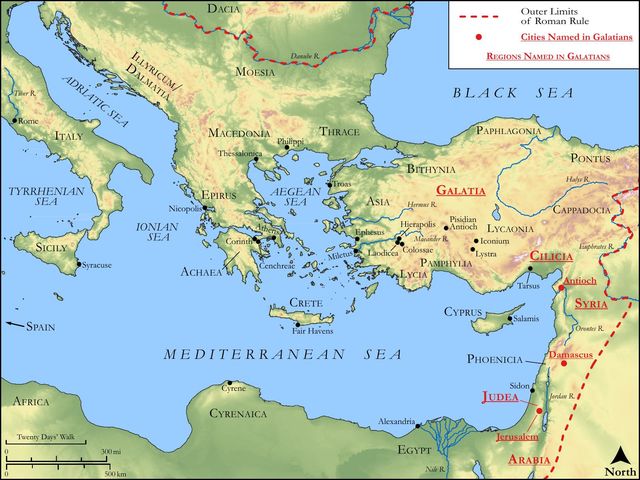
See on the biblical-era maps

Study this verse
Public-domain commentary
Matthew Henry
From his Commentary on the Whole Bible. Henry comments on passages, not single verses — this entry covers Galatians 2:1–10. His three-level outline is real structure in the source text, so it is rendered as structure.
It should seem, by the account Paul gives of himself in this chapter, that, from the very first preaching and planting of Christianity, there was a difference of apprehension between those Christians who had first been Jews and those who had first been Gentiles. Many of those who had first been Jews retained a regard to the ceremonial law, and strove to keep up the reputation of that; but those who had first been Gentiles had no regard to the law of Moses, but took pure Christianity as perfective of natural religion, and resolved to adhere to that. Peter was the apostle to them; and the ceremonial law, though dead with Christ, yet not being as yet buried, he connived at the respect kept up for it. But Paul was the apostle of the Gentiles; and, though he was a Hebrew of the Hebrews, yet he adhered to pure Christianity. Now in this chapter he tells us what passed between him and the other apostles, and particularly between him and Peter hereupon.
In these verses he informs us of another journey which he took to Jerusalem, and of what passed between him and the other apostles there, Gal 2:1-10. Here he acquaints us,
I.With some circumstances relating to this his journey thither. As particularly,
1.With the time of it: that it was not till fourteen years after the former (mentioned Gal 1:18), or, as others choose to understand it, from his conversion, or from the death of Christ. It was an instance of the great goodness of God that so useful a person was for so many years preserved in his work. And it was some evidence that he had no dependence upon the other apostles, but had an equal authority with them, that he had been so long absent from them, and was all the while employed in preaching and propagating pure Christianity, without being called into question by them for it, which it may be thought he would have been, had he been inferior to them, and his doctrine disapproved by them.
2.With his companions in it: he went up with Barnabas, and took with him Titus also. If the journey here spoken of was the same with that recorded Acts 15 (as many think), then we have a plain reason why Barnabas went along with him; for he was chosen by the Christians at Antioch to be his companion and associate in the affair he went about. But, as it does not appear that Titus was put into the same commission with him, so the chief reason of his taking him along with him seems to have been to let those at Jerusalem see that he was neither ashamed nor afraid to own the doctrine which he had constantly preached; for though Titus had now become not only a convert to the Christian faith, but a preacher of it too, yet he was by birth a Gentile and uncircumcised, and therefore, by making him his companion, it appeared that their doctrine and practice were of a piece, and that as he had preached the non-necessity of circumcision, and observing the law of Moses, so he was ready to own and converse with those who were uncircumcised.
3.With the reason of it, which was a divine revelation he had concerning it: he went up be revelation; not of his own head, much less as being summoned to appear there, but by special order and direction from Heaven. It was a privilege with which this apostle was often favoured to be under a special divine direction in his motions and undertakings; and, though this is what we have no reason to expect, yet it should teach us, in every thing of moment we go about, to endeavour, as far as we are capable, to see our way made plain before us, and to commit ourselves to the guidance of Providence.
II.He gives us an account of his behaviour while he was at Jerusalem, which was such as made it appear that he was not in the least inferior to the other apostles, but that both his authority and qualifications were every way equal to theirs. He particularly acquaints us,
1.That he there communicated the gospel to them, which he preached among the Gentiles, but privately, etc. Here we may observe both the faithfulness and prudence of our great apostle.
(1.)His faithfulness in giving them a free and fair account of the doctrine which he had all along preached among the Gentiles, and was still resolved to preach - that of pure Christianity, free from all mixtures of Judaism. This he knew was a doctrine that would be ungrateful to many there, and yet he was not afraid to own it, but in a free and friendly manner lays it open before them and leaves them to judge whether or no it was not the true gospel of Christ. And yet,
(2.)He uses prudence and caution herein, for fear of giving offence. He chooses rather to do it in a more private than in a public way, and to those that were of reputation, that is, to the apostles themselves, or to the chief among the Jewish Christians, rather than more openly and promiscuously to all, because, when he came to Jerusalem, there were multitudes that believed, and yet continued zealous for the law, Act 21:20. And the reason of this his caution was lest he should run, or had run, in vain, lest he should stir up opposition against himself and thereby either the success of his past labours should be lessened, or his future usefulness be obstructed; for nothing more hinders the progress of the gospel than differences of opinion about the doctrines of it, especially when they occasion quarrels and contentions among the professors of it, as they too usually do. It was enough to his purpose to have his doctrine owned by those who were of greatest authority, whether it was approved by others or not. And therefore, to avoid offence, he judges it safest to communicate it privately to them, and not in public to the whole church. This conduct of the apostle may teach all, and especially ministers, how much need they have of prudence, and how careful they should be to use it upon all occasions, as far as is consistent with their faithfulness.
2.That in his practice he firmly adhered to the doctrine which he had preached. Paul was a man of resolution, and would adhere to his principles; and therefore, though he had Titus with him, who was a Greek, yet he would not suffer him to be circumcised, because he would not betray the doctrine of Christ, as he had preached it to the Gentiles. It does not appear that the apostles at all insisted upon this; for, though they connived at the use of circumcision among the Jewish converts, yet they were not for imposing it upon the Gentiles. But there were others who did, whom the apostle here calls false brethren, and concerning whom he informs us that they were unawares brought in, that is, into the church, or into their company, and that they came only to spy out their liberty which they had in Christ Jesus, or to see whether Paul would stand up in defence of that freedom from the ceremonial law which he had taught as the doctrine of the gospel, and represented as the privilege of those who embraced the Christian religion. Their design herein was to bring them into bondage, which they would have effected could they have gained the point they aimed at; for, had they prevailed with Paul and the other apostles to have circumcised Titus, they would easily have imposed circumcision upon other Gentiles, and so have brought them under the bondage of the law of Moses. But Paul, seeing their design, would by no means yield to them; he would not give place by subjection, no, not for an hour, not in this one single instance; and the reason of it was that the truth of the gospel might continue with them - that the Gentile Christians, and particularly the Galatians, might have it preserved to them pure and entire, and not corrupted with the mixtures of Judaism, as it would have been had he yielded in this matter. Circumcision was at that time a thing indifferent, and what in some cases might be complied with without sin; and accordingly we find even Paul himself sometimes giving way to it, as in the case of Timothy, Act 16:3. But when it is insisted on as necessary, and his consenting to it, though only in a single instance, is likely to be improved as giving countenance to such an imposition, he has too great a concern for the purity and liberty of the gospel, to submit to it; he would not yield to those who were for the Mosaic rites and ceremonies, but would stand fast in the liberty wherewith Christ hath made us free, which conduct of his may give us occasion to observe that what under some circumstances may lawfully be complied with, yet, when that cannot be done without betraying the truth, or giving up the liberty, of the gospel, it ought to be refused.
3.That, though he conversed with the other apostles, yet he did not receive any addition to his knowledge or authority from them, Gal 2:6. By those who seemed to be somewhat he means the other apostles, particularly James, Peter, and John, whom he afterwards mentions by name, Gal 2:9. And concerning these he grants that they were deservedly had in reputation by all, that they were looked upon (and justly too) as pillars of the church, who were set not only for its ornament, but for its support, and that on some accounts they might seem to have the advantage of him, in that they had seen Christ in the flesh, which he had not, and were apostles before him, yea, even while he continued a persecutor. But yet, whatever they were, it was no matter to him. This was no prejudice to his being equally an apostle with them; for God does not accept the persons of men on the account of any such outward advantages. As he had called them to this office, so he was at liberty to qualify others for it, and to employ them in it. And it was evident in this case that he had done so; for in conference they added nothing to him, they told him nothing but what he before knew by revelation, nor could they except against the doctrine which he communicated to them, whence it appeared that he was not at all inferior to them, but was as much called and qualified to be an apostle as they themselves were.
4.That the issue of this conversation was that the other apostles were fully convinced of his divine mission and authority, and accordingly acknowledged him as their fellow-apostle, Gal 2:7-10. They were not only satisfied with his doctrine, but they saw a divine power attending him, both in preaching it and in working miracles for the confirmation of it: that he who wrought effectually in Peter to the apostleship of the circumcision, the same was mighty in him towards the Gentiles. And hence they justly concluded that the gospel of the uncircumcision was committed to Paul, as the gospel of the circumcision was to Peter. And therefore, perceiving the grace that was given to him (that he was designed to the honour and office of an apostle as well as themselves) they gave unto him and Barnabas the right hand of fellowship, a symbol whereby they acknowledged their equality with them, and agreed that these should go to the heathen, while they continued to preach to the circumcision, as judging it most agreeable to the mind of Christ, and most conducive to the interest of Christianity, so to divide their work. And thus this meeting ended in an entire harmony and agreement; they approved both Paul's doctrine and conduct, they were fully satisfied in him, heartily embraced him as an apostle of Christ, and had nothing further to add, only that they would remember the poor, which of his own accord he was very forward to do. The Christians of Judea were at that time labouring under great wants and difficulties; and the apostles, out of their compassion to them and concern for them, recommend their case to Paul, that he should use his interest with the Gentile churches to procure a supply for them. This was a reasonable request; for, if the Gentiles were made partakers of their spiritual things, it was their duty to minister to them in carnal things, as Rom 15:27. And he very readily falls in with it, whereby he showed his charitable and catholic disposition, how ready he was to own the Jewish converts as brethren, though many of them could scarcely allow the like favour to the converted Gentiles, and that mere difference of opinion was no reason with him why he should not endeavour to relieve and help them. Herein he has given us an excellent pattern of Christian charity, and has taught us that we should by no means confine it to those who are just of the same sentiments with us, but be ready to extend it to all whom we have reason to look upon as the disciples of Christ.
Historical interpretation
Two Centuries of Reception
11 surviving comments on this verse. Each one is dated, so this reads as a timeline rather than a list.
Select a marker to jump to its quote. Markers stagger vertically where authors wrote within a few decades of each other.
Rightly, then, did Peter and James and John give their right hand of fellowship to Paul, and agree on such a division of their work, as that Paul should go to the heathen, and themselves to the circumcision. Their agreement, also, "to remember the poor" was in complete conformity with the law of the Creator, which cherished the poor and needy, as has been shown in our observations on your Gospel.
Now they certainly would not have been surprised at his having become a preacher instead of a persecutor, if his preaching were of something contrary; nor, moreover, would they have "glorified the Lord," because Paul had presented himself as an adversary to Him They accordingly even gave him "the right hand of fellowship," as a sign of their agreement with him, and arranged amongst themselves a distribution of office, not a diversity of gospel, so that they should severally preach not a different gospel, but (the same), to different persons, Peter to the circumcision, Paul to the Gentiles.
Accordingly, the false brethren who were the spies of their Christian liberty must be thwarted in their efforts to bring it under the yoke of their own Judaism before that Paul discovered whether his labour had been in vain, before that those who preceded him in the apostolate gave him their right hands of fellowship, before that he entered on the office of preaching to the Gentiles, according to their arrangement with him. He therefore made some concession, as was necessary, for a time; and this was the reason why he had Timothy circumcised, and the Nazarites introduced into the temple, which incidents are described in the Acts.
Since then the children have invited us, and have given unto us the right hand of fellowship,
That is, those who supported the church were like pillars supporting roofs and other things. “These men, then,” he says, “being of such quality and so great, gave me their right hands, that is, joined in friendship, peace and steadfastness and declared that they had only one gospel. In view of this accord, Galatians, you are sinning and follow neither my gospel nor that of Peter, James and John, who are the pillars of the church, when you add things that are not approved by any of them.”
“Not to me alone,” [he says], “did they give the right hand of fellowship, but also to Barnabas who was my companion.” He made the addition so that it should not appear that he alone had received the trust.
Just as he allots to Peter companions who were the outstanding men among the apostles, so he joins to himself Barnabas, who was associated with him by God’s appointment. Yet he claims that the grace of his primacy was entrusted to him alone by God, just as the primacy among the apostles was entrusted solely to Peter.
Since we must also ascertain how it is possible to become a “pillar,” so that we too may become worthy of this calling, we ought to hear this again from the dictum of the apostle Paul, who says that the pillar is “the foundation of truth.”
"And when they perceived the grace that was given unto me, James and Cephas and John, they who were reputed to be pillars, gave to me and Barnabas the right hands of fellowship."
He says not when they "heard," but when they "perceived," that is, were assured by the facts themselves, "they gave to me and Barnabas the right hands of fellowship." Observe how he gradually proves that his doctrine was ratified both by Christ and by the Apostles. For grace would neither have been implanted, nor been operative in him, had not his preaching been approved by Christ. Where it was for the purpose of comparison with himself, he mentioned Peter alone; here, when he calls them as witnesses, he names the three together, "Cephas, James, John," and with an encomium, "who were reputed to be pillars." Here again the expression "who were reputed" does not impugn the reality of the fact, but adopts the estimate of others, and implies that these great and distinguished men, whose fame was universal, bare witness that his preaching was ratified by Christ, that they were practically informed and convinced by experience concerning it. "Therefore they gave the right hands of fellowship" to me, and not to me only, but also to Barnabas, "that we should go unto the Gentiles, and they unto the Circumcision." Here indeed is exceeding prudence as well as an incontrovertible proof of their concord. For it shows that his and their doctrine was interchangeable, and that both approved the same thing, that they should so preach to the Jews, and he to the Gentiles. Wherefore he adds,
"That we should go unto the Gentiles and they unto the Circumcision."
Observe that here also he means by "the Circumcision," not the rite, but the Jews; whenever he speaks of the rite, and wishes to contrast it, he adds the word "uncircumcision;" as when he says, "For circumcision indeed profiteth, if thou be a doer of the law; but if thou be a transgressor of the law, thy circumcision is become uncircumcision." (Ro. ii: 25.) And again, "Neither circumcision availeth any thing, nor uncircumcision." But when it is to the Jews and not to the deed that he gives this name, and wishes to signify the nation, he opposes to it not uncircumcision in its literal sense, but the Gentiles. For the Jews are the contradistinction to the Gentiles, the Circumcision to the Uncircumcision. Thus when he says above, "For He that wrought for Peter into the Apostleship of the Circumcision, wrought for me also unto the Gentiles;" and again, "We unto the Gentiles and they unto the Circumcision," he means not the rite itself, but the Jewish nation, thus distinguishing them from the Gentiles.
Three times above we read that the apostles were “reputed.” … And so I was wondering what this word meant. Now he has delivered me from all doubt when he describes them as those “who appeared to be pillars.” Therefore it means the apostles, and above all Peter, James and John, two of whom were deemed fit to go up the Mount with Jesus. One of these introduces the Savior in the Apocalypse saying “He who has overcome I shall make him a pillar in the temple of my God.” This teaches us that all believers who have overcome the enemy can become pillars of the church.
They knew this from the facts; for [he says] “just as divine grace worked with Peter for the preaching to the Jews, so it collaborated with me for the salvation of the Gentiles.”
Continue studying Galatians 2:9 across the web’s major study libraries — every link below opens this exact verse, chapter, or book on the destination site.
Read & Compare
 BibleGatewayThis verse in more than 200 translations and 70 languages.
 Bible.comThe YouVersion reader — hundreds of translations, reading plans, and highlights.
 ESV.orgCrossway's official English Standard Version reader.
 NET BibleThe NET translation with 60,000+ translators' notes on every rendering decision.
 STEP BibleTyndale House's free study tool — original text, vocabulary, and scholarly resources.
 BibliaLogos Bible Software's free web reader.
 USCCBThe New American Bible (Revised Edition) with the U.S. bishops' study notes.
Commentaries
 BibleHub CommentariesDozens of classic commentaries on this verse, gathered on one page.
 StudyLightMore than 100 commentary sets — the largest collection on the web.
 BibleRefPlain-English commentary on what this verse means, verse by verse.
 Enduring WordDavid Guzik's free commentary on this chapter, widely used by Bible teachers.
 Bible Study ToolsVerse commentary alongside Greek and Hebrew study aids.
Original Language & Research
- BibleHub InterlinearThe verse word by word — original language, transliteration, and English.
- BibleHub LexiconEvery word's original-language definition and Strong's entry.
 Blue Letter BibleDeep-study tools — Strong's numbers, concordance, and word studies.
 CNTR CollationThe earliest Greek manuscripts of this verse, collated letter by letter.
Sermons, Hymns & Audio


TrulyRandomVerse is not affiliated with these sites and doesn’t control their content. They’re linked because they’re genuinely useful.
Summary
Galatians 2:9 describes a pivotal moment of apostolic recognition and strategic alignment within the early Christian church. James, Cephas (Peter), and John, acknowledged as leading figures, formally affirmed Paul and Barnabas's God-given ministry to the Gentiles by extending "the right hands of fellowship." This act solidified their partnership and established a division of labor, with Paul and Barnabas focusing on evangelizing the uncircumcised (Gentiles) and the Jerusalem apostles continuing their ministry primarily to the circumcised (Jews), all while maintaining the unity of the gospel message.
Context
ShowHideLiterary Context
This verse is situated within Paul's impassioned defense of his apostleship and the gospel of grace against the Judaizers in Galatia. Immediately preceding this, Paul recounts his private meeting with the Jerusalem leaders (Galatians 2:1-2), where he laid out the gospel he preached to the Gentiles to ensure he was not running in vain. The affirmation in Galatians 2:9 is the crucial outcome of this meeting, establishing the legitimacy of Paul's Gentile mission and setting the stage for his subsequent confrontation with Peter concerning table fellowship in Galatians 2:11-14. This narrative serves to underscore that Paul's gospel was not a deviation but was fully endorsed by the most respected figures in the early church, thereby validating his authority and message to the Galatian believers.
Historical & Cultural Context
The early church faced significant internal tension regarding the inclusion of Gentiles and the necessity of Mosaic Law observance, particularly circumcision. This period, roughly A.D. 48-50, predates the formal Jerusalem Council detailed in Acts 15, but represents a foundational agreement that paved the way for it. The gesture of "giving the right hands of fellowship" was a common ancient practice, signifying a formal agreement, alliance, or pledge of partnership between parties. For the Jerusalem leaders, who were deeply rooted in Jewish tradition, to extend such a gesture to Paul and Barnabas, who championed Gentile inclusion without circumcision, was a profound act of theological and practical unity, acknowledging the Holy Spirit's work among the Gentiles.
Key Themes
ShowHideGalatians 2:9 contributes significantly to several major themes within the letter and broader New Testament. It powerfully illustrates apostolic authority and recognition, demonstrating how God's grace empowers diverse ministries, even those with different focuses, as seen in Paul's defense of his unique calling. The verse also highlights the vital theme of unity in the body of Christ amidst diversity of ministry, showing that differing spheres of evangelism (Jew vs. Gentile) do not necessitate division but can coexist in harmonious partnership for the sake of the gospel. Furthermore, it underscores that divine grace is the foundation of all legitimate ministry, as the Jerusalem apostles "perceived the grace that was given" to Paul, aligning with Paul's consistent emphasis that his labor was "by the grace of God" (1 Corinthians 15:10). Finally, the strategic division of labor exemplifies missional strategy, acknowledging that effective evangelism may require tailored approaches to different cultural and religious contexts, without compromising the singular truth of salvation by faith.
Exposition and Analysis
ShowHideKey Word Analysis
ShowHideThis verb signifies a deep, experiential knowing or understanding, not merely a casual observation. When James, Cephas, and John "perceived" the grace given to Paul, it indicates they recognized God's tangible favor, spiritual empowerment, and divine anointing on his ministry. Their acknowledgment was based on a discerning awareness of God's work, validating Paul's apostolic calling as genuinely from God.
This term is a powerful metaphor describing James, Cephas, and John as foundational supports of the early church. Like architectural pillars that bear the weight and provide stability to a building, these apostles were seen as strong, prominent, and essential figures whose leadership, teaching, and example upheld the structure and integrity of the nascent Christian community. Their recognition of Paul carried immense weight precisely because of their esteemed position.
This rich theological term denotes partnership, communion, sharing, and joint participation. In the context of "the right hands of fellowship," it signifies a deep spiritual and practical alliance. It was an act of formal acceptance and agreement, establishing a shared mission and mutual support in the work of the gospel, despite their distinct target audiences. This koinōnía transcended ethnic and cultural divides, uniting them in a common purpose.
Verse Breakdown
ShowHide"And when James, Cephas, and John, who seemed to be pillars"
This clause introduces the key figures from the Jerusalem church—James (likely the brother of Jesus, a prominent leader in Jerusalem), Cephas (Peter, a leading apostle), and John (another of the inner circle of Jesus' disciples). The phrase "who seemed to be pillars" acknowledges their widely recognized and respected status as foundational leaders and authoritative figures within the early Christian community.
"perceived the grace that was given unto me"
This crucial phrase highlights the spiritual discernment of the Jerusalem leaders. They recognized that Paul's apostolic ministry, particularly to the Gentiles, was not self-appointed or based on human effort, but was a direct manifestation of God's unmerited favor and divine empowerment. This perception of grace validated Paul's unique calling and the effectiveness of his evangelistic work.
"they gave to me and Barnabas the right hands of fellowship"
This describes the formal act of recognition and partnership. The "right hands of fellowship" was a customary gesture in the ancient world signifying agreement, alliance, and shared purpose. By extending this to Paul and Barnabas, the Jerusalem apostles publicly affirmed their acceptance of Paul's apostleship and his gospel message, integrating his Gentile mission into the broader apostolic work.
"that we [should go] unto the heathen, and they unto the circumcision"
This final clause articulates the strategic outcome of their agreement: a division of missionary labor. Paul and Barnabas were affirmed in their primary calling to the "heathen" (Gentiles, or non-Jews), while James, Cephas, and John would continue their focus on the "circumcision" (Jews). This was a practical arrangement to maximize evangelistic reach, ensuring that both Jewish and Gentile populations were intentionally targeted with the one gospel message.
Literary Devices
ShowHideGalatians 2:9 employs several significant literary devices. The most prominent is Metaphor, specifically in the description of James, Cephas, and John as "pillars." This imagery effectively conveys their foundational importance, strength, and supportive role within the early church, highlighting their authority and the stability they provided. The phrase "the right hands of fellowship" uses Synecdoche, where a part ("right hands") represents the whole act of formal agreement, partnership, and shared mission. Furthermore, the terms "the heathen" (Greek: ethnē) and "the circumcision" (Greek: peritomē) function as Metonymy, where a characteristic or sign stands for the people themselves. "The heathen" refers to all non-Jewish nations, and "the circumcision" refers to the Jewish people, who practiced circumcision as a covenant sign. These devices enrich the text, conveying profound theological and relational truths through vivid and concise language.
Theological and Thematic Connections
ShowHideGalatians 2:9 is a powerful testament to the unity and diversity within the early church, demonstrating how God orchestrates various ministries for the advancement of His kingdom. It underscores the theological principle that all genuine ministry flows from divine grace, not human merit or appointment. The recognition of Paul's grace-given apostleship by the Jerusalem leaders not only validated his mission but also ensured a unified front against legalism, affirming that salvation is by faith alone, for both Jew and Gentile. This strategic division of labor, born out of mutual respect and spiritual discernment, showcases a mature understanding of missional effectiveness, allowing the gospel to penetrate different cultural contexts without compromising its core truth. It serves as a model for how leaders can collaborate, affirm one another's unique callings, and work together for the singular purpose of proclaiming Christ, even when their methods or primary audiences differ.
Reflection and Application
ShowHideGalatians 2:9 offers profound lessons for the church today, emphasizing the critical importance of mutual recognition, collaborative ministry, and grace-based service. In an era often marked by competition or isolation among ministries, this verse calls believers and leaders to actively discern and affirm the unique gifts and callings God has placed upon others. It reminds us that true unity in the body of Christ does not demand uniformity in approach or audience but thrives on diverse expressions of the same gospel, working in harmony. Our effectiveness in ministry, whether local or global, is not a result of our own strength or wisdom, but flows from God's unmerited favor and empowerment. This humility should characterize all our endeavors, ensuring that God alone receives the glory. Furthermore, the strategic division of labor reminds us to be wise in our outreach, tailoring our methods to effectively reach different people groups while remaining steadfast to the unchanging message of salvation through faith in Christ.
Questions for Reflection
ShowHideFAQ
ShowHideWho were James, Cephas, and John, and why were they called "pillars"?
ShowHideJames refers to James, the brother of Jesus, who became a prominent leader in the Jerusalem church. Cephas is the Aramaic name for Peter, one of Jesus's twelve apostles and a key leader in the early church. John was also one of Jesus's twelve apostles and a significant figure. They were called "pillars" because they were recognized as foundational, authoritative, and essential leaders who provided stability and strength to the nascent Christian community. Their long-standing association with Jesus and their spiritual maturity made them highly respected figures whose endorsement carried significant weight.
What is the significance of "the right hands of fellowship"?
ShowHide"The right hands of fellowship" was a common symbolic gesture in the ancient world, signifying a formal agreement, alliance, partnership, or pledge of loyalty. In this context, it was a profound act of public affirmation and acceptance. By extending their right hands to Paul and Barnabas, James, Cephas, and John formally recognized Paul's apostolic authority and the legitimacy of his gospel message to the Gentiles. It symbolized a deep spiritual and practical partnership, confirming that despite their differing primary audiences, they were united in the singular mission of spreading the gospel of Christ.
Does this verse imply two different gospels for Jews and Gentiles?
ShowHideNo, this verse does not imply two different gospels. Paul vehemently defends the singularity of the gospel throughout Galatians, stating that anyone who preaches a different gospel is accursed (Galatians 1:6-9). The agreement described in Galatians 2:9 was a strategic division of labor, not a division of doctrine. It recognized that while the message of salvation by grace through faith in Christ was universal, the most effective way to reach different cultural and religious groups (Jews vs. Gentiles) might involve distinct approaches or primary focuses. Both groups were to be saved by the same faith in the same Christ, as Paul clearly articulates in Galatians 3:28.
Christ-Centered Fulfillment
ShowHideGalatians 2:9, though focusing on apostolic relationships, finds its ultimate fulfillment and meaning in Christ. The "grace that was given" to Paul for his ministry to the Gentiles is a direct outflow of the boundless grace of Christ, who, "though he was rich, yet for your sakes he became poor, that ye through his poverty might be rich" (2 Corinthians 8:9). The unity forged between the Jewish and Gentile apostles, symbolized by the "right hands of fellowship," foreshadows the ultimate reconciliation of Jew and Gentile into one new humanity in Christ, who "is our peace, who hath made both one, and hath broken down the middle wall of partition between us" (Ephesians 2:14). The strategic division of labor—to the "heathen" and to the "circumcision"—is a practical outworking of Christ's Great Commission to make disciples of all nations (Matthew 28:18-20), demonstrating the universal scope of His redemptive work. Ultimately, the "pillars" of the church, and indeed all believers, derive their strength, authority, and purpose from Christ, the true cornerstone upon whom the entire spiritual edifice is built (Ephesians 2:20-22). The fellowship shared between these apostles was a participation in the very life and mission of Christ, who continually calls His church to unity and evangelism until His return.