


Acts 16:3
Bible text: King James Version (1769 Blayney text) · Public domain
Bible text: King James Version with Strong's numbers · Public domain
Bible text: Berean Standard Bible · Public domain
Bible text: American Standard Version (1901) · Public domain
Bible text: World English Bible, Messianic edition · Public domain
Bible text: Geneva Bible (1599) · Public domain
Bible text: Young's Literal Translation · Public domain
- τοῦτονtoutonThis oneG3778D-ASMDemonstrative pronoun Accusative Singular Masculine
- ἠθέλησενēthelēsenwantedG2309V-AAI-3SVerb Aorist Active Indicative 3rd Singular
- ὁho<the>G3588T-NSMDefinite article Nominative Singular Masculine
- ΠαῦλοςPaulosPaulG3972N-NSM-PNoun Nominative Singular Masculine Individual
- σὺνsunwithG4862PREPPreposition
- αὐτῷautōhimG846P-DSMPersonal pronoun Dative Singular Masculine
- ἐξελθεῖνexeltheinto go forthG1831V-2AANVerb 2nd Aorist Active Infinitive
- καὶkaiandG2532CONJConjunction
- λαβὼνlabōnhaving takenG2983V-2AAP-NSMVerb 2nd Aorist Active Participle Nominative Singular Masculine
- περιέτεμενperietemenhe circumcisedG4059V-2AAI-3SVerb 2nd Aorist Active Indicative 3rd Singular
- αὐτὸνautonhimG846P-ASMPersonal pronoun Accusative Singular Masculine
- διὰdiaon account ofG1223PREPPreposition
- τοὺςtoustheG3588T-APMDefinite article Accusative Plural Masculine
- ἸουδαίουςIoudaiousJewsG2453N-APM-PGNoun Accusative Plural Masculine Person Gentilic
- τοὺςtousthoseG3588T-APMDefinite article Accusative Plural Masculine
- ὄνταςontasbeingG1510V-PAP-APMVerb Present Active Participle Accusative Plural Masculine
- ἐνeninG1722PREPPreposition
- τοῖςtoistheG3588T-DPMDefinite article Dative Plural Masculine
- τόποιςtopoispartsG5117N-DPMNoun Dative Plural Masculine
- ἐκείνοις·ekeinoisthoseG1565D-DPMDemonstrative pronoun Dative Plural Masculine
- ᾔδεισανēdeisanthey knewG1492V-2LAI-3PVerb Pluperfect Active Indicative 3rd Plural
- γὰρgarforG1063CONJConjunction
- ἅπαντεςhapantesallG537A-NPMAdjective Nominative Plural Masculine
- ὅτιhotithatG3754CONJConjunction
- ἝλληνHellēna GreekG1672N-NSM-LGNoun Nominative Singular Masculine Location Gentilic
- ὁhotheG3588T-NSMDefinite article Nominative Singular Masculine
- πατὴρpatērfatherG3962N-NSMNoun Nominative Singular Masculine
- αὐτοῦautouof himG846P-GSMPersonal pronoun Genitive Singular Masculine
- ὑπῆρχενhupērchenwasG5225V-IAI-3SVerb Imperfect Active Indicative 3rd Singular
English is a literal word-by-word gloss of the Greek, not the KJV's wording. Why?
This is the original text the KJV's translators worked from — each Greek word with its own literal English meaning in this verse, prepared by scholars at Tyndale House, Cambridge. The KJV translates whole sentences, not word by word, so its wording differs: one Greek word can become several English words, and the KJV may choose “charity” where the gloss reads “love”. Both are faithful — they answer different questions. For the KJV's own rendering, switch to the KJV text.
Details
See on the biblical-era maps
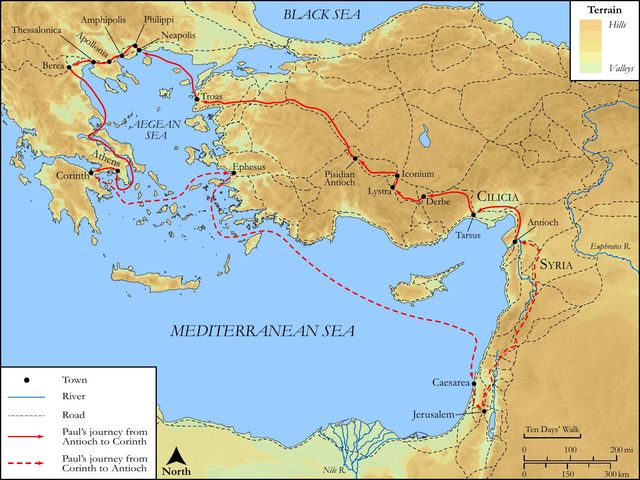
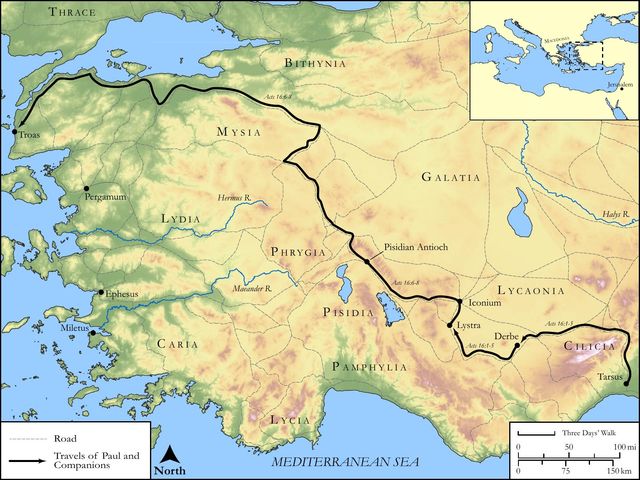
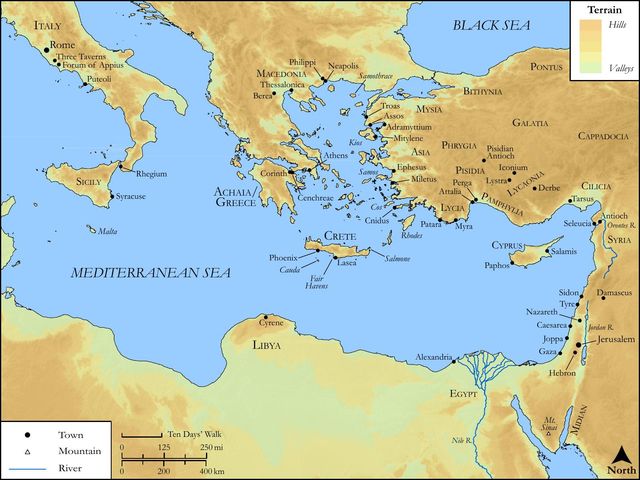
Study this verse
Public-domain commentary
Matthew Henry
From his Commentary on the Whole Bible. Henry comments on passages, not single verses — this entry covers Acts 16:1–5. His three-level outline is real structure in the source text, so it is rendered as structure.
Paul was a spiritual father, and as such a one we have him here adopting Timothy, and taking care of the education of many others who had been begotten to Christ by his ministry: and in all he appears to have been a wise and tender father. Here is,
I.His taking Timothy into his acquaintance and under his tuition.
One thing designed in the book of the Acts is to help us to understand Paul's epistles, two of which are directed to Timothy; it was therefore necessary that in the history of Paul we should have some account concerning him. And we are here accordingly told,
1.That he was a disciple, one that belonged to Christ, and was baptized, probably in his infancy, when his mother became a believer, as Lydia's household was baptized upon her believing, Act 16:15. Him, that was a disciple of Christ, Paul took to be his disciple, that he might further train him up in the knowledge and faith of Christ; he took him to be brought up for Christ.
2.That his mother was a Jewess originally, but believed in Christ; her name was Eunice, his grandmother's name was Lois. Paul speaks of them both with great respect, as women of eminent virtue and piety, and commends them especially for their unfeigned faith (Ti2 1:5), their sincerely embracing and adhering to the doctrine of Christ.
3.That his father was a Greek, a Gentile. The marriage of a Jewish woman to a Gentile husband (though some would make a difference) was prohibited as much as the marriage of a Jewish man to a Gentile wife, Deu 7:3. Thou shalt no more give thy daughter to his son than take his daughter to thy son; yet this seems to have been limited to the nations that lived among them in Canaan, whom they were most in danger of infection from. Now because his father was a Greek he was not circumcised: for the entail of the covenant and the seal of it, as of other entails in that nation, went by the father, not by the mother; so that his father being no Jew he was not obliged to circumcision, nor entitled to it, unless when he grew up he did himself desire it. But, observe, though his mother could not prevail to have him circumcised in his infancy, because his father was of another mind and way, yet she educated him in the fear of God, that though he wanted the sign of the covenant he might not want the thing signified.
4.That he had gained a very good character among the Christians: he was well reported of by the brethren that were at Lystra and Iconium; he had not only an unblemished reputation, and was free from scandal, but he had a bright reputation, and great encomiums were given of him, as an extraordinary young man, and one from whom great things were expected. Not only those in the place where he was born, but those in the neighbouring cities, admired him, and spoke honourably of him. He had a name for good things with good people.
5.That Paul would have him to go forth with him, to accompany him, to give attendance on him, to receive instruction from him, and to join with him in the work of the gospel - to preach for him when there was occasion, and to be left behind in places where he had planted churches. Paul had a great love for him, not only because he was an ingenious young man, and one of great parts, but because he was a serious young man, and one of devout affections: for Paul was always mindful of his tears, Ti2 1:4.
6.That Paul took him and circumcised him, or ordered it to be done. This was strange. Had not Paul opposed those with all his might that were for imposing circumcision upon the Gentile converts? Had he not at this time the decrees of the council at Jerusalem with him, which witnessed against it? He had, and yet circumcised Timothy, not, as those teachers designed in imposing circumcision, to oblige him to keep the ceremonial law, but only to render his conversation and ministry passable, and, if it might be, acceptable among the Jews that abounded in those quarters. He knew Timothy was a man likely to do a great deal of good among them, being admirably qualified for the ministry, if they were not invincibly prejudiced against him; and therefore, that they might not shun him as one unclean, because uncircumcised, he took him and circumcised him. Thus to the Jews he became as a Jew, that he might gain the Jews, and all things to all men, that he might gain some. He was against those who made circumcision necessary to salvation, but used it himself when it was conducive to edification; nor was he rigid in opposing it, as they were in imposing it. Thus, though he went not in this instance according to the letter of the decree, he went according to the spirit of it, which was a spirit of tenderness towards the Jews, and willingness to bring them off gradually from their prejudices. Paul made no difficulty of taking Timothy to be his companion, though he was uncircumcised; but the Jews would not hear him if he were, and therefore Paul will humour them herein. It is probable that it was at this time that Paul laid his hands on Timothy, for the conferring of the gift of the Holy Ghost upon him, Ti2 1:6.
II.His confirming the churches which he had planted (Act 16:4, Act 16:5):
He went through the cities where he had preached the word of the Lord, as he intended (Act 15:36), to enquire into their state. And we are told,
1.That they delivered them copies of the decrees of the Jerusalem synod, to be a direction to them in the government of themselves, and that they might have wherewith to answer the judaizing teachers, and to justify themselves in adhering to the liberty with which Christ had made them free. All the churches were concerned in that decree, and therefore it was requisite they should all have it well attested. Though Paul had for a particular reason circumcised Timothy, yet he would not have that drawn into a precedent; and therefore he delivered the decrees to the churches, to be religiously observed; for they must abide by the rule, and not be drawn from it by a particular example.
2.That this was of very good service to them.
(1.)The churches were hereby established in the faith, Act 16:5. They were confirmed particularly in their opinion against the imposing of the ceremonial law upon the Gentiles; the great assurance and heat wherewith the judaizing teachers pressed the necessity of circumcision, and the plausible arguments they produced for it, had shocked them, so that they began to waver concerning it. But when they saw the testimony, not only of the apostles and elders, but of the Holy Ghost in them, against it, they were established, and did not longer waver about it. Note, Testimonies to truth, though they may not prevail to convince those that oppose it, may be of very good use to establish those that are in doubt concerning it, and to fix them. Nay, the design of this decree being to set aside the ceremonial law, and the carnal ordinances of that, they were by it established in the Christian faith in general, and were the more firmly assured that it was of God, because it set up a spiritual way of serving God, as more suited to the nature both of God and man; and, besides, that spirit of tenderness and condescension which appeared in these letters plainly showed that the apostles and elders were herein under the guidance of him who is love itself.
(2.)They increased in number daily. The imposing of the yoke of the ceremonial law upon their converts was enough to frighten people from them. If they had been disposed to turn Jews, they could have done that long since, before the apostles came among them; but, if they cannot be interested in the Christian privileges without submitting to the Jews' yoke, they will be as they are. But, if they find there is no danger of their being so enslaved, they are ready to embrace Christianity, and join themselves to the church. And thus the church increased in numbers daily; not a day passed but some or other gave up their names to Christ. And it is a joy to those who heartily wish well to the honour of Christ, and the welfare of the church and the souls of men, to see such an increase.
Historical interpretation
Five Centuries of Reception
11 surviving comments on this verse. Each one is dated, so this reads as a timeline rather than a list.
Select a marker to jump to its quote. Markers stagger vertically where authors wrote within a few decades of each other.
Whatever … [the gnostic] has in his mind, he bears on his tongue, to those who are worthy to hear, speaking as well as living from assent and inclination. For he both thinks and speaks the truth; unless at any time, medicinally, as a physician for the safety of the sick, he may deceive or tell an untruth, according to the Sophists. To illustrate: the noble apostle circumcised Timothy, though loudly declaring and writing that circumcision made with hands profits nothing. But that he might not, by dragging all at once away from the law to the circumcision of the heart through faith those of the Hebrews who were reluctant listeners, compel them to break away from the synagogue, he, "accommodating himself to the Jews, became a Jew that he might gain all." He, then, who submits to accommodate himself merely for the benefit of his neighbors, for the salvation of those for whose sake he accommodates himself, not partaking in any dissimulation through the peril impending over the just from those who envy them, such a one by no means acts with compulsion. But for the benefit of his neighbors alone, he will do things that would not have been done by him primarily, if he did not do them on their account. Such a one gives himself: for the church; for the disciples whom he has begotten in faith; for an example to those who are capable of receiving the supreme economy of the philanthropic and God-loving instructor, for confirmation of the truth of his words, for the exercise of love to the Lord. Such a one is unenslaved by fear, true in word, enduring in labor, never willing to lie by uttered word and in it always securing sinlessness; since falsehood, being spoken with a certain deceit, is not an inert word but operates to mischief.
Now, if the apostle had even absolutely permitted marriage when one's partner has been lost subsequently to (conversion to) the faith, he would have done (it), just as (he did) the other (actions) which he did adversely to the (strict) letter of his own rule, to suit the circumstances. of the times: circumcising Timotheus on account of "supposititious false brethren; "and leading certain "shaven men" into the temple on account of the observant watchfulness of the Jews-he who chastises the Galatians when they desire to live in (observance of) the law.
He therefore made some concession, as was necessary, for a time; and this was the reason why he had Timothy circumcised, and the Nazarites introduced into the temple, which incidents are described in the Acts.
[But] perhaps it has been recorded at some time or other with good reason that even the true worshiper who worships in spirit and truth performs certain symbolic acts so that, by acting in a most accommodating manner, he might free those who are enslaved to the symbol and bring them to the truth that the symbols represent. Paul appears to have done this in the case of Timothy, and perhaps also in Cenchrea and Jerusalem, as it is written in the Acts of the Apostles.
There have been in the whole period of the duration of the world two conspicuous changes of people’s lives, which are also called two Testaments, or, on account of the wide fame of the matter, two earthquakes; the one from idols to the law, the other from the law to the gospel. And we are taught in the Gospel of a third earthquake, namely, from this earth to that which cannot be shaken or moved. Now the two Testaments are alike in this respect, that the change was not made on a sudden or at the first movement of the endeavor. Why not (for this is a point on which we must have information)? That no violence might be done to us but that we might be moved by persuasion. For nothing that is involuntary is durable; like streams or trees that are kept back by force. But that which is voluntary is more durable and safe. The former is due to one who uses force, the latter is ours; the one is due to the gentleness of God, the other to a tyrannical authority. Therefore God did not think it behooved him to benefit the unwilling but to do good to the willing. And therefore like a tutor or physician he partly removes and partly condones ancestral habits, conceding some little of what tended to pleasure, just as doctors do with their patients, that their medicine may be taken, being artfully blended with what is nice. For it is no very easy matter to change from those habits that custom and use have made honorable. For instance, the first cut off the idol but left the sacrifices; the second, while it destroyed the sacrifices did not forbid circumcision. Then, when once men had submitted to the curtailment, they also yielded that which had been conceded to them; in the first instance the sacrifices, in the second circumcision; and became instead of Gentiles, Jews, and instead of Jews, Christians, being beguiled into the gospel by gradual changes. Paul is a proof of this; for having at one time administered circumcision and submitted to legal purification, he advanced till he could say, and I, brothers, if I yet preach circumcision, why do I yet suffer persecution? His former conduct belonged to the temporary dispensation, his latter to maturity.
Before blessed Paul, who himself had received circumcision, sent Timothy to teach the Jews, he first circumcised him in order that Timothy, as teacher, might be more acceptable to his audience. So Paul [actually] engaged in circumcision in order to abolish it. He knew why he had circumcised Timothy but chose not to disclose his reasons to the disciples. In fact, if they had known that he had circumcised him with the intention of abolishing circumcision, they would have not listened to anything Timothy had to say, and all the progress he had achieved would have been lost. Indeed, their ignorance was quite useful. As long as they believed that he circumcised Timothy in order to preserve the law, they generously received him and his doctrine. Therefore, by receiving [that doctrine] little by little, and by being taught, they abandoned their old customs. However, this would never have happened if they had known the reason from the beginning. In fact, if they had known, they would have opposed the circumcision and by opposing it they would have remained in their previous error.
And what (then)? Mark the success: he circumcised, that he might take away circumcision: for he preached the decrees of the Apostles. He was about to make him a bishop, and it was not meet that he should be uncircumcised. Since therefore he was about to preach, that he might not smite the Jews a double blow, he circumcised Timothy. And yet he was but half (a Jew by birth), his father being a Greek: but yet, because that was a great point carried in the cause of the Gentiles, he did not care for this: for the Word must needs be disseminated: therefore also he with his own hands circumcised him.
It is indeed amazing, the wisdom of Paul! He that has had so many battles about circumcision, he that moved all things to this end, and did not give over until he had carried his point, now that the decree is made sure, circumcises the disciple. He not only does not forbid others, but himself does this thing. "Him," it says, "he would have to go forth with him." And the wonder is this, that he even took him unto him. "Because of the Jews," it says, "which were in those parts": for they would not endure to hear the word from one uncircumcised. Nothing could be wiser. So that in all things he looked to what was profitable: he did nothing upon his own preference.
As to Paul’s circumcising of Timothy, performing a vow at Cenchrea and undertaking on the suggestion of James at Jerusalem to share the performance of the appointed rites with some who had made a vow, it is manifest that Paul’s design in these things was not to give to others the impression that he thought that by these observances salvation is given under the Christian dispensation. [His intent was] to prevent people from believing that he condemned, as no better than heathen idolatrous worship, those rites that God had appointed in the former dispensation as suitable to it and as shadows of things to come. For this is what James said to him, that the report had gone abroad concerning him that he taught people “to forsake Moses.” This would be by all means wrong for those who believe in Christ, to forsake him who prophesied of Christ, as if they detested and condemned the teaching of him of whom Christ said, “If you had believed Moses, you would have believed me, for he wrote of me.” LETTER 82.
He circumcised him because of the Jews who were in those places. Not that he believed the figures of the law would bring any utility with the truth of the Gospel shining forth, but so that the Jews would not fall away from the faith because of the Gentiles. Though these old shadows were to be gradually taken away, as was the moral depravity of the Gentiles, as said above. For those legal shadows, sometimes established by the Lord, were sometimes used by the Apostles in those times to avoid the infidelity of the Jews. But the Gentile institution, truly found by Satan, was never touched by the saints.
And taking him, he circumcised him because of the Jews. It is rightly asked why the Apostle, who circumcised Timothy, refused to circumcise Titus, as he himself writes to the Galatians. But it must be understood that he circumcised Timothy to avoid scandal among the Jews, to show through him that he does not condemn the sacraments of the Mosaic law, but does not impose them on the Gentiles as necessary for salvation. But after he circumcised Timothy, certain Jews, who wanted the Gentiles to be circumcised because they said that without those sacraments they could not be saved, began to boast and say: "Because Paul also holds this view, which we say, that without these sacraments there is no salvation. For if he does not believe this, why did he circumcise Timothy?" When Paul heard this, who did it out of freedom, not necessity, to avoid scandal among the Jews, not for Timothy's salvation, he saw that they had taken the occasion to preach something else and to cause a bad suspicion towards Paul, and he did not want to circumcise Titus. It is therefore apparent why he wanted to circumcise one and not the other: he wanted to circumcise the first to avoid scandal among the Jews, and did not want to circumcise the latter because of the opportunity for misbelief.
Continue studying Acts 16:3 across the web’s major study libraries — every link below opens this exact verse, chapter, or book on the destination site.
Read & Compare
 BibleGatewayThis verse in more than 200 translations and 70 languages.
 Bible.comThe YouVersion reader — hundreds of translations, reading plans, and highlights.
 ESV.orgCrossway's official English Standard Version reader.
 NET BibleThe NET translation with 60,000+ translators' notes on every rendering decision.
 STEP BibleTyndale House's free study tool — original text, vocabulary, and scholarly resources.
 BibliaLogos Bible Software's free web reader.
 USCCBThe New American Bible (Revised Edition) with the U.S. bishops' study notes.
Commentaries
 BibleHub CommentariesDozens of classic commentaries on this verse, gathered on one page.
 StudyLightMore than 100 commentary sets — the largest collection on the web.
 BibleRefPlain-English commentary on what this verse means, verse by verse.
 Enduring WordDavid Guzik's free commentary on this chapter, widely used by Bible teachers.
 Bible Study ToolsVerse commentary alongside Greek and Hebrew study aids.
Original Language & Research
- BibleHub InterlinearThe verse word by word — original language, transliteration, and English.
- BibleHub LexiconEvery word's original-language definition and Strong's entry.
 Blue Letter BibleDeep-study tools — Strong's numbers, concordance, and word studies.
 CNTR CollationThe earliest Greek manuscripts of this verse, collated letter by letter.
Sermons, Hymns & Audio


TrulyRandomVerse is not affiliated with these sites and doesn’t control their content. They’re linked because they’re genuinely useful.
Summary
Acts 16:3 recounts Paul's decision to circumcise Timothy, a young disciple with a Jewish mother and Greek father, before taking him on his second missionary journey. This seemingly paradoxical act, especially in light of the recent Jerusalem Council's ruling against requiring Gentile circumcision for salvation, was a strategic move by Paul. It aimed to remove a significant cultural and religious stumbling block for ministry among Jewish communities in the regions they intended to visit, demonstrating Paul's profound commitment to contextual sensitivity and the advancement of the gospel above personal preference or non-essential traditions.
Context
ShowHideLiterary Context
This verse is situated at the beginning of Paul's second missionary journey, immediately after the significant theological debate and resolution at the Jerusalem Council concerning Gentile circumcision and salvation. Paul and Silas have just departed from Antioch, retracing some of Paul's earlier steps. They arrive in Derbe and Lystra, where Paul had previously ministered. It is in Lystra that Timothy is introduced, described as a respected disciple with a mixed heritage. The narrative flow highlights Paul's strategic planning for his missionary endeavors, including the selection and preparation of his companions for effective outreach, particularly to both Jewish and Gentile audiences. The decision regarding Timothy is presented as a pragmatic choice for the sake of the mission.
Historical & Cultural Context
In the first century, Jewish identity was inextricably linked to the covenant sign of circumcision, established with Abraham in Genesis 17:9-14. While the Jerusalem Council had affirmed that Gentile believers were not required to be circumcised for salvation (Acts 15:19-21), Timothy's case was unique. As the son of a Jewish mother, he was considered Jewish by rabbinic law, even though his Greek father meant he had not been circumcised. For Timothy to minister effectively in synagogues or among observant Jewish communities, his uncircumcised status would have been a significant barrier, potentially discrediting his message or causing offense. The "Jews which were in those quarters" refers to the local Jewish populations in the regions of Galatia and Phrygia, who would have been aware of Timothy's background and his uncircumcised state.
Key Themes
ShowHideActs 16:3 contributes significantly to several key themes within the book of Acts and Paul's broader ministry. It powerfully illustrates Paul's missional pragmatism and strategic flexibility, demonstrating his willingness to adapt non-essential practices for the sake of the gospel's advancement, as articulated in 1 Corinthians 9:19-23. This act was not about theological compromise but about removing unnecessary stumbling blocks for evangelism, particularly among Jewish audiences who would have been alienated by an uncircumcised Jewish man. It also underscores the theme of discipleship and preparation for ministry, as Timothy is being equipped to serve as Paul's trusted companion, a role he would fulfill faithfully throughout Paul's ministry (Philippians 2:19-22). The verse highlights the tension and navigation required in the early church between core theological truths and cultural sensitivities.
Exposition and Analysis
ShowHideKey Word Analysis
ShowHideThis preposition denotes the channel or reason for an act. Here, it explicitly states the causal link between Paul's action and the presence of the Jews. It highlights that the circumcision was not for Timothy's salvation or spiritual standing, but "by reason of" or "on account of" the specific circumstances related to the Jewish communities.
This verb, primarily meaning "to see," carries the implication of "to know" in its perfect tense. It signifies a settled, established knowledge or awareness. The text emphasizes that the local Jewish population "knew all" about Timothy's heritage, indicating a widespread and certain understanding of his uncircumcised status due to his Greek father. This public knowledge made his status a potential obstacle to ministry.
This term refers to an inhabitant of Hellas or, by extension, a Greek-speaking person, especially a non-Jew. In this context, it clearly distinguishes Timothy's father as a Gentile, emphasizing the mixed heritage that created the unique situation requiring Paul's strategic decision. It underscores the cultural and ethnic distinction that was significant to the Jewish communities.
Verse Breakdown
ShowHide"Him would Paul have to go forth with him;"
This clause reveals Paul's desire and intention for Timothy to accompany him on his missionary journey. Paul recognized Timothy's potential and saw him as a valuable asset for the work of the gospel, indicating a deliberate choice to include him in the apostolic team.
"and took and circumcised him"
This is the central action of the verse. Paul personally oversaw or performed the circumcision of Timothy. This act was a decisive and public step, demonstrating Paul's willingness to engage in a practice he had previously argued against as a requirement for Gentile believers, but here undertook for pragmatic, missional reasons.
"because of the Jews which were in those quarters: for they knew all that his father was a Greek."
This explanatory clause provides the explicit rationale for Paul's action. The circumcision was performed "because of" (or "on account of") the local Jewish communities. Their awareness that Timothy's father was Greek meant they knew he was uncircumcised, despite his Jewish mother. This knowledge would have made him unacceptable in Jewish synagogues and homes, thus hindering the gospel's reception among them. Paul's action removed this specific cultural barrier.
Literary Devices
ShowHideThe passage employs Explanatory Narration, where the author, Luke, provides a direct explanation for Paul's seemingly contradictory action. The phrase "because of the Jews... for they knew all that his father was a Greek" functions as a clear Causal Link, directly connecting Paul's decision to the specific circumstances and the anticipated reaction of the Jewish communities. This narrative technique ensures the reader understands the pragmatic, rather than theological, motivation behind the circumcision. Furthermore, there is an element of Irony or Paradox in Paul, the champion of Gentile freedom from the Law, performing a circumcision. This highlights his consistent principle of becoming "all things to all people" (1 Corinthians 9:22) for the sake of the gospel, even if it meant temporarily adopting a practice he otherwise opposed as a requirement for salvation.
Theological and Thematic Connections
ShowHideActs 16:3 offers a profound theological lesson on the distinction between essential doctrines and flexible cultural practices in ministry. Paul's decision was not a theological concession regarding salvation by grace through faith, but a strategic adaptation to remove a cultural barrier to the gospel. It underscores the principle that while the core message of Christ is non-negotiable, the methods of its proclamation can and should be adaptable to the audience and context. This demonstrates a deep wisdom in discerning what truly hinders the gospel versus what is merely a matter of tradition or preference, prioritizing the mission of reaching people with the truth of Christ.
Reflection and Application
ShowHideActs 16:3 challenges believers today to cultivate a similar spirit of wisdom and adaptability in their witness and ministry. It compels us to critically evaluate our own traditions, preferences, and cultural norms, asking whether they genuinely serve the advancement of the gospel or inadvertently create unnecessary barriers. Are we willing to set aside non-essential practices or embrace unfamiliar ones if it means more effectively reaching those who need to hear about Christ? This verse encourages us to be discerning, recognizing the difference between compromising the truth of the gospel and being flexible in its presentation. It calls for a missional mindset that prioritizes the salvation of souls above personal comfort or cultural rigidity, always seeking to remove stumbling blocks so that the message of Jesus can be heard clearly and received openly.
Questions for Reflection
ShowHideFAQ
ShowHideWhy did Paul circumcise Timothy when the Jerusalem Council had just ruled against requiring circumcision for Gentiles?
ShowHidePaul's decision to circumcise Timothy was a strategic, missional act, not a theological reversal. The Jerusalem Council had affirmed that Gentile believers were saved by grace through faith and did not need to be circumcised. Timothy, however, was unique: his mother was Jewish, making him Jewish according to Jewish law, even though his father was Greek. For Timothy to effectively minister among Jewish communities and in synagogues, his uncircumcised status would have been a significant barrier and cause for offense, as "they knew all that his father was a Greek." Paul circumcised him to remove this cultural stumbling block, enabling Timothy to gain access and credibility with Jewish audiences, thereby facilitating the spread of the gospel. This aligns with Paul's principle of becoming "all things to all people" to win some (1 Corinthians 9:19-23).
Christ-Centered Fulfillment
ShowHidePaul's strategic decision to circumcise Timothy, though seemingly contradictory to his staunch defense of Gentile freedom from the Law, finds its Christ-centered fulfillment in the ultimate flexibility and self-sacrifice of Jesus Himself. Christ, though fully divine, "emptied himself, by taking the form of a servant, being born in the likeness of men" (Philippians 2:7), becoming a Jew under the Law to redeem those under the Law (Galatians 4:4-5). He did not cling to His divine prerogatives but adapted to human limitations, even to the point of death on a cross, to accomplish salvation. Paul's action with Timothy mirrors this divine condescension and adaptability for the sake of the mission. It demonstrates that the gospel, centered on Christ's atoning work, transcends cultural and ceremonial boundaries. The true "circumcision" is now of the heart, by the Spirit, not by the letter (Romans 2:29), a spiritual transformation brought about by faith in Christ. Thus, Paul's pragmatic act ultimately points to the supreme example of Christ, who removed the ultimate barrier of sin through His sacrifice, making a way for all, Jew and Gentile, to be reconciled to God.