


Galatians 2:3
Bible text: King James Version (1769 Blayney text) · Public domain
Bible text: Berean Standard Bible · Public domain
Bible text: American Standard Version (1901) · Public domain
Bible text: World English Bible, Messianic edition · Public domain
Bible text: Geneva Bible (1599) · Public domain
Bible text: Young's Literal Translation · Public domain
- ἀλλ᾽all᾽ButG235CONJConjunction
- οὐδὲoudenot evenG3761CONJ-NConjunction Negative
- ΤίτοςTitosTitusG5103N-NSM-PNoun Nominative Singular Masculine Individual
- ὁhowho [was]G3588T-NSMDefinite article Nominative Singular Masculine
- σὺνsunwithG4862PREPPreposition
- ἐμοίemoime myselfG1473P-1DSPersonal pronoun Dative 1st Singular
- ἝλληνHellēna GreekG1672N-NSM-LGNoun Nominative Singular Masculine Location Gentilic
- ὤνōnbeingG1510V-PAP-NSMVerb Present Active Participle Nominative Singular Masculine
- ἠναγκάσθηēnagkasthēwas compelledG315V-API-3SVerb Aorist Passive Indicative 3rd Singular
- περιτμηθῆναι·peritmēthēnaito be circumcisedG4059V-APNVerb Aorist Passive Infinitive
English is a literal word-by-word gloss of the Greek, not the KJV's wording. Why?
This is the original text the KJV's translators worked from — each Greek word with its own literal English meaning in this verse, prepared by scholars at Tyndale House, Cambridge. The KJV translates whole sentences, not word by word, so its wording differs: one Greek word can become several English words, and the KJV may choose “charity” where the gloss reads “love”. Both are faithful — they answer different questions. For the KJV's own rendering, switch to the KJV text.
Details
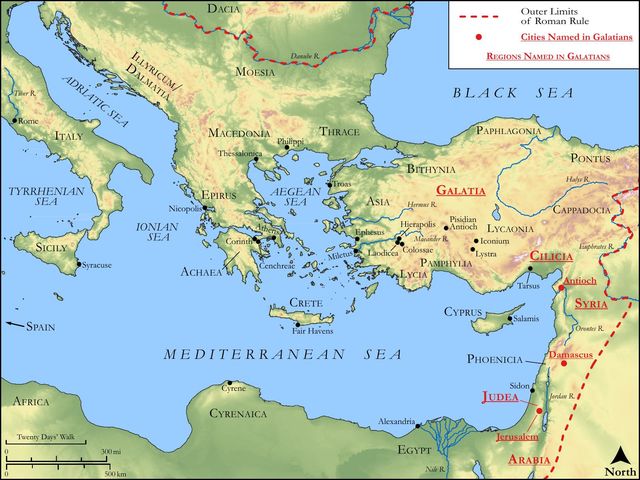
See on the biblical-era maps

Study this verse
Public-domain commentary
Matthew Henry
From his Commentary on the Whole Bible. Henry comments on passages, not single verses — this entry covers Galatians 2:1–10. His three-level outline is real structure in the source text, so it is rendered as structure.
It should seem, by the account Paul gives of himself in this chapter, that, from the very first preaching and planting of Christianity, there was a difference of apprehension between those Christians who had first been Jews and those who had first been Gentiles. Many of those who had first been Jews retained a regard to the ceremonial law, and strove to keep up the reputation of that; but those who had first been Gentiles had no regard to the law of Moses, but took pure Christianity as perfective of natural religion, and resolved to adhere to that. Peter was the apostle to them; and the ceremonial law, though dead with Christ, yet not being as yet buried, he connived at the respect kept up for it. But Paul was the apostle of the Gentiles; and, though he was a Hebrew of the Hebrews, yet he adhered to pure Christianity. Now in this chapter he tells us what passed between him and the other apostles, and particularly between him and Peter hereupon.
In these verses he informs us of another journey which he took to Jerusalem, and of what passed between him and the other apostles there, Gal 2:1-10. Here he acquaints us,
I.With some circumstances relating to this his journey thither. As particularly,
1.With the time of it: that it was not till fourteen years after the former (mentioned Gal 1:18), or, as others choose to understand it, from his conversion, or from the death of Christ. It was an instance of the great goodness of God that so useful a person was for so many years preserved in his work. And it was some evidence that he had no dependence upon the other apostles, but had an equal authority with them, that he had been so long absent from them, and was all the while employed in preaching and propagating pure Christianity, without being called into question by them for it, which it may be thought he would have been, had he been inferior to them, and his doctrine disapproved by them.
2.With his companions in it: he went up with Barnabas, and took with him Titus also. If the journey here spoken of was the same with that recorded Acts 15 (as many think), then we have a plain reason why Barnabas went along with him; for he was chosen by the Christians at Antioch to be his companion and associate in the affair he went about. But, as it does not appear that Titus was put into the same commission with him, so the chief reason of his taking him along with him seems to have been to let those at Jerusalem see that he was neither ashamed nor afraid to own the doctrine which he had constantly preached; for though Titus had now become not only a convert to the Christian faith, but a preacher of it too, yet he was by birth a Gentile and uncircumcised, and therefore, by making him his companion, it appeared that their doctrine and practice were of a piece, and that as he had preached the non-necessity of circumcision, and observing the law of Moses, so he was ready to own and converse with those who were uncircumcised.
3.With the reason of it, which was a divine revelation he had concerning it: he went up be revelation; not of his own head, much less as being summoned to appear there, but by special order and direction from Heaven. It was a privilege with which this apostle was often favoured to be under a special divine direction in his motions and undertakings; and, though this is what we have no reason to expect, yet it should teach us, in every thing of moment we go about, to endeavour, as far as we are capable, to see our way made plain before us, and to commit ourselves to the guidance of Providence.
II.He gives us an account of his behaviour while he was at Jerusalem, which was such as made it appear that he was not in the least inferior to the other apostles, but that both his authority and qualifications were every way equal to theirs. He particularly acquaints us,
1.That he there communicated the gospel to them, which he preached among the Gentiles, but privately, etc. Here we may observe both the faithfulness and prudence of our great apostle.
(1.)His faithfulness in giving them a free and fair account of the doctrine which he had all along preached among the Gentiles, and was still resolved to preach - that of pure Christianity, free from all mixtures of Judaism. This he knew was a doctrine that would be ungrateful to many there, and yet he was not afraid to own it, but in a free and friendly manner lays it open before them and leaves them to judge whether or no it was not the true gospel of Christ. And yet,
(2.)He uses prudence and caution herein, for fear of giving offence. He chooses rather to do it in a more private than in a public way, and to those that were of reputation, that is, to the apostles themselves, or to the chief among the Jewish Christians, rather than more openly and promiscuously to all, because, when he came to Jerusalem, there were multitudes that believed, and yet continued zealous for the law, Act 21:20. And the reason of this his caution was lest he should run, or had run, in vain, lest he should stir up opposition against himself and thereby either the success of his past labours should be lessened, or his future usefulness be obstructed; for nothing more hinders the progress of the gospel than differences of opinion about the doctrines of it, especially when they occasion quarrels and contentions among the professors of it, as they too usually do. It was enough to his purpose to have his doctrine owned by those who were of greatest authority, whether it was approved by others or not. And therefore, to avoid offence, he judges it safest to communicate it privately to them, and not in public to the whole church. This conduct of the apostle may teach all, and especially ministers, how much need they have of prudence, and how careful they should be to use it upon all occasions, as far as is consistent with their faithfulness.
2.That in his practice he firmly adhered to the doctrine which he had preached. Paul was a man of resolution, and would adhere to his principles; and therefore, though he had Titus with him, who was a Greek, yet he would not suffer him to be circumcised, because he would not betray the doctrine of Christ, as he had preached it to the Gentiles. It does not appear that the apostles at all insisted upon this; for, though they connived at the use of circumcision among the Jewish converts, yet they were not for imposing it upon the Gentiles. But there were others who did, whom the apostle here calls false brethren, and concerning whom he informs us that they were unawares brought in, that is, into the church, or into their company, and that they came only to spy out their liberty which they had in Christ Jesus, or to see whether Paul would stand up in defence of that freedom from the ceremonial law which he had taught as the doctrine of the gospel, and represented as the privilege of those who embraced the Christian religion. Their design herein was to bring them into bondage, which they would have effected could they have gained the point they aimed at; for, had they prevailed with Paul and the other apostles to have circumcised Titus, they would easily have imposed circumcision upon other Gentiles, and so have brought them under the bondage of the law of Moses. But Paul, seeing their design, would by no means yield to them; he would not give place by subjection, no, not for an hour, not in this one single instance; and the reason of it was that the truth of the gospel might continue with them - that the Gentile Christians, and particularly the Galatians, might have it preserved to them pure and entire, and not corrupted with the mixtures of Judaism, as it would have been had he yielded in this matter. Circumcision was at that time a thing indifferent, and what in some cases might be complied with without sin; and accordingly we find even Paul himself sometimes giving way to it, as in the case of Timothy, Act 16:3. But when it is insisted on as necessary, and his consenting to it, though only in a single instance, is likely to be improved as giving countenance to such an imposition, he has too great a concern for the purity and liberty of the gospel, to submit to it; he would not yield to those who were for the Mosaic rites and ceremonies, but would stand fast in the liberty wherewith Christ hath made us free, which conduct of his may give us occasion to observe that what under some circumstances may lawfully be complied with, yet, when that cannot be done without betraying the truth, or giving up the liberty, of the gospel, it ought to be refused.
3.That, though he conversed with the other apostles, yet he did not receive any addition to his knowledge or authority from them, Gal 2:6. By those who seemed to be somewhat he means the other apostles, particularly James, Peter, and John, whom he afterwards mentions by name, Gal 2:9. And concerning these he grants that they were deservedly had in reputation by all, that they were looked upon (and justly too) as pillars of the church, who were set not only for its ornament, but for its support, and that on some accounts they might seem to have the advantage of him, in that they had seen Christ in the flesh, which he had not, and were apostles before him, yea, even while he continued a persecutor. But yet, whatever they were, it was no matter to him. This was no prejudice to his being equally an apostle with them; for God does not accept the persons of men on the account of any such outward advantages. As he had called them to this office, so he was at liberty to qualify others for it, and to employ them in it. And it was evident in this case that he had done so; for in conference they added nothing to him, they told him nothing but what he before knew by revelation, nor could they except against the doctrine which he communicated to them, whence it appeared that he was not at all inferior to them, but was as much called and qualified to be an apostle as they themselves were.
4.That the issue of this conversation was that the other apostles were fully convinced of his divine mission and authority, and accordingly acknowledged him as their fellow-apostle, Gal 2:7-10. They were not only satisfied with his doctrine, but they saw a divine power attending him, both in preaching it and in working miracles for the confirmation of it: that he who wrought effectually in Peter to the apostleship of the circumcision, the same was mighty in him towards the Gentiles. And hence they justly concluded that the gospel of the uncircumcision was committed to Paul, as the gospel of the circumcision was to Peter. And therefore, perceiving the grace that was given to him (that he was designed to the honour and office of an apostle as well as themselves) they gave unto him and Barnabas the right hand of fellowship, a symbol whereby they acknowledged their equality with them, and agreed that these should go to the heathen, while they continued to preach to the circumcision, as judging it most agreeable to the mind of Christ, and most conducive to the interest of Christianity, so to divide their work. And thus this meeting ended in an entire harmony and agreement; they approved both Paul's doctrine and conduct, they were fully satisfied in him, heartily embraced him as an apostle of Christ, and had nothing further to add, only that they would remember the poor, which of his own accord he was very forward to do. The Christians of Judea were at that time labouring under great wants and difficulties; and the apostles, out of their compassion to them and concern for them, recommend their case to Paul, that he should use his interest with the Gentile churches to procure a supply for them. This was a reasonable request; for, if the Gentiles were made partakers of their spiritual things, it was their duty to minister to them in carnal things, as Rom 15:27. And he very readily falls in with it, whereby he showed his charitable and catholic disposition, how ready he was to own the Jewish converts as brethren, though many of them could scarcely allow the like favour to the converted Gentiles, and that mere difference of opinion was no reason with him why he should not endeavour to relieve and help them. Herein he has given us an excellent pattern of Christian charity, and has taught us that we should by no means confine it to those who are just of the same sentiments with us, but be ready to extend it to all whom we have reason to look upon as the disciples of Christ.
Historical interpretation
Five Centuries of Reception
7 surviving comments on this verse. Each one is dated, so this reads as a timeline rather than a list.
Select a marker to jump to its quote. Markers stagger vertically where authors wrote within a few decades of each other.
So great had been his desire to be approved and supported by those whom you wish on all occasions to be understood as in alliance with Judaism! When indeed he says, that "neither was Titus circumcised," he for the first time shows us that circumcision was the only question connected with the maintenance of the law, which had been as yet agitated by those whom he therefore calls "false brethren unawares brought in.
When he first says, "Neither Titus, who was with me, being a Greek, was compelled to be circumcised," and then adds, "And that because of false brethren unawares brought in," etc.
The implication is “Why should you be circumcised, when Titus was not compelled to undergo circumcision by the apostles? Titus, who had an important role, was accepted without circumcision.”
"But not even Titus, who was with me, being a Greek, was compelled to be circumcised."
What means, "being a Greek?" Of Greek extraction, and not circumcised; for not only did I so preach but Titus so acted, nor did the Apostles compel him to be circumcised. A plain proof this that the Apostles did not condemn Paul's doctrine or his practice. Nay more, even the urgent representations of the adverse party, who were aware of these facts, did not oblige the Apostles to enjoin circumcision, as appears by his own words.
(Vers. 3-5.) But not even Titus, who was with me, though he was a Gentile, was compelled to be circumcised. Yet because of false brothers secretly brought in—who slipped in to spy out our freedom that we have in Christ Jesus, so that they might bring us into slavery— to them we did not yield in submission even for a moment, so that the truth of the gospel might be preserved for you. But even Titus, who was with me, was not compelled to be circumcised, although he was a Gentile. This matter arose because of false brothers secretly brought in, who slipped in to spy out our freedom that we have in Christ Jesus, so that they might bring us into slavery. But what is this truth of the Gospel, to give in to the hypocrisy of the Jews; and to consider as scybala what you once esteemed, and to despise as losses, and to observe and esteem as something, when they are nothing? But it strongly opposes the meaning of the Epistle itself, to call the Galatians back to circumcision. This is the main theme throughout his discourse, to teach that he is a Hebrew among the Hebrews, once observing all the works of the Law, circumcised on the eighth day according to the Law of the Pharisees: nevertheless, for the grace of Christ, to completely despise everything. For when he went to Jerusalem, and the false brethren, who believed in circumcision, wanted to compel him to circumcise Titus; neither Titus, nor did he give in to violence, so that they would safeguard the truth of the Gospel. But if he says that he was compelled by necessity to circumcise Titus: how does he recall the Galatians from circumcision, from which neither Titus, who was with him from the Gentiles, could excuse himself in Jerusalem? Therefore, according to the Greek manuscripts, it should be read, 'To whom we did not yield in subjection, not even for an hour,' so that it may be understood subsequently: so that the truth of the Gospel may remain with you. But if the testimony of the Latin exemplars is pleasing to anyone, we must understand it according to the higher sense: that the purpose was not for Titus to be circumcised, but to go to Jerusalem. For this reason, Paul and Barnabas submitted to going to Jerusalem, due to the sedition caused by the Law of Antioch. This was done so that the truth of the Gospel would be confirmed by the letter of the apostles and remain among the Galatians, which was not in the literal sense, but in the spiritual sense. It was not in the carnal understanding, but in spiritual intelligence, and not in overt Judaism, but in hidden understanding. It is worth knowing that the conjunction 'autem,' which is placed in this position, is superfluous if it is read without any purpose to respond to it and if it concludes the previous statement. However, it serves to maintain the order of reading and the sense of the passage. So, Titus, who was with me, being a Gentile, was not compelled to be circumcised. And immediately after, it explains the reason why he was being urged to undergo circumcision against his will. 'Because of the false brothers secretly brought in, who slipped in to spy out our freedom that we have in Christ Jesus, so that they might bring us into slavery.' But when they were serving as ministers and wished to drag us into the servitude of the Law from the freedom of Christ, we did not even yield to them for a moment, so that we might not give any occasion to them to accuse us. And we did this primarily because of the ecclesiastical peace, so that we could excuse ourselves from necessity, and we did all of this so that you would not have any opportunity to depart from the grace of the Gospel. Therefore, if we, while in Jerusalem, among so many Jews who were falsely claiming to be brothers and those who were exerting influence over us to some extent, could not be compelled by force or reason to observe the circumcision that we knew was abolished, then you, coming from the Gentiles, you in Galatia, you to whom no violence can be done, voluntarily abandoning the grace, have transcended the antiquity of the already abolished Law.
It was because of the intrigues of false brethren that Titus was not compelled to be circumcised. It was not possible to require circumcision of him. Those who had crept in to spy on their liberty had a vehement expectation and desire for the circumcision of Titus. They wanted, with Paul’s testimony and consent, to preach circumcision as necessary to salvation.
That is, by the Apostles; which is, of course, a highest proof that they should not pass sentence against the Apostle, who did not circumcise the nations.
Continue studying Galatians 2:3 across the web’s major study libraries — every link below opens this exact verse, chapter, or book on the destination site.
Read & Compare
 BibleGatewayThis verse in more than 200 translations and 70 languages.
 Bible.comThe YouVersion reader — hundreds of translations, reading plans, and highlights.
 ESV.orgCrossway's official English Standard Version reader.
 NET BibleThe NET translation with 60,000+ translators' notes on every rendering decision.
 STEP BibleTyndale House's free study tool — original text, vocabulary, and scholarly resources.
 BibliaLogos Bible Software's free web reader.
 USCCBThe New American Bible (Revised Edition) with the U.S. bishops' study notes.
Commentaries
 BibleHub CommentariesDozens of classic commentaries on this verse, gathered on one page.
 StudyLightMore than 100 commentary sets — the largest collection on the web.
 BibleRefPlain-English commentary on what this verse means, verse by verse.
 Enduring WordDavid Guzik's free commentary on this chapter, widely used by Bible teachers.
 Bible Study ToolsVerse commentary alongside Greek and Hebrew study aids.
Original Language & Research
- BibleHub InterlinearThe verse word by word — original language, transliteration, and English.
- BibleHub LexiconEvery word's original-language definition and Strong's entry.
 Blue Letter BibleDeep-study tools — Strong's numbers, concordance, and word studies.
 CNTR CollationThe earliest Greek manuscripts of this verse, collated letter by letter.
Sermons, Hymns & Audio


TrulyRandomVerse is not affiliated with these sites and doesn’t control their content. They’re linked because they’re genuinely useful.
Summary
Galatians 2:3 is a foundational verse in Paul's epistle, recounting his unwavering refusal to compel his Greek companion, Titus, to be circumcised during a critical meeting in Jerusalem. This decision powerfully underscored the core tenet of the gospel: salvation is by grace through faith in Jesus Christ alone, not by adherence to the ceremonial law or human-imposed requirements, thereby affirming the full inclusion of Gentiles into God's covenant people without requiring them to adopt Jewish customs.
Context
ShowHideLiterary Context
Galatians 2:3 is embedded within Paul's intensely personal and theological defense of his apostolic authority and the purity of the gospel. Paul is recounting his second significant visit to Jerusalem, approximately fourteen years after his conversion, a meeting distinct from his initial visit described in Galatians 1:18-20. This strategic visit, likely corresponding to the "Jerusalem Council" detailed in Acts 15, was undertaken "by revelation" (Galatians 2:2) to present the gospel he preached to the Gentiles to the pillar apostles—James, Cephas (Peter), and John. The immediate backdrop is the intense pressure from "false brethren" (Galatians 2:4) who had infiltrated the Christian community, advocating for the necessity of circumcision and adherence to the Mosaic Law for Gentile converts. Paul's account of Titus's uncircumcised status serves as concrete evidence of the apostles' affirmation of his gospel message and their recognition of Gentile freedom in Christ.
Historical & Cultural Context
Circumcision was the quintessential sign of the Abrahamic covenant (Genesis 17:9-14), deeply ingrained in Jewish identity and religious practice for millennia. For many Jewish Christians, it was inconceivable that Gentiles could become full members of God's people without adopting this foundational mark of covenant membership. The early church was grappling with its identity as a movement that transcended ethnic boundaries, a radical departure from the ethno-centric nature of Judaism. The Jerusalem meeting was crucial for establishing whether Christianity would remain a sect of Judaism, requiring converts to become Jewish proselytes, or if it would embrace its universal mission. Titus, a Greek, represented the very heart of this theological and cultural tension. Paul's refusal to yield to the demand for Titus's circumcision was not merely a personal preference but a theological imperative to safeguard the integrity of the gospel and prevent a two-tiered church system that would undermine the unity found in Christ.
Key Themes
ShowHideThis verse powerfully contributes to several overarching themes in Galatians and Pauline theology. Foremost is the theme of Justification by Faith Alone, which Paul champions throughout the letter. The non-compulsion of Titus's circumcision unequivocally demonstrates that acceptance by God is not contingent upon adherence to the Mosaic Law or ceremonial rites, but solely upon faith in Jesus Christ, as Paul explicitly states in Galatians 2:16. Secondly, it underscores the theme of Christian Liberty. Paul vehemently defends the freedom believers have in Christ from legalistic bondage, refusing to compromise the gospel's simplicity and sufficiency. This liberty is a central call to "stand fast therefore in the liberty wherewith Christ hath made us free, and be not entangled again with the yoke of bondage" (Galatians 5:1). Finally, Galatians 2:3 is a pivotal affirmation of Gentile Inclusion into the body of Christ on equal terms with Jewish believers. Titus, as an uncircumcised Greek, served as living proof that God's grace extends to all, breaking down the dividing wall between Jew and Gentile and creating "one new man" in Christ (Ephesians 2:14-16).
Exposition and Analysis
ShowHideKey Word Analysis
ShowHideVerse Breakdown
ShowHide"But neither Titus, who was with me,"
This opening phrase immediately introduces Titus, Paul's traveling companion and fellow worker, establishing his presence and association with Paul during this crucial Jerusalem visit. The "but neither" (G235, G3761) serves as a strong adversative, signaling a contrast to what might have been expected or demanded, setting the stage for Paul's firm stance. Titus's presence as an uncircumcised Gentile was a living test case for the gospel Paul preached.
"being a Greek,"
This clause specifies Titus's ethnicity, which is the crux of the controversy. As a "Greek" (Gentile), Titus was not ethnically Jewish and therefore not naturally subject to the Mosaic Law's requirements, including circumcision. His status highlights the universal scope of the gospel and the radical implication that God accepts people from all nations without requiring them to adopt Jewish cultural or ceremonial markers.
"was compelled to be circumcised:"
This final clause articulates the central conflict. Despite the immense pressure and demands from those who insisted on circumcision for Gentile converts, Paul steadfastly refused to yield. The phrase "was compelled" underscores the external force and theological battle Paul was engaged in. His resolute refusal signifies the absolute sufficiency of Christ's work for salvation and the freedom from legalistic burdens that defines the new covenant.
Literary Devices
ShowHidePaul employs several literary devices in Galatians 2:3 to strengthen his argument for justification by faith. The most prominent is Exemplum, where Titus serves as a concrete example or case study. By presenting Titus, an uncircumcised Greek, as a fully accepted brother in Christ, Paul provides irrefutable evidence against the legalists' demands. Titus embodies the principle that Gentile converts do not need to become Jewish proselytes to be saved. Furthermore, there is an element of Rhetorical Contrast at play. The implied contrast is between the legalistic demands of the "false brethren" and the liberating truth of the gospel. Paul's declarative statement about Titus's non-circumcision stands in stark opposition to the "compulsion" exerted, highlighting the fundamental difference between grace and works-based righteousness. This contrast serves to underscore the radical nature of the gospel and Paul's unwavering commitment to its purity.
Theological and Thematic Connections
ShowHideGalatians 2:3 is a theological linchpin, demonstrating that the essence of the gospel is rooted in God's unmerited favor, not human performance. It asserts that salvation and full acceptance into God's family are granted solely through faith in Jesus Christ, rendering ceremonial laws like circumcision obsolete as requirements for righteousness. This verse powerfully refutes any theology that adds human works or rituals as prerequisites for salvation or spiritual standing, upholding the sufficiency of Christ's atoning work. It underscores the profound truth that in Christ, the old distinctions and dividing walls are broken down, creating a unified body of believers where all are equal in status before God, regardless of ethnic or cultural background.
Reflection and Application
ShowHideGalatians 2:3 offers profound lessons for contemporary believers, serving as a timeless bulwark against legalism and a powerful affirmation of Christian liberty. In a world often prone to adding human-made rules or cultural expectations to the simple gospel, this verse calls us to vigilant discernment. It reminds us that our standing before God is entirely dependent on Christ's finished work, not on our adherence to external rituals, traditions, or self-imposed burdens. Living in the freedom Christ provides means resisting pressures to conform to religious expectations that diminish the centrality of grace. This freedom, however, is not a license for licentiousness but an empowerment to serve God and others in love, unburdened by the need to earn His favor. Furthermore, the inclusion of Titus without circumcision champions unity in diversity, challenging us to embrace and celebrate the rich tapestry of cultures and backgrounds within the global church, ensuring that no one is excluded or made to feel "less than" based on non-essential differences.
Questions for Reflection
ShowHideFAQ
ShowHideWhy was Titus's circumcision such a critical issue for Paul and the early church?
ShowHideTitus's circumcision was a critical issue because it represented the fundamental theological divide between salvation by grace through faith in Christ alone and salvation through adherence to the Mosaic Law, specifically circumcision. For many Jewish Christians, circumcision was the indispensable sign of covenant membership and obedience to God's commands. If Titus, a Gentile, were compelled to be circumcised, it would imply that Gentiles needed to become Jewish proselytes to be true Christians, thereby adding a requirement beyond faith in Christ. Paul viewed this as a direct assault on the sufficiency of Christ's work and a distortion of the gospel of grace, which teaches that both Jews and Gentiles are justified by faith, not by works of the law (Romans 3:28). His refusal to yield ensured that the gospel remained accessible to all without cultural or ceremonial barriers.
Does Paul's stance on Titus mean that all religious traditions or practices are unnecessary for Christians?
ShowHidePaul's stance in Galatians 2:3 does not negate all religious traditions or practices, but it critically distinguishes between those that are essential for salvation and those that are not. Paul's primary concern was to prevent any human tradition or ceremonial law from being elevated to the status of a requirement for salvation or acceptance by God. Practices like circumcision, which were signs of the old covenant, were rendered obsolete as means of righteousness by Christ's fulfillment of the Law. However, the New Testament church developed its own practices (e.g., baptism, communion, gathering for worship) that serve as expressions of faith, discipleship, and community, but they are not presented as conditions for salvation. The key is that no tradition should ever overshadow or contradict the core truth that salvation is a gift received by grace through faith in Jesus Christ alone (Ephesians 2:8-9).
Christ-Centered Fulfillment
ShowHideGalatians 2:3 finds its ultimate fulfillment in the person and work of Jesus Christ, who is the end of the Law for righteousness to everyone who believes (Romans 10:4). The freedom from circumcision, exemplified by Titus, points directly to Christ's establishment of a new covenant, superior to the old, which is not marked by external rites but by an inward transformation of the heart (Hebrews 8:6-13). In Christ, the physical act of circumcision is replaced by a spiritual circumcision, a cutting away of the sinful nature, which is accomplished through faith in His death and resurrection (Colossians 2:11-12). Jesus, through His atoning sacrifice, broke down the dividing wall of hostility between Jew and Gentile, creating "one new man" in Himself, thereby making peace and granting equal access to the Father for all who believe (Ephesians 2:14-18). Therefore, Titus's uncircumcised status is a living testament to the universal and all-sufficient salvation offered by Christ, where there is "neither Jew nor Greek, there is neither bond nor free, there is neither male nor female: for ye are all one in Christ Jesus" (Galatians 3:28).