


Galatians 3:28
Bible text: King James Version (1769 Blayney text) · Public domain
Bible text: King James Version with Strong's numbers · Public domain
Bible text: Berean Standard Bible · Public domain
Bible text: American Standard Version (1901) · Public domain
Bible text: World English Bible, Messianic edition · Public domain
Bible text: Geneva Bible (1599) · Public domain
Bible text: Young's Literal Translation · Public domain
- οὐκoukNeitherG3756PRT-NNegative Particle Negative
- ἔνιenithere isG1762V-PAI-3SVerb Present Active Indicative 3rd Singular
- ἸουδαῖοςIoudaiosJewG2453N-NSM-PGNoun Nominative Singular Masculine Person Gentilic
- οὐδὲoudenorG3761CONJ-NConjunction Negative
- ἝλληνHellēnGreekG1672N-NSM-LGNoun Nominative Singular Masculine Location Gentilic
- οὐκoukneitherG3756PRT-NNegative Particle Negative
- ἔνιenithere isG1762V-PAI-3SVerb Present Active Indicative 3rd Singular
- δοῦλοςdoulosslaveG1401N-NSMNoun Nominative Singular Masculine
- οὐδὲoudenorG3761CONJ-NConjunction Negative
- ἐλεύθεροςeleutherosfreeG1658A-NSMAdjective Nominative Singular Masculine
- οὐκoukneitherG3756PRT-NNegative Particle Negative
- ἔνιenithere isG1762V-PAI-3SVerb Present Active Indicative 3rd Singular
- ἄρσενarsenmaleG730A-NSNAdjective Nominative Singular Neuter
- καὶkaiandG2532CONJConjunction
- θῆλυ·thēlufemaleG2338A-NSNAdjective Nominative Singular Neuter
- πάντεςpantesallG3956A-NPMAdjective Nominative Plural Masculine
- γὰρgarforG1063CONJConjunction
- ὑμεῖςhumeisyou yourselvesG4771P-2NPPersonal pronoun Nominative 2nd Plural
- εἷςheisoneG1520A-NSMAdjective Nominative Singular Masculine
- ἐστεesteareG1510V-PAI-2PVerb Present Active Indicative 2nd Plural
- ἐνeninG1722PREPPreposition
- ΧριστῷChristōChristG5547N-DSM-TNoun Dative Singular Masculine Title
- ἸησοῦIēsouJesusG2424N-DSM-PNoun Dative Singular Masculine Individual
English is a literal word-by-word gloss of the Greek, not the KJV's wording. Why?
This is the original text the KJV's translators worked from — each Greek word with its own literal English meaning in this verse, prepared by scholars at Tyndale House, Cambridge. The KJV translates whole sentences, not word by word, so its wording differs: one Greek word can become several English words, and the KJV may choose “charity” where the gloss reads “love”. Both are faithful — they answer different questions. For the KJV's own rendering, switch to the KJV text.
Details
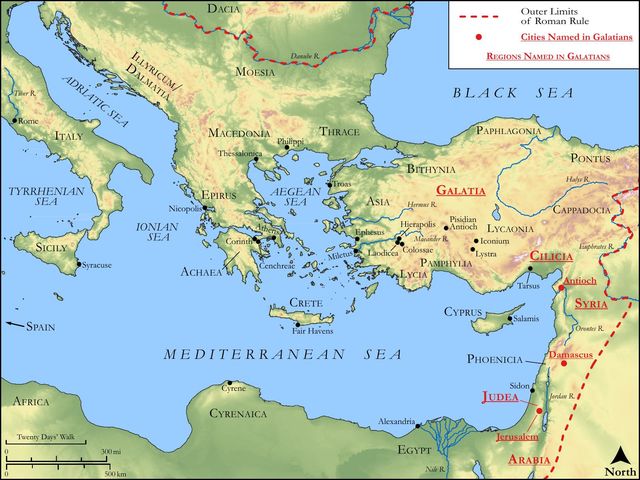
See on the biblical-era maps

Study this verse
Public-domain commentary
Matthew Henry
From his Commentary on the Whole Bible. Henry comments on passages, not single verses — this entry covers Galatians 3:19–29. His four-level outline is real structure in the source text, so it is rendered as structure.
The apostle having just before been speaking of the promise made to Abraham, and representing that as the rule of our justification, and not the law, lest they should think he did too much derogate from the law, and render it altogether useless, he thence takes occasion to discourse of the design and tendency of it, and to acquaint us for what purposes it was given. It might be asked, "If that promise be sufficient for salvation, wherefore then serveth the law? Or, Why did God give the law by Moses?" To this he answers,
I.The law was added because of transgressions, Gal 3:19.
It was not designed to disannul the promise, and to establish a different way of justification from that which was settled by the promise; but it was added to it, annexed on purpose to be subservient to it, and it was so because of transgressions. The Israelites, though they were chosen to be God's peculiar people, were sinners as well as others, and therefore the law was given to convince them of their sin, and of their obnoxiousness to the divine displeasure on the account of it; for by the law is the knowledge of sin (Rom 3:20), and the law entered that sin might abound, Rom 5:20. And it was also intended to restrain them from the commission of sin, to put an awe upon their minds, and be a curb upon their lusts, that they should not run into that excess of riot to which they were naturally inclined; and yet at the same time it was designed to direct them to the true and only way whereby sin was to be expiated, and wherein they might obtain the pardon of it; namely, through the death and sacrifice of Christ, which was the special use for which the law of sacrifices and purifications was given.
The apostle adds that the law was given for this purpose till the seed should come to whom the promise was made; that is, either till Christ should come (the principle seed referred to in the promise, as he had before shown), or till the gospel dispensation should take place, when Jews and Gentiles, without distinction, should, upon believing, become the seed of Abraham. The law was added because of transgressions, till this fulness of time, or this complete dispensation, should come. But when the seed came, and a fuller discovery of divine grace in the promise was made, then the law, as given by Moses, was to cease; that covenant, being found faulty, was to give place to another, and a better, Heb 8:7, Heb 8:8. And though the law, considered as the law of nature, is always in force, and still continues to be of use to convince men of sin and to restrain them from it, yet we are now no longer under the bondage and terror of that legal covenant. The law then was not intended to discover another way of justification, different from that revealed by the promise, but only to lead men to see their need of the promise, by showing them the sinfulness of sin, and to point them to Christ, through whom alone they could be pardoned and justified.
As a further proof that the law was not designed to vacate the promise, the apostle adds, It was ordained by angels in the hand of a mediator. It was given to different persons, and in a different manner from the promise, and therefore for different purposes. The promise was made to Abraham, and all his spiritual seed, including believers of all nations, even of the Gentiles as well as the Jews; but the law was given to the Israelites as a peculiar people, and separated from the rest of the world. And, whereas the promise was given immediately by God himself, the law was given by the ministry of angels, and the hand of a mediator. Hence it appeared that the law could not be designed to set aside the promise; for (Gal 3:20), A mediator is not a mediator of one, of one party only; but God is one, but one party in the promise or covenant made with Abraham: and therefore it is not to be supposed that by a transaction which passed only between him and the nation of the Jews he should make void a promise which he had long before made to Abraham and all his spiritual seed, whether Jews or Gentiles. This would not have been consistent with his wisdom, nor with his truth and faithfulness. Moses was only a mediator between God and the spiritual seed of Abraham; and therefore the law that was given by him could not affect the promise made to them, much less be subversive of it.
II.The law was given to convince men of the necessity of a Saviour.
The apostle asks (Gal 3:21), as what some might be willing to object, "Is the law then against the promises of God? Do they really clash and interfere with each other? Or do you not set the covenant with Abraham, and the law of Moses, at variance with one another?" To this he answers, God forbid; he was far from entertaining such a thought, nor could it be inferred from what he had said. The law is by no means inconsistent with the promise, but subservient to it, as the design of it is to discover men's transgressions, and to show them the need they have of a better righteousness than that of the law. That consequence would much rather follow from their doctrine than from his; for, if there had been a law given that could have given life, verily righteousness would have been by the law, and in that case the promise would have been superseded and rendered useless. But that in our present state could not be, for the scripture hath concluded all under sin (Gal 3:22), or declared that all, both Jew and Gentile, are in a state of guilt, and therefore unable to attain to righteousness and justification by the works of the law. The law discovered their wounds, but could not afford them a remedy: it showed that they were guilty, because it appointed sacrifices and purifications, which were manifestly insufficient to take away sin: and therefore the great design of it was that the promise by faith of Jesus Christ might be given to those that believe, that being convinced of their guilt, and the insufficiency of the law to effect a righteousness for them, they might be persuaded to believe on Christ, and so obtain the benefit of the promise.
III.The law was designed for a schoolmaster, to bring men to Christ, Gal 3:24.
In the foregoing verse, the apostle acquaints us with the state of the Jews under the Mosaic economy, that before faith came, or before Christ appeared and the doctrine of justification by faith in him was more fully discovered, they were kept under the law, obliged, under severe penalties, to a strict observance of the various precepts of it; and at that time they were shut up, held under the terror and discipline of it, as prisoners in a state of confinement: the design of this was that hereby they might be disposed more readily to embrace the faith which should afterwards be revealed, or be persuaded to accept Christ when he came into the world, and to fall in with that better dispensation he was to introduce, whereby they were to be freed from bondage and servitude, and brought into a state of greater light and liberty. Now, in that state, he tells them, the law was their schoolmaster, to bring them to Christ, that they might be justified by faith. As it declared the mind and will of God concerning them, and at the same time denounced a curse against them for every failure in their duty, so it was proper to convince them of their lost and undone condition in themselves, and to let them see the weakness and insufficiency of their own righteousness to recommend them to God. And as it obliged them to a variety of sacrifices, etc., which, though they could not of themselves take away sin, were typical of Christ, and of the great sacrifice which he was to offer up for the expiation of it, so it directed them (though in a more dark and obscure manner) to him as their only relief and refuge. And thus it was their schoolmaster, to instruct and govern them in their state of minority, or, as the word paidagōgos most properly signifies, their servant, to lead and conduct them to Christ (as children were wont to be led to school by those servants who had the care of them); that they might be more fully instructed by him as their schoolmaster, in the true way of justification and salvation, which is only by faith in him, and of which he was appointed to give the fullest and clearest discoveries. But lest it should be said, If the law was of this use and service under the Jewish, why may it not continue to be so under the Christian state too, the apostle adds (Gal 3:25) that after faith has come, and the gospel dispensation has taken place, under which Christ, and the way of pardon and life through faith in him, are set in the clearest light, we are no longer under a schoolmaster - we have no such need of the law to direct us to him as there was then. Thus the apostle acquaints us for what uses and purposes the law served; and, from what he says concerning this matter, we may observe,
1.The goodness of God to his people of old, in giving the law to them; for though, in comparison of the gospel state, it was a dispensation of darkness and terror, yet it furnished them with sufficient means and helps both to direct them in their duty to God and to encourage their hopes in him.
2.The great fault and folly of the Jews, in mistaking the design of the law, and abusing it to a very different purpose from that which God intended in the giving of it; for they expected to be justified by the works of it, whereas it was never designed to be the rule of their justification, but only a means of convincing them of their guilt and of their need of a Saviour, and of directing them to Christ, and faith in him, as the only way of obtaining this privilege. See Rom 9:31, Rom 9:32; Rom 10:3, Rom 10:4.
3.The great advantage of the gospel state above the legal, under which we not only enjoy a clearer discovery of divine grace and mercy than was afforded to the Jews of old, but are also freed from the state of bondage and terror under which they were held. We are not now treated as children in a state of minority, but as sons grown up to a full age, who are admitted to greater freedoms, and instated in larger privileges, than they were. This the apostle enlarges upon in the following verses. For, having shown for what intent the law was given, in the close of the chapter he acquaints us with our privilege by Christ, where he particularly declares,
(1.)That we are the children of God by faith in Christ Jesus, Gal 3:26. And here we may observe,
[1.]The great and excellent privilege which real Christians enjoy under the gospel: They are the children of God; they are no longer accounted servants, but sons; they are not now kept at such a distance, and under such restraints, as the Jews were, but are allowed a nearer and freer access to God than was granted to them; yea, they are admitted into the number, and have a right to all the privileges, of his children.
[2.]How they come to obtain this privilege, and that is by faith in Christ Jesus. Having accepted him as their Lord and Saviour, and relying on him alone for justification and salvation, they are hereupon admitted into this happy relation to God, and are entitled to the privileges of it; for (Joh 1:12) as many as received him, to them gave he power to become the sons of God, even to those that believe on his name. And this faith in Christ, whereby they became the children of God, he reminds us (Gal 3:27), was what they professed in baptism; for he adds, As many of you as have been baptized into Christ have put on Christ. Having in baptism professed their faith in him, they were thereby devoted to him, and had, as it were, put on his livery, and declared themselves to be his servants and disciples; and having thus become the members of Christ, they were through him owned and accounted as the children of God. Here note, First, Baptism is now the solemn rite of our admission into the Christian church, as circumcision was into that of the Jews. Our Lord Jesus appointed it to be so, in the commission he gave to his apostles (Mat 28:19), and accordingly it was their practice to baptize those whom they had discipled to the Christian faith; and perhaps the apostle might take notice of their baptism here, and of their becoming the children of God through faith in Christ, professed therein, to obviate a further objection, which the false teachers might be apt to urge in favour of circumcision. They might be ready to say, "Though it should be allowed that the law, as given at mount Sinai, was abrogated by the coming of Christ the promised seed, yet why should circumcision be set aside too, when that was given to Abraham together with the promise, and long before the giving of the law by Moses?" But this difficulty is sufficiently removed when the apostle says, Those who are baptized into Christ have put on Christ; for thence it appears that under the gospel baptism comes in the room of circumcision, and that those who by baptism are devoted to Christ, and do sincerely believe in him, are to all intents and purposes as much admitted into the privileges of the Christian state as the Jews were by circumcision into those of the legal (Phi 3:3), and therefore there was no reason why the use of that should still be continued. Note, Secondly, In our baptism we put on Christ; therein we profess our discipleship to him, and are obliged to behave ourselves as his faithful servants. Being baptized into Christ, we are baptized into his death, that as he died and rose again, so, in conformity thereunto, we should die unto sin, and walk in newness of life (Rom 6:3, Rom 6:4); it would be of great advantage to us did we oftener remember this.
(2.)That this privilege of being the children of God, and of being by baptism devoted to Christ, is now enjoyed in common by all real Christians. The law indeed made a difference between Jew and Greek, giving the Jews on many accounts the pre-eminence: that also made a difference between bond and free, master and servant, and between male and female, the males being circumcised. But it is not so now; they all stand on the same level, and are all one in Christ Jesus; as the one is not accepted on the account of any national or personal advantages he may enjoy above the other, so neither is the other rejected for the want of them; but all who sincerely believe on Christ, of what nation, or sex, or condition, soever they be, are accepted of him, and become the children of God through faith in him.
(3.)That, being Christ's, we are Abraham's seed, and heirs according to the promise. Their judaizing teachers would have them believe that they must be circumcised and keep the law of Moses, or they could not be saved: "No," says the apostle, "there is no need of that; for if you be Christ's, if you sincerely believe on him, who is the promised seed, in whom all the nations of the earth were to be blessed, you therefore become the true seed of Abraham, the father of the faithful, and as such are heirs according to the promise, and consequently are entitled to the great blessings and privileges of it." And therefore upon the whole, since it appeared that justification was not to be attained by the works of the law, but only by faith in Christ, and that the law of Moses was a temporary institution and was given for such purposes as were only subservient to and not subversive of the promise, and that now, under the gospel, Christians enjoy much greater and better privileges than the Jews did under that dispensation, it must needs follow that they were very unreasonable and unwise, in hearkening to those who at once endeavoured to deprive them of the truth and liberty of the gospel.
Historical interpretation
Nineteen Centuries of Reception
8 surviving comments on this verse. Each one is dated, so this reads as a timeline rather than a list.
Select a marker to jump to its quote. Markers stagger vertically where authors wrote within a few decades of each other.
Masters, be gentle towards your servants, as holy Job has taught you; for there is one nature, and one family of mankind. For "in Christ there is neither bond nor free."
There is neither Jew nor Greek, there is neither bond nor free, there is neither male nor female: for ye are all one in Christ Jesus."
With what consistency do we mount that (future) judgment-seat to pronounce sentence against those whose gifts we (now) seek after? For you too, (women as you are, ) have the self-same angelic nature promised as your reward, the self-same sex as men: the self-same advancement to the dignity of judging, does (the Lord) promise you.
For, says (the Naassene), Attis has been emasculated, that is, he has passed over from the earthly parts of the nether world to the everlasting substance above, where, he says, there is neither female or male,
See what an insatiable soul! for having said, "We are all made children of God through Faith," he does not stop there, but tries to find something more exact, which may serve to convey a still closer oneness with Christ. Having said, "ye have put on Christ," even this does not suffice Him, but by way of penetrating more deeply into this union, he comments on it thus: "Ye are all One in Christ Jesus," that is, ye have all one form and one mould, even Christ's. What can be more awful than these words! He that was a Greek, or Jew, or bondman yesterday, carries about with him the form, not of an Angel or Archangel, but of the Lord of all, yea displays in his own person the Christ.
(Verse 27, 28.) For whoever has been baptized in Christ has clothed themselves with Christ. There is neither Jew nor Greek, slave nor free, male nor female. For you are all one in Christ Jesus. And how we are born as children of God through faith in Christ Jesus, he demonstrates by saying: For whoever has been baptized in Christ has clothed themselves with Christ. And that Christ is our clothing is proven not only in this passage, but also in another by the urging of Paul himself: Clothe yourselves with the Lord Jesus Christ (Rom. XIII, 14). Therefore, if those who have been baptized in Christ have put on Christ, it is clear that those who have not put on Christ have not been baptized in Christ. For it was said to those who were considered faithful and had received the baptism of Christ: Put on the Lord Jesus Christ. If anyone takes only the physical and visible water as a cleansing, they have not put on the Lord Jesus Christ. For even Simon, from the Acts of the Apostles, had received the cleansing of water; but because he did not have the Holy Spirit, he was not clothed with Christ (Acts 8). And heretics or hypocrites, and those who live sordidly, indeed seem to receive baptism, but I do not know whether they have the garment of Christ. Therefore, let us consider lest someone be found among us who, because he does not have the garment of Christ, is accused of not being baptized in Christ. However, when someone has once put on Christ and has been sent into the fire, becoming white with the burning ardor of the Holy Spirit, it is not understood whether it is gold or silver. As long as heat possesses matter in this way, it has a single fiery color, and all diversity of race, condition, and bodies disappears under this covering. For he is not a Jew, nor a Greek. We must understand the Greek as being a Gentile, because 'Ἕλλην' means both Greek and Gentile. Neither is a Jew better because he is circumcised, nor is a Gentile worse because he has a foreskin; but he is better or worse based on the quality of his faith, whether he is a Jew or a Greek. Greetings also to the free, for they are not separated by status but by faith. For a slave can be better than a free person in faith, and a free person can be surpassed by a slave in the quality of faith. Likewise, male and female are separated by the strength and weakness of their bodies. However, faith is considered a devotion of the mind, and it often happens that a woman becomes the cause of salvation for a man, and a man precedes a woman in religion. But when things are like this, and all the diversity of gender, status, and bodies is taken away by the baptism of Christ and his garment, we are all one in Christ Jesus: just as the Father and the Son are one in themselves, so may we be one in them.
Difference of race or condition or sex is indeed taken away by the unity of faith, but it remains embedded in our mortal interactions, and in the journey of this life the apostles themselves teach that it is to be respected.… For we observe in the unity of faith that there are no such distinctions. Yet within the orders of this life they persist. So we walk this path in a way that the name and doctrine of God will not be blasphemed. It is not out of fear or anger that we wish to avoid offense to others but also on account of conscience, so that we may do these things not in mere profession, as if for the eyes of men, but with a pure love toward God.
Lady Nunburnholme has claimed that the equality of men and women is a Christian principle. I do not remember the text in scripture nor the Fathers, nor Hooker, nor the Prayer Book which asserts it; but that is not here my point. The point is that unless 'equal' means 'interchangeable', equality makes nothing for the priesthood of women. And the kind of equality which implies that the equals are interchangeable (like counters or identical machines) is, among humans, a legal fiction. It may be a useful legal fiction. But in church we turn our back on fictions. One of the ends for which sex was created was to symbolize to us the hidden things of God. One of the functions of human marriage is to express the nature of the union between Christ and the Church. We have no authority to take the living and semitive figures which God has painted on the canvas of our nature and shift them about as if they were mere geometrical figures.
Continue studying Galatians 3:28 across the web’s major study libraries — every link below opens this exact verse, chapter, or book on the destination site.
Read & Compare
 BibleGatewayThis verse in more than 200 translations and 70 languages.
 Bible.comThe YouVersion reader — hundreds of translations, reading plans, and highlights.
 ESV.orgCrossway's official English Standard Version reader.
 NET BibleThe NET translation with 60,000+ translators' notes on every rendering decision.
 STEP BibleTyndale House's free study tool — original text, vocabulary, and scholarly resources.
 BibliaLogos Bible Software's free web reader.
 USCCBThe New American Bible (Revised Edition) with the U.S. bishops' study notes.
Commentaries
 BibleHub CommentariesDozens of classic commentaries on this verse, gathered on one page.
 StudyLightMore than 100 commentary sets — the largest collection on the web.
 BibleRefPlain-English commentary on what this verse means, verse by verse.
 Enduring WordDavid Guzik's free commentary on this chapter, widely used by Bible teachers.
 Bible Study ToolsVerse commentary alongside Greek and Hebrew study aids.
Original Language & Research
- BibleHub InterlinearThe verse word by word — original language, transliteration, and English.
- BibleHub LexiconEvery word's original-language definition and Strong's entry.
 Blue Letter BibleDeep-study tools — Strong's numbers, concordance, and word studies.
 CNTR CollationThe earliest Greek manuscripts of this verse, collated letter by letter.
Sermons, Hymns & Audio


TrulyRandomVerse is not affiliated with these sites and doesn’t control their content. They’re linked because they’re genuinely useful.
Summary
Galatians 3:28 stands as a monumental declaration of the radical spiritual unity and profound equality that all believers share in Christ Jesus, transcending all human-made distinctions based on ethnicity, social status, or gender. This verse encapsulates the transformative power of the Gospel, asserting that in Christ, traditional barriers that once divided humanity are rendered irrelevant for one's standing before God and within the new community of faith.
Context
ShowHideLiterary Context
Galatians 3:28 concludes a powerful argument by the Apostle Paul concerning the nature of justification and sonship. Paul has vehemently contended that salvation comes through faith in Christ, not through adherence to the Mosaic Law. He begins chapter 3 by rebuking the Galatians for turning back to legalism after having begun by the Spirit (Galatians 3:1-5). He then uses Abraham as a prime example, demonstrating that Abraham was justified by faith, not by works, and that all who believe are therefore "sons of Abraham" (Galatians 3:6-9). Paul further explains that the Law served as a "guardian" or "tutor" until Christ came, leading people to Christ so that they might be justified by faith (Galatians 3:23-25). Immediately preceding verse 28, Paul states that believers are "all sons of God through faith in Christ Jesus" (Galatians 3:26), and that those who were "baptized into Christ have put on Christ" (Galatians 3:27). Verse 28, therefore, logically flows from this new identity in Christ, detailing the profound implications of having "put on Christ"—namely, the obliteration of divisive social and ethnic categories within the believing community.
Historical & Cultural Context
The distinctions Paul addresses—Jew/Greek, bond/free, male/female—were fundamental hierarchical divisions in that day, deeply embedded in both Jewish and Gentile society. The distinction between Jew and Greek (Gentile) was the most profound ethnic and religious barrier, marked by differing covenants, laws, and social practices, often leading to mutual disdain. Jewish identity was defined by lineage, circumcision, and adherence to the Torah, while Gentiles were considered outside God's covenant people. The bond and free distinction referred to the pervasive institution of slavery. Slaves (bondservants) had virtually no rights and were considered property, while free individuals enjoyed legal and social privileges. This was a massive social and economic divide. Finally, the male and female distinction, while natural and given by God (Genesis 1:27), carried unequal standing in that day: women had limited public roles and legal standing compared to men. In Jewish society, a traditional morning prayer included a blessing thanking God for not making one a Gentile, a slave, or a woman, highlighting the perceived hierarchical order. Paul's declaration directly confronts and dismantles these deeply ingrained societal structures as they pertain to one's spiritual standing and identity in the new community of Christ.
Key Themes
ShowHideThis verse powerfully contributes to several overarching themes in Galatians and Pauline theology. The most prominent is Unity in Christ, emphasizing that the new identity forged through faith in Jesus transcends and redefines all previous human distinctions. This unity is not merely superficial agreement but a profound, organic oneness. Closely related is the theme of Radical Equality, asserting that before God, all believers, regardless of their former status, share equal access, value, and standing as members of His body. This challenges the very foundations of the hierarchical structures prevalent in that day. Furthermore, it underscores the theme of New Creation and Identity in Christ, where one's primary and most significant identity is no longer derived from ethnic heritage, social standing, or even biological sex, but solely from their union with Christ. This new identity means that distinctions that once separated people are now irrelevant in the spiritual realm, fostering a new humanity in which Christ is all (Colossians 3:11). This truth is foundational to understanding the nature of the church as a unified body, where every member is equally valued and gifted by the Spirit (1 Corinthians 12:13).
Exposition and Analysis
ShowHideKey Word Analysis
ShowHideA primary numeral meaning "one." In this context, heîs is particularly significant because it is a masculine singular form, even though it refers to a collective "all" (masculine plural pantes). This grammatical choice emphasizes not just uniformity or similarity among believers, but a profound, organic, and singular unity, as if all believers collectively form one new entity or person in Christ. It points to a spiritual solidarity that transcends individual differences.
A primary preposition denoting fixed position (in place, time, or state), and by implication, instrumentality. Here, "in" signifies the sphere or realm of existence. To be "in Christ Jesus" means to be united with Him, to share in His life, death, and resurrection, and to have one's identity defined by this union. It is the spiritual location or condition that makes the unity and equality possible, indicating that these distinctions are overcome because of one's shared spiritual reality and relationship with Christ.
Meaning "anointed" or "Messiah." This title refers to Jesus as the divinely appointed Savior and King. The phrase "in Christ Jesus" points to the person and work of Jesus as the sole basis for this radical new unity. It is through His atoning sacrifice and resurrection that the barriers are broken down and a new humanity is created, where all who believe are brought into an equal standing before God and into a profound spiritual oneness with each other.
Verse Breakdown
ShowHide"There is neither Jew nor Greek,"
This clause addresses the most significant ethnic and religious division of Paul's day. "Jew" refers to those of Israelite descent who were under the Mosaic Law and considered God's chosen people. "Greek" (Hellen) refers to Gentiles, specifically those influenced by Greek culture, representing all non-Jews. Paul declares that in Christ, this fundamental distinction, which historically created immense separation and animosity, no longer defines one's spiritual standing or access to God.
"there is neither bond nor free,"
This clause tackles the pervasive social and economic hierarchy of slavery. "Bond" refers to a slave (doulos), a person who was property with no legal rights, while "free" refers to a free person (eleutheros), whether freeborn or manumitted. Paul asserts that in the community of Christ, one's social status as slave or free is irrelevant to their spiritual worth, dignity, or position before God. Both have equal access to God and equal standing within the body of Christ.
"there is neither male nor female:"
This clause addresses gender distinctions. In ancient patriarchal societies, women often held subordinate positions with limited rights and roles compared to men. Paul declares that in Christ, the biological distinction of male and female does not result in spiritual unfairness or unequal access to God's grace. Both men and women are equally children of God and co-heirs of His grace, sharing the same spiritual dignity and value.
"for ye are all one in Christ Jesus."
This concluding phrase provides the theological basis for the preceding declarations. The Greek word for "one" (heîs) is masculine singular, emphasizing a profound, organic unity, not just similarity. It means that all believers, regardless of their former distinctions, are integrated into a single, unified spiritual entity or body through their union with Christ. It is this shared spiritual reality "in Christ Jesus" that obliterates the significance of earthly distinctions for spiritual identity and standing.
Literary Devices
ShowHideGalatians 3:28 employs several powerful literary devices to convey its profound message. The most prominent is Anaphora, the repetition of the phrase "there is neither" at the beginning of successive clauses ("There is neither Jew nor Greek, there is neither bond nor free, there is neither male nor female"). This repetition creates a strong rhythmic emphasis and underscores the absolute and comprehensive nature of the distinctions that are nullified in Christ. Coupled with anaphora is Antithesis, the juxtaposition of contrasting pairs (Jew/Greek, bond/free, male/female). This highlights the radical nature of the unity being proclaimed, as it directly confronts the most deeply ingrained societal divisions of the time. The use of these opposing pairs makes the statement comprehensive, implying that all such human-made distinctions are overcome. Finally, the verse culminates in a concise Declarative Statement ("for ye are all one in Christ Jesus"), which serves as the powerful theological summation and explanation for the preceding negations, providing the ultimate reason and basis for this revolutionary unity.
Theological and Thematic Connections
ShowHideGalatians 3:28 is a foundational text for understanding Christian anthropology, ecclesiology, and the transformative power of the Gospel. It asserts that the new creation in Christ transcends and redefines all human categories that historically led to division and hierarchy. This unity is not a mere social ideal but a spiritual reality, rooted in the believer's shared union with Christ through faith and baptism. It means that our primary identity is no longer found in our ethnicity, socio-economic status, or even our biological sex, but solely in our being "in Christ." This profound equality before God should naturally manifest in the church as a community where all members are equally valued, respected, and given opportunity to serve, reflecting the very nature of God's impartial love and grace. The verse challenges believers to live out this spiritual reality, actively dismantling any barriers within the church that contradict the truth of their shared oneness in Christ.
Reflection and Application
ShowHideGalatians 3:28 is not merely a historical statement about ancient social divisions; it is a timeless and living truth that profoundly challenges believers today. It calls us to examine our hearts and our communities, asking whether we truly embody the radical unity and equality that is ours in Christ. In a world still deeply fractured by racial, economic, social, and gender-based prejudices, this verse serves as a powerful reminder that our ultimate identity and value are derived solely from our union with Jesus. It compels us to actively resist any form of discrimination or hierarchy within the church that diminishes the dignity or worth of any individual, regardless of their background or perceived status. Living out this truth means celebrating the diversity within the body of Christ while upholding the spiritual oneness that binds us. It means intentionally seeking to build bridges, foster genuine community, and empower all members to flourish in their God-given gifts, recognizing that in Christ, we are all equally beloved children of God and co-heirs of His grace.
Questions for Reflection
ShowHideFAQ
ShowHideDoes Galatians 3:28 mean that all distinctions between people are abolished, or that gender roles no longer exist?
ShowHideGalatians 3:28 declares that in Christ, distinctions like Jew/Greek, bond/free, and male/female are abolished in terms of spiritual standing, access to God, and fundamental worth before Him. It means that no one group has a superior spiritual status or greater access to God's grace based on these earthly categories. All believers are equally "one in Christ Jesus," sharing the same dignity and value as children of God.
However, this verse does not abolish all natural or functional distinctions. It does not mean that men and women are biologically identical, nor does it necessarily eliminate all functional roles within the church or family that are taught elsewhere in Scripture. For example, Paul himself, in other epistles, addresses specific roles for husbands and wives (Ephesians 5:22-33), and instructions on order and qualifications in the church (1 Timothy 2:11-14 and 1 Timothy 3:1-7). The key is to understand that these functional distinctions, where they exist, do not imply spiritual inferiority or unequal value. The spiritual equality and unity declared in Galatians 3:28 must always be the foundational truth that informs how any roles are understood and practiced, ensuring that all believers are treated with equal dignity and respect as co-heirs of God's grace.
Christ-Centered Fulfillment
ShowHideGalatians 3:28 finds its ultimate fulfillment and power in the person and work of Jesus Christ. He is not merely the subject of this unity, but its very source and substance. Through His incarnation, Jesus entered into humanity, bridging the chasm between God and man. Through His perfect life, He fulfilled the Law, rendering it no longer the means of justification. Most profoundly, through His atoning death on the cross, Christ "broke down the dividing wall of hostility" (Ephesians 2:14), reconciling both Jews and Gentiles to God in one body through the cross (Ephesians 2:16). He became the "second Adam," inaugurating a new humanity where old distinctions are irrelevant because all are made new in Him (2 Corinthians 5:17). The baptism into Christ, mentioned in the preceding verse (Galatians 3:27), signifies this spiritual union, where believers "put on Christ" as a new garment of identity, shedding the old categories that once defined and divided them. Thus, the "one" in Christ Jesus is not just a theological concept but a living reality made possible by His finished work, inviting all to partake in the glorious freedom and equality found solely in Him, the Head of this new, unified body (Colossians 1:18).