


Galatians 4:7
Bible text: King James Version (1769 Blayney text) · Public domain
Bible text: Berean Standard Bible · Public domain
Bible text: American Standard Version (1901) · Public domain
Bible text: World English Bible, Messianic edition · Public domain
Bible text: Geneva Bible (1599) · Public domain
Bible text: Young's Literal Translation · Public domain
- ὥστεhōsteSoG5620CONJConjunction
- οὐκέτιouketino longerG2089PRT-N + G2089=ADV
- εἶeiyou areG1510V-PAI-2SVerb Present Active Indicative 2nd Singular
- δοῦλοςdoulosa slaveG1401N-NSMNoun Nominative Singular Masculine
- ἀλλ᾽all᾽butG235CONJConjunction
- υἱός·huiosa sonG5207N-NSMNoun Nominative Singular Masculine
- εἰeiifG1487CONDConjunction
- δὲdenowG1161CONJConjunction
- υἱόςhuiosa sonG5207N-NSMNoun Nominative Singular Masculine
- καὶkaialsoG2532CONJConjunction
- κληρονόμοςklēronomosan heir ofG2818N-NSMNoun Nominative Singular Masculine
- διὰdiathroughG1223PREPPreposition
- θεοῦtheouGodG2316N-GSM-TNoun Genitive Singular Masculine Title
- ΧριστοῦChristouChristG5547N-GSM-TNoun Genitive Singular Masculine Title
English is a literal word-by-word gloss of the Greek, not the KJV's wording. Why?
This is the original text the KJV's translators worked from — each Greek word with its own literal English meaning in this verse, prepared by scholars at Tyndale House, Cambridge. The KJV translates whole sentences, not word by word, so its wording differs: one Greek word can become several English words, and the KJV may choose “charity” where the gloss reads “love”. Both are faithful — they answer different questions. For the KJV's own rendering, switch to the KJV text.
Details
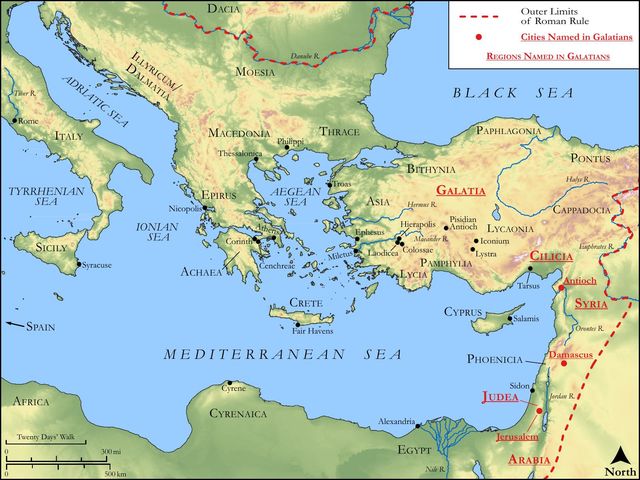
See on the biblical-era maps

Study this verse
Public-domain commentary
Matthew Henry
From his Commentary on the Whole Bible. Henry comments on passages, not single verses — this entry covers Galatians 4:1–7. His four-level outline is real structure in the source text, so it is rendered as structure.
In this chapter the apostle deals plainly with those who hearkened to the judaizing teachers, who cried up the law of Moses in competition with the gospel of Christ, and endeavored to bring them under the bondage of it. To convince them of their folly, and to rectify their mistake herein, in these verses he prosecutes the comparison of a child under age, which he had touched upon in the foregoing chapter, and thence shows what great advantages we have now, under the gospel, above what they had under the law. And here.
I.He acquaints us with the state of the Old Testament church:
it was like a child under age, and it was used accordingly, being kept in a state of darkness and bondage, in comparison of the greater light and liberty which we enjoy under the gospel. That was indeed a dispensation of grace, and yet it was comparatively a dispensation of darkness; for as the heir, in his minority, is under tutors and governors till the time appointed of his father, by whom he is educated and instructed in those things which at present he knows little of the meaning of, though afterwards they are likely to be of great use to him; so it was with the Old Testament church - the Mosaic economy, which they were under, was what they could not fully understand the meaning of; for, as the apostle says (Co2 3:13), They could not stedfastly look to the end of that which is abolished. But to the church, when grown up to maturity, in gospel days, it becomes of great use. And as that was a dispensation of darkness, so of bondage too; for they were in bondage under the elements of the world, being tied to a great number of burdensome rites and observances, by which, as by a kind of first rudiments, they were taught and instructed, and whereby they were kept in a state of subjection, like a child under tutors and governors. The church then lay more under the character of a servant, being obliged to do every thing according to the command of God, without being fully acquainted with the reason of it; but the service under the gospel appears to be more reasonable than that was. The time appointed of the Father having come, when the church was to arrive at its full age, the darkness and bondage under which it before lay are removed, and we are under a dispensation of greater light and liberty.
II.He acquaints us with the much happier state of Christians under the gospel-dispensation, Gal 4:4-7.
When the fulness of time had come, the time appointed of the Father, when he would put an end to the legal dispensation, and set up another and a better in the room of it, he sent forth his Son, etc. The person who was employed to introduce this new dispensation was no other than the Son of God himself, the only-begotten of the Father, who, as he had been prophesied of and promised from the foundation of the world, so in due time he was manifested for this purpose. He, in pursuance of the great design he had undertaken, submitted to be made of a woman - there is his incarnation; and to be made under the law - there is his subjection. He who was truly God for our sakes became man; and he who was Lord of all consented to come into a state of subjection and to take upon him the form of a servant; and one great end of all this was to redeem those that were under the law - to save us from that intolerable yoke and to appoint gospel ordinances more rational and easy. He had indeed something more and greater in his view, in coming into the world, than merely to deliver us from the bondage of the ceremonial law; for he came in our nature, and consented to suffer and die for us, that hereby he might redeem us from the wrath of God, and from the curse of the moral law, which, as sinners, we all lay under. But that was one end of it, and a mercy reserved to be bestowed at the time of his manifestation; then the more servile state of the church was to come to a period, and a better to succeed in the place of it; for he was sent to redeem us, that we might receive the adoption of sons - that we might no longer be accounted and treated as servants, but as sons grown up to maturity, who are allowed greater freedoms, and admitted to larger privileges, than while they were under tutors and governors. This the course of the apostle's argument leads us to take notice of, as one thing intended by this expression, though no doubt it may also be understood as signifying that gracious adoption which the gospel so often speaks of as the privilege of those who believe in Christ. Israel was God's son, his first-born, Rom 9:4. But now, under the gospel, particular believers receive the adoption; and, as an earnest and evidence of it, they have together therewith the Spirit of adoption, putting them upon the duty of prayer, and enabling them in prayer to eye God as a Father (Gal 4:6): Because you are sons, God hath sent forth the Spirit of his Son into your hearts, crying Abba, Father. And hereupon (Gal 4:7) the apostle concludes this argument by adding, Wherefore thou art no more a servant, but a son; and, if a son, then an heir of God through Christ; that is, Now, under the gospel state, we are no longer under the servitude of the law, but, upon our believing in Christ, become the sons of God; we are thereupon accepted of him, and adopted by him; and, being the sons, we are also heirs of God, and are entitled to the heavenly inheritance (as he also reasons Rom 8:17), and therefore it must needs be the greatest weakness and folly to turn back to the law, and to seek justification by the works of it. From what the apostle says in these verses, we may observe,
1.The wonders of divine love and mercy towards us, particularly of God the Father, in sending his Son into the world to redeem and save us, - of the Son of God, in submitting so low, and suffering so much, for us, in pursuance of that design, - and of the Holy Spirit, in condescending to dwell in the hearts of believers for such gracious purposes.
2.The great and invaluable advantages which Christians enjoy under the gospel; for,
(1.)We receive the adoption of sons. Whence note, It is the great privilege which believers have through Christ that they are adopted children of the God of heaven. We who by nature are children of wrath and disobedience have become by grace children of love.
(2.)We receive the Spirit of adoption. Note,
[1.]All who have the privilege of adoption have the Spirit of adoption - all who are received into the number partake of the nature of the children of God; for he will have all his children to resemble him.
[2.]The Spirit of adoption is always the Spirit of prayer, and it is our duty in prayer to eye God as a Father. Christ has taught us in prayer to eye God as our Father in heaven.
[3.]If we are his sons, then his heirs. It is not so among men, with whom the eldest son is heir; but all God's children are heirs. Those who have the nature of sons shall have the inheritance of sons.
Historical interpretation
Two Centuries of Reception
4 surviving comments on this verse. Each one is dated, so this reads as a timeline rather than a list.
Select a marker to jump to its quote. Markers stagger vertically where authors wrote within a few decades of each other.
See how He has admitted those to be children who are under fear and sins; but has conferred manhood on those who are under faith, by calling them sons, in contradistinction from the children that are under the law: "For thou art no more a servant "he says, "but a son; and if a son, then an heir through God."
There is no doubt that one adopts a son in order to leave him an heir; but inheritance depends on the death of someone. How then can mortals be called the heirs of him who lives forever? The fact is that Scripture speaks in our own manner so that we may understand. In order to show that the Father will give from his goods those things that he is going to give his sons, it calls this “inheritance.”
Had not we been first made sons, we could not have called Him Father. If then grace hath made us freemen instead of slaves, men instead of children, heirs and sons instead of aliens, is it not utter absurdity and stupidity to desert this grace, and to turn away backwards?
(Verse 7) So then, you are no longer a slave but a son. And if a son, then an heir through Christ. And because you are sons, God has sent the Spirit of his Son into our hearts, crying, 'Abba! Father!' So you are no longer a slave, but a son, and if a son, then an heir through God. Ask of me and I will give you the nations for your inheritance, and the ends of the earth for your possession (Psalm 2:7-8). But what we say in this place, we should also observe in other cases, that in the whole human race, discussions should be conducted in the singular number. For all believers, we are one in Christ Jesus, and members of his body, and brought into a perfect man, who is our head, for the head of the man is Christ (1 Corinthians 11:2).
Continue studying Galatians 4:7 across the web’s major study libraries — every link below opens this exact verse, chapter, or book on the destination site.
Read & Compare
 BibleGatewayThis verse in more than 200 translations and 70 languages.
 Bible.comThe YouVersion reader — hundreds of translations, reading plans, and highlights.
 ESV.orgCrossway's official English Standard Version reader.
 NET BibleThe NET translation with 60,000+ translators' notes on every rendering decision.
 STEP BibleTyndale House's free study tool — original text, vocabulary, and scholarly resources.
 BibliaLogos Bible Software's free web reader.
 USCCBThe New American Bible (Revised Edition) with the U.S. bishops' study notes.
Commentaries
 BibleHub CommentariesDozens of classic commentaries on this verse, gathered on one page.
 StudyLightMore than 100 commentary sets — the largest collection on the web.
 BibleRefPlain-English commentary on what this verse means, verse by verse.
 Enduring WordDavid Guzik's free commentary on this chapter, widely used by Bible teachers.
 Bible Study ToolsVerse commentary alongside Greek and Hebrew study aids.
Original Language & Research
- BibleHub InterlinearThe verse word by word — original language, transliteration, and English.
- BibleHub LexiconEvery word's original-language definition and Strong's entry.
 Blue Letter BibleDeep-study tools — Strong's numbers, concordance, and word studies.
 CNTR CollationThe earliest Greek manuscripts of this verse, collated letter by letter.
Sermons, Hymns & Audio


TrulyRandomVerse is not affiliated with these sites and doesn’t control their content. They’re linked because they’re genuinely useful.
Summary
Galatians 4:7 stands as a profound declaration of the transformed identity and status of believers in Christ. It succinctly encapsulates the dramatic shift from a state of bondage or subservience under the law to the glorious reality of full sonship and, consequently, an unshakeable heirship with God, all made possible solely through the redemptive work of Jesus Christ. This verse serves as a climactic theological statement, affirming the believer's secure and intimate relationship within the divine family.
Context
ShowHideLiterary Context
This verse concludes Paul's elaborate analogy in Galatians 4:1-6. Paul likens those under the Mosaic Law to a minor heir who, despite being the rightful owner of an estate, remains under the strict supervision of guardians and stewards until a pre-appointed time. This "time" represents the era before Christ, where humanity, including Israel, was held captive by the "elementary principles of the world" or the Law, functioning as spiritual minors. However, Paul asserts that "when the fullness of the time had come" (Galatians 4:4), God sent His Son, born under the Law, specifically "to redeem those who were under the Law, that we might receive adoption as sons" (Galatians 4:5). The sending of the Holy Spirit, enabling believers to cry out "Abba, Father!" (Galatians 4:6), further solidifies this new familial relationship. Therefore, Galatians 4:7 serves as the logical and triumphant conclusion to this theological argument, establishing the believer's new, elevated status.
Historical & Cultural Context
The analogy of the minor heir was deeply resonant in both Roman and Jewish legal traditions of Paul's time. In Roman law, a child, even if the biological heir, remained under the authority of a guardian (tutor) until reaching legal majority (typically around 14 for boys, 12 for girls, followed by a period of curatorship). During this time, the child had no independent legal standing and was treated much like a servant, lacking control over their inheritance. Similarly, Jewish law had provisions for guardianship. Paul uses this familiar concept to illustrate the spiritual immaturity and legal bondage experienced under the Law before Christ. The concept of "adoption" (huiothesia) was also well-understood in the Roman world, where an adopted son gained full legal rights, inheritance, and the family name, often even more securely than a biological son. This cultural backdrop powerfully underscores the radical transformation from legal minority/servitude to full, privileged sonship and heirship that Christ brings.
Key Themes
ShowHideGalatians 4:7 is rich with several interconnected themes central to Paul's theology in Galatians. Foremost is the Transformation of Status and Identity, moving from a "servant" (δοῦλος, doulos) to a "son" (υἱός, huios). This highlights the shift from a relationship based on obligation, fear, and legalistic performance under the Law to one rooted in intimate, loving, and secure familial belonging. Another crucial theme is Divine Heirship, where believers, as sons, become "heirs of God." This signifies an entitlement to share in God's spiritual blessings, promises, and eternal inheritance, not as something earned, but as a gracious gift of their new family status. This concept is echoed in Romans 8:17, where believers are declared "heirs of God and joint heirs with Christ." Finally, the verse powerfully emphasizes Christ's Centrality in Salvation. The entire transition—from servant to son and heir—is explicitly stated as being "through Christ," underscoring that His redemptive work is the sole basis for this profound change, not human effort or adherence to the Law.
Exposition and Analysis
ShowHideKey Word Analysis
ShowHide; a slave (literal or figurative, involuntary or voluntary; frequently, therefore in a qualified sense of subjection or subserviency):--bond(-man), servant. Here, doulos signifies a state of bondage or subservience, contrasting sharply with the freedom and privilege of sonship. It denotes one who lacks personal rights and is subject to another's will, often implying a state of fear or obligation rather than loving relationship.
Apparently a primary word; a "son" (sometimes of animals), used very widely of immediate, remote or figuratively, kinship:--child, foal, son. In this context, huios refers to a mature son, one who has come of age and possesses full legal rights and privileges within the family, including the right to inherit. It speaks of intimacy, belonging, and full participation in the family's life and resources.
And the base of G3551 (in its original sense of partitioning, i.e. (reflexively) getting by apportionment); a sharer by lot, i.e. inheritor (literally or figuratively); by implication, a possessor:--heir. An heir is one who receives an inheritance. This term reinforces the profound implications of sonship, indicating that believers are divinely entitled to all the blessings and promises that God bestows upon His children.
Verse Breakdown
ShowHide"Wherefore thou art no more a servant,"
This opening clause serves as a direct conclusion ("Wherefore" - G5620 hṓste, "so then") to Paul's preceding argument about redemption and adoption. It declares a definitive, irreversible change in status. The believer is no longer in the position of a doulos, a slave or bondservant, bound by the Law or elementary principles, living in fear or obligation. This signifies liberation from the spiritual bondage of sin and the Law.
"but a son;"
This is the glorious antithesis. Instead of a servant, the believer is now a huios, a mature son with full rights and privileges within God's family. This status is not earned but granted through adoption, establishing an intimate, loving, and secure relationship with God as Father. It implies freedom, access, and belonging that a servant could never possess.
"and if a son, then an heir of God"
This conditional statement (G1487 ei, "if") highlights the logical and inevitable consequence of sonship. If one is truly a son, then heirship naturally follows. Being an "heir of God" means sharing in God's own inheritance, which encompasses eternal life, glory, the promises of the covenant, and all the spiritual blessings that flow from His divine nature and redemptive plan. It speaks to an immeasurable and secure future.
"through Christ."
This final phrase is critically important, serving as the sole qualifier and enabler of this entire transformation. The transition from servant to son, and thus to heir, is not achieved by human merit, adherence to the Law, or any other means, but exclusively "through" (G1223 diá) the person and finished work of Jesus Christ. His redemption and mediation are the singular channel through which believers receive this new identity and inheritance.
Literary Devices
ShowHideThe verse powerfully employs Contrast to highlight the radical transformation in the believer's status. The stark opposition between "servant" (doulos) and "son" (huios) immediately conveys a movement from bondage and obligation to freedom and privilege. This contrast is further amplified by the implication of Metaphor, where the legal and familial concepts of sonship and heirship are used to describe a profound spiritual reality. Believers are not merely like sons; they are truly adopted into God's family, receiving the full rights and inheritance that come with this new relationship. The phrase "if a son, then an heir" functions as a Conditional Statement or a logical inference, emphasizing the inherent and undeniable connection between sonship and heirship. This logical progression reinforces the security and certainty of the believer's inheritance once their status as a child of God is established.
Theological and Thematic Connections
ShowHideGalatians 4:7 stands as a cornerstone of Pauline theology, encapsulating the profound shift from a covenant of law to a covenant of grace. It underscores the believer's new identity not as one striving for acceptance through works, but as a beloved child already accepted through Christ. This truth liberates believers from the burden of performance-based religion and invites them into an intimate, filial relationship with God, characterized by security, love, and the promise of an eternal inheritance. It redefines humanity's relationship with the Divine, moving from distant servitude to familial intimacy, all predicated on the finished work of Jesus.
Reflection and Application
ShowHideGalatians 4:7 offers a liberating truth that should profoundly reshape our self-perception and our understanding of God. If we truly grasp that we are no longer servants but sons and heirs, it transforms our motivation for obedience from fear or obligation to love and gratitude. This truth dismantles the lie that our worth or acceptance before God is dependent on our performance, achievements, or adherence to a set of rules. Instead, our identity and inheritance are secure, rooted in Christ's work, not our own. This empowers us to live in the freedom of grace, to approach God with confidence as "Abba, Father," and to embrace our secure future. It calls us to live out the implications of our royal sonship, walking in the authority and love that comes with being an heir of God.
Questions for Reflection
ShowHideFAQ
ShowHideWhat is the practical difference between being a "servant" and a "son" in this verse?
ShowHideThe distinction is profound and practical. A "servant" (δοῦλος, doulos) in this context refers to someone in bondage, under the law, or subject to strict rules and obligations without inherent rights or a permanent place in the household. Their relationship is based on duty and fear. In contrast, a "son" (υἱός, huios) signifies a mature, adopted child who has full legal rights, an intimate familial relationship, and a secure, permanent place within the household. Their relationship is based on love, belonging, and shared inheritance. Practically, it means moving from a life of trying to earn God's favor to living in the secure favor already granted by grace through Christ, with full access to the Father's presence and resources. This freedom empowers genuine, joyful obedience rather than fearful compliance.
Christ-Centered Fulfillment
ShowHideGalatians 4:7 finds its complete fulfillment in the person and work of Jesus Christ. It is precisely because God "sent forth His Son, born of a woman, born under the law" (Galatians 4:4) that humanity could be redeemed from the bondage of the Law and sin. Christ, as the eternal Son of God, perfectly fulfilled the Law and bore its curse on the cross, thereby purchasing our freedom and enabling our adoption. His unique sonship is the foundation for our own; we become sons and heirs "through Christ" because He, the true Heir, shares His inheritance with us. The Spirit of His Son, whom God has sent into our hearts (Galatians 4:6), is the very Spirit of Christ, testifying to our new identity and enabling us to cry out "Abba, Father!" This divine exchange—Christ becoming poor that we might become rich (2 Corinthians 8:9), Christ taking on our servitude that we might receive His sonship—is the heart of the Gospel. Our status as heirs of God is not merely a legal declaration but a relational reality, secured by the finished work of the Son who makes us co-heirs with Him (Romans 8:17) and guarantees our future glory with Him (Colossians 3:4).