


Galatians 4:2
Bible text: King James Version (1769 Blayney text) · Public domain
Bible text: Berean Standard Bible · Public domain
Bible text: American Standard Version (1901) · Public domain
Bible text: World English Bible, Messianic edition · Public domain
Bible text: Geneva Bible (1599) · Public domain
Bible text: Young's Literal Translation · Public domain
- ἀλλ᾽all᾽InsteadG235CONJConjunction
- ὑπὸhupounderG5259PREPPreposition
- ἐπιτρόπουςepitropousguardiansG2012N-APMNoun Accusative Plural Masculine
- ἐστὶνestinhe isG1510V-PAI-3SVerb Present Active Indicative 3rd Singular
- καὶkaiandG2532CONJConjunction
- οἰκονόμουςoikonomoustrusteesG3623N-APMNoun Accusative Plural Masculine
- ἄχριachriuntilG891PREPPreposition
- τῆςtēstheG3588T-GSFDefinite article Genitive Singular Feminine
- προθεσμίαςprothesmiastime appointedG4287N-GSFNoun Genitive Singular Feminine
- τοῦtou<the>G3588T-GSMDefinite article Genitive Singular Masculine
- πατρόςpatrosby [his] fatherG3962N-GSMNoun Genitive Singular Masculine
English is a literal word-by-word gloss of the Greek, not the KJV's wording. Why?
This is the original text the KJV's translators worked from — each Greek word with its own literal English meaning in this verse, prepared by scholars at Tyndale House, Cambridge. The KJV translates whole sentences, not word by word, so its wording differs: one Greek word can become several English words, and the KJV may choose “charity” where the gloss reads “love”. Both are faithful — they answer different questions. For the KJV's own rendering, switch to the KJV text.
Details
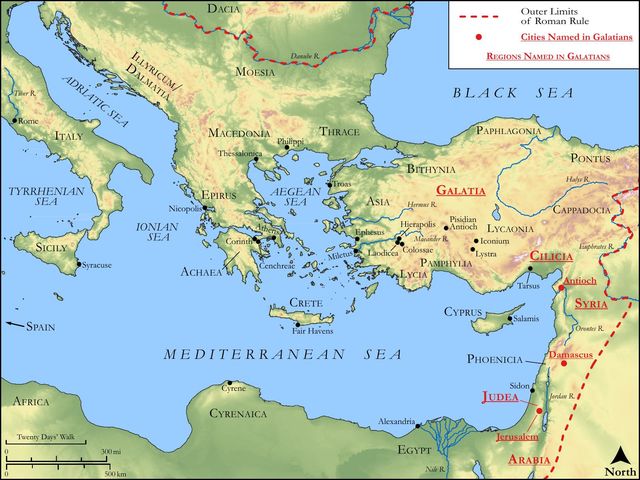
See on the biblical-era maps

Study this verse
Public-domain commentary
Matthew Henry
From his Commentary on the Whole Bible. Henry comments on passages, not single verses — this entry covers Galatians 4:1–7. His four-level outline is real structure in the source text, so it is rendered as structure.
In this chapter the apostle deals plainly with those who hearkened to the judaizing teachers, who cried up the law of Moses in competition with the gospel of Christ, and endeavored to bring them under the bondage of it. To convince them of their folly, and to rectify their mistake herein, in these verses he prosecutes the comparison of a child under age, which he had touched upon in the foregoing chapter, and thence shows what great advantages we have now, under the gospel, above what they had under the law. And here.
I.He acquaints us with the state of the Old Testament church:
it was like a child under age, and it was used accordingly, being kept in a state of darkness and bondage, in comparison of the greater light and liberty which we enjoy under the gospel. That was indeed a dispensation of grace, and yet it was comparatively a dispensation of darkness; for as the heir, in his minority, is under tutors and governors till the time appointed of his father, by whom he is educated and instructed in those things which at present he knows little of the meaning of, though afterwards they are likely to be of great use to him; so it was with the Old Testament church - the Mosaic economy, which they were under, was what they could not fully understand the meaning of; for, as the apostle says (Co2 3:13), They could not stedfastly look to the end of that which is abolished. But to the church, when grown up to maturity, in gospel days, it becomes of great use. And as that was a dispensation of darkness, so of bondage too; for they were in bondage under the elements of the world, being tied to a great number of burdensome rites and observances, by which, as by a kind of first rudiments, they were taught and instructed, and whereby they were kept in a state of subjection, like a child under tutors and governors. The church then lay more under the character of a servant, being obliged to do every thing according to the command of God, without being fully acquainted with the reason of it; but the service under the gospel appears to be more reasonable than that was. The time appointed of the Father having come, when the church was to arrive at its full age, the darkness and bondage under which it before lay are removed, and we are under a dispensation of greater light and liberty.
II.He acquaints us with the much happier state of Christians under the gospel-dispensation, Gal 4:4-7.
When the fulness of time had come, the time appointed of the Father, when he would put an end to the legal dispensation, and set up another and a better in the room of it, he sent forth his Son, etc. The person who was employed to introduce this new dispensation was no other than the Son of God himself, the only-begotten of the Father, who, as he had been prophesied of and promised from the foundation of the world, so in due time he was manifested for this purpose. He, in pursuance of the great design he had undertaken, submitted to be made of a woman - there is his incarnation; and to be made under the law - there is his subjection. He who was truly God for our sakes became man; and he who was Lord of all consented to come into a state of subjection and to take upon him the form of a servant; and one great end of all this was to redeem those that were under the law - to save us from that intolerable yoke and to appoint gospel ordinances more rational and easy. He had indeed something more and greater in his view, in coming into the world, than merely to deliver us from the bondage of the ceremonial law; for he came in our nature, and consented to suffer and die for us, that hereby he might redeem us from the wrath of God, and from the curse of the moral law, which, as sinners, we all lay under. But that was one end of it, and a mercy reserved to be bestowed at the time of his manifestation; then the more servile state of the church was to come to a period, and a better to succeed in the place of it; for he was sent to redeem us, that we might receive the adoption of sons - that we might no longer be accounted and treated as servants, but as sons grown up to maturity, who are allowed greater freedoms, and admitted to larger privileges, than while they were under tutors and governors. This the course of the apostle's argument leads us to take notice of, as one thing intended by this expression, though no doubt it may also be understood as signifying that gracious adoption which the gospel so often speaks of as the privilege of those who believe in Christ. Israel was God's son, his first-born, Rom 9:4. But now, under the gospel, particular believers receive the adoption; and, as an earnest and evidence of it, they have together therewith the Spirit of adoption, putting them upon the duty of prayer, and enabling them in prayer to eye God as a Father (Gal 4:6): Because you are sons, God hath sent forth the Spirit of his Son into your hearts, crying Abba, Father. And hereupon (Gal 4:7) the apostle concludes this argument by adding, Wherefore thou art no more a servant, but a son; and, if a son, then an heir of God through Christ; that is, Now, under the gospel state, we are no longer under the servitude of the law, but, upon our believing in Christ, become the sons of God; we are thereupon accepted of him, and adopted by him; and, being the sons, we are also heirs of God, and are entitled to the heavenly inheritance (as he also reasons Rom 8:17), and therefore it must needs be the greatest weakness and folly to turn back to the law, and to seek justification by the works of it. From what the apostle says in these verses, we may observe,
1.The wonders of divine love and mercy towards us, particularly of God the Father, in sending his Son into the world to redeem and save us, - of the Son of God, in submitting so low, and suffering so much, for us, in pursuance of that design, - and of the Holy Spirit, in condescending to dwell in the hearts of believers for such gracious purposes.
2.The great and invaluable advantages which Christians enjoy under the gospel; for,
(1.)We receive the adoption of sons. Whence note, It is the great privilege which believers have through Christ that they are adopted children of the God of heaven. We who by nature are children of wrath and disobedience have become by grace children of love.
(2.)We receive the Spirit of adoption. Note,
[1.]All who have the privilege of adoption have the Spirit of adoption - all who are received into the number partake of the nature of the children of God; for he will have all his children to resemble him.
[2.]The Spirit of adoption is always the Spirit of prayer, and it is our duty in prayer to eye God as a Father. Christ has taught us in prayer to eye God as our Father in heaven.
[3.]If we are his sons, then his heirs. It is not so among men, with whom the eldest son is heir; but all God's children are heirs. Those who have the nature of sons shall have the inheritance of sons.
Historical interpretation
Historical reception
3 surviving comments on this verse. Each one is dated, so this reads as a timeline rather than a list.
Select a marker to jump to its quote. Markers stagger vertically where authors wrote within a few decades of each other.
The word "child" in this place denotes not age but understanding; meaning that God had from the beginning designed for us these gifts, but, as we yet continued childish, He let us be under the elements of the world, that is, new moons and sabbaths, for these days are regulated by the course of sun and moon. If then also now they bring you under law they do nothing else but lead you backward now in the time of your perfect age and maturity. And see what is the consequence of observing days; the Lord, the Master of the house, the Sovereign Ruler, is thereby reduced to the rank of a servant.
(Chapter IV - 1, 2) However, I say that as long as the heir is a child, he is no different from a slave, even though he is the Lord of all, but he is under guardians and managers until the appointed time by the father. This little heir, who is no different from a slave even though he is the Lord of all, is under guardians and managers until the appointed time by the father, represents the whole human race until the coming of Christ, and, to say more, until the end of the world. For just as all die in the first Adam, not yet born, so also all those who were born before the coming of Christ are made alive in the second Adam. And so it happens that we too served the Law in the fathers, and they are saved by grace in their children. This understanding is in agreement with the Catholic Church, which affirms the one providence of the Old and New Testament and does not distinguish in time those whom it has joined together in condition. We are all built upon the foundation of the apostles and prophets, with Jesus Christ himself as the chief cornerstone. In him, the whole building is joined together and rises to become a holy temple in the Lord. Through him, we are also being built together to become a dwelling in which God lives by his Spirit. (Ephesians 2:20-22) Truly, in Christ, we are all one bread, and we have come together in unity on the earth. And just as we are founded upon the prophets, so too did the patriarchs stand upon the foundation of the apostles. Moreover, the prophets can also be understood as tutors and actors, whose words we were daily instructed by in anticipation of the coming of the Savior, just as the Law was expounded by the pedagogue Moses; and the angels of the little ones who daily behold the face of the Father and intercede for them. Concerning whom it is said: 'The angels of the Lord will encamp around those who fear Him, and will deliver them' (Ps. 34:7). Both priests and rulers can be understood, who were once seen as dominating the people, now providing a form. And rightly are they called under tutors and actors, who, having the spirit of fear, have not yet deserved the spirit of liberty and adoption. For the age of infancy fears sins, fears the tutor, does not trust that it is free, even though by nature it is a mistress. And according to both interpretations, whether we called tutors and actors or prophets or angels, this child is under actors and tutors until the appointed time of the perfect man is fulfilled. But the legitimate time, as in Roman law, is terminated by a period of twenty-five years, so it is considered the coming of Christ to the perfection of the human race. As soon as he comes, and we all grow into perfect men, the pedagogue and tutor depart from us. Then we will enjoy the authority of the Lord and the possession of the inheritance, in which before we were considered somewhat estranged.
“Guardians and trustees” could be taken as the prophets, by whose words we were made ready, day by day, for the coming of the Savior, just as the law of Moses is described above as a custodian.… Or the phrase could be taken to refer to priests and princes, who then held power over the people and are now a reflection of God’s purpose. People are correctly said to live under tutors and overseers when, having the spirit of fear, they have not yet deserved to receive the spirit of freedom and adoption. For the age of infancy feels dread in relation to sin, fears its custodian and does not believe in its own freedom, even if it is sovereign by nature.
Continue studying Galatians 4:2 across the web’s major study libraries — every link below opens this exact verse, chapter, or book on the destination site.
Read & Compare
 BibleGatewayThis verse in more than 200 translations and 70 languages.
 Bible.comThe YouVersion reader — hundreds of translations, reading plans, and highlights.
 ESV.orgCrossway's official English Standard Version reader.
 NET BibleThe NET translation with 60,000+ translators' notes on every rendering decision.
 STEP BibleTyndale House's free study tool — original text, vocabulary, and scholarly resources.
 BibliaLogos Bible Software's free web reader.
 USCCBThe New American Bible (Revised Edition) with the U.S. bishops' study notes.
Commentaries
 BibleHub CommentariesDozens of classic commentaries on this verse, gathered on one page.
 StudyLightMore than 100 commentary sets — the largest collection on the web.
 BibleRefPlain-English commentary on what this verse means, verse by verse.
 Enduring WordDavid Guzik's free commentary on this chapter, widely used by Bible teachers.
 Bible Study ToolsVerse commentary alongside Greek and Hebrew study aids.
Original Language & Research
- BibleHub InterlinearThe verse word by word — original language, transliteration, and English.
- BibleHub LexiconEvery word's original-language definition and Strong's entry.
 Blue Letter BibleDeep-study tools — Strong's numbers, concordance, and word studies.
 CNTR CollationThe earliest Greek manuscripts of this verse, collated letter by letter.
Sermons, Hymns & Audio


TrulyRandomVerse is not affiliated with these sites and doesn’t control their content. They’re linked because they’re genuinely useful.
Summary
Galatians 4:2 continues Paul's profound analogy of the heir, explaining that even a rightful inheritor, while still a minor, remains subject to the oversight and management of appointed guardians and stewards. This state of dependency persists until a specific, predetermined time set by the father, illustrating humanity's spiritual condition under the Old Covenant Law before the arrival of Christ and the full privileges of sonship.
Context
ShowHideLiterary Context
This verse is an integral part of Paul's impassioned argument in Galatians 3-4, where he contrasts the temporary nature of the Mosaic Law with the permanent reality of salvation by faith in Christ. Building directly on the analogy introduced in Galatians 4:1, where he states that a child, though heir to everything, "is no different from a slave," verse 2 elaborates on the practical implications of this minority. The "tutors and governors" are the specific agents of this temporary guardianship, setting the stage for Paul's declaration in Galatians 4:3 that "we also, when we were children, were enslaved to the elementary principles of the world." This analogy powerfully underscores the provisional and restrictive nature of the Law, preparing the reader for the liberating truth of Christ's advent.
Historical & Cultural Context
Paul draws upon a common Roman and Hellenistic legal and cultural practice concerning inheritance. In both Roman and Greek societies, a child heir, even if destined to inherit vast wealth, was legally considered a minor (often until age 14 for males, sometimes 25 for full legal capacity) and placed under the care of guardians (tutors, epitropoi) and stewards (governors, oikonomoi). These individuals were responsible not only for the child's upbringing and education but also for managing the family estate until the heir reached the age of majority. This period was one of strict discipline and limited freedom, despite the child's ultimate status as heir. This cultural reality provided a vivid and relatable illustration for Paul's audience, particularly in the Roman province of Galatia, to understand the temporary, restrictive, yet necessary role of the Law in preparing God's people for the full privileges of sonship in Christ.
Key Themes
ShowHideGalatians 4:2 contributes significantly to several overarching themes in Galatians. Firstly, it reinforces the theme of The Law as a Temporary Guardian, portraying the Law not as an eternal covenant but as a provisional system designed to manage and discipline God's people until the arrival of Christ. This echoes the concept of the Law as a "disciplinarian" or "schoolmaster" in Galatians 3:24. Secondly, the phrase "until the time appointed of the father" highlights God's Sovereign Timing in redemptive history. Just as an earthly father determines the precise moment for his son's maturity, God meticulously planned the advent of Christ, signifying the culmination of the Law's guardianship and the inauguration of a new era of grace. This divine punctuality is explicitly stated in Galatians 4:4, where God sends His Son "when the fullness of the time was come." Finally, the verse underscores the profound Transition from Servitude to Sonship, moving from a state of being "under" the Law (like a minor under strict supervision) to the full rights, privileges, and intimacy of sonship through faith in Christ, a central liberating truth of the Gospel Paul champions.
Exposition and Analysis
ShowHideKey Word Analysis
ShowHideFrom epi (upon) and tropos (manner, way), a "commissioner," referring to a guardian, manager, or steward. In the context of a minor heir, an epítropos was a legal guardian appointed to oversee the child's person, education, and property until they reached legal maturity. They held significant authority and responsibility, ensuring the heir's well-being and the proper management of the estate. Paul uses this term to describe the Law's role in governing and overseeing Israel before Christ.
From oikos (house) and nomos (law, custom), literally a "house-distributor" or "house-manager." This term denotes a steward or administrator responsible for the practical management of a household or estate, including its finances and resources. While an epítropos might oversee the person, the oikonómos managed the property. Together, these terms paint a picture of comprehensive oversight and control, emphasizing the restrictive nature of the Law's dominion over God's people during their spiritual minority.
From pro (before) and a derivative of tithēmi (to place, set), meaning "fixed beforehand" or "designated." This refers to a specific, predetermined day or period. In the analogy, it is the precise moment set by the father for his son to assume full rights and responsibilities. Theologically, it points to God's sovereign and perfect timing for the culmination of His redemptive plan, specifically the sending of His Son, Jesus Christ, to bring humanity into full sonship.
Verse Breakdown
ShowHide"But is under tutors and governors"
This clause directly follows the analogy of the heir in Galatians 4:1. The conjunction "But" (G235, allá) introduces a contrast or clarification, emphasizing that despite the heir's ultimate status, their immediate reality is one of subjugation. The phrase "is under" (G5259, hypó) signifies a position of subordination, control, and dependency. The "tutors" (epítropos) and "governors" (oikonómos) represent the Mosaic Law and its associated regulations, which, though divinely given, functioned as a restrictive, disciplinary system over God's people (Israel) during their spiritual immaturity. They served to manage, protect, and prepare, but also to limit freedom, much like a child under strict supervision.
"until the time appointed of the father."
This concluding clause highlights the temporary nature of this guardianship and the sovereign authority behind its duration. The word "until" (G891, áchri) clearly indicates a finite period, a boundary beyond which the state of being "under" ceases. The "time appointed" (G4287, prothésmios) refers to a specific, predetermined moment set by the "father" (G3962, patḗr). Theologically, this "father" is God Himself, who, in His perfect wisdom and timing, had ordained the precise moment in history for the sending of His Son, Jesus Christ, to bring an end to the Law's guardianship and usher in the era of full spiritual maturity and sonship for all who believe. This divine appointment underscores God's meticulous plan for salvation history.
Literary Devices
ShowHidePaul employs a powerful Analogy throughout Galatians 4:1-7, with Galatians 4:2 being a crucial component. He likens humanity under the Law to a minor heir who, despite being the rightful owner of a vast inheritance, remains under the strict supervision of "tutors and governors" until a predetermined age. This Metaphor of the child heir effectively conveys the provisional and restrictive nature of the Old Covenant. The "tutors and governors" are not literal people but symbolic representations of the Mosaic Law, its commandments, and the entire system of legalistic oversight that governed Israel. The phrase "time appointed of the father" introduces Divine Sovereignty and Perfect Timing as key elements of God's redemptive plan, emphasizing that the transition from legalistic bondage to spiritual freedom was not arbitrary but divinely orchestrated. The entire passage uses this extended analogy to create a stark Contrast between the former state of bondage and the new reality of sonship in Christ.
Theological and Thematic Connections
ShowHideGalatians 4:2 profoundly articulates the theological truth that the Mosaic Law, while holy and good, was never intended to be the ultimate means of salvation or spiritual maturity. Instead, it served a pedagogical and preparatory role, functioning as a temporary custodian or "schoolmaster" (as Paul states in Galatians 3:24) to guide humanity, particularly Israel, until the arrival of Christ. This verse highlights God's meticulous plan for redemptive history, emphasizing that the transition from a state of legalistic minority to the full privileges of sonship was not arbitrary but occurred at the "fullness of time" (as seen in Galatians 4:4)—a divinely appointed moment. It underscores the profound shift from a relationship based on external rules and regulations to one of intimate, Spirit-empowered sonship through faith in Jesus Christ, where believers are no longer slaves but adopted children with full access to God as Father.
Reflection and Application
ShowHideGalatians 4:2 offers a powerful lens through which to understand our spiritual journey and the profound grace of God. It reminds us that before Christ, humanity was in a state of spiritual immaturity, subject to the limitations and disciplines of the Law, much like a child under strict guardians. While the Law was necessary for revealing sin and guiding behavior, it could not confer true freedom or spiritual sonship. Through Christ, however, we have reached the "time appointed" by the Father, transitioning from a state of legalistic bondage to the glorious liberty of being adopted children of God. This truth should fill us with immense gratitude for the freedom we now possess in Christ—freedom from the burden of earning our salvation, freedom from the condemnation of the Law, and freedom to live not as slaves, but as beloved sons and daughters. It calls us to embrace our identity as heirs, not merely servants, and to live in the confidence and intimacy that comes from crying "Abba, Father!" (as in Galatians 4:6). This understanding should shape our worship, inform our obedience, and empower our witness, as we joyfully walk in the maturity and privilege of our new status in Christ.
Questions for Reflection
ShowHideFAQ
ShowHideWhat does Paul mean by "tutors and governors" in this context?
ShowHideIn Galatians 4:2, Paul uses the terms "tutors" (Greek: epítropos) and "governors" (Greek: oikonómos) to refer to legal guardians and household managers who were appointed to oversee a minor heir and their estate until the heir reached the age of majority. In his analogy, Paul uses these figures to symbolize the Mosaic Law and the entire system of the Old Covenant. Just as a child heir, though legally the owner of everything, was subject to strict oversight and discipline by these guardians, so too was humanity (particularly Israel) "under" the Law. The Law, while divinely given and good, functioned as a temporary, restrictive, and disciplinary system, designed to manage and prepare God's people, but not to provide the ultimate freedom or spiritual maturity that comes through faith in Christ. It was a provisional arrangement until God's appointed time for the Messiah's arrival.
How does this verse relate to the concept of "the fullness of time" in Galatians 4:4?
ShowHideGalatians 4:2 directly sets the stage for the pivotal declaration in Galatians 4:4. The phrase "until the time appointed of the father" in verse 2 explicitly points to a divinely predetermined moment when the period of guardianship would end. This "time appointed" is precisely what Paul refers to as "the fullness of the time" in verse 4, when "God sent forth His Son, born of a woman, born under the law." This connection highlights God's perfect sovereignty and meticulous planning throughout redemptive history. It emphasizes that Christ's incarnation was not a random event but the culmination of God's wise and timely design, marking the transition from humanity's spiritual minority under the Law to the era of full sonship and freedom in Christ. The Law's role as a temporary guardian ceased when the true Heir arrived, bringing with Him the adoption of sons.
Does this mean the Law is bad or no longer relevant?
ShowHidePaul's argument in Galatians is not that the Law is inherently bad or evil; in fact, he affirms its divine origin and purpose elsewhere (e.g., Romans 7:12). Rather, he clarifies its function and limitation. In Galatians 4:2, the Law is depicted as a temporary "tutor" or "governor," necessary for a period of spiritual immaturity to reveal sin (Romans 3:20) and guide God's people. However, it was never intended to be the means by which one gains righteousness or enters into a saving relationship with God. With the coming of Christ, the "time appointed" arrived, and believers are no longer "under" the Law as a system of earning salvation or as a means of justification. Instead, we are justified by faith in Christ (Galatians 2:16). While the Law's ceremonial aspects are fulfilled in Christ, its moral principles continue to guide believers as an expression of love for God and neighbor, now empowered by the Holy Spirit, not as a burden for salvation.
Christ-Centered Fulfillment
ShowHideGalatians 4:2, with its analogy of the heir under tutors and governors until the appointed time, finds its profound Christ-centered fulfillment in the person and work of Jesus. He is the ultimate "time appointed" by the Father, the very moment in redemptive history when God sent forth His Son to bring an end to humanity's spiritual minority and usher in the era of full sonship. Before Christ, humanity, particularly Israel, was "under" the Law, a system that, while holy and good, functioned as a temporary guardian, revealing sin and restraining transgression, much like a child confined by strict rules. But in Christ, the "fullness of time" arrived (Galatians 4:4), and the true Heir, Jesus, came not to abolish the Law but to fulfill it (Matthew 5:17), thereby liberating those who were enslaved to its demands. Through His perfect obedience, sacrificial death, and glorious resurrection, Christ secured for us the adoption of sons, granting us the very Spirit of adoption by whom we cry, "Abba, Father!" (Galatians 4:5-7). He is the one who took us from being mere servants or minors under a restrictive covenant and elevated us to the glorious status of co-heirs with Him (Romans 8:17), enjoying direct access and intimate relationship with God, our Heavenly Father. Christ is the appointed time, the ultimate fulfillment, and the very means by which we transition from bondage to the glorious liberty of the children of God.