


Galatians 4:4
- ὅτεhoteWhenG3753CONJConjunction
- δὲdehoweverG1161CONJConjunction
- ἦλθενēlthenhad comeG2064V-2AAI-3SVerb 2nd Aorist Active Indicative 3rd Singular
- τὸtotheG3588T-NSNDefinite article Nominative Singular Neuter
- πλήρωμαplērōmafullnessG4138N-NSNNoun Nominative Singular Neuter
- τοῦtouof theG3588T-GSMDefinite article Genitive Singular Masculine
- χρόνουchronoutimeG5550N-GSMNoun Genitive Singular Masculine
- ἐξαπέστειλενexapesteilensent forthG1821V-2AAI-3SVerb 2nd Aorist Active Indicative 3rd Singular
- ὁho<the>G3588T-NSMDefinite article Nominative Singular Masculine
- θεὸςtheosGodG2316N-NSM-TNoun Nominative Singular Masculine Title
- τὸνtontheG3588T-ASMDefinite article Accusative Singular Masculine
- υἱὸνhuionSonG5207N-ASMNoun Accusative Singular Masculine
- αὐτοῦautouof himG846P-GSMPersonal pronoun Genitive Singular Masculine
- γενόμενονgenomenonhaving been bornG1096V-2ADP-ASMVerb 2nd Aorist Middle Deponent Participle Accusative Singular Masculine
- ἐκekofG1537PREPPreposition
- γυναικόςgunaikosa womanG1135N-GSFNoun Genitive Singular Feminine
- γενόμενονgenomenonhaving been bornG1096V-2ADP-ASMVerb 2nd Aorist Middle Deponent Participle Accusative Singular Masculine
- ὑπὸhupounderG5259PREPPreposition
- νόμονnomon[the] LawG3551N-ASMNoun Accusative Singular Masculine
English is a literal word-by-word gloss of the Greek, not the KJV's wording. Why?
This is the original text the KJV's translators worked from — each Greek word with its own literal English meaning in this verse, prepared by scholars at Tyndale House, Cambridge. The KJV translates whole sentences, not word by word, so its wording differs: one Greek word can become several English words, and the KJV may choose “charity” where the gloss reads “love”. Both are faithful — they answer different questions. For the KJV's own rendering, switch to the KJV text.
Details
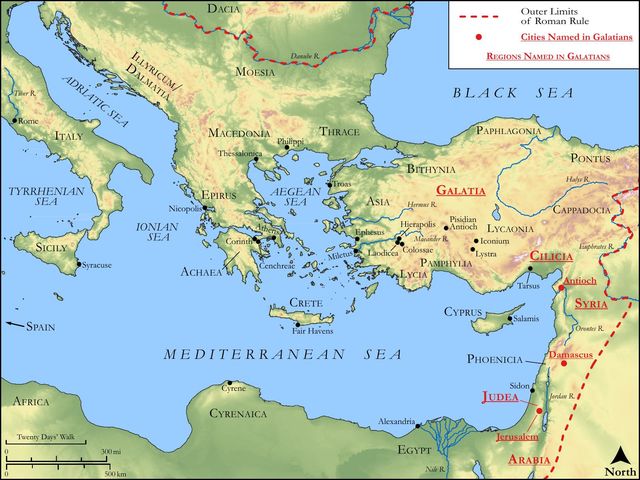
See on the biblical-era map

Study this verse
Public-domain commentary
Matthew Henry
From his Commentary on the Whole Bible. Henry comments on passages, not single verses — this entry covers Galatians 4:1–7. His four-level outline is real structure in the source text, so it is rendered as structure.
In this chapter the apostle deals plainly with those who hearkened to the judaizing teachers, who cried up the law of Moses in competition with the gospel of Christ, and endeavored to bring them under the bondage of it. To convince them of their folly, and to rectify their mistake herein, in these verses he prosecutes the comparison of a child under age, which he had touched upon in the foregoing chapter, and thence shows what great advantages we have now, under the gospel, above what they had under the law. And here.
I.He acquaints us with the state of the Old Testament church:
it was like a child under age, and it was used accordingly, being kept in a state of darkness and bondage, in comparison of the greater light and liberty which we enjoy under the gospel. That was indeed a dispensation of grace, and yet it was comparatively a dispensation of darkness; for as the heir, in his minority, is under tutors and governors till the time appointed of his father, by whom he is educated and instructed in those things which at present he knows little of the meaning of, though afterwards they are likely to be of great use to him; so it was with the Old Testament church - the Mosaic economy, which they were under, was what they could not fully understand the meaning of; for, as the apostle says (Co2 3:13), They could not stedfastly look to the end of that which is abolished. But to the church, when grown up to maturity, in gospel days, it becomes of great use. And as that was a dispensation of darkness, so of bondage too; for they were in bondage under the elements of the world, being tied to a great number of burdensome rites and observances, by which, as by a kind of first rudiments, they were taught and instructed, and whereby they were kept in a state of subjection, like a child under tutors and governors. The church then lay more under the character of a servant, being obliged to do every thing according to the command of God, without being fully acquainted with the reason of it; but the service under the gospel appears to be more reasonable than that was. The time appointed of the Father having come, when the church was to arrive at its full age, the darkness and bondage under which it before lay are removed, and we are under a dispensation of greater light and liberty.
II.He acquaints us with the much happier state of Christians under the gospel-dispensation, Gal 4:4-7.
When the fulness of time had come, the time appointed of the Father, when he would put an end to the legal dispensation, and set up another and a better in the room of it, he sent forth his Son, etc. The person who was employed to introduce this new dispensation was no other than the Son of God himself, the only-begotten of the Father, who, as he had been prophesied of and promised from the foundation of the world, so in due time he was manifested for this purpose. He, in pursuance of the great design he had undertaken, submitted to be made of a woman - there is his incarnation; and to be made under the law - there is his subjection. He who was truly God for our sakes became man; and he who was Lord of all consented to come into a state of subjection and to take upon him the form of a servant; and one great end of all this was to redeem those that were under the law - to save us from that intolerable yoke and to appoint gospel ordinances more rational and easy. He had indeed something more and greater in his view, in coming into the world, than merely to deliver us from the bondage of the ceremonial law; for he came in our nature, and consented to suffer and die for us, that hereby he might redeem us from the wrath of God, and from the curse of the moral law, which, as sinners, we all lay under. But that was one end of it, and a mercy reserved to be bestowed at the time of his manifestation; then the more servile state of the church was to come to a period, and a better to succeed in the place of it; for he was sent to redeem us, that we might receive the adoption of sons - that we might no longer be accounted and treated as servants, but as sons grown up to maturity, who are allowed greater freedoms, and admitted to larger privileges, than while they were under tutors and governors. This the course of the apostle's argument leads us to take notice of, as one thing intended by this expression, though no doubt it may also be understood as signifying that gracious adoption which the gospel so often speaks of as the privilege of those who believe in Christ. Israel was God's son, his first-born, Rom 9:4. But now, under the gospel, particular believers receive the adoption; and, as an earnest and evidence of it, they have together therewith the Spirit of adoption, putting them upon the duty of prayer, and enabling them in prayer to eye God as a Father (Gal 4:6): Because you are sons, God hath sent forth the Spirit of his Son into your hearts, crying Abba, Father. And hereupon (Gal 4:7) the apostle concludes this argument by adding, Wherefore thou art no more a servant, but a son; and, if a son, then an heir of God through Christ; that is, Now, under the gospel state, we are no longer under the servitude of the law, but, upon our believing in Christ, become the sons of God; we are thereupon accepted of him, and adopted by him; and, being the sons, we are also heirs of God, and are entitled to the heavenly inheritance (as he also reasons Rom 8:17), and therefore it must needs be the greatest weakness and folly to turn back to the law, and to seek justification by the works of it. From what the apostle says in these verses, we may observe,
1.The wonders of divine love and mercy towards us, particularly of God the Father, in sending his Son into the world to redeem and save us, - of the Son of God, in submitting so low, and suffering so much, for us, in pursuance of that design, - and of the Holy Spirit, in condescending to dwell in the hearts of believers for such gracious purposes.
2.The great and invaluable advantages which Christians enjoy under the gospel; for,
(1.)We receive the adoption of sons. Whence note, It is the great privilege which believers have through Christ that they are adopted children of the God of heaven. We who by nature are children of wrath and disobedience have become by grace children of love.
(2.)We receive the Spirit of adoption. Note,
[1.]All who have the privilege of adoption have the Spirit of adoption - all who are received into the number partake of the nature of the children of God; for he will have all his children to resemble him.
[2.]The Spirit of adoption is always the Spirit of prayer, and it is our duty in prayer to eye God as a Father. Christ has taught us in prayer to eye God as our Father in heaven.
[3.]If we are his sons, then his heirs. It is not so among men, with whom the eldest son is heir; but all God's children are heirs. Those who have the nature of sons shall have the inheritance of sons.
Historical interpretation
Three Centuries of Reception
17 surviving comments on this verse. Each one is dated, so this reads as a timeline rather than a list.
Select a marker to jump to its quote. Markers stagger vertically where authors wrote within a few decades of each other.
Although in this place the “making” might be understood of his nativity, for there is indeed a distinction between making and generation, … the apostle spoke in this way since the flesh of the Lord was not produced from a human seed in the virgin’s womb and made into a body but by the efficacy and power of the Holy Spirit. For it is one thing for blood to come together with an admixture of seed and cause birth, another to procreate by divine power.
And again, in his Epistle to the Galatians, he says: "But when the fulness of time had come, God sent forth His Son, made of a woman, made under the law, to redeem them that were under the law, that we might receive the adoption; ".
Paul also says: "But when the fulness of time came, God sent forth His Son.".
The Apostle Paul, moreover, in the Epistle to the Galatians, declares plainly, "God sent His Son, made of a woman.".
This fact is exhibited in a still clearer light in the same Epistle, where he thus speaks: "But when the fulness of time was come, God sent forth His Son, made of a woman."
"Still," He said, "I have many things to say to you, but ye are not yet able to bear them: when that Spirit of truth shall have come, He will conduct you into all truth, and will report to you the supervening (things).
"But when the fulness of time was come, God sent forth His Son" -the God, of course, who is the Lord of that very succession of times which constitutes an age; who also ordained, as "signs" of time, suns and moons and constellations and stars; who furthermore both predetermined and predicted that the revelation of His Son should be postponed to the end of the times.
A certain person thought that he had cleverly solved this question: that Mary was called a woman by the angel and the apostle because she was already betrothed. For a betrothed is in some sense a bride. Yet between “in some sense” and “truly” there is a great distance.… He spoke of one who was a virgin and was called woman according to a proper usage of this term with respect to the basic quality of a virgin, which is therefore vindicated by the generic term woman.
Since, then, the Creator promised the gift of His Spirit in the latter days; and since Christ has in these last days appeared as the dispenser of spiritual gifts (as the apostle says, "When the fulness of the time was come, God sent forth His Son; " and again, "This I say, brethren, that the time is short" ), it evidently follows in connection with this prediction of the last days, that this gift of the Spirit belongs to Him who is the Christ of the predicters.
But Paul, too, silences these critics when he says, "God sent forth His Son, made of a woman." Does he mean through a woman, or in a woman? Nay more, for the sake of greater emphasis, he uses the word "made" rather than born, although the use of the latter expression would have been simpler.
That although from the beginning He had been the Son of God, yet He had to be begotten again according to the flesh. In the second Psalm: "The Lord said unto me, Thou art my Son; this day have I begotten Thee. Ask of me, and I will give Thee the nations for Thine inheritance, and the bounds of the earth for Thy possession." Also in the Gospel according to Luke: "And it came to pass, when Elisabeth heard the salutation of Mary, the babe leaped in her womb; and she was filled with the Holy Ghost, and she cried out with a loud voice, and said, Blessed art thou among women, and blessed is the fruit of thy womb. And whence does this happen to me, that the mother of my Lord should come to me? " Also Paul to the Galatians: "But when the fulness of the time was come, God sent His Son, horn of a woman." Also in the Epistle of John: "Every spirit which confesses that Jesus Christ is come in the flesh is of God. But whosoever denies that He is come in the flesh is not of God, but is of the spirit of Antichrist."
But when He says, "As the years draw nigh, thou shalt be recognised "He means, as has been said before, that glorious recognition of our Saviour, God in the flesh, who is otherwise invisible to mortal eye; as somewhere Paul, that great interpreter of sacred mysteries, says: "But when the fulness of the time was come, God sent forth His Son, made of a woman, made under the law, to redeem them that were under the law, that we might receive the adoption of sons."
Because he is brought forth from a woman he can be said to be made, but made for this temporary purpose: to be subject to the law.… The Galatians were to understand from this that they had fallen into error, for the Savior himself, in whom they believed, was made subject to the law though he remained the Lord of the law.
As there is a fullness in things, so there is in times. For each thing has its fullness in a full and copious perfection that abounds in everything. Christ is the fullness of things. The fullness of times is the consummation of freedom. So that his fullness may be whole and perfect Christ collects his members who are scattered, and in this way his fullness is achieved. So in the same way the fullness of times was achieved when all had become ripe for faith and sins had increased to the utmost, so that a remedy was necessarily sought in the judgment of all things. Hence Christ came when the fullness of time was completed.
“The fullness of time” is the completed time which had been foreordained by God the Father for the sending of his Son, so that, made from a virgin, he might be born like a man, subjecting himself to the law up to the time of his baptism, so that he might provide a way by which sinners, washed and snatched away from the yoke of the law, might be adopted as God’s sons by his condescension, as he had promised to those redeemed by the blood of his Son. It was necessary, indeed, that the Savior should be made subject to the law, as a son of Abraham according to the flesh, so that, having been circumcised, he could be seen as the one promised to Abraham, who had come to justify the Gentiles through faith, since he bore the sign of the one to whom the promise had been made.
He says “his Son,” not one of many, not “a Son” but his own. When he says “his own” he confirms that he has the property of eternal generation. This is the one whom he subsequently declares to have been born from a woman, so as to ascribe the fact of being born not to the Godhead but to the assumed body. He was made from a woman by assuming flesh and made under the law by observing the law. But that heavenly birth of his is prior to the law, while the incarnation happens later.
Here he states two objects and effects of the Incarnation, deliverance from evil and supply of good, things which none could compass but Christ. They are these; deliverance from the curse of the Law, and promotion to sonship. Fitly does he say, that we might "receive," "[be paid,]" implying that it was due; for the promise was of old time made for these objects to Abraham, as the Apostle has himself shown at great length. And how does it appear that we have become sons? he has told us one mode, in that we have put on Christ who is the Son; and now he mentions another, in that we have received the Spirit of adoption.
(Verse 4.) But when the fullness of time had come, God sent forth his Son, born of a woman, born under the law, to redeem those who were under the law, so that we might receive adoption as sons. Pay close attention to the fact that it does not say 'made through a woman,' which the heresies of Marcion and others assert, pretending that Christ's flesh was imaginary. Rather, it says 'born of a woman,' so that he may be believed to have been born not just through her, but from her. And the fact that the holy and blessed Mother of the Lord is called a woman and not a Virgin is also written in the Gospel according to Matthew: when Joseph is called her husband (Luke 2), and when the Lord Himself rebukes her as a woman (John 2). For it was not necessary to always speak cautiously and timidly of the Virgin, when the word 'woman' signifies the sex more than the union with a man. And according to the understanding of Greek, both γυνὴ can be interpreted as both 'wife' and 'woman'. But to pass over all else: just as he was made under the law, in order to redeem those who were under the law, so he wanted to be born of a woman for the sake of those who were born of a woman. For he also received baptism in the river Jordan, as though repenting, when he was free from sins, so that he could teach others that they should be cleansed through baptism and be born again as the new children of the Spirit. Not understanding at all, John the Baptist was prohibiting him from approaching the bath, saying: I owe to be baptized by you (Matt. III, 14). And immediately the sacrament is taught: Without hesitation: for thus it befits us to fulfill all righteousness, so that he who came for the salvation of men would not pass over anything concerning the conduct of men. Let someone ask and say: If he became under the Law for this reason, to redeem those who were under the Law, which indeed would have been impossible to redeem those who were under the Law unless he himself had become under the Law: or if he became without the Law, in order to redeem those who were not under the Law; or if he did not become without the Law, he does not redeem those who were not under the Law. But if it was possible to redeem those who were without the Law, so that he himself would not be without the Law, then he was made superfluous under the Law, in order to redeem those who were under the Law. He will solve this question briefly, if anyone uses that example: and he was considered with those who were without the Law. For although it may have been poorly edited in the Latin codices due to the simplicity of the interpreters, 'And he was reckoned with the transgressors' (Luke 22:37) means something different among the Greeks, which is written here, and something different 'unjust', which is found in the Latin volumes. Anomos is called that person who is without law, and is bound by no right. Unjust is also referred to as iniquitous or unjust. Hence the Apostle himself says in another place: 'When I was not, he says, without the Law of God; but I was in the Law of Christ' (I Cor. IX): and certainly in this testimony, 'anomos' is written in Greek; and the one who interprets it here correctly could have interpreted the same word there in a similar way, if ambiguity had not deceived him. But someone will examine the word itself more sharply and will say that those who were first on God's side and then ceased to be are called redeemed; but those who were not under the Law are not so much redeemed as bought. Hence, in the letter to the Corinthians, where fornication was heard of, and such fornication that not even among the Gentiles (Ibid. V), it is written: You were bought at a price, not redeemed: for they had not been under the Law. Therefore, we receive the adoption of the children of God: and having been redeemed by Christ, we cease to be under the servitude of the elements of the world and the power of guardians. Just as we have shown the difference between redeeming and buying, let us also consider what the difference is between receiving and accepting the adoption of children.
It is right to point out that he has linked the sending of the eternal Son with the incarnation. For he does not say “he sent him to come into being as Godhead from a woman,” so that we would misunderstand the sending to be the sending of the Godhead. Instead only the Son, not the Godhead, is born of a woman. Now this is peculiar to the incarnation.
He is God in that “all things were made through him and nothing was made without him.” He is human in that he was “made from a woman, made under the law.” The nativity of his flesh shows his human nature. The virgin birth is an indicator of his divine nature.
Continue studying Galatians 4:4 across the web’s major study libraries — every link below opens this exact verse, chapter, or book on the destination site.
Read & Compare
 BibleGatewayThis verse in more than 200 translations and 70 languages.
 Bible.comThe YouVersion reader — hundreds of translations, reading plans, and highlights.
 ESV.orgCrossway's official English Standard Version reader.
 NET BibleThe NET translation with 60,000+ translators' notes on every rendering decision.
 STEP BibleTyndale House's free study tool — original text, vocabulary, and scholarly resources.
 BibliaLogos Bible Software's free web reader.
 USCCBThe New American Bible (Revised Edition) with the U.S. bishops' study notes.
Commentaries
 BibleHub CommentariesDozens of classic commentaries on this verse, gathered on one page.
 StudyLightMore than 100 commentary sets — the largest collection on the web.
 BibleRefPlain-English commentary on what this verse means, verse by verse.
 Enduring WordDavid Guzik's free commentary on this chapter, widely used by Bible teachers.
 Bible Study ToolsVerse commentary alongside Greek and Hebrew study aids.
Original Language & Research
- BibleHub InterlinearThe verse word by word — original language, transliteration, and English.
- BibleHub LexiconEvery word's original-language definition and Strong's entry.
 Blue Letter BibleDeep-study tools — Strong's numbers, concordance, and word studies.
 CNTR CollationThe earliest Greek manuscripts of this verse, collated letter by letter.
Sermons, Hymns & Audio


TrulyRandomVerse is not affiliated with these sites and doesn’t control their content. They’re linked because they’re genuinely useful.
Summary
Galatians 4:4 stands as a profound declaration of God's perfect timing and sovereign plan for humanity's redemption. It encapsulates the pivotal moment in salvation history when the eternal Son of God, at the appointed "fullness of time," willingly entered human existence, born of a woman and placed under the very Law He came to fulfill and ultimately transcend, thereby securing the liberation and adoption of all who believe.
Context
ShowHideLiterary Context
This verse is a theological linchpin within Paul's impassioned defense of justification by faith, not by works of the Law, in his letter to the Galatians. Chapters 3 and 4 form a cohesive argument, with Paul first establishing the priority of the Abrahamic covenant of promise over the Mosaic Law (Galatians 3:6-9). He then introduces the concept of the Law as a "schoolmaster" or "guardian" (Galatians 3:24-25) that led humanity to Christ. Immediately preceding Galatians 4:4, Paul employs an analogy of a child heir who, though legally the master of all, remains under the authority of guardians and stewards until the time appointed by the father (Galatians 4:1-3). Galatians 4:4 then declares that Christ's advent marked the end of this period of minority and tutelage under the Law, ushering in the era of spiritual maturity and sonship for believers.
Historical & Cultural Context
Paul's audience in Galatia was grappling with the influence of "Judaizers," false teachers who insisted that Gentile converts needed to be circumcised and observe the Mosaic Law to be truly saved. This teaching directly contradicted the Gospel of grace. The cultural backdrop included both Jewish legalism and Greco-Roman concepts of guardianship. In Roman law, a minor heir (even if wealthy) was subject to tutors and administrators until reaching legal majority, typically around age 14 or 25, at which point they received their full inheritance and freedom. Paul leverages this familiar legal concept to illustrate the spiritual state of humanity under the Law—a period of immaturity and bondage—before the coming of Christ. The "fullness of time" also alludes to the providential confluence of historical, political, and philosophical conditions (e.g., Pax Romana, widespread Greek language, Roman road systems, Jewish diaspora synagogues) that prepared the world for the spread of the Gospel.
Key Themes
ShowHideGalatians 4:4 contributes significantly to several major themes in Galatians and broader Pauline theology. Firstly, it underscores Divine Sovereignty and Perfect Timing, emphasizing that Christ's coming was not random but a meticulously orchestrated event in God's redemptive plan, occurring precisely when humanity was ready for salvation (Ephesians 1:10). Secondly, it powerfully affirms the Incarnation and Dual Nature of Christ, highlighting His pre-existence as the Son of God ("God sent forth his Son") and His true humanity ("made of a woman"), essential for His role as mediator and redeemer (John 1:14). Thirdly, the phrase "made under the law" points to Christ's Redemptive Obedience and Fulfillment of the Law. By voluntarily subjecting Himself to the Law, Christ perfectly fulfilled its righteous demands and bore its curse on behalf of humanity, thereby liberating believers from its bondage and condemnation (Galatians 3:13). This act paves the way for the theme of Sonship and Adoption, where believers, no longer slaves under the Law, are now adopted as children of God through faith in Christ (Galatians 4:5-7).
Exposition and Analysis
ShowHideKey Word Analysis
ShowHideFrom πληρόω (plēróō), meaning "to fill." This term signifies repletion or completion, referring to what fills (contents, copiousness) or what is filled (container, performance, period). In this context, "the fulness of the time" indicates a divinely determined, complete, or "ripe" moment in God's redemptive timeline, not merely a passage of chronological time. It speaks to the culmination of all preparatory stages and prophecies, marking the perfect moment for God's ultimate intervention.
From ἐκ (ek, "out from") and ἀποστέλλω (apostéllō, "to send"). This verb means "to send away forth," implying a deliberate, authoritative mission or dispatch. It emphasizes God the Father's purposeful and sovereign initiative in sending His Son from heaven into the world, underscoring the Son's pre-existence and divine origin.
A versatile verb meaning "to cause to be" or "to become" (come into being). In the context of "made of a woman" and "made under the law," it signifies Christ's real and genuine entry into human existence through birth and His voluntary, actual placement under the Mosaic Law. It denotes a true, historical becoming, rather than a mere appearance.
Verse Breakdown
ShowHide"But when the fulness of the time was come,"
This opening clause highlights God's perfect, sovereign timing in salvation history. The "fulness of the time" refers to the divinely appointed, mature, and complete moment when all conditions—prophetic, historical, and spiritual—were ripe for the Messiah's advent. It signifies that Christ's birth was not an arbitrary event but the culmination of God's eternal plan, meticulously orchestrated and brought to fruition.
"God sent forth his Son,"
This declares the divine initiative and the pre-existence of Jesus Christ. It affirms that Jesus is not merely a human prophet or a created being, but the eternal "Son" of God, dispatched by the Father from heaven. The verb "sent forth" (exapostéllō) conveys a deliberate, authoritative mission, emphasizing the Father's active role in the Incarnation and the Son's willing obedience to that mission.
"made of a woman,"
This phrase unequivocally asserts the true and complete humanity of Jesus. He was genuinely born of a human mother (Mary), emphasizing His physical and biological connection to humanity. This reality of His human birth is crucial for His role as the representative and substitute for mankind, enabling Him to identify fully with human experience, including its weaknesses, though without sin.
"made under the law,"
This final clause reveals Christ's voluntary submission to the Mosaic Law. Though divine and sinless, Jesus placed Himself under the legal and moral obligations of the Law given to Israel. This was essential for Him to perfectly fulfill all its requirements, to live a life of complete obedience, and ultimately to become the perfect, unblemished sacrifice that could redeem those who were enslaved and condemned by the Law's demands. His submission under the Law enabled Him to exhaust its curse and bring about a new covenant of grace.
Literary Devices
ShowHidePaul masterfully employs several literary devices in this concise verse to convey profound theological truths. The phrase "the fulness of the time was come" is a powerful example of Divine Sovereignty and Providential Timing, indicating that God is the ultimate orchestrator of history, bringing His plans to fruition at precisely the right moment. The declaration "God sent forth his Son" utilizes Incarnation as a central theme, highlighting the miraculous and pivotal event of God becoming human. The dual description "made of a woman, made under the law" employs Parallelism and Contrast to emphasize both Christ's genuine humanity and His unique submission to the Law. This also serves as a form of Redemptive Paradox, where the divine Son, who is above all law, willingly places Himself under human limitations and legal obligations to achieve salvation for humanity.
Theological and Thematic Connections
ShowHideGalatians 4:4 serves as a theological cornerstone, linking the Old Testament's preparatory period under the Law with the New Testament's era of grace and sonship through Christ. It underscores the profound truth that salvation is not a human endeavor but a divine accomplishment, initiated and completed by God according to His perfect wisdom. The Incarnation—God sending His Son—is the pivotal act that bridges the gap between God and humanity, fulfilling ancient prophecies and inaugurating the new covenant. Christ's dual nature, fully God and fully man, and His perfect obedience under the Law, are essential for His atoning work, transforming humanity's status from enslaved minors to adopted children with full inheritance rights. This verse thus lays the groundwork for understanding the believer's new identity and freedom in Christ, contrasting it sharply with the bondage of legalism.
Reflection and Application
ShowHideGalatians 4:4 offers immense comfort and profound implications for our lives as believers. It reminds us that God is actively involved in history and in our personal lives, orchestrating events with perfect wisdom and timing. We are not left to the whims of chance or the burdens of our own efforts; rather, our salvation is rooted in God's sovereign plan, executed flawlessly through His Son. This truth should cultivate deep trust in God's providence, even when circumstances seem chaotic or delayed. Furthermore, the verse highlights the incredible humility and sacrificial love of Jesus Christ. The eternal Son of God, who deserved all glory, willingly emptied Himself, taking on human flesh and submitting to the very Law that condemned us, all to redeem us from its curse. This profound act of love frees us from the futile attempt to earn God's favor through our own works and invites us into a relationship of grace and intimate sonship. Our identity is no longer defined by legalistic performance but by our adoption into God's family through Christ. This freedom empowers us to live not under compulsion, but out of grateful love and joyful obedience.
Questions for Reflection
ShowHideFAQ
ShowHideWhat does "the fulness of the time" mean in Galatians 4:4?
ShowHide"The fulness of the time" refers to the divinely appointed, perfect moment in history when God chose to send His Son into the world. It signifies that Christ's birth was not a random event but the culmination of God's meticulous preparation and sovereign plan, fulfilling Old Testament prophecies and aligning with specific historical, cultural, and spiritual conditions that made the world ripe for the Gospel's reception. This concept highlights God's precise timing and His ultimate control over human history, ensuring that Christ's redemptive work occurred at the most opportune moment for maximum impact and effectiveness. It speaks to a divinely determined completion of a preparatory period, ushering in a new era of salvation and grace.
Christ-Centered Fulfillment
ShowHideGalatians 4:4 is a powerful declaration of Christ's central role in God's redemptive plan, encapsulating the very essence of the Gospel. It reveals that Jesus is the pre-existent, eternal Son of God, not merely a human figure, who was "sent forth" by the Father, underscoring His divine origin and mission. His Incarnation, being "made of a woman," confirms His true humanity, essential for Him to be our sympathetic High Priest who can relate to our weaknesses (Hebrews 4:15). Crucially, Christ was "made under the law," meaning He willingly subjected Himself to its demands. This voluntary submission was not because He was a sinner, but to perfectly fulfill every righteous requirement of the Law (Matthew 5:17) and to bear its curse on our behalf (Galatians 3:13). By perfectly obeying the Law and then suffering its penalty, Christ accomplished what humanity never could: He redeemed "them that were under the law, that we might receive the adoption of sons" (Galatians 4:5). Thus, Galatians 4:4 presents Christ as the unique God-man, whose perfect life and sacrificial death at the "fulness of the time" are the sole means by which believers are liberated from bondage and granted the glorious status of adopted children of God, crying "Abba, Father!" by the Spirit (Galatians 4:6).