


Galatians 3:19
Bible text: King James Version (1769 Blayney text) · Public domain
Bible text: King James Version with Strong's numbers · Public domain
Bible text: Berean Standard Bible · Public domain
Bible text: American Standard Version (1901) · Public domain
Bible text: World English Bible, Messianic edition · Public domain
Bible text: Geneva Bible (1599) · Public domain
Bible text: Young's Literal Translation · Public domain
- ΤίTiWhyG5101I-ASNInterrogative pronoun Accusative Singular Neuter
- οὖνounthenG3767CONJConjunction
- ὁhotheG3588T-NSMDefinite article Nominative Singular Masculine
- νόμος;nomosLaw?G3551N-NSMNoun Nominative Singular Masculine
- τῶνtōn<the>G3588T-GPFDefinite article Genitive Plural Feminine
- παραβάσεωνparabaseōntransgressionsG3847N-GPFNoun Genitive Plural Feminine
- χάρινcharinBecause ofG5484PREPPreposition
- προσετέθηprosetethēit was addedG4369V-API-3SVerb Aorist Passive Indicative 3rd Singular
- ἄχριςachrisuntilG891PREPPreposition
- οὗhouthatG3739R-GSMRelative pronoun Genitive Singular Masculine
- ἔλθῃelthēmay have comeG2064V-2AAS-3SVerb 2nd Aorist Active Subjunctive 3rd Singular
- τὸtotheG3588T-NSNDefinite article Nominative Singular Neuter
- σπέρμαspermaseedG4690N-NSNNoun Nominative Singular Neuter
- ᾧhōto whomG3739R-DSNRelative pronoun Dative Singular Neuter
- ἐπήγγελταιepēngeltaipromise has been madeG1861V-RNI-3SVerb Perfect Middle Or Passive Deponent Indicative 3rd Singular
- διαταγεὶςdiatageishaving been ordainedG1299V-2APP-NSMVerb 2nd Aorist Passive Participle Nominative Singular Masculine
- δι᾽di᾽throughG1223PREPPreposition
- ἀγγέλωνangelōnangelsG32N-GPMNoun Genitive Plural Masculine
- ἐνeninG1722PREPPreposition
- χειρὶcheiri[the] handG5495N-DSFNoun Dative Singular Feminine
- μεσίτουmesitouof a mediatorG3316N-GSMNoun Genitive Singular Masculine
English is a literal word-by-word gloss of the Greek, not the KJV's wording. Why?
This is the original text the KJV's translators worked from — each Greek word with its own literal English meaning in this verse, prepared by scholars at Tyndale House, Cambridge. The KJV translates whole sentences, not word by word, so its wording differs: one Greek word can become several English words, and the KJV may choose “charity” where the gloss reads “love”. Both are faithful — they answer different questions. For the KJV's own rendering, switch to the KJV text.
Details
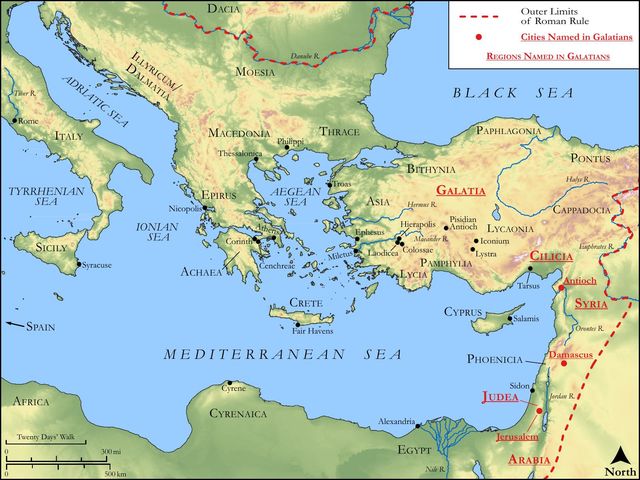
See on the biblical-era maps

Study this verse
Public-domain commentary
Matthew Henry
From his Commentary on the Whole Bible. Henry comments on passages, not single verses — this entry covers Galatians 3:19–29. His four-level outline is real structure in the source text, so it is rendered as structure.
The apostle having just before been speaking of the promise made to Abraham, and representing that as the rule of our justification, and not the law, lest they should think he did too much derogate from the law, and render it altogether useless, he thence takes occasion to discourse of the design and tendency of it, and to acquaint us for what purposes it was given. It might be asked, "If that promise be sufficient for salvation, wherefore then serveth the law? Or, Why did God give the law by Moses?" To this he answers,
I.The law was added because of transgressions, Gal 3:19.
It was not designed to disannul the promise, and to establish a different way of justification from that which was settled by the promise; but it was added to it, annexed on purpose to be subservient to it, and it was so because of transgressions. The Israelites, though they were chosen to be God's peculiar people, were sinners as well as others, and therefore the law was given to convince them of their sin, and of their obnoxiousness to the divine displeasure on the account of it; for by the law is the knowledge of sin (Rom 3:20), and the law entered that sin might abound, Rom 5:20. And it was also intended to restrain them from the commission of sin, to put an awe upon their minds, and be a curb upon their lusts, that they should not run into that excess of riot to which they were naturally inclined; and yet at the same time it was designed to direct them to the true and only way whereby sin was to be expiated, and wherein they might obtain the pardon of it; namely, through the death and sacrifice of Christ, which was the special use for which the law of sacrifices and purifications was given.
The apostle adds that the law was given for this purpose till the seed should come to whom the promise was made; that is, either till Christ should come (the principle seed referred to in the promise, as he had before shown), or till the gospel dispensation should take place, when Jews and Gentiles, without distinction, should, upon believing, become the seed of Abraham. The law was added because of transgressions, till this fulness of time, or this complete dispensation, should come. But when the seed came, and a fuller discovery of divine grace in the promise was made, then the law, as given by Moses, was to cease; that covenant, being found faulty, was to give place to another, and a better, Heb 8:7, Heb 8:8. And though the law, considered as the law of nature, is always in force, and still continues to be of use to convince men of sin and to restrain them from it, yet we are now no longer under the bondage and terror of that legal covenant. The law then was not intended to discover another way of justification, different from that revealed by the promise, but only to lead men to see their need of the promise, by showing them the sinfulness of sin, and to point them to Christ, through whom alone they could be pardoned and justified.
As a further proof that the law was not designed to vacate the promise, the apostle adds, It was ordained by angels in the hand of a mediator. It was given to different persons, and in a different manner from the promise, and therefore for different purposes. The promise was made to Abraham, and all his spiritual seed, including believers of all nations, even of the Gentiles as well as the Jews; but the law was given to the Israelites as a peculiar people, and separated from the rest of the world. And, whereas the promise was given immediately by God himself, the law was given by the ministry of angels, and the hand of a mediator. Hence it appeared that the law could not be designed to set aside the promise; for (Gal 3:20), A mediator is not a mediator of one, of one party only; but God is one, but one party in the promise or covenant made with Abraham: and therefore it is not to be supposed that by a transaction which passed only between him and the nation of the Jews he should make void a promise which he had long before made to Abraham and all his spiritual seed, whether Jews or Gentiles. This would not have been consistent with his wisdom, nor with his truth and faithfulness. Moses was only a mediator between God and the spiritual seed of Abraham; and therefore the law that was given by him could not affect the promise made to them, much less be subversive of it.
II.The law was given to convince men of the necessity of a Saviour.
The apostle asks (Gal 3:21), as what some might be willing to object, "Is the law then against the promises of God? Do they really clash and interfere with each other? Or do you not set the covenant with Abraham, and the law of Moses, at variance with one another?" To this he answers, God forbid; he was far from entertaining such a thought, nor could it be inferred from what he had said. The law is by no means inconsistent with the promise, but subservient to it, as the design of it is to discover men's transgressions, and to show them the need they have of a better righteousness than that of the law. That consequence would much rather follow from their doctrine than from his; for, if there had been a law given that could have given life, verily righteousness would have been by the law, and in that case the promise would have been superseded and rendered useless. But that in our present state could not be, for the scripture hath concluded all under sin (Gal 3:22), or declared that all, both Jew and Gentile, are in a state of guilt, and therefore unable to attain to righteousness and justification by the works of the law. The law discovered their wounds, but could not afford them a remedy: it showed that they were guilty, because it appointed sacrifices and purifications, which were manifestly insufficient to take away sin: and therefore the great design of it was that the promise by faith of Jesus Christ might be given to those that believe, that being convinced of their guilt, and the insufficiency of the law to effect a righteousness for them, they might be persuaded to believe on Christ, and so obtain the benefit of the promise.
III.The law was designed for a schoolmaster, to bring men to Christ, Gal 3:24.
In the foregoing verse, the apostle acquaints us with the state of the Jews under the Mosaic economy, that before faith came, or before Christ appeared and the doctrine of justification by faith in him was more fully discovered, they were kept under the law, obliged, under severe penalties, to a strict observance of the various precepts of it; and at that time they were shut up, held under the terror and discipline of it, as prisoners in a state of confinement: the design of this was that hereby they might be disposed more readily to embrace the faith which should afterwards be revealed, or be persuaded to accept Christ when he came into the world, and to fall in with that better dispensation he was to introduce, whereby they were to be freed from bondage and servitude, and brought into a state of greater light and liberty. Now, in that state, he tells them, the law was their schoolmaster, to bring them to Christ, that they might be justified by faith. As it declared the mind and will of God concerning them, and at the same time denounced a curse against them for every failure in their duty, so it was proper to convince them of their lost and undone condition in themselves, and to let them see the weakness and insufficiency of their own righteousness to recommend them to God. And as it obliged them to a variety of sacrifices, etc., which, though they could not of themselves take away sin, were typical of Christ, and of the great sacrifice which he was to offer up for the expiation of it, so it directed them (though in a more dark and obscure manner) to him as their only relief and refuge. And thus it was their schoolmaster, to instruct and govern them in their state of minority, or, as the word paidagōgos most properly signifies, their servant, to lead and conduct them to Christ (as children were wont to be led to school by those servants who had the care of them); that they might be more fully instructed by him as their schoolmaster, in the true way of justification and salvation, which is only by faith in him, and of which he was appointed to give the fullest and clearest discoveries. But lest it should be said, If the law was of this use and service under the Jewish, why may it not continue to be so under the Christian state too, the apostle adds (Gal 3:25) that after faith has come, and the gospel dispensation has taken place, under which Christ, and the way of pardon and life through faith in him, are set in the clearest light, we are no longer under a schoolmaster - we have no such need of the law to direct us to him as there was then. Thus the apostle acquaints us for what uses and purposes the law served; and, from what he says concerning this matter, we may observe,
1.The goodness of God to his people of old, in giving the law to them; for though, in comparison of the gospel state, it was a dispensation of darkness and terror, yet it furnished them with sufficient means and helps both to direct them in their duty to God and to encourage their hopes in him.
2.The great fault and folly of the Jews, in mistaking the design of the law, and abusing it to a very different purpose from that which God intended in the giving of it; for they expected to be justified by the works of it, whereas it was never designed to be the rule of their justification, but only a means of convincing them of their guilt and of their need of a Saviour, and of directing them to Christ, and faith in him, as the only way of obtaining this privilege. See Rom 9:31, Rom 9:32; Rom 10:3, Rom 10:4.
3.The great advantage of the gospel state above the legal, under which we not only enjoy a clearer discovery of divine grace and mercy than was afforded to the Jews of old, but are also freed from the state of bondage and terror under which they were held. We are not now treated as children in a state of minority, but as sons grown up to a full age, who are admitted to greater freedoms, and instated in larger privileges, than they were. This the apostle enlarges upon in the following verses. For, having shown for what intent the law was given, in the close of the chapter he acquaints us with our privilege by Christ, where he particularly declares,
(1.)That we are the children of God by faith in Christ Jesus, Gal 3:26. And here we may observe,
[1.]The great and excellent privilege which real Christians enjoy under the gospel: They are the children of God; they are no longer accounted servants, but sons; they are not now kept at such a distance, and under such restraints, as the Jews were, but are allowed a nearer and freer access to God than was granted to them; yea, they are admitted into the number, and have a right to all the privileges, of his children.
[2.]How they come to obtain this privilege, and that is by faith in Christ Jesus. Having accepted him as their Lord and Saviour, and relying on him alone for justification and salvation, they are hereupon admitted into this happy relation to God, and are entitled to the privileges of it; for (Joh 1:12) as many as received him, to them gave he power to become the sons of God, even to those that believe on his name. And this faith in Christ, whereby they became the children of God, he reminds us (Gal 3:27), was what they professed in baptism; for he adds, As many of you as have been baptized into Christ have put on Christ. Having in baptism professed their faith in him, they were thereby devoted to him, and had, as it were, put on his livery, and declared themselves to be his servants and disciples; and having thus become the members of Christ, they were through him owned and accounted as the children of God. Here note, First, Baptism is now the solemn rite of our admission into the Christian church, as circumcision was into that of the Jews. Our Lord Jesus appointed it to be so, in the commission he gave to his apostles (Mat 28:19), and accordingly it was their practice to baptize those whom they had discipled to the Christian faith; and perhaps the apostle might take notice of their baptism here, and of their becoming the children of God through faith in Christ, professed therein, to obviate a further objection, which the false teachers might be apt to urge in favour of circumcision. They might be ready to say, "Though it should be allowed that the law, as given at mount Sinai, was abrogated by the coming of Christ the promised seed, yet why should circumcision be set aside too, when that was given to Abraham together with the promise, and long before the giving of the law by Moses?" But this difficulty is sufficiently removed when the apostle says, Those who are baptized into Christ have put on Christ; for thence it appears that under the gospel baptism comes in the room of circumcision, and that those who by baptism are devoted to Christ, and do sincerely believe in him, are to all intents and purposes as much admitted into the privileges of the Christian state as the Jews were by circumcision into those of the legal (Phi 3:3), and therefore there was no reason why the use of that should still be continued. Note, Secondly, In our baptism we put on Christ; therein we profess our discipleship to him, and are obliged to behave ourselves as his faithful servants. Being baptized into Christ, we are baptized into his death, that as he died and rose again, so, in conformity thereunto, we should die unto sin, and walk in newness of life (Rom 6:3, Rom 6:4); it would be of great advantage to us did we oftener remember this.
(2.)That this privilege of being the children of God, and of being by baptism devoted to Christ, is now enjoyed in common by all real Christians. The law indeed made a difference between Jew and Greek, giving the Jews on many accounts the pre-eminence: that also made a difference between bond and free, master and servant, and between male and female, the males being circumcised. But it is not so now; they all stand on the same level, and are all one in Christ Jesus; as the one is not accepted on the account of any national or personal advantages he may enjoy above the other, so neither is the other rejected for the want of them; but all who sincerely believe on Christ, of what nation, or sex, or condition, soever they be, are accepted of him, and become the children of God through faith in him.
(3.)That, being Christ's, we are Abraham's seed, and heirs according to the promise. Their judaizing teachers would have them believe that they must be circumcised and keep the law of Moses, or they could not be saved: "No," says the apostle, "there is no need of that; for if you be Christ's, if you sincerely believe on him, who is the promised seed, in whom all the nations of the earth were to be blessed, you therefore become the true seed of Abraham, the father of the faithful, and as such are heirs according to the promise, and consequently are entitled to the great blessings and privileges of it." And therefore upon the whole, since it appeared that justification was not to be attained by the works of the law, but only by faith in Christ, and that the law of Moses was a temporary institution and was given for such purposes as were only subservient to and not subversive of the promise, and that now, under the gospel, Christians enjoy much greater and better privileges than the Jews did under that dispensation, it must needs follow that they were very unreasonable and unwise, in hearkening to those who at once endeavoured to deprive them of the truth and liberty of the gospel.
Historical interpretation
Three Centuries of Reception
12 surviving comments on this verse. Each one is dated, so this reads as a timeline rather than a list.
Select a marker to jump to its quote. Markers stagger vertically where authors wrote within a few decades of each other.
It was added, until the seed should come to whom the promise was made; .
This is the seed of which the apostle says in the Epistle to the Galatians, "that the law of works was established until the seed should come to whom the promise was made."
Whence the law was rightly said to have been given by Moses, being a rule of right and wrong; and we may call it with accuracy the divine ordinance, inasmuch as it was given by God through Moses. It accordingly conducts to the divine. Paul says: "The law was instituted because of transgressions, till the seed should come, to whom the promise was made." Then, as if in explanation of his meaning, he adds: "But before faith came, we were kept under the law, shut up," manifestly through fear, in consequence of sins, "unto the faith which should afterwards be revealed; so that the law was a schoolmaster to bring us to Christ, that we should be justified by faith."
For he, too, says that the world was originated by those angels; and sets forth Christ as born of the seed of Joseph, contending that He was merely human, without divinity; affirming also that the Law was given by angels; representing the God of the Jews as not the Lord, but an angel.
And He has, he says, been liberated from the nature of the Good One likewise, in order that He may be a Mediator, as Paul states,
By “angels” he means God’s messengers—that is, Moses, [Joshua] son of Nun and the other prophets up to John the Baptist. … Through these, therefore, the Law and Prophets are ordained and disposed by God in the hand, that is, the power, of the Savior. For he is the Mediator, the reconciler of God and humanity, so that he may save whom he will out of those who have received the law from the angels.
This remark again is not superfluous; observe too how he glances round at every thing, as if he had an hundred eyes. Having exalted Faith, and proved its elder claims, that the Law may not be considered superfluous, he sets right this side of the doctrine also, and proves that the Law was not given without a view, but altogether profitably. "Because of transgressions;" that is to say, that the Jews might not be let live carelessly, and plunge into the depth of wickedness, but that the Law might be placed upon them as a bridle, guiding, regulating, and checking them from transgressing, if not all, at least some of the commandments. Not slight then was the advantage of the Law; but for how long?
"Till the seed should come to whom the promise hath been made."
This is said of Christ; if then it was given until His advent, why do you protract it beyond its natural period?
"And it was ordained through Angels by the hand of a Mediator."
He either calls the priests Angels, or he declares that the Angels themselves ministered to the delivery of the Law. By Mediator here he means Christ, and shows that He was before it, and Himself the Giver of it.
It was after the offense of the people in the wilderness, after the adoration of the calf and their murmurings against God, that the law came to forbid transgressions.
(Verse 19, 20.) What then? The law was added because of transgressions until the seed should come to whom the promise was made; ordained by angels in the hand of a mediator. Now a mediator is not a mediator of one, but God is one. Is the law then against the promises of God? Certainly not! For if there had been a law given which could have given life, truly righteousness would have been by the law. But the Scripture has confined all under sin, that the promise by faith in Jesus Christ might be given to those who believe. For indeed the law was not given for the righteous but for the lawless and disobedient, for the ungodly and sinners (I Tim. II, 9): and to go deeper, after the idolatry to which they were enslaved in Egypt, so that they forgot the God of their fathers, and subsequently said, 'These are your gods, O Israel, who brought you out of the land of Egypt'; the ritual of worshiping God and the punishment of sinners was established by the hand of the mediator Christ Jesus, for all things were made through him, and without him nothing was made: not only the heavens, earth, sea, and all that we see, but also those things which were imposed on the stubborn people as the yoke of the Law through Moses (John I). And it is written to Timothy: For there is one God, and one mediator of God and men, the man Christ Jesus (I Tim. II, 5). After He deigned to be born for our salvation from the Virgin’s womb, He is called mediator of God and men, being a separate person. But before He assumed a human body, and when He was with the Father in the beginning, He is called the Word of God made flesh, to all the holy ones to whom the word of God was made, namely Enoch, Noah, Abraham, Isaac, and Jacob, and later Moses and all the Prophets, whom Scripture relates, without the addition of man whom He had not yet assumed, He is called only mediator. But when he says: The law was ordained by angels, this is to be understood, that in every Old Testament, where an angel is first seen and afterwards introduced as speaking as God: The angel indeed among the many ministers who may have been seen truly, but it is in this mediator that he speaks who says: I am the God of Abraham, the God of Isaac, and the God of Jacob (Exodus 3:6). And it is not surprising if God speaks in angels, since He also speaks through angels who are in human beings, as Zechariah says. And the angel who was speaking with me said (Zech. II, 3); and afterwards adding: Thus saith the Lord almighty. For the angel who was said to be in the prophet did not dare to speak in his own person: Thus saith the Lord almighty. The hand of the mediator, we must understand, is the power and might of him. He, being one with the Father according to his Godhood, is understood to be distinct from him according to his office as mediator. But since the order of the reading is confused and disordered by a hyperbaton, it seems that it should be rendered to us thus: The Law was given through angels into the hand of the mediator, ordained by angels because of transgressions, until the seed should come to whom the promise was made. But there is no doubt that the seed signifies Christ, who is also proven to be the son of Abraham from the beginning of Matthew, as Scripture testifies: The book of the genealogy of Jesus Christ, the son of David, the son of Abraham.
Now every dispensation of the Old Testament was given through angels, the Holy Spirit working in them and in the very Word of truth, though not yet incarnate, yet never departing from some true ordering of providence. This law was given through angels, sometimes acting in their own person, sometimes in that of God, as was also the way of the prophets.… The children [of Abraham] were put in the hand of [Christ] the Mediator so that he himself might liberate them from sin when they were forced by their transgression of the law to admit that they needed grace and mercy from the Lord.
Here arises a rather pertinent question: if faith justifies and even the former saints, who were justified before God, were justified through it, what need was there for the law to be given?… The law was given to a proud people, but the grace of love cannot be received by any but the humble. Without this grace the precepts of the law cannot possibly be fulfilled. Israel was rendered humble by transgression, so that it might seek grace and might not arrogantly suppose itself to be saved by its own merits; and so it would be righteous, not in its own power and might but by the hand of the Mediator who justifies the ungodly.
It was imposed through the ministry of angels, and Moses assisted in this imposition. For Moses is the one that is called an intermediary. … For the God of all set Michael over them, as taught by the blessed Daniel. And to the great Moses he promised to send with him an angel to the people.
This question should be read as a personification. “What you want to know,” he says, “is why the law was imposed. I shall tell you.… It was imposed for the tutelage of the race from which that offspring was going to sprout according to the flesh.”
Continue studying Galatians 3:19 across the web’s major study libraries — every link below opens this exact verse, chapter, or book on the destination site.
Read & Compare
 BibleGatewayThis verse in more than 200 translations and 70 languages.
 Bible.comThe YouVersion reader — hundreds of translations, reading plans, and highlights.
 ESV.orgCrossway's official English Standard Version reader.
 NET BibleThe NET translation with 60,000+ translators' notes on every rendering decision.
 STEP BibleTyndale House's free study tool — original text, vocabulary, and scholarly resources.
 BibliaLogos Bible Software's free web reader.
 USCCBThe New American Bible (Revised Edition) with the U.S. bishops' study notes.
Commentaries
 BibleHub CommentariesDozens of classic commentaries on this verse, gathered on one page.
 StudyLightMore than 100 commentary sets — the largest collection on the web.
 BibleRefPlain-English commentary on what this verse means, verse by verse.
 Enduring WordDavid Guzik's free commentary on this chapter, widely used by Bible teachers.
 Bible Study ToolsVerse commentary alongside Greek and Hebrew study aids.
Original Language & Research
- BibleHub InterlinearThe verse word by word — original language, transliteration, and English.
- BibleHub LexiconEvery word's original-language definition and Strong's entry.
 Blue Letter BibleDeep-study tools — Strong's numbers, concordance, and word studies.
 CNTR CollationThe earliest Greek manuscripts of this verse, collated letter by letter.
Sermons, Hymns & Audio


TrulyRandomVerse is not affiliated with these sites and doesn’t control their content. They’re linked because they’re genuinely useful.
Summary
Galatians 3:19 addresses the critical question regarding the purpose of the Mosaic Law, given Paul's preceding argument for justification by faith through the Abrahamic promise. It clarifies that the Law was not a means of salvation but a temporary divine provision, "added because of transgressions" to expose sin and demonstrate humanity's need for redemption, its role extending only "till the seed should come" – a direct reference to Christ – who would fulfill the promise. Furthermore, Paul highlights its administration "by angels in the hand of a mediator," emphasizing its distinct, indirect nature compared to the direct, unconditional promise to Abraham.
Context
ShowHideLiterary Context
Paul's letter to the Galatians is a fervent defense of the gospel of grace against Judaizers who insisted Gentile converts must observe the Mosaic Law, particularly circumcision, for salvation. In Galatians 3, Paul systematically argues that justification comes through faith, not works of the Law. He begins by reminding the Galatians of their initial experience of the Spirit through faith (Galatians 3:2). He then establishes Abraham as the paradigm of faith, whose righteousness was credited to him before the Law was given (Galatians 3:6-9). Crucially, Paul emphasizes that the promise to Abraham and his "seed" was singular, referring to Christ (Galatians 3:16). This sets up the direct question of Galatians 3:19: If the promise predates and supersedes the Law, what then was the Law's purpose? This verse provides Paul's answer, explaining the Law's temporary and specific function within God's redemptive plan.
Historical & Cultural Context
The historical backdrop is the early church's struggle with Jewish Christians (Judaizers) who believed that Gentile converts needed to adopt Jewish customs and laws to be truly part of God's people. This was a significant theological and practical challenge, as seen in the Jerusalem Council. The Law, specifically the Mosaic Law, was central to Jewish identity and covenant relationship with God. For centuries, it had defined Israel's distinctiveness and their path to righteousness. The idea that it was temporary or subservient to a prior promise was revolutionary and deeply challenging to Jewish sensibilities. The mention of "angels" and a "mediator" (Moses) reflects common Jewish traditions regarding the giving of the Law at Sinai, often seen as a glorious and divinely sanctioned event. Paul acknowledges this but uses it to contrast the indirect, mediated nature of the Law with the direct, unconditional promise to Abraham.
Key Themes
ShowHideThis verse is pivotal in developing several key themes within Galatians and Pauline theology. Firstly, it clarifies the purpose of the Law, asserting it was "added because of transgressions" – not to provide life or righteousness, but to expose sin and demonstrate humanity's inability to achieve righteousness through self-effort. This aligns with Paul's broader argument in Romans 3:20 that "by the law is the knowledge of sin." Secondly, it underscores the temporary nature of the Law's primary function as a means of justification, stating it was given "till the seed should come." This "seed" is unequivocally identified as Christ, highlighting the Law's preparatory role in leading humanity to Him (Galatians 3:24). Thirdly, it touches upon the administration of the Law, noting it was "ordained by angels in the hand of a mediator." While acknowledging the Law's divine origin, Paul subtly contrasts its indirect delivery with the direct, unconditional nature of the Abrahamic promise, setting the stage for the superiority of the new covenant in Christ.
Exposition and Analysis
ShowHideKey Word Analysis
ShowHideFrom a primary word meaning "to parcel out," this term refers to a prescriptive usage or regulation. Here, it specifically denotes the Mosaic Law, including its commandments and statutes, which defined the covenant relationship between God and Israel. Paul's use highlights its function as a set of divine stipulations.
Derived from a verb meaning "to step over" or "to go beyond," this noun signifies a violation or a breaking of a rule or boundary. The Law, by clearly delineating God's standards, made clear what constituted sin, thus increasing the awareness and knowledge of "transgressions."
Literally "something sown" or "offspring," Paul's singular usage here is crucial. As he argues in Galatians 3:16, this refers not to multiple descendants but to the singular, ultimate heir of the promise: Christ. This term establishes the eschatological and Christological fulfillment of God's covenant.
Meaning "to arrange thoroughly," "institute," or "prescribe," this verb emphasizes the divine authority and deliberate ordering behind the giving of the Law. It was not a random occurrence but a divinely appointed arrangement.
From a word meaning "middle," this noun denotes a "go-between" or "internunciator," one who stands between two parties to facilitate communication or agreement. In this context, it refers to Moses, who mediated the covenant between God and Israel at Sinai.
Verse Breakdown
ShowHide"Wherefore then serveth the law?"
Paul poses a rhetorical question, anticipating the natural objection from those who might conclude the Law is useless if justification is by faith. This sets the stage for his profound explanation of its true, albeit temporary, purpose.
"It was added because of transgressions,"
The Law was not foundational for salvation but "added" to an already existing promise. Its primary purpose was to define, expose, and multiply sin by clearly setting God's righteous standards, thereby making humanity aware of its inability to meet them and its desperate need for grace. It acted as a mirror, revealing the dirt.
"till the seed should come to whom the promise was made;"
This clause specifies the temporary nature and duration of the Law's primary function. The "seed" refers to Christ (Galatians 3:16), indicating that the Law's preparatory role would conclude with His arrival, at which point the promise made to Abraham would find its ultimate fulfillment and the new covenant would be inaugurated.
"and it was ordained by angels in the hand of a mediator."
This describes the manner of the Law's giving. It was divinely "ordained" (instituted) but delivered indirectly "by angels" (a common Jewish tradition, cf. Acts 7:53 and Hebrews 2:2) and through "the hand of a mediator" (Moses). This indirect, mediated delivery contrasts sharply with the direct, unconditional nature of the promise given to Abraham, subtly implying a lesser status or a different kind of relationship.
Literary Devices
ShowHidePaul employs Rhetorical Question ("Wherefore then serveth the law?") to engage his audience and introduce a crucial theological point, demonstrating his pedagogical skill. The phrase "added because of transgressions" functions as a Purpose Clause, clearly stating the Law's specific, albeit limited, function. The temporal phrase "till the seed should come" acts as a Temporal Marker, emphasizing the Law's temporary nature and its role as a preparatory measure leading to Christ. The entire verse also exhibits Contrast, subtly juxtaposing the Law's indirect, mediated delivery with the direct, unconditional nature of the Abrahamic promise, further solidifying the superiority of the latter.
Theological and Thematic Connections
ShowHideGalatians 3:19 is a cornerstone for understanding the relationship between the Mosaic Law and the Gospel of Christ. It firmly establishes that the Law was not given as a means of justification or life, but rather as a revelatory instrument designed to highlight humanity's sinfulness and consequent need for a Savior. By exposing the depth of human transgression, the Law acted as a "pedagogue" or "guardian" (Galatians 3:24) leading people to Christ, who is the ultimate fulfillment of God's promise. This temporary, preparatory role of the Law underscores the eternal, unchangeable nature of God's promise of salvation through faith, which predates and supersedes the Law. It reorients our understanding of God's redemptive history, showing a consistent plan culminating in Christ.
Reflection and Application
ShowHideThis verse profoundly impacts how we understand our relationship with God and the nature of salvation. It liberates believers from the burden of attempting to earn righteousness through adherence to legalistic codes, emphasizing that such efforts only serve to highlight our shortcomings, not to justify us. The Law's purpose was to expose our need for grace, not to provide it. For us today, this means embracing the freedom found in Christ, recognizing that our standing before God is based entirely on His finished work, not on our performance. It calls us to a deeper appreciation of God's patient and wise redemptive plan, where the Law served a crucial, albeit temporary, role in preparing the way for the ultimate revelation of His grace in Jesus. Understanding this truth fosters humility, gratitude, and a reliance on Christ alone for salvation and sanctification.
Questions for Reflection
ShowHideFAQ
ShowHideWhat does "added because of transgressions" mean?
ShowHideThis phrase means the Law was given to define and reveal sin. Before the Law, sin existed, but the Law made it explicit by setting clear boundaries and standards. It showed humanity what God's perfect will was, thereby making deviations from that will (transgressions) undeniably clear. It didn't create sin, but it illuminated it, demonstrating humanity's inability to live up to God's standards and thus highlighting the need for a Savior. As Romans 7:7 states, "I had not known sin, but by the law."
Who is "the seed" mentioned in this verse?
ShowHideAs Paul explicitly clarifies in Galatians 3:16, "the seed" refers to Jesus Christ. Paul emphasizes the singular nature of the promise made to Abraham's "seed," arguing that it points to one specific descendant, not to Abraham's numerous physical offspring or to Israel as a whole. Christ is the ultimate heir of the promise, and through Him, all who believe become spiritual descendants of Abraham and recipients of the promise.
Why does Paul mention the Law was "ordained by angels in the hand of a mediator"?
ShowHideThis detail acknowledges the traditional Jewish understanding of the giving of the Law at Mount Sinai. Jewish tradition and other biblical texts (Acts 7:53, Hebrews 2:2) indicate that angels were involved in the delivery of the Law. Moses served as the "mediator" between God and Israel, conveying God's commands to the people. Paul includes this detail not to elevate the Law, but to subtly contrast its indirect, mediated delivery with the direct, unconditional nature of the promise made to Abraham, which required no mediator and was given directly by God. This distinction reinforces the superiority of the promise over the Law.
Christ-Centered Fulfillment
ShowHideGalatians 3:19 finds its profound Christ-centered fulfillment in Jesus, who is "the seed" to whom the promise was made. The Law, with its temporary purpose of exposing transgressions and acting as a "guardian" (Galatians 3:24) until Christ came, ultimately points to Him as its true end and fulfillment. Christ did not abolish the Law but fulfilled its righteous requirements through His perfect life and atoning death (Matthew 5:17). He became the curse of the Law for us (Galatians 3:13), thereby redeeming us from its condemnation and enabling us to receive the promised Spirit through faith. In Christ, the temporary administration of the Law gives way to the eternal reality of grace, where believers are justified not by works of the Law but by faith in the One who perfectly satisfied its demands. He is the ultimate mediator of a new and better covenant (Hebrews 8:6), bringing direct access to God and the full realization of the Abrahamic promise.