


Galatians 5:1
Bible text: King James Version (1769 Blayney text) · Public domain
Bible text: King James Version with Strong's numbers · Public domain
Bible text: Berean Standard Bible · Public domain
Bible text: American Standard Version (1901) · Public domain
Bible text: World English Bible, Messianic edition · Public domain
Bible text: Geneva Bible (1599) · Public domain
Bible text: Young's Literal Translation · Public domain
- τῇtēa<the>G3588T-DSFDefinite article Dative Singular Feminine
- ἐλευθερίᾳeleutheriaIn freedomG1657N-DSFNoun Dative Singular Feminine
- ᾗhēwhichG3739R-DSFRelative pronoun Dative Singular Feminine
- ἡμᾶςhēmasusG3165P-1APPersonal pronoun Accusative 1st Plural
- ΧριστὸςChristosChristG5547N-NSM-TNoun Nominative Singular Masculine Title
- ἠλευθέρωσεν·ēleutherōsenhas set freeG1659V-AAI-3SVerb Aorist Active Indicative 3rd Singular
- στήκετεstēketedo stand firmG4739V-PAM-2PVerb Present Active Imperative 2nd Plural
- οὖνounthereforeG3767CONJConjunction
- καὶkaiandG2532CONJConjunction
- μὴmēnotG3361PRT-NNegative Particle Negative
- πάλινpalinagainG3825ADVAdverb
- ζυγῷzugōin a yokeG2218N-DSMNoun Dative Singular Masculine
- δουλείαςdouleiasof slaveryG1397N-GSFNoun Genitive Singular Feminine
- ἐνέχεσθεenechesthedo be entangledG1758V-PPM-2PVerb Present Passive Imperative 2nd Plural
English is a literal word-by-word gloss of the Greek, not the KJV's wording. Why?
This is the original text the KJV's translators worked from — each Greek word with its own literal English meaning in this verse, prepared by scholars at Tyndale House, Cambridge. The KJV translates whole sentences, not word by word, so its wording differs: one Greek word can become several English words, and the KJV may choose “charity” where the gloss reads “love”. Both are faithful — they answer different questions. For the KJV's own rendering, switch to the KJV text.
Details
See on the biblical-era maps

Study this verse
Public-domain commentary
Matthew Henry
From his Commentary on the Whole Bible. Henry comments on passages, not single verses — this entry covers Galatians 5:1–12. His four-level outline is real structure in the source text, so it is rendered as structure.
In the former part of this chapter the apostle cautions the Galatians to take heed of the judaizing teachers, who endeavoured to bring them back under the bondage of the law. He had been arguing against them before, and had largely shown how contrary the principles and spirit of those teachers were to the spirit of the gospel; and now this is as it were the general inference or application of all that discourse. Since it appeared by what had been said that we can be justified only by faith in Jesus Christ, and not by the righteousness of the law, and that the law of Moses was no longer in force, nor Christians under any obligation to submit to it, therefore he would have them to stand fast in the liberty wherewith Christ hath made us free, and not to be again entangled with the yoke of bondage. Here observe, 1. Under the gospel we are enfranchised, we are brought into a state of liberty, wherein we are freed from the yoke of the ceremonial law and from the curse of the moral law; so that we are no longer tied to the observance of the one, nor tied up to the rigour of the other, which curses every one that continues not in all things written therein to do them, Gal 3:10. 2. We owe this liberty to Jesus Christ. It is he who has made us free; by his merits he has satisfied the demands of the broken law, and by his authority as a king he has discharged us from the obligation of those carnal ordinances which were imposed on the Jews. And, 3. It is therefore our duty to stand fast in this liberty, constantly and faithfully to adhere to the gospel and to the liberty of it, and not to suffer ourselves, upon any consideration, to be again entangled in the yoke of bondage, nor persuaded to return back to the law of Moses. This is the general caution or exhortation, which in the following verses the apostle enforces by several reasons or arguments. As,
I.That their submitting to circumcision, and depending on the works of the law for righteousness, were an implicit contradiction of their faith as Christians and a forfeiture of all their advantages by Jesus Christ, Gal 5:2-4. And here we may observe,
1.With what solemnity the apostle asserts and declares this: Behold, I Paul say unto you (Gal 5:2), and he repeats it (Gal 5:3), I testify unto you; as it he had said, "I, who have proved myself an apostle of Christ, and to have received my authority and instructions from him, do declare, and am ready to pawn my credit and reputation upon it, that if you be circumcised Christ shall profit you nothing, etc.," wherein he shows that what he was now saying was not only a matter of great importance, but what might be most assuredly depended on. He was so far from being a preacher of circumcision (as some might report him to be) that he looked upon it as a matter of the greatest consequence that they did not submit to it.
2.What it is which he so solemnly, and with so much assurance, declares; it is that, if they were circumcised, Christ would profit them nothing, etc. We are not to suppose that it is mere circumcision which the apostle is here speaking of, or that it was his design to say that none who are circumcised could have any benefit by Christ; for all the Old Testament saints had been circumcised, and he himself had consented to the circumcising of Timothy. But he is to be understood as speaking of circumcision in the sense in which the judaizing teachers imposed it, who taught that except they were circumcised, and kept the law of Moses, they could not be saved, Act 15:1. That this is his meaning appears from Gal 5:4, where he expresses the same thing by their being justified by the law, or seeking justification by the works of it. Now in this case, if they submitted to circumcision in this sense, he declares that Christ would profit them nothing, that they were debtors to do the whole law, that Christ had become of no effect to them, and that they were fallen from grace. From all these expressions it appears that thereby they renounced that way of justification which God had established; yea, that they laid themselves under an impossibility of being justified in his sight, for they became debtors to do the whole law, which required such an obedience as they were not capable of performing, and denounced a curse against those who failed in it, and therefore condemned, but could not justify them; and, consequently, that having thus revolted from Christ, and built their hopes upon the law, Christ would profit them nothing, nor be of any effect to them. Thus, as by being circumcised they renounced their Christianity, so they cut themselves off from all advantage by Christ; and therefore there was the greatest reason why they should stedfastly adhere to that doctrine which they had embraced, and not suffer themselves to be brought under this yoke of bondage. Note,
(1.)Though Jesus Christ is able to save to the uttermost, yet there are multitudes whom he will profit nothing.
(2.)All those who seek to be justified by the law do thereby render Christ of no effect to them. By building their hopes on the works of the law, they forfeit all their hopes from him; for he will not be the Saviour of any who will not own and rely upon him as their only Saviour.
II.To persuade them to stedfastness in the doctrine and liberty of the gospel, he sets before them his own example, and that of other Jews who had embraced the Christian religion, and acquaints them what their hopes were, namely, That through the Spirit they were waiting for the hope of righteousness by faith. Though they were Jews by nature, and had been bred up under the law, yet being, through the Spirit, brought to the knowledge of Christ, they had renounced all dependence on the works of the law, and looked for justification and salvation only by faith in him; and therefore it must needs be the greatest folly in those who had never been under the law to suffer themselves to be brought into subjection to it, and to found their hopes upon the works of it. Here we may observe,
1.What it is that Christians are waiting for: it is the hope of righteousness, by which we are chiefly to understand the happiness of the other world. This is called the hope of Christians, as it is the great object of their hope, which they are above every thing else desiring and pursuing; and the hope of righteousness, as their hopes of it are founded on righteousness, not their own, but that of our Lord Jesus: for, though a life of righteousness is the way that leads to this happiness, yet it is the righteousness of Christ alone which has procured it for us, and on account of which we can expect to be brought to the possession of it.
2.How they hope to obtain this happiness, namely, by faith, that is, in our Lord Jesus Christ, not by the works of the law, or any thing they can do to deserve it, but only by faith, receiving and relying upon him as the Lord our righteousness. It is in this way only that they expect either to be entitled to it here or possessed of it hereafter. And,
3.Whence it is that they are thus waiting for the hope of righteousness: it is through the Spirit. Herein they act under the direction and influence of the Holy Spirit; it is under his conduct, and by his assistance, that they are both persuaded and enabled to believe on Christ, and to look for the hope of righteousness through him. When the apostle thus represents the case of Christians, it is implied that if they expected to be justified and saved in any other way they were likely to meet with a disappointment, and therefore that they were greatly concerned to adhere to the doctrine of the gospel which they had embraced.
III.He argues from the nature and design of the Christian institution, which was to abolish the difference between Jew and Gentile, and to establish faith in Christ as the way of our acceptance with God. He tells them (Gal 5:6) that in Christ Jesus, or under the gospel dispensation, neither circumcision availeth any thing nor uncircumcision. Though, while the legal state lasted, there was a difference put between Jew and Greek, between those who were and those who were not circumcised, the former being admitted to those privileges of the church of God from which the other were excluded, yet it was otherwise in the gospel state: Christ, who is the end of the law, having come, now it was neither here nor there whether a man were circumcised or uncircumcised; he was neither the better for the one nor the worse for the other, nor would either the one or the other recommend him to God; and therefore as their judaizing teachers were very unreasonable in imposing circumcision upon them, and obliging them to observe the law of Moses, so they must needs be very unwise in submitting to them herein. But, though he assures them that neither circumcision nor uncircumcision would avail to their acceptance with God, yet he informs them what would do so, and that is faith, which worketh by love: such a faith in Christ as discovers itself to be true and genuine by a sincere love to God and our neighbour. If they had this, it mattered not whether they were circumcised or uncircumcised, but without it nothing else would stand them in any stead. Note,
1.No external privileges nor profession will avail to our acceptance with God, without a sincere faith in our Lord Jesus.
2.Faith, where it is true, is a working grace: it works by love, love to God and love to our brethren; and faith, thus working by love, is all in all in our Christianity.
IV.To recover them from their backslidings, and engage them to greater stedfastness for the future, he puts them in mind of their good beginnings, and calls upon them to consider whence it was that they were so much altered from what they had been, Gal 5:7.
1.He tells them that they did run well; at their first setting out in Christianity they had behaved themselves very commendably, they had readily embraced the Christian religion, and discovered a becoming zeal in the ways and work of it; as in their baptism they were devoted to God, and had declared themselves the disciples of Christ, so their behaviour was agreeable to their character and profession. Note,
(1.)The life of a Christian is a race, wherein he must run, and hold on, if he would obtain the prize.
(2.)It is not enough that we run in this race, by a profession of Christianity, but we must run well, by living up to that profession. Thus these Christians had done for awhile, but they had been obstructed in their progress, and were either turned out of the way or at least made to flag and falter in it. Therefore,
2.He asks them, and calls upon them to ask themselves, Who did hinder you? How came it to pass that they did not hold on in the way wherein they had begun to run so well? He very well knew who they were, and what it was that hindered them; but he would have them to put the question to themselves, and seriously consider whether they had any good reason to hearken to those who gave them this disturbance, and whether what they offered was sufficient to justify them in their present conduct. Note,
(1.)Many who set out fair in religion, and run well for awhile - run within the bounds appointed for the race, and run with zeal and alacrity too-are yet by some means or other hindered in their progress, or turned out of the way.
(2.)It concerns those who have run well, but now begin either to turn out of the way or to tire in it, to enquire what it is that hinders them. Young converts must expect that Satan will be laying stumbling blocks in their way, and doing all he can to divert them from the course they are in; but, whenever they find themselves in danger of being turned out of it, they would do well to consider who it is that hinders them. Whoever they were that hindered these Christians, the apostle tells them that by hearkening to them they were kept from obeying the truth, and were thereby in danger of losing the benefit of what they had done in religion. The gospel which he had preached to them, and which they had embraced and professed, he assures them was the truth; it was therein only that the true way of justification and salvation was fully discovered, and, in order to their enjoying the advantage of it, it was necessary that they should obey it, that they should firmly adhere to it, and continue to govern their lives and hopes according to the directions of it. If therefore they should suffer themselves to be drawn away from it they must needs be guilty of the greatest weakness and folly. Note,
[1.]The truth is not only to be believed, but to be obeyed, to be received not only in the light of it, but in the love and power of it.
[2.]Those do not rightly obey the truth, who do not stedfastly adhere to it.
[3.]There is the same reason for our obeying the truth that there was for our embracing it: and therefore those act very unreasonably who, when they have begun to run well in the Christian race, suffer themselves to be hindered, so as not to persevere in it.
V.He argues for their stedfastness in the faith and liberty of the gospel from the ill rise of that persuasion whereby they were drawn away from it (Gal 5:8): This persuasion, says he, cometh not of him that calleth you. The opinion or persuasion of which the apostle here speaks was no doubt that of the necessity of their being circumcised, and keeping the law of Moses, or of their mixing the works of the law with faith in Christ in the business of justification. This was what the judaizing teachers endeavoured to impose upon them, and what they had too easily fallen into. To convince them of their folly herein, he tells them that this persuasion did not come of him that called them, that is, either of God, by whose authority the gospel had been preached to them and they had been called into the fellowship of it, or of the apostle himself, who had been employed as the instrument of calling them hereunto. It could not come from God, for it was contrary to that way of justification and salvation which he had established; nor could they have received it from Paul himself; for, whatever some might pretend, he had all along been an opposer and not a preacher of circumcision, and, if in any instance he had submitted to it for the sake of peace, yet he had never pressed the use of it upon Christians, much less imposed it upon them as necessary to salvation. Since then this persuasion did not come of him that had called them, he leaves them to judge whence it must arise, and sufficiently intimates that it could be owing to none but Satan and his instruments, who by this means were endeavouring to overthrow their faith and obstruct the progress of the gospel, and therefore that the Galatians had every reason to reject it, and to continue stedfast in the truth which they had before embraced. Note,
1.In order to our judging aright of the different persuasions in religion which there are among Christians, it concerns us to enquire whether they come of him that calleth us, whether or no they are founded upon the authority of Christ and his apostles.
2.If, upon enquiry, they appear to have no such foundation, how forward soever others may be to impose them upon us, we should by no means submit to them, but reject them.
VI.The danger there was of the spreading of this infection, and the ill influence it might have upon others, are a further argument which the apostle urges against their complying with their false teachers in what they would impose on them. It is possible that, to extenuate their fault, they might be ready to say that there were but few of those teachers among them who endeavoured to draw them into this persuasion and practice, or that they were only some smaller matters wherein they complied with them - that though they submitted to be circumcised, and to observe some few rites of the Jewish laws, yet they had by no means renounced their Christianity and gone over to Judaism. Or, suppose their complying thus far was as faulty as he could represent it, yet perhaps they might further say that there were but few among them who had done so, and therefore he needed not be so much concerned about it. Now, to obviate such pretences as these, and to convince them that there was more danger in it than they were aware of, he tells them (Gal 5:9) that a little leaven leaveneth the whole lump - that the whole lump of Christianity may be tainted and corrupted by one such erroneous principle, or that the whole lump of the Christian society may be infected by one member of it, and therefore that they were greatly concerned not to yield in this single instance, or, if any had done so, to endeavour by all proper methods to purge out the infection from among them. Note, It is dangerous for Christian churches to encourage those among them who entertain, especially who set themselves to propagate, destructive errors. This was the case here. The doctrine which the false teachers were industrious to spread, and which some in these churches had been drawn into, was subversive of Christianity itself, as the apostle had before shown; and therefore, though the number either of the one or the other of these might be but small, yet, considering the fatal tendency of it and the corruption of human nature, whereby others were too much disposed to be infected with it, he would not have them on that account to be easy and unconcerned, but remember that a little leaven leaveneth the whole lump. If these were indulged the contagion might soon spread further and wider; and, if they suffered themselves to be imposed upon in this instance, it might soon issue in the utter ruin of the truth and liberty of the gospel.
VII.That he might conciliate the greater regard to what he had said, he expresses the hopes he had concerning them (Gal 5:10):
I have confidence in you, says he, through the Lord, that you will be none otherwise minded. Though he had many fears and doubts about them (which was the occasion of his using so much plainness and freedom with them), yet he hoped that through the blessing of God upon what he had written they might be brought to be of the same mind with him, and to own and abide by that truth and that liberty of the gospel which he had preached to them, and was now endeavouring to confirm them in. Herein he teaches us that we ought to hope the best even of those concerning whom we have cause to fear the worst. That they might be the less offended at the reproofs he had given them for their unstedfastness in the faith, he lays the blame of it more upon others than themselves; for he adds, But he that troubleth you shall bear his judgment, whosoever he be. He was sensible that there were some that troubled them, and would pervert the gospel of Christ (as Gal 1:7), and possibly he may point to some one particular man who was more busy and forward than others, and might be the chief instrument of the disorder that was among them; and to this he imputes their defection or inconstancy more than to any thing in themselves. This may give us occasion to observe that, in reproving sin and error, we should always distinguish between the leaders and the led, such as set themselves to draw others thereinto and such as are drawn aside by them. Thus the apostle softens and alleviates the fault of these Christians, even while he is reproving them, that he might the better persuade them to return to, and stand fast in, the liberty wherewith Christ had made them free: but as for him or those that troubled them, whoever he or they were, he declares they should bear their judgment, he did not doubt but God would deal with them according to their deserts, and out of his just indignation against them, as enemies of Christ and his church, he wishes that they were even cut off - not cut off from Christ and all hopes of salvation by him, but cut off by the censures of the church, which ought to witness against those teachers who thus corrupted the purity of the gospel. Those, whether ministers or others, who set themselves to overthrow the faith of the gospel, and disturb the peace of Christians, do thereby forfeit the privileges of Christian communion and deserve to be cut off from them.
VIII.To dissuade these Christians from hearkening to their judaizing teachers, and to recover them from the ill impressions they had made upon them, he represents them as men who had used very base and disingenuous methods to compass their designs, for they had misrepresented him, that they might the more easily gain their ends upon them. That which they were endeavouring was to bring them to submit to circumcision, and to mix Judaism with their Christianity; and, the better to accomplish this design, they had given out among them that Paul himself was a preacher of circumcision: for when he says (Gal 5:11), And I brethren, if I yet preach circumcision, it plainly appears that they had reported him to have done so, and that they had made use of this as an argument to prevail with the Galatians to submit to it. It is probable that they grounded this report upon his having circumcised Timothy, Act 16:3. But, though for good reasons he had yielded to circumcision in that instance, yet that he was a preacher of it, and especially in that sense wherein they imposed it, he utterly denies. To prove the injustice of that charge upon him, he offers such arguments as, if they would allow themselves to consider, could not fail to convince them of it.
1.If he would have preached circumcision, he might have avoided persecution. If I yet preach circumcision, says he, why do I yet suffer persecution? It was evident, and they could not but be sensible of it, that he was hated and persecuted by the Jews; but what account could be given of this their behaviour towards him, if he had so far symbolized with them as to preach up circumcision, and the observance of the law of Moses, as necessary to salvation? This was the great point they were contending for; and, if he had fallen in with them herein, instead of being exposed to their rage he might have been received into their favour. When therefore he was suffering persecution from them, this was a plain evidence that he had not complied with them; yea, that he was so far from preaching the doctrine he was charged with, that, rather than do so, he was willing to expose himself to the greatest hazards.
2.If he had yielded to the Jews herein, then would the offence of the cross have ceased. They would not have taken so much offence against the doctrine of Christianity as they did, nor would he and others have been exposed to so much suffering on the account of it as they were. He informs us (Co1 1:23) that the preaching of the cross of Christ (or the doctrine of justification and salvation only by faith in Christ crucified) was to the Jews a stumbling-block. That which they were most offended at in Christianity was, that thereby circumcision, and the whole frame of the legal administration, were set aside, as no longer in force. This raised their greatest outcries against it, and stirred them up to oppose and persecute the professors of it. Now if Paul and others could have given into this opinion, that circumcision was still to be retained, and the observance of the law of Moses joined with faith in Christ as necessary to salvation, then their offence against it would have been in a great measure removed, and they might have avoided the sufferings they underwent for the sake of it. But though others, and particularly those who were so forward to asperse him as a preacher of this doctrine, could easily come into it, yet so could not he. He rather chose to hazard his ease and credit, yea his very life itself, than thus to corrupt the truth and give up the liberty of the gospel. Hence it was that the Jews continued to be so much offended against Christianity, and against him as the preacher of it. Thus the apostle clears himself from the unjust reproach which his enemies had cast upon him, and at the same time shows how little regard was due to those men who could treat him in such an injurious manner, and how much reason he had to wish that they were even cut off.
Historical interpretation
Two Centuries of Reception
10 surviving comments on this verse. Each one is dated, so this reads as a timeline rather than a list.
Select a marker to jump to its quote. Markers stagger vertically where authors wrote within a few decades of each other.
It was not meet that those who had received liberty should be "entangled again with the yoke of bondage" -that is, of the law; now that the Psalm had its prophecy accomplished: "Let us break their bands asunder, and cast away their cords from us, since the rulers have gathered themselves together against the Lord and against His Christ.
For the Jews say, that from the beginning God sanctified the seventh day, by resting on it from all His works which He made; and that thence it was, likewise, that Moses said to the People: "Remember the day of the sabbaths, to sanctify it: every servile work ye shall not do therein, except what pertaineth unto life." Whence we (Christians) understand that we still more ought to observe a sabbath from all "servile work" always, and not only every seventh day, but through all time.
Both dispensations, therefore, emanate from that same God by whom, as we have found, they were both sketched out beforehand. When he speaks of "the liberty wherewith Christ hath made us free," does not the very phrase indicate that He is the Liberator who was once the Master? For Galba himself never liberated slaves which were not his own, even when about to restore free men to their liberty.
Xerophagies, however, (they consider) the novel name of a studied duty, and very much akin to heathenish superstition, like the abstemious rigours which purify an Apis, an Isis, and a Magna Mater, by a restriction laid upon certain kinds of food; whereas faith, free in Christ, owes no abstinence from particular meats to the Jewish Law even, admitted as it has been by the apostle once for all to the whole range of the meat-market -(the apostle, I say), that detester of such as, in like manner as they prohibit marrying, so bid us abstain from meats created by God.
"Liberty in Christ" has done no injury to innocence.
He obviously means that freedom by which our mother [the church] is free, and she obviously is free by faith. For this is true freedom, to keep faith in God and to believe all God’s promises. Therefore by faith Christ has brought us back to freedom and made us free by the freedom of faith.
He had to add an exhortation that they should persevere in the same way that they had first begun to receive from him the gospel and not return to the slavery under the law. He says “stand” which is not possible for one who is under a heavy yoke. For he bows his neck submissively and therefore cannot stand.
Have ye wrought your own deliverance, that ye run back again to the dominion ye were under before? It is Another who hath redeemed you, it is Another who hath paid the ransom for you. Observe in how many ways he leads them away from the error of Judaism; by showing, first, that it was the extreme of folly for those, who had become free instead of slaves, to desire to become slaves instead of free; secondly, that they would be convicted of neglect and ingratitude to their Benefactor, in despising Him who had delivered, and loving him who had enslaved them; thirdly, that it was impossible. For Another having once for all redeemed all of us from it, the Law ceases to have any sway. By the word, "stand fast," he indicates their vacillation.
By the word "yoke" he signifies to them the burdensomeness of such a course, and by the word "again" he points out their utter senselessness. Had ye never experienced this burden, ye would not have deserved so severe a censure, but for you who by trial have learnt how irksome this yoke is, again to subject yourself to it, is justly unpardonable.
(Chapter 5, Verse 1) Stand fast, and be not held again under the yoke of bondage. And from this it is shown that he who cleaves to the yoke of servitude does not stand. And because he who has been granted freedom by Christ has been under the yoke as long as he has had the spirit of servitude in fear, and has followed the beginnings of the Law. But when he says, stand, he exhorts firm and stable faith in Christ, so that the churches of Galatia may remain rooted in the Savior. About this, and in another place, the righteous one speaks: 'He has set my feet upon a rock' (Ps. 39:3), because it is upon Christ. So that the teachings may not be carried about by every wind and may be carried off in different directions (Eph. 4). Hence it is also said to those who are standing: 'And let anyone who stands take heed lest he fall' (1 Cor. 10:12). And in another place: 'Stand firm, act like men, be strong' (Ibid. 16:13), so that they may stand with Him whom Stephen, persevering in martyrdom, saw standing at the right hand of the Father (Acts 7), and also the one who spoke to Moses: 'But you, stand with me' (Exod. 34:2). But he calls the yoke of servitude a harsh, difficult, laborious law, which consumes its cultivators with heavy work day and night. Just as Peter says in the Acts of the Apostles: Why do you attempt to impose a heavy yoke upon the neck of the brothers, which neither we nor our fathers were able to bear (Acts 15:10)? But what he has added, do not burden yourselves again, not that the Galatians were keeping the Law before; but so that the heavy yoke of idolatry, by which the Egyptian people were oppressed and plunged like lead into the Red Sea (Exodus 15), may not be repeated. According to the sense of which he had said above, How do you turn again to weak and needy elements, which you desire again to serve, observing days, and months, and times, and years? For the Galatians, who, after the preaching of Paul the Apostle, had forsaken the idols and at once ascended to the grace of the Gospel, did not return to the servitude of the Jewish Law, which they had never known before: but wishing to observe times, to be circumcised in the flesh, and to offer corporeal sacrifices, they were in a certain way returning to the same worship to which they had previously served in idolatry. For both the Egyptian priests and the Ishmaelites and the Midianites are said to not have a foreskin. However, if only we did not know that the nations observe days, months, and years, so that we may never have any mixed festivities with them.
He adds “again,” not because the Galatians had previously kept the law … but in their readiness to observe the lunar seasons, to be circumcised in the flesh and to offer sacrifices, they were in a sense returning to the cults that they had previously served in a state of idolatry.
Continue studying Galatians 5:1 across the web’s major study libraries — every link below opens this exact verse, chapter, or book on the destination site.
Read & Compare
 BibleGatewayThis verse in more than 200 translations and 70 languages.
 Bible.comThe YouVersion reader — hundreds of translations, reading plans, and highlights.
 ESV.orgCrossway's official English Standard Version reader.
 NET BibleThe NET translation with 60,000+ translators' notes on every rendering decision.
 STEP BibleTyndale House's free study tool — original text, vocabulary, and scholarly resources.
 BibliaLogos Bible Software's free web reader.
 USCCBThe New American Bible (Revised Edition) with the U.S. bishops' study notes.
Commentaries
 BibleHub CommentariesDozens of classic commentaries on this verse, gathered on one page.
 StudyLightMore than 100 commentary sets — the largest collection on the web.
 BibleRefPlain-English commentary on what this verse means, verse by verse.
 Enduring WordDavid Guzik's free commentary on this chapter, widely used by Bible teachers.
 Bible Study ToolsVerse commentary alongside Greek and Hebrew study aids.
Original Language & Research
- BibleHub InterlinearThe verse word by word — original language, transliteration, and English.
- BibleHub LexiconEvery word's original-language definition and Strong's entry.
 Blue Letter BibleDeep-study tools — Strong's numbers, concordance, and word studies.
 CNTR CollationThe earliest Greek manuscripts of this verse, collated letter by letter.
Sermons, Hymns & Audio


TrulyRandomVerse is not affiliated with these sites and doesn’t control their content. They’re linked because they’re genuinely useful.
Summary
Galatians 5:1 serves as a powerful summation and urgent command following Paul's extensive theological arguments in his letter to the Galatians. It exhorts believers to steadfastly uphold the profound freedom from the Law's condemnation and the burden of legalism, a liberty graciously secured for them by Christ's atoning work. Simultaneously, it warns them against reverting to a system of works-based righteousness, which Paul vividly describes as a "yoke of bondage," thereby jeopardizing the very essence of their salvation and spiritual life.
Context
ShowHideLiterary Context
This verse marks a pivotal transition in Paul's letter from deep theological exposition (chapters 1-4) to practical exhortation and application (chapters 5-6). The preceding chapters meticulously lay the groundwork for this command: Paul defended his apostolic authority and the divine origin of the gospel he preached in Galatians 1 and Galatians 2. He then systematically dismantled the Judaizers' arguments, demonstrating that justification comes not through works of the Law but through faith in Christ, as evidenced by Abraham's faith in Galatians 3 and the Law's temporary role as a guardian until Christ came in Galatians 3:24-25. Chapter 4 further elaborates on the believer's new status as adopted children and heirs, freed from the "elemental spirits of the world" (Galatians 4:3). The "therefore" (οὖν, oun') in Galatians 5:1 explicitly connects this imperative to the preceding theological truths, urging the Galatians to live consistently with the freedom they have received.
Historical & Cultural Context
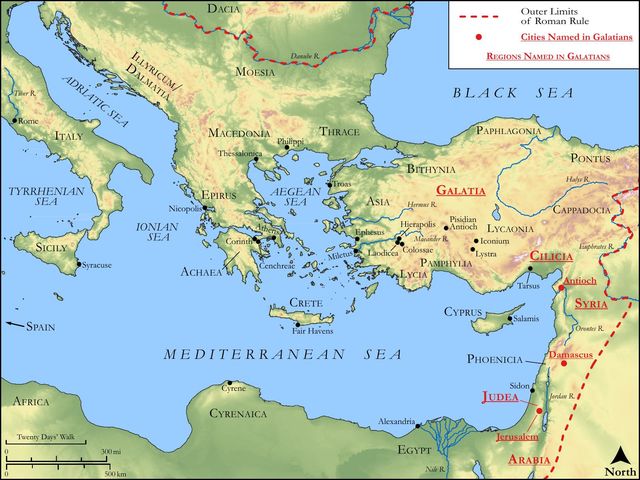
Paul wrote to the churches in Galatia (likely South Galatia, modern-day Turkey) to counter the influence of "Judaizers." These were Jewish Christians who insisted that Gentile converts must be circumcised and adhere to other aspects of the Mosaic Law (e.g., dietary laws, Sabbath observance) to be truly saved or fully righteous. This teaching directly undermined the sufficiency of Christ's work and the doctrine of justification by faith alone. The imagery of a "yoke" would have been immediately understood by a first-century audience. A yoke was a heavy wooden beam placed on the necks of oxen to harness them for labor, symbolizing burdensome servitude or oppressive obligation. For Jews, the Law itself was sometimes referred to as a "yoke," but Paul uses it here to describe the oppressive burden of attempting to achieve righteousness through legalistic adherence, a system that ultimately leads to spiritual slavery rather than freedom.
Key Themes
ShowHideThis verse encapsulates several core themes of the letter. The primary theme is Christian Liberty, which refers to the profound freedom believers experience from the condemnation of sin, the curse of the Law, and the futile attempt to earn salvation through human effort. This liberty is a gift, not an achievement, secured solely by Christ's redemptive work. Contrasting this is the theme of the Yoke of Bondage, which represents the oppressive and enslaving nature of legalism—any system that seeks to add human works or rituals as a requirement for salvation or for maintaining one's standing with God. Paul argues that to return to such a system is to deny the finished work of Christ. Finally, the command to Stand Fast emphasizes the necessity of resolute perseverance in the truth of the Gospel. It is an active call to resist any temptation to compromise the freedom gained in Christ by reverting to legalistic practices or any other form of spiritual slavery. This theme is further developed as Paul explains that this liberty is not a license for sin but an empowerment for a life of love and service, guided by the Spirit, as seen in Galatians 5:13.
Exposition and Analysis
ShowHideKey Word Analysis
ShowHideMeaning "to be stationary, i.e. (figuratively) to persevere." This is an emphatic military command, urging believers to hold their ground firmly against any opposing forces or ideologies. It implies active resistance and steadfastness in the face of pressure to abandon the truth of the Gospel.
Meaning "freedom (legitimate or licentious, chiefly moral or ceremonial)." In this context, it signifies a comprehensive release from the demands of the Mosaic Law as a means of righteousness, as well as freedom from the dominion of sin. It is the spiritual freedom conferred by Christ's work, enabling a life lived by grace.
Meaning "a coupling, i.e. (figuratively) servitude (a law or obligation)." This powerful metaphor refers to a wooden beam used to harness oxen, symbolizing burdensome labor, oppressive obligation, or servitude. Here, it represents the crushing weight of attempting to gain God's favor or salvation through adherence to the Law, a system that offers no true liberation but only spiritual slavery.
Verse Breakdown
ShowHide"Stand fast therefore in the liberty"
This is an imperative command, urging believers to maintain their position firmly and resolutely. The "therefore" links this command directly to Paul's preceding theological arguments, emphasizing that the Galatians' freedom is a logical consequence of Christ's work and the nature of the Gospel. They are to remain steadfast in the state of spiritual freedom they have already entered.
"wherewith Christ hath made us free"
This clause identifies the source and agent of their liberty. It is not a freedom earned by human effort or adherence to law, but a divine gift bestowed by Christ Himself. The Greek word for "made free" (G1659, eleutheróō') means "to liberate, i.e. (figuratively) to exempt (from moral, ceremonial or mortal liability)," highlighting the comprehensive nature of Christ's liberating work from sin's power and the Law's condemnation.
"and be not entangled again with the yoke of bondage"
This is a strong negative command, warning against a relapse into legalism. "Entangled" (G1758, enéchō') means "to hold in or upon, i.e. ensnare," painting a picture of being caught or trapped. The "yoke of bondage" (G2218, zygós' and G1397, douleía') is a vivid metaphor for the oppressive and enslaving nature of a system that demands works for righteousness, particularly the Mosaic Law when viewed as a means of salvation. To return to such a system would be to re-enter a state of spiritual slavery from which Christ has already delivered them.
Literary Devices
ShowHidePaul employs several potent Literary Devices in this concise verse. The most prominent is Metaphor, specifically in the phrase "yoke of bondage." This vivid image of a heavy wooden beam used to harness oxen powerfully conveys the burdensome and oppressive nature of legalism and attempts to earn salvation through works, contrasting sharply with the lightness and freedom offered by Christ. The use of Imperative Mood in "Stand fast" and "be not entangled" underscores the urgency and directness of Paul's command, demanding immediate and resolute action from his readers. Furthermore, the verse is built on a stark Contrast between "liberty" and "bondage," highlighting the two mutually exclusive paths available to the Galatians: freedom in Christ or slavery to the Law. This antithesis emphasizes the critical choice before them and the radical difference between grace and legalism.
Theological and Thematic Connections
ShowHideGalatians 5:1 is a theological cornerstone, asserting that salvation is entirely a work of divine grace, received through faith in Christ alone, and not by human effort or adherence to religious law. It underscores the finished work of Christ as the sole basis for our freedom from sin's dominion and the Law's condemnation. To revert to legalism is not merely a deviation in practice but a profound theological error that nullifies the grace of God and diminishes the sufficiency of Christ's sacrifice. This liberty is not a license for licentiousness but an empowerment for a life of love and Spirit-led obedience, demonstrating the transformative power of the Gospel.
Reflection and Application
ShowHideGalatians 5:1 remains profoundly relevant for believers today, serving as a timeless reminder of the precious gift of Christian liberty and the constant temptation to fall back into various forms of legalism. This verse calls us to a vigilant self-examination, ensuring that our faith rests solely on the finished work of Christ and not on our performance, rituals, or adherence to man-made rules. True freedom in Christ empowers us to live not under the burden of earning God's favor, but out of grateful response to His unmerited grace. This liberty is not a license to indulge sinful desires, but rather freedom from sin's power, enabling us to serve God and others in love, guided by the Holy Spirit. We are called to actively resist any pressures, whether from within religious communities or from cultural expectations, that seek to impose burdens or requirements beyond simple faith in Jesus Christ for salvation or spiritual standing.
Questions for Reflection
ShowHideFAQ
ShowHideWhat does "the yoke of bondage" refer to in Galatians 5:1?
ShowHideIn Galatians 5:1, "the yoke of bondage" primarily refers to the Mosaic Law when it is observed as a means of achieving righteousness or salvation. Paul argues that attempting to gain God's favor or justification through adherence to the Law's commands, such as circumcision or dietary restrictions, is a burdensome and enslaving system. It implies a return to a state of spiritual slavery, from which Christ has already liberated believers. This "yoke" is contrasted with the true freedom found in Christ, where salvation is a gift received by faith, not earned by works. It can also broadly refer to any system of human rules, traditions, or self-effort that attempts to add to or replace the sufficiency of Christ's work for salvation and sanctification, thereby binding people in a way that Christ has set them free.
How does Christian liberty, as described in Galatians 5:1, differ from a license to sin?
ShowHideChristian liberty is fundamentally different from a license to sin. Paul explicitly addresses this in Galatians 5:13 where he states, "For you were called to freedom, brothers. Only do not use your freedom as an opportunity for the flesh, but through love serve one another." True Christian liberty is freedom from the dominion of sin and from the condemnation of the Law, not freedom to indulge in sinful desires. It is a liberation that empowers believers to live righteously, motivated by love for God and neighbor, and guided by the Holy Spirit. Rather than being bound by external rules, believers are now internally transformed and led by the Spirit, producing the "fruit of the Spirit" (Galatians 5:22-23) as evidence of their freedom. This freedom allows for genuine, Spirit-empowered obedience, rather than a legalistic striving that ultimately fails to produce true righteousness.
Christ-Centered Fulfillment
ShowHideGalatians 5:1 finds its ultimate fulfillment and meaning in the person and work of Jesus Christ. He is the one who, through His perfect life, atoning death, and glorious resurrection, has decisively broken the power of sin and the curse of the Law, thereby making true liberty possible. The "liberty wherewith Christ hath made us free" is not merely an abstract concept but a direct result of His substitutionary sacrifice on the cross, where He bore the "yoke of bondage" of sin and the Law's condemnation on our behalf (2 Corinthians 5:21). By becoming a curse for us, He redeemed us from the curse of the Law (Galatians 3:13). Our freedom is therefore entirely dependent on His finished work, not on our ability to keep any law or perform any ritual. He is the ultimate liberator, freeing us not only from the penalty of sin but also from its power (Romans 6:6-7) and from the fear of death (Hebrews 2:14-15). To "stand fast" in this liberty is to continually place our faith and trust in Christ alone, recognizing Him as the sole source of our salvation and the one who has definitively delivered us from every form of spiritual slavery.