


2 Corinthians 3:13
- καὶkaiandG2532CONJConjunction
- οὐounotG3756PRT-NNegative Particle Negative
- καθάπερkathaperasG2509CONJConjunction
- ΜωϋσῆςMōusēsMosesG3475N-NSM-PNoun Nominative Singular Masculine Individual
- ἐτίθειetitheiwas puttingG5087V-IAI-3SVerb Imperfect Active Indicative 3rd Singular
- κάλυμμαkalummaa veilG2571N-ASNNoun Accusative Singular Neuter
- ἐπὶepioverG1909PREPPreposition
- τὸtotheG3588T-ASNDefinite article Accusative Singular Neuter
- πρόσωπονprosōponfaceG4383N-ASNNoun Accusative Singular Neuter
- αὐτοῦautouof himselfG846P-GSMPersonal pronoun Genitive Singular Masculine
- πρὸςprosforG4314PREPPreposition
- τὸto<the>G3588T-ASNDefinite article Accusative Singular Neuter
- μὴmēnotG3361PRT-NNegative Particle Negative
- ἀτενίσαιatenisaito look intentlyG816V-AANVerb Aorist Active Infinitive
- τοὺςtoustheG3588T-APMDefinite article Accusative Plural Masculine
- υἱοὺςhuioussonsG5207N-APMNoun Accusative Plural Masculine
- ἸσραὴλIsraēlof IsraelG2474N-GSM-LNoun Genitive Singular Masculine Location
- εἰςeisintoG1519PREPPreposition
- τὸtotheG3588T-ASNDefinite article Accusative Singular Neuter
- τέλοςtelosendG5056N-ASNNoun Accusative Singular Neuter
- τοῦtouof thatG3588T-GSNDefinite article Genitive Singular Neuter
- καταργουμένου·katargoumenoufading awayG2673V-PPP-GSNVerb Present Passive Participle Genitive Singular Neuter
English is a literal word-by-word gloss of the Greek, not the KJV's wording. Why?
This is the original text the KJV's translators worked from — each Greek word with its own literal English meaning in this verse, prepared by scholars at Tyndale House, Cambridge. The KJV translates whole sentences, not word by word, so its wording differs: one Greek word can become several English words, and the KJV may choose “charity” where the gloss reads “love”. Both are faithful — they answer different questions. For the KJV's own rendering, switch to the KJV text.
Details
See on the biblical-era map
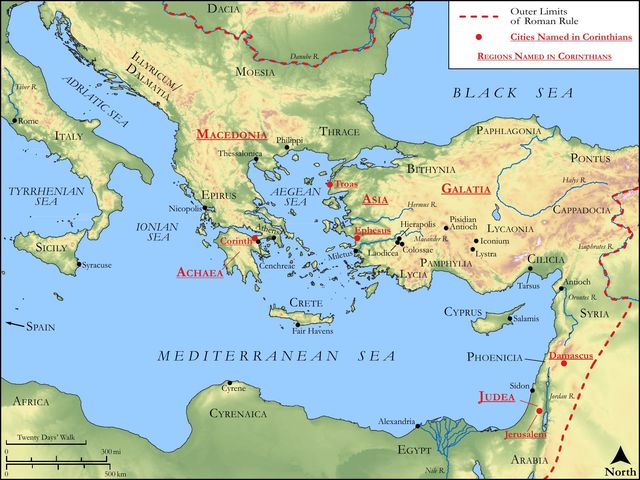

Study this verse
Public-domain commentary
Matthew Henry
From his Commentary on the Whole Bible. Henry comments on passages, not single verses — this entry covers 2 Corinthians 3:12–18. His three-level outline is real structure in the source text, so it is rendered as structure.
In these verses the apostle draws two inferences from what he had said about the Old and New Testament: -
I.Concerning the duty of the ministers of the gospel to use great plainness or clearness of speech.
They ought not, like Moses, to put a veil upon their faces, or obscure and darken those things which they should make plain. The gospel is a more clear dispensation than the law; the things of God are revealed in the New Testament, not in types and shadows, and ministers are much to blame if they do not set spiritual things, and gospel-truth and grace, in the clearest light that is possible. Though the Israelites could not look stedfastly to the end of what was commanded, but is now abolished, yet we may. We may see the meaning of those types and shadows by the accomplishment, seeing the veil is done away in, Christ and he is come, who was the end of the law for righteousness to all those who believe, and whom Moses and all the prophets pointed to, and wrote of.
II.Concerning the privilege and advantage of those who enjoy the gospel, above those who lived under the law. For,
1.Those who lived under the legal dispensation had their minds blinded (Co2 3:14), and there was a veil upon their hearts, Co2 3:15. Thus it was formerly, and so it was especially as to those who remained in Judaism after the coming of the Messiah and the publication of his gospel. Nevertheless, the apostle tells us, there is a time coming when this veil also shall be taken away, and when it (the body of that people) shall turn to the Lord, Co2 3:16. Or, when any particular person is converted to God, then the veil of ignorance is taken away; the blindness of the mind, and the hardness of the heart, are cured.
2.The condition of those who enjoy and believe the gospel is much more happy. For,
(1.)They have liberty: Where the Spirit of the Lord is, and where he worketh, as he does under the gospel-dispensation, there is liberty (Co2 3:17), freedom from the yoke of the ceremonial law, and from the servitude of corruption; liberty of access to God, and freedom of speech in prayer. The heart is set at liberty, and enlarged, to run the ways of God's commandments.
(2.)They have light; for with open face we behold the glory of the Lord, Co2 3:18. The Israelites saw the glory of God in a cloud, which was dark and dreadful; but Christians see the glory of the Lord as in a glass, more clearly and comfortably. It was the peculiar privilege of Moses for God to converse with him face to face, in a friendly manner; but now all true Christians see him more clearly with open face. He showeth them his glory.
(3.)This light and liberty are transforming; we are changed into the same image, from glory to glory (Co2 3:18), from one degree of glorious grace unto another, till grace here be consummated in glory for ever. How much therefore should Christians prize and improve these privileges! We should not rest contented without an experimental knowledge of the transforming power of the gospel, by the operation of the Spirit, bringing us into a conformity to the temper and tendency of the glorious gospel of our Lord and Saviour Jesus Christ.
Historical interpretation
Historical reception
5 surviving comments on this verse. Each one is dated, so this reads as a timeline rather than a list.
Select a marker to jump to its quote. Markers stagger vertically where authors wrote within a few decades of each other.
Now what he says is of this nature. There is no need for us to cover ourselves as Moses did; for ye are able to look upon this glory which we are encircled with, although it is far greater and brighter than the other. Seest thou the advance? For he that in the former Epistle said, "I have fed you with milk, not with meat;" saith here, "We use great boldness of speech." And he produces Moses before them, carrying forward the discourse by means of comparison, and thus leading his hearer upwards.
And for the present he sets them above the Jews, saying that 'we have no need of a veil as he had with those he governed;' but in what comes afterwards he advances them even to the dignity itself of the Lawgiver, or even to a much greater.
Doubtless, there is a veil in the Old Testament, which will be removed as soon as one comes to Christ. At his crucifixion, “the veil of the temple was torn,” to signify what the apostle said about the veil of the Old Testament, “Because in Christ it is made void.”10.
The truth is that the Old Testament of Mount Sinai, “producing children of slavery,” now serves no purpose but to bear witness to the New. Otherwise, the words of St. Paul would not be true: “Yes, down to this very day when Moses is read, the veil covers their hearts”; but when any of them turn from the Old Testament to Christ, “the veil shall be taken away.” What happens is that the deepest aspirations of those who make the change are shifted from the Old Testament to the New, whereupon they begin to look for spiritual—rather than earthly—happiness.
It is not the Old Testament that is done away with in Christ but the concealing veil, so that it may be understood through Christ. That is, as it were, laid bare, which without Christ is hidden and obscure. The same apostle adds immediately: “When you shall turn to Christ, the veil shall be taken away.” He does not say: “The law or the Old Testament will be taken away.” It is not the case, therefore, that by the grace of the Lord that which was covered has been abolished as useless; rather the covering has been removed which concealed useful truth. This is what happens to those who earnestly and piously, not proudly and wickedly, seek the sense of the Scriptures. To them is carefully demonstrated the order of events, the reasons for words and deeds and the agreement of the Old Testament with the New, so that not a point remains where there is not complete harmony; and such secret truths are conveyed in figures. When they are brought to light by interpretation, they compel those who wished to condemn rather than to learn.
Paul says that the law was fading away, by which he means that it was coming to an end in Christ, whose coming was foretold by the law.
Continue studying 2 Corinthians 3:13 across the web’s major study libraries — every link below opens this exact verse, chapter, or book on the destination site.
Read & Compare
 BibleGatewayThis verse in more than 200 translations and 70 languages.
 Bible.comThe YouVersion reader — hundreds of translations, reading plans, and highlights.
 ESV.orgCrossway's official English Standard Version reader.
 NET BibleThe NET translation with 60,000+ translators' notes on every rendering decision.
 STEP BibleTyndale House's free study tool — original text, vocabulary, and scholarly resources.
 BibliaLogos Bible Software's free web reader.
 USCCBThe New American Bible (Revised Edition) with the U.S. bishops' study notes.
Commentaries
 BibleHub CommentariesDozens of classic commentaries on this verse, gathered on one page.
 StudyLightMore than 100 commentary sets — the largest collection on the web.
 BibleRefPlain-English commentary on what this verse means, verse by verse.
 Enduring WordDavid Guzik's free commentary on this chapter, widely used by Bible teachers.
 Bible Study ToolsVerse commentary alongside Greek and Hebrew study aids.
Original Language & Research
- BibleHub InterlinearThe verse word by word — original language, transliteration, and English.
- BibleHub LexiconEvery word's original-language definition and Strong's entry.
 Blue Letter BibleDeep-study tools — Strong's numbers, concordance, and word studies.
 CNTR CollationThe earliest Greek manuscripts of this verse, collated letter by letter.
Sermons, Hymns & Audio


TrulyRandomVerse is not affiliated with these sites and doesn’t control their content. They’re linked because they’re genuinely useful.
Summary
In 2 Corinthians 3:13, the Apostle Paul contrasts the temporary glory of the Old Covenant, as symbolized by Moses' veiled face, with the enduring glory of the New Covenant in Christ. Moses veiled his face not merely to shield the Israelites from the fading brilliance, but to prevent them from perceiving the transient nature of the Law itself, which was destined to be superseded and abolished by a superior, spiritual reality. This verse highlights the spiritual blindness that characterized the Old Covenant and sets the stage for Paul's exposition on the unveiled access to God's glory available through faith in Christ.
Context
ShowHideLiterary Context
This verse is a pivotal point in Paul's extended argument in 2 Corinthians 3, where he meticulously contrasts the "ministry of death" (the Old Covenant, or Law) with the "ministry of the Spirit" (the New Covenant). Paul begins by asserting the Corinthians themselves are a "letter of Christ" written by the Spirit, not on stone tablets but on human hearts, thereby establishing the superiority of the Spirit's ministry over that of the Law (2 Corinthians 3:3). He then references the historical account in Exodus 34, where Moses' face shone with divine glory after speaking with God, a glory so intense that the Israelites could not look directly at it (2 Corinthians 3:7). Paul's central point is that if a ministry leading to condemnation had such glory, how much more glorious is the ministry of righteousness and the Spirit (2 Corinthians 3:8-9)? Verse 13 then directly explains why Moses put on the veil, revealing a deeper theological purpose beyond mere physical protection from the light.
Historical & Cultural Context
The historical backdrop is the giving of the Law at Mount Sinai, specifically the events described in Exodus 34:29-35. After receiving the second set of tablets, Moses descended from the mountain with his face radiating the residual glory of God's presence. The Israelites were afraid to approach him, so he put a veil over his face when speaking to them. Culturally, veiling could signify reverence, modesty, or concealment. In this context, Paul reinterprets the veil's purpose, moving beyond the simple historical narrative to draw a profound theological conclusion. The Law, while glorious in its inception, was inherently temporary, a preparatory stage in God's redemptive plan. The veil, therefore, became a symbol of the Law's impermanence and the spiritual inability of the Israelites to grasp its transient nature or look beyond it to the ultimate reality it foreshadowed.
Key Themes
ShowHideThe central theme in this passage, and particularly in 2 Corinthians 3, is the contrast between the Old and New Covenants. Paul emphasizes the fading glory of the Old Covenant, symbolized by Moses' radiant but diminishing countenance, in stark opposition to the ever-increasing and permanent glory of the New Covenant in Christ. This leads to the theme of spiritual blindness versus spiritual clarity. Under the Old Covenant, the veil on Moses' face paralleled a spiritual veil over the hearts and minds of the Israelites, preventing them from understanding the temporary nature of the Law and seeing its ultimate fulfillment in Christ (2 Corinthians 3:14-15). The verse also touches upon the abolition of the Old Covenant's function as the primary means of relating to God, not its destruction, but its supersession by the superior New Covenant, which brings freedom and direct access to God through the Spirit (2 Corinthians 3:17-18).
Exposition and Analysis
ShowHideKey Word Analysis
ShowHideMeaning "a cover, i.e. veil." In this context, it refers to the physical covering Moses placed over his face. Paul uses this physical object as a potent symbol of spiritual concealment, representing the inability of the Israelites to perceive the true nature and temporary purpose of the Old Covenant. The veil was not just for protection from the glory, but a barrier to understanding its transient nature.
Meaning "to gaze intently," "to fix one's eyes upon." This word emphasizes the inability of the children of Israel to "steadfastly look" at Moses' face. It implies a sustained, focused gaze. Their inability was not just due to the brightness but, as Paul argues, because the glory was fading, hinting at the impermanence of the covenant it represented, a truth they could not bear to perceive or understand.
Meaning "to be (render) entirely idle (useless), literally or figuratively:--abolish, cease, cumber, deliver, destroy, do away, become (make) of no (none, without) effect, fail, loose, bring (come) to nought, put away (down), vanish away, make void." This is a crucial term. It signifies that the Old Covenant, specifically its function as the primary means of righteousness and access to God, was rendered inoperative or brought to an end, not annihilated. Its purpose was fulfilled and superseded by the New Covenant in Christ, much like a temporary scaffolding is removed once a building is complete.
Verse Breakdown
ShowHide"And not as Moses, [which] put a vail over his face"
Paul draws a direct comparison and contrast with Moses. Unlike Moses, who veiled his face, Paul and the ministers of the New Covenant preach with unveiled faces. The historical act of Moses veiling his face (as recorded in Exodus 34:33) is reinterpreted by Paul to serve a deeper theological purpose.
"that the children of Israel could not stedfastly look"
This clause explains the purpose of the veil from Paul's perspective. It was not merely to protect their eyes from the dazzling glory, but to prevent them from a sustained, penetrating gaze. The implication is that such a gaze would have revealed a truth they were not ready to accept or comprehend.
"to the end of that which is abolished"
This is the core theological revelation. The "end" (Greek: télos) here refers not just to the cessation but to the purpose or goal of the Law. The veil prevented the Israelites from seeing that the glory of the Old Covenant was temporary and that the covenant itself was destined to be "abolished" or rendered inoperative. This "abolition" refers to the Law's function as the primary means of righteousness and access to God, which was fulfilled and superseded by Christ. Had they seen its "end," they might have understood its provisional nature and looked forward to the coming Messiah.
Literary Devices
ShowHidePaul masterfully employs several literary devices in this verse. Symbolism is paramount, with the "vail" serving as a multifaceted symbol. Historically, it was a physical covering; theologically, it represents the spiritual blindness of Israel to the temporary nature of the Old Covenant and its ultimate fulfillment in Christ. The veil also symbolizes the obscured glory of the Law, which, though glorious, was fading. There is a strong element of Contrast throughout 2 Corinthians 3, and this verse specifically contrasts Moses' veiled face with the unveiled faces of New Covenant believers (2 Corinthians 3:18). This contrast highlights the difference between the Law's temporary, external glory and the Spirit's enduring, internal transformation. Furthermore, Paul uses Metaphor when describing the "end of that which is abolished." The Law is metaphorically treated as something with a lifespan or a purpose that concludes, emphasizing its provisional nature in God's redemptive plan.
Theological and Thematic Connections
ShowHideThe theological significance of 2 Corinthians 3:13 is profound, underscoring the fundamental shift from the Old Covenant to the New. The veil on Moses' face serves as a powerful metaphor for the spiritual blindness that prevented Israel from grasping the transient nature of the Law and its ultimate purpose to lead to Christ. This blindness was not merely an intellectual failure but a spiritual inability to perceive God's unfolding redemptive plan. The Law, while glorious and divinely given, was never intended to be the final word; it was a temporary administration that pointed forward to a greater reality. Its glory, though real, was always a fading glory, designed to be superseded by the infinitely more glorious and permanent New Covenant, which offers direct, unveiled access to God through the Spirit. This transition highlights God's progressive revelation, moving from shadows and types to the full reality found in Jesus Christ.
Reflection and Application
ShowHide2 Corinthians 3:13 calls believers to a profound appreciation for the New Covenant and the freedom it offers. Unlike the Israelites, who lived under a veiled understanding of God's purposes, we are privileged to live with unveiled faces, beholding the glory of the Lord. This means we have direct access to God, not through rituals or a temporary system, but through a living relationship with Jesus Christ, empowered by the Holy Spirit. This verse encourages us to shed any lingering tendencies to rely on external laws or human efforts for righteousness, recognizing that Christ has fulfilled and superseded the Old Covenant. Our focus should be on growing in an intimate, transformative relationship with God, allowing the Spirit to progressively transform us into the image of Christ, from one degree of glory to another. It reminds us that true spiritual insight comes not from clinging to the past, but from embracing the full revelation of God's grace in the present.
Questions for Reflection
ShowHideFAQ
ShowHideWhat does Paul mean by "the end of that which is abolished" in relation to Moses' veil?
ShowHidePaul's interpretation of Moses' veil goes beyond the simple historical fact of protecting the Israelites from the fading glory. He argues that Moses veiled his face so that the children of Israel could not "stedfastly look to the end of that which is abolished." The "end" (Greek: télos) here signifies not just a termination, but the purpose or goal of the Old Covenant. The "abolished" (Greek: katargéō) refers to the Old Covenant's function as the primary means of righteousness and access to God being rendered inoperative or brought to an end, not destroyed. Paul is saying that the veil prevented the Israelites from understanding that the Law itself was temporary and provisional, designed to lead to Christ. If they had seen its "end" – its purpose and its eventual supersession – they might have looked beyond it to the coming Messiah. This spiritual blindness, symbolized by the veil, continued until Christ came (2 Corinthians 3:14).
Christ-Centered Fulfillment
ShowHide2 Corinthians 3:13 finds its ultimate fulfillment in Jesus Christ, who is the very "end" and purpose of the Law. The veil that obscured the fading glory of the Old Covenant and prevented Israel from seeing its temporary nature is definitively removed in Christ. As Paul declares, "Nevertheless when it shall turn to the Lord, the vail shall be taken away" (2 Corinthians 3:16). Christ is the reality to which the Law pointed, the perfect sacrifice that fulfills its demands, and the one who inaugurates the New Covenant of grace and Spirit. Through His death and resurrection, Jesus has abolished the Old Covenant's function as a system of condemnation and brought in a ministry of righteousness that leads to life (Romans 8:3-4). Now, believers, with unveiled faces, can behold the glory of the Lord and are transformed into His image by the Spirit (2 Corinthians 3:18). Christ is the one who brings true freedom from the letter of the law, empowering us to live in the Spirit, where "the Lord is that Spirit: and where the Spirit of the Lord is, there is liberty" (2 Corinthians 3:17). He is the true light that dispels all shadows and veils, granting us full, unhindered access to the Father (John 1:9).