


2 Corinthians 3:12
- ἜχοντεςEchontesHavingG2192V-PAP-NPMVerb Present Active Participle Nominative Plural Masculine
- οὖνounthereforeG3767CONJConjunction
- τοιαύτηνtoiautēnsuchG5108D-ASFDemonstrative pronoun Accusative Singular Feminine
- ἐλπίδαelpidahopeG1680N-ASFNoun Accusative Singular Feminine
- πολλῇpollēagreatG4183A-DSFAdjective Dative Singular Feminine
- παρρησίᾳparrēsiaboldnessG3954N-DSFNoun Dative Singular Feminine
- χρώμεθαchrōmethawe useG5530V-PNI-1PVerb Present Middle Or Passive Deponent Indicative 1st Plural
English is a literal word-by-word gloss of the Greek, not the KJV's wording. Why?
This is the original text the KJV's translators worked from — each Greek word with its own literal English meaning in this verse, prepared by scholars at Tyndale House, Cambridge. The KJV translates whole sentences, not word by word, so its wording differs: one Greek word can become several English words, and the KJV may choose “charity” where the gloss reads “love”. Both are faithful — they answer different questions. For the KJV's own rendering, switch to the KJV text.
Details
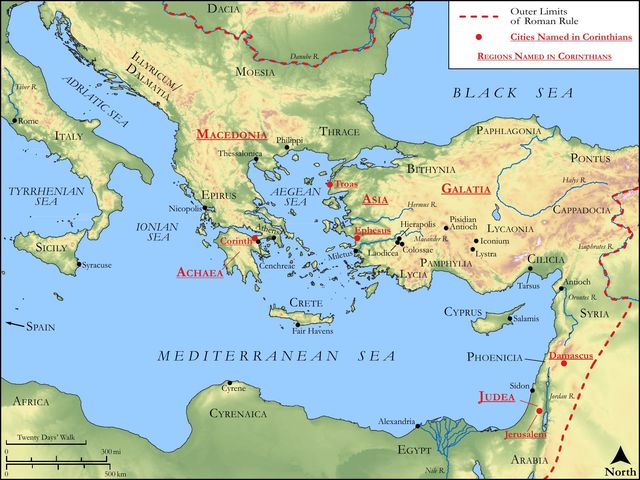
See on the biblical-era map

Study this verse
Public-domain commentary
Matthew Henry
From his Commentary on the Whole Bible. Henry comments on passages, not single verses — this entry covers 2 Corinthians 3:12–18. His three-level outline is real structure in the source text, so it is rendered as structure.
In these verses the apostle draws two inferences from what he had said about the Old and New Testament: -
I.Concerning the duty of the ministers of the gospel to use great plainness or clearness of speech.
They ought not, like Moses, to put a veil upon their faces, or obscure and darken those things which they should make plain. The gospel is a more clear dispensation than the law; the things of God are revealed in the New Testament, not in types and shadows, and ministers are much to blame if they do not set spiritual things, and gospel-truth and grace, in the clearest light that is possible. Though the Israelites could not look stedfastly to the end of what was commanded, but is now abolished, yet we may. We may see the meaning of those types and shadows by the accomplishment, seeing the veil is done away in, Christ and he is come, who was the end of the law for righteousness to all those who believe, and whom Moses and all the prophets pointed to, and wrote of.
II.Concerning the privilege and advantage of those who enjoy the gospel, above those who lived under the law. For,
1.Those who lived under the legal dispensation had their minds blinded (Co2 3:14), and there was a veil upon their hearts, Co2 3:15. Thus it was formerly, and so it was especially as to those who remained in Judaism after the coming of the Messiah and the publication of his gospel. Nevertheless, the apostle tells us, there is a time coming when this veil also shall be taken away, and when it (the body of that people) shall turn to the Lord, Co2 3:16. Or, when any particular person is converted to God, then the veil of ignorance is taken away; the blindness of the mind, and the hardness of the heart, are cured.
2.The condition of those who enjoy and believe the gospel is much more happy. For,
(1.)They have liberty: Where the Spirit of the Lord is, and where he worketh, as he does under the gospel-dispensation, there is liberty (Co2 3:17), freedom from the yoke of the ceremonial law, and from the servitude of corruption; liberty of access to God, and freedom of speech in prayer. The heart is set at liberty, and enlarged, to run the ways of God's commandments.
(2.)They have light; for with open face we behold the glory of the Lord, Co2 3:18. The Israelites saw the glory of God in a cloud, which was dark and dreadful; but Christians see the glory of the Lord as in a glass, more clearly and comfortably. It was the peculiar privilege of Moses for God to converse with him face to face, in a friendly manner; but now all true Christians see him more clearly with open face. He showeth them his glory.
(3.)This light and liberty are transforming; we are changed into the same image, from glory to glory (Co2 3:18), from one degree of glorious grace unto another, till grace here be consummated in glory for ever. How much therefore should Christians prize and improve these privileges! We should not rest contented without an experimental knowledge of the transforming power of the gospel, by the operation of the Spirit, bringing us into a conformity to the temper and tendency of the glorious gospel of our Lord and Saviour Jesus Christ.
Historical interpretation
Historical reception
3 surviving comments on this verse. Each one is dated, so this reads as a timeline rather than a list.
Select a marker to jump to its quote. Markers stagger vertically where authors wrote within a few decades of each other.
Paul is saying that we have a hope of seeing glory, not the kind that was on the face of Moses but the kind which the three apostles saw on the mountain when the Lord revealed himself. Therefore we ought to repay the love of God as far as we can by being more fervent in our love for him, who by cleansing us from our sins has given us this confidence. Now our confidence ought to increase, because what we eventually see will be in proportion to what we now believe.
For since when he had heard so many and so great things concerning the New [Covenant,] the hearer would be desirous of seeing this glory manifested to the eye, mark whither he hurleth him, [even] to the world to come. Wherefore also he brought forward the "hope," saying, "Having therefore such a hope." Such? Of what nature? That we have been counted worthy of greater things than Moses; not we the Apostles only, but also all the faithful. "We use great boldness of speech." Towards whom? tell me. Towards God, or towards the disciples? Towards you who are receiving instruction, he saith; that is, we speak every where with freedom, hiding nothing, withholding nothing, mistrusting nothing, but speaking openly; and we have not feared lest we should wound your eyesight, as Moses did that of the Jews.
What hope do we have? The hope that the grace of the Spirit will not be abolished like the law but that it will remain, even after the resurrection.
Continue studying 2 Corinthians 3:12 across the web’s major study libraries — every link below opens this exact verse, chapter, or book on the destination site.
Read & Compare
 BibleGatewayThis verse in more than 200 translations and 70 languages.
 Bible.comThe YouVersion reader — hundreds of translations, reading plans, and highlights.
 ESV.orgCrossway's official English Standard Version reader.
 NET BibleThe NET translation with 60,000+ translators' notes on every rendering decision.
 STEP BibleTyndale House's free study tool — original text, vocabulary, and scholarly resources.
 BibliaLogos Bible Software's free web reader.
 USCCBThe New American Bible (Revised Edition) with the U.S. bishops' study notes.
Commentaries
 BibleHub CommentariesDozens of classic commentaries on this verse, gathered on one page.
 StudyLightMore than 100 commentary sets — the largest collection on the web.
 BibleRefPlain-English commentary on what this verse means, verse by verse.
 Enduring WordDavid Guzik's free commentary on this chapter, widely used by Bible teachers.
 Bible Study ToolsVerse commentary alongside Greek and Hebrew study aids.
Original Language & Research
- BibleHub InterlinearThe verse word by word — original language, transliteration, and English.
- BibleHub LexiconEvery word's original-language definition and Strong's entry.
 Blue Letter BibleDeep-study tools — Strong's numbers, concordance, and word studies.
 CNTR CollationThe earliest Greek manuscripts of this verse, collated letter by letter.
Sermons, Hymns & Audio


TrulyRandomVerse is not affiliated with these sites and doesn’t control their content. They’re linked because they’re genuinely useful.
Summary
Second Corinthians 3:12 encapsulates the Apostle Paul's profound confidence in the New Covenant, contrasting its unveiled glory with the fading splendor of the Old Covenant. Because believers possess such a secure and transformative hope in Christ, they are empowered to communicate the Gospel with remarkable clarity, openness, and boldness, reflecting the unhindered access and revelation found in the Spirit.
Context
ShowHideLiterary Context
This verse is a pivotal statement within Paul's extended theological argument in 2 Corinthians 3. Paul has been contrasting the Old Covenant, characterized by the Law and its ministry of death, with the New Covenant, which is a ministry of the Spirit and brings life and righteousness. He specifically references Moses' veil, which covered his face to hide the fading glory of the Law (2 Corinthians 3:7-11). The "such hope" in verse 12 directly arises from the superiority and permanence of the New Covenant's glory, which is unveiled and transformative, leading to a freedom that was not fully available under the Law. This verse sets the stage for Paul's further explanation of how the veil is removed in Christ and how believers are transformed by beholding the Lord's glory with unveiled faces (2 Corinthians 3:13-18).
Historical & Cultural Context
Paul's letter to the Corinthians addresses a community grappling with various issues, including challenges to his apostolic authority and the influence of false teachers who might have promoted a legalistic understanding of faith. The cultural backdrop includes a Jewish tradition deeply revering the Law given through Moses. Paul's use of Moses' veil is a powerful rhetorical device, drawing on a well-known Old Testament narrative (Exodus 34:29-35) to illustrate a profound theological truth about the nature of the covenants. The concept of "plainness of speech" (parrhesia) was also significant in Greco-Roman rhetoric, denoting a courageous, open, and unreserved manner of speaking, often associated with philosophical discourse or political freedom. Paul appropriates this concept to describe the spiritual freedom and confidence of New Covenant ministers.
Key Themes
ShowHideThe central themes interwoven in this verse include the Superiority of the New Covenant over the Old, particularly in its enduring glory and life-giving power, as opposed to the Law's temporary and condemning nature (2 Corinthians 3:6-9). This superiority undergirds the Boldness and Clarity in Proclamation, as the unveiled nature of the New Covenant empowers ministers to speak openly and without fear, unlike the veiled communication of the Old Covenant. Furthermore, the verse highlights the Confident Hope in Christ that believers possess, a hope that is not a mere wish but a firm expectation rooted in Christ's finished work and the Spirit's indwelling, leading to transformation and direct access to God's presence (2 Corinthians 3:18).
Exposition and Analysis
ShowHideKey Word Analysis
ShowHideMeaning expectation (abstractly or concretely) or confidence. In this context, it refers to the confident assurance and eager expectation that believers have in the New Covenant, particularly concerning the full realization of God's promises in Christ, including eternal life, righteousness, and the ultimate transformation into His image. This hope is not a mere wish but a certainty based on God's faithfulness and the indwelling Spirit.
A primary verb meaning to furnish what is needed, or by implication, to employ or act towards one in a given manner. Here, it indicates the active employment or exercise of "great plainness of speech" as a direct consequence of possessing "such hope." It signifies a deliberate and characteristic manner of communication adopted by Paul and other ministers of the New Covenant.
Meaning all out-spokenness, i.e., frankness, bluntness, publicity; by implication, assurance. This crucial term denotes boldness, freedom of speech, openness, and a lack of reservation or fear in communication. It implies transparency and directness, contrasting sharply with the veiled or obscure nature of the Old Covenant's glory. The addition of "great" (G4183, polýs) emphasizes the abundant and unrestrained nature of this boldness.
Verse Breakdown
ShowHide"Seeing then that we have such hope,"
This opening clause establishes the foundational premise for Paul's subsequent statement. The conjunction "Seeing then" (oûn) indicates a logical conclusion drawn from the preceding discussion in 2 Corinthians 3:7-11, where Paul contrasts the fading glory of the Old Covenant with the surpassing and enduring glory of the New. The "hope" (elpís) is not a vague wish but a confident, certain expectation rooted in the superior reality of the New Covenant—its ministry of the Spirit, righteousness, and life, all centered in Christ. This hope provides the spiritual grounding for the manner of their ministry.
"we use great plainness of speech:"
This clause describes the direct consequence of possessing "such hope." Because the New Covenant is characterized by unveiled glory and brings freedom, Paul and his fellow ministers proclaim its truths with "great plainness of speech" (polýs parrhēsía). This signifies an unreserved, open, bold, and transparent communication of the Gospel, free from the obscurity or fear that might have characterized the Old Covenant's ministry. It implies a direct, unambiguous presentation of truth, reflecting the clarity and accessibility of God's revelation in Christ.
Literary Devices
ShowHidePaul employs several literary devices in this verse and the surrounding context. Contrast is a dominant feature, as he consistently juxtaposes the Old Covenant (ministry of death, veiled, fading glory) with the New Covenant (ministry of the Spirit, unveiled, surpassing and enduring glory). This contrast highlights the superiority and transformative power of the New Covenant. The Metaphor of the veil is central to the entire chapter, symbolizing the spiritual blindness and limited understanding under the Old Covenant, which is removed only in Christ. The phrase "great plainness of speech" itself uses a form of Emphasis or Hyperbole (through the adjective "great") to underscore the profound and unhindered nature of their communication, reflecting the abundant grace and clarity of the New Covenant.
Theological and Thematic Connections
ShowHideThe "hope" Paul speaks of is not a vague optimism but a theological certainty rooted in the finished work of Christ and the indwelling Holy Spirit. This confident expectation of future glory and present transformation empowers ministers of the New Covenant to proclaim the Gospel with unparalleled boldness and transparency. Unlike the veiled and temporary glory of the Law, the New Covenant reveals God's glory in Christ directly, enabling an open and unhindered proclamation of truth. This plainness of speech reflects the very nature of the New Covenant: it is clear, accessible, and brings freedom, inviting all to behold the Lord with unveiled faces and be transformed.
Reflection and Application
ShowHideFor believers today, 2 Corinthians 3:12 serves as a profound call to confidence and clarity in our witness. If we truly grasp the magnificent hope we possess in Christ—a hope grounded in the Spirit's life-giving power and the unveiled glory of the New Covenant—then our communication of the Gospel should be marked by an authentic and unreserved boldness. This means shedding any timidity or fear that might obscure the clear message of salvation. Our lives, too, should reflect the transparency and freedom that come from beholding Christ with unveiled faces, demonstrating the transformative power of the Spirit. We are called to present the good news without unnecessary complexity or jargon, allowing its inherent power to resonate with clarity, inviting others into the same glorious hope and freedom we enjoy.
Questions for Reflection
ShowHideFAQ
ShowHideWhat is the "hope" that Paul refers to in 2 Corinthians 3:12?
ShowHideThe "hope" (Greek: elpís) Paul refers to is not a mere wishful thinking but a confident, certain expectation rooted in the New Covenant. It is the assurance of future glory, righteousness, and eternal life that believers have through Christ's finished work and the indwelling Holy Spirit. This hope is superior to anything offered by the Old Covenant, which was temporary and veiled. It encompasses the full realization of God's promises and the ultimate transformation into the likeness of Christ, as described later in 2 Corinthians 3:18.
What does "great plainness of speech" mean in this context?
ShowHide"Great plainness of speech" (Greek: polýs parrhēsía) signifies an abundant, unreserved, and bold manner of communication. It means speaking with frankness, openness, and confidence, without fear, ambiguity, or hidden meanings. In contrast to the veiled glory of Moses under the Old Covenant, Paul and other ministers of the New Covenant proclaim the Gospel with transparency and directness because the truth of Christ is unveiled and brings freedom. This boldness is a direct result of the superior and enduring hope found in the New Covenant, which is a ministry of the Spirit and righteousness, leading to life (2 Corinthians 3:6-9).
Christ-Centered Fulfillment
ShowHideThe "hope" and "great plainness of speech" in 2 Corinthians 3:12 find their ultimate fulfillment and enablement in Jesus Christ. He is the very embodiment of the unveiled glory of God, the one through whom the veil of the Old Covenant is removed (2 Corinthians 3:14). Christ's life, death, and resurrection inaugurated the New Covenant, a covenant of the Spirit that brings life and righteousness, surpassing the Law's ministry of condemnation (2 Corinthians 3:6-9). Because Christ has made direct access to God possible through His sacrifice, believers now have the confidence to approach God's throne with boldness (Hebrews 4:16). The "plainness of speech" is thus a direct reflection of the clarity and finality of God's revelation in Christ, who is the "image of the invisible God" (Colossians 1:15). The Spirit, given by Christ, empowers this boldness, transforming believers as they behold the Lord's glory with unveiled faces, from one degree of glory to another (2 Corinthians 3:18). Thus, our hope is in Christ, and our ability to speak plainly about Him is a testament to His completed work and ongoing presence through the Spirit.