


2 Corinthians 3:14
Bible text: King James Version (1769 Blayney text) · Public domain
Bible text: King James Version with Strong's numbers · Public domain
Bible text: Berean Standard Bible · Public domain
Bible text: American Standard Version (1901) · Public domain
Bible text: World English Bible, Messianic edition · Public domain
Bible text: Geneva Bible (1599) · Public domain
Bible text: Young's Literal Translation · Public domain
- ἀλλ᾽all᾽ButG235CONJConjunction
- ἐπωρώθηepōrōthēwere hardenedG4456V-API-3SVerb Aorist Passive Indicative 3rd Singular
- τὰtatheG3588T-NPNDefinite article Nominative Plural Neuter
- νοήματαnoēmatamindsG3540N-NPNNoun Nominative Plural Neuter
- αὐτῶνautōnof themG846P-GPMPersonal pronoun Genitive Plural Masculine
- ἄχριachriUntilG891PREPPreposition
- γὰρgarforG1063CONJConjunction
- τῆςtēstheG3588T-GSFDefinite article Genitive Singular Feminine
- σήμερονsēmeronpresentG4594ADVAdverb
- τὸtotheG3588T-NSNDefinite article Nominative Singular Neuter
- αὐτὸautosameG846P-NSNPersonal pronoun Nominative Singular Neuter
- κάλυμμαkalummaveilG2571N-NSNNoun Nominative Singular Neuter
- ἐπὶepiatG1909PREPPreposition
- τῇtēatheG3588T-DSFDefinite article Dative Singular Feminine
- ἀναγνώσειanagnōseireadingG320N-DSFNoun Dative Singular Feminine
- τῆςtēsof theG3588T-GSFDefinite article Genitive Singular Feminine
- παλαιᾶςpalaiasoldG3820A-GSFAdjective Genitive Singular Feminine
- διαθήκηςdiathēkēscovenantG1242N-GSFNoun Genitive Singular Feminine
- μένειmeneiremainsG3306V-PAI-3SVerb Present Active Indicative 3rd Singular
- μὴmēnotG3361PRT-NNegative Particle Negative
- ἀνακαλυπτόμενονanakaluptomenonbeing liftedG343V-PPP-NSNVerb Present Passive Participle Nominative Singular Neuter
- ὅτιhotiforG3754CONJConjunction
- ἐνeninG1722PREPPreposition
- ΧριστῷChristōChristG5547N-DSM-TNoun Dative Singular Masculine Title
- καταργεῖταιkatargeitaiis being removedG2673V-PPI-3SVerb Present Passive Indicative 3rd Singular
English is a literal word-by-word gloss of the Greek, not the KJV's wording. Why?
This is the original text the KJV's translators worked from — each Greek word with its own literal English meaning in this verse, prepared by scholars at Tyndale House, Cambridge. The KJV translates whole sentences, not word by word, so its wording differs: one Greek word can become several English words, and the KJV may choose “charity” where the gloss reads “love”. Both are faithful — they answer different questions. For the KJV's own rendering, switch to the KJV text.
Details
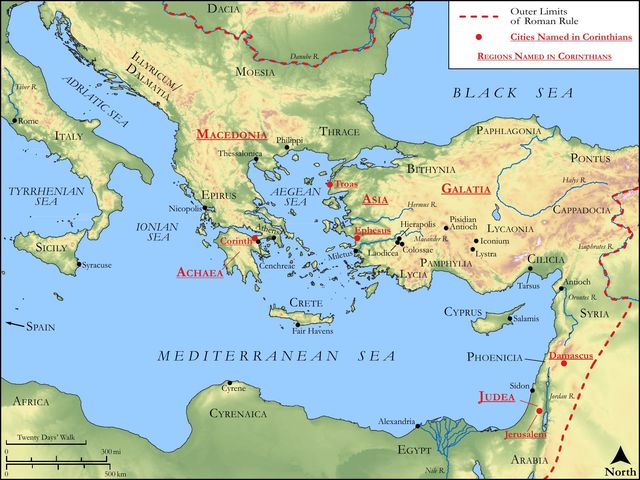
See on the biblical-era maps

Study this verse
Public-domain commentary
Matthew Henry
From his Commentary on the Whole Bible. Henry comments on passages, not single verses — this entry covers 2 Corinthians 3:12–18. His three-level outline is real structure in the source text, so it is rendered as structure.
In these verses the apostle draws two inferences from what he had said about the Old and New Testament: -
I.Concerning the duty of the ministers of the gospel to use great plainness or clearness of speech.
They ought not, like Moses, to put a veil upon their faces, or obscure and darken those things which they should make plain. The gospel is a more clear dispensation than the law; the things of God are revealed in the New Testament, not in types and shadows, and ministers are much to blame if they do not set spiritual things, and gospel-truth and grace, in the clearest light that is possible. Though the Israelites could not look stedfastly to the end of what was commanded, but is now abolished, yet we may. We may see the meaning of those types and shadows by the accomplishment, seeing the veil is done away in, Christ and he is come, who was the end of the law for righteousness to all those who believe, and whom Moses and all the prophets pointed to, and wrote of.
II.Concerning the privilege and advantage of those who enjoy the gospel, above those who lived under the law. For,
1.Those who lived under the legal dispensation had their minds blinded (Co2 3:14), and there was a veil upon their hearts, Co2 3:15. Thus it was formerly, and so it was especially as to those who remained in Judaism after the coming of the Messiah and the publication of his gospel. Nevertheless, the apostle tells us, there is a time coming when this veil also shall be taken away, and when it (the body of that people) shall turn to the Lord, Co2 3:16. Or, when any particular person is converted to God, then the veil of ignorance is taken away; the blindness of the mind, and the hardness of the heart, are cured.
2.The condition of those who enjoy and believe the gospel is much more happy. For,
(1.)They have liberty: Where the Spirit of the Lord is, and where he worketh, as he does under the gospel-dispensation, there is liberty (Co2 3:17), freedom from the yoke of the ceremonial law, and from the servitude of corruption; liberty of access to God, and freedom of speech in prayer. The heart is set at liberty, and enlarged, to run the ways of God's commandments.
(2.)They have light; for with open face we behold the glory of the Lord, Co2 3:18. The Israelites saw the glory of God in a cloud, which was dark and dreadful; but Christians see the glory of the Lord as in a glass, more clearly and comfortably. It was the peculiar privilege of Moses for God to converse with him face to face, in a friendly manner; but now all true Christians see him more clearly with open face. He showeth them his glory.
(3.)This light and liberty are transforming; we are changed into the same image, from glory to glory (Co2 3:18), from one degree of glorious grace unto another, till grace here be consummated in glory for ever. How much therefore should Christians prize and improve these privileges! We should not rest contented without an experimental knowledge of the transforming power of the gospel, by the operation of the Spirit, bringing us into a conformity to the temper and tendency of the glorious gospel of our Lord and Saviour Jesus Christ.
Historical interpretation
Two Centuries of Reception
7 surviving comments on this verse. Each one is dated, so this reads as a timeline rather than a list.
Select a marker to jump to its quote. Markers stagger vertically where authors wrote within a few decades of each other.
So far the apostle respecting knowledge; and in the second Epistle to the Corinthians he calls the common "teaching of faith "the savour of knowledge. "For unto this day the same veil remains on many in the reading of the Old Testament"
For only there is superiority possible where was previously the thing over which superiority can be affirmed. But then he says, "But their minds were blinded" -of the world; certainly not the Creator's mind, but the minds of the people which are in the world.
Also in the second Epistle to the Corinthians: "Their minds are blinded even unto this day, by this same veil which is taken away in Christ, while this same veil remains in the reading of the Old Testament, which is not unveiled, because it is made void in Christ; and even to this day, if at any time Moses is read, the veil is upon their heart. But by and by, when they shall be turned unto the Lord, the veil shall be taken away."
Their minds were hardened through unbelief, and this will not change until they convert and believe in Christ.
“Until this day” means not just until the time of Paul but until our time also, and indeed, till the end of the world.
See what he establisheth by this. For what happened then once in the case of Moses, the same happeneth continually in the case of the Law. What is said, therefore, is no accusation of the Law, as neither is it of Moses that he then veiled himself, but only the senseless Jews. For the law hath its proper glory, but they were unable to see it. 'Why therefore are ye perplexed,' he saith, 'if they are unable to see this glory of the Grace, since they saw not that lesser one of Moses, nor were able to look steadfastly upon his countenance? And why are ye troubled that the Jews believe not Christ, seeing at least that they believe not even the Law? For they were therefore ignorant of the Grace also, because they knew not even the Old Covenant nor the glory which was in it. For the glory of the Law is to turn [men] unto Christ.'
Seest thou how from this consideration also he takes down the inflation of the Jews? By that in which they thought they had the advantage, namely, that Moses' face shone, he proves their grossness and groveling nature. Let them not therefore pride themselves on that, for what was that to Jews who enjoyed it not? Wherefore also he keeps on dwelling upon it, saying one while, "The same veil in the reading of the old covenant remaineth," it "not being revealed that it is done away in Christ:" another while, that "unto this day when Moses is read," the same "veil lieth upon their heart;" showing that the veil lieth both on the reading and on their heart.
So that it is we who know the law also; but to them not only Grace, but this as well is covered with a shadow; "For until this day the same veil upon the reading of the old covenant remaineth," he saith, it "not being revealed that it is done away in Christ." Now what he saith is this. This very thing they cannot see, that it is brought to an end, because they believe not Christ. For if it be brought to an end by Christ, as in truth it is brought to an end, and this the Law said by anticipation, how will they who receive not Christ that hath done away the Law, be able to see that the Law is done away? And being incapable of seeing this, it is very plain that even of the Law itself which asserted these things, they know not the power nor the full glory.
'And where,' saith one, 'did it say this that it is done away in Christ?' It did not say it merely, but also showed it by what was done. And first indeed by shutting up its sacrifices and its whole ritual in one place, the Temple, and afterwards destroying this. For had He not meant to bring these to an end and the whole of the Law concerning them, He would have done one or other of two things; either not destroyed the Temple, or having destroyed it, not forbidden to sacrifice elsewhere. But, as it is, the whole world and even Jerusalem itself He hath made forbidden ground for such religious rites; having allowed and appointed for them only the Temple. Then having destroyed this itself afterwards He showed completely even by what was done that the things of the Law are brought to an end by Christ; for the Temple also Christ destroyed.
Continue studying 2 Corinthians 3:14 across the web’s major study libraries — every link below opens this exact verse, chapter, or book on the destination site.
Read & Compare
 BibleGatewayThis verse in more than 200 translations and 70 languages.
 Bible.comThe YouVersion reader — hundreds of translations, reading plans, and highlights.
 ESV.orgCrossway's official English Standard Version reader.
 NET BibleThe NET translation with 60,000+ translators' notes on every rendering decision.
 STEP BibleTyndale House's free study tool — original text, vocabulary, and scholarly resources.
 BibliaLogos Bible Software's free web reader.
 USCCBThe New American Bible (Revised Edition) with the U.S. bishops' study notes.
Commentaries
 BibleHub CommentariesDozens of classic commentaries on this verse, gathered on one page.
 StudyLightMore than 100 commentary sets — the largest collection on the web.
 BibleRefPlain-English commentary on what this verse means, verse by verse.
 Enduring WordDavid Guzik's free commentary on this chapter, widely used by Bible teachers.
 Bible Study ToolsVerse commentary alongside Greek and Hebrew study aids.
Original Language & Research
- BibleHub InterlinearThe verse word by word — original language, transliteration, and English.
- BibleHub LexiconEvery word's original-language definition and Strong's entry.
 Blue Letter BibleDeep-study tools — Strong's numbers, concordance, and word studies.
 CNTR CollationThe earliest Greek manuscripts of this verse, collated letter by letter.
Sermons, Hymns & Audio


TrulyRandomVerse is not affiliated with these sites and doesn’t control their content. They’re linked because they’re genuinely useful.
Summary
Second Corinthians 3:14 profoundly articulates the spiritual impediment that prevents many from grasping the true significance and ultimate purpose of the Old Testament apart from its fulfillment in Jesus Christ. Paul reveals a persistent spiritual blindness among those who cling to the old covenant without recognizing its provisional nature and its teleological trajectory toward Christ, thereby obscuring the glorious revelation of God's redemptive plan.
Context
ShowHideLiterary Context
This verse is a pivotal statement within Paul's extended argument in 2 Corinthians 3 concerning the superiority of the New Covenant of the Spirit over the Old Covenant of the Law. Paul begins by contrasting letters of recommendation with the Corinthians themselves as living letters of Christ (2 Corinthians 3:1-3). He then transitions to a profound comparison between the ministry of Moses, associated with the Law and death, and the ministry of the Spirit, which brings life and righteousness (2 Corinthians 3:6-9). The immediate preceding verses (2 Corinthians 3:7-13) describe Moses' shining face after encountering God on Mount Sinai and his subsequent veiling of his face to hide the fading glory of the Old Covenant. Paul's critical move in verse 14 is to shift the metaphor: the veil is no longer on Moses' face but on the minds of those who read the Old Testament, preventing them from perceiving its true, Christ-centered purpose. This sets the stage for the promise that the veil is removed when one turns to the Lord (2 Corinthians 3:16).
Historical & Cultural Context
Paul is addressing a predominantly Gentile church in Corinth, but his argument has deep roots in Jewish thought and practice. The "reading of the old testament" likely refers to the public reading of the Torah and Prophets in synagogue services, a central practice in Jewish worship. For many Jews of Paul's day, adherence to the Law was the primary means of righteousness and identity. They understood the Law as an end in itself, rather than as a guide pointing to the Messiah. The historical context includes the ongoing tension between Jewish believers and non-believing Jews regarding the person and work of Jesus as the Messiah. Culturally, the concept of a "veil" was familiar, not only from the account of Moses but also as a common garment. Paul leverages this familiar imagery to explain a profound spiritual reality: a spiritual blindness or hardening that prevented many from seeing the true meaning of their own sacred texts, particularly concerning the identity of Jesus as the Christ.
Key Themes
ShowHideThis verse is rich with theological themes foundational to Paul's understanding of salvation history. A primary theme is Spiritual Blindness, explicitly stated as "their minds were blinded." This is not a physical inability but a profound spiritual dullness, an inability to perceive divine truth, often a consequence of spiritual resistance or unbelief (Romans 11:7-10). This blindness manifests as The Veil of Misunderstanding, where the "vail" symbolizes a spiritual barrier that obscures the true meaning of the Old Testament. Without Christ, the Law appears as a system of rules, a source of condemnation, or merely a national heritage, rather than a prophetic pointer to God's redemptive plan through His Son. Crucially, the verse introduces Christ as the Key to Understanding, asserting that the veil "is done away in Christ." This highlights Jesus as the ultimate fulfillment of the Law and Prophets (Matthew 5:17), the interpretive lens through which the entire Old Testament becomes clear and coherent. Finally, the passage underscores the profound distinction between the Old Covenant vs. New Covenant, emphasizing the superiority and clarity of the New Covenant in Christ, where the Spirit gives life and understanding, in stark contrast to the Old Covenant which, without Christ, could lead to spiritual blindness and condemnation (2 Corinthians 3:6).
Exposition and Analysis
ShowHideKey Word Analysis
ShowHideThis conjunction introduces a strong contrast, signaling a shift from the fading glory of Moses' ministry to the persistent spiritual state of those who do not embrace Christ. It highlights a sharp distinction between the temporary nature of the Old Covenant's glory and the enduring spiritual blindness of those who remain under it without Christ.
This verb means to petrify, to make dull, or to harden, particularly in a figurative sense of rendering stupid or callous. It describes a spiritual insensitivity or obtuseness, not a physical impairment. The perfect passive participle indicates a state of being hardened or calloused, implying a settled condition that prevents spiritual perception and understanding.
Derived from the verb meaning "to cover," this noun literally refers to a covering or shroud. In this context, Paul uses it metaphorically to describe a spiritual covering that obstructs spiritual sight and understanding, directly paralleling Moses' physical veil but applying it to the minds of those reading the Old Testament.
This verb signifies to abolish, render inoperative, bring to nothing, or make of no effect. Its use here emphasizes the decisive and complete work of Christ in nullifying the spiritual barrier and rendering the old covenant's obscuring power ineffective for those in Him. It denotes a cessation of function or power.
Verse Breakdown
ShowHide"But their minds were blinded:"
Paul immediately introduces a stark contrast (signaled by "But") to the preceding discussion of Moses' fading glory. The focus shifts from a physical veil on Moses' face to a spiritual "blindness" or "hardening" of the minds of the Israelites (and by extension, anyone who approaches the Old Testament without Christ). This mental dullness prevents them from perceiving the true, temporary nature of the Old Covenant and its ultimate purpose.
"for until this day remaineth the same vail untaken away in the reading of the old testament;"
This clause provides the reason ("for") for their blindness: a "vail" persists. This veil is not physical but metaphorical, covering their understanding when they engage with the "old testament" (Old Covenant scriptures). The phrase "until this day" emphasizes the ongoing nature of this spiritual impediment, highlighting that the problem was not confined to Moses' generation but continued into Paul's time and beyond. The "reading" indicates that even diligent study of the Scriptures is insufficient to remove this spiritual barrier without divine intervention.
"which [vail] is done away in Christ."
This final, crucial clause reveals the solution to the spiritual blindness and the removal of the veil. The "vail" is "done away," or abolished, rendered ineffective, through the person and work of Christ. This signifies that Jesus is the key to unlocking the true meaning of the Old Testament, revealing its prophecies, types, and shadows, and making its spiritual significance clear and accessible. It is in union with Christ that the spiritual barrier is removed, allowing for true understanding.
Literary Devices
ShowHidePaul masterfully employs several literary devices in 2 Corinthians 3:14. The most prominent is Metaphor, where the physical "vail" Moses wore (Exodus 34:33) is transformed into a spiritual "vail" covering the minds of those who read the Old Testament without Christ. This metaphorical veil Symbolizes spiritual blindness, dullness, or an inability to grasp divine truth, specifically the temporary nature of the Law and its fulfillment in Christ. The concept of "blinded minds" further reinforces this symbolism, indicating a spiritual insensitivity or hardening. Paul also uses Contrast throughout 2 Corinthians 3, and it is evident here as he juxtaposes the persistent, obscuring veil of the Old Covenant with its abolition "in Christ," highlighting the transformative power of the New Covenant. This contrast underscores the radical difference between an understanding of Scripture apart from Christ and one illuminated by Him.
Theological and Thematic Connections
ShowHideThe profound truth of 2 Corinthians 3:14 resonates throughout biblical theology, emphasizing humanity's innate spiritual inability to comprehend divine revelation apart from God's gracious intervention. The "blinded minds" and the "vail" speak to the pervasive effects of the fall, which not only corrupt human will but also darken human understanding (Ephesians 4:18). This verse underscores the necessity of divine illumination for spiritual truth to be apprehended, particularly the truth that all of Scripture, especially the Old Testament, points to Christ. It highlights that the Old Covenant, while glorious in its own right as a revelation of God, was provisional and incomplete without its fulfillment in Jesus. The Law, intended to lead to Christ, became a stumbling block for those whose hearts were hardened, preventing them from seeing its ultimate purpose and the grace it foreshadowed. Thus, Christ is not merely an addendum to the Old Testament but its very telos, its goal and interpretive key.
Reflection and Application
ShowHideSecond Corinthians 3:14 serves as a powerful and enduring reminder that genuine spiritual understanding, particularly of the Scriptures, is not merely an intellectual exercise but a divinely enabled perception. For believers, it calls us to approach the entire Bible with a Christ-centered hermeneutic, recognizing that Jesus is the ultimate key to unlocking its meaning. Without Him, even diligent study can lead to a superficial, legalistic, or distorted interpretation, missing the heart of God's redemptive plan that pulses through every page. This verse challenges us to continually seek the Holy Spirit's illumination, acknowledging our dependence on Him to remove any lingering veils from our own minds, allowing us to see Christ in all of Scripture and to behold the glory of the Lord with unveiled face (2 Corinthians 3:18). It also fosters compassion for those who, through no fault of their own or due to spiritual hardening, struggle to grasp the Gospel, prompting us to pray for their eyes to be opened and to present the truth in love.
Questions for Reflection
ShowHideFAQ
ShowHideWhat does "the old testament" refer to in this verse?
ShowHideIn this context, "the old testament" (Greek: palaiá diathḗkē) refers to the Old Covenant, primarily embodied in the Law of Moses and the writings of the prophets, which constituted the Hebrew Scriptures. Paul is not speaking of the physical collection of books we call the Old Testament, but rather the covenantal arrangement that God made with Israel at Sinai. This covenant, with its laws, rituals, and prophecies, was provisional and designed to point forward to the coming Messiah. The "reading of the old testament" refers to the practice of publicly reading and studying these sacred texts, particularly in the synagogues.
Is Paul suggesting that the Old Testament is flawed or irrelevant?
ShowHideNo, Paul is not suggesting that the Old Testament is flawed or irrelevant. Instead, he emphasizes its temporary nature as a covenant and its true purpose as a pointer to Christ. The Old Testament is divinely inspired and eternally valuable, but its full meaning and saving power are only truly apprehended when understood in light of its fulfillment in Jesus Christ. Without Christ, the Old Covenant can appear as a system of rules that brings condemnation, and its inherent glory, which was fading, remains obscured by a spiritual veil. Paul's point is that the Old Testament's ultimate purpose is revealed when one sees how it testifies to Jesus (John 5:39).
How is the "vail" removed, and what does it mean to "turn to the Lord" as mentioned in a related verse?
ShowHideThe "vail" of spiritual blindness is removed through faith in Jesus Christ. As Paul states in 2 Corinthians 3:16, "Nevertheless when it shall turn to the Lord, the vail shall be taken away." To "turn to the Lord" means to repent and believe in Jesus, acknowledging Him as Messiah and Savior. It signifies a spiritual conversion, a reorientation of one's mind and heart from self-reliance or reliance on the Law to reliance on Christ. When a person embraces Christ, the Holy Spirit indwells them, illuminating their understanding and enabling them to see the Old Testament not as a separate, rigid system, but as a unified narrative culminating in Christ, revealing God's grace and redemptive plan.
Christ-Centered Fulfillment
ShowHideSecond Corinthians 3:14 powerfully articulates the Christ-centered nature of all divine revelation, asserting that the spiritual veil obscuring the Old Testament's true meaning is "done away in Christ." This profound statement reveals Jesus as the ultimate interpretive key and the very fulfillment of the Law and the Prophets. The Old Covenant, with its rituals, sacrifices, and prophecies, was never an end in itself but a shadow pointing to the substance found in Christ (Colossians 2:17). Jesus Himself declared that He came not to abolish the Law but to fulfill it (Matthew 5:17), and He opened the minds of His disciples to understand how all the Scriptures spoke of Him (Luke 24:44-45). Therefore, the "vail" of misunderstanding is removed not by human intellectual effort or strict adherence to the Law, but by a saving encounter with the resurrected Christ. In Him, the Old Covenant's types find their antitype, its promises their "Yes" and "Amen" (2 Corinthians 1:20), and its glorious but fading ministry is superseded by the enduring, life-giving ministry of the Spirit (2 Corinthians 3:6-8). Christ is the unveiled glory, the one through whom we can now behold the true face of God and understand the unified story of redemption woven throughout all of Scripture (John 1:18).