


Romans 11:25
- ΟὐOuNotG3756PRT-NNegative Particle Negative
- γὰρgarforG1063CONJConjunction
- θέλωthelōI wantG2309V-PAI-1SVerb Present Active Indicative 1st Singular
- ὑμᾶςhumasyouG4771P-2APPersonal pronoun Accusative 2nd Plural
- ἀγνοεῖνagnoeinto be ignorantG50V-PANVerb Present Active Infinitive
- ἀδελφοίadelphoibrothersG80N-VPMNoun Vocative Plural Masculine
- τὸtoof theG3588T-ASNDefinite article Accusative Singular Neuter
- μυστήριονmustērionmysteryG3466N-ASNNoun Accusative Singular Neuter
- τοῦτοtoutothisG3778D-ASNDemonstrative pronoun Accusative Singular Neuter
- ἵναinathatG2443CONJConjunction
- μὴmēnotG3361PRT-NNegative Particle Negative
- ἦτεēteyou may beG1510V-PAS-2PVerb Present Active Subjunctive 2nd Plural
- παρ᾽par᾽besideG3844PREPPreposition
- ἑαυτοῖςhe'autoisyourselvesG1438F-2DPMReflexive pronoun Dative 2nd Plural Masculine
- φρόνιμοιphronimoiwiseG5429A-NPMAdjective Nominative Plural Masculine
- ὅτιhotithatG3754CONJConjunction
- πώρωσιςpōrōsisa hardeningG4457N-NSFNoun Nominative Singular Feminine
- ἀπὸapoinG575PREPPreposition
- μέρουςmerouspartG3313N-GSNNoun Genitive Singular Neuter
- τῷtō<the>G3588T-DSMDefinite article Dative Singular Masculine
- ἸσραὴλIsraēlto IsraelG2474N-DSM-LNoun Dative Singular Masculine Location
- γέγονενgegonenhas happenedG1096V-2RAI-3SVerb 2nd Perfect Active Indicative 3rd Singular
- ἄχριachriuntilG891PREPPreposition
- οὗhouthatG3739R-GSMRelative pronoun Genitive Singular Masculine
- τὸtotheG3588T-NSNDefinite article Nominative Singular Neuter
- πλήρωμαplērōmafullnessG4138N-NSNNoun Nominative Singular Neuter
- τῶνtōnof theG3588T-GPNDefinite article Genitive Plural Neuter
- ἐθνῶνethnōnGentilesG1484N-GPNNoun Genitive Plural Neuter
- εἰσέλθῃeiselthēmay come inG1525V-2AAS-3SVerb 2nd Aorist Active Subjunctive 3rd Singular
English is a literal word-by-word gloss of the Greek, not the KJV's wording. Why?
This is the original text the KJV's translators worked from — each Greek word with its own literal English meaning in this verse, prepared by scholars at Tyndale House, Cambridge. The KJV translates whole sentences, not word by word, so its wording differs: one Greek word can become several English words, and the KJV may choose “charity” where the gloss reads “love”. Both are faithful — they answer different questions. For the KJV's own rendering, switch to the KJV text.
Details
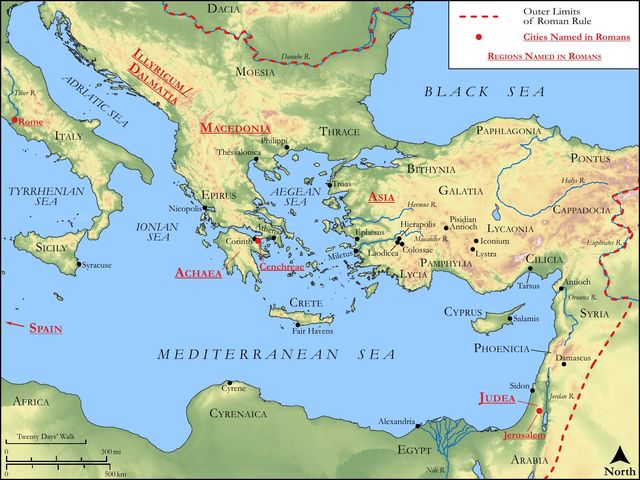
See on the biblical-era map

Study this verse
Public-domain commentary
Matthew Henry
From his Commentary on the Whole Bible. Henry comments on passages, not single verses — this entry covers Romans 11:1–32. His four-level outline is real structure in the source text, so it is rendered as structure.
The apostle proposes here a plausible objection, which might be urged against the divine conduct in casting off the Jewish nation (v. 1): "Hath God cast away his people? Is the rejection total and final? Are they all abandoned to wrath and ruin, and that eternal? Is the extent of the sentence so large as to be without reserve, or the continuance of it so long as to be without repeal? Will he have no more a peculiar people to himself?" In opposition to this, he shows that there was a great deal of goodness and mercy expressed along with this seeming severity, particularly he insists upon three things:—1. That, though some of the Jews were cast off, yet they were not all so. 2. That, though the body of the Jews were cast off, yet the Gentiles were taken in. And, 3. That, though the Jews were cast off at present, yet in God's due time they should be taken into his church again.
I.The Jews, it is true, were many of them cast off, but not all.
The supposition of this he introduces with a God forbid. He will by no means endure such a suggestions. God had made a distinction between some of them and others.
1.There was a chosen remnant of believing Jews, that obtained righteousness and life by faith in Jesus Christ, v. 1-7. These are said to be such as he foreknew (v. 2), that is, had thoughts of love to, before the world was; for whom he thus foreknew he did predestinate. her lies the ground of the difference. They are called the election (v. 7), that is, the elect, God's chosen ones, whom he calls the election, because that which first distinguished them from the dignified them above others was God's electing love. Believers are the election, all those and those only whom God hath chosen. Now,
(1.)He shows that he himself was one of them: For I also am an Israelite; as if he had said, "Should I say that all the Jews are rejected, I should cut off my own claims, and see myself abandoned." Paul was a chosen vessel (Acts ix. 15), and yet he was of the seed of Abraham, and particularly of the tribe of Benjamin, the least and youngest of all the tribes of Israel.
(2.)He suggests that as in Elias's time, so now, this chosen remnant was really more and greater than one would think it was, which intimates likewise that it is no new nor unusual thing for God's grace and favour to Israel to be limited and confined to a remnant of that people; for so it was in Elijah's time. The scripture saith it of Elias, en Elia—in the story of Elias, the great reformer of the Old Testament. Observe,
[1.]His mistake concerning Israel; as if their apostasy in the days of Ahab was so general that he himself was the only faithful servant God had in the world. He refers to 1 Kings xix. 14, where (it is here said) he maketh intercession to God against Israel. A strange kind of intercession: entynchanei to Theo kata tou Israel—He deals with God against Israel; so it may be read; so entynchano is translated, Acts xxv. 24. The Jews enetychon moi—have dealt with me. In prayer we deal with God, commune with him, discourse with him: it is said of Elijah (Jam. v. 17) that he prayed in praying. We are then likely to pray in praying, to make a business of that duty, when we pray as those that are dealing with God in the duty. Now Elijah in this prayer spoke as if there were one left faithful in Israel but himself. See to what a low ebb the profession of religion may sometimes be brought, and how much the face of it may be eclipsed, that the most wise and observing men may give it up for gone. So it was in Elijah's time. That which makes the show of a nation is the powers and the multitude. The powers of Israel were then persecuting powers: They have killed thy prophets, and digged down thine altars, and they seek my life. The multitude of Israel were then idolatrous: I am left alone. Thus those few that were faithful to God were not only lost in the crowd of idolaters, but crushed and driven into corners by the rage of persecutors. When the wicked rise, a man is hidden, Prov. xxviii. 12.—Digged down thine altars; not only neglected them, and let them go out of repair, but digged them down. When altars were set up for Baal, it is no wonder if God's altars were pulled down; they could not endure that standing testimony against their idolatry. This was his intercession against Israel; as if he had said, "Lord, is not this a people ripe for ruin, worthy to be cast off? What else canst thou do for thy great name?" It is a very sad thing for any person or people to have the prayers of God's people against them, especially of God's prophets, for God espouses, and sooner or later will visibly own, the cause of his praying people.
[2.]The rectifying of this mistake by the answer of God (v. 4): I have reserved. Note, First, Things are often much better with the church of God than wise and good men think they are. They are ready to conclude hardly, and to give up all for gone, when it is not so. Secondly, In times of general apostasy, there is usually a remnant that keep their integrity—some, though but a few; all do not go one way. Thirdly, That when there is a remnant who keep their integrity in times of general apostasy it is God that reserves to himself that remnant. If he had left them to themselves, they had gone down the stream with the rest. It is his free and almighty grace that makes the difference between them and others.—Seven thousand: a competent number to bear their testimony against the idolatry of Israel, and yet, compared with the many thousands of Israel, a very small number, one of a city, and two of a tribe, like the grape-gleanings of the vintage. Christ's flock is but a little flock; and yet, when they come all together at last, they will be a great and innumerable multitude, Rev. vii. 9. Now the description of this remnant is that they had not bowed the knee to the image of Baal, which was then the reigning sin of Israel. In court, city, and country, Baal had the ascendant; and the generality of people, more or less, paid their respect to Baal. The best evidence of integrity is a freedom from the present prevailing corruptions of the times and places that we live in, to swim against the stream when it is strong. Those God will own for his faithful witnesses that are bold in bearing their testimony to the present truth, 2 Pet. i. 12. This is thank-worthy, not to bow to Baal when every body bows. Sober singularity is commonly the badge of true sincerity.
[3.]The application of this instance to the case in hand: Even so at this present time, v. 5-7. God's methods of dispensation towards his church are as they used to be. As it has been, so it is. In Elijah's time there was a remnant, and so there is now. If then there was a remnant left under the Old Testament, when the displays of grace were less clear and the pourings out of the Spirit less plentiful, much more now under the gospel, when the grace of God, which bringeth salvation, appears more illustrious.—A remnant, a few of many, a remnant of believing Jews when the rest were obstinate in their unbelief. This is called a remnant according to the election of grace; they are such as were chosen from eternity in the counsels of divine love to be vessels of grace and glory. Whom he did predestinate those he called. If the difference between them and others be made purely by the grace of God, as certainly it is (I have reserved them, saith he, to myself), then it must needs be according to the election; for we are sure that whatever God does he does it according to the counsel of his own will. Now concerning this remnant we may observe, First, Whence it takes its rise, from the free grace of God (v. 6), that grace which excludes works. The eternal election, in which the difference between some and others is first founded, is purely of grace, free grace; not for the sake of works done or foreseen; if so, it would not be grace. Gratia non est ullo modo gratia, si non sit omni modo gratuita—It is not grace, properly so called, if it be not perfectly free. Election is purely according to the good pleasure of his will, Eph. i. 5. Paul's heart was so full of the freeness of God's grace that in the midst of his discourse he turns aside, as it were, to make this remark, If of grace, then not of works. And some observe that faith itself, which in the matter of justification if opposed to works, is here included in them; for faith has a peculiar fitness to receive the free grace of God for our justification, but not to receive that grace for our election. Secondly, What it obtains: that which Israel, that is, the body of that people, in van sought for (v. 7): Israel hath not obtained that which he seeketh for, that is, justification, and acceptance with God (see ch. ix. 31), but the election have obtained it. In them the promise of God has its accomplishment, and God's ancient kindness for that people is remembered. He calls the remnant of believers, not the elect, but the election, to show that the sole foundation of all their hopes and happiness is laid in election. They were the persons whom God had in his eye in the counsels of his love; they are the election; they are God's choice. Such was the favour of God to the chosen remnant. But,
2.The rest were blinded, v. 7. Some are chosen and called, and the call is made effectual. But others are left to perish in their unbelief; nay, they are made worse by that which should have made them better. The gospel, which to those that believed was the savour of life unto life, to the unbelieving was the savour of death unto death. The same sun softens wax and hardens clay. Good old Simeon foresaw that the child Jesus was set for the fall, as well as for the rising again, of many in Israel, Luke ii. 34.—Were blinded; eporothesan—they were hardened; so some. They were seared, and made brawny and insensible. They could neither see the light, nor feel the touch, of gospel grace. Blindness and hardness are expressive of the same senselessness and stupidity of spirit. They shut their eyes, and would not see; this was their sin: and then God, in a way of righteous judgment, blinded their eyes, that they could not see; this was their punishment. This seemed harsh doctrine: to qualify it, therefore, he vouches two witnesses out of the Old Testament, who speak of such a thing.
(1.)Isaiah, who spoke of such a judgment in his day, ch. xxix. 10; vi. 9. The spirit of slumber, that is, an indisposedness to mind either their duty or interest. They are under the power of a prevailing unconcernedness, like people that are slumbering and sleeping; not affected with any thing that is said or done. They were resolved to continue as they were, and would not stir. The following words explain what is meant by the spirit of slumber: Eyes, that they should not see, and ears, that they should not hear. They had the faculties, but in the things that belonged to their peace they had not the use of those faculties; they were quite infatuated, they saw Christ, but they did not believe in him; they heard his word, but they did not receive it; and so both their hearing and their seeing were in vain. It was all one as if they had neither seen nor heard. Of all judgments spiritual judgments are the sorest, and most to be dreaded, though they make the least noise.—Unto this day. Ever since Esaias prophesied, this hardening work has been in the doing; some among them have been blind and senseless. Or, rather, ever since the first preaching of the gospel: though they have had the most convincing evidences that could be of the truth of it, the most powerful preaching, the fairest offers, the clearest calls from Christ himself, and from his apostles, yet to this day they are blinded. It is still true concerning multitudes of them, even to this day in which we live; they are hardened and blinded, the obstinacy and unbelief go by succession from generation to generation, according to their own fearful imprecation, which entailed the curse: His blood be upon us and upon our children.
(2.)David (v. 9, 10), quoted from Ps. lxix. 22, 23, where David having in the Spirit foretold the sufferings of Christ from his own people the Jews, particularly that of their giving him vinegar to drink (v. 21, which was literally fulfilled, Matt. xxvii. 48), an expression of the greatest contempt and malice that could be, in the next words, under the form of an imprecation, he foretels the dreadful judgments of God upon them for it: Let their table become a snare, which the apostle here applies to the present blindness of the Jews, and the offence they took at the gospel, which increased their hardness. This teaches us how to understand other prayers of David against his enemies; they are to be looked upon as prophetic of the judgments of God upon the public and obstinate enemies of Christ and his kingdom. His prayer that it might be so was a prophecy that it should be so, and not the private expression of his own angry resentments. It was likewise intended to justify God, and to clear his righteousness in such judgments. He speaks here,
[1.]Of the ruin of their comforts: Let their table be made a snare, that is, as the psalmist explains it, Let that which should be for their welfare be a trap to them. The curse of God will turn meat into poison. It is a threatening like that in Mal. ii. 2, I will curse your blessings. Their table a snare, that is, an occasion of sin and an occasion of misery. Their very food, that should nourish them, shall choke them.
[2.]Of the ruin of their powers and faculties (v. 10), their eyes darkened, their backs bowed down, that they can neither find the right way, nor, if they could, are they able to walk in it. The Jews, after their national rejection of Christ and his gospel, became infatuated in their politics, so that their very counsels turned against them, and hastened their ruin by the Romans. They looked like a people designed for slavery and contempt, their backs bowed down, to be ridden and trampled upon by all the nations about them. Or, it may be understood spiritually; their backs are bowed down in carnality and worldly-mindedness. Curvæ in terris animæ—They mind earthly things. This is an exact description of the state and temper of the present remainder of that people, than whom, if the accounts we have of them be true, there is not a more worldly, wilful, blind, selfish, ill-natured, people in the world. They are manifestly to this day under the power of this curse. Divine curses will work long. It is a sign we have our eyes darkened if we are bowed down in worldly-mindedness.
II.Another thing which qualified this doctrine of the rejection of the Jews was that though they were cast off and unchurched, yet the Gentiles were taken in (v. 11-14), which he applies by way of caution to the Gentiles, v. 17-22.
1.The rejection of the Jews made room for the reception of the Gentiles. The Jews' leavings were a feast for the poor Gentiles (v. 11): "Have they stumbled that they should fall? Had God no other end in forsaking and rejecting them than their destruction?" He startles at this, rejecting the thought with abhorrence, as usually he does when any thing is suggested which seems to reflect upon the wisdom, or righteousness, or goodness of God: God forbid! no, through their fall salvation is come to the Gentiles. Not but that salvation might have come to the Gentiles if they had stood; but by the divine appointment it was so ordered that the gospel should be preached to the Gentiles upon the Jews' refusal of it. Thus in the parable (Matt. xxii. 8, 9), Those that were first bidden were not worthy—Go ye therefore into the highways, Luke xiv. 21. And so it was in the history (Acts xiii. 46): It was necessary that the word of God should first have been spoken to you; but, seeing you put it from you, lo, we turn to the Gentiles; so Acts xviii. 6. God will have a church in the world, will have the wedding furnished with guests; and, if one will not come, another will, or why was the offer made? The Jews had the refusal, and so the tender came to the Gentiles. See how Infinite Wisdom brings light out of darkness, good out of evil, meat out of the eater, and sweetness out of the strong. To the same purport he says (v. 12), The fall of them was the riches of the world, that is, it hastened the gospel so much the sooner into the Gentile world. The gospel is the greatest riches of the place where it is; it is better than thousands of gold and silver. Or, The riches of the Gentiles was the multitude of converts among them. True believers are God's jewels. To the same purport (v. 15): The casting away of them is the reconciling of the world. God's displeasure towards them made way for his favour towards the Gentiles. God was in Christ reconciling the world, 2 Cor. v. 19. And therefore he took occasion from the unbelief of the Jews openly to disavow and disown them, though they had been his peculiar favourites, to show that in dispensing his favours he would now no longer act in such a way of peculiarity and restriction, but that in every nation he that feared God and wrought righteousness should be accepted of him, Acts x. 34, 35.
2.The use that the apostle makes of this doctrine concerning the substitution of the Gentiles in the room of the Jews.
(1.)As a kinsman to the Jews, here is a word of excitement and exhortation to them, to stir them up to receive and embrace the gospel-offer. This God intended in his favour to the Gentiles, to provoke the Jews to jealousy (v. 11), and Paul endeavours to enforce it accordingly (v. 14): If by any means I might provoke to emulation those who are my flesh. "Shall the despised Gentiles run away with all the comforts and privileges of the gospel, and shall not we repent of our refusal, and now at last put in for a share? Shall not we believe and obey, and be pardoned and saved, as well as the Gentiles?" See an instance of such an emulation in Esau, Gen. xxviii. 6-9. There is a commendable emulation in the affairs of our souls: why should not we be as holy and happy as any of our neighbours? In this emulation there needs no suspicion, undermining or countermining; for the church has room enough, and the new covenant grace and comfort enough, for us all. The blessings are not lessened by the multitudes of the sharers.—And might save some of them. See what was Paul's business, to save souls; and yet the utmost he promises himself is but to save some. Though he was such a powerful preacher, spoke and wrote with such evidence and demonstration of the Spirit, yet of the many he dealt with he could but save some. Ministers must think their pains well bestowed if they can but be instrumental to save some.
(2.)As an apostle to the Gentiles, here is a word of caution for them: "I speak to you Gentiles. You believing Romans, you hear what riches of salvation are come to you by the fall of the Jews, but take heed lest you do any thing to forfeit it." Paul takes this, as other occasions, to apply his discourse to the Gentiles, because he was the apostle of the Gentiles, appointed for the service of their faith, to plant and water churches in the Gentile nations. This was the purport of his extraordinary mission, Acts xxii. 21, I will send thee far hence unto the Gentiles; compare Acts ix. 15. It was likewise the intention of his ordination, Gal. ii. 9. Compare Acts xiii. 2. It ought to be our great and special care to do good to those that are under our charge: we must particularly mind that which is our own work. It was an instance of God's great love to the poor Gentiles that he appointed Paul, who in gifts and graces excelled all the apostles, to be the apostle of the Gentiles. The Gentile world was a wider province; and the work to be done in it required a very able, skilful, zealous, courageous workman: such a one was Paul. God calls those to special work whom he either sees or makes fit for it.—I magnify my office. There were those that vilified it, and him because of it. It was because he was the apostle of the Gentiles that the Jews were so outrageous against him (Acts xxii. 21, 22), and yet he thought never the worse of it, though it set him up as the butt of all the Jewish rage and malice. It is a sign of true love to Jesus Christ to reckon that service and work for him truly honourable which the world looks upon with scorn, as mean and contemptible. The office of the ministry is an office to be magnified. Ministers are ambassadors for Christ, and stewards of the mysteries of God, and for their work's sake are to be esteemed highly in love.—My office; ten diakonian mou—my ministry, my service, not my lordship and dominion. It was not the dignity and power, but the duty and work, of an apostle, that Paul was so much in love with. Now two things he exhorts the Gentiles to, with reference to the rejected Jews:—
[1.]To have a respect for the Jews, notwithstanding, and to desire their conversion. This is intimated in the prospect he gives them of the advantage that would accrue to the church by their conversion, v. 12, 15. It would be as life from the dead; and therefore they must not insult and triumph over those poor Jews, but rather pity them, and desire their welfare, and long for the receiving of them in again.
[2.]To take heed to themselves, lest they should stumble and fall, as they Jews had done, v. 17-22. Here observe,
First, The privilege which the Gentiles had by being taken into the church. They were grafted in (v. 17), as a branch of a wild olive into a good olive, which is contrary to the way and custom of the husbandman, who grafts the good olive into the bad; but those that God grafts into the church he finds wild and barren, and good for nothing. Men graft to mend the tree; but God grafts to mend the branch. 1. The church of God is an olive-tree, flourishing and fruitful as an olive (Ps. lii. 8; Hos. xiv. 6), the fruit useful for the honour both of God and man, Judg. ix. 9. 2. Those that are out of the church are as wild olive-trees, not only useless, but what they do produce is sour and unsavoury: Wild by nature, v. 24. This was the state of the poor Gentiles, that wanted church privileges, and in respect of real sanctification; and it is the natural state of every one of us, to be wild by nature. 3. Conversion is the grafting in of wild branches into the good olive. We must be cut off from the old stock, and be brought into union with a new root. 4. Those that are grafted into the good olive-tree partake of the root and fatness of the olive. It is applicable to a saving union with Christ; all that are by a lively faith grafted into Christ partake of him as the branches of the root—receive from his fulness. But it is here spoken of a visible church-membership, from which the Jews were as branches broken off; and so the Gentiles were grafted in, autois—among those that continued, or in the room of those that were broken off. The Gentiles, being grafted into the church, partake of the same privileges that the Jews did, the root and fatness. The olive-tree is the visible church (called so Jer. xi. 16); the root of this tree was Abraham, not the root of communication, so Christ only is the root, but the root of administration, he being the first with whom the covenant was so solemnly made. Now the believing Gentiles partake of this root: he also is ason of Abraham (Luke xix. 9), the blessing of Abraham comes upon the Gentiles (Gal. iii. 14), the same fatness of the olive-tree, the same for substance, special protection, lively oracles, means of salvation, a standing ministry, instituted ordinances; and, among the rest, the visible church-membership of their infant seed, which was part of the fatness of the olive-tree that the Jews had, and cannot be imagined to be denied to the Gentiles.
Secondly, A caution not to abuse these privileges. 1. "Be not proud (v. 18): Boast not against the branches. Do not therefore trample upon the Jews as a reprobate people, nor insult over those that are broken off, much less over those that do continue." Grace is given, not to make us proud, but to make us thankful. The law of faith excludes all boasting either of ourselves or against others. "Do not say (v. 19): They were broken off that I might be grafted in; that is, do not think that thou didst merit more at the hand of God than they, or didst stand higher in his favour." "But remember, thou bearest not the root, but the root thee. Though thou art grafted in, thou art still but a branch borne by the root; nay, and an engrafted branch, brought into the good olive contrary to nature (v. 24), not free-born, but by an act of grace enfranchised and naturalized. Abraham, the root of the Jewish church, is not beholden to thee; but thou art greatly obliged to him, as the trustee of the covenant and the father of many nations. Therefore, if thou boast, know (this word must be supplied to clear the sense) thou bearest not the root but the root thee." 2. "Be not secure (v. 20): Be not high-minded, but fear. Be not too confident of your own strength and standing." A holy fear is an excellent preservative against high-mindedness: happy is the man that thus feareth always. We need not fear but God will be true to his word; all the danger is lest we be false to ours. Let us therefore fear, Heb. iv. 1. The church of Rome now boasts of a patent of perpetual preservation; but the apostle here, in his epistle to that church when she was in her infancy and integrity, enters an express caveat against that boast, and all claims of that kind.—Fear what? "Why fear lest thou commit a forfeiture as they have done, lest thou lose the privileges thou now enjoyest, as they have lost theirs." The evils that befal others should be warnings to us. Go (saith God to Jerusalem Jer. vii. 12), and see what I did to Shiloh; so now, let all the churches of God go and see what he did to Jerusalem, and what is become of the day of their visitation, that we may hear and fear, and take heed of Jerusalem's sin. The patent which churches have of their privileges is not for a certain term, nor entailed upon them and their heirs; but it runs as long as they carry themselves well, and no longer. Consider, (1.) "How they were broken off. It was not undeservedly, by an act of absolute sovereignty and prerogative, but because of unbelief." It seems, then, it is possible for churches that have long stood by faith to fall into such a state of infidelity as may be their ruin. Their unbelief did not only provoke God to cut them off, but they did by this cut themselves off; it was not only the meritorious, but the formal cause of their separation. "Now, thou art liable to the same infirmity and corruption that they fell by." Further observe, They were natural branches (v. 21), not only interested in Abraham's covenant, but descending from Abraham's loins, and so born upon the premises, and thence had a kind of tenant-right: yet, when they sunk into unbelief, God did not spare them. Prescription, long usage, the faithfulness of their ancestors, would not secure them. It was in vain to plead, though they insisted much upon it, that they were Abraham's seed, Matt. iii. 9; John viii. 33. It is true they were the husbandmen to whom the vineyard was first let out; but, when they forfeited it, it was justly taken from them, Matt. xxi. 41, 43. This is called here severity, v. 22. God laid righteousness to the line and judgment to the plummet, and dealt with them according to their sins. Severity is a word that sounds harshly; and I do not remember that it is any where else in scripture ascribed to God; and it is here applied to the unchurching of the Jews. God is most severe towards those that have been in profession nearest to him, if they rebel against him, Amos iii. 2. Patience and privileges abused turn to the greatest wrath. Of all judgments, spiritual judgments are the sorest; for of these he is here speaking, v. 8. (2.) "How thou standest, thou that art engrafted in." He speaks to the Gentile churches in general, though perhaps tacitly reflecting on some particular person, who might have expressed some such pride and triumph in the Jews' rejection. "Consider then," [1.] "By what means thou standest: By faith, which is a depending grace, and fetches in strength from heaven. Thou dost not stand in any strength of thy own, of which thou mightest be confident: thou art no more than the free grace of God makes thee, and his grace is his own, which he gives or withholds at pleasure. That which ruined them was unbelief, and by faith thou standest; therefore thou hast no faster hold than they had, thou standest on no firmer foundation than they did." [2.] "On what terms (v. 22): Towards thee goodness, if thou continue in his goodness, that is, continue in a dependence upon and compliance with the free grace of God, the want of which it was that ruined the Jews—if thou be careful to keep up thine interest in the divine favour, by being continually careful to please God and fearful of offending him." The sum of our duty, the condition of our happiness, is to keep ourselves in the love of God. Fear the Lord and his goodness. Hos. iii. 5.
III.Another thing that qualified this doctrine of the Jews' rejection is that, though for the present they are cast off, yet the rejection is not final; but, when the fulness of time is come, they will be taken in again. They are not cast off for ever, but mercy is remembered in the midst of wrath. Let us observe,
1.How this conversion of the Jews is here described.
(1.)It is said to be their fulness (v. 12), that is, the addition of them to the church, the filling up again of that place which became vacant by their rejection. This would be the enriching of the world (that is, the church in the world) with a great deal of light and strength and beauty.
(2.)It is called the receiving of them. The conversion of a soul is the receiving of that soul, so the conversion of a nation. They shall be received into favour, into the church, into the love of Christ, whose arms are stretched out for the receiving of all those that will come to him. And this will be as life from the dead—so strange and surprising, and yet withal so welcome and acceptable. The conversion of the Jews will bring great joy to the church. See Luke xv. 32, He was dead, and is alive; and therefore it was meet we should make merry and be glad.
(3.)It is called the grafting of them in again (v. 23), into the church, from which they had been broken off. That which is grafted in receives sap and virtue from the root; so does a soul that is truly grafted into the church receive life, and strength, and grace from Christ the quickening root. They shall be grafted into their own olive-tree (v. 24); that is, into the church of which they had formerly been the most eminent and conspicuous members, to retrieve those privileges of visible church-membership which they had so long enjoyed, but have now sinned away and forfeited by their unbelief.
(4.)It is called the saving of all Israel, v. 26. True conversion may well be called salvation; it is salvation begun. See Acts ii. 47. The adding of them to the church is the saving of them: tous sozomenous, in the present tense, are saved. When conversion-work goes on, salvation-work goes on.
2.What it is grounded upon, and what reason we have to look for it.
(1.)Because of the holiness of the first-fruits and the root, v. 16. Some by the first-fruits understand those of the Jews that were already converted to the faith of Christ and received into the church, who were as the first-fruits dedicated to God, as earnests of a more plentiful and sanctified harvest. A good beginning promises a good ending. Why may we not suppose that others may be savingly wrought upon as well as those who are already brought in? Others by the first-fruits understand the same with the root, namely, the patriarchs, Abraham, Isaac, and Jacob, from whom the Jews descended, and with whom, as the prime trustees, the covenant was deposited: and so they were the root of the Jews, not only as a people, but as a church. Now, if they were holy, which is not meant so much of inherent as of federal holiness—if they were in the church and in the covenant—then we have reason to conclude that God hath a kindness for the lump—the body of that people; and for the branches—the particular members of it. The Jews are in a sense a holy nation (Exod. xix. 6), being descended from holy parents. Now it cannot be imagined that such a holy nation should be totally and finally cast off. This proves that the seed of believers, as such, are within the pale of the visible church, and within the verge of the covenant, till they do, by their unbelief, throw themselves out; for, if the root be holy, so are the branches. Though real qualifications are not propagated, yet relative privileges are. Though a wise man does not beget a wise man, yet a free man begets a free man. Though grace does not run in the blood, yet external privileges do (till they are forfeited), even to a thousand generations. Look how they will answer it another day that cut off the entail, by turning the seed of the faithful out of the church, and so not allowing the blessing of Abraham to come upon the Gentiles. The Jewish branches are reckoned holy, because the root was so. This is expressed more plainly (v. 28): They are beloved for the fathers' sakes. In this love to the fathers the first foundation of their church-state was laid (Deut. iv. 37): Because he loved they fathers, therefore he chose their seed after them. And the same love would revive their privileges, for still the ancient loving-kindness is remembered; they are beloved for the fathers' sakes. It is God's usual method of grace. Kindness to the children for the father's sake is therefore called the kindness of God, 2 Sam. ix. 3, 7. Though, as concerning the gospel (namely, in the present dispensation of it), they are enemies to it for your sakes, that is, for the sake of the Gentiles, against whom they have such an antipathy; yet, when God's time shall come, this will wear off, and God's love to their fathers will be remembered. See a promise that points at this, Lev. xxvi. 42. The iniquity of the fathers is visited but to the third and fourth generation; but there is mercy kept for thousands. Many fare the better for the sake of their godly ancestors. It is upon this account that the church is called their own olive-tree. Long it had been their own peculiar, which is some encouragement to us to hope that there may be room for them in it again, for old acquaintance-sake. That which hath been may be again. Though particular persons and generations wear off in unbelief, yet there having been a national church-membership, though for the present suspended, we may expect that it will be revived.
(2.)Because of the power of God (v. 23): God is able to graft them in again. The conversion of souls is a work of almighty power; and when they seem most hardened, and blinded, and obstinate, our comfort is that God is able to work a change, able to graft those in that have been long cast out and withered. When the house is kept by the strong man armed, with all his force, yet God is stronger than he, and is able to dispossess him. The condition of their restoration is faith: If they abide not still in unbelief. So that nothing is to be done but to remove that unbelief that is the great obstacle; and God is able to take that away, though nothing less than an almighty power will do it, the same power that raised up Christ from the dead, Eph. i. 19, 29. Otherwise, can these dry bones live?
(3.)Because of the grace of God manifested to the Gentiles. Those that have themselves experienced the grace of God, preventing, distinguishing grace, may thence take encouragement to hope well concerning others. This is his argument (v. 24): "If thou wast grafted into a good olive, that was wild by nature, much more shall these that were the natural branches, and may therefore be presumed somewhat nearer to the divine acceptance." This is a suggestion very proper to check the insolence of those Gentile Christians that looked with disdain and triumph upon the condition of the rejected Jews, and trampled upon them; as if he had said, "Their condition, bad as it is, is not so bad as yours was before your conversion; and therefore why may it not be made as good as yours is?" This is his argument (v. 30, 31): As you in times past have not, &c. It is good for those that have found mercy with God to be often thinking what they were in time past, and how they obtained that mercy. This would help to soften our censures of those that still continue in unbelief, and quicken our prayers for them. He argues further from the occasion of the Gentiles' call, that is, the unbelief of the Jews; thence it took rise: "You have obtained mercy through their unbelief; much more shall they obtain mercy through your mercy. If the putting out of their candle was the lighting of yours, by that power of God which brings good out of evil, much more shall the continued light of your candle, when God's time shall come, be a means of lighting theirs again." "That through your mercy they might obtain mercy, that is, that they may be beholden to you, as you have been to them." He takes it for granted that the believing Gentiles would do their utmost endeavour to work upon the Jews—that, when God had persuaded Japhet, Japhet would be labouring to persuade Shem. True grace hates monopolies. Those that have found mercy themselves should endeavour that through their mercy others also may obtain mercy.
(4.)Because of the promises and prophecies of the Old Testament, which point at this. He quotes a very remarkable one, v. 26, from Isa. lix. 20, 21. Where we may observe,
[1.]The coming of Christ promised: There shall come out of Zion the deliverer. Jesus Christ is the great deliverer, which supposes mankind in a state of misery and danger. In Isaiah it is, the Redeemer shall come to Zion. There he is called the Redeemer; here the deliverer; he delivers in a way of redemption, by a price. There he is said to come to Zion, because when the prophet prophesied he was yet to come into the world, and Zion was his first head-quarters. Thither he came, there he took up his residence: but, when the apostle wrote this, he had come, he had been in Zion; and he is speaking of the fruits of his appearing, which shall come out of Zion; thence, as from the spring, issued forth those streams of living water which in the everlasting gospel watered the nations. Out of Zion went forth the law, Isa. ii. 3. Compare Luke xxiv. 47.
[2.]The end and purpose of this coming: He shall turn away ungodliness from Jacob. Christ's errand into the world was to turn away ungodliness, to turn away the guilt by the purchase of pardoning mercy, and to turn away the power by the pouring out of renewing grace, to save his people from their sins (Matt. i. 21), to separate between us and our sins, that iniquity might not be our ruin, and that it might not be our ruler. Especially to turn it away from Jacob, which is that for the sake of which he quotes the text, as a proof of the great kindness God intended for the seed of Jacob. What greater kindness could he do them than to turn away ungodliness from them, to take away that which comes between them and all happiness, take away sin, and then make way for all good? This is the blessing that Christ was sent to bestow upon the world, and to tender it to the Jews in the first place (Acts iii. 26), to turn people from their iniquities. In Isaiah it is, The Redeemer shall come to Zion, and unto those that turn from transgression in Jacob, which shown who in Zion were to have a share in and to reap benefit by the deliverance promised, those and those only that leave their sins and turn to God; to them Christ comes as a Redeemer, but as an avenger to those that persist in impenitence. See Deut. xxx. 2, 3. Those that turn from sin will be owned as the true citizens of Zion (Eph. ii. 19), the right Jacob, Ps. xxiv. 4, 6. Putting both these readings together, we learn that none have an interest in Christ but those that turn from their sins, nor can any turn from their sins but by the strength of the grace of Christ.—For this is my covenant with them—this, that the deliverer shall come to them—this, that my Spirit shall not depart from them, as it follows, Isa. lix. 21. God's gracious intentions concerning Israel were made the matter of a covenant, which the God that cannot lie could not but be true and faithful to. They were the children of the covenant, Acts iii. 25. The apostle adds, When I shall take away their sins, which some think refers to Isa. xxvii. 9, or only to the foregoing words, to turn away ungodliness. Pardon of sin is laid as the foundation of all the blessings of the new covenant (Heb. viii. 12): For I will be merciful. Now from all this he infers that certainly God had great mercy in store for that people, something answerable to the extent of these rich promises: and he proves his inference (v. 29) by this truth: For the gifts and callings of God are without repentance. Repentance is sometimes taken for a change of mind, and so God never repents, for he is in one mind and who can turn him? Sometimes for a change of way, and that is here understood, intimating the constancy and unchangeableness of that love of God which is founded in election. Those gifts and callings are immutable; whom he so loves, he loves to the end. We find God repenting that he had given man a being (Gen. vi. 6, It repented the Lord that he had made man), and repenting that he had given a man honour and power (1 Sam. xv. 11, It repenteth me that I have set up Saul to be king); but we never find God repenting that he had given a man grace, or effectually called him; those gifts and callings are without repentance.
Historical interpretation
Nine Centuries of Reception
5 surviving comments on this verse. Each one is dated, so this reads as a timeline rather than a list.
Select a marker to jump to its quote. Markers stagger vertically where authors wrote within a few decades of each other.
"For I would not, brethren, that ye should be ignorant of this mystery, lest ye should be wise your own conceits."
Meaning by mystery here, that which is unknown and unutterable, and hath much of wonder and much of what one should not expect about it. As in another passage too he says, "Behold, I tell you a mystery. We shall not all sleep, but we shall all be changed." What then is the mystery?
"That blindness in part hath happened unto Israel." Here again he levels a blow at the Jew, while seeming to take down the Gentile. But his meaning is nearly this, and he had said it before, that the unbelief is not universal, but only "in part." As when he says, "But if any hath caused grief, he hath not grieved me, but in part": And so here too he says what he had said above, "God hath not cast off His people whom He foreknew": and again, "What then? Have they stumbled that they should fall? God forbid": This then he says here also; that it is not the whole people that is pulled up, but many have already believed, and more are likely to believe.
All that follows is designed to prevent the Gentiles from being filled with pride toward the Jews. It is a secret unknown to mankind why the Gentiles were saved, because Israel’s blindness in fact furnished the occasion for their salvation. The blindness continued until the Jews saw that the Gentiles were being saved, since all were called to salvation.
Paul insists that only a part of Israel has been hardened, for in fact many of them believe. He thus encourages them not to despair that others will be saved as well. After the Gentiles accepted the gospel, the Jews would believe, when the great Elijah would come to them and bring them the doctrine of faith. The Lord himself said as much: “Elijah will come and will restore all things.”
Then therefore that disciple who had come first to the tomb also entered. After Peter entered, John also went in. He who had come first entered later. It should be noted, brothers, that at the end of the world Judea too will be gathered to faith in the Redeemer, as Paul testifies when he says: "Until the fullness of the Gentiles should enter, and so all Israel should be saved."
After leading the Gentiles to a knowledge of the divine judgments, in which God's kindness and severity were manifested, the Apostle, acting as though they are still unable to consider these things, explains how they seem to him. First, he presents the fact; secondly, he proves it [v. 26b; n. 917]; 453 thirdly, he gives the reason [v. 30; n. 930]. 913. In regard to the first he does three things. First, he states his intention, saying: IO have urged you to consider the kindness and severity of God, because I want you to understand this mystery, for you cannot grasp all mysteries. Hence, this is a prerogative of the perfect to whom the Lord say: "To you it has been given to understand the mystery of God's kingdom: (Lk 8:9); "I will not hide from you the mysteries of God" (Wis 6:24). But ignorance of this mystery would be very damaging to us. 914. Secondly, he discloses the reason for his intention: that you not be wise in your own conceits, i.e., not presume on your own understanding to condemn others and prefer yourself to them: "Never be conceited" (Rom 1:16); "Woe to those who are wise in their own eyes, and shrewd in their own sight (Is 5:21). 915. Thirdly, he states what he intended. First, with respect to the fall of particular Jews, when he says: a hardening has come upon Israel, not universally but upon a part: "Blind the heart of this people" (Is 6:10). Secondly, he predicts the end of this blindness, saying: until the full number of the Gentiles come in to the faith, i.e., not only some Gentile nations as were then converted; but either in all or the greater part the Church would be establishes: "The earth is the Lord's and all its fullness" (Ps 23:1). The Gentiles converted to the faith are said to come in, as though from the exterior and visible things they venerated into spiritual things and the divine will: "Come into his presence with singing" (Ps 100:2). 454 916. It should be noted that the word, until, can signify the cause of the blindness of the Jews. For God permitted them to be blinded, in order that the full number of the Gentiles come in. It can also designate the termination, i.e., that the blindness of the Jews will last up to the time when the full number of the Gentiles will come to the faith. With this agrees his next statement, namely, and then, i.e., when the full number of the Gentiles has come in, all Israel will be saved, not some, as now, but universally all: "I will save them by the Lord their God" (Hos 1:7); "He will again have compassion upon us (Mic 7:19). 917. Then when he says, As it is written, he proves what he had said about the future salvation of the Jews: first, he proves this with an authority; secondly, with a reason [v. 28; n. 921]. 918. First, therefore, he says: I say that all Israel will be saved, as it is written in Is (59:20), where our text says: "A redeemer will come from Zion and this will be my covenant with them that return to Jacob says the Lord." But the Apostle uses the Septuagint and touches on three things. First, the coming of a Savior, when he says: God will come, in human flesh to save us, from Zion, i.e., from the Jewish people who are signified by Zion, the citadel of Jerusalem, a city in Judea. Hence it says in Zech (9:9): " Rejoice greatly, o daughter of Zion! Shout aloud, O daughter of Jerusalem! Lo, our king comes to you..." and in Jn (4:22): "Salvation is from the Jews." 455 Or he says that he comes from Zion, not because he was born there, but because his doctrine went from there into the whole world, inasmuch as the apostles received the Holy Spirit in the cenacle in Zion: "Out of Zion shall go forth the law" (Is 2:3). 919. Secondly, he touches on salvation by Christ offered to the Jews, saying: he will banish ungodliness from Jacob. This could refer to deliverance from punishment: "He will snatch my soul from death" (Ps 115:8). Banish ungodliness from Jacob could refer to deliverance from guilt: "O that deliverance for Israel would come from Zion" (Ps 53:6). Or both could refer to liberation from guilt, but he says he will take out, because of the few, who now are converted with great difficulty and with, so to speak, a certain violence: "As if a shepherd should get out of the lion's mouth two legs, or the tip of the ear, so shall the children of Israel be taken out" (Amos 3:12). But he says will banish ungodliness from Jacob to show the ease with which the Jews will be converted at the end of the world: "Who is a God like thee, pardoning iniquity and passing over transgression for the remnant of his inheritance?" (Mic 7:18). 920. Thirdly, he shows the manner of salvation when hey says: And this will be my covenant with them, a new one from me, when I take away their sins. For the old covenant did not remove sins, because "it is impossible that the blood of bulls and goats should take away sins" (Heb 10:4). Therefore, because the Old Testament was imperfect, a new testament is promised to them: "I will make a new covenant with the house of Israel and the house of Judah" (Jer 31:31) and it will have the power to remit sin through the blood of Christ: "This is my blood of the new covenant, which is poured out for many 456 for the forgiveness of sins" (Mt 26:28); "He will cast all our sins into the depths of the sea" (Mic 7:19). 921. Then when he says, As regards the gospel, he proves his statement with a reason: first, he presents the proof; secondly, he removes an objection [v. 29; n. 924]. 922. First, therefore, he says that their sins will be taken away and that after they have sins, they are enemies of Christ. As regards the gospel, which they resist, they are enemies for your sake, i.e., it has turned out to your benefit. Hence, it says in Lk (19:27): "As for those enemies of mind, who did not want me to reign over them, bring them here and slay them before me"; and in Jn (15:24): "But now they have seen and hated both me and my Father." Or as regards the gospel means their enmity has helped the gospel, which has been spread everywhere by reason of such enmity: "In the word of truth of the gospel, which has come to you, as indeed in the whole world it is bearing fruit and growing" (Col 1:5). 923. But they are beloved by God for the sake of their forefathers as regards election, because He chose their descendants on account of their forefathers' grace: "The Lord loved your fathers and chose their descendants after them" (Dt 10:15). This does not means that the merits established by the fathers were the cause of the eternal election of the descendants, but that God from all eternity chose the fathers and the sons in such a way that the children would obtain salvation on account of the fathers; not as though the merits of the fathers were sufficient for the salvation of the 457 sons, but through an outpouring of divine grace and mercy, the sons would be saved on account of the promises made to the fathers. Or it can mean as regards election, i.e., as regards those elected from that people, salvation was obtained. For if they are dear to God, it is reasonable that they be saved by God: "The eye hath not seen, O God, besides thee, what things thou has prepared for them that wait for thee" (Is 64:4). 924. Then when he says, For the gifts, he excludes an objection. For someone might claim that even though the Jews were formerly beloved on account of their forefathers, nevertheless the hostility they exert against the gospel prevents them from being saved in the future. But the Apostle asserts that this is false, saying: The gifts and call o God are irrevocable, i.e., without repentance. As if to say: That God gives something to certain ones or call certain ones is without repentance, because God does not change His mind: "The Lord has sworn and will not change his mind" (Ps 110:4). 925. However, this seems false, for the Lord says: "It repenteth me that I made man" (Gen 6:7) and "if that nation against which I have spoken shall repent of their evil, I also will repent of the evil that I thought to do to them" (Jer 18:8). The answer is that just as God is said to grow angry, not because the emotion of anger is in him but because he is related to the effect of punishments after the manner of an angry man, so he is said to repent, not because the change involved in repentance is in him but because he changes what he had done after the manner of one who repents. 926. Nevertheless, it does seem that God's gifts are not without repentance, because they are frequently lost, as in Mt (25:28): "Take the talent from him and give it 458 to him that has ten talents." Furthermore, God's call seems to be changed sometimes, since it is written: "Many are called but few are chosen" (Mt 22:14). But it should be noted that "gift" is taken here for a promise made according to God's foreknowledge or predestination, and "call" is taken for election. Because both are so certain, whatever God promises is as good as given and whomever He elects is somehow already called. Such temporal gifts and callings are not voided by a change in God, as though He repented of them, but by a change in man who casts them off: "Take heed lest anyone be wanting in the grace of God" (Heb 12:15). 927. This passage can also be taken to mean that God's gifts which are bestowed in baptism, and the calling by which the baptized person is called, exist without the repentance of the baptized person. Furthermore, it was introduced to counteract any despair about the future salvation of the Jews, since they do not seem to repent of their sin. But against this interpretation are the words of Peter: "Repent and be baptized everyone of you" (Ac 2:38). This can be answered by recalling that repentance is of two kinds: interior and exterior. Interior repentance consists in the heart's contrition by which one is sorry for past sins. Such repentance is required of the baptized, because, as Augustine says: "No one who is arbiter of his own will can begin the new life, unless he repents of the old life; otherwise, he would approach dissembling." But exterior repentance consists in making satisfaction outwardly, and this is not required of the baptized person, because by baptismal grace man is freed not only of guilt but of all penalty, in virtue of the passion of Christ who satisfied for the sins of all: "All 459 of us who have been baptized into Jesus Christ were baptized into his death" (Rom 6:3); "By the washing of regeneration and renewal in the Holy Spirit which he poured out upon us richly through Jesus Christ" (*** 3:5). 928. But since the keys of the Church and all the other sacraments work by the power of Christ’s passion, it seems that by the same reasoning all the other sacraments should liberate man from guilt and from all punishment. But the answer is that Christ’s passion works in baptism in the manner of a generation, which requires that a man die completely to his former life to receive a new life. And because the debt of punishment belongs to the oldness of the former life, it is taken away in baptism. But in the other sacraments Christ’s passion works in the manner of a cleansing, as in the sacrament of penance. But a cleansing does not require that right away every remnant of weakness be taken away. And the same argument applies to the other sacraments. 929. But since the confession of sins is relevant for exterior repentance, one could ask whether confession of sins is required at baptism. And it seems that it is, because Mt 3(:6) says that men were baptized by John, "confessing their sins." But the answer is that John’s baptism was a baptism of repentance, namely because by receiving that baptism they declared that they would undertake penance for their sins, and so it was fitting that they should confess so that penance could be meted out to them in accord with the nature of their sins. But Christ’s baptism is a baptism for the remission of all sins, such that the baptized person no longer owes any satisfaction for his past sins, and for this reason there is no need for vocal confession. For the reason 460 confession is necessary on the sacrament of penance is so that the priest can, by the power of the keys, fittingly loose or bind the penitent. 930. Then when he says, Just as you were, he gives the reason for the future salvation of the Jews after their unbelief. First, he shows a similarity between the salvation of both people; secondly, the cause of this similarity [v. 32; n. 932]. 931. First, therefore, he says: So I say that Israel will be saved, although they are now enemies. For just as you Gentiles once did not believe God: "You were once without God in the world" (Eph 2:12); but now have received mercy because of their unbelief: below (15:9), "The Gentiles are to honor God for his mercy"; "I will have mercy on him who was without mercy" (Hos 2:23). And this was because of their unbelief, which was the occasion of your salvation, as was said above. So they, i.e., the Jews, now, i.e., in the time of grace, have not believed, namely, Christ: "Why do you not believe me?" (Jn 8:46). And this is what he adds: In order that by the mercy shown to you, i.e., in Christ's grace, by which you have obtained mercy: "You have saved us according to your mercy" (*** 3:5). Or they have not believed so that they enter into your mercy. Or they have not believed, which turned out to be the occasion of the mercy shown to you, in order that they also at some time may receive mercy: "The Lord will have compassion on Jacob" (Is 14:1). 932. Then when he says, For God, he gives the reason for this similarity, namely, because God wills that His mercy find room in all. And this is what he says: For God has included, i.e., allowed to be included, all, i.e., every race of men, both Jews and Gentiles, in unbelief, as in a chain of error: "They were all bound together with one chain of 461 darkness" (Wis 17:17), that he may have mercy on us, i.e., that His mercy find a place in every race of men. This should not be extended to included demons, as Origen would, or even to all men individually, but to all races of men. The statement applies to the genera of individuals not to all the individuals of the genera. God wishes all men to be saved by His mercy, in order that they be humbled by this fact and ascribe their salvation not to themselves but to God: "Destruction is thy own, O Israel: they help is only in me" (Hos 13:9); "In order that every mouth may be stopped, and the whole world may be made subject to God" (Rom 3:19).
Continue studying Romans 11:25 across the web’s major study libraries — every link below opens this exact verse, chapter, or book on the destination site.
Read & Compare
 BibleGatewayThis verse in more than 200 translations and 70 languages.
 Bible.comThe YouVersion reader — hundreds of translations, reading plans, and highlights.
 ESV.orgCrossway's official English Standard Version reader.
 NET BibleThe NET translation with 60,000+ translators' notes on every rendering decision.
 STEP BibleTyndale House's free study tool — original text, vocabulary, and scholarly resources.
 BibliaLogos Bible Software's free web reader.
 USCCBThe New American Bible (Revised Edition) with the U.S. bishops' study notes.
Commentaries
 BibleHub CommentariesDozens of classic commentaries on this verse, gathered on one page.
 StudyLightMore than 100 commentary sets — the largest collection on the web.
 BibleRefPlain-English commentary on what this verse means, verse by verse.
 Enduring WordDavid Guzik's free commentary on this chapter, widely used by Bible teachers.
 Bible Study ToolsVerse commentary alongside Greek and Hebrew study aids.
Original Language & Research
- BibleHub InterlinearThe verse word by word — original language, transliteration, and English.
- BibleHub LexiconEvery word's original-language definition and Strong's entry.
 Blue Letter BibleDeep-study tools — Strong's numbers, concordance, and word studies.
 CNTR CollationThe earliest Greek manuscripts of this verse, collated letter by letter.
Sermons, Hymns & Audio


TrulyRandomVerse is not affiliated with these sites and doesn’t control their content. They’re linked because they’re genuinely useful.
Summary
Romans 11:25 is a pivotal revelation from the Apostle Paul to Gentile believers in Rome, disclosing a divine "mystery" concerning God's ongoing plan for Israel and the nations. Paul reveals that a partial and temporary spiritual hardening has come upon Israel, preventing the majority from recognizing Jesus as Messiah. This hardening serves a specific redemptive purpose: to allow for the full inclusion of Gentiles into God's covenant people, a period that will continue "until the fulness of the Gentiles be come in," after which God's focus will return to Israel's ultimate salvation. This disclosure aims to prevent Gentile Christians from developing spiritual pride or conceit over Israel's present spiritual state.
Context
ShowHideLiterary Context
This verse is strategically placed within Romans chapters 9-11, a profound theological discourse where Paul grapples with the perplexing question of Israel's present rejection of Jesus as Messiah, despite their historical election as God's chosen people. Having established God's unwavering faithfulness to His promises (even if not all Israel is saved, a remnant remains, as seen in Romans 9:6 and Romans 11:1), Paul employs the vivid metaphor of an olive tree in Romans 11:17-24. In this analogy, Gentile believers are depicted as wild branches grafted into the cultivated olive tree (representing God's covenant people, rooted in the patriarchs), while some natural branches (unbelieving Israel) have been broken off. Paul sternly warns the grafted-in Gentile branches against arrogance or boasting over the natural branches, emphasizing that their standing is by grace through faith, not inherent superiority. Romans 11:25 directly follows this warning, providing the theological rationale and a crucial piece of God's redemptive timeline that should foster humility among Gentiles and hope for Israel.
Historical & Cultural Context
Paul is writing to a diverse church in Rome, which included both Jewish and Gentile believers, though by this point, Gentile converts likely formed the majority. Tensions between Jewish and Gentile Christians were evident, particularly concerning the role of the Mosaic Law and Israel's place in God's plan. Many early Christians struggled to reconcile God's historical covenant with Israel with the widespread Gentile conversion and Israel's general rejection of Christ. The concept of a "mystery" (Greek: mystḗrion) was not entirely foreign; Hellenistic mystery religions often involved secret knowledge revealed to initiates. However, Paul redefines it as a divine truth, previously hidden in God's eternal counsel, now revealed through the Gospel and apostolic teaching. The idea of "blindness" or "hardening" (Greek: pṓrōsis) would resonate with Old Testament themes of spiritual insensitivity (e.g., Isaiah 6:9-10), but Paul presents it as a partial and temporary condition with a redemptive purpose, rather than a final judgment.
Key Themes
ShowHideThis verse contributes significantly to several overarching themes in Romans and Paul's theology. Firstly, it underscores the theme of Divine Sovereignty and Redemptive History, demonstrating that God is meticulously working out His plan through both Israel and the Gentiles, even through Israel's temporary stumble. Secondly, it highlights the Inclusion of the Gentiles as a central part of God's global redemptive purpose, fulfilling Old Testament prophecies that the nations would come to God (e.g., Isaiah 2:2-4). Thirdly, it addresses the theme of Humility vs. Pride, particularly warning Gentile believers against spiritual arrogance, reinforcing that salvation is entirely by grace and not ethnic privilege or merit, a recurring motif throughout Romans 3 and Romans 4). Finally, it lays the groundwork for the Future Restoration of Israel, a profound hope that Paul elaborates on in the subsequent verses (Romans 11:26-32), affirming God's unwavering faithfulness to His covenant people despite their present unbelief.
Exposition and Analysis
ShowHideKey Word Analysis
ShowHideThis term refers to a truth previously hidden in God's counsel but now revealed, particularly through Christ and the apostles. It is not something inherently unknowable or incomprehensible, but a divine secret disclosed at God's appointed time, concerning His overarching redemptive strategy involving both Jews and Gentiles.
Derived from a word meaning "to harden" or "to make callous," this term describes a spiritual insensitivity, dullness of understanding, or calloused heart. It signifies an inability to perceive or respond to spiritual truth, specifically Israel's failure to recognize Jesus as their Messiah. Paul clarifies that this is "in part," indicating it is neither total nor permanent.
This word denotes completion, abundance, or the full measure. In this context, it refers to the complete number or full complement of Gentiles that God intends to bring into salvation during the current age, signifying a quantitative and qualitative completion of Gentile inclusion before God's primary redemptive focus shifts back to Israel.
Verse Breakdown
ShowHide"For I would not, brethren, that ye should be ignorant of this mystery,"
Paul, addressing his fellow believers (likely predominantly Gentile in Rome), expresses his strong desire that they not remain uninformed about a crucial divine truth. The word "mystery" (Greek: mystḗrion) here signifies a truth previously hidden but now revealed by God, specifically concerning His plan for Israel and the Gentiles. Paul's intent is pastoral: to provide clarity and prevent misunderstanding.
"lest ye should be wise in your own conceits;"
This clause reveals Paul's primary pastoral concern. He fears that without this understanding, Gentile believers might develop spiritual arrogance or self-importance, presuming their inclusion implies God's permanent rejection of Israel. "Wise in your own conceits" (Greek: phrónimos en heautoû) points to a self-centered wisdom or pride that misinterprets God's actions and elevates oneself above others.
"that blindness in part is happened to Israel,"
Paul discloses the core of the mystery: a spiritual hardening or insensitivity (Greek: pṓrōsis) has come upon a significant portion of Israel. The phrase "in part" is crucial, indicating that this is neither a universal hardening (a believing remnant exists, as Paul argued earlier in Romans 11:5) nor a permanent one. This spiritual dullness prevents the majority of Israel from recognizing Jesus as their Messiah.
"until the fulness of the Gentiles be come in."
This temporal clause defines the duration and purpose of Israel's partial hardening. It will persist "until" (Greek: áchri) a specific point in redemptive history: when "the fulness of the Gentiles" (Greek: plḗrōma tōn ethnōn) has been "come in" (Greek: eisérchomai). "Fullness" here refers to the complete number or full complement of Gentiles whom God intends to bring into salvation during this present age. This signifies that Israel's temporary blindness serves to facilitate the widespread inclusion of Gentiles into God's covenant people.
Literary Devices
ShowHidePaul employs several significant literary devices in Romans 11:25. The most prominent is the Revelation of Mystery, where Paul explicitly states he is disclosing a "mystery" (Greek: mystḗrion). This device elevates the truth he is about to impart, signaling its divine origin and profound significance, previously unknown but now unveiled by God. The phrase "blindness... is happened to Israel" functions as a Metaphor for spiritual insensitivity or hardening, akin to a physical inability to see, but applied to spiritual perception. This effectively conveys the idea of a spiritual dullness that prevents recognition of Christ. Furthermore, the verse contains a Temporal Clause ("until the fulness of the Gentiles be come in"), which establishes a specific timeframe for Israel's partial hardening, indicating its temporary nature and linking it directly to the completion of God's work among the Gentiles. This temporal marker provides a sense of divine intentionality and a future hope, preventing despair over Israel's present condition.
Theological and Thematic Connections
ShowHideRomans 11:25 stands as a cornerstone in understanding God's intricate and sovereign plan for salvation history, demonstrating that His purposes are not thwarted by human unbelief but rather incorporate it into a grander design. It reveals that Israel's partial hardening is not a sign of God's rejection, but a strategic, temporary measure designed to facilitate the widespread inclusion of Gentiles into the family of God. This highlights God's unwavering faithfulness to His covenant promises, not only to Israel but also to His global redemptive mission to save people from every nation. The "mystery" disclosed here underscores the depth of God's wisdom, showing how even a stumble can serve a divine purpose, ultimately leading to a greater display of His mercy and glory for both Jews and Gentiles.
Reflection and Application
ShowHidePaul's revelation in Romans 11:25 serves as a powerful call to humility and a profound source of hope for believers today. For Gentile Christians, it is a direct warning against spiritual pride, reminding us that our salvation is not due to any inherent superiority over Israel, but entirely to God's sovereign grace and mercy. We are grafted in, not naturally entitled, and should therefore approach Jewish people with respect, love, and a desire to share the Gospel, rather than with a sense of theological triumphalism. For all believers, this verse deepens our understanding of God's intricate and wise plan for history. Even in apparent setbacks or periods of spiritual blindness, God is actively working out His purposes, demonstrating His ability to bring good out of difficult circumstances and fulfilling His long-term promises. This should inspire patient trust in God's timing and unwavering commitment to the global mission of sharing the Gospel, knowing that God is gathering His people from every tribe and nation. It also fuels our prayers for the salvation of Israel, recognizing that their partial hardening is temporary and that God's ultimate plan for them is restoration.
Questions for Reflection
ShowHideFAQ
ShowHideWhat does Paul mean by "mystery" in this verse?
ShowHideIn the New Testament, particularly in Paul's writings, a "mystery" (Greek: mystḗrion) does not refer to something incomprehensible or unknowable. Instead, it signifies a divine truth that was previously hidden in God's eternal counsel but has now been revealed by Him, often through Christ and the apostles, at a specific point in redemptive history. In Romans 11:25, the mystery is the specific detail of God's plan for Israel's partial and temporary spiritual hardening, which serves to facilitate the inclusion of the Gentiles into salvation, before Israel's ultimate restoration. This revelation provides a crucial piece of God's redemptive timeline that was not fully understood before.
What is the "blindness in part" that has happened to Israel?
ShowHideThe "blindness" (Greek: pṓrōsis, meaning "hardening" or "callousness") refers to a spiritual insensitivity or dullness of understanding that has come upon the majority of the nation of Israel. This hardening prevents them from recognizing Jesus as their Messiah. The phrase "in part" is critical; it means this hardening is not total (there has always been a believing remnant, as Paul notes in Romans 11:5) nor is it permanent. This spiritual condition, though tragic, is part of God's sovereign plan to bring salvation to the Gentiles, as Paul explains in Romans 11:11.
What does "until the fulness of the Gentiles be come in" signify?
ShowHideThis phrase refers to a specific period in God's redemptive timeline. "Fullness" (Greek: plḗrōma) denotes the complete number or full complement of Gentiles whom God intends to bring into salvation during the current age, primarily through the preaching of the Gospel. It implies that there is a divinely appointed number or measure of Gentile converts that must be reached. Once this "fulness" has "come in" (meaning they have been brought into the body of Christ through faith), God's primary focus will shift back to Israel, leading to their national spiritual awakening and salvation, as elaborated in Romans 11:26. This concept highlights the global scope of God's redemptive plan and the temporary nature of Israel's partial hardening.
Christ-Centered Fulfillment
ShowHideRomans 11:25, while focusing on God's plan for Israel and the Gentiles, finds its ultimate Christ-centered fulfillment in the person and work of Jesus Christ, who is the central figure of God's redemptive history. The "mystery" Paul reveals is intrinsically tied to Christ: it is through His death and resurrection that both Jews and Gentiles can be reconciled to God and to each other, forming one new humanity in Him (Ephesians 2:14-16). Israel's partial "blindness" ultimately served to open the door wider for the Gospel to reach the Gentile world, fulfilling the prophetic vision that Christ would be a light to the Gentiles (Isaiah 49:6). The "fulness of the Gentiles" coming in is a direct result of Christ's Great Commission to His disciples to make disciples of all nations (Matthew 28:19-20), empowered by the Holy Spirit. Thus, the entire trajectory of salvation history, including Israel's temporary hardening and the ingathering of the Gentiles, converges on Christ, demonstrating His universal Lordship and His role as the one Mediator through whom all humanity can access God's saving grace (1 Timothy 2:5-6). The ultimate hope for Israel's future salvation, as hinted at here and explicitly stated in Romans 11:26, is also predicated on their turning to Christ, the "Deliverer" who will come from Zion.