


Romans 9:6
Bible text: King James Version (1769 Blayney text) · Public domain
Bible text: Berean Standard Bible · Public domain
Bible text: American Standard Version (1901) · Public domain
Bible text: World English Bible, Messianic edition · Public domain
Bible text: Geneva Bible (1599) · Public domain
Bible text: Young's Literal Translation · Public domain
- ΟὐχOuch[It is] notG3756PRT-NNegative Particle Negative
- οἷονhoionasG3634K-NSNCorrelative pronoun Nominative Singular Neuter
- δὲdehoweverG1161CONJConjunction
- ὅτιhotithatG3754CONJConjunction
- ἐκπέπτωκενekpeptōkenhas failedG1601V-RAI-3SVerb Perfect Active Indicative 3rd Singular
- ὁhotheG3588T-NSMDefinite article Nominative Singular Masculine
- λόγοςlogoswordG3056N-NSMNoun Nominative Singular Masculine
- τοῦtou<the>G3588T-GSMDefinite article Genitive Singular Masculine
- θεοῦtheouof GodG2316N-GSM-TNoun Genitive Singular Masculine Title
- οὐouNotG3756PRT-NNegative Particle Negative
- γὰρgarforG1063CONJConjunction
- πάντεςpantesallG3956A-NPMAdjective Nominative Plural Masculine
- οἱhoiwho [are]G3588T-NPMDefinite article Nominative Plural Masculine
- ἐξexofG1537PREPPreposition
- ἸσραὴλIsraēlIsraelG2474N-GSM-LNoun Genitive Singular Masculine Location
- οὗτοιhoutoi[are] theseG3778D-NPMDemonstrative pronoun Nominative Plural Masculine
- Ἰσραήλ·IsraēlIsraelG2474N-NSM-LNoun Nominative Singular Masculine Location
English is a literal word-by-word gloss of the Greek, not the KJV's wording. Why?
This is the original text the KJV's translators worked from — each Greek word with its own literal English meaning in this verse, prepared by scholars at Tyndale House, Cambridge. The KJV translates whole sentences, not word by word, so its wording differs: one Greek word can become several English words, and the KJV may choose “charity” where the gloss reads “love”. Both are faithful — they answer different questions. For the KJV's own rendering, switch to the KJV text.
Details
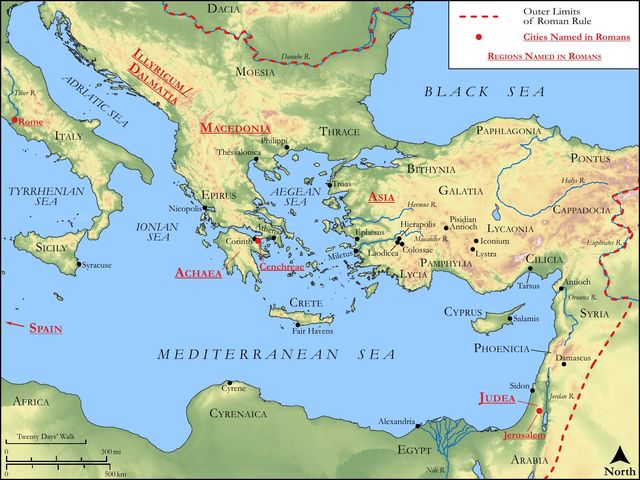
See on the biblical-era maps

Study this verse
Public-domain commentary
Matthew Henry
From his Commentary on the Whole Bible. Henry comments on passages, not single verses — this entry covers Romans 9:6–13. His three-level outline is real structure in the source text, so it is rendered as structure.
The apostle, having made his way to that which he had to say, concerning the rejection of the body of his countrymen, with a protestation of his own affection for them and a concession of their undoubted privileges, comes in these verses, and the following part of the chapter, to prove that the rejection of the Jews, by the establishment of the gospel dispensation, did not at all invalidate the word of God's promise to the patriarchs: Not as though the word of God hath taken no effect (Rom 9:6), which, considering the present state of the Jews, which created to Paul so much heaviness and continual sorrow (Rom 9:2), might be suspected. We are not to ascribe inefficacy to any word of God: nothing that he has spoken does or can fall to the ground; see Isa 55:10, Isa 55:11. The promises and threatenings shall have their accomplishment; and, one way or other, he will magnify the law and make it honourable. This is to be understood especially of the promise of God, which by subsequent providences may be to a wavering faith very doubtful; but it is not, it cannot be, made of no effect; at the end it will speak and not lie.
Now the difficulty is to reconcile the rejection of the unbelieving Jews with the word of God's promise, and the external tokens of the divine favour, which had been conferred upon them. This he does in four ways: - 1. By explaining the true meaning and intention of the promise, Rom 9:6-13. 2. By asserting and proving the absolute sovereignty of God, in disposing of the children of men, Rom 9:14-24. 3. By showing how this rejection of the Jews, and the taking in of the Gentiles, were foretold in the Old Testament, Rom 9:25-29. 4. By fixing the true reason of the Jews' rejection, Rom 9:30, to the end.
In this paragraph the apostle explains the true meaning and intention of the promise. When we mistake the word, and misunderstand the promise, no marvel if we are ready to quarrel with God about the accomplishment; and therefore the sense of this must first be duly stated. Now he here makes it out that, when God said he would be a God to Abraham, and to his seed (which was the famous promise made unto the fathers), he did not mean it of all his seed according to the flesh, as if it were a necessary concomitant of the blood of Abraham; but that he intended it with a limitation only to such and such. And as from the beginning it was appropriated to Isaac and not to Ishmael, to Jacob and not to Esau, and yet for all this the word of God was not made of no effect; so now the same promise is appropriated to believing Jews that embrace Christ and Christianity, and, though it throws off multitudes that refuse Christ, yet the promise is not therefore defeated and invalidated, any more than it was by the typical rejection of Ishmael and Esau.
I.He lays down this proposition - that they are not all Israel who are of Israel (Rom 9:6), neither because they are, etc., Rom 9:7.
Many that descended from the loins of Abraham and Jacob, and were of that people who were surnamed by the name of Israel, yet were very far from being Israelites indeed, interested in the saving benefits of the new covenant. They are not all really Israel that are so in name and profession. It does not follow that, because they are the seed of Abraham, therefore they must needs be the children of God, though they themselves fancied so, boasted much of, and built much upon, their relation to Abraham, Mat 3:9; Joh 8:38, Joh 8:39. But it does not follow. Grace does not run in the blood; nor are saving benefits inseparably annexed to external church privileges, though it is common for people thus to stretch the meaning of God's promise, to bolster themselves up in a vain hope.
II.He proves this by instances; and therein shows not only that some of Abraham's seed were chosen, and others not, but that God therein wrought according to the counsel of his own will; and not with regard to that law of commandments to which the present unbelieving Jews were so strangely wedded.
1.He specifies the case of Isaac and Ishmael, both of them the seed of Abraham; and yet Isaac only taken into covenant with God, and Ishmael rejected and cast out. For this he quotes Gen 21:12, In Isaac shall thy seed be called, which comes in there as a reason why Abraham must be willing to cast out the bond-woman and her son, because the covenant was to be established with Isaac, Gen 17:19. And yet the word which God had spoken, that he would be a God to Abraham and to his seed, did not therefore fall to the ground; for the blessings wrapt up in that great word, being communicated by God as a benefactor, he was free to determine on what head they should rest, and accordingly entailed them upon Isaac, and rejected Ishmael. This he explains further (Rom 9:8, Rom 9:9), and shows what God intended to teach us by this dispensation.
(1.)That the children of the flesh, as such, by virtue of their relation to Abraham according to the flesh, are not therefore the children of God, for then Ishmael had put in a good claim. This remark comes home to the unbelieving Jews, who boasted of their relation to Abraham according to the flesh, and looked for justification in a fleshly way, by those carnal ordinances which Christ had abolished. They had confidence in the flesh, and looked for justification in a fleshly way, by those carnal ordinances which Christ had abolished. They had confidence in the flesh, Phi 3:3. Ishmael was a child of the flesh, conceived by Hagar, who was young and fresh, and likely enough to have children. There was nothing extraordinary or supernatural in his conception, as there was in Isaac's; he was born after the flesh (Gal 4:29), representing those that expect justification and salvation by their own strength and righteousness.
(2.)That the children of the promise are counted for the seed. Those that have the honour and happiness of being counted for the seed have it not for the sake of any merit or desert of their own, but purely by virtue of the promise, in which God hath obliged himself of his own good pleasure to grant the promised favour. Isaac was a child of promise; this his proves, Rom 9:9, quoted from Gen 18:10. he was a child promised (so were many others), and he was also conceived and born by force and virtue of the promise, and so a proper type and figure of those who are now counted for the seed, even true believers, who are born, not of the will of the flesh, nor of the will of man, but of God - of the incorruptible seed, even the word of promise, by virtue of the special promise of a new heart: see Gal 4:28. It was through faith that Isaac was conceived, Heb 11:11. Thus were the great mysteries of salvation taught under the Old Testament, not in express words, but by significant types and dispensations of providence, which to them then were not so clear as they are to us now, when the veil is taken away, and the types are expounded by the antitypes.
2.The case of Jacob and Esau (Rom 9:10-13), which is much stronger, to show that the carnal seed of Abraham were not, as such, interested in the promise, but only such of them as God in sovereignty had appointed. There was a previous difference between Ishmael and Isaac, before Ishmael was cast out: Ishmael was the son of the bond-woman, born long before Isaac, was of a fierce and rugged disposition, and had mocked or persecuted Isaac, to all which it might be supposed God had regard when he appointed Abraham to cast him out. But, in the case of Jacob and Esau, it was neither so nor so, they were both the sons of Isaac by one mother; they were conceived hex henos - by one conception; hex henos koitou, so some copies read it. The difference was made between them by the divine counsel before they were born, or had done any good or evil. Both lay struggling alike in their mother's womb, when it was said, The elder shall serve the younger, without respect to good or bad works done or foreseen, that the purpose of God according to election might stand - that this great truth may be established, that God chooses some and refuses others as a free agent, by his own absolute and sovereign will, dispensing his favours or withholding them as he pleases. This difference that was put between Jacob and Esau he further illustrates by a quotation from Mal 1:2, Mal 1:3, where it is said, not of Jacob and Esau the person, but the Edomites and Israelites their posterity, Jacob have I loved, and Esau have I hated. The people of Israel were taken into the covenant of peculiarity, had the land of Canaan given them, were blessed with the more signal appearances of God for them in special protections, supplies, and deliverances, while the Edomites were rejected, had no temple, altar, priests, nor prophets - no such particular care taken of them nor kindness shown to them. Such a difference did God put between those two nations, that both descended from the loins of Abraham and Isaac, as at first there was a difference put between Jacob and Esau, the distinguishing heads of those two nations. So that all this choosing and refusing was typical, and intended to shadow forth some other election and rejection.
(1.)Some understand it of the election and rejection of conditions or qualifications. As God chose Isaac and Jacob, and rejected Ishmael and Esau, so he might and did choose faith to be the condition of salvation and reject the works of the law. Thus Arminius understands it, De rejectis et assumptis talibus, certa qualitate notatis - Concerning such as are rejected and such as are chosen, being distinguished by appropriate qualities; so John Goodwin. But this very much strains the scripture; for the apostle speaks all along of persons, he has mercy on whom (he does not say on what kind of people) he will have mercy, besides that against this sense those two objections (Rom 9:14, Rom 9:19) do not at all arise, and his answer to them concerning God's absolute sovereignty over the children of men is not at all pertinent if no more be meant than his appointing the conditions of salvation.
(2.)Others understand it of the election and rejection of particular person - some loved, and others hated, from eternity. But the apostle speaks of Jacob and Esau, not in their own persons, but as ancestors - Jacob the people, and Esau the people; nor does God condemn any, or decree so to do, merely because he will do it, without any reason taken from their own deserts.
(3.)Others therefore understand it of the election and rejection of people considered complexly. His design is to justify God, and his mercy and truth, in calling the Gentiles, and taking them into the church, and into covenant with himself, while he suffered the obstinate part of the Jews to persist in unbelief, and so to unchurch themselves - thus hiding from their eyes the things that belonged to their peace. The apostle's reasoning for the explication and proof of this is, however, very applicable to, and, no doubt (as is usual in scripture) was intended for the clearing of the methods of God's grace towards particular person, for the communication of saving benefits bears some analogy to the communication of church-privileges. The choosing of Jacob the younger, and preferring him before Esau the elder (so crossing hands), were to intimate that the Jews, though the natural seed of Abraham, and the first-born of the church, should be laid aside; and the Gentiles, who were as the younger brother, should be taken in in their stead, and have the birthright and blessing. The Jews, considered as a body politic, a nation and people, knit together by the bond and cement of the ceremonial law, the temple and priesthood, the centre of their unity, had for many ages been the darlings and favourites of heaven, a kingdom of priests, a holy nation, dignified and distinguished by God's miraculous appearances among them and for them. Now that the gospel was preached, and Christian churches were planted, this national body was thereby abandoned, their church-polity dissolved; and Christian churches (and in process of time Christian nations), embodied in like manner, become their successors in the divine favour, and those special privileges and protections which were the products of that favour. To clear up the justice of God in this great dispensation is the scope of the apostle here.
Historical interpretation
Nine Centuries of Reception
4 surviving comments on this verse. Each one is dated, so this reads as a timeline rather than a list.
Select a marker to jump to its quote. Markers stagger vertically where authors wrote within a few decades of each other.
Because the promises which had been given to the Jews had been transferred to the Gentiles, Paul wanted to avoid the charge that God had lied about his promises, and so he shows how God remains faithful. The Scriptures make it clear that it was not those who were Israelites according to the flesh but those who by their godliness showed that they were worthy to be Israelites who were called children of Abraham.
"Not as though the word of God had taken none effect." To show that he had courage to bear all these things for the word of God, that is, the promise made to Abraham. For as Moses seemed to be pleading for the Jews, yet was doing everything for God's glory (for he says, "Lest they say, Because He was not able to save them, He led them forth to destroy them in the wilderness"; stay Thy wrath), so also does Paul, That they may not say (he means) that the promise of God has fallen to the ground, and He has disappointed us of that. He vouched to us, and this word has not issued in deed, I could wish to be accursed.
This then was why he did not speak of the Gentiles (for to them no promises had been made by Him, nor had they worshipped Him, wherefore neither did any blaspheme Him on their account), but it was for the Jews who had both received the promise, and had also been brought into closer connection with Him than others, that he expressed this wish.
Since Paul has said above that he is upset that the people of Israel had been shut out of the kingdom by their own fault, for all these things had belonged to them, he shows here that those who do not believe are not sons of Abraham, lest someone think that he was opposed to all Jews and retort: “Did God then lie to Abraham?”
After asserting the greatness of the Jews [n. 735], the Apostle now shows that it did not refer to those who descended according to the flesh from the ancient patriarchs but to the spiritual progeny chosen by God. First, he shows that this greatness arises from God's selection; secondly, that this selection applies generally to Jew and Gentiles [v. 24; n. 796]. In regard to the first he does two things: first, he shows how from God's choice men obtain spiritual greatness; secondly, he raises a question about the justice of God's choice [v. 14; n. 765]. In regard to the first he does two things: First, he states his proposition; secondly shows it [v. 7b; n. 751]. Concerning the first, he does two things. First he sets out the firmness of the divine election; second, he shows in whom it is accomplished [v. 6b; n. 750]. 369 749. First, therefore, he says: It has been stated that the promises, the adoption of sons, and glory referred to people whose fall is to me a source of great sadness and unceasing sorrow. But it is not as though the word of God had failed, i.e., was frustrated, because although it has found no place in those who had fallen, it has a place in others: "The word that goes forth from my mouth shall not return to me empty, but it shall accomplish that which I purpose" (Is 55:11); "For ever, O Lord, thy word is firmly fixed" (Ps 119:89). 750. Then (v. 6b) he shows how and in whom God's word had failed. In regard to this it should be noted that the Jews boasted mainly of two things, namely, Abraham, who first received the pact of circumcision from God (Gen c.17) and Jacob of Israel, all of whom descendants were counted as God's people. This was not true of Isaac, for the descendants of his son Esau did not belong to God's people. Hence the Apostle states his proposition: first, by a comparison with Jacob: For not all who are descended form Israel i.e., from Jacob according to the flesh, are true Israelites, to whom God's promises belong, but those who are upright and see God by faith: "Fear not, Jacob, and thus most righteous whom I have chosen" (Is 44:2). Hence the Lord also said to Nathanael: "Behold, an Israelite indeed, in whom there is no guile" (Jn 1:47). Now this name, "Israel," had been put on Jacob by an angel (Gen c.32). Secondly, he states the same things by comparison with Abraham saying: and not all are children of Abraham because they are his descendants, i.e., are not the spiritual sons of Abraham to whom God promised the blessings, but only those who imitate his faith and works: "If you were Abraham's children, you would do what Abraham did" (Jn 8:40). 370 751. Then (v. 7b) he clarifies his statement: first, in regard to Abraham; secondly, in regard to Jacob [v. 10; n. 755]. 752. In regard to the first he does three things: first, he cites a text from Scripture, saying: through Isaac shall your descendants be named. This the Lord said to Abraham, as it says in Gen (c. 21), when describing the expulsion of Ishmael. As if to say: not all who were born from Abraham according to the flesh belong to that seed to whom the promises were made, but hose who are like Isaac. 753. Then (v. 8) he explains the quoted text so far as it applies to his thesis. To understand this it should be noted that the Apostle says in Gal (4:22): "Abraham had two sons, on e by a slave and one by a free woman. But the son of the slave," namely, Ishmael, "was born according to the flesh," because he was born according to the law and custom of the flesh from a young woman: "the son of the free woman," namely, Isaac, "through promise" and not according to the flesh, i.e., not according to the law and custom of the flesh, because he was born from a sterile, old woman, as it says in Gen (c.18); although he was born according to the flesh, i.e., according to the substance of the flesh he received from his parents. From this the Apostle decides that those adopted into the sonship of God are not the sons of the flesh, i.e., not because they are the bodily descendants of Abraham, but the children of the promise are descendants, i.e., those who are made songs of Abraham because they imitate his faith, as it says in Mt (3:9): "God is able from these stones to raise up children to Abraham." Thus, Ishmael, born according to the flesh was not numbered among the seed, but Isaac born by the promise was. 371 Thirdly, (v.9) he proves that his explanation is valid, when he says that the children of the promise are the ones signified by Isaac, namely, because Isaac was born as the result of a promise. Hence he says: For this is what the promise said. Indeed, this is the statement the angel or the Lord through an angel made to Abraham: About this time I will return, by which the time of grace is signified: "When the time had fully come, God sent forth his Son" (Gal 4:4) and Sarah shall have a son on account of the promise. Hence, it says in Gal (4:5): "So that we might receive adoption of sons." 755. Then (v. 10) he clarifies his thesis so far as it concerns Jacob. First he states his intention; secondly, he clarifies his position [v. 11; n. 757]. 756. First, therefore, he says: And not only she, namely, Sarah, begot a son about whom the promise was made, but also Rebecca, having in her womb two sons, one of whom pertained to the promise and the other only to the flesh, had conceived children by one man, our forefather Isaac. For it says in Gen (25:21): "Isaac prayed to the Lord for his wife, because she was barren, and the Lord gave her conception, but the children struggled together within her." And it should be noted that the Apostle cites this against the Jews who supposed that they would obtain righteousness through the merits of their forefathers, which is contrary to what is said about just men, namely, that "they will deliver neither sons nor daughters but they alone will be delivered" (Ez 14:18). This is why John said to the Jews: "Do not presume to say, 'We have Abraham as our father'" (Mt 3:9). Paul, therefore, 372 counters this opinion by reminding them that of Abraham's children one was chosen and the other rejected. But he could have ascribed this difference to the mothers, because Ishmael was born of a slave and Isaac of a free woman, or to the changed meriting state of the father; because while uncircumcised he begot Ishmael but circumcised he begot Isaac. To exclude any such subterfuge, therefore, he cites the case where one is chosen and the other rejected, even though both were born of the same father and the same mother at the same time and, indeed, from one coition. 757. Then (v. 11) he clarifies his thesis: first, by the authority of Gen (c. 28); secondly, by a text from the prophet Malachi (v. 13). 758. In regard to the first he does three things: first, he indicates the time of the promise and says that when they were not yet born, one of the sons of Rebecca was set over the other in virtue of the promise. And just as his previous statement excluded the opinion of the Jews trusting in the merits of their forefathers, so this statement counters the error of the Manicheans who claimed that a person's life and death were controlled by the constellation under which he was born, against what is said in Jer (10:2) "Be not afraid of the signs of heaven which the heathens fear." Then when he continues: though they had done nothing either good or bad, the Pelagian error is refuted which says that grace is given according to one's preceding merits, even though it says in *** (3:5): "He saved us, not because of deeds done by us in righteousness, but in virtue of his own mercy." 373 Both of these are shown false by the fact that before birth and before doing anything one of Rebecca's sons is preferred to the other. This also corrects Origen's error who supposed that men's souls were created when the angels were, and that they merited different lives depending on the merits they earned for the good or evil they had done there. This could not be true in the light of what is stated here, namely that they had done nothing either good or bad. Against this also is Job (38:7): "Where were you when the morning stars praised me together and all the sons of God made joyful melody?" For according to Origen's error, he could have answered: I was among those joyful sons of God. 759. Secondly, he shows what could be understood from that promise by which one of the twins in the womb was chosen over the other. He says: In order that God's purpose, by which one would be greater than the other, might continue, i.e., be made firm: and this not by reason of merits but of election i.e., inasmuch as God himself spontaneously forechose one over the other, not because he was holy but in order that he be holy, as it says in Eph (1:4): "He chose us in himself before the foundation of the world that we should be holy." But this is a decree of predestination about which the same text says: "Predestined according to the purpose of his will" (Eph 1:15). 760. Thirdly, he sets down the promise, saying, not because of works, for no works preceded it, as has been said: but because of his call, i.e., through the grace of God calling, for she was told, i.e., Rebecca, that the elder, i.e., Esau, will serve the younger, i.e., Jacob. This can be understood in three ways. 761. In one way, as referring to the persons involved, and then Esau is understood to have served Jacob, not directly but indirectly, inasmuch as the persecution he launched 374 27 A capsa was a box for holding parchment scrolls. A capsarius was slave whose job it was to carry the scrolls. against him ended in Jacob's benefit, as it says in Pr (11:29): "The fool will serve the wise." Secondly, it can be referred to the people who sprang from each, because the Edomites were once subject to the Israelites, as it says in Ps 60 (v.8); "Upon Edom I cast my shoe." This seems to fit Gen (25:23): "The nations are in your womb; the one shall be stronger than the other." Thirdly, it can be taken figuratively so that by the elder is understood the Jewish people, who were the first to receive the adoption of sons, in accord with Ex 4:22, "Israel is my firstborn son," and by the younger is understood the Gentiles, who were called to the Father later and were signified by the prodigal son (Lk c. 15). The elder people in this case serve the younger, inasmuch as the Jews are our capsarii,27 guarding the books form which the truths of our faith are drawn: "Search the scriptures" (Jn 5:39). 762. Then (v. 13) he proves his point by the authority of the prophet Malachi speaking in the person of God Who says: Jacob I loved, but Esau I hated. A gloss on this says that the statement, the elder will serve the younger, was spoken from foreknowledge, but that the present statement results from judgment, i.e., that God loved Jacob on account of his good works, just as He loves all the saints: "I love those who love me (Pr 8:17), but he hated Esau on account of his sings, as it says in Si (12:3): "The Highest hates sinners." But because man's love is preceded by God's love: "Not that we loved God, but that he has first loved us" (1 Jn 4:20), we must say that Jacob was loved by God before he 375 loved God. Nor can it be said that God began to love him at a fixed point in time; otherwise His love would be changeable. Consequently, one must say that God loved Jacob from all eternity, as it says in Jer (31:3): "I have loved you with an everlasting love." 763. Now these words of the Apostle identify in God three things pertaining to the saints, namely, election, by which is understood God's predestination and election. In God these are really the same, but in our understanding they differ. For it is called God's love, inasmuch as he wills good to a person absolutely; it is election, inasmuch as through the good he wills for a person, he prefers him to someone else. But it is called predestination, inasmuch as he directs a person to the good he wills for him by loving and choosing him. According to these definitions predestination comes after love, just as the will's fixation on the end naturally precedes the process of directing things towards the end. Election and love, however, are ordered differently in God than in man. For in men, election precedes love, for a man's will is inclined to love a thing on account of the good perceived in it, this good also being the reason why he prefers one thing to another and why he fixed his love on the thing he preferred. But God's love is the cause of every good found in a creature; consequently, the good in virtue of which one is preferred to another through election follows upon Gods willing it—which pertains to His love, Consequently, it is not in virtue of some good which He selects in a man that God love him; rather, it is because He loved him that He prefers him to someone by election. 376 764. But just as the love, about which we are speaking, pertains to Gods eternal predestination, so the hatred about which we are speaking pertains to the rejection by which God rejects sinners. It should not be supposed that this rejection is temporal, because nothing in the divine will is temporal; rather, it is eternal. Furthermore, it is akin to love or predestination in some respect and different in another. It is akin in the sense that just as predestination is preparation for glory, so rejection is preparation for punishment: "For a burning place has long been prepared, yes, for the king it is made ready" (Is 30:33). It is different in that predestination implies preparation of the merits by which glory is reached, but rejection implies preparation of the sins by which punishment is reached. Consequently, a foreknowledge of merits cannot be the reason for predestination, because the foreknown merits fall under predestination; but the foreknowledge of sins can be a reason for rejection on the part of the punishment prepared for the rejected, inasmuch as God proposes to punish the wicked for the sins they have from themselves, not from God; the just He proposes to reward on account of the merits they do not have from themselves: "Destruction is thy own, O Israel; thy help is only in me" (Hos 13:9).
Continue studying Romans 9:6 across the web’s major study libraries — every link below opens this exact verse, chapter, or book on the destination site.
Read & Compare
 BibleGatewayThis verse in more than 200 translations and 70 languages.
 Bible.comThe YouVersion reader — hundreds of translations, reading plans, and highlights.
 ESV.orgCrossway's official English Standard Version reader.
 NET BibleThe NET translation with 60,000+ translators' notes on every rendering decision.
 STEP BibleTyndale House's free study tool — original text, vocabulary, and scholarly resources.
 BibliaLogos Bible Software's free web reader.
 USCCBThe New American Bible (Revised Edition) with the U.S. bishops' study notes.
Commentaries
 BibleHub CommentariesDozens of classic commentaries on this verse, gathered on one page.
 StudyLightMore than 100 commentary sets — the largest collection on the web.
 BibleRefPlain-English commentary on what this verse means, verse by verse.
 Enduring WordDavid Guzik's free commentary on this chapter, widely used by Bible teachers.
 Bible Study ToolsVerse commentary alongside Greek and Hebrew study aids.
Original Language & Research
- BibleHub InterlinearThe verse word by word — original language, transliteration, and English.
- BibleHub LexiconEvery word's original-language definition and Strong's entry.
 Blue Letter BibleDeep-study tools — Strong's numbers, concordance, and word studies.
 CNTR CollationThe earliest Greek manuscripts of this verse, collated letter by letter.
Sermons, Hymns & Audio


TrulyRandomVerse is not affiliated with these sites and doesn’t control their content. They’re linked because they’re genuinely useful.
Summary
Romans 9:6 serves as a pivotal statement in Paul's defense of God's faithfulness amidst Israel's widespread rejection of the Messiah. Paul emphatically declares that God's divine word and promises have not failed, despite the apparent contradiction of many Jewish people not embracing Christ. He immediately clarifies this by introducing a crucial distinction: not all who are ethnically descended from Israel are considered true, spiritual Israel in God's eyes, thereby setting the stage for a deeper exploration of God's sovereign election and the true nature of His covenant people.
Context
ShowHideLiterary Context
Romans 9:6 stands at the nexus of Paul's theological argument in his letter to the Romans. Chapters 1-8 establish the universal need for salvation by grace through faith in Christ, applicable to both Jew and Gentile. However, this raises a profound question: If salvation is now by faith and many Jews have not believed, has God's covenant with Israel failed? Paul anticipates this objection, expressing deep sorrow and anguish for his kinsmen in Romans 9:1-5. Verse 6 directly addresses this perceived failure, asserting God's unwavering faithfulness and introducing the critical theological distinction between ethnic Israel and the true, spiritual Israel, which forms the bedrock for his subsequent arguments concerning God's sovereign election and the inclusion of Gentiles in God's redemptive plan.
Historical & Cultural Context
For centuries, the Jewish people understood themselves as God's chosen nation, distinct by covenant, law, and lineage from all other peoples. Their identity was inextricably linked to their descent from Abraham, Isaac, and Jacob (Israel). The idea that God's promises to them could somehow "fail" or that their ethnic heritage might not guarantee their standing before God was profoundly challenging. Paul, a Jew himself, understood this deeply ingrained identity. His argument in Romans 9-11 navigates this complex issue, seeking to reconcile God's historical promises to Israel with the new reality of salvation in Christ, which transcends ethnic boundaries. The Roman church, composed of both Jewish and Gentile believers, needed clarity on this matter to understand God's unified plan for humanity and to foster harmonious relationships within the diverse Christian community.
Key Themes
ShowHideThis verse introduces and reinforces several key themes central to Romans 9 and the broader Pauline corpus. Primarily, it underscores God's unwavering faithfulness to His word and promises, even when human circumstances seem to suggest otherwise. Secondly, it establishes the crucial distinction between physical and spiritual Israel, asserting that true membership in God's covenant people is not solely based on ethnic descent but on God's sovereign election and call. This concept lays the groundwork for understanding the doctrine of election, as further elaborated by Paul through examples like Jacob and Esau. Ultimately, Romans 9:6 sets the stage for Paul's robust defense of God's justice and sovereignty in salvation history, paving the way for the inclusion of Gentiles and the eventual restoration of Israel, as discussed in Romans 11.
Exposition and Analysis
ShowHideKey Word Analysis
ShowHideThis term (G3056) refers to "something said," "a topic," "reasoning," or "the Divine Expression." In the phrase "the word of God," it signifies God's divine utterance, His promises, and His revealed plan. Paul is asserting that God's authoritative declaration and covenant faithfulness have not been rendered ineffective.
Derived from ek (out of) and píptō (to fall), this word (G1601) literally means "to drop away," "to fall off," or "to fail." Figuratively, it conveys the idea of becoming inefficient, losing power, or being rendered void. Paul emphatically denies that God's word has "fallen short" or "failed" in its intended purpose, despite the apparent contradiction of Israel's unbelief.
This proper noun (G2474), of Hebrew origin, refers to Jacob's adopted name and, by extension, his descendants. Paul's masterful use of "Israel" twice in the same clause—"not all Israel, which are of Israel"—is the linchpin of his argument. The first "Israel" refers to the true, spiritual people of God, chosen by divine purpose. The second "Israel" refers to the physical, ethnic descendants of Jacob. This deliberate repetition highlights the crucial distinction Paul is making.
Verse Breakdown
ShowHide"Not as though the word of God hath taken none effect."
This opening phrase is a powerful rhetorical denial. Paul anticipates and refutes the potential accusation that God's promises to Israel have somehow failed or been nullified due to the majority of the Jewish people's rejection of Jesus as Messiah. He firmly asserts God's unwavering faithfulness and the absolute reliability of His divine word, setting the stage for his explanation.
"For they are not all Israel, which are of Israel:"
This is the core theological statement of the verse, providing the reason for the preceding assertion. Paul introduces a critical distinction: merely being a physical descendant of Jacob (ethnic "Israel") does not automatically qualify one as part of the "true" or "spiritual" Israel in God's eyes. This implies that within the broader ethnic Israel, there is a distinct, chosen remnant—the "Israel within Israel"—who are the true recipients of God's promises, not by birthright alone, but by God's sovereign election and grace.
Literary Devices
ShowHideRomans 9:6 employs several impactful literary devices. The most prominent is Distinction or Qualification, as Paul carefully distinguishes between two senses of "Israel" within a single sentence. This precise use of language clarifies that ethnic lineage is not the sole determinant of one's standing as God's covenant people. Furthermore, the verse presents a profound Paradox: while outward appearances suggest God's word has failed concerning Israel, Paul asserts the opposite, creating a tension that he resolves by introducing the concept of a spiritual Israel. The opening phrase, "Not as though the word of God hath taken none effect," can also be seen as a form of Euphemism or Understatement, as it gently addresses a deeply troubling theological problem (the perceived failure of God's promises) without directly stating the accusation, allowing Paul to immediately offer his profound clarification. The Repetition of "Israel" within the same clause serves to emphasize and delineate the two distinct meanings, forcing the reader to grapple with the nuance of Paul's argument.
Theological and Thematic Connections
ShowHideRomans 9:6 is foundational for understanding God's ongoing relationship with Israel and the nature of His covenant faithfulness. It clarifies that God's promises are not contingent on human response or ethnic lineage alone, but on His sovereign purpose and election. This verse introduces the profound theological truth that there is a "spiritual Israel" chosen by grace, distinct from those who are merely physical descendants. This distinction is crucial for reconciling God's historical promises to Israel with the reality of salvation by faith in Christ, open to both Jews and Gentiles. It underscores the principle that God's redemptive plan is always on track, even when human actions or historical events seem to contradict it, affirming His unwavering faithfulness to His ultimate purposes.
Reflection and Application
ShowHideRomans 9:6 offers profound lessons for believers today, primarily reinforcing the absolute trustworthiness of God's word and His unyielding faithfulness. In a world where promises are often broken and circumstances frequently challenge our faith, this verse reminds us that God's divine plan will never "take none effect." Our salvation is not based on our heritage, accomplishments, or outward religious affiliation, but solely on God's sovereign grace and our response of faith in Christ. This truth is incredibly liberating, emphasizing that the true mark of belonging to God's people is a spiritual one, not a genetic or cultural one. It calls us to examine where we place our ultimate identity—in our family, nation, or achievements, or in our spiritual union with Christ, who is the embodiment of true Israel.
Questions for Reflection
ShowHideFAQ
ShowHideDoes Romans 9:6 imply that God has rejected ethnic Israel?
ShowHideNo, Romans 9:6 does not imply that God has entirely rejected ethnic Israel. Instead, it clarifies that God's promises were never exclusively for all ethnic Israelites, but for a chosen remnant within Israel, those who are "true Israel" by God's sovereign design. Paul's argument in Romans 9-11 is a nuanced one. While he acknowledges the widespread unbelief among his kinsmen, he also expresses his deep sorrow and hope for their salvation (Romans 10:1). Furthermore, he explicitly states that God has not cast away His people (Romans 11:1) and prophesies a future time when "all Israel will be saved" (Romans 11:26), indicating God's enduring faithfulness to His covenant people, even if their salvation unfolds according to His sovereign timeline and method.
Christ-Centered Fulfillment
ShowHideRomans 9:6, by distinguishing between physical and spiritual Israel, profoundly points to Christ as the ultimate fulfillment of God's promises and the true "Israel" in whom all God's redemptive purposes coalesce. Jesus, as the perfect Son of God and the faithful Israelite, embodies the true spiritual lineage that God always intended. He is the "seed" of Abraham through whom all the nations of the earth are blessed, as promised in Genesis 12:3. In Christ, the promises made to Israel find their "Yes" and "Amen" (2 Corinthians 1:20). Through His atoning work, the barrier between Jew and Gentile is broken down, and a new spiritual "Israel of God" is formed, comprised of all who believe in Him, regardless of their ethnic background (Galatians 6:16). Thus, the true Israel is not merely a physical lineage, but a people defined by their relationship with Christ, who is the very essence and embodiment of God's redemptive plan for humanity.