


Romans 3:3
- τίtiWhatG5101I-NSNInterrogative pronoun Nominative Singular Neuter
- γὰρgarforG1063CONJConjunction
- εἰeiifG1487CONDConjunction
- ἠπίστησάνēpistēsandisbelievedG569V-AAI-3PVerb Aorist Active Indicative 3rd Plural
- τινες;tinessome?G5100X-NPMIndefinite pronoun Nominative Plural Masculine
- μὴmēSurely notG3361PRT-NNegative Particle Negative
- ἡhētheG3588T-NSFDefinite article Nominative Singular Feminine
- ἀπιστίαapistiaunbeliefG570N-NSFNoun Nominative Singular Feminine
- αὐτῶνautōnof themG846P-GPMPersonal pronoun Genitive Plural Masculine
- τὴνtēntheG3588T-ASFDefinite article Accusative Singular Feminine
- πίστινpistinfaithfulnessG4102N-ASFNoun Accusative Singular Feminine
- τοῦtou<the>G3588T-GSMDefinite article Genitive Singular Masculine
- θεοῦtheouof GodG2316N-GSM-TNoun Genitive Singular Masculine Title
- καταργήσει;katargēseiwill nullify?G2673V-FAI-3SVerb Future Active Indicative 3rd Singular
English is a literal word-by-word gloss of the Greek, not the KJV's wording. Why?
This is the original text the KJV's translators worked from — each Greek word with its own literal English meaning in this verse, prepared by scholars at Tyndale House, Cambridge. The KJV translates whole sentences, not word by word, so its wording differs: one Greek word can become several English words, and the KJV may choose “charity” where the gloss reads “love”. Both are faithful — they answer different questions. For the KJV's own rendering, switch to the KJV text.
Details
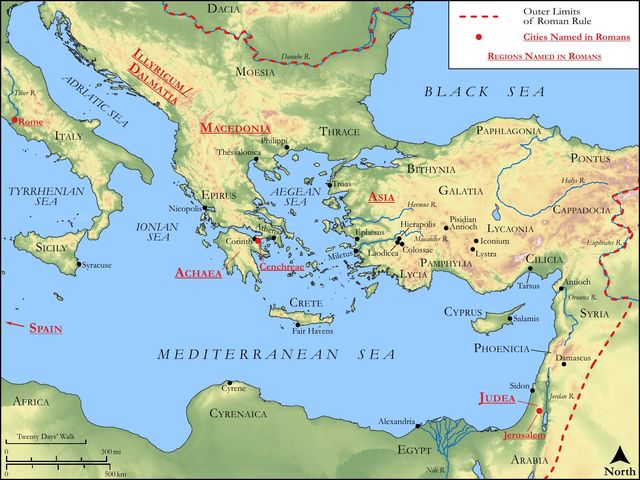
See on the biblical-era map

Study this verse
Public-domain commentary
Matthew Henry
From his Commentary on the Whole Bible. Henry comments on passages, not single verses — this entry covers Romans 3:1–18. His four-level outline is real structure in the source text, so it is rendered as structure.
I.Here the apostle answers several objections, which might be made, to clear his way.
No truth so plain and evident but wicked wits and corrupt carnal hearts will have something to say against it; but divine truths must be cleared from cavil.
Object. 1. If Jew and Gentile stand so much upon the same level before God, what advantage then hath the Jew? Hath not God often spoken with a great deal of respect for the Jews, as a non-such people (Deu 33:29), a holy nation, a peculiar treasure, the seed of Abraham his friend: Did not he institute circumcision as a badge of their church-membership, and a seal of their covenant-relation to God? Now does not this levelling doctrine deny them all such prerogatives, and reflect dishonour upon the ordinance of circumcision, as a fruitless insignificant thing.
Answer. The Jews are, notwithstanding this, a people greatly privileged and honoured, have great means and helps, though these be not infallibly saving (Rom 3:2): Much every way. The door is open to the Gentiles as well as the Jews, but the Jews have a fairer way up to this door, by reason of their church-privileges, which are not to be undervalued, though many that have them perish eternally for not improving them. He reckons up many of the Jews' privileges Rom 9:4, Rom 9:5; here he mentions but one (which is indeed instar omnium - equivalent to all), that unto them were committed the oracles of God, that is, the scriptures of the Old Testament, especially the law of Moses, which is called the lively oracles (Act 7:38), and those types, promises, and prophecies, which relate to Christ and the gospel. The scriptures are the oracles of God: they are a divine revelation, they come from heaven, are of infallible truth, and of eternal consequence as oracles. The Septuagint call the Urim and Thummim the logia - the oracles. The scripture is our breast-plate of judgment. We must have recourse to the law and to the testimony, as to an oracle. The gospel is called the oracles of God, Heb 5:12; Pe1 4:11. Now these oracles were committed to the Jews; the Old Testament was written in their language; Moses and the prophets were of their nation, lived among them, preached and wrote primarily to and for the Jews. They were committed to them as trustees for succeeding ages and churches. The Old Testament was deposited in their hands, to be carefully preserved pure and uncorrupt, and so transmitted down to posterity. The Jews were the Christians' library-keepers, were entrusted with that sacred treasure for their own use and benefit in the first place, and then for the advantage of the world; and, in preserving the letter of the scripture, they were very faithful to their trust, did not lose one iota or tittle, in which we are to acknowledge God's gracious care and providence. The Jews had the means of salvation, but they had not the monopoly of salvation. Now this he mentions with a chiefly, prōton men gar - this was their prime and principal privilege. The enjoyment of God's word and ordinances is the chief happiness of a people, is to be put in the imprimis of their advantages, Deu 4:8; Deu 33:3; Psa 147:20.
Object. 2. Against what he had said of the advantages the Jews had in the lively oracles, some might object the unbelief of many of them. To what purpose were the oracles of God committed to them, when so many of them, notwithstanding these oracles, continued strangers to Christ, and enemies to his gospel? Some did not believe, Rom 3:3.
Answer. It is very true that some, nay most of the present Jews, do not believe in Christ; but shall their unbelief make the faith of God without effect? The apostle startles at such a thought: God forbid! The infidelity and obstinacy of the Jews could not invalidate and overthrow those prophecies of the Messiah which were contained in the oracles committed to them. Christ will be glorious, though Israel be not gathered, Isa 49:5. God's words shall be accomplished, his purposes performed, and all his ends answered, though there be a generation that by their unbelief go about to make God a liar. Let God be true but every man a liar; let us abide by this principle, that God is true to every word which he has spoken, and will let none of his oracles fall to the ground, though thereby we give the lie to man; better question and overthrow the credit of all the men in the world than doubt of the faithfulness of God. What David said in his haste (Psa 116:11), that all men are liars, Paul here asserts deliberately. Lying is a limb of that old man which we every one of us come into the world clothed with. All men are fickle, and mutable, and given to change, vanity and a lie (Psa 62:9), altogether vanity, Psa 39:5. All men are liars, compared with God. It is very comfortable, when we find every man a liar (no faith in man), that God is faithful. When they speak vanity every one with his neighbour, it is very comfortable to think that the words of the Lord are pure words, Psa 12:2, Psa 12:6. For the further proof of this he quotes Psa 51:4, That thou mightest be justified, the design of which is to show, 1. That God does and will preserve his own honour in the world, notwithstanding the sins of men. 2. That it is our duty, in all our conclusions concerning ourselves and others, to justify God and to assert and maintain his justice, truth, and goodness, however it goes. David lays a load upon himself in his confession, that he might justify God, and acquit him from any injustice. So here, Let the credit or reputation of man shift for itself, the matter is not great whether it sink or swim; let us hold fast this conclusion, how specious soever the premises may be to the contrary, that the Lord is righteous in all his ways, and holy in all his works. Thus is God justified in his sayings, and cleared when he judges (as it is Psa 51:4), or when he is judged, as it is here rendered. When men presume to quarrel with God and his proceedings, we may be sure the sentence will go on God's side.
Object. 3. Carnal hearts might hence take occasion to encourage themselves in sin. He had said that the universal guilt and corruption of mankind gave occasion to the manifestation of God's righteousness in Jesus Christ. Now it may be suggested, If all our sin be so far from overthrowing God's honour that it commends it, and his ends are secured, so that there is no harm done, is it not unjust for God to punish our sin and unbelief so severely? If the unrighteousness of the Jews gave occasion to the calling in of the Gentiles, and so to God's greater glory, why are the Jews so much censured? If our unrighteousness commend the righteousness of God, what shall we say? Rom 3:5. What inference may be drawn from this? Is God unrighteous, mē adikos ho Theos - Is not God unrighteous (so it may be read, more in the form of an objection), who taketh vengeance? Unbelieving hearts will gladly take any occasion to quarrel with equity of God's proceedings, and to condemn him that is most just, Job 34:17. I speak as a man, that is, I object this as the of carnal hearts; it is suggested like a man, a vain, foolish, proud creature.
Answer. God forbid; far be it from us to imagine such a thing. Suggestions that reflect dishonour upon God and his justice and holiness are rather to be startled at than parleyed with. Get thee behind me, Satan; never entertain such a thought. For then how shall God judge the world? Rom 3:6. The argument is much the same with that of Abraham (Gen 18:25): Shall not the Judge of all the earth do right? No doubt, he shall. If he were not infinitely just and righteous, he would be unfit to be the judge of all the earth. Shall even he that hateth right govern? Job 34:17. Compare Job 34:18, Job 34:19. The sin has never the less of malignity and demerit in it though God bring glory to himself out of it. It is only accidentally that sin commends God's righteousness. No thanks to the sinner for that, who intends no such thing. The consideration of God's judging the world should for ever silence all our doubtings of, and reflections upon, his justice and equity. It is not for us to arraign the proceedings of such an absolute Sovereign. The sentence of the supreme court, whence lies no appeal, is not to be called in question.
Object. 4. The former objection is repeated and prosecuted (Rom 3:7, Rom 3:8), for proud hearts will hardly be beaten out of their refuge of lies, but will hold fast the deceit. But his setting off the objection in its own colours is sufficient to answer it: If the truth of God has more abounded through my lie. He supposes the sophisters to follow their objection thus: "If my lie, that is, my sin" (for there is something of a lie in every sin, especially in the sins of professors) "have occasioned the glorifying of God's truth and faithfulness, why should I be judged and condemned as a sinner, and not rather thence take encouragement to go on in my sin, that grace may abound?" an inference which at first sight appears too black to be argued, and fit to be cast out with abhorrence. Daring sinners take occasion to boast in mischief, because the goodness of God endures continually, Psa 52:1. Let us do evil that good may come is oftener in the heart than in the mouth of sinners, so justifying themselves in their wicked ways. Mentioning this wicked thought, he observes, in a parenthesis, that there were those who charged such doctrines as this upon Paul and his fellow-ministers: Some affirm that we say so. It is no new thing for the best of God's people and ministers to be charged with holding and teaching such things as they do most detest and abhor; and it is not to be thought strange, when our Master himself was said to be in league with Beelzebub. Many have been reproached as if they had said that the contrary of which they maintain: it is an old artifice of Satan thus to cast dirt upon Christ's ministers, Fortiter calumniari, aliquid adhaerebit - Lay slander thickly on, for some will be sure to stick. The best men and the best truths are subject to slander. Bishop Sanderson makes a further remark upon this, as we are slanderously reported - blasphēmoumetha. Blasphemy in scripture usually signifies the highest degree of slander, speaking ill of God. The slander of a minister and his regular doctrine is a more than ordinary slander, it is a kind of blasphemy, not for his person's sake, but for his calling's sake and his work's sake, Th1 5:13.
Answer. He says no more by way of confutation but that, whatever they themselves may argue, the damnation of those is just. Some understand it of the slanderers; God will justly condemn those who unjustly condemn his truth. Or, rather, it is to be applied to those who embolden themselves in sin under a pretence of God's getting glory to himself out of it. Those who deliberately do evil that good may come of it will be so far from escaping, under the shelter of that excuse, that it will rather justify their damnation, and render them the more inexcusable; for sinning upon such a surmise, and in such a confidence, argues a great deal both of the wit and of the will in the sin - a wicked will deliberately to choose the evil, and a wicked wit to palliate it with the pretence of good arising from it. Therefore their damnation is just; and, whatever excuses of this kind they may now please themselves with, they will none of them stand good in the great day, but God will be justified in his proceedings, and all flesh, even the proud flesh that now lifts up itself against him, shall be silent before him. Some think Paul herein refers to the approaching ruin of the Jewish church and nation, which their obstinacy and self-justification in their unbelief hastened upon them apace.
II.Paul, having removed these objections, next revives his assertion of the general guilt and corruption of mankind in common, both of Jews and Gentiles, Rom 3:9-18. "Are we better than they, we Jews, to whom were committed the oracles of God? Does this recommend us to God, or will this justify us? No, by no means." Or, "Are we Christians (Jews and Gentiles) so much better antecedently than the unbelieving part as to have merited God's grace? Alas! no: before free grace made the difference, those of us that had been Jews and those that had been Gentiles were all alike corrupted." They are all under sin. Under the guilt of sin: under it as under a sentence; - under it as under a bond, by which they are bound over to eternal ruin and damnation; - under it as under a burden (Psa 38:4) that will sink them to the lowest hell: we are guilty before God, Rom 3:19. Under the government and dominion of sin: under it as under a tyrant and cruel task-master, enslaved to it; - under it as under a yoke; - under the power of it, sold to work wickedness. And this he had proved, proētiasametha. It is a law term: We have charged them with it, and have made good our charge; we have proved the indictment, we have convicted them by the notorious evidence of the fact. This charge and conviction he here further illustrates by several scriptures out of the Old Testament, which describe the corrupt depraved state of all men, till grave restrain or change them; so that herein as in a glass we may all of us behold our natural face. The Rom 3:10, Rom 3:11, and Rom 3:12 verses are taken from Psa 14:1-3, which are repeated as containing a very weighty truth, Psa 53:1-3. The rest that follows here is found in the Septuagint translation of the 14th Psalm, which some think the apostle chooses to follow as better known; but I rather think that Paul took these passages from other places of scripture here referred to, but in later copies of the Septuagint they were all added in Psa 14:1-7 from this discourse of Paul. It is observable that, to prove the general corruption of nature, he quotes some scriptures which speak of the particular corruptions of particular persons, as of Doeg (Psa 140:3), of the Jews (Isa 59:7, Isa 59:8), which shows that the same sins that are committed by one are in the nature of all. The times of David and Isaiah were some of the better times, and yet to their days he refers. What is said Psa 14:1-7 is expressly spoken of all the children of men, and that upon a particular view and inspection made by God himself. The Lord looked down, as upon the old world, Gen 6:5. And this judgment of God was according to truth. He who, when he himself had made all, looked upon every thing that he had made, and behold all was very good, now that man had marred all, looked, and behold all was very bad. Let us take a view of the particulars. Observe,
1.That which is habitual, which is two-fold: -
(1.)An habitual defect of every thing that is good.
[1.]There is none righteous, none that has an honest good principle of virtue, or is governed by such a principle, none that retains any thing of that image of God, consisting in righteousness, wherein man was created; no, not one; implying that, if there had been but one, God would have found him out. When all the world was corrupt, God had his eye upon one righteous Noah. Even those who through grace are justified and sanctified were none of them righteous by nature. No righteousness is born with us. The man after God's own heart owns himself conceived in sin.
[2.]There is none that understandeth, Rom 3:11. The fault lies in the corruption of the understanding; that is blinded, depraved, perverted. Religion and righteousness have so much reason on their side that if people had but any understanding they would be better and do better. But they do not understand. Sinners are fools.
[3.]None that seeketh after God, that is, none that has any regard to God, any desire after him. Those may justly be reckoned to have no understanding that do not seek after God. The carnal mind is so far from seeking after God that really it is enmity against him.
[4.]They are together become unprofitable, Rom 3:12. Those that have forsaken God soon grow good for nothing, useless burdens of the earth. Those that are in a state of sin are the most unprofitable creatures under the sun; for it follows,
[5.]There is none that doeth good; no, not a just man upon the earth, that doeth good, and sinneth not, Ecc 7:23. Even in those actions of sinners that have some goodness in them there is a fundamental error in the principle and end; so that it may be said, There is none that doeth good. Malum oritur ex quolibet defectu - Every defect is the source of evil.
(2.)An habitual defection to every thing that is evil: They are all gone out of the way. No wonder that those miss the right way who do not seek after God, the highest end. God made man in the way, set him in right, but he hath forsaken it. The corruption of mankind is an apostasy.
2.That which is actual. And what good can be expected from such a degenerate race? He instances,
(1.)In their words (Rom 3:13, Rom 3:14), in three things particularly: - [1.] Cruelty: Their throat is an open sepulchre, ready to swallow up the poor and innocent, waiting an opportunity to do mischief, like the old serpent seeking to devour, whose name is Abaddon and Apollyon, the destroyer. And when they do not openly avow this cruelty, and vent it publicly, yet they are underhand intending mischief: the poison of asps is under their lips (Jam 3:8), the most venomous and incurable poison, with which they blast the good name of their neighbour by reproaches, and aim at his life by false witness. These passages are borrowed from Psa 5:9 and Psa 140:3. [2.] Cheating: With their tongues they have used deceit. Herein they show themselves the devil's children, for he is a liar, and the father of lies. They have used it: it intimates that they make a trade of lying; it is their constant practice, especially belying the ways and people of God. [3.] Cursing: reflecting upon God, and blaspheming his holy name; wishing evil to their brethren: Their mouth is full of cursing and bitterness. This is mentioned as one of the great sins of the tongue, Jam 3:9. But those that thus love cursing shall have enough of it, Psa 109:17-19. How many, who are called Christians, do by these sin evince that they are still under the reign and dominion of sin, still in the condition that they were born in.
(2.)In their ways (Rom 3:15-17): Their feet are swift to shed blood; that is, they are very industrious to compass any cruel design, ready to lay hold of all such opportunities. Wherever they go, destruction and misery go along with them; these are their companions-destruction and misery to the people of God, to the country and neighbourhood where they live, to the land and nation, and to themselves at last. Besides the destruction and misery that are at the end of their ways (death is the end of these things), destruction and misery are in their ways; their sin is its own punishment: a man needs no more to make him miserable than to be a slave to his sins. - And the way of peace have they not known; that is, they know not how to preserve peace with others, nor how to obtain peace for themselves. They may talk of peace, such a peace as is in the devil's palace, while he keeps it, but they are strangers to all true peace; they know not the things that belong to their peace. These are quoted from Pro 1:16; Isa 59:7, Isa 59:8.
(3.)The root of all this we have: There is no fear of God before their eyes, Rom 3:18. The fear of God is here put for all practical religion, which consists in an awful and serious regard to the word and will of God as our rule, to the honour and glory of God as our end. Wicked people have not this before their eyes; that is, they do not steer by it; they are governed by other rules, aim at other ends. This is quoted from Psa 36:1. Where no fear of God is, no good is to be expected. The fear of God is would lay a restraint upon our spirits, and keep them right, Neh 5:15. When once fear is cast off, prayer is restrained (Job 15:4), and then all goes to wreck and ruin quickly. So that we have here a short account of the general depravity and corruption of mankind; and may say, O Adam! what hast thou done? God made man upright, but thus he hath sought out many inventions.
Historical interpretation
Two Centuries of Reception
12 surviving comments on this verse. Each one is dated, so this reads as a timeline rather than a list.
Select a marker to jump to its quote. Markers stagger vertically where authors wrote within a few decades of each other.
Of the Greek: but glory, honour, and peace, to every man that worketh good."
The oracles of God were entrusted to the Jews, as we have said above, but some of them did not believe either God or his oracles. Those who did not believe were carnal, as Paul says elsewhere: “The unspiritual man does not receive the gifts of the Spirit of God, for they are folly to him.” But their faithlessness does not nullify the faithfulness of God. By God’s faithfulness we understand either the faith which God had when he entrusted his oracles to them or the faith by which those who received the oracles from God believed in him. We are therefore reminded that their faithlessness has not nullified the faithfulness of God, which he has shown to us.
For the Lord chose Judas also among the apostles, and yet afterwards Judas betrayed the Lord. Yet not on that account did the faith and firmness of the apostles fail, because the traitor Judas failed from their fellowship: so also in the case in question the holiness and dignity of confessors is not forthwith diminished, because the faith of some of them is broken. The blessed Apostle Paul in his epistle speaks in this manner: "For what if some of them fall away from the faith, shall their unbelief make the faith of God without effect? God forbid: for God is true, though every man be a liar." The greater and better part of the confessors stand firm in the strength of their faith, and in the truth of the law and discipline of the Lord; neither do they depart from the peace of the Church, who remember that they have obtained grace in the Church by the condescension of God; and by this very thing they obtain a higher praise of their faith, that they have separated from the faithlessness of those who have been associated with them in the fellowship of confession, and withdrawn from the contagion of crime. Illuminated by the true light of the Gospel, shone upon with the Lord's pure and white brightness, they are as praiseworthy in maintaining the peace of Christ, as they have been victorious in their combat with the devil.
Paulus of Obba said: It does not disturb me if any man does not assert the faith and truth of the Church, since the apostle says, "For what if some of them have fallen away from the faith? Has their unbelief made the faith of God of no effect? By no means. For God is true, but every man a liar." But if God is true, how can the truth of baptism be among the heretics, among whom God is not?
Yet although, in these last times, evangelic rigour has not so failed in the Church of God, nor the strength of Christian virtue or faith so languished, that there is not left a portion of the priests which in no respect gives way under these ruins of things and wrecks of faith; but, bold and stedfast, they maintain the honour of the divine majesty and the priestly dignity, with full observance of fear. We remember and keep in view that, although others succumbed and yielded, Mattathias boldly vindicated God's law; that Elias, when the Jews gave way and departed from the divine religion, stood and nobly contended; that Daniel, deterred neither by the loneliness of a foreign country nor by the harassment of continual persecution, frequently and gloriously suffered martyrdoms; also that the three youths, subdued neither by their tender years nor by threats, stood up faithfully against the Babylonian fires, and conquered the victor king even in their very captivity itself. Let the number either of prevaricators or of traitors see to it, who have now begun to rise in the Church against the Church, and to corrupt as well the faith as the truth. Among very many there still remains a sincere mind and a substantial religion, and a spirit devoted to nothing but the Lord and its God. Nor does the perfidy of others press down the Christian faith into ruin, but rather stimulates and exalts it to glory, according to what the blessed Apostle Paul exhorts, and says: "For what if some of these have fallen from their faith: hath their unbelief made the faith of God of none effect? God forbid. For God is true, but every man a liar." But if every man is a liar,and God only true, what else ought we, the servants, and especially the priests, of God, to do, than forsake human errors and lies, and continue in the truth of God, keeping the Lord's precepts?
Nor ought it, my dearest brother, to disturb any one who is faithful and mindful of the Gospel, and retains the commands of the apostle who forewarns us; if in the last days certain persons, proud, contumacious, and enemies of God's priests, either depart from the Church or act against the Church, since both the Lord and His apostles have previously foretold that there should be such. Nor let any one wonder that the servant placed over them should be forsaken by some, when His own disciples forsook the Lord Himself, who performed such great and wonderful works, and illustrated the attributes of God the Father by the testimony of His doings. And yet He did not rebuke them when they went away, nor even severely threaten them; but rather, turning to His apostles, He said, "Will ye also go away? " manifestly observing the law whereby a man left to his own liberty, and established in his own choice, himself desires for himself either death or salvation. Nevertheless, Peter, upon whom by the same Lord the Church had been built, speaking one for all, and answering with the voice of the Church, says, "Lord, to whom shall we go? Thou hast the words of eternal life; and we believe, and are sure that Thou art the Christ, the Son of the living God: " signifying, doubtless, and showing that those who departed from Christ perished by their own fault, yet that the Church which believes on Christ, and holds that which it has once learned, never departs from Him at all, and that those are the Church who remain in the house of God; but that, on the other hand, they are not the plantation planted by God the Father, whom we see not to be established with the stability of wheat, but blown about like chaff by the breath of the enemy scattering them, of whom John also in his epistle says, "They went out from us, but they were not of us; for if they had been of us, no doubt they would have continued with us." Paul also warns us, when evil men perish out of the Church, not to be disturbed, nor to let our faith be lessened by the departure of the faithless. "For what," he says, "if some of them have departed from the faith? Hath their unbelief made the faith of God of none effect? God forbid! For God is true, but every man a liar."
You have written also, that on my account the Church has now a portion of herself in a state of dispersion, although the whole people of the Church are collected, and united, and joined to itself in an undivided concord: they alone have remained without, who even, if they had been within, would have had to be cast out. Nor does the Lord, the protector of His people, and their guardian, suffer the wheat to be snatched from His floor; but the chaff alone can be separated from the Church, since also the apostle says, "For what if some of them have departed from the faith? shall their unbelief make the faith of God of none effect? God forbid; for God is true, but every man a liar." And the Lord also in the Gospel, when disciples forsook Him as He spoke, turning to the twelve, said, "Will ye also go away? "then Peter answered Him, "Lord, to whom shall we go? Thou hast the word of eternal life; and we believe, and are sure, that Thou art the Son of the living God." Peter speaks there, on whom the Church was to be built, teaching and showing in the name of the Church, that although a rebellious and arrogant multitude of those who will not hear and obey may depart, yet the Church does not depart from Christ; and they are the Church who are a people united to the priest, and the flock which adheres to its pastor. Whence you ought to know that the bishop is in the Church, and the Church in the bishop; and if any one be not with the bishop, that he is not in the Church, and that those flatter themselves in vain who creep in, not having peace with God's priests, and think that they communicate secretly with some; while the Church, which is Catholic and one, is not cut nor divided, but is indeed connected and bound together by the cement of priests who cohere with one another.
Let it be agreed, Paul says, that God is faithful and true in every case, whereas men have been judged as unfaithful and untrue, so that God by his goodness may conquer the self-righteousness of men by bestowing his own righteousness upon them.
Paul says this because it was not foreordained that believing Jews would not be thought worthy of receiving what God had promised just because the others were unbelieving, for the promise was such that the gift of grace would be given to those who believed.Therefore God is not put out because of the unbelief of the Jews and will grant eternal life to their believers, which he promised would be given to those who believed in Christ. Those who did not believe excluded themselves from consideration without doing the rest any injury. Having said this, Paul commends Jewish believers, because it was not their fault that many of their kinsmen refused to believe.
"For what if some did not believe?" And what comes next makes the same point clear. For he again adds and follows; "Shall their unbelief make the faith of God without effect? God forbid." The word "entrusted," then, proclaims God's gift. And I would have you here also note his judgment. For again he does not bring in his accusation of them on his own part, but as it were by way of objection, as if he said, But perhaps you will say, `What then is the use of this circumcision since they used it not as was fitting, since they were trusted with the Law and were unfaithful to the trust?' And hitherto he is not a severe accuser, but as if to clear God of complaints against Him, he by this means turns the whole of the accusation round upon themselves. For why, he would say, do you complain that they did not believe? and how doth this affect God? For as for His benefit, doth the ingratitude of those benefited overturn it? Or doth it make the honor to be no honor? For this is what the words, "Shall their unfaithfulness make the faith of God without effect," amount to. "God forbid." As if one should say, I have honored such an one. And if he did not receive the honor, this gives no ground for accusing me, nor impairs my kindness, but shows his want of feeling. But Paul does not say this merely, but what is much more. That not only does their unbelief not leave the soil of complaint upon God, but even shows His honor and love of man to be the greater, in that He is seen to have bestowed honor upon one who would dishonor Him.
The faithfulness meant here is that to the promises made to Abraham, to whom it was said that “in your seed all the nations will be blessed.”
God knew in advance who would obey the law and who would break it. Therefore those who did not believe were unable to stand in the way of his blessings.
Continue studying Romans 3:3 across the web’s major study libraries — every link below opens this exact verse, chapter, or book on the destination site.
Read & Compare
 BibleGatewayThis verse in more than 200 translations and 70 languages.
 Bible.comThe YouVersion reader — hundreds of translations, reading plans, and highlights.
 ESV.orgCrossway's official English Standard Version reader.
 NET BibleThe NET translation with 60,000+ translators' notes on every rendering decision.
 STEP BibleTyndale House's free study tool — original text, vocabulary, and scholarly resources.
 BibliaLogos Bible Software's free web reader.
 USCCBThe New American Bible (Revised Edition) with the U.S. bishops' study notes.
Commentaries
 BibleHub CommentariesDozens of classic commentaries on this verse, gathered on one page.
 StudyLightMore than 100 commentary sets — the largest collection on the web.
 BibleRefPlain-English commentary on what this verse means, verse by verse.
 Enduring WordDavid Guzik's free commentary on this chapter, widely used by Bible teachers.
 Bible Study ToolsVerse commentary alongside Greek and Hebrew study aids.
Original Language & Research
- BibleHub InterlinearThe verse word by word — original language, transliteration, and English.
- BibleHub LexiconEvery word's original-language definition and Strong's entry.
 Blue Letter BibleDeep-study tools — Strong's numbers, concordance, and word studies.
 CNTR CollationThe earliest Greek manuscripts of this verse, collated letter by letter.
Sermons, Hymns & Audio


TrulyRandomVerse is not affiliated with these sites and doesn’t control their content. They’re linked because they’re genuinely useful.
Summary
Romans 3:3 is a pivotal rhetorical question posed by the Apostle Paul, serving to emphatically affirm the unwavering faithfulness of God despite the unfaithfulness or unbelief of some of His chosen people, Israel. It addresses a potential objection that if some Jews did not believe, then God's covenant promises or His very character might be rendered void. Paul's response is a resounding negative, establishing the absolute reliability of God's word and His steadfast nature, which remains unaffected by human infidelity.
Context
ShowHideLiterary Context
Romans 3:3 follows Paul's detailed exposition in Romans 1 and 2, where he systematically demonstrates that both Gentiles and Jews are under the power of sin and are equally in need of God's righteousness. He has just concluded a section (Romans 2:17-29) highlighting the hypocrisy of some Jews who boasted in the Law but failed to live by it, thereby dishonoring God. However, in Romans 3:1-2, Paul immediately pivots to acknowledge the undeniable advantages given to the Jews, primarily that "to them were committed the oracles of God" (Romans 3:2). Romans 3:3 then anticipates a logical counter-argument: if these privileged recipients of God's word failed to believe, does that negate the value of their privilege or, more significantly, God's faithfulness? This verse sets the stage for Paul's profound declaration of God's righteousness and the doctrine of justification by faith in the subsequent verses of Romans 3.
Historical & Cultural Context
Paul is writing to a diverse church in Rome, comprising both Jewish and Gentile believers. The question of Israel's standing before God, given their historical unfaithfulness and rejection of Jesus as Messiah, was a significant theological and practical concern. Many Jewish people, despite receiving God's law and promises, had not embraced the Gospel. This raised questions about God's fidelity to His covenant with Abraham and His promises to Israel. The cultural context includes the Jewish understanding of covenant and election, where their identity and security were deeply intertwined with their status as God's chosen people. Paul's argument here directly confronts the potential for human failure to undermine divine promises, a concept crucial for both Jewish Christians grappling with their heritage and Gentile Christians understanding God's consistent character.
Key Themes
ShowHideThis verse powerfully contributes to several overarching themes in Romans and Paul's theology. Firstly, it underscores the sovereignty and immutability of God, asserting that His character and promises are not contingent upon human response or performance. God remains true to Himself, regardless of human actions, echoing the truth that "He cannot deny Himself." Secondly, it highlights the contrast between divine faithfulness and human unfaithfulness, a recurring motif throughout biblical narrative, from the rebellion in Genesis 3 to Israel's repeated apostasy in the Old Testament. Thirdly, it subtly introduces the theme of God's righteousness, which is the central subject of Romans. Paul is laying the groundwork to explain how God's righteousness is revealed not through human obedience to the Law, but through His faithfulness in providing salvation by faith in Christ, a salvation available to both Jews and Gentiles who believe, as elaborated in Romans 3:21-26.
Exposition and Analysis
ShowHideKey Word Analysis
ShowHideThis verb, derived from apistía (unbelief), signifies a state of being unbelieving, to disbelieve, or by implication, to disobey. In this context, it refers to the failure of some within Israel to embrace the truth of God's revelation, particularly concerning the Messiah. Their lack of faith is not merely intellectual skepticism but a failure to trust and obey God's revealed will.
This noun denotes faithlessness, lack of Christian faith, or unfaithfulness/disobedience. It is the abstract concept of the state of "not believing." Paul uses it here to refer to the collective or individual failure of trust and fidelity on the part of those who were entrusted with God's oracles.
This powerful verb means to render entirely idle, useless, to abolish, destroy, or bring to nothing. Paul employs it to ask if human unbelief has the power to nullify, invalidate, or render ineffective God's faithfulness or His promises. The implied answer is a resounding "no," emphasizing God's absolute power and constancy.
Verse Breakdown
ShowHide"For what if some did not believe?"
Paul introduces a hypothetical, yet very real, objection. The "some" refers to a portion of the Jewish people who, despite their unique privileges and access to God's revelation, failed to exercise faith. This question acknowledges the undeniable reality of human infidelity within God's chosen people.
"shall their unbelief make the faith of God without effect?"
This is the core rhetorical question. Paul uses the term "the faith of God" (Greek: pistis theou). While it could mean human faith in God, in this context, contrasted directly with human "unbelief" (apistía), it most certainly refers to God's own faithfulness, reliability, and fidelity to His promises and His character. The question probes whether human failure can diminish or nullify God's inherent truthfulness, His commitment to His word, or His divine plan. The structure of the Greek (using the particle mē) anticipates a negative answer, indicating that such a notion is absurd.
Literary Devices
ShowHidePaul masterfully employs several literary devices in this concise verse. The most prominent is the Rhetorical Question, "For what if some did not believe? shall their unbelief make the faith of God without effect?" This is a hallmark of Paul's argumentative style, allowing him to anticipate and immediately refute potential objections, thereby strengthening his theological point. By posing the question, he engages the reader and then provides the emphatic, implied answer (which he makes explicit in Romans 3:4). Furthermore, there is a clear Antithesis or Contrast between "their unbelief" and "the faith of God." This stark juxtaposition highlights the fundamental difference between the fallibility of humanity and the unwavering fidelity of the divine. The concept of "the faith of God" also carries a subtle Personification, as God's faithfulness is presented as an active, unyielding force that cannot be "made without effect" by external factors, underscoring His active and constant nature.
Theological and Thematic Connections
ShowHideRomans 3:3 serves as a powerful theological anchor, asserting the absolute immutability and faithfulness of God, a truth that undergirds all of divine revelation and salvation history. It teaches us that God's character and His promises are not dependent on human performance or belief. Even when humanity fails or rebels, God remains true to Himself and His word. This divine constancy provides the ultimate ground for hope and assurance, for if God's faithfulness were contingent on ours, salvation would be precarious indeed. This principle is foundational to understanding the New Covenant, where God's initiative and faithfulness are paramount in bringing about redemption.
Reflection and Application
ShowHideRomans 3:3 offers profound spiritual nourishment, particularly in moments of doubt or discouragement. It reminds us that the solidity of our faith rests not on the strength of our own belief, but on the unshakeable faithfulness of God. In a world where promises are broken, and trust is often betrayed, this verse provides an unyielding bedrock: God is always faithful. This truth should inspire confidence in prayer, in relying on God's word, and in persevering through trials, knowing that His plan and His character are constant. It also challenges us to examine our own lives: do we live as if God's promises are true, regardless of external circumstances or the unbelief around us? Our response to God's faithfulness should be a reciprocal faithfulness, not born of obligation, but of gratitude and trust in His unchanging nature.
Questions for Reflection
ShowHideFAQ
ShowHideWhat does "the faith of God" mean in this verse?
ShowHideIn Romans 3:3, "the faith of God" (Greek: pistis theou) refers primarily to God's own faithfulness, reliability, and fidelity to His word and promises. It is contrasted with "their unbelief," making it clear that Paul is emphasizing God's steadfast character, which remains constant and true, regardless of human infidelity or failure to believe. This interpretation aligns with the broader theological argument of Romans, which highlights God's righteousness as a divine attribute, not something contingent on human actions.
Does human unbelief negate God's promises or His plan?
ShowHideAbsolutely not. Romans 3:3 explicitly states that human unbelief does not "make the faith of God without effect." Paul's rhetorical question anticipates and firmly rejects this notion. God's promises and His overarching plan of salvation are grounded in His immutable character, not in the fluctuating belief of humanity. Even if some or many do not believe, God remains faithful to His covenant and His purposes, as seen throughout biblical history and ultimately in the work of Christ. This truth is a cornerstone of Christian assurance.
What is the significance of Paul using a rhetorical question here?
ShowHidePaul's use of a rhetorical question in Romans 3:3 is a powerful argumentative technique. It allows him to engage his audience directly, anticipate a potential objection (that Israel's unbelief might invalidate God's covenant), and then immediately dismiss it as absurd. By posing the question, he highlights the logical fallacy of such a thought and prepares the reader for his emphatic declaration in Romans 3:4, "God forbid: yea, let God be true, but every man a liar." This method not only refutes the objection but also strengthens the impact of his subsequent affirmation of God's absolute truthfulness.
Christ-Centered Fulfillment
ShowHideRomans 3:3, by asserting God's unwavering faithfulness despite human unbelief, profoundly points to Christ as the ultimate embodiment and demonstration of this divine attribute. In a world steeped in sin and rebellion, God's faithfulness was not thwarted but found its climactic expression in the person and work of Jesus Christ. God's promise of salvation, first hinted at in Genesis 3:15 and continually reiterated through the covenants, found its "Yes" and "Amen" in Christ (2 Corinthians 1:20). Even when humanity's unbelief led to the crucifixion of God's own Son, God's faithfulness was supremely vindicated through Christ's resurrection, proving His power over sin and death and His unwavering commitment to His redemptive plan. The New Covenant, established through Christ's shed blood, is a testament to God's fidelity, offering salvation not through human merit or faithfulness to the Law, but through faith in Christ's perfect obedience and atoning sacrifice (Romans 5:8). Thus, Christ is the living proof that God's "faith" (faithfulness) can never be made "without effect" by human "unbelief," for He himself is the faithful one who perfectly fulfilled all of God's promises.