


Job 15:4
Bible text: King James Version (1769 Blayney text) · Public domain
Bible text: Berean Standard Bible · Public domain
Bible text: American Standard Version (1901) · Public domain
Bible text: World English Bible, Messianic edition · Public domain
Bible text: Geneva Bible (1599) · Public domain
Bible text: Young's Literal Translation · Public domain
- אַף'afalsoH637PrtParticle Interjection
- אַתָּה'A·tahyouH859Pro-2msPronoun Personal 2nd Singular Masculine
- תָּפֵרta·Feryou annulH6565V-Hiphil-Imperf-2msVerb Hiphil Imperfect 2nd Singular Masculine
- יִרְאָהyir·'AhfearH3374N-fsNoun Singular Feminine Absolute
- וְתִגְרַעve·tig·Ra'so you may diminishH1639Conj-w ¦ V-Qal-ConjImperf-2msVerb Qal Conjunction+Imperfect 2nd Singular Masculineוְsoתִגְרַעyou may diminish
- שִׂיחָהSi·ChahmeditationH7881N-fsNoun Singular Feminine Absolute
- לִפְנֵיlif·nei<to> beforeH6440Prep-l ¦ N-mpcNoun Plural Masculine Constructלִ<to>פְנֵיbefore
- אֵל'ElGodH410N-msNoun Singular Masculine Absolute
English is a literal word-by-word gloss of the Hebrew, not the KJV's wording. Why?
This is the original text the KJV's translators worked from — each Hebrew word with its own literal English meaning in this verse, prepared by scholars at Tyndale House, Cambridge. The KJV translates whole sentences, not word by word, so its wording differs: one Hebrew word can become several English words, and the KJV may choose “the LORD” where the gloss reads “Yahweh”. Both are faithful — they answer different questions. For the KJV's own rendering, switch to the KJV text.
Details
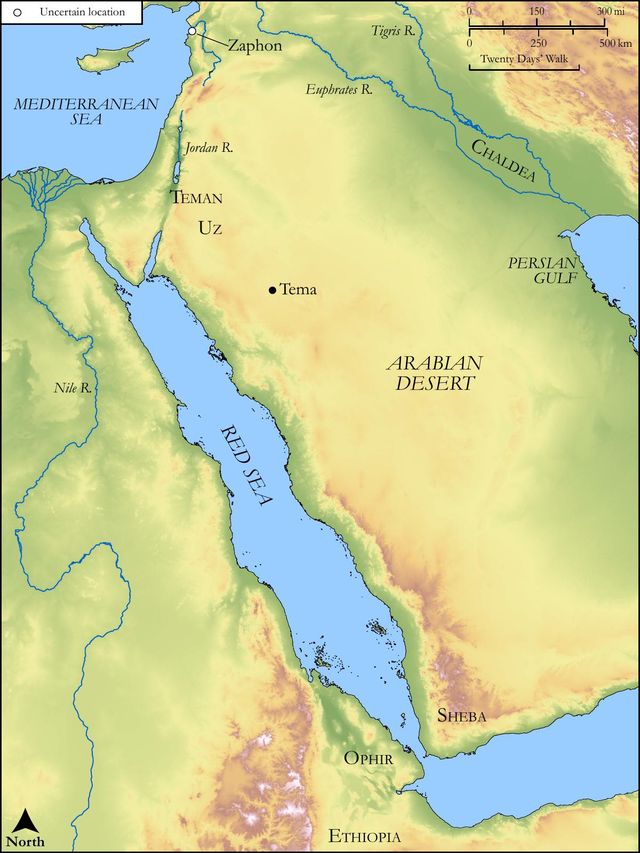
See on the biblical-era map
Study this verse
Public-domain commentary
Matthew Henry
From his Commentary on the Whole Bible. Henry comments on passages, not single verses — this entry covers Job 15:1–16. His three-level outline is real structure in the source text, so it is rendered as structure.
Eliphaz here falls very foul upon Job, because he contradicted what he and his colleagues had said, and did not acquiesce in it and applaud it, as they expected. Proud people are apt thus to take it very much amiss if they may not have leave to dictate and give law to all about them, and to censure those as ignorant and obstinate, and all that is naught, who cannot in every thing say as they say. Several great crimes Eliphaz here charges Job with, only because he would not own himself a hypocrite.
I.He charges him with folly and absurdity (Job 15:2, Job 15:3), that, whereas he had been reputed a wise man, he had now quite forfeited his reputation; any one would say that his wisdom had departed from him, he talked so extravagantly and so little to the purpose. Bildad began thus (Job 8:2), and Zophar, Job 11:2, Job 11:3. It is common for angry disputants thus to represent one another's reasonings as impertinent and ridiculous more than there is cause, forgetting the doom of him that calls his brother Raca, and Thou fool. It is true,
1.That there is in the world a great deal of vain knowledge, science falsely so called, that is useless, and therefore worthless.
2.That this is the knowledge that puffs up, with which men swell in a fond conceit of their own accomplishments.
3.That, whatever vain knowledge a man may have in his head, if he would be thought a wise man he must not utter it, but let it die with himself as it deserves.
4.Unprofitable talk is evil talk. We must give an account in the great day not only for wicked words, but for idle words. Speeches therefore which do no good, which do no service either to God or our neighbour, or no justice to ourselves, which are no way to the use of edifying, were better unspoken. Those words which are as wind, light and empty, especially which are as the east wind, hurtful and pernicious, it will be pernicious to fill either ourselves or others with, for they will pass very ill in the account.
5.Vain knowledge or unprofitable talk ought to be reproved and checked, especially in a wise man, whom it worst becomes and who does most hurt by the bad example of it.
II.He charges him with impiety and irreligion (Job 15:4):
"Thou castest off fear," that is, "the fear of God, and that regard to him which thou shouldst have; and then thou restrainest prayer." See what religion is summed up in, fearing God and praying to him, the former the most needful principle, the latter the most needful practice. Where no fear of God is no good is to be expected; and those who live without prayer certainly live without God in the world. Those who restrain prayer do thereby give evidence that they cast off fear. Surely those have no reverence of God's majesty, no dread of his wrath, and are in no care about their souls and eternity, who make no applications to God for his grace. Those who are prayerless are fearless and graceless. When the fear of God is cast off all sin is let in and a door opened to all manner of profaneness. It is especially bad with those who have had some fear of God, but have now cast it off - have been frequent in prayer, but now restrain it. How have they fallen! How is their first love lost! It denotes a kind of force put upon themselves. The fear of God would cleave to them, but they throw it off; prayer would be uttered, but they restrain it; and, in both, they baffle their convictions. Those who either omit prayer or straiten and abridge themselves in it, quenching the spirit of adoption and denying themselves the liberty they might take in the duty, restrain prayer. This is bad enough, but it is worse to restrain others from prayer, to prohibit and discourage prayer, as Darius, Dan 6:7. Now,
1.Eliphaz charges this upon Job, either,
(1.)As that which was his own practice. He thought that Job talked of God with such liberty as if he had been his equal, and that he charged him so vehemently with hard usage of him, and challenged him so often to a fair trial, that he had quite thrown off all religious regard to him. This charge was utterly false, and yet wanted not some colour. We ought not only to take care that we keep up prayer and the fear of God, but that we never drop any unwary expressions which may give occasion to those who seek occasion to question our sincerity and constancy in religion. Or,
(2.)As that which others would infer from the doctrine he maintained. "If this be true" (thinks Eliphaz) "which Job says, that a man may be thus sorely afflicted and yet be a good man, then farewell all religion, farewell prayer and the fear of God. If all things come alike to all, and the best men may have the worst treatment in this world, every one will be ready to say, It is vain to serve God; and what profit is it to keep his ordinances? Mal 3:14. Verily I have cleansed my hands in vain, Psa 73:13, Psa 73:14. Who will be honest if the tabernacles of robbers prosper? Job 12:6. If there be no forgiveness with God (Job 7:21), who will fear him? Psa 130:4. If he laugh at the trial of the innocent (Job 9:23), if he be so difficult of access (Job 9:32), who will pray to him?" Note, It is a piece of injustice which even wise and good men are too often guilty of, in the heat of disputation, to charge upon their adversaries those consequences of their opinions which are not fairly drawn from them and which really they abhor. This is not doing as we would be done by.
2.Upon this strained innuendo Eliphaz grounds that high charge of impiety (Job 15:5): Thy mouth utters thy iniquity - teaches it, so the word is. "Thou teachest others to have the same hard thoughts of God and religion that thou thyself hast." It is bad to break even the least of the commandments, but worse to teach men so, Mat 5:19. If we ever thought evil, let us lay our hand upon our mouth to suppress the evil thought (Pro 30:32), and let us by no means utter it; that is putting an imprimatur to it, publishing it with allowance, to the dishonour of God and the damage of others. Observe, When men have cast off fear and prayer their mouths utter iniquity. Those that cease to do good soon learn to do evil. What can we expect but all manner of iniquity from those that arm not themselves with the grace of God against it? But thou choosest the tongue of the crafty, that is, "Thou utterest thy iniquity with some show and pretence of piety, mixing some good words with the bad, as tradesmen do with their wares to help them off." The mouth of iniquity could not do so much mischief as it does without the tongue of the crafty. The serpent beguiled Eve through his subtlety. See Rom 16:18. The tongue of the crafty speaks with design and deliberation; and therefore those that use it may be said to choose it, as that which will serve their purpose better than the tongue of the upright: but it will be found, at last, that honesty is the best policy. Eliphaz, in his first discourse, had proceeded against Job upon mere surmise (Job 4:6, Job 4:7), but now he has got proof against him from his own discourses (Job 15:6): Thy own mouth condemns thee, and not I. But he should have considered that he and his fellows had provoked him to say that which now they took advantage of; and that was not fair. Those are most effectually condemned that are condemned by themselves, Tit 3:11; Luk 19:22. Many a man needs no more to sink him than for his own tongue to fall upon him.
III.He charges him with intolerable arrogancy and self-conceitedness.
It was a just, and reasonable, and modest demand that Job had made (Job 12:3), Allow that I have understanding as well as you; but see how they seek occasion against him: that is misconstrued, as if he pretended to be wiser than any man. Because he will not grant to them the monopoly of wisdom, they will have it thought that he claims it to himself, Job 15:7-9. As if he thought he had the advantage of all mankind,
1.In length of acquaintance with the world, which furnishes men with so much the more experience: "Art thou the first man that was born; and, consequently, senior to us, and better able to give the sense of antiquity and the judgment of the first and earliest, the wisest and purest, ages? Art thou prior to Adam?" So it may be read. "Did not he suffer for sin; and yet wilt not thou, who art so great a sufferer, own thyself a sinner? Wast thou made before the hills, as Wisdom herself was? Pro 8:23, etc. Must God's counsels, which are as the great mountains (Psa 36:6), and immovable as the everlasting hills, be subject to thy notions and bow to them? Dost thou know more of the world than any of us do? No, thou art but of yesterday even as we are," Job 8:9. Or,
2.In intimacy of acquaintance with God (Job 15:8): "Hast thou heard the secret of God? Dost thou pretend to be of the cabinet-council of heaven, that thou canst give better reasons than others can for God's proceedings?" There are secret things of God, which belong not to us, and which therefore we must not pretend to account for. Those are daringly presumptuous who do. He also represents him,
(1.)As assuming to himself such knowledge as none else had: "Dost thou restrain wisdom to thyself, as if none were wise besides?" Job had said (Job 13:2), What you know, the same do I know also; and now they return upon him, according to the usage of eager disputants, who think they have a privilege to commend themselves: What knowest thou that we know not? How natural are such replies as these in the heat of argument! But how simple do they look afterwards, upon the review!
(2.)As opposing the stream of antiquity, a venerable name, under the shade of which all contending parties strive to shelter themselves: "With us are the gray-headed and very aged men, Job 15:10. We have the fathers on our side; all the ancient doctors of the church are of our opinion." A thing soon said, but not so soon proved; and, when proved, truth is not so soon discovered and proved by it as most people imagine. David preferred right scripture-knowledge before that of antiquity (Psa 119:100): I understand more than the ancients, because I keep thy precepts. Or perhaps one or more, if not all three, of these friends of Job, were older than he (Job 32:6), and therefore they thought he was bound to acknowledge them to be in the right. This also serves contenders to make a noise with to very little purpose. If they are older than their adversaries, and can say they knew such a thing before their opponents were born, this will not serve to justify them in being arrogant and overbearing; for the oldest are not always the wisest, Job 32:9.
IV.He charges him with a contempt of the counsels and comforts that were given him by his friends (Job 15:11): Are the consolations of God small with thee?
1.Eliphaz takes it ill that Job did not value the comforts which he and his friends administered to him more than it seems he did, and did not welcome every word they said as true and important. It is true they had said some very good things, but, in their application to Job, they were miserable comforters. Note, We are apt to think that great and considerable which we ourselves say, when others perhaps with good reason think it small and trifling. Paul found that those who seemed to be somewhat, yet, in conference, added nothing to him, Gal 2:6.
2.He represents this as a slight put upon divine consolations in general, as if they were of small account with him, whereas really they were not. If he had not highly valued them, he could not have borne up as he did under his sufferings. Note,
(1.)The consolations of God are not in themselves small. Divine comforts are great things, that is, the comfort which is from God, especially the comfort which is in God.
(2.)The consolations of God not being small in themselves, it is very lamentable if they be small with us. It is a great affront to God, and an evidence of a degenerate depraved mind, to disesteem and undervalue spiritual delights and despise the pleasant land. "What!" (says Eliphaz) "is there any secret thing with thee? Hast thou some cordial to support thyself with, that is a proprium, an arcanum, that nobody else can pretend to, or knows any thing of?" Or, "Is there some secret sin harboured and indulged in thy bosom, which hinders the operation of divine comforts?" None disesteem divine comforts but those that secretly affect the world and the flesh.
V.He charges him with opposition to God himself and to religion (Job 15:12, Job 15:13):
"Why doth thy heart carry thee away into such indecent irreligious expressions?" Note, Every man is tempted when he is drawn away of his own lust, Jam 1:14. if we fly off from God and our duty, or fly out into anything amiss, it is our own heart that carries us away. If thou scornest, thou alone shalt bear it. There is a violence, an ungovernable impetus, in the turnings of the soul; the corrupt heart carries men away, as it were, by force, against their convictions. "What is it that thy eyes wink at? Why so careless and mindless of what is said to thee, hearing it as if thou wert half asleep? Why so scornful, disdaining what we say, as if it were below thee to take notice of it? What have we said that deserves to be thus slighted - nay, that thou turnest thy spirit against God?" It was bad that his heart was carried away from God, but much worse that it was turned against God. But those that forsake God will soon break out in open enmity to him. But how did this appear? Why, "Thou lettest such words go out of thy mouth, reflecting on God, and his justice and goodness." It is the character of the wicked that they set their mouth against the heavens (Psa 73:9), which is a certain indication that the spirit is turned against God. He thought Job's spirit was soured against God, and so turned from what it had been, and exasperated at his dealings with him. Eliphaz wanted candour and charity, else he would not have put such a harsh construction upon the speeches of one that had such a settled reputation for piety and was now in temptation. This was, in effect, to give the cause on Satan's side, and to own that Job had done as Satan said he would, had cursed God to his face.
VI.He charges him with justifying himself to such a degree as even to deny his share in the common corruption and pollution of the human nature (Job 15:14): What is man, that he should be clean? that is, that he should pretend to be so, or that any should expect to find him so. What is he that is born of a woman, a sinful woman, that he should be righteous? Note,
1.Righteousness is cleanness; it makes us acceptable to God and easy to ourselves, Psa 18:24.
2.Man, in his fallen state, cannot pretend to be clean and righteous before God, either to acquit himself to God's justice or recommend himself to his favour.
3.He is to be adjudged unclean and unrighteous because born of a woman, from whom he derives a corrupt nature, which is both his guilt and his pollution. With these plain truths Eliphaz thinks to convince Job, whereas he had just now said the same (Job 14:4): Who can bring a clean thing out of an unclean? But does it therefore follow that Job is a hypocrite, and a wicked man, which is all that he denied? By no means. Though man, as born of a woman, is not clean, yet, as born again of the Spirit, he is clean.
4.Further to evince this he here shows,
(1.)That the brightest creatures are imperfect and impure before God, Job 15:15. God places no confidence in saints and angels; he employs both, but trusts neither with his service, without giving them fresh supplies of strength and wisdom for it, as knowing they are not sufficient of themselves, neither more nor better than his grace makes them. He takes no complacency in the heavens themselves. How pure soever they seem to us, in his eye they have many a speck and many a flaw: The heavens are not clean in his sight. If the stars (says Mr. Caryl) have no light in the sight of the sun, what light has the sun in the sight of God! See Isa 24:23.
(2.)That man is much more so (Job 15:16): How much more abominable and filthy is man! If saints are not to be trusted, much less sinners. If the heavens are not pure, which are as God made them, much less man, who is degenerated. Nay, he is abominable and filthy in the sight of God, and if ever he repent he is so in his own sight, and therefore he abhors himself. Sin is an odious thing, it makes men hateful. The body of sin is so, and is therefore called a dead body, a loathsome thing. Is it not a filthy thing, and enough to make any one sick, to see a man eating swine's food or drinking some nauseous and offensive stuff? Such is the filthiness of man that he drinks iniquity (that abominable thing which the Lord hates) as greedily, and with as much pleasure, as a man drinks water when he is thirsty. It is his constant drink; it is natural to sinners to commit iniquity. It gratifies, but does not satisfy, the appetites of the old man. It is like water to a man in a dropsy. The more men sin the more they would sin.
Historical interpretation
Historical reception
1 surviving comment on this verse from the historical church.
Because Job reproached his friends with confidence, they were irritated and hurt. This did not demonstrate any arrogance before God. In fact, since Job trusted in his own innocence, he did not take seriously at all the vain power of his accusers. Feeling ashamed in rebuking Job for his former words, [Eliphaz] says, in a vain attempt at useless chatter, that Job spoke of him with arrogance before God. And then, without waiting any longer, he hastens to reveal the reason why he denigrated Job, because Job had no consideration for “the words of the powerful.”
Continue studying Job 15:4 across the web’s major study libraries — every link below opens this exact verse, chapter, or book on the destination site.
Read & Compare
 BibleGatewayThis verse in more than 200 translations and 70 languages.
 Bible.comThe YouVersion reader — hundreds of translations, reading plans, and highlights.
 ESV.orgCrossway's official English Standard Version reader.
 NET BibleThe NET translation with 60,000+ translators' notes on every rendering decision.
 STEP BibleTyndale House's free study tool — original text, vocabulary, and scholarly resources.
 BibliaLogos Bible Software's free web reader.
 USCCBThe New American Bible (Revised Edition) with the U.S. bishops' study notes.
Commentaries
 BibleHub CommentariesDozens of classic commentaries on this verse, gathered on one page.
 StudyLightMore than 100 commentary sets — the largest collection on the web.
 BibleRefPlain-English commentary on what this verse means, verse by verse.
 Enduring WordDavid Guzik's free commentary on this chapter, widely used by Bible teachers.
 Bible Study ToolsVerse commentary alongside Greek and Hebrew study aids.
Original Language & Research
- BibleHub InterlinearThe verse word by word — original language, transliteration, and English.
- BibleHub LexiconEvery word's original-language definition and Strong's entry.
 Blue Letter BibleDeep-study tools — Strong's numbers, concordance, and word studies.
 SefariaThe Hebrew text with Rashi and centuries of Jewish commentary.
Sermons, Hymns & Audio


TrulyRandomVerse is not affiliated with these sites and doesn’t control their content. They’re linked because they’re genuinely useful.
Summary
Job 15:4 presents a cutting accusation from Eliphaz the Temanite against Job, asserting that Job has deliberately abandoned reverence for God and actively hindered prayer. This verse is a central component of Eliphaz's second discourse, where he continues to apply a rigid retribution theology, interpreting Job's profound suffering as irrefutable evidence of his deep-seated sinfulness and spiritual rebellion. The accusation powerfully highlights Eliphaz's fundamental misunderstanding of Job's blameless character and the true, often mysterious, nature of God's dealings with humanity, thereby intensifying the theological debate that forms the core of the book.
Context
ShowHideLiterary Context
Job 15:4 is situated within Eliphaz's second, more aggressive response to Job's lament, which concluded in Job 14. The dialogue between Job and his friends is structured as a series of cycles, with the friends consistently applying retribution theology—the belief that God invariably rewards the righteous with prosperity and punishes the wicked with suffering. In Job 15, Eliphaz, having been challenged by Job's persistent claims of innocence, dismisses Job's words as "windy knowledge" and "empty talk" (Job 15:2-3). He then escalates his accusations, implying that Job's suffering is not merely a consequence of sin, but a result of his active subversion of piety. This verse serves as a direct, pointed charge against Job's spiritual integrity, revealing Eliphaz's inability to reconcile Job's suffering with his presumed righteousness, and setting the stage for the increasingly strained and accusatory tone of the subsequent speeches.
Historical & Cultural Context
The Book of Job is set in a patriarchal, pre-Mosaic period, likely in the land of Uz, a region outside of Israel proper, among the men of the east. The prevailing wisdom tradition of this era, which heavily influenced the friends' arguments, often linked an individual's material prosperity and well-being directly to their moral uprightness, and conversely, suffering to divine punishment for sin. This "retribution theology" was a widely accepted framework for understanding divine justice and the order of God's creation. Within this worldview, "fear of the Lord" (signifying profound reverence, awe, and obedient submission to God) was considered the cornerstone of true piety, and prayer was understood as the vital conduit for communion with the divine. Therefore, to "cast off fear" and "restrain prayer" would be perceived as the epitome of spiritual rebellion and a direct affront to God, providing, in the friends' eyes, ample justification for any calamity that might befall an individual.
Key Themes
ShowHideJob 15:4, despite being an unjust accusation, contributes significantly to several overarching themes in the Book of Job. Firstly, it vividly illustrates the misapplication and inadequacy of retribution theology in explaining the complexities of human suffering, particularly the suffering of the innocent. The reader, having been granted a divine perspective in the prologue (Job 1-2), understands that Job's suffering is not a result of sin, making Eliphaz's charge a prime example of false accusation and the limitations of human wisdom in discerning God's mysterious purposes. Secondly, the verse implicitly underscores the biblical importance of reverence for God (the "fear of the Lord") and persistent prayer as foundational elements of true piety, even as it falsely accuses Job of abandoning them. Finally, it contributes to the broader theme of the nature of true wisdom, contrasting the conventional, limited wisdom of the friends with the profound, inscrutable wisdom of God that transcends human categories and challenges simplistic explanations for life's deepest mysteries.
Exposition and Analysis
ShowHideKey Word Analysis
ShowHideDerived from the primitive root H6565, pârar means "to break up (usually figuratively)," "to violate," or "to frustrate." The Hiphil conjugation, used here as tafer, intensifies the action, implying a deliberate and decisive act of nullification, rejection, or making void. Eliphaz is not merely suggesting Job has neglected fear, but that he has actively and intentionally "broken off" or "made of none effect" his reverence for God, indicating a willful severing of his spiritual connection.
This term (H3374) in biblical Hebrew signifies much more than mere fright. As a feminine noun derived from the verb yare (to fear), yirʼâh denotes a profound awe, reverence, respect, and humble submission to God's majesty, power, and moral authority. It is often synonymous with true piety, wisdom, and the very foundation of a righteous life, as exemplified in Proverbs 9:10. To "cast off fear" implies a deliberate and active rejection of this fundamental posture of humility and devotion before God, signifying a profound spiritual rebellion.
From the primitive root H1639, gâraʻ means "to scrape off," and by implication, "to shave, remove, lessen, withhold." The Hiphil conjugation, used here as tigra, implies an active suppression, diminution, or holding back. Eliphaz accuses Job not just of failing to pray, but of actively "withholding" or "diminishing" prayer, perhaps even discouraging it in himself or others. This suggests a deliberate act of spiritual negligence or defiance.
Verse Breakdown
ShowHide"Yea, thou castest off fear"
Eliphaz launches a direct and severe spiritual indictment against Job. The phrase "castest off fear" implies a deliberate and active rejection of the reverential awe and humble submission that are due to God. In the biblical worldview, the "fear of the Lord" is paramount, considered the beginning of wisdom and the bedrock of true piety and a righteous life. By accusing Job of abandoning this fundamental posture, Eliphaz claims that Job has forfeited his moral compass and spiritual integrity, suggesting a rebellious heart that no longer acknowledges God's sovereignty, holiness, or wisdom. This charge goes beyond mere neglect; it implies a willful renunciation.
"and restrainest prayer before God"
This second clause builds upon the first, asserting that Job has not only rejected reverence but has also actively suppressed or diminished his communion with God through prayer. To "restrain prayer" suggests a deliberate withholding of supplication, meditation, or even lament in the divine presence. From Eliphaz's perspective, this implies a profound spiritual alienation, a refusal to seek God's face, or perhaps even a defiant stance against Him. This accusation further solidifies the idea of Job's profound guilt and unrighteousness in Eliphaz's mind, painting a picture of a man who has turned his back on the very disciplines that define a relationship with the Almighty.
Literary Devices
ShowHideJob 15:4 primarily employs Accusation, a direct and confrontational rhetorical strategy used by Eliphaz to indict Job. This accusation is delivered with a tone of absolute certainty and moral authority, despite being fundamentally untrue from the reader's perspective, thereby creating powerful Dramatic Irony. The audience, privy to the divine prologue in Job 1:1, knows that Job is "blameless and upright, one who feared God and turned away from evil," making Eliphaz's words a stark example of profound misjudgment and a flawed theological framework. Furthermore, there is a clear Juxtaposition of "fear" and "prayer," presenting them as two interconnected and essential aspects of genuine piety that Eliphaz believes Job has supposedly abandoned. This pairing emphasizes Eliphaz's conviction that Job's spiritual core has been corrupted, leading to both a lack of internal reverence and an external failure in communion with God. The verse also contains an element of Hyperbole in Eliphaz's overstatement of Job's alleged spiritual failings, driven by his rigid theological assumptions.
Theological and Thematic Connections
ShowHideJob 15:4, while a false accusation against a righteous man, paradoxically highlights two profoundly important theological concepts: the "fear of the Lord" and the practice of prayer. Eliphaz's charge underscores the ancient understanding that genuine piety is characterized by a deep reverence for God's majesty and an ongoing, unhindered dialogue with Him. Theologically, the verse serves as a foil to true faith, which, even in the crucible of suffering, strives to maintain awe for God and to persist in communication with Him, whether through lament, petition, or praise. It implicitly warns against the spiritual dangers of abandoning these disciplines, while simultaneously exposing the flawed human tendency to equate suffering with sin and to judge others based on a limited, often erroneous, understanding of divine justice. The passage thus becomes a cautionary tale against simplistic theological frameworks that fail to account for the complexities of God's sovereign purposes and the reality of innocent suffering.
Reflection and Application
ShowHideEliphaz's accusation in Job 15:4, though unjust and rooted in a flawed theology, serves as a powerful mirror for self-reflection on the state of our own spiritual lives. It challenges us to examine whether we truly cultivate a profound reverence for God, not merely as an abstract concept, but as a lived reality that shapes our attitudes, decisions, and actions. In times of prosperity and ease, it is often simple to maintain outward displays of piety, but in the crucible of suffering, confusion, or prolonged adversity, our true "fear of the Lord" and commitment to prayer are rigorously tested. Do we, like Eliphaz, fall into the trap of judging others' struggles through a narrow theological lens, or do we extend compassion, grace, and humility, recognizing the limits of our own understanding? This verse calls us to persevere in faith, to maintain open and honest lines of communication with God even when His ways are mysterious or His presence seems distant, and to guard against the subtle temptations to abandon reverence or restrain our earnest cries to Him, regardless of life's circumstances or the accusations of others.
Questions for Reflection
ShowHideFAQ
ShowHideWhy does Eliphaz accuse Job of casting off fear and restraining prayer?
ShowHideEliphaz's accusations stem directly from his rigid adherence to retribution theology, a common belief among the men of the east that God invariably rewards the righteous with prosperity and punishes the wicked with suffering. From this perspective, Job's immense and inexplicable suffering could only be the result of significant, unconfessed sin. Therefore, Eliphaz concludes that Job must have abandoned his reverence for God ("cast off fear") and neglected his spiritual communion ("restrained prayer") as irrefutable evidence of his hidden wickedness, even though the reader knows from Job 1 that Job was blameless.
Was Job actually guilty of casting off fear or restraining prayer?
ShowHideNo, the Book of Job explicitly states the opposite. The prologue in Job 1:1 describes Job as "blameless and upright, one who feared God and turned away from evil." Furthermore, Job's actions throughout the narrative, including his laments, his persistent desire to present his case before God (Job 13:3), and his ultimate vindication by God (Job 42:7-8), contradict Eliphaz's accusations. Eliphaz's words are a testament to his flawed theological framework and his inability to comprehend suffering outside of a retributive paradigm, rather than an accurate reflection of Job's spiritual state.
What is the "fear of God" in biblical terms, and why is it important?
ShowHideIn biblical terms, the "fear of God" (Hebrew: yir'ah) is not primarily a feeling of terror or dread, but rather a profound sense of awe, reverence, respect, and humble submission to God's majesty, power, and moral authority. It involves acknowledging His sovereignty, wisdom, and holiness, and living in obedience to His will. This "fear" is often presented as the beginning of wisdom (Proverbs 9:10) and the foundation of true piety and a righteous life. It fosters a healthy relationship with God, characterized by trust, obedience, and a desire to please Him, leading to blessing and spiritual flourishing.
Christ-Centered Fulfillment
ShowHideWhile Eliphaz falsely accused Job of casting off fear and restraining prayer, Jesus Christ perfectly embodied the "fear of the Lord" and exemplified unhindered communion with God. Unlike Job, who was innocent but suffered, Christ was perfectly innocent and willingly embraced suffering as the ultimate act of obedience to His Father's will. He did not "cast off fear" but lived a life of perfect reverence and submission, even to the point of death on a cross (Philippians 2:8). Furthermore, far from "restraining prayer," Jesus consistently modeled a vibrant and intimate prayer life, frequently withdrawing to commune with His Father (Luke 5:16). His agony in Gethsemane (Luke 22:42) demonstrates His perfect submission through prayer, even when facing the deepest anguish. Ultimately, Christ's perfect life, innocent suffering, and atoning death remove the need for us to fear God's judgment for our sins, replacing it with a filial reverence born of love and gratitude. Through His finished work, we are granted bold access to God, not by our own merit or perfect prayer life, but by His intercession, as He ever lives to make intercession for us (Hebrews 7:25; Romans 8:34). Thus, what Eliphaz falsely accused Job of lacking, Christ perfectly fulfilled, enabling all who believe to approach God with both reverence and confidence.