


Job 1:1
Bible text: King James Version (1769 Blayney text) · Public domain
Bible text: Berean Standard Bible · Public domain
Bible text: American Standard Version (1901) · Public domain
Bible text: World English Bible, Messianic edition · Public domain
Bible text: Geneva Bible (1599) · Public domain
Bible text: Young's Literal Translation · Public domain
- אִישׁ'isha manH376N-msNoun Singular Masculine Absolute
- הָיָהha·Yahhe wasH1961V-Qal-Perf-3msVerb Qal Perfect 3rd Singular Masculine
- בְאֶרֶץve·'e·retzin [the] land ofH776Prep-b ¦ N-fscNoun Singular Feminine Constructבְinאֶרֶץ[the] land of
- עוּץ'utzUzH5780N-properNoun Proper Location
- אִיּוֹב'i·Yov[was] JobH347N-proper-mNoun Proper Masculine
- שְׁמוֹshe·Mohis nameH8034N-msc ¦ 3msNoun Singular Masculine Constructשְׁמnameוֹhis
- וְהָיָהve·ha·Yahand he wasH1961Conj-w ¦ V-Qal-ConsecPerf-3msVerb Qal Consecutive Perfect 3rd Singular Masculineוְandהָיָהhe was
- הָאִישׁha·'Ishthe manH376Art ¦ N-msNoun Singular Masculine Absoluteהָtheאִישׁman
- הַהוּאha·Hu'<the> thatH1931Art ¦ Pro-3msPronoun Personal 3rd Singular Masculineהַ<the>הוּאthat
- תָּםtamblamelessH8535Adj-msAdjective Singular Masculine Absolute
- וְיָשָׁרve·ya·Sharand uprightH3477Conj-w ¦ Adj-msAdjective Singular Masculine Absoluteוְandיָשָׁרupright
- וִירֵאvi·Re'and fearingH3373Conj-w ¦ Adj-mscAdjective Singular Masculine Constructוִandירֵאfearing
- אֱלֹהִים'E·lo·Him<of> GodH430N-mpNoun Plural Masculine Absolute
- וְסָרve·Sarand turning asideH5493Conj-w ¦ V-Qal-Prtcpl-msVerb Qal Participle Singular Masculine Absoluteוְandסָרturning aside
- מֵרָעme·Ra'from evilH7451Prep-m ¦ Adj-msAdjective Singular Masculine Absoluteמֵfromרָעevil
English is a literal word-by-word gloss of the Hebrew, not the KJV's wording. Why?
This is the original text the KJV's translators worked from — each Hebrew word with its own literal English meaning in this verse, prepared by scholars at Tyndale House, Cambridge. The KJV translates whole sentences, not word by word, so its wording differs: one Hebrew word can become several English words, and the KJV may choose “the LORD” where the gloss reads “Yahweh”. Both are faithful — they answer different questions. For the KJV's own rendering, switch to the KJV text.
Details
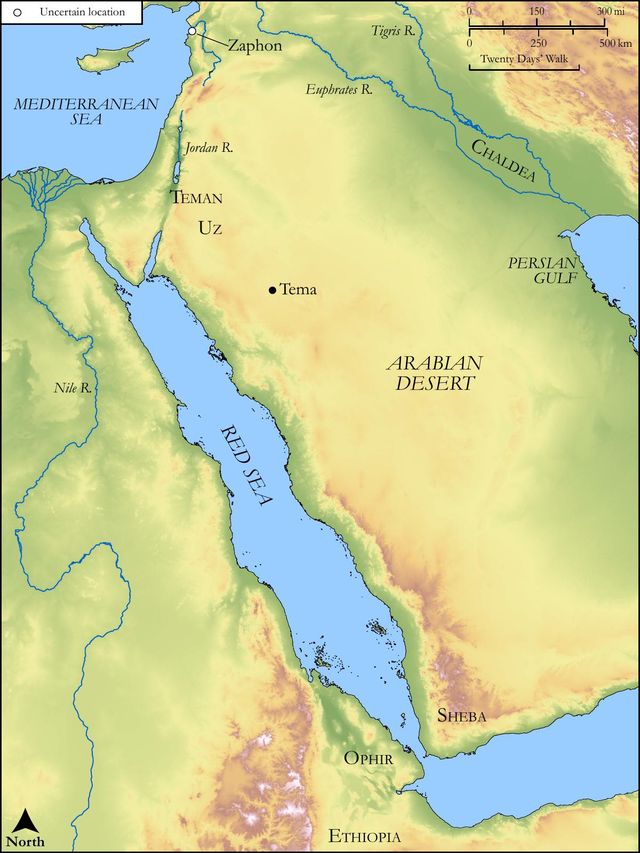
See on the biblical-era map
Study this verse
Public-domain commentary
Matthew Henry
From his Commentary on the Whole Bible. Henry comments on passages, not single verses — this entry covers Job 1:1–3. His three-level outline is real structure in the source text, so it is rendered as structure.
Concerning Job we are here told,
I.That he was a man; therefore subject to like passions as we are.
He was Ish, a worthy man, a man of note and eminency, a magistrate, a man in authority. The country he lived in was the land of Uz, in the eastern part of Arabia, which lay towards Chaldea, near Euphrates, probably not far from Ur of the Chaldees, whence Abraham was called. When God called one good man out of that country, yet he left not himself without witness, but raised up another in it to be a preacher of righteousness. God has his remnant in all places, sealed ones out of every nation, as well as out of every tribe of Israel, Rev 7:9. It was the privilege of the land of Uz to have so good a man as Job in it; now it was Arabia the Happy indeed: and it was the praise of Job that he was eminently good in so bad a place; the worse others were round about him the better he was. His name Job, or Jjob, some say, signifies one hated and counted as an enemy. Others make it to signify one that grieves or groans; thus the sorrow he carried in his name might be a check to his joy in his prosperity. Dr. Cave derives it from Jaab - to love, or desire, intimating how welcome his birth was to his parents, and how much he was the desire of their eyes; and yet there was a time when he cursed the day of his birth. Who can tell what the day may prove which yet begins with a bright morning?
II.That he was a very good man, eminently pious, and better than his neighbours:
He was perfect and upright. This is intended to show us, not only what reputation he had among men (that he was generally taken for an honest man), but what was really his character; for it is the judgment of God concerning him, and we are sure that is according to truth.
1.Job was a religious man, one that feared God, that is, worshipped him according to his will, and governed himself by the rules of the divine law in every thing.
2.He was sincere in his religion: He was perfect; not sinless, as he himself owns (Job 9:20): If I say I am perfect, I shall be proved perverse. But, having a respect to all God's commandments, aiming at perfection, he was really as good as he seemed to be, and did not dissemble in his profession of piety; his heart was sound and his eye single. Sincerity is gospel perfection. I know no religion without it.
3.He was upright in his dealings both with God and man, was faithful to his promises, steady in his counsels, true to every trust reposed in him, and made conscience of all he said and did. See Isa 33:15. Though he was not of Israel, he was indeed an Israelite without guile.
4.The fear of God reigning in his heart was the principle that governed his whole conversation. This made him perfect and upright, inward and entire for God, universal and uniform in religion; this kept him close and constant to his duty. He feared God, had a reverence for his majesty, a regard to his authority, and a dread of his wrath.
5.He dreaded the thought of doing what was wrong; with the utmost abhorrence and detestation, and with a constant care and watchfulness, he eschewed evil, avoided all appearances of sin and approaches to it, and this because of the fear of God, Neh 5:15. The fear of the Lord is to hate evil (Pro 8:13) and then by the fear of the Lord men depart from evil, Pro 16:6.
III.That he was a man who prospered greatly in this world, and made a considerable figure in his country.
He was prosperous and yet pious. Though it is hard and rare, it is not impossible, for a rich man to enter into the kingdom of heaven. With God even this is possible, and by his grace the temptations of worldly wealth are not insuperable. He was pious, and his piety was a friend to his prosperity; for godliness has the promise of the life that now is. He was prosperous, and his prosperity put a lustre upon his piety, and gave him who was so good so much greater opportunity of doing good. The acts of his piety were grateful returns to God for the instances of his prosperity; and, in the abundance of the good things God gave him, he served God the more cheerfully.
1.He had a numerous family. He was eminent for religion, and yet not a hermit, not a recluse, but the father and master of a family. It was an instance of his prosperity that his house was filled with children, which are a heritage of the Lord, and his reward, Psa 127:3. he had seven sons and three daughters, Job 1:2. Some of each sex, and more of the more noble sex, in which the family is built up. Children must be looked upon as blessings, for so they are, especially to good people, that will give them good instructions, and set them good examples, and put up good prayers for them. Job had many children, and yet he was neither oppressive nor uncharitable, but very liberal to the poor, Job 31:17, etc. Those that have great families to provide for ought to consider that what is prudently given in alms is set out to the best interest and put into the best fund for their children's benefit.
2.He had a good estate for the support of his family; his substance was considerable, Job 1:3. Riches are called substance, in conformity to the common form of speaking; otherwise, to the soul and another world, they are but shadows, things that are not, Pro 23:5. It is only in heavenly wisdom that we inherit substance, Pro 8:21. In those days, when the earth was not fully peopled, it was as now in some of the plantations, men might have land enough upon easy terms if they had but wherewithal to stock it; and therefore Job's substance is described, not by the acres of land he was lord of, but,
(1.)By his cattle - sheep and camels, oxen and asses. The numbers of each are here set down, probably not the exact number, but thereabout, a very few under or over. The sheep are put first, because of most use in the family, as Solomon observes (Pro 27:23, Pro 27:26, Pro 27:27): Lambs for thy clothing, and milk for the food of thy household. Job, it is likely, had silver and gold as well as Abraham (Gen 13:2); but then men valued their own and their neighbours' estates by that which was for service and present use more than by that which was for show and state, and fit only to be hoarded. As soon as God had made man, and provided for his maintenance by the herbs and fruits, he made him rich and great by giving him dominion over the creatures, Gen 1:28. That therefore being still continued to man, notwithstanding his defection (Gen 9:2), is still to be reckoned one of the most considerable instances of men's wealth, honour, and power, Psa 8:6.
(2.)By his servants. He had a very good household or husbandry, many that were employed for him and maintained by him; and thus he both had honour and did good; yet thus he was involved in a great deal of care and put to a great deal of charge. See the vanity of this world; as goods are increased those must be increased that tend them and occupy them, and those will be increased that eat them; and what good has the owner thereof save the beholding of them with his eyes? Ecc 5:11. In a word, Job was the greatest of all the men of the east; and they were the richest in the world: those were rich indeed who were replenished more than the east, Isa 2:6. Margin. Job's wealth, with his wisdom, entitled him to the honour and power he had in his country, which he describes (ch. 29), and made him sit chief. Job was upright and honest, and yet grew rich, nay, therefore grew rich; for honesty is the best policy, and piety and charity are ordinarily the surest ways of thriving. He had a great household and much business, and yet kept up the fear and worship of God; and he and his house served the Lord. The account of Job's piety and prosperity comes before the history of his great afflictions, to show that neither will secure us from the common, no, nor from the uncommon calamities of human life. Piety will not secure us, as Job's mistaken friends thought, for all things come alike to all; prosperity will not, as a careless world thinks, Isa 47:8. I sit as a queen and therefore shall see no sorrow.
Historical interpretation
Five Centuries of Reception
7 surviving comments on this verse. Each one is dated, so this reads as a timeline rather than a list.
Select a marker to jump to its quote. Markers stagger vertically where authors wrote within a few decades of each other.
Let us be imitators also of those who in goat-skins and sheep-skins [Hebrews 11:37] went about proclaiming the coming of Christ; I mean Elijah, Elisha, and Ezekiel among the prophets, with those others to whom a like testimony is borne [in Scripture]. Abraham was specially honoured, and was called the friend of God; yet he, earnestly regarding the glory of God, humbly declared, "I am but dust and ashes." [Genesis 18:27] Moreover, it is thus written of Job, "Job was a righteous man, and blameless, truthful, God-fearing, and one that kept himself from all evil." [Job 1:1] But bringing an accusation against himself, he said, "No man is free from defilement, even if his life be but of one day." [Job 14:4-5] Moses was called faithful in all God's house; and through his instrumentality, God punished Egypt with plagues and tortures. Yet he, though thus greatly honoured, did not adopt lofty language, but said, when the divine oracle came to him out of the bush, "Who am I, that You send me? I am a man of a feeble voice and a slow tongue." [Exodus 4:10] And again he said, "I am but as the smoke of a pot."
Even though many others lived in Uz, no one was comparable to Job with regard to piety and innocence. He was of high reputation and was celebrated in everybody’s words. And so that no one might think these things had been granted to Job thanks to his human ability, God never allowed a single possession of Job’s to perish. [God] said, “My desire is that even a single hair, a loss that would be the very slightest, may be returned and increased for Job.”
Each of these epithets is sufficient to show the beauty of Job’s soul. But, as a lover multiplies the details in order to describe the one he loves, so the same occurs here. “Blameless” the text says, that is, perfectly virtuous. “Upright,” and also “true,” and also “pious,” and again, “he turned away from any evil.” Notice the words “from any,” and not simply from one evil and not from another. Where are those who assert that human nature is inclined toward evil? What fear, what tribunals and what laws made Job as he is?
I am forced, through each of the books of Divine Scripture, to respond to the slander of adversaries who accuse my translation of rebuking the Seventy translators, not as though among the Greeks Aquila, Symmachus, and Theodotion had also translated either word for word, or meaning for meaning, or by mixing both together, also a kind of translation of equal proportion, and also Origen had divided all the scrolls of the Old Instrument with obeli and asterisks which, either added by him or taken from Theodotion, he added to the ancient translation, proving what was added to have been lacking. Therefore my detractors should learn to accept in full what they have accepted in part, or to erase my translation along with their asterisks. For it should not be, that those who they accepted to have omitted many things may not be acknowledged to have certainly erred in some things, especially in Job, in which if you will have removed those things which are added under the asterisks, the greater part will be cut off. And this is only among the Greeks. Otherwise, among the Latins, before their translation which we recently edited under asterisks and obeli, almost seven hundred or eight hundred verses are (missing), so that the book, shortened and cut up and eaten away, shows its deformity publicly to readers.
And this translation follows no translator of the ancients, but will rather convey from the speech itself (which is) Hebrew and Arabic and sometimes Syrian, now words, now meanings, now both together. For even among the Hebrews the whole book is considered oblique and slippery and what the Greek rhetors call figuratively arranged (εσχηματισμενος), and while one thing is said, it does another, as if you would hold tightly an eel or a little murena fish, when you press harder, then the sooner it escapes. I remember I paid not a little money toward understanding of this scroll, for an instructor from Lydda who among the Hebrews was thought to have first rank, with whose teaching I know not whether I accomplished anything; this one thing I know: for me not to have been able to translate anything that I didn’t know before.
Therefore, from the beginning to the words of Job, among the Hebrews the speech is prose. Next, from the words of Job in which he says, "May the day perish in which I was born, and the night in which it was said: A man is conceived," to that place, where it is written before the end of the scroll: "Therefore I accuse myself and make repentance in dust and ashes," the verses are in hexameter, running in dactyl and spondee and, according to the idiom of the language, also accepting numerous other (poetic) feet not of the same (number of) syllables, but of the same intervals. Sometimes also, by breaking the law of (poetic metrical) numbers, the rhythm itself is found sweet and ringing, which is understood better by prosodists than by a simple reader. And from the verse mentioned above to the end of the book, the small section that remains continues with prose speech. If that seems unbelievable to anyone, namely that among the Hebrews there are meters, and either the Psalter or the Lamentation of Jermiah or almost all the songs of the Scriptures are to be understood in the manner of our Flaccus and the Greek Pindar and Alkaios and Sappho, let him read Philo, Josephus, Origen, and Eusebius of Caesarea, and by their testimony he will prove me to speak the truth.
For which reason, let my dogs therefore hear me to have labored at this scroll, not as rebuking the ancient translation, but rather so those things in it which are either obscure or missing or certainly corrupted by the error of scribes may be made more clear by our translation, who have both learned Hebrew speech in part, and also in Latin, almost from our cradle we were worn out (?) among grammarians and rhetors and philosophers. But if among the Greeks, after the edition of the Seventy, with the Gospel of Christ shining, the Jew Aquila, and Symmachus and Theodotion, judaizing heretics, are accepted, who have hidden many mysteries of the Savior by sly translation, and yet are found in the Hexapla among the churches and are explained by men of the Church, how much more should I, a Christian of Christian parents and bearing the standard of the cross on my forehead, whose study was to recover the missing, to correct the corrupted, and to open the sacraments of the Church with pure and faithful speech, not be rejected by either disdainful or by malicious readers? Let whoever will to keep the old books, either written on purple skins with gold and silver, or in uncial letters, as they commonly say, loads of writing rather than books, while they leave to me and mine to have poor little leaves and not such beautiful books as correct ones. Each edition, the Seventy according to the Greeks and mine according to the Hebrews, was translated into Latin by my labor. May each one choose what he will, and prove himself studious rather than malevolent.
1. It is for this reason that we are told where the holy man dwelt, that the meritoriousness of his virtue might be expressed; for who knows not that Uz is a land of the Gentiles? and the Gentile world came under the dominion of wickedness, in the same proportion that its eyes were shut to the knowledge of its Creator. Let us be told then where he dwelt, that this circumstance may be reckoned to his praise, that he was good among bad men; for it is no very great praise to be good in company with the good, but to be good with the bad; for as it is a greater offence not to be good among good men, so it is immeasurably high testimony for any one to have shown himself good even among the wicked. Hence it is that the same blessed Job bears witness to himself, saying, I am a brother to dragons, and a companion to owls. [Job 30, 29] Hence it was that Peter extolled Lot with high commendation, because he found him to be good among a reprobate people; saying, And delivered just Lot, vexed with the filthy conversation of the wicked; for he was righteous in seeing and hearing [so Vulg.], dwelling with them who vexed his righteous soul from day to day with their unlawful deeds. [2 Pet. 2, 7.8.] Now he evidently could not have been vexed unless he had both heard and witnessed the wicked deeds of his neighbours, and yet he is called righteous both in seeing and in hearing, because their wicked lives affected the ears and eyes of the Saint not with a pleasant sensation, but with the pain of a blow. Hence it is that Paul says to his disciples, In the midst of a crooked and perverse nation, among whom ye shine like lights in the world. [Phil. 2, 15] Hence it is said to the Angel of the Church of Pergamos, I know thy works,and where thou dwellest, even where Satan's seat is; and thou holdest fast My name, and hast not denied My faith. [Rev. 2, 13] Hence the Holy Church is commended by the voice of the Spouse, where He says to her in the Song of love, As the lily among the thorns, so is my love among the daughters. [Cant. 2, 2] Well then is the blessed Job described, (by the mention of a gentile land,) as having dwelt among the wicked, that according to the testimony borne by the Spouse, be might be shown to have grown up a lily among thorns, for which reason it is well subjoined immediately after,
And that man was simple [so Vulg.] and upright.
2. For there are some in such wise simple as not to know what uprightness is, but these walk wide of the innocence of real simplicity, in proportion as they are far from mounting up to the virtue of uprightness; for while they know not how to take heed to their steps by following uprightness, they can never remain innocent by walking in simplicity. Hence it is that Paul warns his disciples, and says, But yet I would have you wise unto that which is good, and simple concerning evil. [Rom. 16, 19] Hence again he says, Brethren, be not children in understanding, howbeit in malice be ye children. [1 Cor. 14, 20] Hence Truth enjoins Her disciples by Her own lips, saying, Be ye wise as serpents and harmless as doves. [Mat. 10, 16] For in giving them admonition, He needfully joined the two together, so that both the simplicity of the dove might be instructed by the craftiness of the serpent, and again the craftiness of the serpent might be attempered by the simplicity of the dove. Hence it is that the Holy Spirit has manifested His presence to mankind, not in the form of a dove only, but also in the form of fire. For by the dove simplicity is indicated, and by fire, zeal. Therefore He is manifested in a dove, and in fire, because all they, who are full of Him, yield themselves to the mildness of simplicity, in such sort as yet to kindle with a zeal of uprightness against the offences of sinners. It follows,
And one ,that feared God and eschewed evil.
3. To fear God is never to pass over any good thing, that ought to be done. Whence it is said by Solomon, Whoso fears God, neglects nothing [Eccl. 7, 18, (Vulg.) 19.]; but because there are some, who practise some good actions, yet in such wise that they are by no means withheld from certain evil practices; after he is said to have been one that feared God, it is still rightly reported of him that he also eschewed evil; for it is written, Depart from evil, and do good [Ps. 37, 27]; for indeed those good actions are not acceptable to God, which are stained in His sight by the admixture of evil deeds; and hence it is said by Solomon, He who offendeth in one point, spoileth many good deeds [Eccl. 9, 18]. Hence James bears witness, saying, For whosoever shall keep the whole law, and yet offend in one point, he is guilty of all. [James 2, 10] Hence Paul saith, A little leaven leaveneth the whole lump [1 Cor. 5, 6]. So then that it might be shown us how spotless the blessed Job stood forth in his good actions, it is wisely done that we have it pointed out how far he was removed from evil deeds.
4. But it is the custom of narrators, when a wrestling match is woven into the story, first to describe the limbs of the combatants, how broad and strong the chest, how sound, how full their muscles swelled, how the belly below neither clogged by its weight, nor weakened by its shrunken size, that when they have first shown the limbs to be fit for the combat, they may then at length describe their bold and mighty strokes. Thus because our athlete was about to combat the devil, the writer of the sacred story, recounting as it were before the exhibition in the arena the spiritual merits in this athlete, describes the members of the soul [mentis], saying, And that man was perfect and upright, and one that feared God, and eschewed evil; that when the powerful setting of the limbs is known, from this very strength we may already prognosticate also the victory to follow.
33. Now because in the very opening of our exposition we so made the Lord to be set forth in the person of blessed Job, that we said that both the Head and the Body, i.e. both Christ and His Church, were represented by him; therefore since we have shown how our Head may be taken to be represented, let us now point out, how His Body, which we are, is set forth; that as we have heard from the history somewhat to admire, and learnt from the Head somewhat to believe, we may now deduce from the Body somewhat to maintain in our lives. For we should transform within ourselves that we read, that when the mind is moved by hearing, the life may concur to the execution of that which it has heard.
There was a man in the land of Uz, whose name was Job.
34. If ‘Job’ signifies ‘grieving’ and ‘Uz’ ‘a Counsellor,' every elect person is not improperly represented by either name; in that be certainly abides in a mind of wise counsel, who hastens grieving from things present to things eternal. For there are some that take no heed to their life, and whilst they are seeking transitory objects, and either do not understand those that are eternal, or understanding despise them, they neither feel grief nor know how to entertain counsel, and when they are taking no account of the things above which they have lost, they think, unhappy wretches, that they are in the midst of good things. For these never raise the eyes of their mind to the light of truth which they were created for, they never bend the keenness of desire to the contemplation of their eternal country, but forsaking themselves amidst those things in which they are cast away, instead of their country they love the exile which is their lot, and rejoice in the darkness which they undergo as if in the brightness of the light. But, on the contrary, when the minds of the elect perceive that all things transitory are nought, they seek out which be the things for which they were created, and whereas nothing suffices to the satisfying them out of God, thought itself, being wearied in them by the effort of the search, finds rest in the hope and contemplation of its Creator, longs to have a place among the citizens above; and each one of them, while yet in the body an inhabitant of the world, in mind already soars beyond the world, bewails the weariness of exile which he endures, and with the ceaseless incitements of love urges himself on to the country on high. When then he sees grieving how that that which he lost is eternal, he finds the salutary counsel, to look down upon this temporal scene which he is passing through, and the more the knowledge of that counsel increases, which bids him forsake perishable things, the more is grief augmented that he cannot yet attain to lasting objects. Hence Solomon well says, He that increaseth knowledge increaseth sorrow [Eccles. 1, 18]; for he that already knows the high state which he does not as yet enjoy, is the more grieved for the low condition, in which he is yet held.
35. Job therefore is well said to dwell in the land of Uz, in that the mind of every elect person is kept going grieving in the counsels of knowledge. We must also observe what absence of grief of mind there is in precipitancy of action. For they that live without counsel, who give themselves over precipitately to the issue of events, are meanwhile harassed by no grief of reflection. For he that discreetly settles his mind in the counsels of life, heedfully takes account of himself, exercising circumspection in his every doing, and lest from that which he is doing a sudden and adverse issue should seize him, he first feels at it, gently applying to it the foot of reflection; he takes thought that fear may not withhold him from those things which ought to be done, nor precipitance hurry him into those which ought to be deferred; that evil things may not get the better of him through his desires by an open assault, nor good things work his downfall insidiously by vain glory. Thus Job dwells in the land of Uz, in that the more the mind of the elect strives to live by following counsel, so much the more is it worn with the grief of so narrow a way. It goes on;
And that man sincere [simplex, E.V. perfect] and upright, one that feared God, and eschewed evil.
36. Whoso longs for the eternal country, lives without doubt sincere and upright; I mean, perfect in practice, and right in faith, sincere in the good that he does in this lower state, right in the high truths which he minds in his inner self. For there are some who in the good actions that they do are not sincere, whereas they look to them not for a reward within but to win favour without. Hence it is well said by a certain wise man, Woe to the sinner that goeth two ways [Ecclus. 2, 12]; for the sinner goes two ways, when at the same time that what he sets forth in deed is of God, what he aims at in thought is of the world.
37. Now it is well said, one that feared God and eschewed evil; in that the holy Church of the elect enters indeed upon its paths of simplicity and of uprightness in [al. from] fear, but finishes them in charity, and it is hers then entirely ‘to depart from evil,’ when she has begun now from the love of God to feel unwillingness to sin. But whilst she still does good deeds from fear, she has not entirely departed from evil; because she sins even herein, that she would sin if she could have done it without punishment. So then when Job is said to fear God, it is rightly related that he also ‘departs from evil,’ in that whereas charity follows upon fear, that offence which is left behind in the mind is even trodden under foot in the purpose of the heart.
15. We believe from the history that these things took place, but let us here turn to see in what way they were allegorically fulfilled; for, as we have said, Job is interpreted, ‘a mourner,’ and Uz ‘a counsellor.’ Whom else then does the blessed Job express by his name, saving Him, of Whom the Prophet speaks, saying, Surely He hath borne our griefs? [Isa. 53, 4] He dwells in the land of Uz, in that He rules the hearts of a people of wise counsels; for Paul saith, that Christ is the Wisdom of God and the Power of God [1 Cor. 1, 24]; and this same Wisdom Herself by the lips of Solomon declareth, I Wisdom dwell with Prudence, and am in the midst of witty inventions. [Prov. 8, 12] So Job is an inhabitant of the land of Uz, because Wisdom, Which underwent the pain of the Passion in our behalf, has made an habitation for Herself in those hearts, which are instinct with the counsels of life.
16. And that man was perfect and upright, In uprightness, justice is signified, and in simplicity, mercy [or ‘meekness,’ mansuetudo]. We in following out the straight line of justice, generally leave mercy behind; and in aiming to observe mercy, we deviate from the straight line of justice. Yet the Incarnate Lord maintained simplicity with uprightness; for He neither in showing mercy parted with the strictness of Justice, nor again in the exactitude of justice did He part with the virtue of mercifulness. Hence when certain persons, having brought an adulteress before Him, would have tempted Him, in order that He might step into the fault either of unmercifulness or of injustice, He answered both alternatives by saying, He that is without sin among you, let him first cast a stone at her.[John 8, 7] He that is without sin among you, gives us the simplicity of mercy, let him first cast a stone at her, gives us the jealous sense of justice. Whence too the Prophet saith to him, And in Thy Majesty ride prosperously, because of truth, and meekness, and righteousness. [Ps. 45, 4] For in executing truth, He kept mercy united with justice, so that He neither lost the jealous sense of rectitude in the preponderance of mercy's scale, nor again unsettled the preponderance of mercy by that jealousy of rectitude.
17. And one that feared God, and eschewed evil. It is written of Him, and the Spirit of the fear of the Lord hath filled Him; for the Incarnate Lord showed forth in His own person whatsoever He hath inspired us withal, that what He delivered by precept, He might recommend by example. So then according to our human nature our Redeemer feared God, for to redeem proud man, He took for man's sake an humble mind. And His acting likewise is fitly designated hereby, in that the blessed Job is said to eschew evil. For He Himself eschewed evil, not evil which He came in contact with in the doing, but which upon meeting with it, He rejected; for He forsook the old life after man's method, which He found at His birth, and He stamped upon the character of His followers that new life, which He brought down with Him.
Continue studying Job 1:1 across the web’s major study libraries — every link below opens this exact verse, chapter, or book on the destination site.
Read & Compare
 BibleGatewayThis verse in more than 200 translations and 70 languages.
 Bible.comThe YouVersion reader — hundreds of translations, reading plans, and highlights.
 ESV.orgCrossway's official English Standard Version reader.
 NET BibleThe NET translation with 60,000+ translators' notes on every rendering decision.
 STEP BibleTyndale House's free study tool — original text, vocabulary, and scholarly resources.
 BibliaLogos Bible Software's free web reader.
 USCCBThe New American Bible (Revised Edition) with the U.S. bishops' study notes.
Commentaries
 BibleHub CommentariesDozens of classic commentaries on this verse, gathered on one page.
 StudyLightMore than 100 commentary sets — the largest collection on the web.
 BibleRefPlain-English commentary on what this verse means, verse by verse.
 Enduring WordDavid Guzik's free commentary on this chapter, widely used by Bible teachers.
 Bible Study ToolsVerse commentary alongside Greek and Hebrew study aids.
Original Language & Research
- BibleHub InterlinearThe verse word by word — original language, transliteration, and English.
- BibleHub LexiconEvery word's original-language definition and Strong's entry.
 Blue Letter BibleDeep-study tools — Strong's numbers, concordance, and word studies.
 SefariaThe Hebrew text with Rashi and centuries of Jewish commentary.
Sermons, Hymns & Audio


TrulyRandomVerse is not affiliated with these sites and doesn’t control their content. They’re linked because they’re genuinely useful.
Summary
Job 1:1 serves as the foundational introduction to the protagonist of one of the Bible's most profound wisdom books, immediately establishing Job's extraordinary character and moral standing. It presents him as a man of unparalleled integrity and piety, living in the land of Uz, whose life is defined by a deep reverence for God and a consistent avoidance of evil. This initial portrait sets the stage for the dramatic unfolding of the narrative, where the nature of true righteousness and suffering will be rigorously tested against the backdrop of this blameless man's life, inviting readers to ponder the complexities of divine justice and human faithfulness.
Context
ShowHideLiterary Context
Job 1:1 functions as the crucial prologue to the Book of Job, a masterpiece of wisdom literature primarily presented as a dramatic poem. This opening verse is part of a prose framework (chapters Job 1-Job 2 and Job 42:7-17) that encloses the extensive poetic dialogues between Job and his friends. The immediate literary context is the very beginning of the narrative arc, meticulously introducing the central character, his geographical setting, and his exemplary moral and spiritual character before the divine challenge and subsequent trials commence. This detailed introduction of Job's blamelessness is paramount, as it establishes the premise that his impending suffering is not a direct consequence of personal sin, thereby setting up the central theological problem of the book: why the righteous suffer.
Historical & Cultural Context
The "land of Uz" is a geographical location generally believed to be east of Palestine, possibly in the region of Edom, northern Arabia, or southern Syria. The fact that Job is not an Israelite but a righteous Gentile patriarch is profoundly significant, suggesting that true piety and the fear of God are not exclusive to a particular nation or covenant, but are universal principles accessible to all humanity. This context places the narrative among the wisdom books, which often explore themes of justice, suffering, and the nature of the divine. The prevailing cultural understanding of the time, particularly within Israelite wisdom, often linked suffering directly to sin (the retribution principle), making Job's blamelessness a radical challenge to this conventional theological framework and preparing the reader for a deeper theological inquiry.
Key Themes
ShowHideJob 1:1 introduces several pivotal themes that permeate the entire book. Foremost among these is the theme of righteousness and integrity, embodied in Job's "perfect and upright" character. This blamelessness sets up the central theological dilemma of the book, questioning the simplistic retribution principle that suffering is always a direct result of sin, a concept often explored in Proverbs. Another key theme is the fear of God, which is presented as the cornerstone of Job's piety and the foundation of true wisdom, a concept echoed throughout biblical wisdom literature, as seen in Proverbs 9:10. The verse also highlights the active rejection of evil, demonstrating that Job's righteousness was not merely passive but involved a deliberate turning away from wrongdoing. These themes collectively establish Job as an ideal figure whose subsequent trials will test the very nature of his devotion and the justice of God's governance.
Exposition and Analysis
ShowHideKey Word Analysis
ShowHideThis term (H8535) does not imply sinless perfection in an absolute sense, but rather "blameless," "complete," or "wholehearted." It signifies integrity and moral soundness, indicating that Job was consistent in his devotion to God and upright in his dealings with humanity. He was without significant blemish in the eyes of God and man, fulfilling all expected duties and living in accordance with divine standards. This concept of blamelessness emphasizes a life lived in full devotion and obedience.
Meaning "straight" or "right," this word (H3477) describes Job's moral rectitude and ethical conduct. It suggests that Job walked a straight path, adhering to justice and righteousness in his actions and decisions. He was honest, fair, and honorable, not deviating into crooked or deceitful ways. This term complements "perfect" by focusing on the outward manifestation of his inner integrity, demonstrating consistency between his character and his conduct.
This word (H3373), used in the phrase "feared God," is a profound theological term denoting deep reverence, awe, and submission to God's will. It is not a fear of terror, but a reverential respect that leads to obedience and worship. In wisdom literature, the "fear of the LORD" is often presented as the "beginning of wisdom" and knowledge. For Job, this fear was the foundation of his piety, motivating his blamelessness and uprightness, and demonstrating a right relationship with the divine.
Verse Breakdown
ShowHide"There was a man in the land of Uz, whose name [was] Job;"
This opening clause immediately introduces the protagonist, Job (H347), and situates him geographically in "the land of Uz" (H5780), a non-Israelite territory. The indefinite "a man" (H376, ʼîysh) suggests a universal human experience, while the specific naming "Job" grounds the narrative in a particular individual. The mention of Uz broadens the scope of the book's message beyond the covenant people, indicating that divine principles and human suffering transcend national boundaries.
"and that man was perfect and upright,"
This phrase begins the four-fold description of Job's exemplary character. "Perfect" (H8535, tâm) signifies blamelessness, integrity, and completeness in his moral and spiritual walk, indicating a wholehearted devotion to God. "Upright" (H3477, yâshâr) describes his moral rectitude, suggesting he walked a straight, just, and honorable path in all his dealings. Together, these terms establish Job's impeccable character, setting him apart as a man of exceptional virtue.
"and one that feared God, and eschewed evil."
This final clause completes the description of Job's piety. "Feared God" (H3373, yârêʼ, and H430, ʼĕlôhîym) denotes a profound reverence, awe, and obedient submission to the divine will, which is the cornerstone of true wisdom and piety. "Eschewed evil" (H5493, çûwr, and H7451, raʻ) means he actively turned away from and avoided wrongdoing. This wasn't merely passive abstinence but a deliberate and consistent rejection of sin, demonstrating his active commitment to God's ways and the practical outworking of his fear of God.
Literary Devices
ShowHideJob 1:1 masterfully employs several literary devices to establish its central character and foreshadow the narrative's trajectory. Characterization is immediately evident, as the verse provides a concise yet comprehensive four-fold description of Job's moral and spiritual excellence, painting him as an ideal figure. This detailed portrayal is a form of hyperbole, emphasizing Job's extraordinary righteousness to underscore the paradox of his subsequent suffering. The deliberate use of four distinct, yet complementary, descriptors ("perfect," "upright," "feared God," "eschewed evil") also demonstrates parallelism and repetition, reinforcing the depth and consistency of Job's character. Furthermore, this initial, pristine depiction of Job serves as a powerful instance of foreshadowing, setting up the dramatic tension and theological challenge that will unfold as such a blameless man endures inexplicable suffering, forcing the reader to grapple with the nature of divine justice and human faithfulness.
Theological and Thematic Connections
ShowHideJob 1:1 establishes a profound theological foundation by presenting a man whose righteousness is not merely external conformity but an internal disposition rooted in a deep reverence for God. This portrayal challenges the simplistic notion that suffering is always a direct consequence of sin, a common theological framework in ancient Israel. Job's blamelessness, uprightness, and active rejection of evil highlight the biblical ideal of living a life of integrity before God, irrespective of one's national or covenantal identity. His "fear of God" is presented as the wellspring of his moral excellence, aligning with the broader biblical wisdom tradition that identifies reverence for the Creator as the beginning of true knowledge and righteous living. This verse thus sets the stage for a profound exploration of divine sovereignty, human suffering, and the nature of faith when conventional explanations fail.
Reflection and Application
ShowHideJob 1:1 presents us with an ideal of human character, challenging believers to cultivate a similar integrity and devotion in their own lives. Job's "perfection" is not about sinlessness but about wholeness and consistency—a life where inner conviction aligns with outward conduct. His "uprightness" calls us to walk a straight path of justice and honesty in all our dealings, rejecting duplicity and deceit. Most profoundly, his "fear of God" reminds us that genuine reverence and awe for the Almighty are the wellsprings of true wisdom and righteous living, leading to a deliberate and active "eschewing of evil." In a world that often compromises on truth and embraces moral relativism, Job's example urges us to pursue a consistent, God-honoring life, not merely avoiding sin passively but actively turning away from anything that displeases God. This foundation of character, as seen in Job, is what prepares an individual to face life's inevitable trials with steadfast faith, demonstrating that true piety is not contingent on circumstances but on an unwavering commitment to God, regardless of the trials that may come.
Questions for Reflection
ShowHideFAQ
ShowHideWhat does "perfect" mean in the context of Job 1:1, if not sinless?
ShowHideIn Job 1:1, "perfect" (Hebrew: tam) does not imply absolute sinlessness, which is a state only attributable to God and, ultimately, Christ. Instead, it signifies "blameless," "complete," or "wholehearted." It describes a person of integrity whose character is sound, consistent, and fully devoted to God. Job was morally upright and religiously sincere, without any significant blemish or hypocrisy in his walk with God or man. This is similar to how Noah is described as "perfect" in his generations, meaning he was righteous and blameless in his context, not that he never committed a sin. Job's perfection refers to his unwavering commitment to God's ways and his consistent obedience, setting him apart as an exemplary figure.
Why is it significant that Job was from the "land of Uz" and not an Israelite?
ShowHideThe location "land of Uz" is generally believed to be outside the geographical boundaries of ancient Israel, possibly in Edom or northern Arabia. The fact that Job was not an Israelite is highly significant because it broadens the theological scope of the book. It demonstrates that righteousness, piety, and the fear of God are not exclusive to the covenant people of Israel but are universal principles applicable to all humanity. Job's story thus transcends national and ethnic boundaries, presenting a model of faith and integrity that resonates with people from all backgrounds. It also suggests that God's dealings and the universal problem of suffering extend beyond the specific covenant relationship with Israel, highlighting God's sovereignty over all nations and peoples. This universal appeal is a key aspect of the book's enduring relevance, showing that God's justice and human suffering are not limited to one people group, but are part of the broader human experience under divine providence, as seen in passages like Romans 2:14-15.
Christ-Centered Fulfillment
ShowHideJob 1:1, with its portrayal of a "perfect and upright" man who "feared God and eschewed evil," powerfully foreshadows the ultimate righteous sufferer, Jesus Christ. While Job's perfection was relative and human, albeit exemplary, Christ's perfection was absolute and divine. Jesus alone truly fulfilled the description of being "perfect" (Hebrews: tam), being "without sin" (Hebrews 4:15), and perfectly "upright" in every thought, word, and deed, as attested in 1 Peter 2:22. He perfectly "feared God" in absolute obedience to the Father's will, even to the point of death on a cross (Philippians 2:8), embodying the ultimate reverence and submission. More than merely "eschewing evil," Christ was the very embodiment of goodness who "knew no sin" (2 Corinthians 5:21) and actively overcame all temptation, triumphing over the evil one (John 16:33). Job's blameless suffering, though profound, was a shadow of the innocent suffering of the Lamb of God, who, though perfectly righteous, bore the sins of the world and became "the propitiation for our sins" (1 John 2:2). Thus, Job 1:1 introduces a human ideal that finds its ultimate and complete fulfillment only in the person and work of Jesus Christ, the truly perfect and upright one, whose suffering was not for His own sin but for the redemption of humanity.