


Romans 3:31
- νόμονnomonLawG3551N-ASMNoun Accusative Singular Masculine
- οὖνounthenG3767CONJConjunction
- καταργοῦμενkatargoumendo we nullifyG2673V-PAI-1PVerb Present Active Indicative 1st Plural
- διὰdiathroughG1223PREPPreposition
- τῆςtēs<the>G3588T-GSFDefinite article Genitive Singular Feminine
- πίστεως;pisteōsfaith?G4102N-GSFNoun Genitive Singular Feminine
- μὴmēNeverG3361PRT-NNegative Particle Negative
- γένοιτοgenoitowould it be!G1096V-2ADO-3SVerb 2nd Aorist Middle Deponent Optative 3rd Singular
- ἀλλὰallaInsteadG235CONJConjunction
- νόμονnomonlawG3551N-ASMNoun Accusative Singular Masculine
- ἱστάνομενhistanomenwe upholdG2476V-PAI-1PVerb Present Active Indicative 1st Plural
English is a literal word-by-word gloss of the Greek, not the KJV's wording. Why?
This is the original text the KJV's translators worked from — each Greek word with its own literal English meaning in this verse, prepared by scholars at Tyndale House, Cambridge. The KJV translates whole sentences, not word by word, so its wording differs: one Greek word can become several English words, and the KJV may choose “charity” where the gloss reads “love”. Both are faithful — they answer different questions. For the KJV's own rendering, switch to the KJV text.
Details
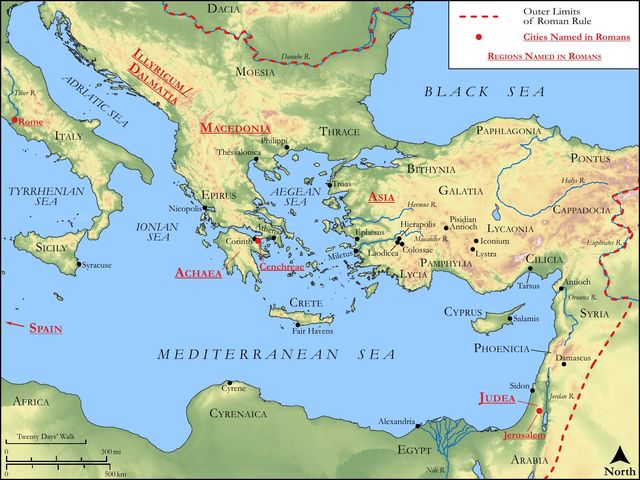
See on the biblical-era map

Study this verse
Public-domain commentary
Matthew Henry
From his Commentary on the Whole Bible. Henry comments on passages, not single verses — this entry covers Romans 3:19–31. His four-level outline is real structure in the source text, so it is rendered as structure.
From all this Paul infers that it is in vain to look for justification by the works of the law, and that it is to be had only by faith, which is the point he has been all along proving, from Rom 1:17, and which he lays down (Rom 3:28) as the summary of his discourse, with a quod erat demonstrandum - which was to be demonstrated. We conclude that a man is justified by faith, without the deeds of the law; not by the deeds of the first law of pure innocence, which left no room for repentance, nor the deeds of the law of nature, how highly soever improved, nor the deeds of the ceremonial law (the blood of bulls and goats could not take away sin), nor the deeds of the moral law, which are certainly included, for he speaks of that law by which is the knowledge of sin and those works which might be matter of boasting. Man, in his depraved state, under the power of such corruption, could never, by any works of his own, gain acceptance with God; but it must be resolved purely into the free grace of God, given through Jesus Christ to all true believers that receive it as a free gift. If we had never sinned, our obedience to the law would have been our righteousness: "Do this, and live." But having sinned, and being corrupted, nothing that we can do will atone for our former guilt. It was by their obedience to the moral law that the Pharisees looked for justification, Luk 18:11. Now there are two things from which the apostle here argues: the guiltiness of man, to prove that we cannot be justified by the works of the law, and the glory of God, to prove that we must be justified by faith.
I.He argues from man's guiltiness, to show the folly of expecting justification by the works of the law.
The argument is very plain: we can never be justified and saved by the law that we have broken. A convicted traitor can never come off by pleading the statute of 25 Edward III, for that law discovers his crime and condemns him: indeed, if he had never broken it, he might have been justified by it; but now it is past that he has broken it, and there is no way of coming off but by pleading the act of indemnity, upon which he has surrendered and submitted himself, and humbly and penitently claiming the benefit of it and casting himself upon it. Now concerning the guiltiness of man,
1.He fastens it particularly upon the Jews; for they were the men that made their boast of the law, and set up for justification by it. He had quoted several scriptures out of the Old Testament to show this corruption: Now, says he (Rom 3:19), this that the law says, it says to those who are under the law; this conviction belongs to the Jews as well as others, for it is written in their law. The Jews boasted of their being under the law, and placed a great deal of confidence in it: "But," says he, "the law convicts and condemns you - you see it does." That every mouth may be stopped - that all boasting may be silenced. See the method that God takes both in justifying and condemning: he stops every mouth; those that are justified have their mouths stopped by a humble conviction; those that are condemned have their mouths stopped too, for they shall at last be convinced (Jde 1:15), and sent speechless to hell, Mat 22:12. All iniquity shall stop her mouth, Psa 107:42.
2.He extends it in general to all the world: That all the world may become guilty before God. If the world likes in wickedness (Jo1 5:19), to be sure it is guilty. - May become guilty; that is, may be proved guilty, liable to punishment, all by nature children of wrath, Eph 2:3. They must all plead guilty; those that stand most upon their own justification will certainly be cast. Guilty before God is a dreadful word, before an all-seeing God, that is not, nor can be, deceived in his judgment - before a just and righteous judge, who will by no means clear the guilty. All are guilty, and therefore all have need of a righteousness wherein to appear before God. For all have sinned (Rom 3:23); all are sinners by nature, by practice, and have come short of the glory of God - have failed of that which is the chief end of man. Come short, as the archer comes short of the mark, as the runner comes short of the prize; so come short, as not only not to win, but to be great losers. Come short of the glory of God.
(1.)Come short of glorifying God. See Rom 1:21, They glorified him not as God. Man was placed at the head of the visible creation, actively to glorify that great Creator whom the inferior creatures could glorify only objectively; but man by sin comes short of this, and, instead of glorifying God, dishonours him. It is a very melancholy consideration, to look upon the children of men, who were made to glorify God, and to think how few there are that do it.
(2.)Come short of glorying before God. There is no boasting of innocency: if we go about to glory before God, to boast of any thing we are, or have, or do, this will be an everlasting estoppe - hat we have all sinned, and this will silence us. We may glory before men, who are short-sighted, and cannot search our hearts, - who are corrupt, as we are, and well enough pleased with sin; but there is no glorying before God, who cannot endure to look upon iniquity.
(3.)Come short of being glorified by God. Come short of justification, or acceptance with God, which is glory begun - come short of the holiness or sanctification which is the glorious image of God upon man, and have overthrown all hopes and expectations of being glorified with God in heaven by any righteousness of their own. It is impossible now to get to heaven in the way of spotless innocency. That passage is blocked up. There is a cherub and a flaming sword set to keep that way to the tree of life.
3.Further to drive us off from expecting justification by the law, he ascribes this conviction to the law (Rom 3:20): For by the law is the knowledge of sin. That law which convicts and condemns us can never justify us. The law is the straight rule, that rectum which is index sui et obliqui - that which points out the right and the wrong; it is the proper use and intendment of the law to open our wound, and therefore not likely to be the remedy. That which is searching is not sanative. Those that would know sin must get the knowledge of the law in its strictness, extent, and spiritual nature. If we compare our own hearts and lives with the rule, we shall discover wherein we have turned aside. Paul makes this use of the law, Rom 7:9, Therefore by the deeds of the law shall no flesh be justified in his sight. Observe,
(1.)No flesh shall be justified, no man, no corrupted man (Gen 6:3), for that he also is flesh, sinful and depraved; therefore not justified, because we are flesh. The corruption that remains in our nature will for ever obstruct any justification by our own works, which, coming from flesh, must needs taste of the cask, Job 14:4.
(2.)Not justified in his sight. He does not deny that justification which was by the deeds of the law in the sight of the church: they were, in their church-estate, as embodied in a polity, a holy people, a nation of priests; but as the conscience stands in relation to God, in his sight, we cannot be justified by the deeds of the law. The apostle refers to Psa 143:2.
II.He argues from God's glory to prove that justification must be expected only by faith in Christ's righteousness.
There is no justification by the works of the law. Must guilty man then remain eternally under wrath? Is there no hope? Is the wound become incurable because of transgression? No, blessed be God, it is not (Rom 3:21, Rom 3:22); there is another way laid open for us, the righteousness of God without the law is manifested now under the gospel. Justification may be obtained without the keeping of Moses's law: and this is called the righteousness of God, righteousness of his ordaining, and providing, and accepting, - righteousness which he confers upon us; as the Christian armour is called the armour of God, Eph 6:11.
1.Now concerning this righteousness of God observe,
(1.)That it is manifested. The gospel-way of justification is a high-way, a plain way, it is laid open for us: the brazen serpent is lifted up upon the pole; we are not left to grope our way in the dark, but it is manifested to us.
(2.)It is without the law. Here he obviates the method of the judaizing Christians, who would needs join Christ and Moses together - owning Christ for the Messiah, and yet too fondly retaining the law, keeping up the ceremonies of it, and imposing it upon the Gentile converts: no, says he, it is without the law. The righteousness that Christ hath brought in is a complete righteousness.
(3.)Yet it is witnessed by the law and the prophets; that is, there were types, and prophecies, and promises, in the Old Testament, that pointed at this. The law is so far from justifying us that it directs us to another way of justification, points at Christ as our righteousness, to whom bear all the prophets witness. See Act 10:43. This might recommend it to the Jews, who were so fond of the law and the prophets.
(4.)It is by the faith of Jesus Christ, that faith which hath Jesus Christ for its object - an anointed Saviour, so Jesus Christ signifies. Justifying faith respects Christ as a Saviour in all his three anointed offices, as prophet, priest, and king-trusting in him, accepting of him, and adhering to him, in all these. It is by this that we become interested in that righteousness which God has ordained, and which Christ has brought in.
(5.)It is to all, and upon all, those that believe. In this expression he inculcates that which he had been often harping upon, that Jews and Gentiles, if they believe, stand upon the same level, and are alike welcome to God through Christ; for there is no difference. Or, it is eis pantas - to all, offered all in general; the gospel excludes none that do not exclude themselves; but it is to epi pantas tous piseuonta, upon all that believe, not only tendered to them, but put upon them as a crown, as a robe; they are, upon their believing, interested in it, and entitled to all the benefits and privileges of it.
2.But now how is this for God's glory?
(1.)It is for the glory of his grace (Rom 3:24): Justified freely by his grace - dōrean tē chariti. It is by his grace, not by the grace wrought in us as the papists say, confounding justification and sanctification, but by the gracious favour of God to us, without any merit in us so much as foreseen. And, to make it the more emphatic, he says it is freely by his grace, to show that it must be understood of grace in the most proper and genuine sense. It is said that Joseph found grace in the sight of his master (Gen 39:4), but there was a reason; he saw that what he did prospered. There was something in Joseph to invite that grace; but the grace of God communicated to us comes freely, freely; it is free grace, mere mercy; nothing in us to deserve such favours: no, it is all through the redemption that is in Jesus Christ. It comes freely to us, but Christ bought it, and paid dearly for it, which yet is so ordered as not to derogate from the honour of free grace. Christ's purchase is no bar to the freeness of God's grace; for grace provided and accepted this vicarious satisfaction.
(2.)It is for the glory of his justice and righteousness (Rom 3:25, Rom 3:26): Whom God hath set forth to be a propitiation, etc. Note,
[1.]Jesus Christ is the great propitiation, or propitiatory sacrifice, typified by the hilastērion, or mercy-seat, under the law. He is our throne of grace, in and through whom atonement is made for sin, and our persons and performances are accepted of God, Jo1 2:2. He is all in all in our reconciliation, not only the maker, but the matter of it - our priest, our sacrifice, our altar, our all. God was in Christ as in his mercy-seat, reconciling the world unto himself.
[2.]God hath set him forth to be so. God, the party offended, makes the first overtures towards a reconciliation, appoints the days-man; proetheto - fore-ordained him to this, in the counsels of his love from eternity, appointed, anointed him to it, qualified him for it, and has exhibited him to a guilty world as their propitiation. See Mat 3:17, and Mat 17:5.
[3.]That by faith in his blood we become interested in this propitiation. Christ is the propitiation; there is the healing plaster provided. Faith is the applying of this plaster to the wounded soul. And this faith in the business of justification hath a special regard to the blood of Christ, as that which made the atonement; for such was the divine appointment that without blood there should be no remission, and no blood but his would do it effectually. Here may be an allusion to the sprinkling of the blood of the sacrifices under the law, as Exo 24:8. Faith is the bunch of hyssop, and the blood of Christ is the blood of sprinkling.
[4.]That all who by faith are interested in this propitiation have the remission of their sins that are past. It was for this that Christ was set forth to be a propitiation, in order to remission, to which the reprieves of his patience and forbearance were a very encouraging preface. Through the forbearance of God. Divine patience has kept us out of hell, that we might have space to repent, and get to heaven. Some refer the sins that are past to the sins of the Old Testament saints, which were pardoned for the sake of the atonement which Christ in the fulness of time was to make, which looked backward as well as forward. Past through the forbearance of God. It is owing to the divine forbearance that we were not taken in the very act of sin. Several Greek copies make en tēanochē tou Theou - through the forbearance of God, to begin Rom 3:26, and they denote two precious fruits of Christ's merit and God's grace: - Remission: dia tēn paresin - for the remission; and reprieves: the forbearance of God. It is owing to the master's goodness and the dresser's mediation that barren trees are let alone in the vineyard; and in both God's righteousness is declared, in that without a mediator and a propitiation he would not only not pardon, but not so much as forbear, not spare a moment; it is owning to Christ that there is ever a sinner on this side hell.
[5.]That God does in all this declare his righteousness. This he insists upon with a great deal of emphasis: To declare, I say, at this time his righteousness. It is repeated, as that which has in it something surprising. He declares his righteousness, First, In the propitiation itself. Never was there such a demonstration of the justice and holiness of God as there was in the death of Christ. It appears that he hates sin, when nothing less than the blood of Christ would satisfy for it. Finding sin, though but imputed, upon his own Son, he did not spare him, because he had made himself sin for us, Co2 5:21. The iniquities of us all being laid upon him, though he was the Son of his love, yet it pleased the Lord to bruise him, Isa 53:10. Secondly, In the pardon upon that propitiation; so it follows, by way of explication: That he might be just, and the justifier of him that believeth. Mercy and truth are so met together, righteousness and peace have so kissed each other, that it is now become not only an act of grace and mercy, but an act of righteousness, in God, to pardon the sins of penitent believers, having accepted the satisfaction that Christ by dying made to his justice for them. It would not comport with his justice to demand the debt of the principal when the surety has paid it and he has accepted that payment in full satisfaction. See Jo1 1:9. He is just, that is, faithful to his word.
(3.)It is for God's glory; for boasting is thus excluded, Rom 3:27. God will have the great work of the justification and salvation of sinners carried on from first to last in such a way as to exclude boasting, that no flesh may glory in his presence, Co1 1:29-31. Now, if justification were by the works of the law, boasting would not be excluded. How should it? If we were saved by our own works, we might put the crown upon our own heads. But the law of faith, that is, the way of justification by faith, doth for ever exclude boasting; for faith is a depending, self-emptying, self-denying grace, and casts every crown before the throne; therefore it is most for God's glory that thus we should be justified. Observe, He speaks of the law of faith. Believers are not left lawless: faith is a law, it is a working grace, wherever it is in truth; and yet, because it acts in a strict and close dependence upon Jesus Christ, it excludes boasting.
From all this he draws this conclusion (Rom 3:28): That a man is justified by faith without the deeds of the law.
III.In the close of the chapter he shows the extent of this privilege of justification by faith, and that it is not the peculiar privilege of the Jews, but pertains to the Gentiles also; for he had said (Rom 3:22) that there is no difference: and as to this,
1.He asserts and proves it (Rom 3:29): Is he the God of the Jews only? He argues from the absurdity of such a supposition. Can it be imagined that a God of infinite love and mercy should limit and confine his favours to that little perverse people of the Jews, leaving all the rest of the children of men in a condition eternally desperate? This would by no means agree with the idea we have of the divine goodness, for his tender mercies are over all his works; therefore it is one God of grace that justifies the circumcision by faith, and the uncircumcision through faith, that is, both in one and the same way. However the Jews, in favour of themselves, will needs fancy a difference, really there is no more difference than between by and through, that is, no difference at all.
2.He obviates an objection (Rom 3:31), as if this doctrine did nullify the law, which they knew came from God: "No," says he, "though we do say that the law will not justify us, yet we do not therefore say that it was given in vain, or is of no use to us; no, we establish the right use of the law, and secure its standing, by fixing it on the right basis. The law is still of use to convince us of what is past, and to direct us for the future; though we cannot be saved by it as a covenant, yet we own it, and submit to it, as a rule in the hand of the Mediator, subordinate to the law of grace; and so are so far from overthrowing that we establish the law." Let those consider this who deny the obligation of the moral law on believers.
Historical interpretation
Two Centuries of Reception
9 surviving comments on this verse. Each one is dated, so this reads as a timeline rather than a list.
Select a marker to jump to its quote. Markers stagger vertically where authors wrote within a few decades of each other.
But he had withal said above: "Are we, then, making void the law through faith? Far be it; but we are establishing the law " -forsooth in those (points) which, being even now interdicted by the New Testament, are prohibited by an even more emphatic precept: instead of, "Thou shalt not commit adultery," "Whoever shall have seen with a view to concupiscence, hath already committed adultery in his own heart; " and instead of, "Thou shalt not kill," "Whoever shall have said to his brother, Racha, shall be in danger of hell.
Whoever does not believe in Christ, of whom Moses wrote in the law, destroys the law. But whoever believes in Christ, of whom Moses wrote, confirms the law through faith, because he believes in Christ.The Lord himself said: “I have not come to abolish the law but to fulfill it.” None of the saints nor even the Lord himself has destroyed the law. Rather its glory, which is temporal and transient, has been destroyed and replaced by a glory which is eternal and permanent.
Paul says that the law is not nullified by faith but fulfilled. For its status is confirmed when faith bears witness that what it said would come has actually happened. Paul says this because of the Jews who thought that faith in Christ was inimical to the law because they did not understand the true meaning of the law. For Paul does not nullify the law when he says that it must come to an end, because he asserts that at the time it was given it was rightly given, but now it does not have to be kept any longer. In the law itself it is said that a time would come when the promise would be fulfilled and the law would no longer have to be kept.… “Behold the days are coming, says the Lord, when I will make a new covenant with the house of Israel and the house of Judah, not like the covenant which I made with their fathers.”
"Do we then," he says, "make void the Law through faith? God forbid: yea, we establish the Law." Do you see his varied and unspeakable judgment? For the bare use of the word "establish" shows that it was not then standing, but was worn out. And note also Paul's exceeding power, and how superabundantly he maintains what he wishes. For here he shows that the faith, so far from doing any disparagement to the "Law," even assists it, as it on the other hand paved the way for the faith. For as the Law itself before bore witness to it (for he saith, "being witnessed by the Law and the Prophets"), so here this establisheth that, now that it is unnerved. And how did it establish? he would say. What was the object of the Law and what the scope of all its enactments? Why, to make man righteous. But this it had no power to do. "For all," it says, "have sinned:" but faith when it came accomplished it. For when a man is once a believer, he is straightway justified. The intention then of the Law it did establish, and what all its enactments aim after, this hath it brought to a consummation. Consequently it has not disannulled, but perfected it. Here then three points he has demonstrated; first, that without the Law it is possible to be justified; next, that this the Law could not effect; and, that faith is not opposed to the Law.
Is the law which enjoins us to be circumcised unnecessary? Not at all! On the contrary, we enable it to stand firm when we show that what it said is true, viz., that (spiritual) law would follow after (physical) law, (spiritual) testament after (physical) testament, (spiritual) circumcision after (physical) circumcision.
How should the law be upheld if not by righteousness? By a righteousness, moreover, which is of faith, for what could not be fulfilled through the law is fulfilled through faith.
Do we then make void freedom of choice through grace? God forbid! Rather, we establish freedom of choice. As the law is not made void by faith, so freedom of choice is not made void but established by grace. Freedom of choice is necessary to the fulfillment of the law. But by the law comes the knowledge of sin; by faith comes the obtaining of grace against sin; by grace comes the healing of the soul from sin’s sickness; by the healing of the soul comes freedom of choice; by freedom of choice comes the love of righteousness; by the love of righteousness comes the working of the law. Thus, as the law is not made void but established by faith, since faith obtains the grace whereby the law may be fulfilled, so freedom of choice is not made void but established by grace, since grace heals the will whereby righteousness may freely be loved.
The law is confirmed by faith. Apart from faith the law merely commands, and it holds guilty those who do not fulfill its commands, so that it might thereafter turn to the grace of the Deliverer those groaning in their inability to do what is commanded.
On account of his humanity Emmanuel is called a prophet, who following Moses is the mediator between God and humanity. The law was a shadow, but even so it presented an image of the truth. Furthermore, the truth hardly destroys its images; rather it makes-them clearer.
Continue studying Romans 3:31 across the web’s major study libraries — every link below opens this exact verse, chapter, or book on the destination site.
Read & Compare
 BibleGatewayThis verse in more than 200 translations and 70 languages.
 Bible.comThe YouVersion reader — hundreds of translations, reading plans, and highlights.
 ESV.orgCrossway's official English Standard Version reader.
 NET BibleThe NET translation with 60,000+ translators' notes on every rendering decision.
 STEP BibleTyndale House's free study tool — original text, vocabulary, and scholarly resources.
 BibliaLogos Bible Software's free web reader.
 USCCBThe New American Bible (Revised Edition) with the U.S. bishops' study notes.
Commentaries
 BibleHub CommentariesDozens of classic commentaries on this verse, gathered on one page.
 StudyLightMore than 100 commentary sets — the largest collection on the web.
 BibleRefPlain-English commentary on what this verse means, verse by verse.
 Enduring WordDavid Guzik's free commentary on this chapter, widely used by Bible teachers.
 Bible Study ToolsVerse commentary alongside Greek and Hebrew study aids.
Original Language & Research
- BibleHub InterlinearThe verse word by word — original language, transliteration, and English.
- BibleHub LexiconEvery word's original-language definition and Strong's entry.
 Blue Letter BibleDeep-study tools — Strong's numbers, concordance, and word studies.
 CNTR CollationThe earliest Greek manuscripts of this verse, collated letter by letter.
Sermons, Hymns & Audio


TrulyRandomVerse is not affiliated with these sites and doesn’t control their content. They’re linked because they’re genuinely useful.
Summary
Romans 3:31 serves as a pivotal rhetorical question and emphatic declaration, concluding Paul's profound argument for justification by faith alone. Having established that both Jews and Gentiles are under the condemnation of sin and that righteousness is imputed through faith in Jesus Christ apart from works of the law, Paul anticipates a critical objection: Does this radical doctrine of salvation by grace through faith nullify or abolish the divine law? His unequivocal response, "God forbid: yea, we establish the law," asserts that true faith in Christ, far from undermining God's holy law, actually upholds, confirms, and properly understands its enduring purpose and authority.
Context
ShowHideLiterary Context
Romans 3:31 immediately follows Paul's comprehensive exposition on the universal sinfulness of humanity (Romans 1:18-3:20) and the groundbreaking revelation of God's righteousness apart from the law, which is received through faith in Jesus Christ (Romans 3:21-30). This verse acts as a crucial bridge, addressing a potential theological misunderstanding that could arise from the preceding arguments. Paul has just declared that both Jews and Gentiles are justified freely by God's grace through the redemption that is in Christ Jesus Romans 3:24. The question in Romans 3:31 is therefore a natural and necessary one, directly confronting the perceived tension between God's grace and His established moral and ceremonial law, particularly the Mosaic Law, which was central to Jewish identity and covenant.
Historical & Cultural Context
For Paul's Jewish audience, the Law (Torah) was the cornerstone of their identity, their covenant relationship with God, and their understanding of righteousness. The idea that salvation could be obtained "apart from the law" Romans 3:21 would have been deeply unsettling, potentially interpreted as a direct assault on God's eternal commands and the very foundation of their religious life. Paul, a former Pharisee, understood this tension acutely. His argument in Romans is not merely theoretical but directly addresses the deeply ingrained cultural and religious convictions of his Jewish readers, while also demonstrating the universal applicability of God's plan of salvation to Gentiles. The concept of "making void" the law would have implied a disregard for God's revealed will, leading to antinomianism (lawlessness), a charge Paul vehemently refutes.
Key Themes
ShowHideThis verse powerfully contributes to several overarching themes in Romans. It directly engages with the theme of Faith and the Law, demonstrating that these are not antithetical but complementary in God's redemptive plan. It underscores God's Righteousness and Consistency, showing that His method of salvation through faith does not negate His holy character or His revealed will, but rather upholds it. Furthermore, it touches upon the theme of True Obedience, implying that genuine faith leads not to license but to a deeper, Spirit-empowered adherence to the spirit of the law. Paul's emphatic "God forbid" (Greek: mē genoito) is a recurring rhetorical device throughout Romans, used to strongly reject false conclusions drawn from his gospel of grace, such as the idea that grace encourages continued sin Romans 6:1-2 or that God has abandoned Israel Romans 11:1.
Exposition and Analysis
ShowHideKey Word Analysis
ShowHideMeaning "to be (render) entirely idle (useless), literally or figuratively:--abolish, cease, cumber, deliver, destroy, do away, become (make) of no (none, without) effect, fail, loose, bring (come) to nought, put away (down), vanish away, make void." Paul's use of katargéō here is crucial. The question is not whether faith merely bypasses the law, but whether it renders the law completely inoperative, useless, or brings it to nothing. This word implies a total abolition or nullification.
A combination of G3361 (mḗ), a particle of qualified negation, and G1096 (gínomai), meaning "to cause to be... to become (come into being)." The phrase mē genoito (a form of mḗ gínomai) is a strong idiom, best translated as "May it never be!" or "Absolutely not!" It expresses the strongest possible rejection of the preceding idea, indicating that the suggestion of faith making the law void is utterly repugnant to God's character and Paul's theology.
Meaning "to stand (transitively or intransitively), used in various applications (literally or figuratively):--abide, appoint, bring, continue, covenant, establish, hold up, lay, present, set (up), stanch, stand (by, forth, still, up)." In direct contrast to "make void," hístēmi signifies to confirm, uphold, make firm, or cause to stand. Paul asserts that faith does not tear down the law but rather sets it firmly in its proper place and validates its true purpose.
Verse Breakdown
ShowHide"Do we then make void the law through faith?"
This is a rhetorical question, anticipating an objection from those who might misunderstand the doctrine of justification by faith. The "then" (Greek: oûn, G3767) connects this question directly to the preceding argument that righteousness is by faith apart from works of the law. The core concern is whether faith, as the sole means of righteousness, somehow renders God's holy and righteous law irrelevant, abolished, or without effect. This question reflects a common misconception that grace leads to antinomianism, or lawlessness.
"God forbid:"
This emphatic Greek idiom (mē genoito, G3361 G1096) serves as Paul's unequivocal and vehement rejection of the premise that faith nullifies the law. It is the strongest possible negative response, signaling that such a conclusion is utterly unthinkable and contrary to divine truth. It underscores Paul's theological conviction that the gospel of grace does not undermine God's moral standards.
"yea, we establish the law."
This is Paul's affirmative and counter-intuitive declaration. The "yea" (Greek: allá, G235) introduces a strong contrast to the rejected premise. Rather than abolishing the law, faith actually "establishes" it (Greek: hístēmi, G2476). This means that faith confirms, upholds, validates, and gives the law its proper and intended place within God's redemptive plan. True faith recognizes the law's divine origin, its revelation of sin, its role in pointing to Christ, and its ongoing function as a guide for righteous living for those who are justified.
Literary Devices
ShowHidePaul employs several effective literary devices in Romans 3:31. The primary device is a Rhetorical Question, "Do we then make void the law through faith?" This technique allows Paul to anticipate and immediately address a likely objection from his readers, particularly those from a Jewish background. By posing the question himself, he controls the narrative and guides the audience toward his intended conclusion. Following this, he uses a powerful Apostolic Interjection or Exclamation, "God forbid!" (Greek: mē genoito). This is a strong negative idiom, functioning as an emphatic denial and expressing Paul's utter rejection of the implied premise. It adds dramatic force and emotional intensity to his argument. Finally, there is a clear Antithesis or Contrast between "make void" (katargéō) and "establish" (hístēmi). This stark opposition highlights the diametrically opposed outcomes: faith does not destroy the law but rather confirms and upholds it, revealing its true purpose and enduring validity.
Theological and Thematic Connections
ShowHideRomans 3:31 is a crucial theological statement that clarifies the relationship between God's grace, human faith, and the divine law. It asserts that the gospel of justification by faith does not lead to lawlessness but rather provides the only true foundation for upholding the law. The law, in its essence, reveals God's holy character and His righteous demands, exposing humanity's inability to meet those demands and thus pointing to the need for a Savior. When a person is justified by faith in Christ, they are not freed from the moral obligations of the law, but rather empowered by the Holy Spirit to fulfill the law's righteous requirements, not as a means to salvation, but as a fruit of salvation. This understanding prevents antinomianism and reinforces the coherence of God's redemptive plan, showing that His grace does not contradict His justice or His holy standards.
Reflection and Application
ShowHideRomans 3:31 calls believers to a profound understanding of how grace and law intersect in the Christian life. It challenges the misconception that because salvation is a free gift received by faith, moral living becomes optional or irrelevant. On the contrary, genuine faith in Christ, which brings justification, also transforms the heart and empowers the believer to live in a way that honors God's commands. We are no longer under the law as a system of earning righteousness, but we are called to live according to the spirit of the law, which is love, as a response to God's saving grace. This means our faith should lead us to a deeper appreciation for God's holiness and a greater desire to conform our lives to His will, not out of compulsion or fear of judgment, but out of gratitude and love for the One who justified us. Our obedience becomes a joyful expression of our new identity in Christ, establishing the law's principles in our lives as a testimony to God's transformative power.
Questions for Reflection
ShowHideFAQ
ShowHideDoes "establish the law" mean Christians must follow all Old Testament laws, including ceremonial ones?
ShowHideNo, "establish the law" does not mean Christians are bound to every detail of the Mosaic Law, especially its ceremonial or civil aspects, in the same way ancient Israel was. Paul's argument throughout Romans and Galatians clarifies that salvation is not through adherence to the Mosaic Law, which includes dietary restrictions, sacrificial systems, or circumcision. Instead, "establish the law" refers to upholding its divine origin, its moral principles, and its ultimate purpose. The law reveals sin Romans 7:7, points to the need for a Savior, and reflects God's holy character. Through faith in Christ, believers fulfill the law's righteous requirement not by perfect external adherence to its letter, but by the Spirit's power working within them, leading to lives characterized by love Romans 13:8-10 and obedience to Christ's commands. The moral essence of the law, particularly as summarized in the command to love God and neighbor, is affirmed and empowered by faith, not abolished.
Christ-Centered Fulfillment
ShowHideRomans 3:31 finds its ultimate Christ-centered fulfillment in the person and work of Jesus Christ Himself. Far from making the law void, Jesus perfectly embodied and fulfilled its every demand, living a life of impeccable obedience where all others failed Matthew 5:17. He did not come to abolish the Law or the Prophets, but to fulfill them, thereby establishing their divine authority and demonstrating the perfect standard of God's righteousness. Furthermore, through His sacrificial death on the cross, Christ bore the curse of the law for humanity's transgression, offering Himself as the propitiation for our sins Romans 3:25. In doing so, He satisfied the law's righteous demands for justice, making it possible for God to be both "just and the justifier of the one who has faith in Jesus" Romans 3:26. Thus, faith in Christ does not discard the law but rather validates its purpose by revealing the only one who could perfectly keep it and ultimately redeem us from its condemnation, thereby establishing its true and eternal significance within God's redemptive plan. The law, therefore, serves as a "guardian" leading us to Christ Galatians 3:24, and through faith in Him, its righteous requirements are met in us by the power of the Spirit Romans 8:3-4.