


Romans 3:9
- ΤίTiWhatG5101I-ASNInterrogative pronoun Accusative Singular Neuter
- οὖν;ounthen?G3767CONJConjunction
- προεχόμεθα;proechomethaAre we better?G4284V-PNI-1PVerb Present Middle Or Passive Deponent Indicative 1st Plural
- οὐouNotG3756PRT-NNegative Particle Negative
- πάντως·pantōsat allG3843ADVAdverb
- προῃτιασάμεθαproētiasamethaWe have already chargedG4256V-ADI-1PVerb Aorist Middle Deponent Indicative 1st Plural
- γὰρgarforG1063CONJConjunction
- ἸουδαίουςIoudaiousJewsG2453N-APM-PGNoun Accusative Plural Masculine Person Gentilic
- τεtebothG5037CONJConjunction
- καὶkaiandG2532CONJConjunction
- ἝλληναςHellēnasGreeksG1672N-APM-LGNoun Accusative Plural Masculine Location Gentilic
- πάνταςpantasallG3956A-APMAdjective Accusative Plural Masculine
- ὑφ᾽huph᾽underG5259PREPPreposition
- ἁμαρτίανhamartiansinG266N-ASFNoun Accusative Singular Feminine
- εἶναιeinaito beG1511V-PANVerb Present Active Infinitive
English is a literal word-by-word gloss of the Greek, not the KJV's wording. Why?
This is the original text the KJV's translators worked from — each Greek word with its own literal English meaning in this verse, prepared by scholars at Tyndale House, Cambridge. The KJV translates whole sentences, not word by word, so its wording differs: one Greek word can become several English words, and the KJV may choose “charity” where the gloss reads “love”. Both are faithful — they answer different questions. For the KJV's own rendering, switch to the KJV text.
Details
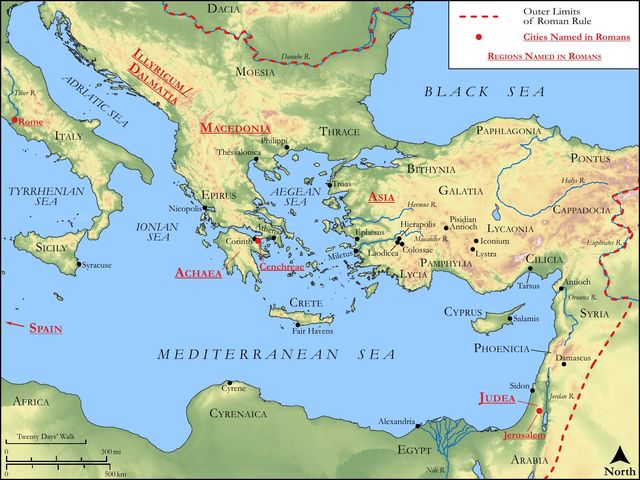
See on the biblical-era map

Study this verse
Public-domain commentary
Matthew Henry
From his Commentary on the Whole Bible. Henry comments on passages, not single verses — this entry covers Romans 3:1–18. His four-level outline is real structure in the source text, so it is rendered as structure.
I.Here the apostle answers several objections, which might be made, to clear his way.
No truth so plain and evident but wicked wits and corrupt carnal hearts will have something to say against it; but divine truths must be cleared from cavil.
Object. 1. If Jew and Gentile stand so much upon the same level before God, what advantage then hath the Jew? Hath not God often spoken with a great deal of respect for the Jews, as a non-such people (Deu 33:29), a holy nation, a peculiar treasure, the seed of Abraham his friend: Did not he institute circumcision as a badge of their church-membership, and a seal of their covenant-relation to God? Now does not this levelling doctrine deny them all such prerogatives, and reflect dishonour upon the ordinance of circumcision, as a fruitless insignificant thing.
Answer. The Jews are, notwithstanding this, a people greatly privileged and honoured, have great means and helps, though these be not infallibly saving (Rom 3:2): Much every way. The door is open to the Gentiles as well as the Jews, but the Jews have a fairer way up to this door, by reason of their church-privileges, which are not to be undervalued, though many that have them perish eternally for not improving them. He reckons up many of the Jews' privileges Rom 9:4, Rom 9:5; here he mentions but one (which is indeed instar omnium - equivalent to all), that unto them were committed the oracles of God, that is, the scriptures of the Old Testament, especially the law of Moses, which is called the lively oracles (Act 7:38), and those types, promises, and prophecies, which relate to Christ and the gospel. The scriptures are the oracles of God: they are a divine revelation, they come from heaven, are of infallible truth, and of eternal consequence as oracles. The Septuagint call the Urim and Thummim the logia - the oracles. The scripture is our breast-plate of judgment. We must have recourse to the law and to the testimony, as to an oracle. The gospel is called the oracles of God, Heb 5:12; Pe1 4:11. Now these oracles were committed to the Jews; the Old Testament was written in their language; Moses and the prophets were of their nation, lived among them, preached and wrote primarily to and for the Jews. They were committed to them as trustees for succeeding ages and churches. The Old Testament was deposited in their hands, to be carefully preserved pure and uncorrupt, and so transmitted down to posterity. The Jews were the Christians' library-keepers, were entrusted with that sacred treasure for their own use and benefit in the first place, and then for the advantage of the world; and, in preserving the letter of the scripture, they were very faithful to their trust, did not lose one iota or tittle, in which we are to acknowledge God's gracious care and providence. The Jews had the means of salvation, but they had not the monopoly of salvation. Now this he mentions with a chiefly, prōton men gar - this was their prime and principal privilege. The enjoyment of God's word and ordinances is the chief happiness of a people, is to be put in the imprimis of their advantages, Deu 4:8; Deu 33:3; Psa 147:20.
Object. 2. Against what he had said of the advantages the Jews had in the lively oracles, some might object the unbelief of many of them. To what purpose were the oracles of God committed to them, when so many of them, notwithstanding these oracles, continued strangers to Christ, and enemies to his gospel? Some did not believe, Rom 3:3.
Answer. It is very true that some, nay most of the present Jews, do not believe in Christ; but shall their unbelief make the faith of God without effect? The apostle startles at such a thought: God forbid! The infidelity and obstinacy of the Jews could not invalidate and overthrow those prophecies of the Messiah which were contained in the oracles committed to them. Christ will be glorious, though Israel be not gathered, Isa 49:5. God's words shall be accomplished, his purposes performed, and all his ends answered, though there be a generation that by their unbelief go about to make God a liar. Let God be true but every man a liar; let us abide by this principle, that God is true to every word which he has spoken, and will let none of his oracles fall to the ground, though thereby we give the lie to man; better question and overthrow the credit of all the men in the world than doubt of the faithfulness of God. What David said in his haste (Psa 116:11), that all men are liars, Paul here asserts deliberately. Lying is a limb of that old man which we every one of us come into the world clothed with. All men are fickle, and mutable, and given to change, vanity and a lie (Psa 62:9), altogether vanity, Psa 39:5. All men are liars, compared with God. It is very comfortable, when we find every man a liar (no faith in man), that God is faithful. When they speak vanity every one with his neighbour, it is very comfortable to think that the words of the Lord are pure words, Psa 12:2, Psa 12:6. For the further proof of this he quotes Psa 51:4, That thou mightest be justified, the design of which is to show, 1. That God does and will preserve his own honour in the world, notwithstanding the sins of men. 2. That it is our duty, in all our conclusions concerning ourselves and others, to justify God and to assert and maintain his justice, truth, and goodness, however it goes. David lays a load upon himself in his confession, that he might justify God, and acquit him from any injustice. So here, Let the credit or reputation of man shift for itself, the matter is not great whether it sink or swim; let us hold fast this conclusion, how specious soever the premises may be to the contrary, that the Lord is righteous in all his ways, and holy in all his works. Thus is God justified in his sayings, and cleared when he judges (as it is Psa 51:4), or when he is judged, as it is here rendered. When men presume to quarrel with God and his proceedings, we may be sure the sentence will go on God's side.
Object. 3. Carnal hearts might hence take occasion to encourage themselves in sin. He had said that the universal guilt and corruption of mankind gave occasion to the manifestation of God's righteousness in Jesus Christ. Now it may be suggested, If all our sin be so far from overthrowing God's honour that it commends it, and his ends are secured, so that there is no harm done, is it not unjust for God to punish our sin and unbelief so severely? If the unrighteousness of the Jews gave occasion to the calling in of the Gentiles, and so to God's greater glory, why are the Jews so much censured? If our unrighteousness commend the righteousness of God, what shall we say? Rom 3:5. What inference may be drawn from this? Is God unrighteous, mē adikos ho Theos - Is not God unrighteous (so it may be read, more in the form of an objection), who taketh vengeance? Unbelieving hearts will gladly take any occasion to quarrel with equity of God's proceedings, and to condemn him that is most just, Job 34:17. I speak as a man, that is, I object this as the of carnal hearts; it is suggested like a man, a vain, foolish, proud creature.
Answer. God forbid; far be it from us to imagine such a thing. Suggestions that reflect dishonour upon God and his justice and holiness are rather to be startled at than parleyed with. Get thee behind me, Satan; never entertain such a thought. For then how shall God judge the world? Rom 3:6. The argument is much the same with that of Abraham (Gen 18:25): Shall not the Judge of all the earth do right? No doubt, he shall. If he were not infinitely just and righteous, he would be unfit to be the judge of all the earth. Shall even he that hateth right govern? Job 34:17. Compare Job 34:18, Job 34:19. The sin has never the less of malignity and demerit in it though God bring glory to himself out of it. It is only accidentally that sin commends God's righteousness. No thanks to the sinner for that, who intends no such thing. The consideration of God's judging the world should for ever silence all our doubtings of, and reflections upon, his justice and equity. It is not for us to arraign the proceedings of such an absolute Sovereign. The sentence of the supreme court, whence lies no appeal, is not to be called in question.
Object. 4. The former objection is repeated and prosecuted (Rom 3:7, Rom 3:8), for proud hearts will hardly be beaten out of their refuge of lies, but will hold fast the deceit. But his setting off the objection in its own colours is sufficient to answer it: If the truth of God has more abounded through my lie. He supposes the sophisters to follow their objection thus: "If my lie, that is, my sin" (for there is something of a lie in every sin, especially in the sins of professors) "have occasioned the glorifying of God's truth and faithfulness, why should I be judged and condemned as a sinner, and not rather thence take encouragement to go on in my sin, that grace may abound?" an inference which at first sight appears too black to be argued, and fit to be cast out with abhorrence. Daring sinners take occasion to boast in mischief, because the goodness of God endures continually, Psa 52:1. Let us do evil that good may come is oftener in the heart than in the mouth of sinners, so justifying themselves in their wicked ways. Mentioning this wicked thought, he observes, in a parenthesis, that there were those who charged such doctrines as this upon Paul and his fellow-ministers: Some affirm that we say so. It is no new thing for the best of God's people and ministers to be charged with holding and teaching such things as they do most detest and abhor; and it is not to be thought strange, when our Master himself was said to be in league with Beelzebub. Many have been reproached as if they had said that the contrary of which they maintain: it is an old artifice of Satan thus to cast dirt upon Christ's ministers, Fortiter calumniari, aliquid adhaerebit - Lay slander thickly on, for some will be sure to stick. The best men and the best truths are subject to slander. Bishop Sanderson makes a further remark upon this, as we are slanderously reported - blasphēmoumetha. Blasphemy in scripture usually signifies the highest degree of slander, speaking ill of God. The slander of a minister and his regular doctrine is a more than ordinary slander, it is a kind of blasphemy, not for his person's sake, but for his calling's sake and his work's sake, Th1 5:13.
Answer. He says no more by way of confutation but that, whatever they themselves may argue, the damnation of those is just. Some understand it of the slanderers; God will justly condemn those who unjustly condemn his truth. Or, rather, it is to be applied to those who embolden themselves in sin under a pretence of God's getting glory to himself out of it. Those who deliberately do evil that good may come of it will be so far from escaping, under the shelter of that excuse, that it will rather justify their damnation, and render them the more inexcusable; for sinning upon such a surmise, and in such a confidence, argues a great deal both of the wit and of the will in the sin - a wicked will deliberately to choose the evil, and a wicked wit to palliate it with the pretence of good arising from it. Therefore their damnation is just; and, whatever excuses of this kind they may now please themselves with, they will none of them stand good in the great day, but God will be justified in his proceedings, and all flesh, even the proud flesh that now lifts up itself against him, shall be silent before him. Some think Paul herein refers to the approaching ruin of the Jewish church and nation, which their obstinacy and self-justification in their unbelief hastened upon them apace.
II.Paul, having removed these objections, next revives his assertion of the general guilt and corruption of mankind in common, both of Jews and Gentiles, Rom 3:9-18. "Are we better than they, we Jews, to whom were committed the oracles of God? Does this recommend us to God, or will this justify us? No, by no means." Or, "Are we Christians (Jews and Gentiles) so much better antecedently than the unbelieving part as to have merited God's grace? Alas! no: before free grace made the difference, those of us that had been Jews and those that had been Gentiles were all alike corrupted." They are all under sin. Under the guilt of sin: under it as under a sentence; - under it as under a bond, by which they are bound over to eternal ruin and damnation; - under it as under a burden (Psa 38:4) that will sink them to the lowest hell: we are guilty before God, Rom 3:19. Under the government and dominion of sin: under it as under a tyrant and cruel task-master, enslaved to it; - under it as under a yoke; - under the power of it, sold to work wickedness. And this he had proved, proētiasametha. It is a law term: We have charged them with it, and have made good our charge; we have proved the indictment, we have convicted them by the notorious evidence of the fact. This charge and conviction he here further illustrates by several scriptures out of the Old Testament, which describe the corrupt depraved state of all men, till grave restrain or change them; so that herein as in a glass we may all of us behold our natural face. The Rom 3:10, Rom 3:11, and Rom 3:12 verses are taken from Psa 14:1-3, which are repeated as containing a very weighty truth, Psa 53:1-3. The rest that follows here is found in the Septuagint translation of the 14th Psalm, which some think the apostle chooses to follow as better known; but I rather think that Paul took these passages from other places of scripture here referred to, but in later copies of the Septuagint they were all added in Psa 14:1-7 from this discourse of Paul. It is observable that, to prove the general corruption of nature, he quotes some scriptures which speak of the particular corruptions of particular persons, as of Doeg (Psa 140:3), of the Jews (Isa 59:7, Isa 59:8), which shows that the same sins that are committed by one are in the nature of all. The times of David and Isaiah were some of the better times, and yet to their days he refers. What is said Psa 14:1-7 is expressly spoken of all the children of men, and that upon a particular view and inspection made by God himself. The Lord looked down, as upon the old world, Gen 6:5. And this judgment of God was according to truth. He who, when he himself had made all, looked upon every thing that he had made, and behold all was very good, now that man had marred all, looked, and behold all was very bad. Let us take a view of the particulars. Observe,
1.That which is habitual, which is two-fold: -
(1.)An habitual defect of every thing that is good.
[1.]There is none righteous, none that has an honest good principle of virtue, or is governed by such a principle, none that retains any thing of that image of God, consisting in righteousness, wherein man was created; no, not one; implying that, if there had been but one, God would have found him out. When all the world was corrupt, God had his eye upon one righteous Noah. Even those who through grace are justified and sanctified were none of them righteous by nature. No righteousness is born with us. The man after God's own heart owns himself conceived in sin.
[2.]There is none that understandeth, Rom 3:11. The fault lies in the corruption of the understanding; that is blinded, depraved, perverted. Religion and righteousness have so much reason on their side that if people had but any understanding they would be better and do better. But they do not understand. Sinners are fools.
[3.]None that seeketh after God, that is, none that has any regard to God, any desire after him. Those may justly be reckoned to have no understanding that do not seek after God. The carnal mind is so far from seeking after God that really it is enmity against him.
[4.]They are together become unprofitable, Rom 3:12. Those that have forsaken God soon grow good for nothing, useless burdens of the earth. Those that are in a state of sin are the most unprofitable creatures under the sun; for it follows,
[5.]There is none that doeth good; no, not a just man upon the earth, that doeth good, and sinneth not, Ecc 7:23. Even in those actions of sinners that have some goodness in them there is a fundamental error in the principle and end; so that it may be said, There is none that doeth good. Malum oritur ex quolibet defectu - Every defect is the source of evil.
(2.)An habitual defection to every thing that is evil: They are all gone out of the way. No wonder that those miss the right way who do not seek after God, the highest end. God made man in the way, set him in right, but he hath forsaken it. The corruption of mankind is an apostasy.
2.That which is actual. And what good can be expected from such a degenerate race? He instances,
(1.)In their words (Rom 3:13, Rom 3:14), in three things particularly: - [1.] Cruelty: Their throat is an open sepulchre, ready to swallow up the poor and innocent, waiting an opportunity to do mischief, like the old serpent seeking to devour, whose name is Abaddon and Apollyon, the destroyer. And when they do not openly avow this cruelty, and vent it publicly, yet they are underhand intending mischief: the poison of asps is under their lips (Jam 3:8), the most venomous and incurable poison, with which they blast the good name of their neighbour by reproaches, and aim at his life by false witness. These passages are borrowed from Psa 5:9 and Psa 140:3. [2.] Cheating: With their tongues they have used deceit. Herein they show themselves the devil's children, for he is a liar, and the father of lies. They have used it: it intimates that they make a trade of lying; it is their constant practice, especially belying the ways and people of God. [3.] Cursing: reflecting upon God, and blaspheming his holy name; wishing evil to their brethren: Their mouth is full of cursing and bitterness. This is mentioned as one of the great sins of the tongue, Jam 3:9. But those that thus love cursing shall have enough of it, Psa 109:17-19. How many, who are called Christians, do by these sin evince that they are still under the reign and dominion of sin, still in the condition that they were born in.
(2.)In their ways (Rom 3:15-17): Their feet are swift to shed blood; that is, they are very industrious to compass any cruel design, ready to lay hold of all such opportunities. Wherever they go, destruction and misery go along with them; these are their companions-destruction and misery to the people of God, to the country and neighbourhood where they live, to the land and nation, and to themselves at last. Besides the destruction and misery that are at the end of their ways (death is the end of these things), destruction and misery are in their ways; their sin is its own punishment: a man needs no more to make him miserable than to be a slave to his sins. - And the way of peace have they not known; that is, they know not how to preserve peace with others, nor how to obtain peace for themselves. They may talk of peace, such a peace as is in the devil's palace, while he keeps it, but they are strangers to all true peace; they know not the things that belong to their peace. These are quoted from Pro 1:16; Isa 59:7, Isa 59:8.
(3.)The root of all this we have: There is no fear of God before their eyes, Rom 3:18. The fear of God is here put for all practical religion, which consists in an awful and serious regard to the word and will of God as our rule, to the honour and glory of God as our end. Wicked people have not this before their eyes; that is, they do not steer by it; they are governed by other rules, aim at other ends. This is quoted from Psa 36:1. Where no fear of God is, no good is to be expected. The fear of God is would lay a restraint upon our spirits, and keep them right, Neh 5:15. When once fear is cast off, prayer is restrained (Job 15:4), and then all goes to wreck and ruin quickly. So that we have here a short account of the general depravity and corruption of mankind; and may say, O Adam! what hast thou done? God made man upright, but thus he hath sought out many inventions.
Historical interpretation
Ten Centuries of Reception
5 surviving comments on this verse. Each one is dated, so this reads as a timeline rather than a list.
Select a marker to jump to its quote. Markers stagger vertically where authors wrote within a few decades of each other.
Here it must be understood that the reference is to all men, whether they are under the written law [of Moses] or the natural law. For we understand that this applies to the Gentiles in the same way as we have already said above. When they begin to do the works of the law by nature and become a law for themselves, then they are reproached by their conscience for the things they do which are contrary to that law. For this reason it seems to me that those who have thought that the law of nature is the law of God and that the law of Moses is merely the written law are correct. If Paul was speaking of the written law, the law of Moses, when he said: “Sin is not imputed when there is no law,” neither Cain nor those who perished in the flood nor those who were burnt with fire at Sodom would have had their sins imputed to them. But since we see that not only did they have their sins imputed to them, they also suffered retribution for them, it is clear that Paul was speaking here of the natural law, which with the exception of the early years of childhood, is present in all men. For this reason he was quite right to say that all are under the power of sin. Whence it seems to me that the philosophers were right when they said that every mortal being on coming to the age of discretion, when by the entry of the natural law it might distinguish between good and evil, first of all discovers what is evil and afterward combats it by means of instructions, precepts and warnings, so as to move on to virtue. I think that Paul was agreeing with them when he said: “But when the commandment came, sin sprang to life.” … It must not be thought that everyone is guilty of all the sins which are listed below. Rather, some are guilty of some of them, and others are guilty of others but in such a way that taken together the whole range of sinfulness is found in the human race.
Paul is saying: “Why go on talking like this? For we have shown by the examples given that all, Jews and Gentiles alike, are guilty and that the law is being pursued in vain.” For Paul first showed that the Gentiles are guilty according to the law of nature and also because they did not accept the law of Moses, for which reason their case is very dire indeed. Then he showed that the Jews were also guilty. While they appeared to be living under God’s law and defended their privilege by the merit of their ancestors, they in fact brought the grace of God into disrepute because they rejected the promise made to their ancestors.
"What then have we more than they? For we have proved both Jews and Gentiles, that they are all under sin. As it is written, There is none righteous, no, not one." He had accused the Gentiles, he had accused the Jews; it came next in order to mention the righteousness which is by faith. For if the law of nature availed not, and the written Law was of no advantage, but both weighed down those that used them not aright, and made it plain that they were worthy of greater punishment, then after this the salvation which is by grace was necessary. Speak then of it, O Paul, and display it. But as yet he does not venture, as having an eye to the violence of the Jews, and so turns afresh to his accusation of them; and first he brings in as accuser, David speaking of the same things at length, which Isaiah mentioned all in short compass, so furnishing a strong curb for them, so that they might not bound off, nor any of his hearers, while the matters of faith were laid open to them, might after this start away; being beforehand safely held down by the accusations of the prophets. For there are three excesses which the prophet lays down; he says that all of them together did evil, and that they did not do good indifferently with evil, but that they followed after wickedness alone, and followed it also with all earnestness. And next that they should not say, "What then, if these things were said to others?" he goes on:
Paul finds no reason for saying that the Jews are better than others.… Both Jews and Gentiles are under sin—something we not only deduce by reason but also corroborate by the witness of the Jews themselves.
271. After showing the Jews’ advantage over the Gentiles so far as God’s blessings are concerned [n. 248], the Apostle now rejects their vainglory, by which they preferred themselves to Gentiles converted to the faith. First, he states his point; secondly, be proves it, there [v. 9b; n. 274] at For we have charged. 272. First, therefore, he says: I have asked what advantage has the Jew. The first is that God’s words were delivered to them. What then shall we Jews say to converts to 141 the faith? Are we Jews any better off than Gentiles converted to the faith? For this was a matter discussed among them: "A dispute also rose among them, which of them was to be regarded as the greatest" (Lk 23:24). He answers this when he says, No, not at all. 273. But this seems to be at variance with an earlier statement (v. 2), which said that their advantage was much in every way. The gloss [of Lombard, col. 1356] explains that in the first statement the Apostle was thinking of the Jews in the time of the Law, but now he is speaking of the time of grace because, as is written in Col (3:11): "In Christ there cannot be Greek and Jew, circumcised and uncircumcised," since these make no difference so far as the state of grace is concerned. But this explanation does not seem to be altogether in keeping with the Apostle’s intention, because later he will show that even while they were under the Law, they were under the power of sin, just as the Gentiles were, and even more so: "This is Jerusalem; I have set her in the center of the nations, with countries round about her. And she has wickedly rebelled against my ordinances and become more wicked than these countries" (Ez 5:5). Hence, it seems that above he was showing the excellence of God’s blessings; consequently, he did not say that the Jew was more excellent, but that something greater had been conferred on the Jew. Here he is rejecting the notion that they are excellent persons, because in spite of receiving God’s blessings they did not use them properly. 274. Then when he says For we have charged (v. 9b) he establishes his points: first, that the Jews do not excel the Gentiles so far as the state of sin is concerned; 142 secondly, so far as the state of justice is concerned, there [v. 2; n. 299] at But now apart from the law. He establishes the first in two ways: first, from what has been stated above; secondly, from an authority, there [v. 10; n. 176] at As it is written. 275. First, therefore, he says: We have already charged, i.e., we have supported with reasons, that Jews and Greeks, i.e., Gentiles, are all under the power of sin: "From the sole of the foot even to the head there is no soundness in him" (Is 1:6). For he showed, first of all, that the Gentiles suppressed the truth they knew by their wickedness and unrighteousness; secondly, that the Jews, after receiving the Law, dishonored God by transgressing it. 276. Then when he says, As it is written, he establishes his point by the authority of the Psalmist: first, he quotes him; secondly, he explains, there [v. 19; n. 290] at Now we know. In regard to the first he does two things: first, he mentions sins of omission; secondly, sins of commission, there [v. 13; n. 282] at Their throat. He touches on the sins of omission in two ways: first, by removing the sources of good works; secondly, by removing the good works themselves, there [v. 12; n. 280] at All have turned aside. 143 277. Now there are three sources or principles that make a work good: one of these pertains to the righteousness of the work, namely, justice, which he says is lacking: no one is just: "The godly man has perished from the earth; and there is none upright among men" (Mic 7:2). No one is just can be interpreted in three ways: in one way as meaning that no one is just within himself and of himself, but of himself everyone is a sinner and it is owing to God that he is righteous: "The Lord, a God merciful and gracious, forgiving iniquity and transgression and sin, but who will by no means clear the guilty" (Ex 34:6). In another way it means that no one is just in every way but has some sin according to Pr (20:9): "Who can say, ‘I have made my heart clean’?" and Ec (7:20): "Surely there is not a righteous man on earth who does good and never sins." In a third way it can be understood as referring to the wicked members of a populace, among which no one is just. For it is the custom of Scripture sometimes to speak of an entire populace in terms of its evil members and sometimes of its good members as in Jer (26:8 ff) where it is stated that when Jeremiah finished saying everything the Lord had commanded him to say to the entire populace, the priests and prophets and the entire people took hold of him and said that he would die the death. Then it is added: "Then the princes and all the people said to the priests and prophets: ‘This man does not deserve the sentence of death.’" (Jer 26:16). However, the first two meanings seem to be more in keeping with the Apostle’s intent; and the same must be said for the following. 144 278. The second element that makes a work good is intellectual discernment, whose absence is declared when he says, no one understands: "They have neither knowledge nor understanding" (Ps 82:5); "He would not understand" (Ps 36:3). 279. The third element is a right intention, whose absence is described when he says, no one seeks after God, namely, by directing his intention toward Him: "It is time to seek the Lord that he may come and rain salvation upon you" (Hos 10:12). 280. Then he removes the good works themselves. First, he cites offenses against the divine Law when he says, all have turned aside, namely, from regulation by divine Law: "They have all turned to their own way" (Is 56:11). Secondly, failure to pursue the end; hence he adds, together they have become unprofitable. For we call unprofitable whatever does not attain its end. Therefore, when men turn from God for Whom they were made, they are rendered unprofitable: "The brood of the ungodly will be of no use" (Wis 4:3). Thirdly, he excludes the good works themselves, when he adds, no one does good: "They are skilled in doing evil, but how to do good they know not" (Jer 4:22). 281. He adds, not even one. This can be taken exclusively, to mean: except the one who alone did good by redeeming the human race: "One man among a thousand I found, but a woman among all these I have not found" (Ec 7:28). Or it can be taken inclusively, to mean: there is not even one pure man doing good, i.e., what is perfect: "Search the squares [of Jerusalem] to see if you can find a man, one who does justice and seeks truth" (Jer 5:1). 282. Then when he says Their throats (v. 13) he mentions the sins of commission: 145 first, sins of speech; secondly, sinful deeds, there [v. 15; n. 287] at their feet are swift. The sins of the heart can be gathered from these. 283. In regard to sins of speech he mentions four things. First, readiness and foulness, when he says: their throat is an open grave. For an open grave has two features. For it is ready to receive the dead. According to this, a man’s throat is said to be an open grave, when it is prepared to utter deadly remarks in the manner described by Jer (5:16): "Their quiver is like an open tomb." Secondly, it exudes a foul odor: "You are like white-washed tombs, which outwardly appear beautiful, but within they are full of dead men’s bones and all uncleanness" (Mt 23:27). Therefore, a person from whose mouth proceeds the foul odor of filthy remarks has a throat which is an open grave: "Fire and smoke and sulphur issued from their mouths" (Rev 19:17). 284. Secondly, in regard to sins of speech, he touches on deception when he says, they use their tongues to deceive, having one thing in their heart and another in their words: "Their tongues is a deadly arrow; it speaks deceitfully" (Jer 9:8). 285. Thirdly, he mentions the havoc wrought by their words, when he says: The venom of asps is under their lips, because they utter words which kill their neighbor either spiritually or bodily: "Their wine is the poison of serpents and the cruel venom of asps" (Dt 32:33). 286. Fourthly, he designates the abundance of these sins when he says: Their mouth is full of curses and bitterness, because they have a plentiful supply of curses, for 146 they curse in slandering others, contrary to what he says below (12:14): "Bless and do not curse them". And bitterness, inasmuch as they do not hesitate to say insulting words to their neighbor’s face, being provoked by bitterness, contrary to what is written in Eph (4:31): "Let all bitterness be put away from you." 287. Then when he says their feet are swift (v.15) he touches on sinful deeds, in regard to which he mentions three things. First, readiness to do wickedly. Hence he says, Their feet are swift, i.e., their feelings, to shed blood, i.e., to commit any serious sin, because among the sins committed against our neighbor, murder is the most grievous: "Their feet run to evil, and they make haste to shed blood" (Pr 1:16). 288. Secondly, he touches on the number of injuries they inflict on others when he adds: in their paths, i.e., in their deeds, are ruin; because they crush others by oppressing them: "It is in his mind to destroy" (Is 10:7); and misery, inasmuch as they deprive men of their goods and reduce them to wretchedness: "They send men away naked, taking away their clothes" (Jb 24:7). Yet these two, ruin and misery, can be taken as designating the punishment rather than the sin. Then the sense is: In their paths are ruin and misery, i.e., their deeds, which are signified as paths, lead them to misery. In this case, ruin would refer to the oppressive punishment they suffer for their sins: "They shall be broken as a potter’s vessel" (Is 30:14) and misery, to the punishment of damnation, because they will be refused eternal happiness: "They are miserable, with their hopes set on dead things" (Wis 14:10). 147 289. Thirdly, he shows their persistence in evil, from which men are returned in two ways. In one way by a desire to be at peace with others. Against this he says, the way of peace they have not known, i.e., have not accepted: "Among those who hate peace I was peaceful" (Ps 120:6). In another way by the fear of God; but they neither fear God nor regard man (Lk 18:2). Hence he adds, there is no fear of God before their eyes, i.e., in their plans: "The fear of the Lord casts out sin; for without fear a person cannot be justified" (Si 1:27). This could also refer in a particular way to the Jews who did not believe Christ, i.e., that they have not known the way of peace, name1y, Christ, of Whom it is written: "He is our peace" (Eph 2:14). 290. Then when he says Now we know (v. 19) he explains the text he quoted in three ways: first, by expounding its sense; secondly, its intention, there [v. l9b; n. 294] at that every mouth; thirdly, he gives the reason for his words, there [v. 20; n. 295] at For by the works of the law. 291. It should be noted that the Jews, against whom the Apostle was speaking, could, to excuse themselves, pervert the sense of the text he cited and claim that it referred to the Gentiles, not to the Jews. But the Apostle rejects this, saying: Now we know that whatever the law says, it speaks to those who are under the law, i.e., to whom the Law is given and who profess 148 the Law: "When Moses commanded us a law" (Dt 33:4). But the Gentiles were not under the law; accordingly, the above words pertain to the Jews. 292. Two objections are raised here. The first is that the above words were not taken from the Law but from a psalm. The answer is that the word "Law" is sometimes taken for the entire Old Testament, not for the five books of Moses alone, as in Jn (15:25): "It is to fulfill the word that is written in their law, ‘They hated me without cause,’" which was written in the Old Testament, not in the five books of Moses. This is the way, "Law" is taken here. Again, the Old Testament is sometimes divided into three parts, namely, the Law, the psalms and the prophets, as in Lk (24:44): "That everything written about me in the law of Moses and the prophets and the psalms must be fulfilled." Finally, the entire Old Testament is sometimes divided into two, namely, the Law and the prophets, as in Mt (22:40): "On these two commandments depend all the law and the prophets." In this sense the Psalter is included under the prophets. 293. The second objection is that in the Law, i.e., in the Old Testament, many things are said that pertain to other nations, as is clear in many passages of Isaiah and Jeremiah, where many statements are directed against Babylon and other nations. Therefore, not everything that the Law says speaks to those and about those who are under the Law. The answer is that whatever it says indeterminately seems to be directed to those to whom the Law has been given; but when the Scripture speaks of others it mentions them by name, as when it is written: "The burden of Babylon," "The burden of Tyre," etc. Furthermore, whatever was said against other nations in the Old Testament was 149 somehow directed to the Jews, inasmuch as ill fortune was foretold for their consolation or fear, just as any preacher should say what pertains to his audience, not what pertains to others: "Declare to my people their transgressions" (Is 58:1), as if to say: "not others’ transgressions." 294. Then when he says that every mouth (v. 19b) he states the intent of the text cited, for Sacred Scripture accuses all of injustice for two reasons. First, to suppress their boasting, by which they considered themselves just, as in Lk (18:12): "I fast twice a week." In regard to this he says, that every mouth may be stopped, which presumptuously ascribes justice to itself: "For the mouths of liars will be stopped" (Ps 63:11); "Talk no more so very proudly" (1 Sam 2:3). Secondly, so that recognizing their guilt, they might subject themselves to God as the sick to a physician. Hence he continues: and the whole world may be held accountable [made subject] to God, i.e., not only the Gentiles but the Jews also, after recognizing their guilt: "Shall not my soul be subject to God?" (Ps 62:1). 295. Then when he says For by the works of the law (v. 20) he assigns the reason for these words: first, he assigns the reason; secondly, he explains it, there [v. 20b; n. 298] at Since through the law. 296. First, therefore, he says: The reason no one is just is that no human being will be justified in his sight, i.e., according to His judgment, by works of the law; because, as is stated in Gal (2:2l): "If justification were through the law, then Christ died to no purpose," and in *** (3:5): "Not because of deeds done by us in righteousness, but in virtue of his own mercy he saved us." 150 297. However, a work of the Law is of two kinds: one is peculiar to the Mosaic Law, as the observance of ceremonial precepts; the other is a work of the Law of nature, because it pertains to the natural law, as "Thou shalt not kill, thou shalt not steal," etc. Now some take the Apostle’s words as referring to the first works, namely, that the ceremonials did not confer the grace through which men are made just. But this does not seem to be the Apostle’s intent, for he immediately adds: "since through the law comes knowledge of sin." But it is clear that sins are made known through prohibitions contained in the moral precepts. Consequently, the Apostle intends to say that by no works of the Law, even those commanded by the moral precepts, is man justified in the sense that justice would be caused in him by works, because, as he states below (11:6): "But if it is by grace it is no longer on the basis of works." 298. Then when he says, since through the law, he proves his statement, namely, that the works of the Law do not justify. For the Law is given that man might know what to do and what to avoid: "He has not dealt thus with any other nation; they do not know his ordinances" (Ps 147:20); "The commandment is a lamp and the teaching a light and the way of life" (Pr 6:23). But from the fact that man knows a sin he should avoid as being forbidden, it does not at once follow that he avoids it (because this pertains to the nature of righteousness), because concupiscence subverts the judgment of reason, when it bears on a particular moral action as performable. Consequently, the Law is not enough to make one just; another remedy is needed to suppress concupiscence.
Continue studying Romans 3:9 across the web’s major study libraries — every link below opens this exact verse, chapter, or book on the destination site.
Read & Compare
 BibleGatewayThis verse in more than 200 translations and 70 languages.
 Bible.comThe YouVersion reader — hundreds of translations, reading plans, and highlights.
 ESV.orgCrossway's official English Standard Version reader.
 NET BibleThe NET translation with 60,000+ translators' notes on every rendering decision.
 STEP BibleTyndale House's free study tool — original text, vocabulary, and scholarly resources.
 BibliaLogos Bible Software's free web reader.
 USCCBThe New American Bible (Revised Edition) with the U.S. bishops' study notes.
Commentaries
 BibleHub CommentariesDozens of classic commentaries on this verse, gathered on one page.
 StudyLightMore than 100 commentary sets — the largest collection on the web.
 BibleRefPlain-English commentary on what this verse means, verse by verse.
 Enduring WordDavid Guzik's free commentary on this chapter, widely used by Bible teachers.
 Bible Study ToolsVerse commentary alongside Greek and Hebrew study aids.
Original Language & Research
- BibleHub InterlinearThe verse word by word — original language, transliteration, and English.
- BibleHub LexiconEvery word's original-language definition and Strong's entry.
 Blue Letter BibleDeep-study tools — Strong's numbers, concordance, and word studies.
 CNTR CollationThe earliest Greek manuscripts of this verse, collated letter by letter.
Sermons, Hymns & Audio


TrulyRandomVerse is not affiliated with these sites and doesn’t control their content. They’re linked because they’re genuinely useful.
Summary
Romans 3:9 stands as a pivotal declaration within Paul's letter, serving as the conclusive summary of his preceding argument regarding humanity's universal sinfulness. After meticulously demonstrating the moral culpability of both Gentiles (who suppress truth) and Jews (who fail to uphold the Law despite having it), Paul poses a rhetorical question concerning any perceived advantage for the Jews. His emphatic answer leaves no room for doubt: neither group holds a superior position before God, for both have been definitively proven to be entirely subjected to the dominion and guilt of sin. This verse thus establishes the foundational premise for the subsequent revelation of God's righteous solution through faith in Christ.
Context
ShowHideLiterary Context
Romans 3:9 marks a critical transition point in Paul's theological argument. Chapters 1 and 2 systematically lay out the indictment against all humanity. Romans 1:18-32 details the sin of the Gentiles, who, despite natural revelation, suppress the truth and engage in idolatry and immorality. Romans 2:1-29 then turns to the Jews, demonstrating that their possession of the Law and the covenant does not exempt them from God's righteous judgment, as they too have failed to live up to its demands. Paul highlights their hypocrisy and spiritual circumcision's true meaning. Romans 3:1-8 addresses potential Jewish objections regarding the value of their heritage, asserting God's faithfulness despite Israel's unfaithfulness. Verse 9 then serves as the culminating summary of this entire section, definitively leveling the playing field and setting the stage for Paul's exposition of justification by faith in Romans 3:21-31.
Historical & Cultural Context
Within the first-century Roman world, there was a significant distinction between Jews and Gentiles. Jews, as the covenant people of God, often held a sense of spiritual superiority due to their unique possession of the Law, the prophets, and the promises of God (Romans 9:4-5). They saw themselves as distinct and righteous in contrast to the idolatrous and immoral Gentile world. This cultural self-perception is precisely what Paul challenges. Gentiles, lacking the Mosaic Law, were often viewed by Jews as "sinners" by default, outside the sphere of God's special favor. Paul's argument in Romans 3:9 deliberately dismantles these long-held social and religious hierarchies, asserting that before God's holy standard, the moral and spiritual condition of both groups is equally dire. The question "are we better [than they]?" directly reflects this prevailing Jewish sentiment of privilege and distinction.
Key Themes
ShowHideRomans 3:9 powerfully reinforces several key theological themes central to Paul's epistle. Firstly, it underscores the theme of Universal Sinfulness, declaring unequivocally that all humanity, regardless of religious background or ethnic identity, is enslaved to sin. This is not merely about committing individual acts of sin, but about being under the pervasive power and dominion of sin itself, a state of spiritual bondage. Secondly, the verse establishes Equality in Condemnation, dismantling any notion of inherent advantage for the Jew due to their covenant status or the Law. Paul levels the playing field, asserting that both Jews and Gentiles stand equally guilty and helpless before a holy God. This equality in sin is crucial for understanding the subsequent theme: the Necessity of God's Righteousness. By proving universal human inability to achieve righteousness, Paul creates a profound need for an external, divine solution, paving the way for the glorious revelation of God's righteousness through faith in Jesus Christ, which is the heart of the gospel message presented in Romans 3:21-26.
Exposition and Analysis
ShowHideKey Word Analysis
ShowHideThis word means "to hold oneself before others," or figuratively, "to excel." In this context, it refers to a perceived advantage or superiority. Paul's rhetorical question directly challenges the Jewish assumption that their covenantal status or possession of the Law made them inherently "better" or more righteous in God's eyes than the Gentiles. His emphatic "No, in no wise" shatters this illusion.
This term means "to accuse already" or "to previously charge." Paul uses it to refer to the extensive evidence he has already presented in Romans 1 and Romans 2, where he systematically laid out the case against both Gentiles and Jews. The verb implies a definitive and conclusive demonstration of their guilt and moral failure.
This word denotes "a sin" (properly abstract), referring not just to individual acts of transgression but to the state or power of sin itself. Coupled with the preposition "under" (Greek, hypó' G5259), it signifies being under the dominion, authority, or enslavement of sin. It implies a condition of spiritual bondage from which humanity cannot free itself, a pervasive force that governs human nature and actions.
Verse Breakdown
ShowHide"What then? are we better [than they]?"
Paul opens with a rhetorical question, anticipating a likely objection or a natural follow-up question from his Jewish audience or an imagined interlocutor. The "we" here refers to the Jews, and "they" refers to the Gentiles. The question directly addresses the core issue of Jewish privilege and whether their heritage or Law-keeping offered them a superior standing before God compared to the uncircumcised Gentiles.
"No, in no wise:"
Paul delivers an immediate and absolute negative response, leaving no ambiguity. The Greek phrase "ou pantōs" (G3756 G3843) is a strong double negative, emphasizing the complete absence of any advantage. It emphatically rejects any notion of Jewish superiority in the realm of righteousness before God.
"for we have before proved both Jews and Gentiles,"
This clause provides the justification for Paul's emphatic "no." He refers back to the extensive arguments and evidence presented in the preceding chapters (Romans 1 and Romans 2), where he meticulously demonstrated the sinfulness of both segments of humanity. The "proved" (proaitiáomai) signifies a prior, conclusive accusation or charge.
"that they are all under sin;"
This is the damning conclusion of Paul's argument. The phrase "under sin" (hypo hamartian) powerfully conveys a state of subjugation or enslavement to sin's power and guilt. It means humanity is not merely committing sins but is fundamentally controlled by sin, unable to escape its pervasive influence. The word "all" (pas) is crucial, emphasizing the universal scope of this condition, leaving no one exempt.
Literary Devices
ShowHidePaul masterfully employs several literary devices in Romans 3:9 to deliver his profound theological truth. The verse begins with a Rhetorical Question ("What then? are we better [than they]?"), which is a common Pauline technique to engage the reader or an imagined interlocutor, anticipating and addressing potential objections or logical next steps in his argument. This device draws the audience into the theological discussion. Paul then immediately follows with a forceful Assertion or Declaration ("No, in no wise:"), providing an unequivocal and emphatic answer that leaves no room for doubt or further debate on the matter of Jewish superiority. Finally, the phrase "under sin" functions as a powerful Metaphor or Idiom, portraying sin not merely as a series of actions but as a tyrannical ruler or a state of bondage. This vivid imagery helps the reader grasp the pervasive and controlling nature of humanity's fallen condition, setting the stage for the liberating power of the gospel.
Theological and Thematic Connections
ShowHideRomans 3:9 is a cornerstone of Pauline theology, asserting the universal depravity of humanity and the leveling effect of sin before a holy God. By declaring that both Jews and Gentiles are "under sin," Paul strips away all human pretensions of self-righteousness or inherent spiritual advantage. This universal indictment is not meant to condemn without hope, but rather to highlight the desperate need for a divine solution. It establishes the critical theological premise that no one can achieve righteousness through their own efforts, religious heritage, or adherence to law. This profound truth prepares the reader for the glorious revelation of God's righteousness, which is freely given through faith in Jesus Christ, demonstrating that salvation is entirely a work of God's grace, accessible to all who believe, precisely because all are equally lost without it.
Reflection and Application
ShowHideRomans 3:9 serves as a profound and humbling mirror, reflecting the true spiritual condition of humanity. It shatters any illusion of self-righteousness or superiority based on our background, achievements, or religious affiliations. Whether we identify with a particular heritage, moral code, or spiritual tradition, this verse reminds us that before God, we are all equally in need of His grace. Understanding that we are "under sin" compels us to abandon any attempts to earn God's favor through our own efforts and instead to embrace our utter dependence on His mercy. This truth is not meant to foster despair, but to cultivate humility and to magnify the astonishing magnitude of God's love and the sufficiency of Christ's work. It calls us to recognize our shared humanity in brokenness, fostering empathy and dismantling pride, thereby opening our hearts to receive the universal salvation offered in the gospel.
Questions for Reflection
ShowHideFAQ
ShowHideWhat does it mean to be "under sin"?
ShowHideTo be "under sin" (Greek: hypo hamartian) means to be under the power, dominion, and authority of sin. It's not merely about having committed individual sinful acts, but about being in a state of spiritual bondage where sin is the reigning master. This condition affects one's nature, desires, and actions, leading to a pervasive inability to perfectly obey God or achieve righteousness on one's own. Paul emphasizes that this is a universal human condition, affecting both Jews and Gentiles, highlighting humanity's utter helplessness apart from divine intervention. This concept is further elaborated in passages like Romans 6:14, where Paul speaks of believers no longer being "under law, but under grace," implying a shift from one dominion to another.
Christ-Centered Fulfillment
ShowHideRomans 3:9, by definitively establishing the universal problem of humanity being "under sin," sets the indispensable stage for the glorious revelation of Jesus Christ as the unique and perfect solution. If all, without exception, are enslaved to sin and incapable of self-salvation, then a divine deliverer is absolutely necessary. Jesus Christ fulfills this need by stepping into humanity's condemned state, perfectly living out God's righteousness, and then, crucially, becoming sin for us on the cross, as 2 Corinthians 5:21 declares, "For he hath made him to be sin for us, who knew no sin; that we might be made the righteousness of God in him." His atoning death breaks the dominion of sin, offering freedom to all who believe, regardless of their former status as Jew or Gentile. The "all under sin" of Romans 3:9 is met by the "all who believe" of Romans 3:22, demonstrating that Christ's work provides a universal righteousness that perfectly addresses the universal problem, bringing all who trust in Him from under the condemnation of sin to the glorious freedom and imputed righteousness found only in Him (Romans 8:1-2).