


Romans 3:19
Bible text: King James Version (1769 Blayney text) · Public domain
Bible text: King James Version with Strong's numbers · Public domain
Bible text: Berean Standard Bible · Public domain
Bible text: American Standard Version (1901) · Public domain
Bible text: World English Bible, Messianic edition · Public domain
Bible text: Geneva Bible (1599) · Public domain
Bible text: Young's Literal Translation · Public domain
- οἴδαμενoidamenWe knowG1492V-RAI-1PVerb Perfect Active Indicative 1st Plural
- δὲdenowG1161CONJConjunction
- ὅτιhotithatG3754CONJConjunction
- ὅσαhosaas much asG3745K-APNCorrelative pronoun Accusative Plural Neuter
- ὁhotheG3588T-NSMDefinite article Nominative Singular Masculine
- νόμοςnomoslawG3551N-NSMNoun Nominative Singular Masculine
- λέγειlegeisaysG3004V-PAI-3SVerb Present Active Indicative 3rd Singular
- τοῖςtoisto thoseG3588T-DPMDefinite article Dative Plural Masculine
- ἐνenunderG1722PREPPreposition
- τῷtōtheG3588T-DSMDefinite article Dative Singular Masculine
- νόμῳnomōlawG3551N-DSMNoun Dative Singular Masculine
- λαλεῖlaleiit speaksG2980V-PAI-3SVerb Present Active Indicative 3rd Singular
- ἵναinaso thatG2443CONJConjunction
- πᾶνpaneveryG3956A-NSNAdjective Nominative Singular Neuter
- στόμαstomamouthG4750N-NSNNoun Nominative Singular Neuter
- φραγῇphragēamay be stoppedG5420V-2APS-3SVerb 2nd Aorist Passive Subjunctive 3rd Singular
- καὶkaiandG2532CONJConjunction
- ὑπόδικοςhupodikosunder judgmentG5267A-NSMAdjective Nominative Singular Masculine
- γένηταιgenētaimay beG1096V-2ADS-3SVerb 2nd Aorist Middle Deponent Subjunctive 3rd Singular
- πᾶςpasallG3956A-NSMAdjective Nominative Singular Masculine
- ὁhotheG3588T-NSMDefinite article Nominative Singular Masculine
- κόσμοςkosmosworldG2889N-NSMNoun Nominative Singular Masculine
- τῷtō<the>G3588T-DSMDefinite article Dative Singular Masculine
- θεῷtheōto GodG2316N-DSM-TNoun Dative Singular Masculine Title
English is a literal word-by-word gloss of the Greek, not the KJV's wording. Why?
This is the original text the KJV's translators worked from — each Greek word with its own literal English meaning in this verse, prepared by scholars at Tyndale House, Cambridge. The KJV translates whole sentences, not word by word, so its wording differs: one Greek word can become several English words, and the KJV may choose “charity” where the gloss reads “love”. Both are faithful — they answer different questions. For the KJV's own rendering, switch to the KJV text.
Details
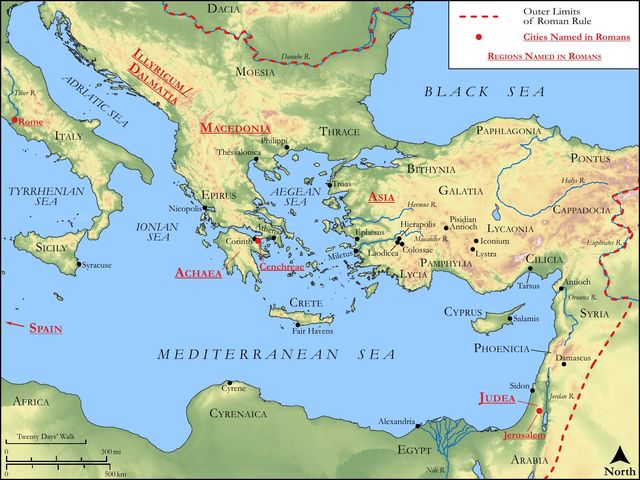
See on the biblical-era maps

Study this verse
Public-domain commentary
Matthew Henry
From his Commentary on the Whole Bible. Henry comments on passages, not single verses — this entry covers Romans 3:19–31. His four-level outline is real structure in the source text, so it is rendered as structure.
From all this Paul infers that it is in vain to look for justification by the works of the law, and that it is to be had only by faith, which is the point he has been all along proving, from Rom 1:17, and which he lays down (Rom 3:28) as the summary of his discourse, with a quod erat demonstrandum - which was to be demonstrated. We conclude that a man is justified by faith, without the deeds of the law; not by the deeds of the first law of pure innocence, which left no room for repentance, nor the deeds of the law of nature, how highly soever improved, nor the deeds of the ceremonial law (the blood of bulls and goats could not take away sin), nor the deeds of the moral law, which are certainly included, for he speaks of that law by which is the knowledge of sin and those works which might be matter of boasting. Man, in his depraved state, under the power of such corruption, could never, by any works of his own, gain acceptance with God; but it must be resolved purely into the free grace of God, given through Jesus Christ to all true believers that receive it as a free gift. If we had never sinned, our obedience to the law would have been our righteousness: "Do this, and live." But having sinned, and being corrupted, nothing that we can do will atone for our former guilt. It was by their obedience to the moral law that the Pharisees looked for justification, Luk 18:11. Now there are two things from which the apostle here argues: the guiltiness of man, to prove that we cannot be justified by the works of the law, and the glory of God, to prove that we must be justified by faith.
I.He argues from man's guiltiness, to show the folly of expecting justification by the works of the law.
The argument is very plain: we can never be justified and saved by the law that we have broken. A convicted traitor can never come off by pleading the statute of 25 Edward III, for that law discovers his crime and condemns him: indeed, if he had never broken it, he might have been justified by it; but now it is past that he has broken it, and there is no way of coming off but by pleading the act of indemnity, upon which he has surrendered and submitted himself, and humbly and penitently claiming the benefit of it and casting himself upon it. Now concerning the guiltiness of man,
1.He fastens it particularly upon the Jews; for they were the men that made their boast of the law, and set up for justification by it. He had quoted several scriptures out of the Old Testament to show this corruption: Now, says he (Rom 3:19), this that the law says, it says to those who are under the law; this conviction belongs to the Jews as well as others, for it is written in their law. The Jews boasted of their being under the law, and placed a great deal of confidence in it: "But," says he, "the law convicts and condemns you - you see it does." That every mouth may be stopped - that all boasting may be silenced. See the method that God takes both in justifying and condemning: he stops every mouth; those that are justified have their mouths stopped by a humble conviction; those that are condemned have their mouths stopped too, for they shall at last be convinced (Jde 1:15), and sent speechless to hell, Mat 22:12. All iniquity shall stop her mouth, Psa 107:42.
2.He extends it in general to all the world: That all the world may become guilty before God. If the world likes in wickedness (Jo1 5:19), to be sure it is guilty. - May become guilty; that is, may be proved guilty, liable to punishment, all by nature children of wrath, Eph 2:3. They must all plead guilty; those that stand most upon their own justification will certainly be cast. Guilty before God is a dreadful word, before an all-seeing God, that is not, nor can be, deceived in his judgment - before a just and righteous judge, who will by no means clear the guilty. All are guilty, and therefore all have need of a righteousness wherein to appear before God. For all have sinned (Rom 3:23); all are sinners by nature, by practice, and have come short of the glory of God - have failed of that which is the chief end of man. Come short, as the archer comes short of the mark, as the runner comes short of the prize; so come short, as not only not to win, but to be great losers. Come short of the glory of God.
(1.)Come short of glorifying God. See Rom 1:21, They glorified him not as God. Man was placed at the head of the visible creation, actively to glorify that great Creator whom the inferior creatures could glorify only objectively; but man by sin comes short of this, and, instead of glorifying God, dishonours him. It is a very melancholy consideration, to look upon the children of men, who were made to glorify God, and to think how few there are that do it.
(2.)Come short of glorying before God. There is no boasting of innocency: if we go about to glory before God, to boast of any thing we are, or have, or do, this will be an everlasting estoppe - hat we have all sinned, and this will silence us. We may glory before men, who are short-sighted, and cannot search our hearts, - who are corrupt, as we are, and well enough pleased with sin; but there is no glorying before God, who cannot endure to look upon iniquity.
(3.)Come short of being glorified by God. Come short of justification, or acceptance with God, which is glory begun - come short of the holiness or sanctification which is the glorious image of God upon man, and have overthrown all hopes and expectations of being glorified with God in heaven by any righteousness of their own. It is impossible now to get to heaven in the way of spotless innocency. That passage is blocked up. There is a cherub and a flaming sword set to keep that way to the tree of life.
3.Further to drive us off from expecting justification by the law, he ascribes this conviction to the law (Rom 3:20): For by the law is the knowledge of sin. That law which convicts and condemns us can never justify us. The law is the straight rule, that rectum which is index sui et obliqui - that which points out the right and the wrong; it is the proper use and intendment of the law to open our wound, and therefore not likely to be the remedy. That which is searching is not sanative. Those that would know sin must get the knowledge of the law in its strictness, extent, and spiritual nature. If we compare our own hearts and lives with the rule, we shall discover wherein we have turned aside. Paul makes this use of the law, Rom 7:9, Therefore by the deeds of the law shall no flesh be justified in his sight. Observe,
(1.)No flesh shall be justified, no man, no corrupted man (Gen 6:3), for that he also is flesh, sinful and depraved; therefore not justified, because we are flesh. The corruption that remains in our nature will for ever obstruct any justification by our own works, which, coming from flesh, must needs taste of the cask, Job 14:4.
(2.)Not justified in his sight. He does not deny that justification which was by the deeds of the law in the sight of the church: they were, in their church-estate, as embodied in a polity, a holy people, a nation of priests; but as the conscience stands in relation to God, in his sight, we cannot be justified by the deeds of the law. The apostle refers to Psa 143:2.
II.He argues from God's glory to prove that justification must be expected only by faith in Christ's righteousness.
There is no justification by the works of the law. Must guilty man then remain eternally under wrath? Is there no hope? Is the wound become incurable because of transgression? No, blessed be God, it is not (Rom 3:21, Rom 3:22); there is another way laid open for us, the righteousness of God without the law is manifested now under the gospel. Justification may be obtained without the keeping of Moses's law: and this is called the righteousness of God, righteousness of his ordaining, and providing, and accepting, - righteousness which he confers upon us; as the Christian armour is called the armour of God, Eph 6:11.
1.Now concerning this righteousness of God observe,
(1.)That it is manifested. The gospel-way of justification is a high-way, a plain way, it is laid open for us: the brazen serpent is lifted up upon the pole; we are not left to grope our way in the dark, but it is manifested to us.
(2.)It is without the law. Here he obviates the method of the judaizing Christians, who would needs join Christ and Moses together - owning Christ for the Messiah, and yet too fondly retaining the law, keeping up the ceremonies of it, and imposing it upon the Gentile converts: no, says he, it is without the law. The righteousness that Christ hath brought in is a complete righteousness.
(3.)Yet it is witnessed by the law and the prophets; that is, there were types, and prophecies, and promises, in the Old Testament, that pointed at this. The law is so far from justifying us that it directs us to another way of justification, points at Christ as our righteousness, to whom bear all the prophets witness. See Act 10:43. This might recommend it to the Jews, who were so fond of the law and the prophets.
(4.)It is by the faith of Jesus Christ, that faith which hath Jesus Christ for its object - an anointed Saviour, so Jesus Christ signifies. Justifying faith respects Christ as a Saviour in all his three anointed offices, as prophet, priest, and king-trusting in him, accepting of him, and adhering to him, in all these. It is by this that we become interested in that righteousness which God has ordained, and which Christ has brought in.
(5.)It is to all, and upon all, those that believe. In this expression he inculcates that which he had been often harping upon, that Jews and Gentiles, if they believe, stand upon the same level, and are alike welcome to God through Christ; for there is no difference. Or, it is eis pantas - to all, offered all in general; the gospel excludes none that do not exclude themselves; but it is to epi pantas tous piseuonta, upon all that believe, not only tendered to them, but put upon them as a crown, as a robe; they are, upon their believing, interested in it, and entitled to all the benefits and privileges of it.
2.But now how is this for God's glory?
(1.)It is for the glory of his grace (Rom 3:24): Justified freely by his grace - dōrean tē chariti. It is by his grace, not by the grace wrought in us as the papists say, confounding justification and sanctification, but by the gracious favour of God to us, without any merit in us so much as foreseen. And, to make it the more emphatic, he says it is freely by his grace, to show that it must be understood of grace in the most proper and genuine sense. It is said that Joseph found grace in the sight of his master (Gen 39:4), but there was a reason; he saw that what he did prospered. There was something in Joseph to invite that grace; but the grace of God communicated to us comes freely, freely; it is free grace, mere mercy; nothing in us to deserve such favours: no, it is all through the redemption that is in Jesus Christ. It comes freely to us, but Christ bought it, and paid dearly for it, which yet is so ordered as not to derogate from the honour of free grace. Christ's purchase is no bar to the freeness of God's grace; for grace provided and accepted this vicarious satisfaction.
(2.)It is for the glory of his justice and righteousness (Rom 3:25, Rom 3:26): Whom God hath set forth to be a propitiation, etc. Note,
[1.]Jesus Christ is the great propitiation, or propitiatory sacrifice, typified by the hilastērion, or mercy-seat, under the law. He is our throne of grace, in and through whom atonement is made for sin, and our persons and performances are accepted of God, Jo1 2:2. He is all in all in our reconciliation, not only the maker, but the matter of it - our priest, our sacrifice, our altar, our all. God was in Christ as in his mercy-seat, reconciling the world unto himself.
[2.]God hath set him forth to be so. God, the party offended, makes the first overtures towards a reconciliation, appoints the days-man; proetheto - fore-ordained him to this, in the counsels of his love from eternity, appointed, anointed him to it, qualified him for it, and has exhibited him to a guilty world as their propitiation. See Mat 3:17, and Mat 17:5.
[3.]That by faith in his blood we become interested in this propitiation. Christ is the propitiation; there is the healing plaster provided. Faith is the applying of this plaster to the wounded soul. And this faith in the business of justification hath a special regard to the blood of Christ, as that which made the atonement; for such was the divine appointment that without blood there should be no remission, and no blood but his would do it effectually. Here may be an allusion to the sprinkling of the blood of the sacrifices under the law, as Exo 24:8. Faith is the bunch of hyssop, and the blood of Christ is the blood of sprinkling.
[4.]That all who by faith are interested in this propitiation have the remission of their sins that are past. It was for this that Christ was set forth to be a propitiation, in order to remission, to which the reprieves of his patience and forbearance were a very encouraging preface. Through the forbearance of God. Divine patience has kept us out of hell, that we might have space to repent, and get to heaven. Some refer the sins that are past to the sins of the Old Testament saints, which were pardoned for the sake of the atonement which Christ in the fulness of time was to make, which looked backward as well as forward. Past through the forbearance of God. It is owing to the divine forbearance that we were not taken in the very act of sin. Several Greek copies make en tēanochē tou Theou - through the forbearance of God, to begin Rom 3:26, and they denote two precious fruits of Christ's merit and God's grace: - Remission: dia tēn paresin - for the remission; and reprieves: the forbearance of God. It is owing to the master's goodness and the dresser's mediation that barren trees are let alone in the vineyard; and in both God's righteousness is declared, in that without a mediator and a propitiation he would not only not pardon, but not so much as forbear, not spare a moment; it is owning to Christ that there is ever a sinner on this side hell.
[5.]That God does in all this declare his righteousness. This he insists upon with a great deal of emphasis: To declare, I say, at this time his righteousness. It is repeated, as that which has in it something surprising. He declares his righteousness, First, In the propitiation itself. Never was there such a demonstration of the justice and holiness of God as there was in the death of Christ. It appears that he hates sin, when nothing less than the blood of Christ would satisfy for it. Finding sin, though but imputed, upon his own Son, he did not spare him, because he had made himself sin for us, Co2 5:21. The iniquities of us all being laid upon him, though he was the Son of his love, yet it pleased the Lord to bruise him, Isa 53:10. Secondly, In the pardon upon that propitiation; so it follows, by way of explication: That he might be just, and the justifier of him that believeth. Mercy and truth are so met together, righteousness and peace have so kissed each other, that it is now become not only an act of grace and mercy, but an act of righteousness, in God, to pardon the sins of penitent believers, having accepted the satisfaction that Christ by dying made to his justice for them. It would not comport with his justice to demand the debt of the principal when the surety has paid it and he has accepted that payment in full satisfaction. See Jo1 1:9. He is just, that is, faithful to his word.
(3.)It is for God's glory; for boasting is thus excluded, Rom 3:27. God will have the great work of the justification and salvation of sinners carried on from first to last in such a way as to exclude boasting, that no flesh may glory in his presence, Co1 1:29-31. Now, if justification were by the works of the law, boasting would not be excluded. How should it? If we were saved by our own works, we might put the crown upon our own heads. But the law of faith, that is, the way of justification by faith, doth for ever exclude boasting; for faith is a depending, self-emptying, self-denying grace, and casts every crown before the throne; therefore it is most for God's glory that thus we should be justified. Observe, He speaks of the law of faith. Believers are not left lawless: faith is a law, it is a working grace, wherever it is in truth; and yet, because it acts in a strict and close dependence upon Jesus Christ, it excludes boasting.
From all this he draws this conclusion (Rom 3:28): That a man is justified by faith without the deeds of the law.
III.In the close of the chapter he shows the extent of this privilege of justification by faith, and that it is not the peculiar privilege of the Jews, but pertains to the Gentiles also; for he had said (Rom 3:22) that there is no difference: and as to this,
1.He asserts and proves it (Rom 3:29): Is he the God of the Jews only? He argues from the absurdity of such a supposition. Can it be imagined that a God of infinite love and mercy should limit and confine his favours to that little perverse people of the Jews, leaving all the rest of the children of men in a condition eternally desperate? This would by no means agree with the idea we have of the divine goodness, for his tender mercies are over all his works; therefore it is one God of grace that justifies the circumcision by faith, and the uncircumcision through faith, that is, both in one and the same way. However the Jews, in favour of themselves, will needs fancy a difference, really there is no more difference than between by and through, that is, no difference at all.
2.He obviates an objection (Rom 3:31), as if this doctrine did nullify the law, which they knew came from God: "No," says he, "though we do say that the law will not justify us, yet we do not therefore say that it was given in vain, or is of no use to us; no, we establish the right use of the law, and secure its standing, by fixing it on the right basis. The law is still of use to convince us of what is past, and to direct us for the future; though we cannot be saved by it as a covenant, yet we own it, and submit to it, as a rule in the hand of the Mediator, subordinate to the law of grace; and so are so far from overthrowing that we establish the law." Let those consider this who deny the obligation of the moral law on believers.
Historical interpretation
Two Centuries of Reception
5 surviving comments on this verse. Each one is dated, so this reads as a timeline rather than a list.
Select a marker to jump to its quote. Markers stagger vertically where authors wrote within a few decades of each other.
Whose grace, if not of that God from whom also came the law? Unless it be, forsooth, that the Creator intercalated His law for the mere purpose of producing some employment for the grace of a rival god, an enemy to Himself (I had almost said, a god unknown to Him), "that as sin had" in His own dispensation "reigned unto death, even so might grace reign through righteousness unto (eternal) life by Jesus Christ," His own antagonist! For this (I suppose it was, that) the law of the Creator had "concluded all under sin," and had brought in "all the world as guilty (before God)," and had "stopped every mouth," so that none could glory through it, in order that grace might be maintained to the glory of the Christ, not of the Creator, but of Marcion! I may here anticipate a remark about the substance of Christ, in the prospect of a question which will now turn up.
Here we must consider carefully what this law is that speaks to those who are under the law. By what it says to them it deprives them of every excuse, so that they can find no hiding place for their sins. It is this which stops every mouth and makes the whole world accountable to God. Now if we want to take this as referring to the law of Moses, which without doubt spoke only to those who had been circumcised from their mother’s womb and had learned what the law was, how is it possible that by that law, which applies to only one nation, every mouth should be stopped and the whole world should be held accountable to God? What have the other nations to do with that law, and why does it affect the entire world? And how is it that a knowledge of sin is said to have originated with the law of Moses, when there were many before his time who were well aware of their sins?From this it appears that the apostle Paul is not speaking here about the law of Moses but about the natural law which is written on the hearts of men.… This natural law speaks to all men who are under that law with the sole exception, it seems to me, of those children who are not yet able to distinguish good from evil.…
When Paul says “the whole world” he is not talking about trees and rocks and so on but about the rational animal, i.e., the human being. Anything which is not rational is excluded from consideration in this context.
It is clear that the law censures those who did not believe first of all their leader Moses nor their ancestors the prophets, whom they killed, nor the apostles who were their kinsmen according to the flesh, whose blood they spilled. They were always ungodly and rebellious against God, so as to be condemned by the law whose authority they thought should be despised.Paul says this because with the Jews bound in sin the whole world has become subject to God. For there is no doubt that the pagans were immersed in sins and wickedness and that for that reason the whole world bowed before God in order to obtain forgiveness. The “whole world” means Jews and Gentiles, from whom believers are set apart. Therefore when Paul affirms that the Jews, who had received God’s law and to whom the promise had been given, were bound in sin, there is no doubt that all the Gentiles were guilty of death … for all have been found guilty and need the mercy of God, whether they be Jews or Gentiles.
"Now we know that what things soever the Law saith, it saith to them who are under the Law." This then is why, next to Isaiah, who confessedly aimed at them, he brought in David; that he might show that these things also belonged to the same subject. For what need was there, he means, that a prophet who was sent for your correction should accuse other people. For neither was the Law given to any else than you. And for what reason did he not say, we know that what things soever the prophet saith, but what things soever the Law saith? It is because Paul uses to call the whole Old Testament the Law. And in another place he says, "Do ye not hear the Law, that Abraham had two sons?" (Gal. iv. 21, 22.) And here he calls the Psalm the Law when he says, "We know that what things soever the Law saith, it saith to them who are under the Law." Next he shows that neither are these things he said merely for accusation's sake, but that he may again be paving the way for faith. So close is the relationship of the Old Testament with the New, since even the accusations and reproofs were entirely with a view to this, that the door of faith might open brightly upon them that hear it.
In case the Jews might claim that these verses of the psalm were spoken about the Gentiles, Paul indicates that what has been said in the law has been said to those who are under the law. Of course, it is a question as to who is meant by saying that the fool claims that there is no God. The Jews did not say this in words but in deeds, for they claimed to know God but denied it by their behavior. Paul is not talking to the Gentiles here, because he has already made similar statements about them.
Continue studying Romans 3:19 across the web’s major study libraries — every link below opens this exact verse, chapter, or book on the destination site.
Read & Compare
 BibleGatewayThis verse in more than 200 translations and 70 languages.
 Bible.comThe YouVersion reader — hundreds of translations, reading plans, and highlights.
 ESV.orgCrossway's official English Standard Version reader.
 NET BibleThe NET translation with 60,000+ translators' notes on every rendering decision.
 STEP BibleTyndale House's free study tool — original text, vocabulary, and scholarly resources.
 BibliaLogos Bible Software's free web reader.
 USCCBThe New American Bible (Revised Edition) with the U.S. bishops' study notes.
Commentaries
 BibleHub CommentariesDozens of classic commentaries on this verse, gathered on one page.
 StudyLightMore than 100 commentary sets — the largest collection on the web.
 BibleRefPlain-English commentary on what this verse means, verse by verse.
 Enduring WordDavid Guzik's free commentary on this chapter, widely used by Bible teachers.
 Bible Study ToolsVerse commentary alongside Greek and Hebrew study aids.
Original Language & Research
- BibleHub InterlinearThe verse word by word — original language, transliteration, and English.
- BibleHub LexiconEvery word's original-language definition and Strong's entry.
 Blue Letter BibleDeep-study tools — Strong's numbers, concordance, and word studies.
 CNTR CollationThe earliest Greek manuscripts of this verse, collated letter by letter.
Sermons, Hymns & Audio


TrulyRandomVerse is not affiliated with these sites and doesn’t control their content. They’re linked because they’re genuinely useful.
Summary
Romans 3:19 serves as a climactic declaration in Paul's argument for humanity's universal sinfulness, asserting that the Mosaic Law, though given to Israel, speaks to all who are subject to its divine standard. Its purpose is not to justify, but to expose and silence every human claim to righteousness, thereby rendering the entire world unequivocally guilty and accountable before a holy God, thus preparing the way for the revelation of God's righteousness apart from the Law.
Context
ShowHideLiterary Context
Romans 3:19 concludes Paul's extensive argument, initiated in Romans 1:18, demonstrating the universal need for God's righteousness. He systematically indicts the Gentiles for their suppression of truth and idolatry (Romans 1:18-32), then the Jews for their hypocrisy and failure to live up to the Law they boasted in (Romans 2:1-29). Following a series of Old Testament citations in Romans 3:10-18 that paint a bleak picture of human depravity, verse 19 functions as a summary statement, explaining the Law's role in this comprehensive indictment, effectively closing off any avenue for self-justification and setting the stage for the revelation of salvation by grace through faith.
Historical & Cultural Context
In Paul's time, the Mosaic Law (Torah) was central to Jewish identity and their covenant relationship with God. Many Jews believed their possession of the Law and their adherence to its rituals set them apart and guaranteed their righteousness before God. Gentiles, on the other hand, often relied on philosophical systems, moral codes, or their own perceived good deeds. Paul's assertion that "whatsoever the law saith, it saith to them who are under the law" directly challenges the Jewish presumption of a privileged status that exempted them from universal sin. Simultaneously, by declaring "all the world may become guilty before God," Paul extends this indictment beyond Israel, dismantling any human claim to self-sufficiency or moral superiority in the Greco-Roman world, thereby leveling the playing field before God.
Key Themes
ShowHideThis verse powerfully underscores several foundational themes within Romans and the broader biblical narrative. Firstly, it clarifies The Purpose of the Law, revealing that its primary function is not to provide a path to salvation through works, but rather to expose sin and demonstrate humanity's inability to meet God's perfect standard, as articulated later in Romans 7:7. Secondly, it establishes Universal Guilt, asserting that the Law's pronouncements apply to "all the world," signifying that every individual, regardless of background, stands condemned before God. This theme is crucial for understanding the necessity of God's grace. Thirdly, the phrase "every mouth may be stopped" highlights the theme of Silencing Self-Justification, indicating that the Law leaves no room for human boasting, excuses, or claims of innocence before a holy God. Finally, by revealing humanity's desperate state, the verse implicitly points to the Need for Another Way of justification, preparing the reader for Paul's subsequent exposition of righteousness through faith in Jesus Christ, which is the heart of the Gospel message found in Romans 3:21-26.
Exposition and Analysis
ShowHideKey Word Analysis
ShowHideDerived from a primary verb meaning "to see" (literally or figuratively), this term, used in its perfect tense, signifies "to know" or "to be aware." In Romans 3:19, "we know" indicates a shared, established understanding or a self-evident truth that Paul is appealing to among his readers, emphasizing the undeniable reality of the Law's purpose.
This primary preposition denotes a fixed position "in, at, or upon," but here, combined with "the law," it signifies being "under" its authority, subject to its requirements, and liable to its judgments and consequences. It describes the state of being bound by the Law's jurisdiction, particularly for those to whom it was directly given, but by extension, for all who are subject to God's moral standard.
This word literally means "under sentence" or "liable to a penalty." In this context, it signifies being "condemned" or "accountable" before God. It conveys the legal status of one who has failed to meet a standard and is therefore subject to divine judgment, without defense or excuse.
Verse Breakdown
ShowHide"Now we know that what things soever the law saith, it saith to them who are under the law:"
This opening clause establishes a foundational truth. Paul asserts a common understanding ("we know") that the pronouncements and judgments of the Mosaic Law are specifically directed at those who are subject to its authority and covenant obligations, primarily the Jewish people. This clarifies that the Law's indictment is not arbitrary but is binding on those who received it.
"that every mouth may be stopped,"
This phrase reveals the immediate, intended effect of the Law's pronouncements. The Law functions as a divine prosecutor, presenting such an overwhelming case against humanity that all attempts at self-justification, boasting, or offering excuses are utterly silenced. It strips away any pretense of righteousness or innocence, leaving humanity speechless and without defense before God.
"and all the world may become guilty before God."
This final clause extends the Law's convicting power universally. While the Law was given to Israel, its moral standard and the revelation of sin it provides apply to "all the world" (referring to all humanity, both Jew and Gentile). The result is that everyone is rendered "guilty" – liable to divine judgment and condemnation – not merely in a legal sense, but in a profound spiritual and moral sense before the perfectly holy God. This universal guilt highlights the desperate need for a divine solution to the problem of sin.
Literary Devices
ShowHidePaul employs several powerful literary devices in Romans 3:19 to convey his theological argument. Personification is evident in "what things soever the law saith," giving the abstract concept of "the Law" an active voice, as if it is speaking and issuing pronouncements. This emphasizes the Law's authority and its direct communication of God's standards. Hyperbole is used in the phrases "every mouth" and "all the world," which are deliberate exaggerations to underscore the absolute and universal scope of the Law's convicting power. This is not merely a few people, but literally everyone, without exception, who stands condemned. Finally, the imagery of a "mouth... stopped" functions as a powerful Metaphor for the cessation of all human argument, boasting, or self-justification. It evokes the image of a defendant in a courtroom whose guilt has been so overwhelmingly proven that they have nothing left to say in their defense. These devices collectively amplify the Law's effectiveness in revealing universal sin and preparing the way for God's grace.
Theological and Thematic Connections
ShowHideRomans 3:19 is a cornerstone for understanding the biblical doctrine of sin and the necessity of grace. It asserts that the Law's primary function is not to justify but to expose sin and demonstrate humanity's utter inability to achieve righteousness on its own. This universal condemnation, encompassing "all the world," underscores the profound holiness and justice of God, against whom all have sinned. The Law acts as a divine mirror, reflecting humanity's fallen state and silencing any human attempt at self-vindication. This conviction of sin is not an end in itself but a crucial prerequisite for appreciating the good news of salvation. Only when humanity recognizes its complete guilt and helplessness before God can it truly grasp the magnitude and necessity of God's unmerited favor and the righteousness freely offered through faith in Jesus Christ. The verse thus sets the stage for the glorious revelation of God's saving grace that follows.
Reflection and Application
ShowHideRomans 3:19 profoundly shapes our understanding of ourselves, God, and the Gospel. It dismantles any illusion of self-righteousness or moral superiority, revealing that every human being, regardless of background, stands condemned and speechless before a holy God. This truth is not meant to crush us with despair, but to cultivate a profound humility and a deep appreciation for God's grace. If our mouths are stopped and we are truly guilty, then our only hope lies outside of ourselves, in the mercy of God. This verse compels us to abandon all attempts at earning God's favor through our own efforts and to embrace the radical truth that salvation is a gift, freely given. It should also ignite within us a compassionate urgency to share the Gospel, for if "all the world" is guilty, then "all the world" desperately needs to hear about the righteousness that comes by faith in Jesus Christ.
Questions for Reflection
ShowHideFAQ
ShowHideWhat is the primary purpose of the Law according to this verse?
ShowHideAccording to Romans 3:19, the primary purpose of the Law is not to provide a means of justification or salvation, but rather to expose sin and silence all human boasting. It functions as a divine standard that reveals humanity's inherent sinfulness, leading to the universal conclusion that "all the world may become guilty before God." This conviction of sin is essential because it demonstrates humanity's desperate need for a Savior, paving the way for the revelation of God's righteousness through faith.
How can "all the world" be "under the law" if the Law was given specifically to Israel?
ShowHideWhile the Mosaic Law was indeed given specifically to Israel, Paul's argument in Romans indicates that its moral principles and the revelation of God's righteous standard apply universally. Even Gentiles, who did not have the written Law, are shown to have the "work of the law written in their hearts" (Romans 2:14-15), demonstrating that all humanity is accountable to God's moral order. Therefore, when Paul states that "what things soever the law saith, it saith to them who are under the law," he means that its condemning power extends to all who are subject to God's divine authority and moral expectations, ultimately encompassing "all the world." The Law, in its broadest sense, reveals the universal failure to meet God's holy standard.
What does it mean for "every mouth" to be "stopped"?
ShowHideFor "every mouth" to be "stopped" signifies that all human attempts at self-justification, excuses, or boasting about one's own righteousness are rendered utterly futile and silent before God. It implies a complete and undeniable conviction of sin, where the evidence against humanity is so overwhelming that there is no defense left to offer. This imagery portrays a courtroom scene where the accused is left speechless and without argument, fully exposed in their guilt before the divine Judge. This silencing is crucial because it removes any obstacle to recognizing the need for God's grace and accepting the righteousness provided through faith.
Christ-Centered Fulfillment
ShowHideRomans 3:19, in its stark declaration of universal guilt, serves as the essential dark backdrop against which the brilliant light of Christ's righteousness shines most brightly. The Law's function is to condemn and silence, revealing humanity's profound inability to meet God's holy standard. This verse, therefore, sets the stage for the glorious truth that follows: since no one can be justified by the works of the Law, God has provided a different way. Jesus Christ is the ultimate fulfillment of what the Law foreshadowed and demanded. He perfectly obeyed the Law, living a sinless life, and then, as the Lamb of God, He bore the full curse and penalty of the Law's condemnation on the cross, becoming sin for us so that in Him we might become the righteousness of God (2 Corinthians 5:21). Through His atoning sacrifice, Christ redeems us from the Law's curse (Galatians 3:13) and provides the righteousness that is credited to all who believe, as Paul passionately explains in Romans 3:21-26. Thus, the Law's indictment in Romans 3:19 compels us to flee to Christ, who alone offers the perfect and complete solution to our universal guilt.