


Romans 3:21
Bible text: King James Version (1769 Blayney text) · Public domain
Bible text: Berean Standard Bible · Public domain
Bible text: American Standard Version (1901) · Public domain
Bible text: World English Bible, Messianic edition · Public domain
Bible text: Geneva Bible (1599) · Public domain
Bible text: Young's Literal Translation · Public domain
- νυνὶnuniNowG3570ADVAdverb
- δὲdehoweverG1161CONJConjunction
- χωρὶςchōrisapart fromG5565PREPPreposition
- νόμουnomoulawG3551N-GSMNoun Genitive Singular Masculine
- δικαιοσύνηdikaiosunē[the] righteousnessG1343N-NSFNoun Nominative Singular Feminine
- θεοῦtheouof GodG2316N-GSM-TNoun Genitive Singular Masculine Title
- πεφανέρωταιpephanerōtaihas been revealedG5319V-RPI-3SVerb Perfect Passive Indicative 3rd Singular
- μαρτυρουμένηmarturoumenēbeing borne witness toG3140V-PPP-NSFVerb Present Passive Participle Nominative Singular Feminine
- ὑπὸhupobyG5259PREPPreposition
- τοῦtoutheG3588T-GSMDefinite article Genitive Singular Masculine
- νόμουnomouLawG3551N-GSMNoun Genitive Singular Masculine
- καὶkaiandG2532CONJConjunction
- τῶνtōntheG3588T-GPMDefinite article Genitive Plural Masculine
- προφητῶνprophētōnProphetsG4396N-GPMNoun Genitive Plural Masculine
English is a literal word-by-word gloss of the Greek, not the KJV's wording. Why?
This is the original text the KJV's translators worked from — each Greek word with its own literal English meaning in this verse, prepared by scholars at Tyndale House, Cambridge. The KJV translates whole sentences, not word by word, so its wording differs: one Greek word can become several English words, and the KJV may choose “charity” where the gloss reads “love”. Both are faithful — they answer different questions. For the KJV's own rendering, switch to the KJV text.
Details
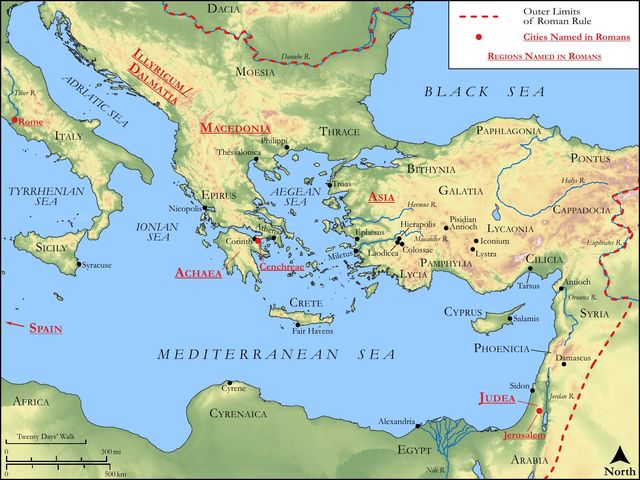
See on the biblical-era maps

Study this verse
Public-domain commentary
Matthew Henry
From his Commentary on the Whole Bible. Henry comments on passages, not single verses — this entry covers Romans 3:19–31. His four-level outline is real structure in the source text, so it is rendered as structure.
From all this Paul infers that it is in vain to look for justification by the works of the law, and that it is to be had only by faith, which is the point he has been all along proving, from Rom 1:17, and which he lays down (Rom 3:28) as the summary of his discourse, with a quod erat demonstrandum - which was to be demonstrated. We conclude that a man is justified by faith, without the deeds of the law; not by the deeds of the first law of pure innocence, which left no room for repentance, nor the deeds of the law of nature, how highly soever improved, nor the deeds of the ceremonial law (the blood of bulls and goats could not take away sin), nor the deeds of the moral law, which are certainly included, for he speaks of that law by which is the knowledge of sin and those works which might be matter of boasting. Man, in his depraved state, under the power of such corruption, could never, by any works of his own, gain acceptance with God; but it must be resolved purely into the free grace of God, given through Jesus Christ to all true believers that receive it as a free gift. If we had never sinned, our obedience to the law would have been our righteousness: "Do this, and live." But having sinned, and being corrupted, nothing that we can do will atone for our former guilt. It was by their obedience to the moral law that the Pharisees looked for justification, Luk 18:11. Now there are two things from which the apostle here argues: the guiltiness of man, to prove that we cannot be justified by the works of the law, and the glory of God, to prove that we must be justified by faith.
I.He argues from man's guiltiness, to show the folly of expecting justification by the works of the law.
The argument is very plain: we can never be justified and saved by the law that we have broken. A convicted traitor can never come off by pleading the statute of 25 Edward III, for that law discovers his crime and condemns him: indeed, if he had never broken it, he might have been justified by it; but now it is past that he has broken it, and there is no way of coming off but by pleading the act of indemnity, upon which he has surrendered and submitted himself, and humbly and penitently claiming the benefit of it and casting himself upon it. Now concerning the guiltiness of man,
1.He fastens it particularly upon the Jews; for they were the men that made their boast of the law, and set up for justification by it. He had quoted several scriptures out of the Old Testament to show this corruption: Now, says he (Rom 3:19), this that the law says, it says to those who are under the law; this conviction belongs to the Jews as well as others, for it is written in their law. The Jews boasted of their being under the law, and placed a great deal of confidence in it: "But," says he, "the law convicts and condemns you - you see it does." That every mouth may be stopped - that all boasting may be silenced. See the method that God takes both in justifying and condemning: he stops every mouth; those that are justified have their mouths stopped by a humble conviction; those that are condemned have their mouths stopped too, for they shall at last be convinced (Jde 1:15), and sent speechless to hell, Mat 22:12. All iniquity shall stop her mouth, Psa 107:42.
2.He extends it in general to all the world: That all the world may become guilty before God. If the world likes in wickedness (Jo1 5:19), to be sure it is guilty. - May become guilty; that is, may be proved guilty, liable to punishment, all by nature children of wrath, Eph 2:3. They must all plead guilty; those that stand most upon their own justification will certainly be cast. Guilty before God is a dreadful word, before an all-seeing God, that is not, nor can be, deceived in his judgment - before a just and righteous judge, who will by no means clear the guilty. All are guilty, and therefore all have need of a righteousness wherein to appear before God. For all have sinned (Rom 3:23); all are sinners by nature, by practice, and have come short of the glory of God - have failed of that which is the chief end of man. Come short, as the archer comes short of the mark, as the runner comes short of the prize; so come short, as not only not to win, but to be great losers. Come short of the glory of God.
(1.)Come short of glorifying God. See Rom 1:21, They glorified him not as God. Man was placed at the head of the visible creation, actively to glorify that great Creator whom the inferior creatures could glorify only objectively; but man by sin comes short of this, and, instead of glorifying God, dishonours him. It is a very melancholy consideration, to look upon the children of men, who were made to glorify God, and to think how few there are that do it.
(2.)Come short of glorying before God. There is no boasting of innocency: if we go about to glory before God, to boast of any thing we are, or have, or do, this will be an everlasting estoppe - hat we have all sinned, and this will silence us. We may glory before men, who are short-sighted, and cannot search our hearts, - who are corrupt, as we are, and well enough pleased with sin; but there is no glorying before God, who cannot endure to look upon iniquity.
(3.)Come short of being glorified by God. Come short of justification, or acceptance with God, which is glory begun - come short of the holiness or sanctification which is the glorious image of God upon man, and have overthrown all hopes and expectations of being glorified with God in heaven by any righteousness of their own. It is impossible now to get to heaven in the way of spotless innocency. That passage is blocked up. There is a cherub and a flaming sword set to keep that way to the tree of life.
3.Further to drive us off from expecting justification by the law, he ascribes this conviction to the law (Rom 3:20): For by the law is the knowledge of sin. That law which convicts and condemns us can never justify us. The law is the straight rule, that rectum which is index sui et obliqui - that which points out the right and the wrong; it is the proper use and intendment of the law to open our wound, and therefore not likely to be the remedy. That which is searching is not sanative. Those that would know sin must get the knowledge of the law in its strictness, extent, and spiritual nature. If we compare our own hearts and lives with the rule, we shall discover wherein we have turned aside. Paul makes this use of the law, Rom 7:9, Therefore by the deeds of the law shall no flesh be justified in his sight. Observe,
(1.)No flesh shall be justified, no man, no corrupted man (Gen 6:3), for that he also is flesh, sinful and depraved; therefore not justified, because we are flesh. The corruption that remains in our nature will for ever obstruct any justification by our own works, which, coming from flesh, must needs taste of the cask, Job 14:4.
(2.)Not justified in his sight. He does not deny that justification which was by the deeds of the law in the sight of the church: they were, in their church-estate, as embodied in a polity, a holy people, a nation of priests; but as the conscience stands in relation to God, in his sight, we cannot be justified by the deeds of the law. The apostle refers to Psa 143:2.
II.He argues from God's glory to prove that justification must be expected only by faith in Christ's righteousness.
There is no justification by the works of the law. Must guilty man then remain eternally under wrath? Is there no hope? Is the wound become incurable because of transgression? No, blessed be God, it is not (Rom 3:21, Rom 3:22); there is another way laid open for us, the righteousness of God without the law is manifested now under the gospel. Justification may be obtained without the keeping of Moses's law: and this is called the righteousness of God, righteousness of his ordaining, and providing, and accepting, - righteousness which he confers upon us; as the Christian armour is called the armour of God, Eph 6:11.
1.Now concerning this righteousness of God observe,
(1.)That it is manifested. The gospel-way of justification is a high-way, a plain way, it is laid open for us: the brazen serpent is lifted up upon the pole; we are not left to grope our way in the dark, but it is manifested to us.
(2.)It is without the law. Here he obviates the method of the judaizing Christians, who would needs join Christ and Moses together - owning Christ for the Messiah, and yet too fondly retaining the law, keeping up the ceremonies of it, and imposing it upon the Gentile converts: no, says he, it is without the law. The righteousness that Christ hath brought in is a complete righteousness.
(3.)Yet it is witnessed by the law and the prophets; that is, there were types, and prophecies, and promises, in the Old Testament, that pointed at this. The law is so far from justifying us that it directs us to another way of justification, points at Christ as our righteousness, to whom bear all the prophets witness. See Act 10:43. This might recommend it to the Jews, who were so fond of the law and the prophets.
(4.)It is by the faith of Jesus Christ, that faith which hath Jesus Christ for its object - an anointed Saviour, so Jesus Christ signifies. Justifying faith respects Christ as a Saviour in all his three anointed offices, as prophet, priest, and king-trusting in him, accepting of him, and adhering to him, in all these. It is by this that we become interested in that righteousness which God has ordained, and which Christ has brought in.
(5.)It is to all, and upon all, those that believe. In this expression he inculcates that which he had been often harping upon, that Jews and Gentiles, if they believe, stand upon the same level, and are alike welcome to God through Christ; for there is no difference. Or, it is eis pantas - to all, offered all in general; the gospel excludes none that do not exclude themselves; but it is to epi pantas tous piseuonta, upon all that believe, not only tendered to them, but put upon them as a crown, as a robe; they are, upon their believing, interested in it, and entitled to all the benefits and privileges of it.
2.But now how is this for God's glory?
(1.)It is for the glory of his grace (Rom 3:24): Justified freely by his grace - dōrean tē chariti. It is by his grace, not by the grace wrought in us as the papists say, confounding justification and sanctification, but by the gracious favour of God to us, without any merit in us so much as foreseen. And, to make it the more emphatic, he says it is freely by his grace, to show that it must be understood of grace in the most proper and genuine sense. It is said that Joseph found grace in the sight of his master (Gen 39:4), but there was a reason; he saw that what he did prospered. There was something in Joseph to invite that grace; but the grace of God communicated to us comes freely, freely; it is free grace, mere mercy; nothing in us to deserve such favours: no, it is all through the redemption that is in Jesus Christ. It comes freely to us, but Christ bought it, and paid dearly for it, which yet is so ordered as not to derogate from the honour of free grace. Christ's purchase is no bar to the freeness of God's grace; for grace provided and accepted this vicarious satisfaction.
(2.)It is for the glory of his justice and righteousness (Rom 3:25, Rom 3:26): Whom God hath set forth to be a propitiation, etc. Note,
[1.]Jesus Christ is the great propitiation, or propitiatory sacrifice, typified by the hilastērion, or mercy-seat, under the law. He is our throne of grace, in and through whom atonement is made for sin, and our persons and performances are accepted of God, Jo1 2:2. He is all in all in our reconciliation, not only the maker, but the matter of it - our priest, our sacrifice, our altar, our all. God was in Christ as in his mercy-seat, reconciling the world unto himself.
[2.]God hath set him forth to be so. God, the party offended, makes the first overtures towards a reconciliation, appoints the days-man; proetheto - fore-ordained him to this, in the counsels of his love from eternity, appointed, anointed him to it, qualified him for it, and has exhibited him to a guilty world as their propitiation. See Mat 3:17, and Mat 17:5.
[3.]That by faith in his blood we become interested in this propitiation. Christ is the propitiation; there is the healing plaster provided. Faith is the applying of this plaster to the wounded soul. And this faith in the business of justification hath a special regard to the blood of Christ, as that which made the atonement; for such was the divine appointment that without blood there should be no remission, and no blood but his would do it effectually. Here may be an allusion to the sprinkling of the blood of the sacrifices under the law, as Exo 24:8. Faith is the bunch of hyssop, and the blood of Christ is the blood of sprinkling.
[4.]That all who by faith are interested in this propitiation have the remission of their sins that are past. It was for this that Christ was set forth to be a propitiation, in order to remission, to which the reprieves of his patience and forbearance were a very encouraging preface. Through the forbearance of God. Divine patience has kept us out of hell, that we might have space to repent, and get to heaven. Some refer the sins that are past to the sins of the Old Testament saints, which were pardoned for the sake of the atonement which Christ in the fulness of time was to make, which looked backward as well as forward. Past through the forbearance of God. It is owing to the divine forbearance that we were not taken in the very act of sin. Several Greek copies make en tēanochē tou Theou - through the forbearance of God, to begin Rom 3:26, and they denote two precious fruits of Christ's merit and God's grace: - Remission: dia tēn paresin - for the remission; and reprieves: the forbearance of God. It is owing to the master's goodness and the dresser's mediation that barren trees are let alone in the vineyard; and in both God's righteousness is declared, in that without a mediator and a propitiation he would not only not pardon, but not so much as forbear, not spare a moment; it is owning to Christ that there is ever a sinner on this side hell.
[5.]That God does in all this declare his righteousness. This he insists upon with a great deal of emphasis: To declare, I say, at this time his righteousness. It is repeated, as that which has in it something surprising. He declares his righteousness, First, In the propitiation itself. Never was there such a demonstration of the justice and holiness of God as there was in the death of Christ. It appears that he hates sin, when nothing less than the blood of Christ would satisfy for it. Finding sin, though but imputed, upon his own Son, he did not spare him, because he had made himself sin for us, Co2 5:21. The iniquities of us all being laid upon him, though he was the Son of his love, yet it pleased the Lord to bruise him, Isa 53:10. Secondly, In the pardon upon that propitiation; so it follows, by way of explication: That he might be just, and the justifier of him that believeth. Mercy and truth are so met together, righteousness and peace have so kissed each other, that it is now become not only an act of grace and mercy, but an act of righteousness, in God, to pardon the sins of penitent believers, having accepted the satisfaction that Christ by dying made to his justice for them. It would not comport with his justice to demand the debt of the principal when the surety has paid it and he has accepted that payment in full satisfaction. See Jo1 1:9. He is just, that is, faithful to his word.
(3.)It is for God's glory; for boasting is thus excluded, Rom 3:27. God will have the great work of the justification and salvation of sinners carried on from first to last in such a way as to exclude boasting, that no flesh may glory in his presence, Co1 1:29-31. Now, if justification were by the works of the law, boasting would not be excluded. How should it? If we were saved by our own works, we might put the crown upon our own heads. But the law of faith, that is, the way of justification by faith, doth for ever exclude boasting; for faith is a depending, self-emptying, self-denying grace, and casts every crown before the throne; therefore it is most for God's glory that thus we should be justified. Observe, He speaks of the law of faith. Believers are not left lawless: faith is a law, it is a working grace, wherever it is in truth; and yet, because it acts in a strict and close dependence upon Jesus Christ, it excludes boasting.
From all this he draws this conclusion (Rom 3:28): That a man is justified by faith without the deeds of the law.
III.In the close of the chapter he shows the extent of this privilege of justification by faith, and that it is not the peculiar privilege of the Jews, but pertains to the Gentiles also; for he had said (Rom 3:22) that there is no difference: and as to this,
1.He asserts and proves it (Rom 3:29): Is he the God of the Jews only? He argues from the absurdity of such a supposition. Can it be imagined that a God of infinite love and mercy should limit and confine his favours to that little perverse people of the Jews, leaving all the rest of the children of men in a condition eternally desperate? This would by no means agree with the idea we have of the divine goodness, for his tender mercies are over all his works; therefore it is one God of grace that justifies the circumcision by faith, and the uncircumcision through faith, that is, both in one and the same way. However the Jews, in favour of themselves, will needs fancy a difference, really there is no more difference than between by and through, that is, no difference at all.
2.He obviates an objection (Rom 3:31), as if this doctrine did nullify the law, which they knew came from God: "No," says he, "though we do say that the law will not justify us, yet we do not therefore say that it was given in vain, or is of no use to us; no, we establish the right use of the law, and secure its standing, by fixing it on the right basis. The law is still of use to convince us of what is past, and to direct us for the future; though we cannot be saved by it as a covenant, yet we own it, and submit to it, as a rule in the hand of the Mediator, subordinate to the law of grace; and so are so far from overthrowing that we establish the law." Let those consider this who deny the obligation of the moral law on believers.
Historical interpretation
Eleven Centuries of Reception
10 surviving comments on this verse. Each one is dated, so this reads as a timeline rather than a list.
Select a marker to jump to its quote. Markers stagger vertically where authors wrote within a few decades of each other.
For verily I say unto you, Until heaven and earth pass away, one jot or one tittle shall not pass from the law and the prophets till all come to pass."
And if, the Creator above all is confessed to be just, and the Lord to be the Son of the Creator; then the Lord is the Son of Him who is just. Wherefore also Paul says, "But now the righteousness of God without the law is manifested; "
It was once the law; now it is "the righteousness of God which is by the faith of (Jesus) Christ." What means this distinction? Has your god been subserving the interests of the Creator's dispensation, by affording time to Him and to His law? Is the "Now" in the hands of Him to whom belonged the "Then"? Surely, then, the law was His, whose is now the righteousness of God.
We have just said that in the above verses Paul was speaking about the natural law and not about the law of Moses, but now it appears that there can be no doubt that he is referring to the law of Moses, by which the righteousness of God is made manifest through faith in Christ Jesus in all who believe, whether they are Jews or Gentiles, and who are justified not by works but by the grace of God, who has redeemed them in Jesus Christ. Does this mean that our interpretation of the foregoing was mistaken?…Just as there is nothing in this verse which makes it possible for us to argue that it is talking about the natural law and not about the law of Moses, so there is nothing in the preceding verses to indicate that they are talking about the law of Moses and not about the natural law. Thus we would argue that just as the foregoing cannot be used to interpret what we now have before us, so neither should our interpretation of it be altered simply because what follows cannot be read in the same way.
Does this mean that the apostle has contradicted himself? There are plenty of people who would like to think so!… But we shall try to show how this passage does not go against our interpretation of the foregoing one. We have often said, and have expounded this most clearly in the preface, that the apostle mentions many different kinds of law in this epistle, and only the most attentive reader will be able to detect when he is shifting from one to another.… The law of nature was able to explain the nature of sin and give us some knowledge of it, but the righteousness of God is above and beyond this, and the human mind is unable to attain it by its natural senses.… For this the law of Moses was required, to teach us what God’s righteousness is. Do not be surprised that the word law is used here in two different senses!…
Moreover, there is a way to tell which meaning of the word law is intended. The Greek language uses articles in front of proper names. Thus when the law of Moses is intended, the article is used, but when the natural law is meant, the article is omitted.
[The righteousness of God] has not been manifested in opposition to the law but as an increase of good and as the free gift of God, so that we may no longer be judged according to human righteousness, which is always under judgment, but that we may be made perfect by the righteousness which comes from God. For this is the righteousness which comes by faith in Christ to all who believe and which dwells in them all.
It is clear that the righteousness of God has now appeared apart from the law, but this means apart from the law of the sabbath, the circumcision, the new moon and revenge, not apart from the sacrament of God’s divinity, because the righteousness of God is all about God’s divinity. For when the law held them guilty, the righteousness of God forgave them and did so apart from the law so that until the law was brought to bear God forgave them their sin. And lest someone think that this was done against the law, Paul added that the righteousness of God had a witness in the Law and the Prophets, which means that the law itself had said that in the future someone would come who would save mankind. But it was not allowed for the law to forgive sin.Therefore, what is called the righteousness of God appears to be mercy because it has its origin in the promise, and when God’s promise is fulfilled it is called “the righteousness of God.” For it is righteousness when what is promised has been delivered. And when God accepts those who flee to him for refuge, this is called righteousness, because wickedness would not accept such people.
"But now the righteousness of God without the Law is manifested." Here he utters a great thing, and such as needed much proof. For if they that lived in the Law not only did not escape punishment, but were even the more weighed down thereby, how without the Law is it possible not only to escape vengeance, but even to be justified? For he has here set down two high points, the being justified, and the obtaining these blessings, without the Law. And this is why he does not say righteousness simply, but the righteousness of God, so by the worthiness of the Person displaying the greater degree of the grace, and the possibility of the promise. For to Him all things are possible. And he does not say, "was given," but "is manifested," so cutting away the accusation of novelty. For that which is manifested, is so as being old, but concealed. And it is not this only, but the sequel that shows that this is no recent thing. For after saying, "is manifested," he proceeds: "Being witnessed by the Law and the Prophets." Do not be troubled, he means, because it has but now been given, nor be affrighted as though at a thing new and strange. For of old both the Law and the Prophets foretold it.
The righteousness which has been given to us freely by God, not acquired by our effort, has been made plain without the written law, and having been hidden in the law has been revealed with greater clarity by the examples of Christ, which are more obvious. The law and the prophets foretold that this righteousness would come in the last times, or perhaps this means that they both bore witness to the recognition of sin.
The righteousness of God is not that by which God is righteous but that with which he clothes man when he justifies the ungodly. To this the Law and the Prophets bear witness.… The righteousness of God is not manifested outside the law, since in that case it could not have been witnessed to in the law. It is a righteousness of God apart from the law because God confers it on the believer through the Spirit of grace without the help of the law.
299. After showing that Jews and gentiles are equal as far as the state of previous guilt is concerned [n. 274], the Apostle now shows that they are also equal as far as the state of subsequent grace is concerned. In regard to this he does three things: first, he states his teaching; secondly, he explains something he had presupposed, there [v. 29; n. 318] at Or is God the God of the Jews only?; thirdly, he answers an objection, there [v. 31; n. 321] at Do we therefore destroy the law? 152 In regard to the first he does three things: first, he states his teaching; secondly, he manifests it, there [v. 22c; n. 304] at There is no distinction; thirdly, he draws the intended conclusion, there [v. 27; n. 313] at Where therefore is your glorying? In regard to the first he does three things: first, he states the relation between justice and the law; secondly, he gives the cause of justice, there [v. 22; n. 302] at the justice of God; thirdly, he shows that such justice is available to all, there [v. 22b; n. 303] at in all. 300. First, he sets down a twofold comparison or relation of justice to the Law [n. 301]. The first is that it is not caused by the Law. This is what he says: It has been stated that in times past God’s justice could not exist in virtue of the works of the Law, either because the just one himself fulfills the promises about men’s justification: "For I tell you that Christ became a servant to the circumcised to show God’s truthfulness, in order to confirm the promises given to the patriarchs" (Rom 15:8). Or, rather, God’s justice, by which a person is justified by God, of which it says below: "not knowing the justice of God" (Rom 10:3). This justice of God, I say, has been manifested now, i.e., in the time of grace, by the teachings of Christ, by his miracles, as well as by the evidence of the fact, inasmuch as it is evident that many have been divinely made just. And this apart from the Law, i.e., without the Law causing righteousness: "You are severed from Christ, you who had 153 been justified by the Law; you have fallen away from grace" (Gal 5:4); "Soon my salvation will come, and my justice will be revealed" (Is 56:1). 301. But lest anyone suppose that this justice is contrary to the Law, secondly, he sets down another relation of justice to the Law when he says: although the law and the prophets bear witness to it. The Law bears witness to Christ’s justice by foretelling and prefiguring it: "If you believed Moses, you would believe me, for he wrote of me" (Jn 5:46); and also by its effect, for, since it could not justify, it bore witness that justice was to be sought elsewhere. The prophets bore witness by foretelling it: "To him all the prophets bear witness" (Ac 10:43). 302. Then he assigns the cause of this justice, and says the justice of God through the faith of Christ Jesus, i.e., which he delivered: "Looking to Jesus the perfecter of our faith" (Heb 12:2); or which is held concerning Him: "Because if you confess with your lips that Jesus is Lord and believe in your heart that God raised him from the dead, you will be saved" (Rom 10:9). God’s justice is said to exist through faith in Christ Jesus, not as though by faith we merit being justified, as if faith exists from ourselves and through it we merit God’s justice, as the Pelagians assert; but because in the very justification, by which we are made just by God, the first motion of the mind toward God is through faith: "Whoever would draw near to God must believe" (Heb 11:6). Hence faith, as the first part of justice, is given to us by God: "By grace you have been saved through faith; and this is not your own doing; for it is the gift of God" (Eph 2:8). 154 But this faith, out of which justice exists, is not the unformed faith about which James 2(:26) says, "Faith without works is dead," but it is faith formed by charity, about which Gal 5(:6) says, "For in Christ Jesus neither circumcision nor uncircumcision is of any avail, but faith [working through love]," through which Christ dwells in us; "that Christ may dwell in your hearts through faith" (Eph 3:17), which does not happen without charity: "He who abides in love abides in God and God in him" (1 Jn 4:16). This is the faith about which Acts 15(:9) says, "He cleansed their hearts by faith," a cleansing that does not occur without charity: "Love covers all offenses" (Pr 10:12). 303. And lest anyone suppose that only the Jews are made just through this faith, third, he shows that this justice is common, when he adds in all. In other words this justice is in the heart, not in fleshly observances, about which Hebrews 9(:10) says that carnal observances were directed to the justification of the flesh, being regulations for the body and imposed until the time of reformation. And over all, because it transcends human power and merit: "Not that we are sufficient of ourselves to claim anything as coming from us" (2Cor 3:5). He adds, who believe in him, which refers to the living faith, by which man is justified, as has been said. 304. Then when he says for there is no distinction, he manifests what he had said: first, in regard to the common availability of justice; secondly, as to its cause, there [v. 24; n. 306] at justified by grace; thirdly, as to its manifestation, there [v. 25b; n. 310] at for the manifestation. 305. First, therefore, he says: It has been stated that the righteousness of God is in all and above all who believe in Christ. For in this matter there is no distinction between 155 Jew and Gentile: "In Christ Jesus there is not Gentile and Jew" (Col 3:11), namely [a Jew] who has some distinction, as though the Jew does not need to be made just by God as the Gentile does. Since all have sinned, as has been shown above: "All we like sheep have gone astray" (Is 53:6) and for this reason need the glory of God, i.e., the justification that redounds to God’s glory. Furthermore, man should not ascribe this glory to himself: "Not to us, O Lord, not to us, but to thy name give glory" (Ps 115:1); "Give glory to God" (Ps 66:2). 306. Consequently, because all have sinned and cannot of themselves be justified, they need some other cause to make them just. This cause he indicates when he continues, being justified. First [cf. n. 307], he shows that such justification exists without the Law, i.e., that it does not come from the works of the Law, when he says being justified freely [gratis], i.e., without the merit of previous works: "You were sold for nothing and you shall be redeemed without money" (Is 52:3). And this is by his grace, namely, God’s, to whom glory is due on this account: "By the grace of God I am what I am" (1 Cor 15:10). 307. Secondly, he shows what is the cause of justification. First [cf. n. 308ff.], he discloses the cause itself, when he says, through redemption. For as is stated in John 8(:34), "Everyone who commits sin is a slave of sin." From this slavery a man is redeemed, if he makes satisfaction for sin. For example, if a man owes a king a fine for some guilty action, the one who paid the fine would be said to have redeemed him from the debt. Now, this debt involved the whole human race, which was infected by the sin of the first parent. Hence no other person could satisfy for the sin of the entire human race except Christ alone, who was immune from all sin. 156 Hence he adds, which is in Christ Jesus. As if to say: in no other could there be redemption: "Not with perishable things, such as silver and gold" (1 Pt 1:18). 308. Secondly, he shows whence this redemption has efficacy, when he says whom God put forward as an expiation. For Christ’s satisfaction was efficacious for justifying and redeeming by the fact that God had assigned him to this in his plan, which he designates when he says whom God put forward as an expiation: "According to the purpose of him who accomplishes all things according to the counsel of his will" (Eph 1:11). Or put forward, that is, he put [him] forward for all, because the human race had no way of making satisfaction unless God himself gave them a redeemer and satisfier: "He sent redemption to his people" (Ps 111:9). And so, while making satisfaction, he redeems us from the debt of sin and obtains pardon for our sins, which the Psalmist begged: "Be propitious to our sins" (Ps 79:9); and this is why he calls him a propitiation. Propitiation. As a figure of this it was commanded in Exodus (25:17) that a propitiatory [seat], i.e., Christ, be placed on the ark, i.e., the Church. 369. Thirdly, he indicates how the effect of redemption reached us, when he says, by faith in his blood, i.e., faith concerning his blood poured out for us. For in order to satisfy for us, it was fitting that he undergo the penalty of death for us, a penalty man had incurred by sin, as indicated in Genesis 2(:17), "In the day that you eat of it you shall die." Hence 1Peter 3(:18) states, "For Christ also died for sins once for all." This death of Christ is applied to us through faith, by which we believe that the world has been redeemed by His death: "I live by faith in the Son of God, who loved me 157 and gave himself for me" (Gal 2:20). For even among men payment made by one man does not benefit another, unless [that other] considers it valid. And so it is clear how there is justification through faith in Jesus Christ, as has been stated above. 310. But because he had stated above [n. 300] that God’s justice is manifested now, he considers this manifestation [n. 311ff]. First, he touches on the manner of this manifestation, saying for the manifestation. As if to say: I say that we are justified by the redemption of Christ and by faith in his blood, for the manifestation of his justice, i.e., to the end that God might show his justice, and this because of the remission of former sins. For in remitting former sins, which the Law could not remit or men by their own power sufficiently guard against, God showed that the justice by which they are made just by God is necessary for men. But only through the blood of Christ could sins both present and past be remitted, because the power of Christ’s blood works through man’s faith, which the men who lived before his passion had, just as we have: "Since we have the same spirit of faith . . . we too believe" (2 Cor 14:13). Hence another way of reading it is: for the remission of the sins of those men who preceded the passion of Christ: "He will tread our iniquities under foot and he will cast all our sins into the depth of the sea" (Mic 7:19). 311. Secondly, he shows the time of its manifestation, when he adds: in the forbearance of God, for the manifestation of his justice in this time. As if to say: former sins before the passion of Christ were in the forbearance of God as, so to speak, under a certain divine support [sustinentia], because he neither damned believers and penitents 158 for them nor completely absolved them, in the sense that, the sins notwithstanding, they might enter into glory. Or, according to another reading, it can mean that the saintly fathers themselves were in God’s forbearance, because they were detained in limbo, not suffering sensible pain but waiting to enter into glory through the passion of Christ: "Wait for the forbearance of God" (Sir 2:3). For this purpose, I say, previous sins and the ancient fathers were in the forbearance of God, namely to for the manifestation of his justice in this time, i.e., that in this time of grace he might manifest his justice perfectly by granting full remission of sins: "Now is the acceptable time; now is the day of salvation" (2 Cor 6:2). And this is what he had said above, namely that God’s justice is now manifest. Up to this present time former sins had be in the forbearance of God, in order to convince man of his lack of knowledge, since in the time of the law of nature man fell into errors and base sins; and of his lack of power, since after the written law, which gave knowledge of sin, man still sinned through weakness. 312. Thirdly, he shows that by remitting sins God’s justice is shown, whether it be taken as the justice of God by which he himself is just or as the justice by which he justifies others. Hence he continues: that he himself may be just, i.e., that by remitting sins God may appear to be just in himself, both because he remitted sins as he had promised and because it belongs to God’s justice to destroy sins by leading men back to his justice: "The Lord is righteous, he loves righteous deeds" (Ps 11:7). 159 19 Cf. n. 274, 299, and 304. And also the justifier of him who is of the faith of Jesus Christ, i.e., who approaches God through faith in Jesus Christ: "Whoever would draw near to God must believe" (Heb 11:6).
Continue studying Romans 3:21 across the web’s major study libraries — every link below opens this exact verse, chapter, or book on the destination site.
Read & Compare
 BibleGatewayThis verse in more than 200 translations and 70 languages.
 Bible.comThe YouVersion reader — hundreds of translations, reading plans, and highlights.
 ESV.orgCrossway's official English Standard Version reader.
 NET BibleThe NET translation with 60,000+ translators' notes on every rendering decision.
 STEP BibleTyndale House's free study tool — original text, vocabulary, and scholarly resources.
 BibliaLogos Bible Software's free web reader.
 USCCBThe New American Bible (Revised Edition) with the U.S. bishops' study notes.
Commentaries
 BibleHub CommentariesDozens of classic commentaries on this verse, gathered on one page.
 StudyLightMore than 100 commentary sets — the largest collection on the web.
 BibleRefPlain-English commentary on what this verse means, verse by verse.
 Enduring WordDavid Guzik's free commentary on this chapter, widely used by Bible teachers.
 Bible Study ToolsVerse commentary alongside Greek and Hebrew study aids.
Original Language & Research
- BibleHub InterlinearThe verse word by word — original language, transliteration, and English.
- BibleHub LexiconEvery word's original-language definition and Strong's entry.
 Blue Letter BibleDeep-study tools — Strong's numbers, concordance, and word studies.
 CNTR CollationThe earliest Greek manuscripts of this verse, collated letter by letter.
Sermons, Hymns & Audio


TrulyRandomVerse is not affiliated with these sites and doesn’t control their content. They’re linked because they’re genuinely useful.
Summary
Romans 3:21 marks a pivotal transition in Paul's epistle, announcing the revelation of God's righteousness—a divine provision for humanity's sin problem that operates independently of the Mosaic Law. This righteousness, though new in its full manifestation through Christ, is not a novel concept but was consistently foretold and attested to throughout the Old Testament Scriptures, specifically by the Law and the Prophets, demonstrating the continuity and coherence of God's redemptive plan across the ages.
Context
ShowHideLiterary Context
Romans 3:21 serves as a dramatic "but now" (G3570, G1161) turn, shifting the theological landscape of Paul's argument. Prior to this verse, Paul meticulously builds a case for universal human sinfulness, demonstrating that both Gentiles, who suppress the truth of God in unrighteousness (Romans 1:18-32), and Jews, who possess the Law but fail to keep it (Romans 2:1-29 and Romans 3:1-20), are equally condemned under sin. The climax of this argument is found in Romans 3:9-20, where Paul quotes various Old Testament passages to prove that "all, both Jews and Greeks, are under sin" (Romans 3:9). He concludes that "by the works of the law no human being will be justified in his sight, since through the law comes knowledge of sin" (Romans 3:20). Thus, Romans 3:21 introduces God's solution to this desperate human predicament, transitioning from diagnosis to divine remedy.
Historical & Cultural Context
Paul's letter to the Romans was written to a diverse church in the heart of the Roman Empire, comprising both Jewish and Gentile believers. A significant tension existed regarding the role of the Mosaic Law in salvation and Christian living. Many Jewish Christians, steeped in centuries of covenant identity tied to the Law, struggled to fully embrace a salvation "without the law" (G5565, G3551). Gentiles, on the other hand, might have been tempted to dismiss the Old Testament entirely. Paul's argument in Romans is therefore carefully constructed to address these concerns, demonstrating that God's plan of salvation through faith is neither a new invention nor an abrogation of His prior promises, but rather the fulfillment of what the "Law and the Prophets" (G3551, G4396) had always pointed towards. This context underscores the revolutionary nature of Paul's declaration while simultaneously rooting it firmly in the continuity of God's redemptive history.
Key Themes
ShowHideThis verse contributes significantly to several major theological themes in Romans. The primary theme is the Righteousness of God (G1343, G2316), which is presented not merely as an attribute of God's character but as a saving status that God imputes to believers. This is distinct from human righteousness achieved through works. Another crucial theme is the Inadequacy of the Law for justification, highlighted by the phrase "without the law" (G5565, G3551). Paul asserts that the Law's purpose was to reveal sin and prepare humanity for God's gracious solution, not to provide the means of salvation, as seen in Galatians 3:24. Finally, the theme of Continuity of God's Plan is evident in the declaration that this new righteousness is "witnessed by the law and the prophets" (G3140, G3551, G4396). This demonstrates that the gospel of grace is not a deviation from God's Old Testament promises but their culmination, fulfilling prophecies found in passages like Isaiah 53 and Jeremiah 31:31-34.
Exposition and Analysis
ShowHideKey Word Analysis
ShowHideThis term denotes equity of character or act, and specifically in a Christian context, justification. In Romans 3:21, it refers not merely to God's inherent moral perfection but to a righteous standing or status that God Himself provides to humanity. It is a gift, an imputed righteousness, rather than an earned one, making humans acceptable in His sight.
Meaning "at a space, i.e., separately or apart from." This adverb emphasizes a complete separation or independence. When applied to "the law" (G3551) in this verse, it unequivocally states that the righteousness God provides is obtained entirely apart from human effort, works, or adherence to the Mosaic Law. It underscores the non-meritorious nature of this divine gift.
Meaning "to be a witness, i.e., testify." This verb signifies that the Old Testament Scriptures (the Law and the Prophets) did not merely hint at this righteousness but actively bore testimony to it. It implies a legal or authoritative declaration, confirming that God's method of justification by faith was always part of His plan, even if not fully revealed until Christ.
Verse Breakdown
ShowHide"But now"
This phrase (G1161, G3570) signals a dramatic and decisive turning point in Paul's argument. Having established the universal reign of sin and the Law's inability to justify, Paul introduces God's redemptive solution. It marks a shift from the problem to the divine provision, from condemnation to salvation.
"the righteousness of God without the law is manifested"
This is the core declaration. "The righteousness of God" refers to God's own saving righteousness, a status He bestows upon believers. The crucial qualifier "without the law" (G5565, G3551) emphasizes that this righteousness is not earned through human obedience to the Mosaic Law or any other human effort. It is a gift, freely given. The term "manifested" (G5319) indicates that this righteousness, though always part of God's character and plan, has now been openly revealed and made clear, primarily through the person and work of Jesus Christ.
"being witnessed by the law and the prophets"
This clause provides crucial validation for Paul's radical claim. Despite being "without the law" as a means of earning it, this divine righteousness is not a new or foreign concept. Instead, it is precisely what the entirety of the Old Testament Scriptures—categorized as "the Law" (Torah, referring to the Pentateuch) and "the Prophets" (Nevi'im, referring to the prophetic books and historical narratives)—has consistently foretold and attested to. This demonstrates the continuity of God's redemptive plan and grounds the gospel firmly in the historical revelation of God.
Literary Devices
ShowHideRomans 3:21 employs several significant literary devices. The most prominent is Antithesis, signaled by the opening "But now" (G1161, G3570), which sharply contrasts the preceding argument of universal sin and the Law's inability to justify with the new revelation of God's saving righteousness. This creates a dramatic shift in tone and theological focus. There is also a subtle use of Paradox or Reconciliation of Opposites: the righteousness is "without the law" (G5565, G3551) as a means of attainment, yet it is simultaneously "witnessed by the law and the prophets" (G3140, G3551, G4396). This highlights that the Old Testament, while not providing salvation through its demands, consistently pointed to God's ultimate plan of salvation by grace through faith. Finally, Metonymy is present in "the law and the prophets," which stands for the entire Old Testament Scriptures, emphasizing their unified testimony to God's unfolding redemptive purpose.
Theological and Thematic Connections
ShowHideRomans 3:21 is a foundational verse for understanding the doctrine of justification by faith, a cornerstone of Pauline theology and the Protestant Reformation. It declares that humanity's desperate state of sin, established in the preceding chapters, is met by God's gracious and sovereign provision of righteousness. This righteousness is not earned by human merit or adherence to religious codes, but is freely given by God. It underscores God's character as both just and the justifier, providing a way for sinful humanity to stand righteous before Him without compromising His perfect standards. This divine act of justification is rooted in God's eternal plan, demonstrating that salvation by grace through faith was not an afterthought but the consistent trajectory of His covenant dealings with humanity from the very beginning.
Reflection and Application
ShowHideRomans 3:21 offers profound comfort and liberation to those who labor under the burden of trying to earn God's favor through their own efforts. It shatters the illusion that our standing before God depends on our performance, obedience to rules, or moral achievements. Instead, it directs our gaze to God's magnificent initiative: He provides the righteousness we desperately need but can never produce. This truth should lead to deep humility, recognizing our utter dependence on His grace, and overflowing gratitude for such a costly and freely given gift. For the believer, it means security and peace, knowing that our acceptance by God is based entirely on His perfect righteousness, not our fluctuating worthiness. For those still seeking, it points the way to true salvation, inviting them to lay down their striving and receive what God has already manifested.
Questions for Reflection
ShowHideFAQ
ShowHideWhat does "the righteousness of God" mean in this context?
ShowHideIn Romans 3:21, "the righteousness of God" (G1343, G2316) refers primarily to a righteous status or standing that God Himself provides and imputes to believers. It's not merely God's inherent attribute of being righteous, but His divine act of making sinful humans righteous in His sight. This righteousness is a gift, freely given, and is the basis for our justification before Him. It is the perfect righteousness of Christ credited to us.
How can righteousness be "without the law" yet "witnessed by the law and the prophets"?
ShowHideThis apparent paradox is central to Paul's argument. Righteousness is "without the law" (G5565, G3551) in the sense that human obedience to the Mosaic Law is not the means by which one obtains this righteous standing. No one can earn it through works. However, it is "witnessed by the law and the prophets" (G3140, G3551, G4396) because the Old Testament Scriptures consistently pointed forward to God's plan of salvation by grace through faith. The Law revealed humanity's need for a Savior (Galatians 3:24), and the Prophets foretold the coming of a Messiah who would bring righteousness and redemption (Isaiah 53:11). Thus, the Old Testament prepared the way and testified to the very righteousness that is now fully revealed in Christ.
Christ-Centered Fulfillment
ShowHideRomans 3:21 finds its ultimate and profound fulfillment in Jesus Christ. The "righteousness of God" (G1343, G2316) that is "manifested" (G5319) is none other than the righteousness accomplished and embodied by Jesus Himself. He alone lived a life of perfect obedience to the Law, fulfilling all its righteous demands where humanity failed (Matthew 5:17). His sacrificial death on the cross served as the propitiation for sin, satisfying God's just wrath and providing the basis for this divine righteousness to be freely offered to all who believe (Romans 3:25). The Old Testament "Law and the Prophets" (G3551, G4396) bore witness to Him, foreshadowing His coming and His atoning work, as seen in the Suffering Servant passages in Isaiah 53 or the promise of a new covenant in Jeremiah 31:31-34. Therefore, Christ is the very embodiment and source of this righteousness, and it is "through faith in Jesus Christ" that it is given "to all who believe" (Romans 3:22), making Him the central figure in God's plan of salvation and the perfect fulfillment of all that the Scriptures testified.