


Philippians 3:9
- καὶkaiandG2532CONJConjunction
- εὑρεθῶheurethōmay be foundG2147V-APS-1SVerb Aorist Passive Subjunctive 1st Singular
- ἐνeninG1722PREPPreposition
- αὐτῷautōHimG846P-DSMPersonal pronoun Dative Singular Masculine
- μὴmēnotG3361PRT-NNegative Particle Negative
- ἔχωνechōnhavingG2192V-PAP-NSMVerb Present Active Participle Nominative Singular Masculine
- ἐμὴνemēnmy ownG1473S-1SASFPossessive pronoun Accusative 1st Person Singular Feminine
- δικαιοσύνηνdikaiosunēnrighteousnessG1343N-ASFNoun Accusative Singular Feminine
- τὴνtēnwhich [is]G3588T-ASFDefinite article Accusative Singular Feminine
- ἐκekofG1537PREPPreposition
- νόμουnomou[the] LawG3551N-GSMNoun Genitive Singular Masculine
- ἀλλὰallabutG235CONJConjunction
- τὴνtēnthatG3588T-ASFDefinite article Accusative Singular Feminine
- διὰdiathroughG1223PREPPreposition
- πίστεωςpisteōsfaithG4102N-GSFNoun Genitive Singular Feminine
- ΧριστοῦChristoufrom ChristG5547N-GSM-TNoun Genitive Singular Masculine Title
- τὴνtēntheG3588T-ASFDefinite article Accusative Singular Feminine
- ἐκekofG1537PREPPreposition
- θεοῦtheouGodG2316N-GSM-TNoun Genitive Singular Masculine Title
- δικαιοσύνηνdikaiosunēnrighteousnessG1343N-ASFNoun Accusative Singular Feminine
- ἐπὶepion the basis ofG1909PREPPreposition
- τῇtēa<the>G3588T-DSFDefinite article Dative Singular Feminine
- πίστειpisteifaithG4102N-DSFNoun Dative Singular Feminine
English is a literal word-by-word gloss of the Greek, not the KJV's wording. Why?
This is the original text the KJV's translators worked from — each Greek word with its own literal English meaning in this verse, prepared by scholars at Tyndale House, Cambridge. The KJV translates whole sentences, not word by word, so its wording differs: one Greek word can become several English words, and the KJV may choose “charity” where the gloss reads “love”. Both are faithful — they answer different questions. For the KJV's own rendering, switch to the KJV text.
Details
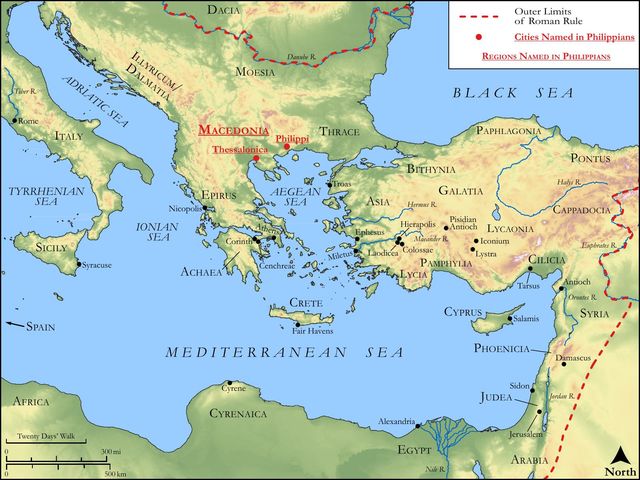
See on the biblical-era map

Study this verse
Public-domain commentary
Matthew Henry
From his Commentary on the Whole Bible. Henry comments on passages, not single verses — this entry covers Philippians 3:9–14. His four-level outline is real structure in the source text, so it is rendered as structure.
We now heard what the apostle renounced; let us now see what he laid hold on, and resolved to cleave to, namely, Christ and heaven. He had his heart on these two great peculiarities of the Christian religion.
I.The apostle had his heart upon Christ as his righteousness. This is illustrated in several instances.
1.He desired to win Christ; and an unspeakable gainer he would reckon himself if he had but an interest in Christ and his righteousness, and if Christ became his Lord and his Saviour: That I may win him; as the runner wins the prize, as the sailor makes the port he is bound for. The expression intimates that we have need to strive for him and after him, and that all is little enough to win him.
2.That he might be found in him (Phi 3:9), as the manslayer was found in the city of refuge, where he was safe from the avenger of blood, Num 35:25. Or it alludes to a judicial appearance; so we are to be found of our Judge in peace, Pe2 3:14. We are undone without a righteousness wherein to appear before God, for we are guilty. There is a righteousness provided for us in Jesus Christ, and it is a complete and perfect righteousness. None can have interest or benefit by it but those who come off from confidence in themselves, and are brought heartily to believe in him. "Not having my own righteousness, which is of the law; not thinking that my outward observances and good deeds are able to atone for my bad ones, or that by setting the one over against the other I can come to balance accounts with God. No, the righteousness which I depend upon is that which is through the faith of Christ, not a legal, but evangelical righteousness: The righteousness which is of God by faith, ordained and appointed of God." The Lord Jesus Christ is the Lord our righteousness, Isa 45:24; Jer 23:6. Had he not been God, he could not have been our righteousness; the transcendent excellence of the divine nature put such a value upon, and such a virtue into, his sufferings, that they became sufficient to satisfy for the sins of the world, and to bring in a righteousness which will be effectual to all that believe. Faith is the ordained means of actual interest and saving benefit in all the purchase of his blood. It is by faith in his blood, Rom 3:25.
3.That he might know Christ (Phi 3:10): That I may know him, and the power of his resurrection, and the fellowship of his sufferings. Faith is called knowledge, Isa 53:11. Knowing him here is believing in him: it is an experimental knowledge of the power of his resurrection, and the fellowship of his sufferings, or feeling the transforming efficacy and virtue of them. Observe, The apostle was as ambitious of being sanctified as he was of being justified. He was as desirous to know the power of Christ's death and resurrection killing sin in him, and raising him up to newness of life, as he was to receive the benefit of Christ's death and resurrection in his justification.
4.That he might be conformable unto him, and this also is meant of his sanctification. We are then made conformable to his death when we die to sin, as Christ died for sin, when we are crucified with Christ, the flesh and affections of it mortified, and the world is crucified to us, and we to the world, by virtue of the cross of Christ. This is our conformity to his death.
II.The apostle had his heart upon heaven as his happiness: If by any means I might attain to the resurrection of the dead, Phi 3:11.
1.The happiness of heaven is here called the resurrection of the dead, because, though the souls of the faithful, when they depart, are immediately with Christ, yet their happiness will not be complete till the general resurrection of the dead at the last day, when soul and body shall be glorified together. Anastasis sometimes signifies the future state. This the apostle had his eye upon; this he would attain. There will be a resurrection of the unjust, who shall arise to shame and everlasting contempt; and our care must be to escape that: but the joyful and glorious resurrection of saints is called the resurrection, kat' exochēn - by eminence, because it is in virtue of Christ's resurrection, as their head and first-fruits; whereas the wicked shall rise only by the power of Christ, as their judge. To the saints it will be indeed a resurrection, a return to bliss, and life, and glory; while the resurrection of the wicked is a rising from the grave, but a return to a second death. It is called the resurrection of the just, and the resurrection of life (Joh 5:29), and they are counted worthy to obtain that world and the resurrection from the dead, Luk 20:35.
2.This joyful resurrection the apostle pressed towards. He was willing to do any thing, or suffer any thing, that he might attain that resurrection. The hope and prospect of it carried him with so much courage and constancy through all the difficulties he met with in his work. He speaks as if they were in danger of missing it, and coming short of it. A holy fear of coming short is an excellent means of perseverance. Observe, His care to be found in Christ was in order to his attaining the resurrection of the dead. Paul himself did not hope to attain it through his own merit and righteousness, but through the merit and righteousness of Jesus Christ. "Let me be found in Christ, that I may attain the resurrection of the dead, be found a believer in him, and interested in him by faith," Observe,
(1.)He looks upon himself to be in a state of imperfection and trial: Not as though I had already attained, or were already perfect, Phi 3:12. Observe, The best men in the world will readily own their imperfection in the present state. We have not yet attained, are not already perfect; there is still much wanting in all our duties, and graces, and comforts. If Paul had not attained to perfection (who had reached to so high a pitch of holiness), much less have we. Again, Brethren, I count not myself to have apprehended (Phi 3:13), ou logizomai. "I make this judgment of the case; I thus reason with myself." Observe, Those who think they have grace enough give proof that they have little enough, or rather that they have none at all; because, wherever there is true grace, there is a desire of more grace, and a pressing towards the perfection of grace.
(2.)What the apostle's actings were under this conviction. Considering that he had not already attained, and had not apprehended, he pressed forward: "I follow after (Phi 3:12), diōkō - I pursue with vigour, as one following after the game. I endeavour to get more grace and do more good, and never think I have done enough: If that I may apprehend that for which also I am apprehended of Christ Jesus." Observe,
[1.]Whence our grace comes - from our being apprehended of Christ Jesus. It is not our laying hold of Christ first, but his laying hold of us, which is our happiness and salvation. We love him because he first loved us, Jo1 4:19. Not our keeping hold of Christ, but his keeping hold of us, is our safety. We are kept by his mighty power through faith unto salvation, Pe1 1:5. Observe,
[2.]What the happiness of heaven is: it is to apprehend that for which we are apprehended of Christ. When Christ laid hold of us, it was to bring us to heaven; and to apprehend that for which he apprehended us is to attain the perfection of our bliss. He adds further (Phi 3:13): This one thing I do (this was his great care and concern), forgetting those things which are behind, and reaching forth to those things which are before. There is a sinful forgetting of past sins and past mercies, which ought to be remembered for the exercise of constant repentance and thankfulness to God. But Paul forgot the things which were behind so as not to be content with present measures of grace: he was still for having more and more. So he reaches forth, epekteinomenos - stretched himself forward, bearing towards his point: it is expressive of a vehement concern.
(3.)The apostle's aim in these actings: I press towards the mark, for the prize of the high calling of God in Christ Jesus, Phi 3:14. He pressed towards the mark. As he who runs a race never takes up short of the end, but is still making forwards as fast as he can, so those who have heaven in their eye must still be pressing forward to it in holy desires and hopes, and constant endeavours and preparations. The fitter we grow for heaven the faster we must press towards it. Heaven is called here the mark, because it is that which every good Christian has in his eye; as the archer has his eye fixed upon the mark he designs to hit. For the prize of the high calling. Observe, A Christian's calling is a high calling: it is from heaven, as its original; and it is to heaven in its tendency. Heaven is the prize of the high calling; to brabeion - the prize we fight for, and run for, and wrestle for, what we aim at in all we do, and what will reward all our pains. It is of great use in the Christian course to keep our eye upon heaven. This is proper to give us measures in all our service, and to quicken us every step we take; and it is of God, from whom we are to expect it. Eternal life is the gift of God (Rom 6:23), but it is in Christ Jesus; through his hand it must come to us, as it is procured for us by him. There is no getting to heaven as our home but by Christ as our way.
Historical interpretation
Two Centuries of Reception
5 surviving comments on this verse. Each one is dated, so this reads as a timeline rather than a list.
Select a marker to jump to its quote. Markers stagger vertically where authors wrote within a few decades of each other.
These are also the things "which he counts but dung for the excellency of the knowledge of Christ" (but by no means for the rejection of God the Creator); "whilst he has not his own righteousness, which is of the law, but that which is through Him," i.e. Christ, "the righteousness which is of God." Then, say you, according to this distinction the law did not proceed from the God of Christ.
If, as he tells the Colossians, “in Christ are hidden all the treasures of wisdom and knowledge,” then everything, whatever it is, is to be reckoned of no account, so that we may attain to the height of this wisdom and knowledge. Not only sufficient but superabundant indeed is the righteousness that comes from faith. This salvation is freely given by the grace of God through the knowledge of Christ. It can hardly be said to be a gift of the law. For to know rightly the mystery of his incarnation and passion and resurrection is the perfection of life and the treasure of wisdom.
Thus is it required of them to conduct themselves. That "the harvest is great, but the workmen are few," this also is well-known and manifest. Let us, therefore, "ask of the Lord of the harvest" that He would send forth workmen into the harvest; [Matthew 9:37-38] such workmen as "shall skilfully dispense the word of truth;" workmen "who shall not be ashamed;" faithful workmen; workmen who shall be "the light of the world;" [Matthew 5:14] workmen who "work not for the food that perishes, but for that food which abides unto life eternal;" [John 6:27] workmen who shall be such as the apostles; workmen who imitate the Father, and the Son, and the Holy Spirit; who are concerned for the salvation of men; not "hireling" [John 10:12-13] workmen; not workmen to whom the fear of God and righteousness appear to be gain; not workmen who "serve their belly;" not workmen who "with fair speeches and pleasant words mislead the hearts of the innocent;" [Romans 16:18] not workmen who imitate the children of light, while they are not light but darkness — "men whose end is destruction;" [Philippians 3:9] not workmen who practise iniquity and wickedness and fraud; not "crafty workmen;" [2 Corinthians 11:13] not workmen "drunken" and "faithless;" nor workmen who traffic in Christ; not misleaders; not "lovers of money; not malevolent."
"And that I may be found in Him, not having a righteousness of mine own, even that which is of the Law." If he who had righteousness, ran to this other righteousness because his own was nothing, how much rather ought they, who have it not, to run to Him? And he well said, "a righteousness of mine own," not that which I gained by labor and toil, but that which I found from grace. If then he who was so excellent is saved by grace, much more are you. For since it was likely they would say that the righteousness which comes from toil is the greater, he shows that it is dung in comparison with the other. For otherwise I, who was so excellent in it, would not have cast it away, and run to the other. But what is that other? That which is from the faith of God, i.e. it too is given by God. This is the righteousness of God; this is altogether a gift. And the gifts of God far exceed those worthless good deeds, which are due to our own diligence.
Now what does he mean, “not having my own righteousness,” when that law was not his but God’s? He can only have called it his own righteousness because, although it was from the law, he used to think that he could fulfill it without the aid of the grace that is through Christ.
Continue studying Philippians 3:9 across the web’s major study libraries — every link below opens this exact verse, chapter, or book on the destination site.
Read & Compare
 BibleGatewayThis verse in more than 200 translations and 70 languages.
 Bible.comThe YouVersion reader — hundreds of translations, reading plans, and highlights.
 ESV.orgCrossway's official English Standard Version reader.
 NET BibleThe NET translation with 60,000+ translators' notes on every rendering decision.
 STEP BibleTyndale House's free study tool — original text, vocabulary, and scholarly resources.
 BibliaLogos Bible Software's free web reader.
 USCCBThe New American Bible (Revised Edition) with the U.S. bishops' study notes.
Commentaries
 BibleHub CommentariesDozens of classic commentaries on this verse, gathered on one page.
 StudyLightMore than 100 commentary sets — the largest collection on the web.
 BibleRefPlain-English commentary on what this verse means, verse by verse.
 Enduring WordDavid Guzik's free commentary on this chapter, widely used by Bible teachers.
 Bible Study ToolsVerse commentary alongside Greek and Hebrew study aids.
Original Language & Research
- BibleHub InterlinearThe verse word by word — original language, transliteration, and English.
- BibleHub LexiconEvery word's original-language definition and Strong's entry.
 Blue Letter BibleDeep-study tools — Strong's numbers, concordance, and word studies.
 CNTR CollationThe earliest Greek manuscripts of this verse, collated letter by letter.
Sermons, Hymns & Audio


TrulyRandomVerse is not affiliated with these sites and doesn’t control their content. They’re linked because they’re genuinely useful.
Summary
Philippians 3:9 stands as a pivotal declaration of the Apostle Paul's theological understanding of salvation, contrasting human-achieved righteousness derived from adherence to the Mosaic Law with the divine righteousness freely granted by God through faith in Jesus Christ. This verse encapsulates the core Gospel message that a right standing before God is not earned by human effort or religious performance, but is a gracious gift received through a trusting relationship with Christ, leading to a profound union with Him.
Context
ShowHideLiterary Context
Philippians 3:9 is nestled within a powerful section where Paul passionately warns the Philippian believers against "dogs" and "evil workers" (likely Judaizers) who insisted on circumcision and adherence to the Law for salvation. Having previously exhorted them to unity and humility, Paul now presents his own radical transformation as a prime example. In verses 4-6, he meticulously lists his impeccable Jewish credentials—circumcision, lineage, zeal for the Law—which, by worldly standards, would have guaranteed his righteousness. However, in verse 7, he declares these former "gains" as "loss for the sake of Christ," and in verse 8, he emphatically counts them as "rubbish" or "dung" (σκύβαλα, skybala) in comparison to the surpassing worth of knowing Christ Jesus his Lord. Verse 9 then articulates the profound theological reason for this radical re-evaluation: the pursuit of a different, superior righteousness.
Historical & Cultural Context
Paul's letter to the Philippians was written from prison, likely in Rome or Ephesus, around A.D. 60-62. The church in Philippi was a Gentile-majority congregation, but like many early Christian communities, it faced pressure from Judaizers—Jewish Christians who believed that Gentile converts must observe Jewish Law, including circumcision, to be truly saved. This theological conflict was a major issue in the early church, as seen in the Jerusalem Council (Acts 15) and Paul's letter to the Galatians. Paul's personal testimony in Philippians 3 directly confronts the Judaizers' claims by demonstrating that even someone with his unparalleled Jewish pedigree found all such efforts utterly worthless for securing a right standing with God. The concept of "righteousness of the law" (δικαιοσύνη ἐκ νόμου, dikaiosynē ek nomou) refers to the Jewish understanding that one could achieve a justified status before God through perfect obedience to the Mosaic Law, a path Paul now explicitly rejects.
Key Themes
ShowHideThis verse is central to several overarching themes in Philippians and Paul's broader theology. The primary theme is the nature of true righteousness and how it is obtained. Paul contrasts human effort and self-righteousness with divine grace and faith. This aligns with the pervasive New Testament teaching that salvation is not by works but by grace through faith, a concept powerfully articulated in passages like Romans 3:21-28 and Ephesians 2:8-9. Furthermore, the verse emphasizes the supremacy of Christ and the transformative power of union with Him. To "be found in him" means that one's identity, standing, and hope are inextricably linked to Christ, not to any personal achievement. This profound union is the source of the "righteousness which is of God by faith," distinguishing it from any righteousness derived from the Law, which Paul considers "loss" in Philippians 3:7.
Exposition and Analysis
ShowHideKey Word Analysis
ShowHideThis term denotes equity of character or act, and specifically in a Christian context, justification. In Philippians 3:9, Paul uses it to refer to a right standing or acceptance before God. He contrasts two sources: "mine own righteousness," which is based on human effort and legal observance, and "the righteousness which is of God," which is a divinely imputed status.
This possessive pronoun emphasizes personal ownership and origin. Paul uses it to highlight the self-generated nature of the righteousness he once pursued through the law, underscoring its human origin and inherent inadequacy when compared to God's provision.
This word signifies persuasion, credence, or moral conviction, especially reliance upon Christ for salvation. In this verse, Paul uses "faith of Christ" (διὰ πίστεως Χριστοῦ) and "by faith" (ἐπὶ τῇ πίστει) to describe the means by which God's righteousness is received. It indicates a trusting dependence on Christ's work, rather than on one's own performance. The prepositions G1223 (διὰ, diá - "through") and G1909 (ἐπὶ, epí - "by" or "upon") further clarify that faith is the channel and the basis for receiving this divine righteousness.
Verse Breakdown
ShowHide"And be found in him,"
This opening clause expresses Paul's ultimate desire and goal: to be identified with Christ. To "be found" (G2147, heurískō) implies a state of being discovered or recognized, emphasizing that one's entire existence and standing are now defined by their union "in him" (G1722, en G846, autós). This union with Christ is the context within which true righteousness is experienced.
"not having mine own righteousness, which is of the law,"
Paul explicitly rejects any form of self-generated righteousness. "Mine own righteousness" (G1699, emós G1343, dikaiosýnē) refers to a right standing achieved through personal effort, particularly through adherence to the Mosaic Law (G3551, nómos). This is the righteousness that Paul, as a zealous Pharisee, once pursued and excelled in, but now considers utterly insufficient and even detrimental.
"but that which is through the faith of Christ,"
This introduces the contrasting source of true righteousness. The phrase "through the faith of Christ" (G1223, diá G4102, pístis G5547, Christós) is crucial. While it could grammatically mean "Christ's faithfulness," the overwhelming theological context of Paul's letters strongly supports the interpretation of "faith in Christ." It signifies that the channel or means by which this righteousness is obtained is a trusting belief directed towards Jesus Christ.
"the righteousness which is of God by faith:"
This final clause clarifies the origin and basis of this true righteousness. It is "of God" (G1537, ek G2316, theós), meaning it originates from God and is His gift, not something earned or produced by humans. It is received "by faith" (G1909, epí G4102, pístis), reiterating and emphasizing that faith is the sole condition for its reception, solidifying the contrast with righteousness based on the Law.
Literary Devices
ShowHidePaul masterfully employs Antithesis and Juxtaposition in this verse to highlight the stark contrast between two irreconcilable paths to righteousness. He sets "mine own righteousness, which is of the law" directly against "that which is through the faith of Christ, the righteousness which is of God by faith." This creates a powerful rhetorical effect, forcing the reader to choose between human effort and divine grace. The Repetition of the word "righteousness" (δικαιοσύνη, dikaiosýnē) underscores its central importance to the argument, while also distinguishing between its false and true forms. Furthermore, the verse uses Inclusion by beginning and ending with the concept of "faith" as the means of acquiring righteousness, framing the entire statement around this pivotal theological principle.
Theological and Thematic Connections
ShowHidePhilippians 3:9 is a cornerstone of Pauline theology, articulating the doctrine of justification by faith alone. It asserts that humanity, inherently flawed and unable to perfectly fulfill the demands of the Law, cannot achieve a righteous standing before a holy God through its own efforts. Instead, God, in His sovereign grace, provides a perfect righteousness through the person and work of Jesus Christ, which is freely given to those who place their trust in Him. This divine imputation of righteousness is not merely a legal declaration but a transformative reality that establishes a new relationship with God, grounded in Christ's finished work rather than human performance. This truth liberates believers from the impossible burden of earning salvation and anchors their hope in God's unfailing grace.
Reflection and Application
ShowHidePhilippians 3:9 serves as a profound call to examine the source of our confidence and assurance before God. In a world that often values self-reliance, achievement, and visible performance, this verse radically reorients our perspective. It challenges us to relinquish any lingering reliance on our own good deeds, moral uprightness, or religious observances as a basis for God's acceptance. True spiritual security and peace are found only when we fully embrace the truth that our righteousness is a gift from God, received solely through faith in Christ. This understanding fosters humility, gratitude, and a deeper dependence on God, freeing us from the exhausting treadmill of trying to earn what can only be freely given. It invites us to rest in Christ's perfect work, knowing that our standing before God is secure, not because of who we are or what we have done, but because of who He is and what He has accomplished for us.
Questions for Reflection
ShowHideFAQ
ShowHideWhat is the difference between "my own righteousness" and "the righteousness which is of God"?
ShowHide"My own righteousness" refers to any attempt by a person to achieve a right standing before God through their own efforts, obedience to religious laws (like the Mosaic Law), or good deeds. It is a righteousness that originates from human performance and is inherently flawed and insufficient to meet God's perfect standard. In contrast, "the righteousness which is of God" is a divine gift. It is God's own perfect righteousness, which He imputes (credits) to believers through their faith in Jesus Christ. This righteousness is not earned but freely received, making a person acceptable in God's sight not because of their own merit, but because of Christ's perfect obedience and atoning sacrifice. This distinction is central to the Gospel message found throughout Paul's letters, such as in Romans 1:17 and Romans 10:3-4.
Christ-Centered Fulfillment
ShowHidePhilippians 3:9 finds its ultimate fulfillment in the person and work of Jesus Christ, who is the very embodiment and source of the "righteousness which is of God." Humanity's inability to achieve righteousness through the Law (as demonstrated by the Law itself, which reveals sin, see Romans 3:20) necessitated a divine solution. Christ perfectly fulfilled the Law on our behalf, living a sinless life and offering Himself as the spotless Lamb of God (as foreshadowed in John 1:29). Through His atoning death on the cross, He absorbed the penalty for our unrighteousness, and through His resurrection, He demonstrated victory over sin and death. Thus, the "faith of Christ" is not merely our belief, but our reliance on Christ's perfect faithfulness and His completed work. When we are "found in him," God graciously imputes Christ's perfect righteousness to us, making us "the righteousness of God in Him" (2 Corinthians 5:21). This divine exchange is the heart of the Gospel, where our sin is laid upon Christ, and His righteousness is freely given to us, establishing an eternal covenant of grace and peace through the Lord Jesus Christ (Ephesians 2:13-16).