


Philippians 3:4
Bible text: King James Version (1769 Blayney text) · Public domain
Bible text: King James Version with Strong's numbers · Public domain
Bible text: Berean Standard Bible · Public domain
Bible text: American Standard Version (1901) · Public domain
Bible text: World English Bible, Messianic edition · Public domain
Bible text: Geneva Bible (1599) · Public domain
Bible text: Young's Literal Translation · Public domain
- καίπερkaiperthoughG2539CONJConjunction
- ἐγὼegōI myselfG1473P-1NSPersonal pronoun Nominative 1st Singular
- ἔχωνechōnhaveG2192V-PAP-NSMVerb Present Active Participle Nominative Singular Masculine
- πεποίθησινpepoithēsinconfidenceG4006N-ASFNoun Accusative Singular Feminine
- καὶkaievenG2532CONJConjunction
- ἐνeninG1722PREPPreposition
- σαρκίsarki[the] fleshG4561N-DSFNoun Dative Singular Feminine
- εἴeiIfG1487CONDConjunction
- τιςtisanyG5100X-NSMIndefinite pronoun Nominative Singular Masculine
- δοκεῖdokeithinksG1380V-PAI-3SVerb Present Active Indicative 3rd Singular
- ἄλλοςallosotherG243A-NSMAdjective Nominative Singular Masculine
- πεποιθέναιpepoithenaito have confidenceG3982V-2RANVerb 2nd Perfect Active Infinitive
- ἐνeninG1722PREPPreposition
- σαρκίsarki[the] fleshG4561N-DSFNoun Dative Singular Feminine
- ἐγὼegōI myselfG1473P-1NSPersonal pronoun Nominative 1st Singular
- μᾶλλον·mallonmoreG3123ADVAdverb
English is a literal word-by-word gloss of the Greek, not the KJV's wording. Why?
This is the original text the KJV's translators worked from — each Greek word with its own literal English meaning in this verse, prepared by scholars at Tyndale House, Cambridge. The KJV translates whole sentences, not word by word, so its wording differs: one Greek word can become several English words, and the KJV may choose “charity” where the gloss reads “love”. Both are faithful — they answer different questions. For the KJV's own rendering, switch to the KJV text.
Details
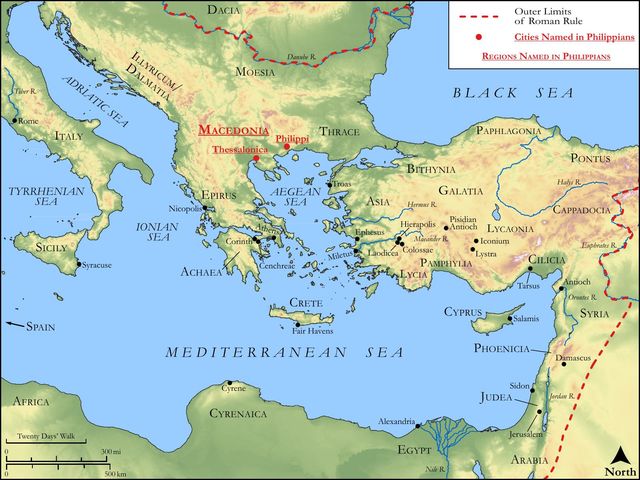
See on the biblical-era maps

Study this verse
Public-domain commentary
Matthew Henry
From his Commentary on the Whole Bible. Henry comments on passages, not single verses — this entry covers Philippians 3:4–8. His two-level outline is real structure in the source text, so it is rendered as structure.
The apostle here proposes himself for an example of trusting in Christ only, and not in his privileges as an Israelite.
I.He shows what he had to boast of as a Jew and a Pharisee.
Let none think that the apostle despised these things (as men commonly do) because he had them not himself to glory in. No, if he would have gloried and trusted in the flesh, he had as much cause to do so as any man: If any other man thinketh that he hath whereof to trust in the flesh, I more, Phi 3:4. He had as much to boast of as any Jew of them all.
1.His birth-right privileges. He was not a proselyte, but a native Israelite: of the stock of Israel. And he was of the tribe of Benjamin, in which tribe the temple stood, and which adhered to Judah when all the other tribes revolted. Benjamin was the father's darling, and this was a favourite tribe. A Hebrew of the Hebrews, an Israelite on both sides, by father and mother, and from one generation to another; none of his ancestors had matched with Gentiles.
2.He could boast of his relations to the church and the covenant, for he was circumcised the eighth day; he had the token of God's covenant in his flesh, and was circumcised the very day which God had appointed.
3.For learning, he was a Pharisee, brought up at the feet of Gamaliel, an eminent doctor of the law: and was a scholar learned in all the learning of the Jews, taught according to the perfect manner of the laws of the fathers, Act 22:3. He was a Pharisee, the son of a Pharisee (Act 23:6), and after the most strict sect of his religion lived a Pharisee, Act 26:5.
4.He had a blameless conversation: Toughing the righteousness which is of the law, blameless: as far as the Pharisees' exposition of the law went, and as to the mere letter of the law and outward observance of it, he could acquit himself from the breach of it and could not be accused by any.
5.He had been an active man for his religion. As he made a strict profession of it, under the title and character of a Pharisee, so he persecuted those whom he looked upon as enemies to it. Concerning zeal, persecuting the church.
6.He showed that he was in good earnest, though he had a zeal without knowledge to direct and govern the exercise of it: I was zealous towards God, as you all are this day, and I persecuted this way unto the death, Act 22:3, Act 22:4. All this was enough to have made a proud Jew confident, and was stock sufficient to set up with for his justification. But,
II.The apostle tells us here how little account he made of these, in comparison of his interest in Christ and his expectations from him:
But what things were gain to me those have I counted loss for Christ (Phi 3:7); that is, those things which he had counted gain while he was a Pharisee, and which he had before reckoned up, these he counted loss for Christ. "I should have reckoned myself an unspeakable loser of, to adhere to them, I had lost my interest in Jesus Christ." He counted them loss; not only insufficient to enrich him, but what would certainly impoverish and ruin him, if he trusted to them, in opposition to Christ. Observe, The apostle did not persuade them to do any thing but what he had himself did, to quit any thing but what he had himself quitted, nor venture on any bottom but what he himself had ventured his immortal soul upon. - Yea doubtless, and I count all things but loss for the excellency of the knowledge of Christ Jesus my Lord, Phi 3:8. Here the apostle explains himself.
1.He tells us what it was that he was ambitious of and reached after: it was the knowledge of Christ Jesus his Lord, a believing experimental acquaintance with Christ as Lord; not a merely notional and speculative, but a practical and efficacious knowledge of him. So knowledge is sometimes put for faith: By his knowledge, or the knowledge of him, shall my righteous servant justify many, Isa 53:11. And it is the excellency of knowledge. There is an abundant and transcendent excellency in the doctrine of Christ, or the Christian religion above all the knowledge of nature, and improvements of human wisdom; for it is suited to the case of fallen sinners, and furnishes them with all they need and all they can desire and hope for, with all saving wisdom and saving grace.
2.He shows how he had quitted his privileges as a Jew and a Pharisee: Yea doubtless; his expression rises with a holy triumph and elevation, alla men oun ge kai. There are five particles in the original: But indeed even also do I count all things but loss. He had spoken before of those things, his Jewish privileges: here he speaks of all things, all worldly enjoyments and mere outward privileges whatsoever, things of a like kind or any other kind which could stand in competition with Christ for the throne in his heart, or pretend to merit and desert. There he had said that he did count them but loss; but it might be asked, "Did he continue still in the same mind, did he not repent his renouncing them?" No, now he speaks in the present tense: Yea doubtless, I do count them but loss. But it may be said, "It is easy to say so; but what would he do when he came to the trial?" Why he tells us that he had himself practised according to this estimate of the case: For whom I have suffered the loss of all things. He had quitted all his honours and advantages, as a Jew and a Pharisee, and submitted to all the disgrace and suffering which attended the profession and preaching of the gospel. When he embarked in the bottom of the Christian religion, he ventured all in it, and suffered the loss of all for the privileges of a Christian. Nay, he not only counted them loss, but dung, skubala - offals thrown to dogs; they are not only less valuable than Christ, but in the highest degree contemptible, when they come in competition with him. Note, The New Testament never speaks of saving grace in any terms of diminution, but on the contrary represents it as the fruits of the divine Spirit and the image of God in the soul of man; as a divine nature, and the seed of God: and faith is called precious faith; and meekness is in the sight of God of great price, Pe1 3:4; Pe2 1:1, etc.
Historical interpretation
Two Centuries of Reception
2 surviving comments on this verse. Each one is dated, so this reads as a timeline rather than a list.
Select a marker to jump to its quote. Markers stagger vertically where authors wrote within a few decades of each other.
But "those things which he had once accounted gain," and which he enumerates in the preceding verse-"trust in the flesh," the sign of "circumcision," his origin as "an Hebrew of the Hebrews," his descent from "the tribe of Benjamin," his dignity in the honours of the Pharisee -he now reckons to be only "loss" to himself; (in other words, ) it was not the God of the Jews, but their stupid obduracy, which he repudiates.
"And have no confidence," says he, "in the flesh; though I myself might have confidence even in the flesh." What does he call "confidence" here, and "in the flesh"? Boasting, boldness, a high tone. And he did well to add this; for if he had been of the Gentiles, and had condemned circumcision, and not only circumcision, but all those that adopted it out of place, it would have seemed that he was running it down, because he lacked the high ancestry of Judaism, as being a stranger to its solemn rites, and having no part therein. But as it is, he, who, though a sharer, yet blames them, will not therefore blame them as having no share in them, but as disowning them; not from ignorance, but most especially from acquaintance with them. Accordingly observe what he says in his Epistle to the Galatians also; having been brought into a necessity of saying great things about himself, how even in these circumstances does he manifest nought but humility. "For ye have heard, of my manner of life in time past," he says, "in the Jews' religion" (Gal. i. 13); and again here; "if any other man thinketh to have confidence in the flesh, I more." And he immediately added, "a Hebrew of Hebrews." But "if any other man," says he, showing the necessity, showing that it was on their account that he spoke. "If ye have confidence," he says, I also say so, since I am silent. And observe the absence of all ungraciousness in the reproofs; by forbearing to do it by name, he gave even them the opportunity of retracing their steps. "If any one thinketh to have confidence"; and it was well to say "thinketh," either inasmuch as they really had no such confidence, or as that confidence was no real confidence, for all was by necessity, and not of choice.
Continue studying Philippians 3:4 across the web’s major study libraries — every link below opens this exact verse, chapter, or book on the destination site.
Read & Compare
 BibleGatewayThis verse in more than 200 translations and 70 languages.
 Bible.comThe YouVersion reader — hundreds of translations, reading plans, and highlights.
 ESV.orgCrossway's official English Standard Version reader.
 NET BibleThe NET translation with 60,000+ translators' notes on every rendering decision.
 STEP BibleTyndale House's free study tool — original text, vocabulary, and scholarly resources.
 BibliaLogos Bible Software's free web reader.
 USCCBThe New American Bible (Revised Edition) with the U.S. bishops' study notes.
Commentaries
 BibleHub CommentariesDozens of classic commentaries on this verse, gathered on one page.
 StudyLightMore than 100 commentary sets — the largest collection on the web.
 BibleRefPlain-English commentary on what this verse means, verse by verse.
 Enduring WordDavid Guzik's free commentary on this chapter, widely used by Bible teachers.
 Bible Study ToolsVerse commentary alongside Greek and Hebrew study aids.
Original Language & Research
- BibleHub InterlinearThe verse word by word — original language, transliteration, and English.
- BibleHub LexiconEvery word's original-language definition and Strong's entry.
 Blue Letter BibleDeep-study tools — Strong's numbers, concordance, and word studies.
 CNTR CollationThe earliest Greek manuscripts of this verse, collated letter by letter.
Sermons, Hymns & Audio


TrulyRandomVerse is not affiliated with these sites and doesn’t control their content. They’re linked because they’re genuinely useful.
Summary
Philippians 3:4 initiates a crucial section where the Apostle Paul powerfully contrasts his former, impressive reliance on human credentials and religious performance with the surpassing worth and righteousness found only in knowing Christ Jesus. Through this verse, Paul establishes his unique authority to speak on the futility of "confidence in the flesh," asserting that if anyone had reason to boast in their personal achievements or heritage apart from God, he possessed far greater grounds, yet he utterly rejected them for Christ.
Context
ShowHideLiterary Context
This verse immediately follows Paul's stern warning in Philippians 3:2 against "dogs," "evil workers," and those who mutilate the flesh. These pejorative terms refer to the Judaizers, a group that insisted on circumcision and adherence to the Mosaic Law as necessary for salvation or for attaining a higher level of righteousness. By presenting his own impeccable Jewish credentials in Philippians 3:4-6, Paul is not boasting in them, but rather demonstrating that if anyone could legitimately trust in such things for their standing before God, he could – and yet he utterly renounced them. This sets the stage for his profound declaration in Philippians 3:7, where he counts all his former gains as "rubbish" for the sake of Christ, leading into the exposition of true righteousness by faith in Philippians 3:8-9.
Historical & Cultural Context
Paul, a Pharisee of Pharisees, was born into a Jewish family, circumcised on the eighth day, and a zealous persecutor of the church, all marks of exemplary Jewish piety and commitment to the Law. In the first century, Jewish identity and righteousness were often tied to lineage, adherence to the Law (especially circumcision), and meticulous observance of traditions. The Judaizers, a faction within early Christianity, sought to impose these Jewish practices on Gentile converts, believing them essential for salvation or full inclusion in God's covenant people. Paul's own background, detailed in the verses immediately following Philippians 3:4, demonstrates that he was the epitome of someone who could claim righteousness based on these very criteria. His renunciation of these things, therefore, carried immense weight and authority in refuting the Judaizers' claims.
Key Themes
ShowHidePhilippians 3:4 contributes significantly to several major theological themes within the book and Pauline theology as a whole. It introduces the theme of the rejection of self-righteousness, immediately highlighting the futility of relying on human effort, heritage, or religious performance for acceptance with God. Paul is dismantling the idea that one's own achievements can contribute to salvation or righteousness, setting the stage for the declaration that true righteousness comes only from God through faith in Christ, as seen in Philippians 3:9. The verse also establishes Paul's authority and credibility on this matter; by stating he had more reason than anyone to boast in the flesh, he demonstrates that his condemnation of such confidence is not from ignorance but from profound personal experience and conviction. This passage underscores the fundamental contrast between human achievement and divine grace, a foundational principle of the gospel that permeates Paul's letters, emphasizing that salvation is by grace through faith, not by works, as articulated in Ephesians 2:8-9.
Exposition and Analysis
ShowHideKey Word Analysis
ShowHideThis word denotes reliance or trust. In this context, it refers to the misplaced assurance or security that one might derive from their own human efforts, achievements, or external religious observances. Paul uses it to describe the false sense of security that comes from trusting in anything other than God's grace.
"flesh" here is not merely the physical body but, in Pauline theology, often refers to human nature in its unredeemed state, apart from the Spirit of God. It encompasses human effort, ability, lineage, religious performance, or any aspect of human existence that one might rely on for righteousness or standing before God, emphasizing its inherent weakness and inability to please God.
This verb means to convince, assent, or rely. In the context of the verse, it describes the act of placing one's reliance or persuasion in one's own human attributes or accomplishments for salvation or spiritual standing, rather than in Christ. It highlights the active choice to place faith in self rather than in God.
Verse Breakdown
ShowHide"Though I might also have confidence in the flesh."
Paul begins by acknowledging that, if the criteria for boasting were human achievements or external religious markers, he would certainly qualify. The phrase "confidence in the flesh" encapsulates reliance on human effort, lineage, religious performance, or any external factor for one's standing before God. Paul is setting himself up as the prime example of someone who had every reason, by worldly standards, to trust in such things.
"If any other man thinketh that he hath whereof he might trust in the flesh,"
This clause introduces a hypothetical scenario, challenging anyone else who might consider their own credentials sufficient. Paul is directly addressing those who might be tempted to boast or rely on their own merits, particularly the Judaizers. The repetition of "flesh" reinforces the idea that any human-derived source of confidence is ultimately futile.
"I more:"
This succinct declaration serves as Paul's emphatic conclusion to the hypothetical. He asserts that whatever grounds anyone else might claim for confidence in the flesh, his own grounds were superior. This statement is not a boast in his past but a rhetorical device to underscore the absolute worthlessness of such confidence, precisely because even he, the most qualified, utterly rejected it.
Literary Devices
ShowHideThe verse employs Irony and Rhetorical Questioning (implicitly). Paul's statement, "I more," is deeply ironic. He asserts his superior credentials in the "flesh" not to boast, but to utterly dismantle the very concept of boasting in human merit. He is setting up an argument where his unparalleled qualifications in the Law and Jewish tradition serve only to highlight the utter futility of such things compared to Christ. This ironic setup leads into his subsequent declaration that he counts all these things as loss. The verse also functions as an implicit Rhetorical Challenge, daring anyone to compare their "fleshly" qualifications to his, knowing that he will then declare all such qualifications to be worthless. This technique effectively disarms his opponents by showing that he understands their position better than they do, having surpassed them in it, only to abandon it entirely.
Theological and Thematic Connections
ShowHidePhilippians 3:4 serves as a crucial theological bridge, connecting Paul's warning against false teachers to his profound exposition of righteousness by faith. It underscores the pervasive human tendency to seek justification or worth through personal effort, heritage, or external religious observance – what Paul terms "confidence in the flesh." This verse highlights the fundamental theological truth that human merit, no matter how impressive, is utterly insufficient for salvation or standing before a holy God. It sets the stage for the radical reorientation of values that occurs when one truly apprehends the surpassing worth of knowing Christ, where all self-derived righteousness is discarded as worthless in favor of a righteousness that comes from God through faith.
Reflection and Application
ShowHidePhilippians 3:4 challenges believers today to deeply examine the hidden corners of their hearts for any lingering reliance on "the flesh." It's easy to condemn overt self-righteousness, but Paul's words probe deeper, asking us to consider if we subtly trust in our good deeds, our church attendance, our spiritual disciplines, our moral uprightness, our theological knowledge, or even our Christian heritage as a basis for our acceptance with God. Are we tempted to compare ourselves to others, finding comfort in our perceived spiritual superiority? Paul's radical renunciation of his own impeccable credentials serves as a powerful reminder that anything we might boast in, apart from Christ, is ultimately worthless for salvation and true righteousness. Genuine security and acceptance come not from what we do, but from the finished work of Christ alone, calling us to a posture of profound humility and complete dependence on Him. This verse speaks against any form of spiritual pride or self-reliance, pointing us solely to the cross of Jesus Christ as the immovable foundation of our hope and identity.
Questions for Reflection
ShowHideFAQ
ShowHideWhat does "confidence in the flesh" mean in Philippians 3:4?
ShowHideIn Philippians 3:4, "confidence in the flesh" refers to placing one's trust, assurance, or reliance on human achievements, external religious observances, lineage, or any self-derived merit for one's standing with God. For Paul, this specifically included his impeccable Jewish heritage, his strict adherence to the Law, and his zealous religious performance, all of which he details in Philippians 3:5-6. It represents any human effort or attribute that one might mistakenly believe contributes to their righteousness or acceptance before God, apart from His grace.
Christ-Centered Fulfillment
ShowHidePhilippians 3:4, while initially detailing Paul's former reliance on human merit, ultimately points to the absolute necessity and supremacy of Christ. Paul's radical renunciation of his "confidence in the flesh" in Philippians 3:7 is precisely because he has found the "surpassing worth of knowing Christ Jesus my Lord" (Philippians 3:8). The futility of human effort, so starkly highlighted by Paul's own example, serves to magnify the perfect and complete work of Christ. Our righteousness is not found in our own obedience to the Law or our religious zeal, but in Christ's perfect obedience and His atoning sacrifice on the cross, which is imputed to us by faith (Romans 3:21-22). Jesus, as the perfect Lamb of God, fulfilled all righteousness and bore the penalty for sin, offering a righteousness that is "from God and depends on faith" (Philippians 3:9). Thus, this verse, by demonstrating the bankruptcy of all human boasting, powerfully directs all glory and trust to Christ alone, who is our wisdom, righteousness, sanctification, and redemption (1 Corinthians 1:30-31).