


2 Corinthians 11:22
Bible text: King James Version (1769 Blayney text) · Public domain
Bible text: Berean Standard Bible · Public domain
Bible text: American Standard Version (1901) · Public domain
Bible text: World English Bible, Messianic edition · Public domain
Bible text: Geneva Bible (1599) · Public domain
Bible text: Young's Literal Translation · Public domain
- ἙβραῖοίHebraioiHebrewsG1445N-NPM-PGNoun Nominative Plural Masculine Person Gentilic
- εἰσιν;eisinare they?G1510V-PAI-3PVerb Present Active Indicative 3rd Plural
- κἀγώ·kagōI myself alsoG2532P-1NS + G2532=CONJ
- ἸσραηλῖταίIsraēlitaiIsraelitesG2475N-NPM-PGNoun Nominative Plural Masculine Person Gentilic
- εἰσιν;eisinare they?G1510V-PAI-3PVerb Present Active Indicative 3rd Plural
- κἀγώ·kagōI myself alsoG2532P-1NS + G2532=CONJ
- σπέρμαspermaDescendantsG4690N-NSNNoun Nominative Singular Neuter
- ἈβραάμAbraamof AbrahamG11N-GSM-PNoun Genitive Singular Masculine Individual
- εἰσιν;eisinare they?G1510V-PAI-3PVerb Present Active Indicative 3rd Plural
- κἀγώ·kagōI myself alsoG2532P-1NS + G2532=CONJ
English is a literal word-by-word gloss of the Greek, not the KJV's wording. Why?
This is the original text the KJV's translators worked from — each Greek word with its own literal English meaning in this verse, prepared by scholars at Tyndale House, Cambridge. The KJV translates whole sentences, not word by word, so its wording differs: one Greek word can become several English words, and the KJV may choose “charity” where the gloss reads “love”. Both are faithful — they answer different questions. For the KJV's own rendering, switch to the KJV text.
Details
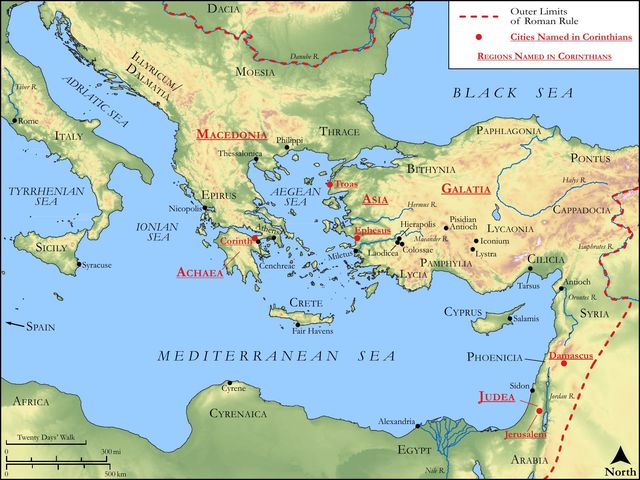
See on the biblical-era maps

Study this verse
Public-domain commentary
Matthew Henry
From his Commentary on the Whole Bible. Henry comments on passages, not single verses — this entry covers 2 Corinthians 11:22–33.
Here the apostle gives a large account of his own qualifications, labours, and sufferings (not out of pride or vain-glory, but to the honour of God, who had enabled him to do and suffer so much for the cause of Christ), and wherein he excelled the false apostles, who would lessen his character and usefulness among the Corinthians. Observe,
I.He mentions the privileges of his birth (Co2 11:22), which were equal to any they could pretend to.
He was a Hebrew of the Hebrews; of a family among the Jews that never intermarried with the Gentiles. He was also an Israelite, and could boast of his being descended from the beloved Jacob as well as they, and was also of the seed of Abraham, and not of the proselytes. It should seem from this that the false apostles were of the Jewish race, who gave disturbance to the Gentile converts.
II.He makes mention also of his apostleship, that he was more than an ordinary minister of Christ, Co2 11:23.
God had counted him faithful, and had put him into the ministry. He had been a useful minister of Christ unto them; they had found full proofs of his ministry: Are they ministers of Christ? I am more so.
III.He chiefly insists upon this, that he had been an extraordinary sufferer for Christ; and this was what he gloried in, or rather he gloried in the grace of God that had enabled him to be more abundant in labours, and to endure very great sufferings, such as stripes above measure, frequent imprisonments, and often the dangers of death, Co2 11:23. Note, When the apostle would prove himself an extraordinary minister, he proves that he had been an extraordinary sufferer. Paul was the apostle of the Gentiles, and for that reason was hated of the Jews. They did all they could against him; and among the Gentiles also he met with hard usage. Bonds and imprisonments were familiar to him; never was the most notorious malefactor more frequently in the hands of public justice than Paul was for righteousness' sake. The jail and the whipping-post, and all other hard usages of those who are accounted the worst of men, were what he was accustomed to. As to the Jews, whenever he fell into their hands, they never spared him. Five times he fell under their lash, and received forty stripes save one, Co2 11:24. Forty stripes was the utmost their law allowed (Deu 25:3), but it was usual with them, that they might not exceed, to abate one at least of that number. And to have the abatement of one only was all the favour that ever Paul received from them. The Gentiles were not tied up to that moderation, and among them he was thrice beaten with rods, of which we may suppose once was at Philippi, Act 16:22. Once he was stoned in a popular tumult, and was taken up for dead, Act 14:19. He says that thrice he suffered shipwreck; and we may believe him, though the sacred history gives a relation but of one. A night and a day he had been in the deep (Co2 11:25), in some deep dungeon or other, shut up as a prisoner. Thus he was all his days a constant confessor; perhaps scarcely a year of his life, after his conversion, passed without suffering some hardship or other for his religion; yet this was not all, for, wherever he went, he went in perils; he was exposed to perils of all sorts. If he journeyed by land, or voyaged by sea, he was in perils of robbers, or enemies of some sort; the Jews, his own countrymen, sought to kill him, or do him a mischief; the heathen, to whom he was sent, were not more kind to him, for among them he was in peril. If he was in the city, or in the wilderness, still he was in peril. He was in peril not only among avowed enemies, but among those also who called themselves brethren, but were false brethren, Co2 11:26. Besides all this, he had great weariness and painfulness in his ministerial labours, and these are things that will come into account shortly, and people will be reckoned with for all the care and pains of their ministers concerning them. Paul was a stranger to wealth and plenty, power and pleasure, preferment and ease; he was in watchings often, and exposed to hunger and thirst; in fastings often, it may be out of necessity; and endured cold and nakedness, Co2 11:27. Thus was he, who was one of the greatest blessings of the age, used as if he had been the burden of the earth, and the plague of his generation. And yet this is not all; for, as an apostle, the care of all the churches lay on him, Co2 11:28. He mentions this last, as if this lay the heaviest upon him, and as if he could better bear all the persecutions of his enemies than the scandals that were to be found in the churches he had the oversight of. Who is weak, and I am not weak? Who is offended, and I burn not? Co2 11:29. There was not a weak Christian with whom he did not sympathize, nor any one scandalized, but he was affected therewith. See what little reason we have to be in love with the pomp and plenty of this world, when this blessed apostle, one of the best of men that ever lived, excepting Jesus Christ, felt so much hardship in it. Nor was he ashamed of all this, but, on the contrary, it was what he accounted his honour; and therefore, much against the grain as it was with him to glory, yet, says he, if I must needs glory, if my adversaries will oblige me to it in my own necessary vindication, I will glory in these my infirmities, Co2 11:30. Note, Sufferings for righteousness' sake will, the most of any thing, redound to our honour.
In the last two verses, he mentions one particular part of his sufferings out of its place, as if he had forgotten it before, or because the deliverance God wrought for him was most remarkable; namely, the danger he was in at Damascus, soon after he was converted, and not settled in Christianity, at least in the ministry and apostleship. This is recorded, Act 9:24, Act 9:25. This was his first great danger and difficulty, and the rest of his life was a piece with this. And it is observable that, lest it should be thought he spoke more than was true, the apostle confirms this narrative with a solemn oath, or appeal to the omniscience of God, Co2 11:31. It is a great comfort to a good man that the God and Father of our Lord Jesus Christ, who is an omniscient God, knows the truth of all he says, and knows all he does and all he suffers for his sake.
Historical interpretation
Historical reception
2 surviving comments on this verse. Each one is dated, so this reads as a timeline rather than a list.
Select a marker to jump to its quote. Markers stagger vertically where authors wrote within a few decades of each other.
Paul is making it clear that he is the equal of the men to whom he referred above. His purpose was to show that the disparaging opinions by which they were judging him were false.
"Are they Hebrews? so am I. Are they Israelites? so am I." For it was not all Hebrews that were Israelites, since both the Ammonites and Moabites were Hebrews. Wherefore he added somewhat to clear his nobility of descent.
Continue studying 2 Corinthians 11:22 across the web’s major study libraries — every link below opens this exact verse, chapter, or book on the destination site.
Read & Compare
 BibleGatewayThis verse in more than 200 translations and 70 languages.
 Bible.comThe YouVersion reader — hundreds of translations, reading plans, and highlights.
 ESV.orgCrossway's official English Standard Version reader.
 NET BibleThe NET translation with 60,000+ translators' notes on every rendering decision.
 STEP BibleTyndale House's free study tool — original text, vocabulary, and scholarly resources.
 BibliaLogos Bible Software's free web reader.
 USCCBThe New American Bible (Revised Edition) with the U.S. bishops' study notes.
Commentaries
 BibleHub CommentariesDozens of classic commentaries on this verse, gathered on one page.
 StudyLightMore than 100 commentary sets — the largest collection on the web.
 BibleRefPlain-English commentary on what this verse means, verse by verse.
 Enduring WordDavid Guzik's free commentary on this chapter, widely used by Bible teachers.
 Bible Study ToolsVerse commentary alongside Greek and Hebrew study aids.
Original Language & Research
- BibleHub InterlinearThe verse word by word — original language, transliteration, and English.
- BibleHub LexiconEvery word's original-language definition and Strong's entry.
 Blue Letter BibleDeep-study tools — Strong's numbers, concordance, and word studies.
 CNTR CollationThe earliest Greek manuscripts of this verse, collated letter by letter.
Sermons, Hymns & Audio


TrulyRandomVerse is not affiliated with these sites and doesn’t control their content. They’re linked because they’re genuinely useful.
Summary
In 2 Corinthians 11:22, the Apostle Paul, in a moment of "foolish boasting," reluctantly asserts his impeccable Jewish heritage to counter the false apostles who challenged his legitimacy and sought to undermine the Corinthian church. By affirming his identity as a Hebrew, an Israelite, and a descendant of Abraham, Paul demonstrates that if external lineage were the measure of apostolic authority, he would far surpass his opponents, thereby exposing the superficiality of their claims and reinforcing the authenticity of his divinely appointed ministry.
Context
ShowHideLiterary Context
This verse is situated within Paul's extensive and ironic defense of his apostleship, often referred to as his "foolish boasting" or "boasting in weakness," which spans from 2 Corinthians 10 through 2 Corinthians 12. Having been accused by false apostles of being weak in person and unimpressive in speech, Paul is compelled to defend his ministry not by worldly standards but by contrasting his suffering and humility with the self-exaltation of his rivals. Specifically, 2 Corinthians 11:1-21 sets the stage for Paul's reluctant self-commendation, where he highlights his pure motives and contrasts his self-sacrifice with the deceitful practices of the "super-apostles." Verse 22 begins a direct comparison of his credentials with theirs, leading into a detailed list of his sufferings for Christ in 2 Corinthians 11:23-33.
Historical & Cultural Context
The Corinthian church was plagued by external agitators, likely Jewish Christians, who had infiltrated the community and were challenging Paul's authority. These "false apostles" or "super-apostles" (as Paul sarcastically calls them in 2 Corinthians 11:5) probably boasted of their Jewish lineage, rhetorical prowess, and perhaps even ecstatic spiritual experiences, presenting themselves as superior to Paul. Among the Greeks, and particularly within Jewish communities, lineage and rhetorical skill were highly valued. Being a "Hebrew," an "Israelite," or "seed of Abraham" carried immense prestige, signifying purity of Jewish descent, adherence to traditional customs, and status as a member of God's chosen covenant people. Paul's opponents likely used these very claims to diminish his standing, perhaps suggesting he was less authentically Jewish or less connected to the foundational promises of God.
Key Themes
ShowHideThis verse contributes significantly to several major themes within 2 Corinthians. First, it underscores the theme of Apostolic Authority and Legitimacy, as Paul is forced to defend his divine calling against those who questioned it based on superficial criteria. Second, it highlights True vs. False Boasting, contrasting the worldly, self-exalting boasting of the false apostles with Paul's "foolish" yet divinely ordained boasting in his weakness and suffering for Christ, as seen in 2 Corinthians 12:9-10. Third, the verse touches upon Jewish Identity and Christian Faith, demonstrating Paul's deep roots in Judaism while simultaneously foreshadowing his later theological arguments that true spiritual lineage is ultimately defined by faith in Christ, not merely physical descent (e.g., Romans 9:6-8).
Exposition and Analysis
ShowHideKey Word Analysis
ShowHideThis term (G1445) primarily referred to Jews who spoke Aramaic or Hebrew and maintained traditional Jewish customs, distinguishing them from Hellenistic (Greek-speaking) Jews who might have adopted more Greek cultural practices. By identifying as a "Hebrew," Paul emphasizes his adherence to the most ancient and pure form of Jewish heritage, including language and tradition, countering any insinuation that he was less authentically Jewish than his opponents.
This term (G2475) is a more formal and theological designation, emphasizing one's identity as a descendant of Jacob (whose name was changed to Israel) and thus a member of God's chosen covenant people. It highlights the spiritual and national identity of the Jewish people as heirs of the divine promises given to Abraham, Isaac, and Jacob. Paul's claim to be an "Israelite" asserts his full participation in the covenant community.
The word "seed" (G4690) here refers to offspring or physical descent. To be the "seed of Abraham" (G11) was the ultimate claim to Jewish lineage, signifying direct physical descent from the patriarch with whom God made the foundational covenant. This was paramount for establishing one's right to the covenant blessings and inheritance within Judaism. Paul's assertion underscores his undeniable physical connection to the father of the Jewish nation.
Verse Breakdown
ShowHide"Are they Hebrews? so am I."
Paul initiates a rhetorical question, directly addressing the claims of his opponents. The implication is that if their authority or prestige derives from being "Hebrews"—meaning those who adhere strictly to traditional Jewish language and customs—then Paul meets and even surpasses that qualification. His immediate affirmation, "so am I," serves as a direct, unequivocal counter-claim, establishing his own impeccable credentials on this front.
"Are they Israelites? so am I."
Building on the previous point, Paul moves to a more profound theological designation. "Israelites" refers to their identity as God's chosen people, the descendants of Jacob (Israel), heirs to the covenant promises. If the false apostles boast in their status as members of this elect nation, Paul asserts his equal standing. This reinforces his connection not just to Jewish culture, but to the very spiritual lineage and divine election of God's covenant people.
"Are they the seed of Abraham? so am I."
This final question addresses the most fundamental claim to Jewish identity: direct physical descent from Abraham, the patriarch of faith. This lineage was considered essential for inheriting the promises given to Abraham. By declaring himself "the seed of Abraham," Paul lays claim to the most foundational aspect of Jewish identity, demonstrating that in every conceivable aspect of Jewish heritage, he is fully qualified and, by implication, superior to those who would challenge him based on such external criteria.
Literary Devices
ShowHideThe primary literary device employed in this verse is Rhetorical Question, where Paul poses questions not to elicit information but to make a forceful assertion. Each question is immediately followed by a definitive, emphatic answer ("so am I"), creating a powerful sense of Parallelism and Repetition. This structured repetition underscores Paul's unwavering confidence in his Jewish heritage and serves to systematically dismantle the implied claims of his opponents. The overall tone is one of Irony, as Paul reluctantly engages in this "boasting" (which he elsewhere condemns) purely to expose the superficiality of the false apostles' claims and to highlight the true basis of apostolic authority, which lies in suffering and faithfulness, not human credentials.
Theological and Thematic Connections
ShowHidePaul's assertion of his Jewish heritage in 2 Corinthians 11:22 serves a strategic purpose: to expose the superficiality of the false apostles' claims and to demonstrate that if lineage were the measure, he would far exceed them. However, Paul's ultimate theological point, made clear in other epistles, is that true spiritual identity and the inheritance of God's promises are not based on physical descent but on faith in Christ. While Paul cherishes his heritage, he consistently redefines what it means to be a true "seed of Abraham" or a genuine "Israelite" through the lens of the New Covenant. His willingness to "boast" in these external markers is a concession to his opponents' worldly standards, a temporary lowering of himself to their level to then elevate the true standard of Christ-like suffering and service.
Reflection and Application
ShowHidePaul's reluctant boasting in 2 Corinthians 11:22 offers a profound lesson for believers today. In a world that often values external credentials, impressive resumes, and self-promotion, Paul reminds us that true spiritual authority and effectiveness in ministry are not rooted in human achievements or lineage, but in humble, sacrificial service to Christ. His willingness to "become all things to all people" (1 Corinthians 9:22) even to the point of "foolish boasting" for the sake of the Gospel, challenges us to discern true leadership not by outward show but by character, faithfulness to the message of Christ, and a willingness to suffer for the sake of others. We are called to guard against any form of spiritual pride or reliance on our own qualifications, remembering that our ultimate identity and worth are found solely in Christ.
Questions for Reflection
ShowHideFAQ
ShowHideWhy did Paul feel the need to list his Jewish credentials, given his emphasis on faith over works?
ShowHidePaul's listing of his Jewish credentials in 2 Corinthians 11:22 was not because he genuinely valued these things as the basis for salvation or apostolic authority. Rather, it was a strategic and ironic move, which he himself called "foolish boasting" in 2 Corinthians 11:1. He was responding directly to false apostles in Corinth who were likely boasting about their own Jewish lineage, rhetorical skills, and perhaps even spiritual experiences to undermine Paul's ministry and mislead the church. By demonstrating that he possessed even more impeccable Jewish credentials than they did, Paul exposed the superficiality of their claims. His true point, however, was that genuine apostolic authority and the mark of a true servant of Christ are found not in external qualifications, but in suffering for the Gospel, humility, and faithfulness, as he elaborates in the subsequent verses describing his hardships (e.g., 2 Corinthians 11:23-28). He used their own worldly criteria to show he surpassed them, then immediately pivoted to the true, spiritual criteria.
Christ-Centered Fulfillment
ShowHideWhile 2 Corinthians 11:22 highlights Paul's impeccable physical lineage, its Christ-centered fulfillment lies in the New Testament's redefinition of what it means to be the "seed of Abraham" and a true "Israelite." Paul himself, in other epistles, powerfully articulates that the ultimate "seed of Abraham" is Christ Himself (e.g., Galatians 3:16), and that all who are "in Christ" become spiritual descendants of Abraham by faith, regardless of their physical heritage (e.g., Galatians 3:29). Furthermore, the concept of "Israelite" is transformed from a purely ethnic designation to a spiritual one, where "not all who are descended from Israel are Israel" (Romans 9:6), but rather, "he is a Jew who is one inwardly" (Romans 2:29). Thus, Paul's boasting in his physical lineage, though strategically necessary in the Corinthian context, ultimately points beyond itself to the profound truth that in Christ, all believers are grafted into the covenant promises, becoming part of the "Israel of God" (Galatians 6:16), and heirs according to the promise through faith in the ultimate "seed," Jesus Christ, who perfectly embodies and fulfills all the promises made to Abraham and Israel.