


2 Corinthians 11:23
Bible text: King James Version (1769 Blayney text) · Public domain
Bible text: King James Version with Strong's numbers · Public domain
Bible text: Berean Standard Bible · Public domain
Bible text: American Standard Version (1901) · Public domain
Bible text: World English Bible, Messianic edition · Public domain
Bible text: Geneva Bible (1599) · Public domain
Bible text: Young's Literal Translation · Public domain
- διάκονοιdiakonoiServantsG1249N-NPMNoun Nominative Plural Masculine
- ΧριστοῦChristouof ChristG5547N-GSM-TNoun Genitive Singular Masculine Title
- εἰσιν;eisinare they?G1510V-PAI-3PVerb Present Active Indicative 3rd Plural
- παραφρονῶνparaphronōnAs being beside myselfG3912V-PAP-NSMVerb Present Active Participle Nominative Singular Masculine
- λαλῶ·lalōI speakG2980V-PAI-1SVerb Present Active Indicative 1st Singular
- ὑπὲρhuperabove [measure]G5228PREPPreposition
- ἐγώegōI myself[am]G1473P-1NSPersonal pronoun Nominative 1st Singular
- ἐνeninG1722PREPPreposition
- κόποιςkopoislaborsG2873N-DPMNoun Dative Plural Masculine
- περισσοτέρωςperissoterōsmore abundantlyG4056ADV-CAdverb Comparative
- ἐνeninG1722PREPPreposition
- φυλακαῖςphulakaisimprisonmentsG5438N-DPFNoun Dative Plural Feminine
- περισσοτέρωςperissoterōsmore abundantlyG4056ADV-CAdverb Comparative
- ἐνeninG1722PREPPreposition
- πληγαῖςplēgaisbeatingsG4127N-DPFNoun Dative Plural Feminine
- ὑπερβαλλόντωςhuperballontōsabove measureG5234ADVAdverb
- ἐνeninG1722PREPPreposition
- θανάτοιςthanatoisdeathsG2288N-DPMNoun Dative Plural Masculine
- πολλάκιςpollakisoftenG4178ADVAdverb
English is a literal word-by-word gloss of the Greek, not the KJV's wording. Why?
This is the original text the KJV's translators worked from — each Greek word with its own literal English meaning in this verse, prepared by scholars at Tyndale House, Cambridge. The KJV translates whole sentences, not word by word, so its wording differs: one Greek word can become several English words, and the KJV may choose “charity” where the gloss reads “love”. Both are faithful — they answer different questions. For the KJV's own rendering, switch to the KJV text.
Details
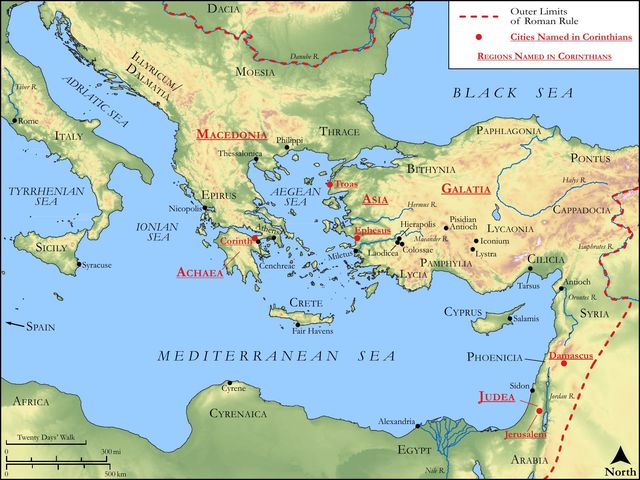
See on the biblical-era maps

Study this verse
Public-domain commentary
Matthew Henry
From his Commentary on the Whole Bible. Henry comments on passages, not single verses — this entry covers 2 Corinthians 11:22–33.
Here the apostle gives a large account of his own qualifications, labours, and sufferings (not out of pride or vain-glory, but to the honour of God, who had enabled him to do and suffer so much for the cause of Christ), and wherein he excelled the false apostles, who would lessen his character and usefulness among the Corinthians. Observe,
I.He mentions the privileges of his birth (Co2 11:22), which were equal to any they could pretend to.
He was a Hebrew of the Hebrews; of a family among the Jews that never intermarried with the Gentiles. He was also an Israelite, and could boast of his being descended from the beloved Jacob as well as they, and was also of the seed of Abraham, and not of the proselytes. It should seem from this that the false apostles were of the Jewish race, who gave disturbance to the Gentile converts.
II.He makes mention also of his apostleship, that he was more than an ordinary minister of Christ, Co2 11:23.
God had counted him faithful, and had put him into the ministry. He had been a useful minister of Christ unto them; they had found full proofs of his ministry: Are they ministers of Christ? I am more so.
III.He chiefly insists upon this, that he had been an extraordinary sufferer for Christ; and this was what he gloried in, or rather he gloried in the grace of God that had enabled him to be more abundant in labours, and to endure very great sufferings, such as stripes above measure, frequent imprisonments, and often the dangers of death, Co2 11:23. Note, When the apostle would prove himself an extraordinary minister, he proves that he had been an extraordinary sufferer. Paul was the apostle of the Gentiles, and for that reason was hated of the Jews. They did all they could against him; and among the Gentiles also he met with hard usage. Bonds and imprisonments were familiar to him; never was the most notorious malefactor more frequently in the hands of public justice than Paul was for righteousness' sake. The jail and the whipping-post, and all other hard usages of those who are accounted the worst of men, were what he was accustomed to. As to the Jews, whenever he fell into their hands, they never spared him. Five times he fell under their lash, and received forty stripes save one, Co2 11:24. Forty stripes was the utmost their law allowed (Deu 25:3), but it was usual with them, that they might not exceed, to abate one at least of that number. And to have the abatement of one only was all the favour that ever Paul received from them. The Gentiles were not tied up to that moderation, and among them he was thrice beaten with rods, of which we may suppose once was at Philippi, Act 16:22. Once he was stoned in a popular tumult, and was taken up for dead, Act 14:19. He says that thrice he suffered shipwreck; and we may believe him, though the sacred history gives a relation but of one. A night and a day he had been in the deep (Co2 11:25), in some deep dungeon or other, shut up as a prisoner. Thus he was all his days a constant confessor; perhaps scarcely a year of his life, after his conversion, passed without suffering some hardship or other for his religion; yet this was not all, for, wherever he went, he went in perils; he was exposed to perils of all sorts. If he journeyed by land, or voyaged by sea, he was in perils of robbers, or enemies of some sort; the Jews, his own countrymen, sought to kill him, or do him a mischief; the heathen, to whom he was sent, were not more kind to him, for among them he was in peril. If he was in the city, or in the wilderness, still he was in peril. He was in peril not only among avowed enemies, but among those also who called themselves brethren, but were false brethren, Co2 11:26. Besides all this, he had great weariness and painfulness in his ministerial labours, and these are things that will come into account shortly, and people will be reckoned with for all the care and pains of their ministers concerning them. Paul was a stranger to wealth and plenty, power and pleasure, preferment and ease; he was in watchings often, and exposed to hunger and thirst; in fastings often, it may be out of necessity; and endured cold and nakedness, Co2 11:27. Thus was he, who was one of the greatest blessings of the age, used as if he had been the burden of the earth, and the plague of his generation. And yet this is not all; for, as an apostle, the care of all the churches lay on him, Co2 11:28. He mentions this last, as if this lay the heaviest upon him, and as if he could better bear all the persecutions of his enemies than the scandals that were to be found in the churches he had the oversight of. Who is weak, and I am not weak? Who is offended, and I burn not? Co2 11:29. There was not a weak Christian with whom he did not sympathize, nor any one scandalized, but he was affected therewith. See what little reason we have to be in love with the pomp and plenty of this world, when this blessed apostle, one of the best of men that ever lived, excepting Jesus Christ, felt so much hardship in it. Nor was he ashamed of all this, but, on the contrary, it was what he accounted his honour; and therefore, much against the grain as it was with him to glory, yet, says he, if I must needs glory, if my adversaries will oblige me to it in my own necessary vindication, I will glory in these my infirmities, Co2 11:30. Note, Sufferings for righteousness' sake will, the most of any thing, redound to our honour.
In the last two verses, he mentions one particular part of his sufferings out of its place, as if he had forgotten it before, or because the deliverance God wrought for him was most remarkable; namely, the danger he was in at Damascus, soon after he was converted, and not settled in Christianity, at least in the ministry and apostleship. This is recorded, Act 9:24, Act 9:25. This was his first great danger and difficulty, and the rest of his life was a piece with this. And it is observable that, lest it should be thought he spoke more than was true, the apostle confirms this narrative with a solemn oath, or appeal to the omniscience of God, Co2 11:31. It is a great comfort to a good man that the God and Father of our Lord Jesus Christ, who is an omniscient God, knows the truth of all he says, and knows all he does and all he suffers for his sake.
Historical interpretation
Two Centuries of Reception
5 surviving comments on this verse. Each one is dated, so this reads as a timeline rather than a list.
Select a marker to jump to its quote. Markers stagger vertically where authors wrote within a few decades of each other.
Wherefore also Paul rejoices for Christ's sake that he was "in labours, more abundantly, in stripes above measure, in deaths oft."
Of the Jews five times received I forty stripes, save one; thrice was I beaten with rods; once was I stoned," and the rest.
The other apostles labored, but not as much as Paul. He used to earn his living with his own hands, from early morning until about eleven o’clock, and from then until four in the afternoon he would engage in public disputation with such energy that he would usually persuade those who spoke in opposition to him.
"Are they the seed of Abraham? so am I. Are they ministers of Christ. (I speak as one beside himself,) I more." He is not content with his former deprecation, but uses it again here also. "I speak as one beside himself, I more." I am their superior and their better. And indeed he possessed clear proofs of his superiority, but nevertheless even so he terms the thing a folly. And yet if they were false Apostles, he heeded not to have introduced his own superiority by way of comparison, but to have destroyed their claim to "be ministers" at all. Well, he did destroy it, saying, "False Apostles, deceitful workers, fashioning themselves into Apostles of Christ," but now he doth not proceed in that way, for his discourse was about to proceed to strict examination; and no one when an examination is in hand simply asserts; but having first stated the case in the way of comparison, he shows it to be negatived by the facts, a very strong negative. But besides, it is their opinion he gives, not his own assertion, when he says, "Are they ministers of Christ?" And having said, "I more," he proceeds in his comparison, and shows that not by bare assertions, but by furnishing the proof that facts supply, he maintains the impress of the Apostleship. And leaving all his miracles, he begins with his trials; thus saying, "In labors more abundantly, in stripes above measure." This latter is greater than the former; to be both beaten and scourged. "In prisons more abundantly." Here too again is there an increase. "In deaths oft." For, "I die," saith he, "daily." But here, even in reality; 'for I have oft been delivered into mortal dangers.'
No one else has been granted such a love of the Lord as this blessed spirit. I mean, as though freed from the body and raised on high, so to say, and not considering himself to tread the earth, he delivers himself of all these remarks. You see, desire for God and burning love elevated his thinking from material things to spiritual, from present to future, from visible to unseen. This is what faith is like, after all, and love of God. For proof of his sound attitude, see this man, with his great love for the Lord and his burning desire for him hunted, persecuted, chastised, suffering countless abuses and exclaiming, “In toils more frequently, in scourgings beyond counting, at death’s door often; at the Jews’ hands I five times received forty lashes bar one; I was thrice beaten with rods; once I was stoned; a day and night I spent adrift at sea, always traveling, at peril from rivers, at peril from false brothers, in toil and hardship”—and while suffering such things he rejoiced and was glad. You see, he was quite convinced that the labors of the present life proved an occasion of great reward for him, and dangers were the source of a crown. After all, if out of love for Rachel Jacob regarded as a few days the period of seven years, much more did this blessed man count it all of no consequence, on fire as he was with love of God and prepared to endure everything for the Christ he loved. Let us too, therefore, I beseech you, be concerned to love Christ. Christ looks for nothing else from you, in fact, Scripture says, than loving him with all your heart and carrying out his commands.
Continue studying 2 Corinthians 11:23 across the web’s major study libraries — every link below opens this exact verse, chapter, or book on the destination site.
Read & Compare
 BibleGatewayThis verse in more than 200 translations and 70 languages.
 Bible.comThe YouVersion reader — hundreds of translations, reading plans, and highlights.
 ESV.orgCrossway's official English Standard Version reader.
 NET BibleThe NET translation with 60,000+ translators' notes on every rendering decision.
 STEP BibleTyndale House's free study tool — original text, vocabulary, and scholarly resources.
 BibliaLogos Bible Software's free web reader.
 USCCBThe New American Bible (Revised Edition) with the U.S. bishops' study notes.
Commentaries
 BibleHub CommentariesDozens of classic commentaries on this verse, gathered on one page.
 StudyLightMore than 100 commentary sets — the largest collection on the web.
 BibleRefPlain-English commentary on what this verse means, verse by verse.
 Enduring WordDavid Guzik's free commentary on this chapter, widely used by Bible teachers.
 Bible Study ToolsVerse commentary alongside Greek and Hebrew study aids.
Original Language & Research
- BibleHub InterlinearThe verse word by word — original language, transliteration, and English.
- BibleHub LexiconEvery word's original-language definition and Strong's entry.
 Blue Letter BibleDeep-study tools — Strong's numbers, concordance, and word studies.
 CNTR CollationThe earliest Greek manuscripts of this verse, collated letter by letter.
Sermons, Hymns & Audio


TrulyRandomVerse is not affiliated with these sites and doesn’t control their content. They’re linked because they’re genuinely useful.
Summary
In 2 Corinthians 11:23, the Apostle Paul, in a moment of profound irony he terms "speaking as a fool," defends his legitimate apostolic ministry against the false apostles in Corinth. He asserts his superior claim to being a "minister of Christ" not through worldly status or eloquent speech, but by recounting an overwhelming litany of intense sufferings, exhausting labors, severe beatings, frequent imprisonments, and numerous brushes with death, thereby demonstrating that true service to Christ is often marked by immense personal cost and sacrificial endurance.
Context
ShowHideLiterary Context
2 Corinthians 11:23 is situated within Paul's highly charged "fool's speech," which begins in 2 Corinthians 11:16 and extends through 2 Corinthians 12:10. Paul is reluctantly forced to "boast" in his own credentials and experiences, a rhetorical strategy he adopts to counter the self-aggrandizing claims of the "super-apostles" who have infiltrated the Corinthian church. These false teachers likely boasted in their eloquence, Jewish heritage, or worldly success, undermining Paul's authority. By ironically adopting their boasting posture, Paul subverts their values, demonstrating that his true credentials lie not in worldly advantages but in the profound suffering and self-sacrifice he has endured for the Gospel. The rhetorical question, "Are they ministers of Christ?", sets up his audacious claim to be "more," immediately followed by the detailed evidence of his unparalleled hardships.
Historical & Cultural Context
The Corinthian church was a vibrant but problematic community, grappling with internal divisions, moral laxity, and susceptibility to external influences. False apostles, possibly Jewish Christian itinerants, had arrived in Corinth, challenging Paul's authority and integrity. They likely presented themselves as superior, perhaps charging fees for their ministry, boasting of their rhetorical skills, or emphasizing their Jewish lineage. Paul, by contrast, had ministered without charge (2 Corinthians 11:7-9) and often appeared outwardly unimpressive (2 Corinthians 10:10). Among the Greeks and Romans, suffering and weakness were generally viewed as shameful, while power, eloquence, and success were highly esteemed. Paul's "boast" in his sufferings was therefore counter-cultural, challenging the prevailing notions of strength and authority, and forcing the Corinthians to reconsider what truly signifies a legitimate minister of Christ.
Key Themes
ShowHideThis verse powerfully contributes to several overarching themes in 2 Corinthians. Firstly, it highlights the Authentic Ministry vs. Counterfeit Claims, exposing the superficiality of the false apostles by demonstrating that true ministerial authority is evidenced through sacrificial service and suffering, not by outward show or worldly gain. Paul's list of trials serves as a stark contrast to their easy prosperity, echoing his earlier defense in 2 Corinthians 4:7-12. Secondly, the verse vividly details the immense personal cost Paul paid for his commitment to the Gospel, underscoring the theme of Suffering for Christ. The "labours," "stripes," "prisons," and "deaths" paint a picture of relentless persecution and near-death experiences, a theme further elaborated in 2 Corinthians 11:24-27. Finally, and perhaps most profoundly, Paul's "boasting" in his weakness ironically reveals the divine power at work through his human frailty, reinforcing the Paradox of Strength in Weakness. This aligns with his overarching theological principle that God's strength is perfected in human weakness, famously articulated in 2 Corinthians 12:9-10.
Exposition and Analysis
ShowHideKey Word Analysis
ShowHideFrom an obsolete verb meaning "to run on errands," this term refers to an attendant or waiter, often implying menial duties. In a Christian context, it denotes a servant, a Christian teacher, or pastor. Paul uses it here to refer to those who serve Christ, contrasting his deep, sacrificial service with the superficial claims of his opponents. His argument is that true ministry is characterized by humble, diligent service, even to the point of suffering.
Literally meaning "to misthink" or "to be insane/silly," this word highlights Paul's ironic stance. He acknowledges that boasting, especially in one's sufferings, would be perceived as foolish by worldly standards. However, by embracing this "folly," he exposes the true foolishness of those who evaluate ministry based on worldly success and self-promotion, thereby elevating a divine standard of humble, suffering service.
This primary preposition means "over," "beyond," or "more than." Here, it functions comparatively, asserting Paul's superior claim to being a "minister of Christ." It's not a boast of personal superiority in a worldly sense, but a claim to having endured "more" for the sake of Christ and the Gospel, thus validating his authentic apostleship in a way his rivals cannot.
Verse Breakdown
ShowHide"Are they ministers of Christ?"
This is a direct rhetorical question, challenging the legitimacy of the false apostles' claims to be servants of Christ. Paul implies that their outward appearance and self-promotion do not align with the true nature of Christ's service.
"(I speak as a fool)"
Paul inserts this parenthetical remark to acknowledge the highly unconventional and ironic nature of his subsequent boasting. He knows that boasting is generally inappropriate, especially for a Christian leader, but he deems it necessary in this specific context to counter the deceptive boasting of his opponents. This phrase sets the tone for his "fool's speech."
"I [am] more;"
This is Paul's audacious and direct claim. He asserts that he is a "minister of Christ" to a greater degree than his opponents. This "more" is not based on worldly status or eloquence, but on the depth and extent of his sacrificial service and suffering for the Gospel.
"in labours more abundant,"
Paul begins to list the evidence for his "more." "Labours" (κόπος, kópos) refers to exhausting toil, strenuous effort, and the weariness that results from it. "More abundant" (περισσοτέρως, perissotérōs) emphasizes the excessive and overwhelming nature of his work for Christ, far exceeding that of others.
"in stripes above measure,"
"Stripes" (πληγή, plēgḗ) refers to severe blows or wounds, typically from beatings. "Above measure" (ὑπερβαλλόντως, hyperballóntōs) intensifies this, indicating an excessive, extraordinary, and perhaps even uncountable number of beatings, highlighting the extreme physical abuse he endured.
"in prisons more frequent,"
This refers to his numerous incarcerations for the sake of the Gospel. "More frequent" (περισσοτέρως, perissotérōs) again underscores the high number of times he was imprisoned, demonstrating a consistent pattern of persecution and restriction of his freedom.
"in deaths oft."
This powerful phrase indicates that Paul faced life-threatening situations repeatedly. "Deaths" (θάνατος, thánatos) here signifies not literal deaths and resurrections, but frequent, imminent encounters with death, where he was at the brink of losing his life. "Oft" (πολλάκις, pollákis) emphasizes the sheer frequency of these perilous situations.
Literary Devices
ShowHidePaul employs several powerful literary devices in 2 Corinthians 11:23 to convey his message. The passage opens with a Rhetorical Question, "Are they ministers of Christ?", which is not meant to be answered directly but to provoke thought and highlight the contrast between the false apostles and himself. Paul then immediately introduces profound Irony with the parenthetical "I speak as a fool." By labeling his own necessary boasting as "folly," he simultaneously disarms potential criticism and critiques the worldly standards by which the Corinthians (and the false apostles) are evaluating ministry. The subsequent list of sufferings utilizes Hyperbole and Intensification through phrases like "more abundant," "above measure," "more frequent," and "oft," emphasizing the extreme and unparalleled nature of his trials. While these are not literal exaggerations, they convey the overwhelming reality of his experiences. Furthermore, the repetitive structure of "in labours... in stripes... in prisons... in deaths..." demonstrates Anaphora and Parallelism, creating a rhythmic, emphatic catalog that underscores the relentless and varied nature of his suffering. This detailed enumeration also serves as a stark Juxtaposition to the implied ease and self-promotion of the false apostles, highlighting the true cost of authentic ministry.
Theological and Thematic Connections
ShowHidePaul's "boast" in his sufferings in 2 Corinthians 11:23 serves as a profound theological statement on the nature of authentic Christian ministry. It challenges the worldly paradigm that equates success with comfort, prosperity, or outward acclaim, asserting instead that genuine service to Christ often entails significant personal cost, sacrifice, and even suffering. This suffering is not a sign of God's disfavor, but rather a mark of identification with Christ and a testament to the power of the Gospel at work through human weakness. Paul's endurance through these trials validates his apostleship far more than any superficial boast, demonstrating that God's strength is made perfect in weakness, and that faithfulness is proven in adversity.
Reflection and Application
ShowHide2 Corinthians 11:23 offers a challenging and deeply convicting mirror for contemporary believers and leaders. In an age that often prioritizes comfort, convenience, and outward success, Paul's example reminds us that true faithfulness to Christ may demand significant personal sacrifice and endurance of hardship. It compels us to re-evaluate our definitions of "successful" ministry, shifting our focus from worldly metrics to the profound, often hidden, costs of discipleship. Paul's willingness to suffer "more" for Christ reveals a heart fully devoted to the Gospel, prioritizing the spread of God's kingdom over personal ease or reputation. This verse encourages us to embrace the paradox that God's power is most evident not in our strength or accomplishments, but in our weaknesses and willingness to suffer for His name. It calls us to a deeper commitment, understanding that our trials can become powerful testimonies to God's sustaining grace and the transformative power of the cross.
Questions for Reflection
ShowHideFAQ
ShowHideWhy does Paul call himself a "fool" when boasting about his sufferings?
ShowHidePaul's use of "I speak as a fool" (and similar phrases throughout 2 Corinthians 11) is a masterful rhetorical device known as irony. He is not genuinely admitting to being foolish, but rather adopting the posture of a "fool" by worldly standards. Among the Greeks and Romans, boasting was generally considered undignified, especially boasting about one's weaknesses or sufferings. Paul uses this ironic self-designation to highlight the absurdity of the false apostles' self-promotion and to expose the superficiality of the Corinthian church's judgment, which was swayed by outward appearances rather than true spiritual depth. By "boasting" in his sufferings, Paul subverts conventional wisdom, demonstrating that true apostolic authority and genuine ministry are validated not by worldly success or eloquence, but by sacrificial endurance for Christ, which the world might deem "foolish."
What does Paul mean by "deaths oft"? Did he literally die multiple times?
ShowHideWhen Paul states he faced "deaths oft," he does not mean he literally died and was resurrected on numerous occasions. Instead, the phrase signifies that he frequently encountered situations where his life was in extreme peril, where he was at the very brink of death. These were life-threatening experiences that could have easily resulted in his demise, such as severe beatings, shipwrecks, stoning, and various perils from enemies and nature, as he elaborates in the subsequent verses (2 Corinthians 11:24-27). This expression powerfully conveys the constant danger and immense physical toll his missionary work took on him, underscoring the depth of his commitment and the divine protection he experienced.
How does Paul's "boast" in suffering relate to Christian leadership today?
ShowHidePaul's "boast" in suffering provides a crucial counter-narrative to many modern conceptions of leadership, both secular and Christian. It challenges the idea that effective leadership is solely defined by charisma, popularity, or outward success. Instead, Paul demonstrates that authentic Christian leadership is often marked by self-sacrifice, endurance through hardship, and a willingness to suffer for the sake of the Gospel and the flock. It reminds us that true authority in the Kingdom of God is often found in humility and service, mirroring Christ's own path of suffering. For leaders today, it means embracing the potential for difficulty, rejection, and personal cost in ministry, trusting that God's power is perfected in their weaknesses (2 Corinthians 12:9). It calls for a re-evaluation of what truly validates a leader: not worldly acclaim, but faithful perseverance in the face of adversity for Christ's sake.
Christ-Centered Fulfillment
ShowHidePaul's "boast" in his sufferings in 2 Corinthians 11:23 finds its ultimate meaning and power in Christ-centered fulfillment. Paul's "more" in labors, stripes, prisons, and deaths is a profound echo of the "more" that Christ Himself endured. Jesus, the ultimate "minister of Christ," bore the ultimate "labour" in His earthly ministry and the agony of Gethsemane (Luke 22:44). He received "stripes above measure" in His scourging (Matthew 27:26) and was "imprisoned" by the Sanhedrin and Pilate (Matthew 27:1-2). Most significantly, Christ faced "deaths oft" in the spiritual sense, bearing the full weight of humanity's sin and experiencing the ultimate separation from God on the cross, a death that was truly "above measure" in its redemptive power (Isaiah 53:5). Paul's willingness to suffer and face death repeatedly is a direct participation in the sufferings of Christ (Philippians 3:10), demonstrating that the life of a true minister of Christ is one that continually crucifies the self and takes up the cross daily (Luke 9:23). Thus, Paul's trials are not merely personal hardships but a living testimony to the power of Christ's resurrection working through him, transforming weakness into a conduit for divine strength and making his life a tangible expression of the crucified and risen Lord.