


2 Corinthians 12:9
Bible text: King James Version (1769 Blayney text) · Public domain
Bible text: King James Version with Strong's numbers · Public domain
Bible text: Berean Standard Bible · Public domain
Bible text: American Standard Version (1901) · Public domain
Bible text: World English Bible, Messianic edition · Public domain
Bible text: Geneva Bible (1599) · Public domain
Bible text: Young's Literal Translation · Public domain
- καὶkaiAndG2532CONJConjunction
- εἴρηκένeirēkenHe has saidG2046V-RAI-3SVerb Perfect Active Indicative 3rd Singular
- μοι·moito meG3165P-1DSPersonal pronoun Dative 1st Singular
- ἀρκεῖarkeiSufficesG714V-PAI-3SVerb Present Active Indicative 3rd Singular
- σοιsoiyouG4771P-2DSPersonal pronoun Dative 2nd Singular
- ἡhētheG3588T-NSFDefinite article Nominative Singular Feminine
- χάριςcharisgraceG5485N-NSFNoun Nominative Singular Feminine
- μου·mouof MineG3165P-1GSPersonal pronoun Genitive 1st Singular
- ἡhētheG3588T-NSFDefinite article Nominative Singular Feminine
- γὰρgarforG1063CONJConjunction
- δύναμιςdunamispowerG1411N-NSFNoun Nominative Singular Feminine
- μουmouof mineG3165P-1GSPersonal pronoun Genitive 1st Singular
- ἐνeninG1722PREPPreposition
- ἀσθενείᾳastheneiaweaknessG769N-DSFNoun Dative Singular Feminine
- τελεῖταιteleitaiis finishedG5055V-PPI-3SVerb Present Passive Indicative 3rd Singular
- ἥδισταhēdistaMost gladlyG2236A-APNAdjective Accusative Plural Neuter
- οὖνounthereforeG3767CONJConjunction
- μᾶλλονmallonratherG3123ADVAdverb
- καυχήσομαιkauchēsomaiwill I boastG2744V-FDI-1SVerb Future Middle Deponent Indicative 1st Singular
- ἐνeninG1722PREPPreposition
- ταῖςtaistheG3588T-DPFDefinite article Dative Plural Feminine
- ἀσθενείαιςastheneiaisweaknessesG769N-DPFNoun Dative Plural Feminine
- μουmouof mineG3165P-1GSPersonal pronoun Genitive 1st Singular
- ἵναinaso thatG2443CONJConjunction
- ἐπισκηνώσῃepiskēnōsēmay restG1981V-AAS-3SVerb Aorist Active Subjunctive 3rd Singular
- ἐπ᾽ep᾽uponG1909PREPPreposition
- ἐμὲememe myselfG1473P-1ASPersonal pronoun Accusative 1st Singular
- ἡhētheG3588T-NSFDefinite article Nominative Singular Feminine
- δύναμιςdunamispowerG1411N-NSFNoun Nominative Singular Feminine
- τοῦtou<the>G3588T-GSMDefinite article Genitive Singular Masculine
- ΧριστοῦChristouof ChristG5547N-GSM-TNoun Genitive Singular Masculine Title
English is a literal word-by-word gloss of the Greek, not the KJV's wording. Why?
This is the original text the KJV's translators worked from — each Greek word with its own literal English meaning in this verse, prepared by scholars at Tyndale House, Cambridge. The KJV translates whole sentences, not word by word, so its wording differs: one Greek word can become several English words, and the KJV may choose “charity” where the gloss reads “love”. Both are faithful — they answer different questions. For the KJV's own rendering, switch to the KJV text.
Details
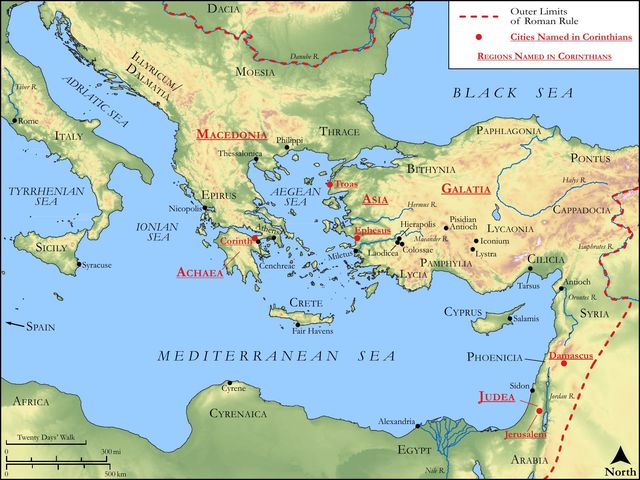
See on the biblical-era maps

Study this verse
Public-domain commentary
Matthew Henry
From his Commentary on the Whole Bible. Henry comments on passages, not single verses — this entry covers 2 Corinthians 12:1–10. His three-level outline is real structure in the source text, so it is rendered as structure.
Here we may observe,
I.The narrative the apostle gives of the favours God had shown him, and the honour he had done him; for doubtless he himself is the man in Christ of whom he speaks. Concerning this we may take notice,
1.Of the honour itself which was done to the apostle: he was caught up into the third heaven, Co2 12:2. When this was we cannot say, whether it was during those three days that he lay without sight at his conversion or at some other time afterwards, much less can we pretend to say how this was, whether by a separation of his soul from his body or by an extraordinary transport in the depth of contemplation. It would be presumption for us to determine, if not also to enquire into, this matter, seeing the apostle himself says, Whether in the body or out of the body, I cannot tell. It was certainly a very extraordinary honour done him: in some sense he was caught up into the third heaven, the heaven of the blessed, above the aerial heaven, in which the fowls fly, above the starry heaven, which is adorned with those glorious orbs: it was into the third heaven, where God most eminently manifests his glory. We are not capable of knowing all, nor is it fit we should know very much, of the particulars of that glorious place and state; it is our duty and interest to give diligence to make sure to ourselves a mansion there; and, if that be cleared up to us, then we should long to be removed thither, to abide there for ever. This third heaven is called paradise (Co2 12:4), in allusion to the earthly paradise out of which Adam was driven for his transgression; it is called the paradise of God (Rev 2:7), signifying to us that by Christ we are restored to all the joys and honours we lost by sin, yea, to much better. The apostle does not mention what he saw in the third heaven or paradise, but tells us that he heard unspeakable words, such as it is not possible for a man to utter - such are the sublimity of the matter and our unacquaintedness with the language of the upper world: nor was it lawful to utter those words, because, while we are here in this world, we have a more sure word of prophecy than such visions and revelations. Pe2 1:19. We read of the tongue of angels as well as men, and Paul knew as much of that as ever any man upon earth did, and yet preferred charity, that is, the sincere love of God and our neighbour. This account which the apostle gives us of his vision should check our curious desires after forbidden knowledge, and teach us to improve the revelation God has given us in his word. Paul himself, who had been in the third heaven, did not publish to the world what he had heard there, but adhered to the doctrine of Christ: on this foundation the church is built, and on this we must build our faith and hope.
2.The modest and humble manner in which the apostle mentions this matter is observable. One would be apt to think that one who had had such visions and revelations as these would have boasted greatly of them; but, says he, It is not expedient for me doubtless to glory, Co2 12:1. He therefore did not mention this immediately, nor till above fourteen years after, Co2 12:2. And then it is not without some reluctancy, as a thing which in a manner he was forced to by the necessity of the case. Again, he speaks of himself in the third person, and does not say, I am the man who was thus honoured above other men. Again, his humility appears by the check he seems to put upon himself (Co2 12:6), which plainly shows that he delighted not to dwell upon this theme. Thus was he, who was not behind the chief of the apostles in dignity, very eminent for his humility. Note, It is an excellent thing to have a lowly spirit in the midst of high advancements; and those who abase themselves shall be exalted.
II.The apostle gives an account of the methods God took to keep him humble, and to prevent his being lifted up above measure; and this he speaks of to balance the account that was given before of the visions and revelations he had had. Note, When God's people communicate their experiences, let them always remember to take notice of what God has done to keep them humble, as well as what he has done in favour to them and for their advancement. Here observe,
1.The apostle was pained with a thorn in the flesh, and buffeted with a messenger of Satan, Co2 12:7. We are much in the dark what this was, whether some great trouble or some great temptation. Some think it was an acute bodily pain or sickness; others think it was the indignities done him by the false apostles, and the opposition he met with from them, particularly on the account of his speech, which was contemptible. However this was, God often brings this good out of evil, that the reproaches of our enemies help to hide pride from us; and this is certain, that what the apostle calls a thorn in his flesh was for a time very grievous to him: but the thorns Christ wore for us, and with which he was crowned, sanctify and make easy all the thorns in the flesh we may at any time be afflicted with; for he suffered, being tempted, that he might be able to succour those that are tempted. Temptations to sin are most grievous thorns; they are messengers of Satan, to buffet us. Indeed it is a great grievance to a good man to be so much as tempted to sin.
2.The design of this was to keep the apostle humble: Lest he should be exalted above measure, Co2 12:7. Paul himself knew he had not yet attained, neither was already perfect; and yet he was in danger of being lifted up with pride. If God love us, he will hide pride from us, and keep us from being exalted above measure; and spiritual burdens are ordered, to cure spiritual pride. This thorn in the flesh is said to be a messenger of Satan, which he did not send with a good design, but on the contrary, with ill intentions, to discourage the apostle (who had been so highly favoured of God) and hinder him in his work. But God designed this for good, and he overruled it for good, and made this messenger of Satan to be so far from being a hindrance that it was a help to the apostle.
3.The apostle prayed earnestly to God for the removal of this sore grievance. Note, Prayer is a salve for every sore, a remedy for every malady; and when we are afflicted with thorns in the flesh we should give ourselves to prayer. Therefore we are sometimes tempted that we may learn to pray. The apostle besought the Lord thrice, that it might depart from him, Co2 12:8. Note, Though afflictions are sent for our spiritual benefit, yet we may pray to God for the removal of them: we ought indeed to desire also that they may reach the end for which they are designed. The apostle prayed earnestly, and repeated his requests; he besought the Lord thrice, that is, often. So that if an answer be not given to the first prayer, nor to the second, we must hold on, and hold out, till we receive an answer. Christ himself prayed to his Father thrice. As troubles are sent to teach us to pray, so they are continued to teach us to continue instant in prayer.
4.We have an account of the answer given to the apostle's prayer, that, although the trouble was not removed, yet an equivalent should be granted: My grace is sufficient for thee. Note,
(1.)Though God accepts the prayer of faith, yet he does not always answer it in the letter; as he sometimes grants in wrath, so he sometimes denies in love.
(2.)When God does not remove our troubles and temptations, yet, if he gives us grace sufficient for us, we have no reason to complain, nor to say that he deals ill by us. It is a great comfort to us, whatever thorns in the flesh we are pained with, that God's grace is sufficient for us. Grace signifies two things: - [1.] The good-will of God towards us, and this is enough to enlighten and enliven us, sufficient to strengthen and comfort us, to support our souls and cheer up our spirits, in all afflictions and distresses. [2.] The good work of God in us, the grace we receive from the fulness that is in Christ our head; and from him there shall be communicated that which is suitable and seasonable, and sufficient for his members. Christ Jesus understands our case, and knows our need, and will proportion the remedy to our malady, and not only strengthen us, but glorify himself. His strength is made perfect in our weakness. Thus his grace is manifested and magnified; he ordains his praise out of the mouths of babes and sucklings.
III.Here is the use which the apostle makes of this dispensation:
He gloried in his infirmities (Co2 12:9), and took pleasure in them, Co2 12:10. He does not mean his sinful infirmities (those we have reason to be ashamed of and grieved at), but he means his afflictions, his reproaches, necessities, persecutions, and distresses for Christ's sake, Co2 12:10. And the reason of his glory and joy on account of these things was this - they were fair opportunities for Christ to manifest the power and sufficiency of his grace resting upon him, by which he had so much experience of the strength of divine grace that he could say, When I am weak, then am I strong. This is a Christian paradox: when we are weak in ourselves, then we are strong in the grace of our Lord Jesus Christ; when we see ourselves weak in ourselves, then we go out of ourselves to Christ, and are qualified to receive strength from him, and experience most of the supplies of divine strength and grace.
Historical interpretation
Four Centuries of Reception
17 surviving comments on this verse. Each one is dated, so this reads as a timeline rather than a list.
Select a marker to jump to its quote. Markers stagger vertically where authors wrote within a few decades of each other.
Long-suffering therefore was God, when man became a defaulter, as foreseeing that victory which should be granted to him through the Word. For, when strength was made perfect in weakness,
He will love the flesh which is, so very closely and in so many ways, His neighbour-(He will love it), although infirm, since His strength is made perfect in weakness; although disordered, since "they that are whole need not the physician, but they that are sick; " although not honourable, since "we bestow more abundant honour upon the less honourable members; " although ruined, since He says, "I am come to save that which was lost; " although sinful, since He says, "I desire rather the salvation of the sinner than his death; " although condemned, for says He, "I shall wound, and also heal.
Is he then the same God as He who gave Satan power over the person of Job that his "strength might be made perfect in weakness? " How is it that the censurer of the Galatians still retains the very formula of the law: "In the mouth of two or three witnesses shall every word be established? " How again is it that he threatens sinners "that he will not spare" them -he, the preacher of a most gentle god? Yea, he even declares that "the Lord hath given to him the power of using sharpness in their presence!" Deny now, O heretic, (at your cost, ) that your god is an object to be feared, when his apostle was for making himself so formidable!
All proof of abstinence is lost when excess is impossible; for sundry things have thus their evidence in their contraries. Just as "strength is made perfect in weakness," so likewise is continence made manifest by the permission to marry.
In this way also "shall strength be made perfect in weakness," -saving what is lost, reviving what is dead, healing what is stricken, curing what is faint, redeeming what is lost, freeing what is enslaved, recalling what has strayed, raising what is fallen; and this from earth to heaven, where, as the apostle teaches the Philippians, "we have our citizenship, from whence also we look for our Saviour Jesus Christ, who shall change our body of humiliation, that it may be fashioned like unto His glorious body" -of course after the resurrection, because Christ Himself was not glorified before He suffered.
Lastly, when Paul is praying the Lord for its removal, what does he hear? "Hold my grace sufficient; for virtue is perfected in infirmity." This they who are surrendered to Satan cannot hear.
Still, we must realize that as you cannot have a persecution without evil on the part of the devil or a trial of faith without a persecution, the evil that seems required for the trial of faith is not the cause of persecution but only its instrument. The real cause of the persecution is the act of God’s will, choosing that there be a trial of faith; then there follows evil on the part of the devil as the chosen instrument of persecution which is the proximate cause of the trial of faith. For in other respects too, insofar as evil is the rival of justice, to that extent it provides material to give testimony of that of which it is a rival, and so justice may be said to be perfected in injustice, as strength is perfected in weakness. For the weak things of the world are chosen by God that the strong may be put to shame, and the foolish things of this world to put to shame its wisdom. Thus even evil may be used that justice may be glorified when evil is put to shame.
For in other respects, too, injustice in proportion to the enmity it displays against righteousness affords occasion for attestations of that to which it is opposed as an enemy, that so righteousness may be perfected in injustice, as strength is perfected in weakness. For the weak things of the world have been chosen by God to confound the strong, and the foolish things of the world to confound its wisdom.
When some infirmity and weakness and desolation attacks us, then our power is made perfect, and our faith is crowned if it has stood firm through temptation.
Paul is clearly teaching that the time for boasting is when one is being humiliated by unjust injuries. Christ gives us the power to endure these so that what previously appeared to be painful and loathsome may be accepted with gladness.
"And He said unto me, My grace is sufficient for thee; for my power is made perfect in weakness."
That is to say, 'It is sufficient for thee that thou raisest the dead, that thou curest the blind, that thou cleansest lepers, that thou workest those other miracles; seek not also exemption from danger and fear and to preach without annoyances. But art thou pained and dejected lest it should seem to be owing to My weakness, that there are many who plot against and beat thee and harass and scourge thee? Why this very thing doth show My power. "For My power," He saith, "is made perfect in weakness," when being persecuted ye overcome your persecutors; when being harassed ye get the better of them that harass you; when being put in bonds ye convert them that put you in bonds. Seek not then more than is needed.' Seest thou how he himself assigns one reason, and God another? For he himself says, "Lest I should be exalted overmuch, there was given to me a thorn;" but he says that God said He permitted it in order to show His power. 'Thou seekest therefore a thing which is not only not needed, but which also obscureth the glory of My power.' For by the words, "is sufficient for thee," He would signify this, that nothing else need be added, but the whole was complete. So that from this also it is plain that he does not intend pains in the head; for in truth they did not preach when they were sick, for they could not preach when ill; but that harassed and persecuted, they overcame all. 'After having heard this then,' he says,
"Most gladly therefore will I glory in my weaknesses." For that they may not sink down, when those false Apostles are glorying over their contrary lot and these are suffering persecution, he shows that he shineth all the brighter for this, and that thus the power of God shines forth the rather, and what happens is just matter for glorying. Wherefore he says, "Most gladly therefore will I glory." 'Not as therefore sorrowing did I speak of the things which I enumerated, or of that which I have just now said, "there was given to me a thorn;" but as priding myself upon them and drawing to myself greater power.' Wherefore also he adds,
"That the strength of Christ may rest upon me." Here he hints at another thing also, namely, that in proportion as the trials waxed in intensity, in the same proportion the grace was increased and continued.
We learn from this that even a wrong prayer will receive an answer, even if it does not get what it wants.
God’s power is made perfect in persecutions and sufferings.
The more one easily conquers, the less one needs combat. But who would fight within himself if there were no opposition from self? And why is there opposition from self if nothing remains in us to be healed and cured? Therefore, the sole cause of our fighting is weakness in ourselves. Again, weakness cautions against pride. Truly, that strength and virtue by which one is not proud in this life where he could be proud is made perfect in weakness.
Paul wanted to make it clear that his affliction was not a natural property of the body but something which was intended by God for a higher purpose.
[Syncletica] also said, ‘When the devil does not use the goad of poverty to tempt us, he uses wealth for the same purpose. When he cannot win by scorn and mockery, he tries praise and flattery. If he cannot win by giving health, he tries illness. If he cannot win by comfort, he tries to ruin the soul by vexations that lead us to act against our monastic vows. He inflicts severe sicknesses on people whom he wants to tempt and so makes them weak, and thereby shakes the love they feel towards God. But although the body is shattered and running a high temperature and thirsting unbearably, yet you, who endure all this, are a sinner; you should therefore remember the punishments of the next world, the everlasting fire, the torments of judgement. Then you will not fail in the sufferings of this present time, indeed you should rejoice because God has visited you. Keep saying the famous text: “The Lord hath chastened and corrected me: but he hath not given me over unto death” (Ps. 118:18). Iron is cleaned of rust by fire. If you are righteous and suffer, you grow to a higher sanctity. Gold is tested by fire. When a messenger from Satan is given to you to be a thorn in your flesh, lift up your heart, for you have received a gift like that of St Paul. If you suffer from fever and cold, remember the text of Scripture, “We went through fire and water,” and “thou broughtest us out into a place of rest” (Ps. 66:12). If you have overcome suffering, you may expect rest, provided you are following what is good. Cry aloud the prophet’s words, “I am poor and destitute and in misery” (Ps. 66:29). Threefold suffering like this shall make you perfect. He said also, “Thou hast set me at liberty when I was in trouble” (Ps. 4:1). So let this kind of self-discipline test our souls, for our enemy is always in sight.’
It follows: "That whatsoever you shall ask the Father in my name, he may give it you." Behold, here he says: "Whatsoever you shall ask the Father in my name, he will give it you." Again, elsewhere through the same Evangelist he says: "If you shall ask the Father anything in my name, he will give it you. Hitherto you have not asked anything in my name." If the Father gives us everything we ask in the name of the Son, what then does it mean that Paul asked the Lord three times and did not deserve to be heard, but it was said to him: "My grace is sufficient for you, for power is made perfect in weakness"? Did not that most excellent preacher ask in the name of the Son? Why then did he not receive what he asked? How then is it true that whatever we ask the Father in the name of the Son, the Father gives us, if the Apostle asked in the name of the Son that the angel of Satan be removed from him, and yet did not receive what he asked? But since the name of the Son is Jesus, and Jesus means savior, or is also called salvation, therefore he asks in the name of the Savior who asks for that which pertains to true salvation. For if something that is not expedient is asked for, the Father is not being asked in the name of Jesus. Hence the Lord says to those same apostles while they were still weak: "Hitherto you have not asked anything in my name." As if it were openly said: You have not asked in the name of the Savior because you do not know how to seek eternal salvation. Hence it is that Paul also is not heard, because if he were freed from the temptation, it would not profit him unto salvation.
Continue studying 2 Corinthians 12:9 across the web’s major study libraries — every link below opens this exact verse, chapter, or book on the destination site.
Read & Compare
 BibleGatewayThis verse in more than 200 translations and 70 languages.
 Bible.comThe YouVersion reader — hundreds of translations, reading plans, and highlights.
 ESV.orgCrossway's official English Standard Version reader.
 NET BibleThe NET translation with 60,000+ translators' notes on every rendering decision.
 STEP BibleTyndale House's free study tool — original text, vocabulary, and scholarly resources.
 BibliaLogos Bible Software's free web reader.
 USCCBThe New American Bible (Revised Edition) with the U.S. bishops' study notes.
Commentaries
 BibleHub CommentariesDozens of classic commentaries on this verse, gathered on one page.
 StudyLightMore than 100 commentary sets — the largest collection on the web.
 BibleRefPlain-English commentary on what this verse means, verse by verse.
 Enduring WordDavid Guzik's free commentary on this chapter, widely used by Bible teachers.
 Bible Study ToolsVerse commentary alongside Greek and Hebrew study aids.
Original Language & Research
- BibleHub InterlinearThe verse word by word — original language, transliteration, and English.
- BibleHub LexiconEvery word's original-language definition and Strong's entry.
 Blue Letter BibleDeep-study tools — Strong's numbers, concordance, and word studies.
 CNTR CollationThe earliest Greek manuscripts of this verse, collated letter by letter.
Sermons, Hymns & Audio


TrulyRandomVerse is not affiliated with these sites and doesn’t control their content. They’re linked because they’re genuinely useful.
Summary
In 2 Corinthians 12:9, the Apostle Paul recounts God's profound response to his earnest prayer for the removal of a "thorn in the flesh." God declares that His grace is entirely sufficient for Paul, and His divine strength is most perfectly displayed and brought to completion precisely when human weakness is most evident. This revelation prompts Paul to embrace and even "glory" in his infirmities, recognizing that such vulnerability creates the ideal condition for the indwelling and empowering presence of the power of Christ to rest upon him.
Context
ShowHideLiterary Context
This verse is the climax of Paul's personal revelation regarding his "thorn in the flesh," introduced in 2 Corinthians 12:7. Paul describes this affliction as a "messenger of Satan" sent to buffet him, preventing him from becoming conceited due to the extraordinary revelations he had received. In 2 Corinthians 12:8, he reveals that he pleaded with the Lord three times for its removal. God's answer in 2 Corinthians 12:9 is not the removal Paul sought, but a deeper theological truth about the nature of divine power and human weakness, which then informs Paul's subsequent resolve to embrace his infirmities. This passage serves as a powerful illustration of God's often counter-intuitive methods and Paul's profound spiritual maturity in accepting God's will over his own desires.
Historical & Cultural Context
Paul's ministry was characterized by immense hardship, persecution, and physical suffering, as detailed throughout 2 Corinthians. He faced shipwrecks, beatings, imprisonments, and constant threats (e.g., 2 Corinthians 11:23-27). Among the Greeks and Romans, strength, eloquence, and physical prowess were highly valued, and weakness was often seen as a sign of divine disfavor or personal failure. Paul's embrace of weakness, therefore, stood in stark contrast to prevailing cultural norms and even to the expectations of some within the Corinthian church who admired outward displays of power and rhetoric. His message here challenges the world's wisdom, asserting that true divine power operates differently than human strength.
Key Themes
ShowHideThe central theme is the paradox of strength in weakness, where God's omnipotence is most clearly manifested not through human ability, but through human frailty and dependence on Him. This concept is foundational to Paul's theology, as seen in 1 Corinthians 1:27-29. Another key theme is the sufficiency of God's grace, emphasizing that divine favor and enabling power are always adequate for every trial and need. This grace is not merely forgiveness but empowering presence. The passage also highlights the nature of suffering in the Christian life, portraying it not as a hindrance but as a potential conduit for deeper communion with Christ and a greater display of His power. This understanding transforms suffering from a curse into a crucible for spiritual growth and divine manifestation.
Exposition and Analysis
ShowHideKey Word Analysis
ShowHideFrom Strong's G5485, this word denotes "graciousness (as gratifying), of manner or act (abstract or concrete; literal, figurative or spiritual; especially the divine influence upon the heart, and its reflection in the life; including gratitude)." Here, it refers to God's unmerited favor and enabling power, which is not merely "enough" but fully adequate and abundant for Paul's needs, particularly in his weakness. It encompasses both divine benevolence and the spiritual strength it imparts.
Derived from Strong's G1411, this term signifies "force (literally or figuratively); specially, miraculous power (usually by implication, a miracle itself)." In this context, it refers to God's inherent, active, and often miraculous power. The verse emphasizes that this divine power is not diminished but rather "made perfect" or brought to full completion and display precisely when human strength is absent.
According to Strong's G769, this word means "feebleness (of mind or body); by implication, malady; morally, frailty." It encompasses physical infirmities, illnesses, and general human limitations or vulnerabilities. Paul's "thorn in the flesh" is an example of such a weakness, which God uses as a vessel for His strength.
Verse Breakdown
ShowHide"And he said unto me, My grace is sufficient for thee:"
This is God's direct, personal response to Paul's repeated petition. The declaration "My grace is sufficient" (from Greek arkéō, G714, meaning "to ward off, to avail, to be satisfactory") assures Paul that God's unmerited favor and empowering presence are more than enough to sustain him through his affliction. It implies that God's provision is perfectly tailored to his need, not by removing the struggle, but by providing the divine resource to endure and even thrive within it.
"for my strength is made perfect in weakness."
This clause explains why God's grace is sufficient and introduces the profound paradox at the heart of the verse. God's "strength" (dýnamis) is "made perfect" (teleióō, G5048, meaning "to complete, to accomplish, to consummate") not in human self-sufficiency or strength, but in the context of human "weakness" (asthéneia). It means that God's power is fully realized, demonstrated, and brought to its intended purpose when human frailty provides the clear backdrop against which divine omnipotence can shine without human interference or competition.
"Most gladly therefore will I rather glory in my infirmities,"
Paul's response to God's revelation is radical. "Most gladly" (hḗdista, G2236, "with great pleasure") indicates a joyful and willing acceptance. He chooses to "glory" (kaucháomai, G2744, "to vaunt, to boast") not in his achievements or strengths, but "rather" (mâllon, G3123, "more, in a greater degree") in his "infirmities" (asthéneia, the same word as weakness). This is a profound shift from desiring removal to embracing the very conditions that highlight his dependence on God.
"that the power of Christ may rest upon me."
This final clause states the ultimate purpose of Paul's embrace of weakness. The word "rest upon" (episkēnóō, G1981) literally means "to tent upon" or "to dwell with," implying an intimate, abiding, and protective presence. Paul's willingness to be weak creates the spiritual space for the active, dynamic "power of Christ" (dýnamis of Christós) to overshadow, indwell, and empower him, making his life a clear demonstration of divine strength.
Literary Devices
ShowHideThe most prominent literary device in this verse is Paradox. The statement "my strength is made perfect in weakness" presents a seemingly contradictory truth that reveals a deeper reality. Human logic dictates that strength is diminished by weakness, but God's economy operates differently, where vulnerability becomes the very canvas for divine power. Another device is Metaphor in the phrase "that the power of Christ may rest upon me." The Greek word episkēnóō (to tent upon) evokes the imagery of a tent or tabernacle, suggesting a protective, indwelling, and overshadowing presence, much like the Shekinah glory of God dwelling among His people in the Old Testament tabernacle. This metaphor communicates a profound intimacy and active presence of Christ's power in Paul's life.
Theological and Thematic Connections
ShowHideThis verse profoundly shapes our understanding of God's character and His working in the lives of believers. It reveals a God who does not always remove suffering but redeems it, using human frailty as the primary stage for the display of His omnipotence. It underscores the truth that true spiritual power is not self-generated but is derived from absolute dependence on God. This divine sufficiency in weakness guards against pride and fosters humility, ensuring that God alone receives the glory. It challenges believers to re-evaluate their perception of weakness, transforming it from a source of shame or despair into an opportunity for deeper communion with Christ and a more evident manifestation of His indwelling power.
Reflection and Application
ShowHideThis profound declaration from God to Paul offers immense comfort and challenge to believers facing their own "thorns in the flesh" – whether they be physical ailments, emotional struggles, relational difficulties, or persistent temptations. It invites us to shift our perspective from demanding removal of our weaknesses to embracing them as potential conduits for God's glory. When we are at the end of our own resources, it is then that God's boundless grace and perfect strength can truly shine through us, demonstrating His power to a watching world. This requires a radical trust, a surrender of our desire for self-sufficiency, and a willingness to be vulnerable before God and others. It transforms our struggles from burdens to opportunities, knowing that in our weakness, Christ's power finds its most perfect expression.
Questions for Reflection
ShowHideFAQ
ShowHideWhat was Paul's "thorn in the flesh" that prompted this response from God?
ShowHideThe exact nature of Paul's "thorn in the flesh" (mentioned in 2 Corinthians 12:7) is not explicitly stated in Scripture, leading to much scholarly debate. Theories range from a chronic physical ailment (like an eye disease, malaria, or epilepsy) to a persistent spiritual or emotional struggle, or even a specific opponent or group that continually harassed him in his ministry. What is clear, however, is that it was a debilitating and humbling affliction, a "messenger of Satan" designed to keep him from pride, and one that he desperately wished to be rid of. The ambiguity allows the passage to speak to all forms of human weakness and suffering.
How is God's strength "made perfect in weakness"?
ShowHideGod's strength is "made perfect" (or brought to full completion and display) in weakness because human weakness creates the necessary conditions for God's power to be undeniably evident. When we are strong, we tend to rely on our own abilities, and any success might be attributed to ourselves. However, when we are weak, vulnerable, and at the end of our own resources, any accomplishment or endurance can only be explained by divine intervention. It is in our inability that God's omnipotence shines brightest, demonstrating that the power is "from God and not from us" (2 Corinthians 4:7). This paradox ensures that God receives all the glory.
What does it mean for "the power of Christ to rest upon me"?
ShowHideThe phrase "rest upon me" uses the Greek word episkēnóō, which literally means "to pitch a tent upon" or "to dwell with." It signifies an active, intimate, and protective indwelling presence. When the power of Christ "rests upon" Paul, it means that Christ's enabling, transforming, and sustaining power overshadows him, abides with him, and actively works through him. It's not just a passive presence but an empowering one, much like the Shekinah glory of God dwelling in the Tabernacle in the Old Testament. Paul's weakness becomes the "tent" where Christ's power chooses to dwell and manifest itself, making him a vessel for divine strength and effectiveness.
Christ-Centered Fulfillment
ShowHideThe profound truth of God's strength being made perfect in weakness finds its ultimate and most glorious fulfillment in the person and work of Jesus Christ. While Jesus was fully divine, He willingly embraced human weakness and vulnerability, not for His own sin, but for ours. He "emptied himself, by taking the form of a servant, being born in the likeness of men. And being found in human form, he humbled himself by becoming obedient to the point of death, even death on a cross" (Philippians 2:7-8). The cross, in human eyes, was the ultimate display of weakness, defeat, and shame. Yet, it was precisely through this ultimate act of weakness and suffering that God's greatest power—the power to conquer sin, death, and hell—was perfectly displayed. The resurrection, following the crucifixion, is the ultimate testament to God's strength being made perfect in Christ's weakness. Therefore, when Paul declares that the "power of Christ may rest upon me," he is not just speaking of a general divine power, but specifically the resurrection power of the crucified and risen Christ, which now indwells and empowers believers in their own weaknesses, enabling them to live lives that manifest His victory and glory (Colossians 1:29). Our weaknesses become the very means by which we participate in Christ's suffering and experience His life-giving power (Philippians 3:10).