


Revelation 2:7
Bible text: King James Version (1769 Blayney text) · Public domain
Bible text: King James Version with Strong's numbers · Public domain
Bible text: Berean Standard Bible · Public domain
Bible text: American Standard Version (1901) · Public domain
Bible text: World English Bible, Messianic edition · Public domain
Bible text: Geneva Bible (1599) · Public domain
Bible text: Young's Literal Translation · Public domain
- ὁhoThe [one]G3588T-NSMDefinite article Nominative Singular Masculine
- ἔχωνechōnhavingG2192V-PAP-NSMVerb Present Active Participle Nominative Singular Masculine
- οὖςousan earG3775N-ASNNoun Accusative Singular Neuter
- ἀκουσάτωakousatōhe should hearG191V-AAM-3SVerb Aorist Active Imperative 3rd Singular
- τίtiwhatG5101I-ASNInterrogative pronoun Accusative Singular Neuter
- τὸtotheG3588T-NSNDefinite article Nominative Singular Neuter
- πνεῦμαpneumaSpiritG4151N-NSNNoun Nominative Singular Neuter
- λέγειlegeisaysG3004V-PAI-3SVerb Present Active Indicative 3rd Singular
- ταῖςtaisto theG3588T-DPFDefinite article Dative Plural Feminine
- ἐκκλησίαις·ekklēsiaischurchesG1577N-DPFNoun Dative Plural Feminine
- τῷtōTo the [one]G3588T-DSMDefinite article Dative Singular Masculine
- νικῶντιnikōntiovercomingG3528V-PAP-DSMVerb Present Active Participle Dative Singular Masculine
- δώσωdōsōI will giveG1325V-FAI-1SVerb Future Active Indicative 1st Singular
- αὐτῷautōto himG846P-DSMPersonal pronoun Dative Singular Masculine
- φαγεῖνphageinto eatG5315V-AANVerb Aorist Active Infinitive
- ἐκekofG1537PREPPreposition
- τοῦtoutheG3588T-GSNDefinite article Genitive Singular Neuter
- ξύλουxuloutreeG3586N-GSNNoun Genitive Singular Neuter
- τῆςtēs<the>G3588T-GSFDefinite article Genitive Singular Feminine
- ζωῆςzōēsof lifeG2222N-GSFNoun Genitive Singular Feminine
- ὅhowhichG3739R-NSNRelative pronoun Nominative Singular Neuter
- ἐστινestinisG1510V-PAI-3SVerb Present Active Indicative 3rd Singular
- ἐνeninG1722PREPPreposition
- μέσῶmesōmidstG3319A-DSNAdjective Dative Singular Neuter
- τῷtōtheG3588T-DSMDefinite article Dative Singular Masculine
- παραδείσῳparadeisōparadiseG3857N-DSMNoun Dative Singular Masculine
- τοῦtou<the>G3588T-GSMDefinite article Genitive Singular Masculine
- θεοῦtheouof GodG2316N-GSM-TNoun Genitive Singular Masculine Title
English is a literal word-by-word gloss of the Greek, not the KJV's wording. Why?
This is the original text the KJV's translators worked from — each Greek word with its own literal English meaning in this verse, prepared by scholars at Tyndale House, Cambridge. The KJV translates whole sentences, not word by word, so its wording differs: one Greek word can become several English words, and the KJV may choose “charity” where the gloss reads “love”. Both are faithful — they answer different questions. For the KJV's own rendering, switch to the KJV text.
Details
See on the biblical-era maps

Study this verse
Public-domain commentary
Matthew Henry
From his Commentary on the Whole Bible. Henry comments on passages, not single verses — this entry covers Revelation 2:1–7. His three-level outline is real structure in the source text, so it is rendered as structure.
We have here,
I.The inscription, where observe,
1.To whom the first of these epistles is directed: To the church of Ephesus, a famous church planted by the apostle Paul (Acts 19), and afterwards watered and governed by John, who had his residence very much there. We can hardly think that Timothy was the angel, or sole pastor and bishop, of this church at this time, - that he who was of a very excellent spirit, and naturally cared for the good state of the souls of the people, should become so remiss as to deserve the rebukes given to the ministry of this church. Observe,
2.From whom this epistle to Ephesus was sent; and here we have one of those titles that were given to Christ in his appearance to John in the chapter foregoing: He that holds the seven stars in his right hand, and walks in the midst of the seven golden candlesticks, Rev 1:13, Rev 1:16. This title consists of two parts: - (1.) He that holds the stars in his right hand. The ministers of Christ are under his special care and protection. It is the honour of God that he knows the number of the stars, calls them by their names, binds the sweet influences of Pleiades and looses the bands of Orion; and it is the honour of the Lord Jesus Christ that the ministers of the gospel, who are greater blessings to the church than the stars are to the world, are in his hand. He directs all their motions; he disposes of them into their several orbs; he fills them with light and influence; he supports them, or else they would soon be falling stars; they are instruments in his hand, and all the good they do is done by his hand with them. (2.) He walks in the midst of the golden candlesticks. This intimates his relation to his churches, as the other his relation to his ministers. Christ is in an intimate manner present and conversant with his churches; he knows and observes their state; he takes pleasure in them, as a man does to walk in his garden. Though Christ is in heaven, he walks in the midst of his churches on earth, observing what is amiss in them and what it is that they want. This is a great encouragement to those who have the care of the churches, that the Lord Jesus has graven them upon the palms of his hands.
II.The contents of the epistle, in which, as in most of those that follow, we have,
1.The commendation Christ gave this church, ministers and members, which he always brings in by declaring that he knows their works, and therefore both his commendation and reprehension are to be strictly regarded; for he does not in either speak at a venture: he knows what he says. Now the church of Ephesus is commended,
(1.)For their diligence in duty: I know thy works, and thy labour, Rev 2:2. This may more immediately relate to the ministry of this church, which had been laborious and diligent. Dignity calls for duty. Those that are stars in Christ's hand had need to be always in motion, dispensing light to all about them. For my name's sake thou hast laboured, and hast not fainted, Rev 2:3. Christ keeps an account of every day's work, and every hour's work, his servants do for him, and their labour shall not be in vain in the Lord.
(2.)For their patience in suffering: Thy labour and thy patience, Rev 2:2. It is not enough that we be diligent, but we must be patient, and endure hardness as good soldiers of Christ. Ministers must have and exercise great patience, and no Christian can be without it. There must be bearing patience, to endure the injuries of men and the rebukes of Providence; and there must be waiting patience, that, when they have done the will of God, they may receive the promise: Thou hast borne, and hast patience, Rev 2:3. We shall meet with such difficulties in our way and work as require patience to go on and finish well.
(3.)For their zeal against what was evil: Thou canst not bear those that are evil, Rev 2:2. It consists very well with Christian patience not to dispense with sin, much less allow it; though we must show all meekness to men, yet we must show a just zeal against their sins. This their zeal was the more to be commended because it was according to knowledge, a discreet zeal upon a previous trial made of the pretences, practices, and tenets of evil men: Thou hast tried those that say they are apostles and are not, and hast found them liars. True zeal proceeds with discretion; none should be cast off till they be tried. Some had risen up in this church that pretended to be not ordinary ministers, but apostles; and their pretensions had been examined but found to be vain and false. Those that impartially search after truth may come to the knowledge of it.
2.The rebuke given to this church: Nevertheless, I have somewhat against thee, Rev 2:4. Those that have much good in them may have something much amiss in them, and our Lord Jesus, as an impartial Master and Judge, takes notice of both; though he first observes what is good, and is most ready to mention this, yet he also observes what is amiss, and will faithfully reprove them for it. The sin that Christ charged this church with was their decay and declension in holy love and zeal: Thou hast left thy first love; not left and forsaken the object of it, but lost the fervent degree of it that at first appeared. Observe,
(1.)The first affections of men towards Christ, and holiness, and heaven, are usually lively and warm. God remembered the love of Israel's espousals, when she would follow him withersoever he went.
(2.)These lively affections will abate and cool if great care be not taken, and diligence used, to preserve them in constant exercise.
(3.)Christ is grieved and displeased with his people when he sees them grow remiss and cold towards him, and he will one way or other make them sensible that he does not take it well from them.
3.The advice and counsel given them from Christ: Remember therefore whence thou hast fallen, and repent, etc.
(1.)Those that have lost their first love must remember whence they have fallen; they must compare their present with their former state, and consider how much better it was with them then than now, how much peace, strength, purity, and pleasure they have lost, by leaving their first love, - how much more comfortably they could lie down and sleep at night, - how much more cheerfully they could awake in the morning, - how much better they could bear afflictions, and how much more becomingly they could enjoy the favours of Providence, - how much easier the thoughts of death were to them, and how much stronger their desires and hopes of heaven.
(2.)They must repent. They must be inwardly grieved and ashamed for their sinful declension; they must blame themselves, and shame themselves, for it, and humbly confess it in the sight of God, and judge and condemn themselves for it.
(3.)They must return and do their first works. They must as it were begin again, go back step by step, till they come to the place where they took the first false step; they must endeavour to revive and recover their first zeal, tenderness, and seriousness, and must pray as earnestly, and watch as diligently, as they did when they first set out in the ways of God.
4.This good advice is enforced and urged,
(1.)By a severe threatening, if it should be neglected: I will come unto thee quickly, and remove thy candlestick out of its place. If the presence of Christ's grace and Spirit be slighted, we may expect the presence of his displeasure. He will come in a way of judgment, and that suddenly and surprisingly, upon impenitent churches and sinners; he will unchurch them, take away his gospel, his ministers, and his ordinances from them, and what will the churches or the angels of the churches do when the gospel is removed?
(2.)By an encouraging mention that is made of what was yet good among them: This thou hast, that thou hatest the deeds of the Nicolaitans, which I also hate, Rev 2:6. "Though thou hast declined in thy love to what is good, yet thou retainest thy hatred to what is evil, especially to what is grossly so." The Nicolaitans were a loose sect who sheltered themselves under the name of Christianity. They held hateful doctrines, and they were guilty of hateful deeds, hateful to Christ and to all true Christians; and it is mentioned to the praise of the church of Ephesus that they had a just zeal and abhorrence of those wicked doctrines and practices. An indifference of spirit between truth and error, good and evil, may be called charity and meekness, but it is not pleasing to Christ. Our Saviour subjoins this kind commendation to his severe threatening, to make the advice more effectual.
III.We have the conclusion of this epistle, in which, as in those that follow, we have,
1.A call to attention: He that hath an ear, let him hear what the Spirit saith unto the churches. Observe,
(1.)What is written in the scriptures is spoken by the Spirit of God.
(2.)What is said to one church concerns all the churches, in every place and age.
(3.)We can never employ our faculty of hearing better than in hearkening to the word of God: and we deserve to lose it if we do not employ it to this purpose. Those who will not hear the call of God now will wish at length they had never had a capacity of hearing any thing at all.
2.A promise of great mercy to those who overcome. The Christian life is a warfare against sin, Satan, the world, and the flesh. It is not enough that we engage in this warfare, but we must pursue it to the end, we must never yield to our spiritual enemies, but fight the good fight, till we gain the victory, as all persevering Christians shall do; and the warfare and victory shall have a glorious triumph and reward. That which is here promised to the victors is that they shall eat of the tree of life which is in the midst of the paradise of God. They shall have that perfection of holiness, and that confirmation therein, which Adam would have had if he had gone well through the course of his trial: he would then have eaten of the tree of life which was in the midst of paradise, and this would have been the sacrament of confirmation to him in his holy and happy state; so all who persevere in their Christian trial and warfare shall derive from Christ, as the tree of life, perfection and confirmation in holiness and happiness in the paradise of God; not in the earthly paradise, but the heavenly, Rev 22:1, Rev 22:2.
Historical interpretation
Eight Centuries of Reception
12 surviving comments on this verse. Each one is dated, so this reads as a timeline rather than a list.
Select a marker to jump to its quote. Markers stagger vertically where authors wrote within a few decades of each other.
In still another sense, a persecution can be considered as a contest. Who sets the terms of any contest if not the one who provides the crown and the prizes? You will find the terms of this contest decreed in the Apocalypse, where he proclaims the rewards of victory, especially for those who really come through persecution victorious, and in their victorious struggle have fought not merely against flesh and blood but against the spirits of wickedness. Obviously, then, the superintendent of the games and the one who sets the prize is the one who decides who is the winner of the contest. The essence, then, of a persecution is the glory of God, whether he approves or condemns, raises up or casts down.
Why should I add more touching these two planks (as it were) of human salvation, caring more for the business of the pen than the duty of my conscience? For, sinner as I am of every dye, and born for nothing save repentance, I cannot easily be silent about that concerning which also the very head and fount of the human race, and of human offence, Adam, restored by exomologesis to his own paradise, is not silent.
Of the benefits of martyrdom. In the Proverbs of Solomon: "The faithful martyr delivers his soul from evils." Also in the same place: "Then shall the righteous stand in great boldness against them who have afflicted them, and who took away their labours. When they see them, they shall be disturbed with a horrible fear; and they shall wonder at the suddenness of their unhoped-for salvation, saying among themselves, repenting and groaning with distress of spirit, These are they whom some time we had in derision, and in the likeness of a proverb; we fools counted their life madness, and their end without honour. How are they reckoned among the children of God, and their lot among the saints! Therefore we have wandered from the way of truth, and the light of righteousness has not shined upon us, and the sun has not risen upon us. We have been wearied in the way of iniquity and of perdition, and we have walked through difficult solitudes; but we have not known the way of the Lord. What hath pride profited us? or what hath the boasting of riches brought to us? All these things have passed away as a shadow." Of this same thing in the cxvth Psalm: "Precious in the sight of the Lord is the death of His saints." Also in the cxxvth Psalm: "They who sow in tears shall reap in joy. Walking they walked, and wept as they cast their seeds; but coming they shall come in joy, raising up their laps." Of this same thing in the Gospel according to John: "He who loveth his life shall lose it; and he that hateth his life in this world shall find it to life eternal." Also in the same place: "But when they shall deliver you up, take no thought what ye shall speak; for it is not ye who speak, but the Spirit of your Father which speaketh in you." Also in the same place: "The hour shall come, that every one that killeth you shall think he doeth service to God l but they shall do this also because they have not known the Father nor me." Of this same matter, according to Matthew: "Blessed are they which shall suffer persecution for righteousness' sake; for theirs is the kingdom of heaven." Also in the same place: "Fear not them which kill the body, but are not able to kill the soul; but rather fear Him which is able to kill the soul and body in Gehenna." Also in the same place: "Whosoever shall confess me before men, him also will I confess before my Father which is in heaven; but he who shall deny me before men, him also will I deny before my Father which is in heaven. And he that shall endure to the end, the same shall be saved." Of this same thing, according to Luke: "Blessed shall ye be when men shall hate you, and shall separate you (from their company), and shall drive you out, and shall speak evil of your name, as wicked, for the Son of man's sake. Rejoice in that day, and exult; for, lo, your reward is great in heaven." Also in the same place: "Verily I say unto you, There is no man that leaveth house, or parents, or brethren, or wife, or children, for the sake of the kingdom of God, and does not receive seven times as much in this present time, but in the world to come life everlasting." Of this same thing in the Apocalypse: "And when he had opened the fifth seal, I saw under the altar of God the souls of them that were slain on account of the word of God and His testimony. And they cried with a loud voice, saying, How long, O Lord, holy and true, dost Thou not judge and avenge our blood on them that dwell on the earth? And unto every one of them were given white robes; and it was said to them, that they should rest still for a short time, until the number of their fellow-servants, and of their brethren, should be fulfilled, and they who shall afterwards be slain, after their example." Also in the same place: "After these things I saw a great crowd, which no one among them could number, from every nation, and from every tribe, and from every people and tongue, standing before the throne and before the Lamb; and they were clothed with white robes, and palms were in their hands. And they said with a loud voice, Salvation to our God, that sitteth upon the throne, and to the Lamb. And one of the elders answered and said to me, What are these which are clothed with white robes? who are they, and whence have they come? And I said unto him, My lord, thou knowest. And he said unto me, These are they who have come out of great tribulation, and have washed their robes, and made them white in the blood of the Lamb. Therefore they are before the throne of God, and serve Him day and night in His temple; and He who sitteth upon the throne shall dwell among them. They shall neither hunger nor thirst ever; and neither shall the sun fall upon them, nor shall they suffer any heat: for the Lamb who is in the midst of the throne shall protect them, and shall lead them to the fountains of the waters of life; and God shall wipe away every tear from their eyes." Also in the same place: "He who shall overcome I will give him to eat of the tree of life, which as in the paradise of my God." Also in the same place: "Be thou faithful even unto death, and I will give thee a crown of life." Also in the same place: "Blessed shall they be who shall watch, and shall keep their garments, lest they walk naked, and they see their shame." Of this same thing, Paul in the second Epistle to Timothy: "I am now offered up, and the time of my assumption is at hand. I have fought a good fight, I have finished my course, I have kept the faith. There now remains for me a crown of righteousness, which the Lord, the righteous Judge, will give me in that day; and not only to me, but to all also who love His appearing." Of this same thing to the Romans: "We are the sons of God: but if sons and heirs of God, we are also joint-heirs with Christ; if we suffer together, that we may also be magnified together." Of this same thing in the cxviiith Psalm: "Blessed are they who are undefiled in the way, and walk in the law of the Lord. Blessed are they who search into His testimonies."
The tree of life which paradise once bore, now again the church has produced for all, even the ripe and comely fruit of faith. It is necessary that we bring such fruit when we come to the judgment seat of Christ, on the first day of the feast. For if we are without it we shall not be able to feast with God nor to have part, according to John, in the first resurrection. For the tree of life is wisdom first begotten of all. “She is a tree of life to them that lay hold upon her,” says the prophet, “and happy is every one that retains her.” “A tree planted by the waterside, that will bring forth its fruit in due season.” That is, learning and charity and discretion are imparted in due time to those who come to the waters of redemption. One who has not believed in Christ nor understood that he is the first principle and the tree of life, since he cannot show to God his tabernacle adorned with the best of fruits, how shall [this person] celebrate the feast? How shall he rejoice? Do you desire to know good fruit of the tree? Consider the words of our Lord Jesus Christ, how pleasant they are beyond mere human words. Good fruit came by Moses, that is the law, but not as good as the gospel. For the law is a kind of figure and shadow of things to come, but the gospel is truth and the grace of life. The fruit of the prophets was pleasant, but not so pleasant as the fruit of immortality which is plucked from the gospel.
Who, after the creation of the earth and the firmament, was formed out of clay? And how shall he be admitted to be "the tree of life "who was cast out for his transgression,
“Who conquers, I will grant to eat from the tree of life,” that is, from the fruit of the cross, “which is in the paradise of my God.” The church is to be regarded as paradise, for “all things were done in figure,” and Adam was “the shadow of the one to come,” as the apostle teaches. Indeed, the tree of life is the wisdom of God, the Lord Jesus Christ, who hung on the cross. In the church and in the spiritual paradise, he gives to the faithful food of life and the sacrament of the celestial bread, of which you read, “Wisdom is the tree of life to those who embrace her.”
He has spoken of the toil of the church. He has described the perversity of the heretics. Now to those still in their failures, he exhorts to repentance, and [he] promises rewards after this toil to those who are victorious, so that, entering into paradise, they might freely eat from the tree of life, for which Adam was expelled from paradise, lest he eat anything from it. And so he says, “which is in the paradise of my God,” where, namely, the wind breathes life, where the mysteries give virtue, and he furnishes the fruit of the tree of life, that is, an eternity which does not fade away.
Every person has a physical ear, but only the spiritual person has a spiritual ear, such as was granted to Isaiah. And to such as conquer in the struggle against the demons, he promised to give “to eat from the tree of life,” that is, to grant them to share in the blessings of the future age, for eternal life is figuratively depicted through the tree. And Christ is said to be both, as is clear from what Solomon says and what our apostle writes in another passage. For, concerning wisdom, Solomon says, “She is the tree of life,” while John writes about Christ,“This is God and eternal life.” If, therefore, we are allowed to attain to these things, let us accomplish the victory over our sufferings. For, most certainly proper recompense will follow our trials, by the grace and beneficence of our Lord, Jesus Christ, with whom be glory to the Father together with the Holy Spirit for ever and ever. Amen.
To him who overcomes, I will give to eat from the tree of life which is in the paradise of God. The tree of life is Christ, in whose vision in the heavenly paradise, and in the present body of the Church, the holy souls are refreshed.
He who has an ear, let him hear, etc. What he writes to each, he demonstrates he says to all churches. For it was not only the church of the Ephesians that was to be removed from its place if it did not repent, nor is the seat of Satan only in Pergamum and not everywhere. Thus, the other matters of each individual church are common to the whole Church.
He, that hath an ear, let him hear what the Spirit saith to the churches. By saying this, he clearly shows that in the one church of the Ephesians, he includes the totality of believers. He is not after the ears of the body, but after those of the heart, according to this: I say to you that hear. [Luke 6:27] Now, since the angel bore the person of the Son specifically, what does it mean that it is not said “what the Son of God” but what the Spirit saith to the churches, if not that, to instruct human manners, the words of the Son are the words of the Spirit? Or, alternatively, we should understand in the Spirit not the person of the Holy Spirit specifically, but the whole Trinity. To him, that overcometh, I will give to eat of the tree of life, which is in the paradise of my God. The tree of life is the wisdom of God the Father, according to this saying of Solomon's: Blessed is the man that findeth wisdom, a tree of life, etc. [Prov. 3:13-18] It is fitting for it to be called a tree of life, because in the present it protects its elect from the heat of vices, and in the future blessedness it will provide those who desire wisdom with the food of eternal contemplation; whence this: I shall be filled when thy glory shall appear to me. [Variant of Ps. 16:15] So to him who overcomes, that is to him who, in Christ and through Christ, prevails over the temptations of the old enemy, Christ will, according to his humanity, give to eat of the tree of life, because, when he comes for the judgment, he will bring him to contemplate the majesty of his divinity. As for the paradise the tree of life is in, it is eternal life, which is in the tree of life. Note also that he says he has a God as he speaks according to his humanity which he assumed for us. Furthermore, the fact that he both partly praises and partly blames this angel, is in accordance with the latter's name: for “Ephesus” means both “great fall” and “my will.”
He who has an ear, that is, one who is obedient, and who obeys divine laws, let him hear what the Spirit says to the churches. The Spirit says, either that the things of the Revelation were being accomplished in the Spirit, or that the Spirit refers to Christ, as He is and is understood to be God, just as a servant and the Son of Man speaks as he is and is understood to be a man. For the Godhead has been said to be spirit in general, as the Lord Himself says to the Samaritan woman He was speaking with: "God is spirit, and those who worship Him must worship in spirit and truth." (Jn. 4:24) What then does the Spirit say?
This is a figurative expression; for the tree of life refers to the blessed and everlasting life, which the saints will enjoy in the kingdom of God, which is now called Paradise. For indeed, those here are said to be worthy as victors over the enemy and as avengers in these trials. But indeed, for the Lord to say, of my God, let no one be caused to stumble; for it is necessary, according to the economy of the flesh, that all humble words be observed. For indeed He also said in the Gospel: "I am going to my Father, and your Father, and my God, and your God." (Jn. 20:17) These things were conveyed to the church of Ephesus.
Continue studying Revelation 2:7 across the web’s major study libraries — every link below opens this exact verse, chapter, or book on the destination site.
Read & Compare
 BibleGatewayThis verse in more than 200 translations and 70 languages.
 Bible.comThe YouVersion reader — hundreds of translations, reading plans, and highlights.
 ESV.orgCrossway's official English Standard Version reader.
 NET BibleThe NET translation with 60,000+ translators' notes on every rendering decision.
 STEP BibleTyndale House's free study tool — original text, vocabulary, and scholarly resources.
 BibliaLogos Bible Software's free web reader.
 USCCBThe New American Bible (Revised Edition) with the U.S. bishops' study notes.
Commentaries
 BibleHub CommentariesDozens of classic commentaries on this verse, gathered on one page.
 StudyLightMore than 100 commentary sets — the largest collection on the web.
 BibleRefPlain-English commentary on what this verse means, verse by verse.
 Enduring WordDavid Guzik's free commentary on this chapter, widely used by Bible teachers.
 Bible Study ToolsVerse commentary alongside Greek and Hebrew study aids.
Original Language & Research
- BibleHub InterlinearThe verse word by word — original language, transliteration, and English.
- BibleHub LexiconEvery word's original-language definition and Strong's entry.
 Blue Letter BibleDeep-study tools — Strong's numbers, concordance, and word studies.
 CNTR CollationThe earliest Greek manuscripts of this verse, collated letter by letter.
Sermons, Hymns & Audio


TrulyRandomVerse is not affiliated with these sites and doesn’t control their content. They’re linked because they’re genuinely useful.
Summary
Revelation 2:7 concludes the letter to the Ephesian church with a universal call to spiritual discernment and a profound promise of eternal life. It challenges believers to heed the Holy Spirit's message to the churches, assuring those who overcome the trials and temptations of the world that they will be granted access to the tree of life within the paradise of God, symbolizing restored communion and unending sustenance in God's presence.
Context
ShowHideLiterary Context
This verse serves as the concluding exhortation and promise for the first of seven letters dictated by the resurrected Christ to specific churches in Asia Minor, found in Revelation chapters 2 and 3. Each letter follows a consistent pattern: an address identifying Christ, commendation for their faithfulness (if any), rebuke for their failings (if any), an exhortation to repent or persevere, and a final, often eschatological, promise "to him that overcometh." For the Ephesian church, Christ commended their hard work, perseverance, and discernment against false apostles, but sharply rebuked them for having "left their first love" (Revelation 2:4). The promise in Revelation 2:7 thus acts as a powerful incentive for them to return to their initial fervent devotion and to overcome their spiritual apathy, with the ultimate reward of restored fellowship with God.
Historical & Cultural Context
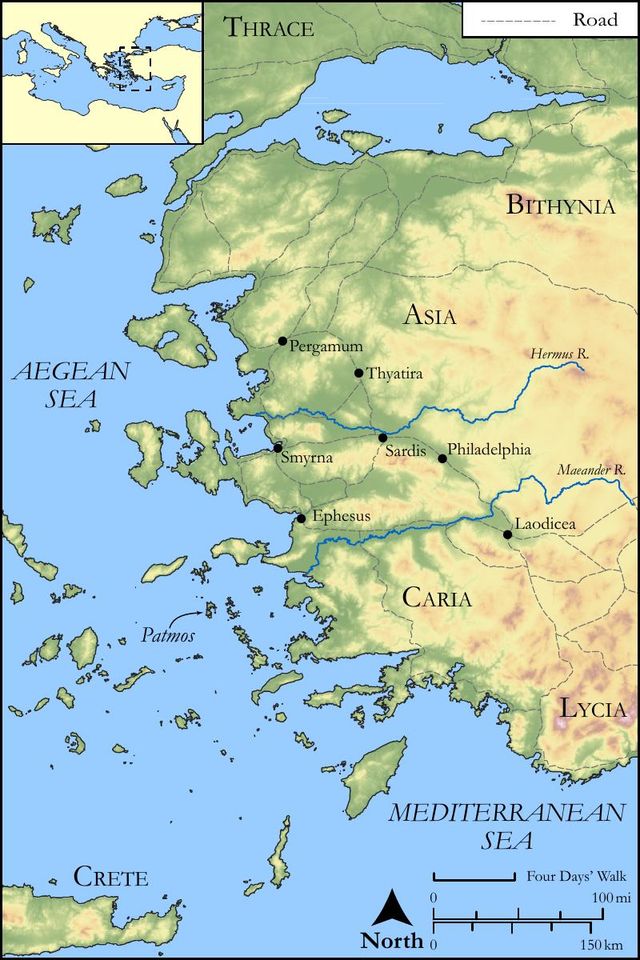
The seven churches were located in the Roman province of Asia (modern-day Turkey), a region deeply integrated into the Roman imperial cult and Hellenistic culture. Ephesus, a major port city and the capital of Asia, was a hub of commerce, politics, and pagan worship, notably home to the Temple of Artemis. Christians in these cities faced immense pressure to conform to pagan practices, participate in emperor worship, and contend with various false teachings and heresies that threatened the purity of their faith. The call to "overcome" was not merely spiritual but also a call to steadfastness in the face of social ostracism, economic hardship, and potential persecution for refusing to compromise their allegiance to Christ. The imagery of "paradise" and the "tree of life" would have resonated with both Jewish and Hellenistic audiences, evoking ancient myths of a primordial garden and a golden age, but here imbued with distinct theological meaning rooted in the biblical narrative.
Key Themes
ShowHideRevelation 2:7 contributes significantly to several overarching themes in Revelation. The repeated phrase, "He that hath an ear, let him hear what the Spirit saith unto the churches," underscores the theme of spiritual hearing and discernment, emphasizing that divine truth requires more than mere physical audition; it demands receptive hearts and minds attuned to the Holy Spirit's ongoing communication to the universal church. The promise "To him that overcometh" highlights the central theme of victorious perseverance in the face of spiritual warfare, worldly pressures, and persecution. This concept of "overcoming" (Greek: nikaō) is foundational to the book, appearing repeatedly as a condition for receiving Christ's blessings and sharing in His ultimate triumph, as seen in other letters like the promise in Revelation 3:21. Finally, the reward of eating from the "tree of life, which is in the midst of the paradise of God," introduces the theme of eternal life and eschatological restoration. This imagery directly alludes to the Garden of Eden from which humanity was expelled after the Fall (Genesis 3:24), signifying the reversal of the curse, the restoration of perfect fellowship with God, and the promise of unending life in the New Creation, a theme further developed in Revelation 22:2.
Exposition and Analysis
ShowHideKey Word Analysis
ShowHideThis verb signifies a proactive bestowal, a granting or delivering. In this context, it emphasizes the sovereign act of Christ in bestowing a divine privilege and blessing upon the overcomer. It is not something earned by human merit but a gift freely given by the victorious Christ.
Meaning to subdue, conquer, prevail, or get the victory. This word implies an active, ongoing struggle against opposing forces—sin, the world system, false teaching, and persecution—culminating in triumph. It denotes a dynamic spiritual victory achieved through steadfast faith and endurance in Christ.
Of Oriental origin, this term refers to a park or a garden, specifically an Eden-like place of future happiness. It evokes a lush, enclosed garden, a place of delight and security, signifying the restored, intimate presence of God, a state of ultimate bliss and divine communion that awaits the faithful.
Verse Breakdown
ShowHide"He that hath an ear, let him hear what the Spirit saith unto the churches"
This is a recurring imperative, emphasizing the necessity of spiritual receptivity. It's a call not merely to physical hearing, but to attentive listening, understanding, and obedient application of the divine message. The message originates from "the Spirit," referring to the Holy Spirit, who conveys Christ's words to the collective body of believers ("the churches"), indicating a universal and ongoing relevance of these messages beyond the specific congregations.
"To him that overcometh will I give to eat of the tree of life"
This clause presents the condition and the primary reward. The promise is exclusively to the "overcomer," highlighting the active, enduring faith required. The "tree of life" is a direct allusion to the tree in the Garden of Eden, access to which was lost after the Fall. Eating from it symbolizes the reception of eternal life, divine sustenance, and perpetual fellowship with God.
"which is in the midst of the paradise of God"
This phrase further specifies the location and nature of the reward. The "paradise of God" evokes a restored Eden, a place of perfect communion, peace, and abundance, directly in God's presence. "In the midst of" suggests centrality and full access, implying that the overcomer will enjoy the very heart of God's glorious dwelling and the blessings it contains.
Literary Devices
ShowHideRevelation 2:7 is rich in literary devices that enhance its theological depth. The most prominent is Allusion, specifically to the primordial Garden of Eden in Genesis. The "tree of life" and "paradise of God" directly recall humanity's original state of perfect communion with God and the subsequent loss of access to eternal life due to sin (Genesis 2:9 and Genesis 3:22-24). This allusion signifies a profound eschatological reversal and restoration, promising that what was lost in Eden will be regained and surpassed in Christ. Symbolism is also central, with the "tree of life" symbolizing eternal life, divine sustenance, and restored fellowship with God, and "paradise of God" symbolizing the ultimate dwelling place of God's people, characterized by peace, joy, and His immediate presence. The phrase "He that hath an ear, let him hear" employs Metaphor, transforming physical hearing into a spiritual act of discernment and obedience, emphasizing the need for inward spiritual receptivity to God's truth.
Theological and Thematic Connections
ShowHideRevelation 2:7 encapsulates profound theological truths concerning God's redemptive plan and the destiny of His faithful people. It underscores the active role of the believer in persevering through faith and obedience, while simultaneously highlighting the gracious provision of God. The promise of the tree of life in the paradise of God speaks to the restoration of humanity's original blessed state, not merely returning to Eden but entering into an even greater, perfected communion with God made possible through Christ. This ultimate reward for faithfulness affirms God's covenant loyalty and His desire for intimate fellowship with His creation, a fellowship that sin had broken but which Christ fully restores.
Reflection and Application
ShowHideRevelation 2:7 offers a timeless message of hope, challenge, and ultimate reward for believers across all generations. It calls us to cultivate a posture of deep spiritual listening, recognizing that the Holy Spirit continues to speak to the church today, guiding, correcting, and encouraging. This verse reminds us that the Christian life is not passive but an active journey of "overcoming"—conquering sin, resisting worldly pressures, enduring trials, and remaining steadfast in our devotion to Christ, even when it is costly. The promise of the tree of life in the paradise of God provides an eternal perspective, reminding us that our ultimate reward is not found in earthly comforts or fleeting successes, but in restored, unending communion with God Himself. This profound assurance fuels our perseverance, transforming our struggles into opportunities for victorious faith and reminding us that our temporary afflictions are incomparable to the eternal weight of glory awaiting those who remain faithful.
Questions for Reflection
ShowHideFAQ
ShowHideWhat does "overcometh" mean in the context of Revelation?
ShowHideIn Revelation, "overcometh" (Greek: nikáō) refers to those who conquer or prevail in their spiritual walk. This victory is not achieved through human strength but through steadfast faith in Jesus Christ, enabling believers to resist the temptations of sin, endure persecution, reject false teachings, and remain loyal to Christ despite the pressures of the world. It signifies a dynamic, active perseverance in faith, even unto death, as seen in passages like Revelation 12:11.
What is the significance of the "tree of life" and the "paradise of God"?
ShowHideThe "tree of life" is an allusion to the tree in the Garden of Eden, access to which was lost after humanity's expulsion due to sin (Genesis 3:22-24). Its reappearance signifies the restoration of eternal life, divine sustenance, and unending fellowship with God. The "paradise of God" (Greek: parádeisos) also harks back to Eden's garden, symbolizing a place of perfect peace, joy, and intimate communion with God. Together, they represent the ultimate eschatological blessing for believers—a return to and surpassing of humanity's original blessed state, in the very presence of God, where all needs are met and life is eternal (Revelation 22:1-5).
Who is "the Spirit" that "saith unto the churches"?
ShowHide"The Spirit" refers to the Holy Spirit, the third person of the Trinity. In Revelation, the Holy Spirit is central to revealing God's truth and empowering believers. The phrase "what the Spirit saith unto the churches" emphasizes that the messages conveyed through John from Christ are not merely human words but divine utterances, inspired and communicated by the Holy Spirit. This highlights the Spirit's ongoing role in guiding, teaching, and speaking to the collective body of Christ throughout history, urging spiritual attentiveness and obedience from all who claim to have "an ear" to hear (John 16:13).
Christ-Centered Fulfillment
ShowHideRevelation 2:7 finds its ultimate fulfillment in Jesus Christ, who is the very embodiment of the promise and the means by which it is attained. He is the ultimate "Overcomer," having conquered sin, death, and the grave through His crucifixion and resurrection (John 16:33; Colossians 2:15). It is through His finished work that believers are empowered to overcome, for our victory is not our own but a participation in His triumph (1 John 5:4-5). Furthermore, Christ Himself is the true "Tree of Life." He declared, "I am the bread of life; whoever comes to me shall not hunger, and whoever believes in me shall never thirst" (John 6:35). He is the source of eternal life, and to "eat" of the tree of life is to partake of Him, to live in intimate, unending fellowship with Him, the one who grants access to the "paradise of God." His sacrificial death opened the way back to the Father's presence, restoring what was lost in Eden and ushering in a new, eternal covenant where believers can dwell with God forever (Hebrews 10:19-20). Thus, the promise of Revelation 2:7 is a glorious invitation to embrace Christ, the Overcomer and the Life-Giver, and through Him, to enter into the fullness of God's eternal presence.