


Revelation 2:11
Bible text: King James Version (1769 Blayney text) · Public domain
Bible text: King James Version with Strong's numbers · Public domain
Bible text: Berean Standard Bible · Public domain
Bible text: American Standard Version (1901) · Public domain
Bible text: World English Bible, Messianic edition · Public domain
Bible text: Geneva Bible (1599) · Public domain
Bible text: Young's Literal Translation · Public domain
- ὁhoThe [one]G3588T-NSMDefinite article Nominative Singular Masculine
- ἔχωνechōnhavingG2192V-PAP-NSMVerb Present Active Participle Nominative Singular Masculine
- οὖςousan earG3775N-ASNNoun Accusative Singular Neuter
- ἀκουσάτωakousatōhe should hearG191V-AAM-3SVerb Aorist Active Imperative 3rd Singular
- τίtiwhatG5101I-ASNInterrogative pronoun Accusative Singular Neuter
- τὸtotheG3588T-NSNDefinite article Nominative Singular Neuter
- πνεῦμαpneumaSpiritG4151N-NSNNoun Nominative Singular Neuter
- λέγειlegeisaysG3004V-PAI-3SVerb Present Active Indicative 3rd Singular
- ταῖςtaisto theG3588T-DPFDefinite article Dative Plural Feminine
- ἐκκλησίαις·ekklēsiaischurchesG1577N-DPFNoun Dative Plural Feminine
- ὁhoThe [one]G3588T-NSMDefinite article Nominative Singular Masculine
- νικῶνnikōnovercomingG3528V-PAP-NSMVerb Present Active Participle Nominative Singular Masculine
- οὐoucertainlyG3756PRT-NNegative Particle Negative
- μὴmēnotG3361PRT-NNegative Particle Negative
- ἀδικηθῇadikēthēamay be injuredG91V-APS-3SVerb Aorist Passive Subjunctive 3rd Singular
- ἐκekbyG1537PREPPreposition
- τοῦtoutheG3588T-GSMDefinite article Genitive Singular Masculine
- θανάτουthanatoudeathG2288N-GSMNoun Genitive Singular Masculine
- τοῦtou<the>G3588T-GSMDefinite article Genitive Singular Masculine
- δευτέρουdeuterousecondG1208A-GSMAdjective Genitive Singular Masculine
English is a literal word-by-word gloss of the Greek, not the KJV's wording. Why?
This is the original text the KJV's translators worked from — each Greek word with its own literal English meaning in this verse, prepared by scholars at Tyndale House, Cambridge. The KJV translates whole sentences, not word by word, so its wording differs: one Greek word can become several English words, and the KJV may choose “charity” where the gloss reads “love”. Both are faithful — they answer different questions. For the KJV's own rendering, switch to the KJV text.
Details
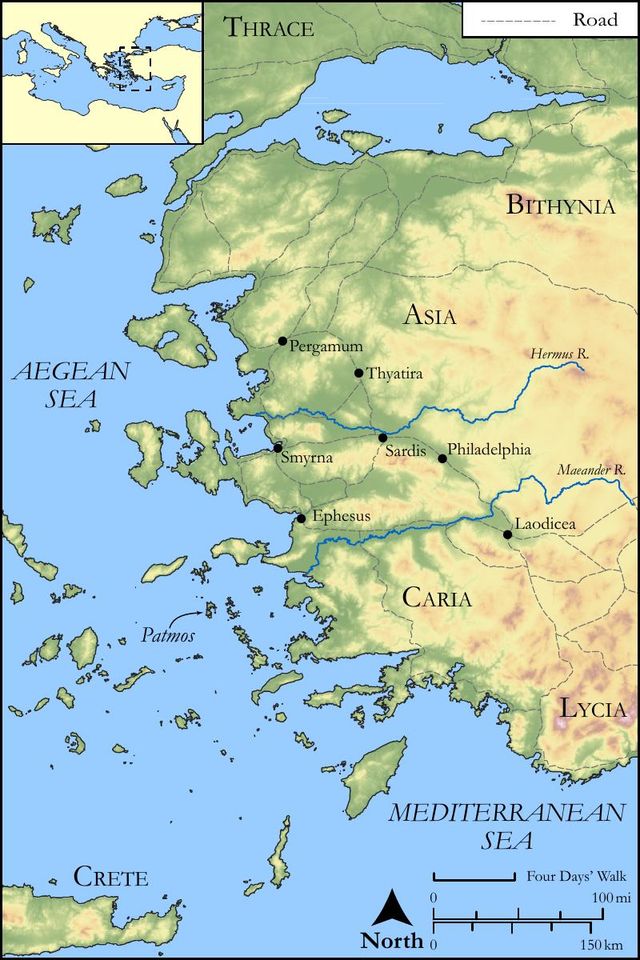
See on the biblical-era maps

Study this verse
Public-domain commentary
Matthew Henry
From his Commentary on the Whole Bible. Henry comments on passages, not single verses — this entry covers Revelation 2:8–11. His four-level outline is real structure in the source text, so it is rendered as structure.
We now proceed to the second epistle sent to another of the Asian churches, where, as before, observe,
I.The preface or inscription in both parts.
1.The superscription, telling us to whom it was more expressly and immediately directed: To the angel of the church in Smyrna, a place well known at this day by our merchants, a city of great trade and wealth, perhaps the only city of all the seven that is still known by the same name, now however no longer distinguished for its Christian church being overrun by Mahomedism.
2.The subscription, containing another of the glorious titles of our Lord Jesus, the first and the last, he that was dead and is alive, taken out of Rev 1:17, Rev 1:18.
(1.)Jesus Christ is the first and the last. It is but a little scantling of time that is allowed to us in this world, but our Redeemer is the first and the last. He is the first, for by him all things were made, and he was before all things with God and was God himself. he is the last, for all things are made for him, and he will be the Judge of all. This surely is the title of God, from everlasting and to everlasting, and it is the title of one that is an unchangeable Mediator between God and man, Jesus, the same yesterday, today, and for ever. He was the first, for by him the foundation of the church was laid in the patriarchal state; and he is the last, for by him the top-stone will be brought forth and laid in the end of time.
(2.)He was dead and is alive. He was dead, and died for our sins; he is alive, for he rose again for our justification, and he ever lives to make intercession for us. He was dead, and by dying purchased salvation for us; he is alive, and by his life applies this salvation to us. And if, when we were enemies, we were reconciled by his death, much more, being reconciled, we shall be saved by his life. His death we commemorate every sacrament day; his resurrection and life every sabbath day.
II.The subject-matter of this epistle to Smyrna, where, after the common declaration of Christ's omniscience, and the perfect cognizance he has of all the works of men and especially of his churches, he takes notice,
1.Of the improvement they had made in their spiritual state. This comes in in a short parentheses; yet it is very emphatic: But thou art rich (Rev 2:10), poor in temporals, but rich in spirituals - poor in spirit, and yet rich in grace. Their spiritual riches are set off by their outward poverty. Many who are rich in temporals are poor in spirituals. Thus it was with the church of Laodicea. Some who are poor outwardly are inwardly rich, rich in faith and in good works, rich in privileges, rich in bonds and deeds of gift, rich in hope, rich in reversion. Spiritual riches are usually the reward of great diligence; the diligent hand makes rich. Where there is spiritual plenty, outward poverty may be better borne; and when God's people are impoverished in temporals, for the sake of Christ and a good conscience, he makes all up to them in spiritual riches, which are much more satisfying and enduring.
2.Of their sufferings: I know thy tribulation and thy poverty - the persecution they underwent, even to the spoiling of their goods. Those who will be faithful to Christ must expect to go through many tribulations; but Jesus Christ takes particular notice of all their troubles. In all their afflictions, he is afflicted, and he will recompense tribulation to those who trouble them, but to those that are troubled rest with himself.
3.He knows the wickedness and the falsehood of their enemies: I know the blasphemy of those that say they are Jews, but are not; that is, of those who pretend to be the only peculiar covenant-people of God, as the Jews boasted themselves to be, even after God had rejected them; or of those who would be setting up the Jewish rites and ceremonies, which were now not only antiquated, but abrogated; these may say that they only are the church of God in the world, when indeed they are the synagogue of Satan. Observe,
(1.)As Christ has a church in the world, the spiritual Israel of God, so the devil has his synagogue. Those assemblies which are set up in opposition to the truths of the gospel, and which promote and propagate damnable errors, - those which are set up in opposition to the purity and spirituality of gospel worship, and which promote and propagate the vain inventions of men and rites and ceremonies which never entered into the thoughts of God, - these are all synagogues of Satan: he presides over them, he works in them, his interests are served by them, and he receives a horrid homage and honour from them.
(2.)For the synagogues of Satan to give themselves out to be the church or Israel of God is no less than blasphemy. God is greatly dishonoured when his name is made use of to promote and patronize the interests of Satan; and he has a high resentment of this blasphemy, and will take a just revenge on those who persist in it.
4.He foreknows the future trials of his people, and forewarns them of them, and fore-arms them against them.
(1.)He forewarns them of future trials: The devil shall cast some of you into prison, and you shall have tribulation, Rev 2:10. The people of God must look for a series and succession of troubles in this world, and their troubles usually rise higher. They had been impoverished by their tribulations before; now they must be imprisoned. Observe, It is the devil that stirs up his instruments, wicked men, to persecute the people of God; tyrants and persecutors are the devil's tools, though they gratify their own sinful malignity, and know not that they are actuated by a diabolical malice.
(2.)Christ fore-arms them against these approaching troubles,
[1.]By his counsel: Fear none of these things. This is not only a word of command, but of efficacy, no, only forbidding slavish fear, but subduing it and furnishing the soul with strength and courage.
[2.]By showing them how their sufferings would be alleviated and limited. First, They should not be universal. It would be some of them, not all, who should be cast into prison, those who were best able to bear it and might expect to be visited and comforted by the rest. Secondly, They were not to be perpetual, but for a set time, and a short time: Ten days. It should not be everlasting tribulation, the time should be shortened for the elect's sake. Thirdly, It should be to try them, not to destroy them, that their faith, and patience, and courage, might be proved and improved, and be found to honour and glory.
[3.]By proposing and promising a glorious reward to their fidelity: Be thou faithful to death, and I will give thee a crown of life. Observe, First, The sureness of the reward: I will give thee. He has said it that is able to do it; and he has undertaken that he will do it. They shall have the reward from his own hand, and none of their enemies shall be able to wrest it out of his hand, or to pull it from their heads. Secondly, The suitableness of it. 1. A crown, to reward their poverty, their fidelity, and their conflict. 2. A crown of life, to reward those who are faithful even unto death, who are faithful till they die, and who part with life itself in fidelity to Christ. The life so worn out in his service, or laid down in his cause, shall be rewarded with another and a much better life that shall be eternal.
III.The conclusion of this message, and that, as before,
1.With a call to universal attention, that all men, all the world, should hear what passes between Christ and his churches - how he commends them, how he comforts them, how he reproves their failures, how he rewards their fidelity. It concerns all the inhabitants of the world to observe God's dealings with his own people; all the world may learn instruction and wisdom thereby.
2.With a gracious promise to the conquering Christian: He that overcometh shall not be hurt of the second death, Rev 2:11. Observe,
(1.)There is not only a first, but a second death, a death after the body is dead.
(2.)This second death is unspeakably worse than the first death, both in the dying pangs and agonies of it (which are the agonies of the soul, without any mixture of support) and in the duration; it is eternal death, dying the death, to die and to be always dying. This is hurtful indeed, fatally hurtful, to all who fall under it.
(3.)From this hurtful, this destructive death, Christ will save all his faithful servants; the second death shall have no power over those who are partakers of the first resurrection: the first death shall not hurt them, and the second death shall have no power over them.
Historical interpretation
Seven Centuries of Reception
6 surviving comments on this verse. Each one is dated, so this reads as a timeline rather than a list.
Select a marker to jump to its quote. Markers stagger vertically where authors wrote within a few decades of each other.
The following epistle unfolds the mode of life and habit of another order which follows. He proceeds to say:-
"I know thy tribulation and thy poverty, but thou art rich." For He knows that with such men there are riches hidden with Him, and that they deny the blasphemy of the Jews, who say that they are Jews and are not; but they are the synagogue of Satan, since they are gathered together by Antichrist; and to them He says:-
"Be thou faithful unto death." That they should continue to be faithful even unto death.
"He that shall overcome, shall not be hurt by the second death." That is, he shalt not be chastised in hell.
This then is done in them through grace so that the change brought about by divine gift may begin in them here. The change begins first through justification, in which there is a spiritual resurrection, and afterwards, in the resurrection of the body, in which the change of the justified is brought to completion; the perfected glorification, remaining for eternity, is not changed. To this end, first the grace of justification, then the grace of glorification changes them so that the glorification itself remains, unchangeable and eternal in them. For here they are changed through the first resurrection by which they are enlightened that they may be converted. That is, they change from death to life by this, from iniquity to justice, from infidelity to faith, and from evil acts to a holy way of life. Therefore, the second death has no power over them. Concerning such people, it is said in the Apocalypse: “Blessed is the one who shares in the first resurrection. The second death has no power over them.” Again it is said in the same book: “The victor shall not be harmed by the second death.” Therefore, just as the first resurrection is found in conversion of the heart, so the second death is found in eternal punishment. Let every person who does not wish to be condemned by eternal punishment of the second death hasten here to become a participant of the first resurrection.
“He who conquers shall not be hurt by the second death.” Having eaten of the forbidden tree, [Adam] procured this [death] for posterity. However, watering the tree of the cross by the water and blood which flowed from the holy place of his side, Christ caused the firstfruits of salvation to sprout up where he knew the original evil had arisen, saying, “Rejoice, I have overcome the world.” Thus, if anyone conquers, he will conquer in him.
He who overcomes shall not be hurt by the second death. He who remains faithful until the death of the flesh will not fear the eternal death of the soul.
He, that hath an ear, let him hear what the Spirit saith to the churches: He that shall overcome, shall not be hurt by the second death. When the sacred Scripture usually mentions three deaths, namely one of sin, one of the flesh, and one of damnation, why is the last damnation in this passage not called the third, but the second death, if not because it seems that here are mentioned only the deaths that are demonstrated to harm? Namely the death of sin and the death of eternal punishment, compared to which that of the flesh is not worthy to be called death. By the word hurting, we should understand decay in afflictions.
He who has an ear, let him hear what the Spirit says to the churches. The one who conquers will not be harmed by the second death. What has been said is very precise; for in the first death, which is the separation of the soul from the body, all alike, both the righteous and the sinners, become prisoners, so that the divine decree may reach its end: "you are dust, and to dust you shall return." (Gen. 3:19) But in the second death, which the Lord calls sin, saying, "Let the dead bury their own dead," (Matt. 8:22) the victors over temptations would not be wronged.
Continue studying Revelation 2:11 across the web’s major study libraries — every link below opens this exact verse, chapter, or book on the destination site.
Read & Compare
 BibleGatewayThis verse in more than 200 translations and 70 languages.
 Bible.comThe YouVersion reader — hundreds of translations, reading plans, and highlights.
 ESV.orgCrossway's official English Standard Version reader.
 NET BibleThe NET translation with 60,000+ translators' notes on every rendering decision.
 STEP BibleTyndale House's free study tool — original text, vocabulary, and scholarly resources.
 BibliaLogos Bible Software's free web reader.
 USCCBThe New American Bible (Revised Edition) with the U.S. bishops' study notes.
Commentaries
 BibleHub CommentariesDozens of classic commentaries on this verse, gathered on one page.
 StudyLightMore than 100 commentary sets — the largest collection on the web.
 BibleRefPlain-English commentary on what this verse means, verse by verse.
 Enduring WordDavid Guzik's free commentary on this chapter, widely used by Bible teachers.
 Bible Study ToolsVerse commentary alongside Greek and Hebrew study aids.
Original Language & Research
- BibleHub InterlinearThe verse word by word — original language, transliteration, and English.
- BibleHub LexiconEvery word's original-language definition and Strong's entry.
 Blue Letter BibleDeep-study tools — Strong's numbers, concordance, and word studies.
 CNTR CollationThe earliest Greek manuscripts of this verse, collated letter by letter.
Sermons, Hymns & Audio


TrulyRandomVerse is not affiliated with these sites and doesn’t control their content. They’re linked because they’re genuinely useful.
Summary
This verse, the concluding exhortation to the church in Smyrna, encapsulates the divine call for spiritual discernment and unwavering faithfulness amidst tribulation. It offers a profound promise of eternal security to those who overcome the world's pressures and persecutions, assuring them deliverance from the ultimate and terrifying reality of the second death.
Context
ShowHideLiterary Context
This verse serves as the concluding exhortation within the letter to the church in Smyrna, found in Revelation 2:8-11. It follows a pattern established in the letters to the seven churches of Asia Minor, where each message begins with a description of Christ, followed by commendation, rebuke (if any), exhortation, and a promise to the overcomer. Smyrna, uniquely among these churches, receives no rebuke, only commendation for its endurance through severe poverty and tribulation. The phrase "He that hath an ear, let him hear what the Spirit saith unto the churches" is a recurring motif, appearing at the end of each of the first four letters, Revelation 2:17, Revelation 2:29, and Revelation 3:6, Revelation 3:13, Revelation 3:22, emphasizing the urgent and personal nature of the divine message.
Historical & Cultural Context
Smyrna was a wealthy and beautiful port city, fiercely loyal to Rome, and a center of imperial cult worship. Citizens were expected to participate in emperor worship, often by burning a pinch of incense and declaring "Caesar is Lord." Christians, who refused to do so, were branded as atheists and traitors, leading to intense persecution. The city also had a significant and often hostile Jewish population, some of whom actively opposed the Christians, as indicated by the reference to "the synagogue of Satan" in Revelation 2:9. This context of economic hardship, social ostracism, and the very real threat of martyrdom—exemplified by the martyrdom of Polycarp, bishop of Smyrna, around A.D. 155—makes the promise to "not be hurt of the second death" particularly poignant and powerful for the original audience.
Key Themes
ShowHideThis verse powerfully encapsulates several overarching themes prevalent in the Book of Revelation. The repeated call, "He that hath an ear, let him hear what the Spirit saith unto the churches," underscores the theme of spiritual discernment and the vital importance of heeding divine revelation, not just intellectually, but existentially. It is a call to individual responsibility within the corporate body. The promise to "He that overcometh" highlights the central theme of victorious perseverance (Greek: nikáō). In Revelation, overcoming is not merely enduring, but actively conquering the forces of evil, the temptations of the world, and the fear of death through steadfast faith in Christ, as seen in Revelation 12:11. Finally, the assurance of escaping "the second death" introduces the critical theme of eternal judgment and salvation. This concept, further elaborated in Revelation 20:6 and Revelation 21:8, distinguishes physical death from an ultimate, eternal separation from God in the "lake of fire," making the promise a profound declaration of ultimate salvation for the faithful.
Exposition and Analysis
ShowHideKey Word Analysis
ShowHideMeaning "to subdue," "conquer," "prevail," or "get the victory." This verb is central to the Book of Revelation, appearing 17 times. It signifies not merely passive endurance but active triumph over spiritual adversaries, worldly pressures, and even death itself, through steadfast faith in Christ. The one who "overcomes" is the one who remains faithful to Jesus despite all opposition.
Referring to a "current of air," "breath," or "breeze," and by analogy, a "spirit," often referring to the Holy Spirit. In this context, "the Spirit" is the divine agent through whom Christ's message is conveyed to the churches, emphasizing the supernatural origin and authority of the revelation. It implies a spiritual, not merely intellectual, reception of the message.
Meaning "second" in time, place, or rank.
Meaning "death" literally or figuratively.
This compound phrase denotes a distinct and ultimate form of death, beyond physical demise. As explicitly defined in Revelation, it refers to eternal separation from God, often depicted as the "lake of fire," signifying ultimate spiritual condemnation and destruction for the unrighteous. The promise is to be "not hurt" (G91 adikéō, meaning "to do wrong" or "to injure") by this final, eternal judgment.
Verse Breakdown
ShowHide"He that hath an ear, let him hear what the Spirit saith unto the churches"
This recurring imperative serves as a solemn call to profound spiritual attention and discernment. It implies that the message is not for casual listening but requires an open, receptive heart and mind, capable of understanding divine truth beyond mere intellectual apprehension. The "Spirit" is the Holy Spirit, the divine communicator of Christ's message, emphasizing the supernatural origin and authority of the words delivered to the collective body of believers, "the churches."
"He that overcometh"
This phrase identifies the recipient of the promise. "Overcometh" (Greek: nikáō) signifies active victory and perseverance in faith. In the context of Smyrna, it refers to those who conquer fear, resist apostasy, endure persecution, and remain loyal to Christ even unto physical death. It highlights the active role of the believer in maintaining their faith amidst trials.
"shall not be hurt of the second death"
This is the glorious promise to the overcomer. The Greek phrase "shall not be hurt" (οὐ μὴ ἀδικηθῇ, ou mē adikēthē) uses a strong double negative, emphasizing an absolute and certain protection. "The second death" is a distinct concept from physical death, referring to eternal spiritual judgment and separation from God, often identified with the "lake of fire" in Revelation. The promise assures believers that their ultimate destiny is not condemnation but eternal life and communion with God, regardless of the physical suffering or death they may experience in this life.
Literary Devices
ShowHideRevelation 2:11 employs several powerful literary devices. The most prominent is Symbolism, particularly in the phrase "the second death," which is a symbolic representation of eternal spiritual condemnation and separation from God, distinct from physical death. This symbol is further elucidated later in Revelation as the "lake of fire," serving as a terrifying ultimate consequence for the unfaithful. The repeated phrase "He that hath an ear, let him hear what the Spirit saith unto the churches" is a form of Exhortation and Apostrophe, directly addressing the reader and calling for individual spiritual responsiveness. It acts as a rhetorical device to underscore the urgency and personal relevance of the divine message. Furthermore, the use of Contrast is evident between the temporary physical suffering and potential death faced by the Smyrnan believers and the eternal, ultimate "second death" they are promised to escape. This contrast highlights the profound eternal security offered to those who remain faithful. The language also contains Metaphor, as "having an ear" is not merely about physical hearing but about spiritual receptivity and understanding.
Theological and Thematic Connections
ShowHideRevelation 2:11 profoundly reinforces the biblical doctrines of divine sovereignty, human responsibility, and eschatological hope. It teaches that God's messages, though delivered to specific churches, carry universal application, requiring individual spiritual attentiveness. The concept of "overcoming" is not a call to self-reliance but a description of the Spirit-empowered perseverance of believers who remain faithful to Christ, even unto death, trusting in His ultimate victory. The promise of exemption from the "second death" underscores the radical distinction between temporal suffering and eternal judgment, emphasizing that true security lies not in avoiding earthly trials but in securing one's eternal destiny through Christ. This verse thus provides immense comfort and motivation for believers facing any form of persecution or hardship, reminding them that their ultimate reward is eternal life with God, free from ultimate condemnation.
Reflection and Application
ShowHideRevelation 2:11 speaks powerfully to believers in every age, reminding us that faithfulness to Christ often entails enduring hardship and opposition. In a world that often prioritizes comfort and conformity, this verse challenges us to cultivate a spiritual "ear" that is attuned to the Spirit's voice, enabling us to discern truth from error and remain steadfast in our convictions. The call to "overcome" is not a passive waiting but an active, Spirit-empowered resistance to the pressures that would compromise our faith. This includes resisting the allure of worldly success, the fear of social ostracism, or even the threat of physical harm. The ultimate promise—freedom from the "second death"—serves as an eternal anchor, assuring us that any earthly suffering is temporary and pales in comparison to the everlasting joy and security found in Christ. It compels us to live with an eternal perspective, prioritizing our spiritual integrity and unwavering loyalty to God above all else, knowing that our ultimate reward is secure.
Questions for Reflection
ShowHideFAQ
ShowHideWhat is the "second death" mentioned in Revelation 2:11?
ShowHideThe "second death" is a theological concept unique to the Book of Revelation, distinct from physical death. It refers to eternal spiritual judgment and separation from God, often depicted as the "lake of fire." While physical death is the cessation of earthly life, the second death is the ultimate and irreversible condemnation for those who reject Christ and whose names are not found in the Book of Life. It signifies ultimate destruction and eternal suffering for the unrighteous, as described in Revelation 20:14-15.
How does one "overcome" according to Revelation 2:11?
ShowHideTo "overcome" (Greek: nikáō) in the context of Revelation means to remain faithful to Christ despite intense pressure, persecution, and temptation. For the church in Smyrna, this meant enduring poverty, slander, and the threat of martyrdom without compromising their faith. Generally, it involves resisting the world's systems, sin, and the devil's schemes through the power of the Holy Spirit and faith in Jesus. Believers overcome "by the blood of the Lamb, and by the word of their testimony; and they loved not their lives unto the death," as stated in Revelation 12:11. It is a victory achieved through Christ, not by human strength alone.
Christ-Centered Fulfillment
ShowHideRevelation 2:11, while a direct promise to the overcomer, finds its ultimate Christ-centered fulfillment in Jesus Himself. He is the supreme "Overcomer," who conquered sin, death, and the grave, as declared in John 16:33 where He states, "I have overcome the world." His victory on the cross and resurrection from the tomb (see 1 Corinthians 15:54-57) is the foundation upon which believers can also overcome. We are able to "overcome" not by our own strength, but by being united with Christ through faith, sharing in His triumph (see Romans 8:37). The promise of not being hurt by the "second death" is a direct result of Christ's substitutionary sacrifice, where He bore the ultimate judgment for sin, thus delivering those who believe in Him from eternal condemnation (see Romans 6:23 and John 3:16). Therefore, the call to "hear what the Spirit saith" is fundamentally a call to hear and respond to the Person and work of Jesus Christ, the one who guarantees eternal life and freedom from the ultimate death.