


Revelation 20:6
Bible text: King James Version (1769 Blayney text) · Public domain
Bible text: King James Version with Strong's numbers · Public domain
Bible text: Berean Standard Bible · Public domain
Bible text: American Standard Version (1901) · Public domain
Bible text: World English Bible, Messianic edition · Public domain
Bible text: Geneva Bible (1599) · Public domain
Bible text: Young's Literal Translation · Public domain
- μακάριοςmakariosBlessedG3107A-NSMAdjective Nominative Singular Masculine
- καὶkaiandG2532CONJConjunction
- ἅγιοςhagiosholy [is]G40A-NSMAdjective Nominative Singular Masculine
- ὁhothe [one]G3588T-NSMDefinite article Nominative Singular Masculine
- ἔχωνechōnhavingG2192V-PAP-NSMVerb Present Active Participle Nominative Singular Masculine
- μέροςmerosa partG3313N-ASNNoun Accusative Singular Neuter
- ἐνeninG1722PREPPreposition
- τῇtēatheG3588T-DSFDefinite article Dative Singular Feminine
- ἀναστάσειanastaseiresurrectionG386N-DSFNoun Dative Singular Feminine
- τῇtēa<the>G3588T-DSFDefinite article Dative Singular Feminine
- πρώτῃ·prōtēfirst!G4413A-DSFAdjective Dative Singular Feminine
- ἐπὶepiOverG1909PREPPreposition
- τούτωνtoutōntheseG3778D-GPMDemonstrative pronoun Genitive Plural Masculine
- ὁhotheG3588T-NSMDefinite article Nominative Singular Masculine
- δεύτεροςdeuterossecondG1208A-NSMAdjective Nominative Singular Masculine
- θάνατοςthanatosdeathG2288N-NSMNoun Nominative Singular Masculine
- οὐκouknotG3756PRT-NNegative Particle Negative
- ἔχειecheihasG2192V-PAI-3SVerb Present Active Indicative 3rd Singular
- ἐξουσίανexousianpowerG1849N-ASFNoun Accusative Singular Feminine
- ἀλλ᾽all᾽butG235CONJConjunction
- ἔσονταιesontaithey will beG1510V-FDI-3PVerb Future Middle Deponent Indicative 3rd Plural
- ἱερεῖςhi'ereispriestsG2409N-NPMNoun Nominative Plural Masculine
- τοῦtou<the>G3588T-GSMDefinite article Genitive Singular Masculine
- θεοῦtheouof GodG2316N-GSM-TNoun Genitive Singular Masculine Title
- καὶkaiandG2532CONJConjunction
- τοῦtou<the>G3588T-GSMDefinite article Genitive Singular Masculine
- ΧριστοῦChristouof ChristG5547N-GSM-TNoun Genitive Singular Masculine Title
- καὶkaiandG2532CONJConjunction
- βασιλεύσουσινbasileusousinwill reignG936V-FAI-3PVerb Future Active Indicative 3rd Plural
- μετ᾽met᾽withG3326PREPPreposition
- αὐτοῦautouHimG846P-GSMPersonal pronoun Genitive Singular Masculine
- χίλιαchiliaa thousandG5507A-APNAdjective Accusative Plural Neuter
- ἔτηetēyearsG2094N-APNNoun Accusative Plural Neuter
English is a literal word-by-word gloss of the Greek, not the KJV's wording. Why?
This is the original text the KJV's translators worked from — each Greek word with its own literal English meaning in this verse, prepared by scholars at Tyndale House, Cambridge. The KJV translates whole sentences, not word by word, so its wording differs: one Greek word can become several English words, and the KJV may choose “charity” where the gloss reads “love”. Both are faithful — they answer different questions. For the KJV's own rendering, switch to the KJV text.
Details
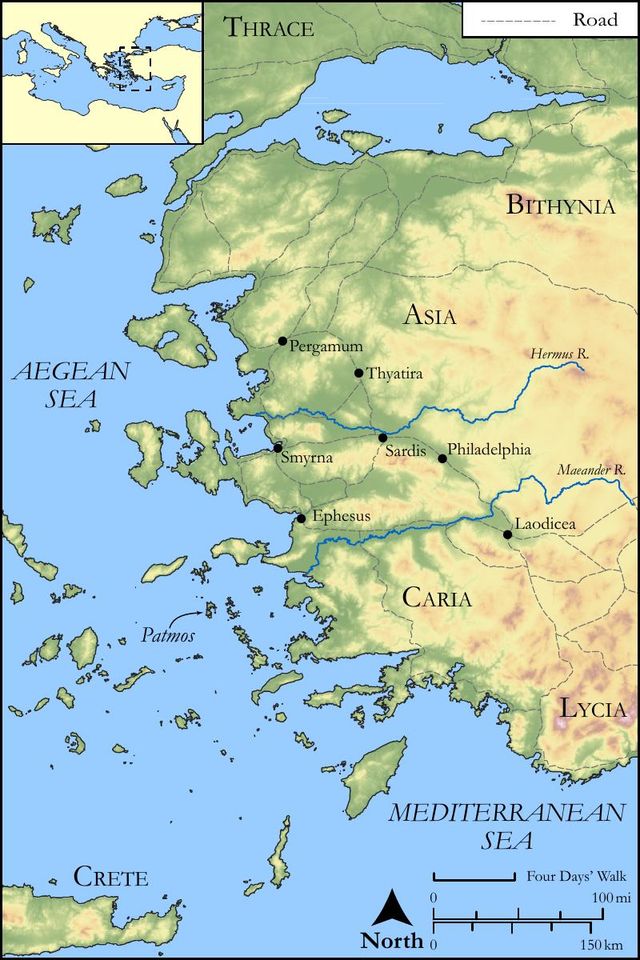
See on the biblical-era maps

Study this verse
Public-domain commentary
Matthew Henry
From his Commentary on the Whole Bible. Henry comments on passages, not single verses — this entry covers Revelation 20:1–10. His three-level outline is real structure in the source text, so it is rendered as structure.
We have here, I. A prophecy of the binding of Satan for a certain term of time, in which he should have much less power and the church much more peace than before. The power of Satan was broken in part by the setting up of the gospel kingdom in the world; it was further reduced by the empire's becoming Christian; it was yet further broken by the downfall of the mystical Babylon; but still this serpent had many heads, and, when one is wounded, another has life remaining in it. Here we have a further limitation and diminution of his power. Observe, 1. To whom this work of binding Satan is committed - to an angel from heaven. It is very probable that this angel is no other than the Lord Jesus Christ; the description of him will hardly agree with any other. He is one who has power to bind the strong man armed, to cast him out, and to spoil his goods; and therefore must be stronger than he. 2. The means he makes use of in this work: he has a chain and a key, a great chain to bind Satan, and the key of the prison in which he was to be confined. Christ never wants proper powers and instruments to break the power of Satan, for he has the powers of heaven and the keys of hell. 3. The execution of this work, Rev 20:2, Rev 20:3. (1.) He laid hold on the dragon, that old serpent, which is the devil, and Satan. Neither the strength of the dragon, nor the subtlety of the serpent, was sufficient to rescue him out of the hands of Christ; he caught hold, and kept his hold. And, (2.) He cast him into the bottomless pit, cast him down with force, and with a just vengeance, to his own place and prison, from which he had been permitted to break out, and disturb the churches, and deceive the nations; now he is brought back to that prison, and there laid in chains. (3.) He is shut up, and a seal set upon him. Christ shuts, and none can open; he shuts by his power, seals by his authority; and his lock and seal even the devils themselves cannot break open. (4.) We have the term of this confinement of Satan - a thousand years, after which he was to be loosed again for a little season. The church should have a considerable time of peace and prosperity, but all her trials were not yet over.
II.An account of the reign of the saints for the same space of time in which Satan continued bound (Rev 20:4-6), and here observe,
1.Who those were that received such honour - those who had suffered for Christ, and all who had faithfully adhered to him, not receiving the mark of the beast, nor worshipping his image; all who had kept themselves clear of pagan and papal idolatry.
2.The honour bestowed upon them.
(1.)They were raised from the dead, and restored to life. This may be taken either literally or figuratively; they were in a civil and political sense dead, and had a political resurrection; their liberties and privileges were revived and restored.
(2.)Thrones, and power of judgment, were given to them; they were possessed of great honour, and interest, and authority, I suppose rather of a spiritual than of a secular nature.
(3.)They reigned with Christ a thousand years. Those who suffer with Christ shall reign with Christ; they shall reign with him in his spiritual and heavenly kingdom, in a glorious conformity to him in wisdom, righteousness, and holiness, beyond what had been known before in the world. This is called the first resurrection, which none but those who have served Christ and suffered for him shall be favoured with. As for the wicked, they shall not be raised up and restored to their power again, till Satan be let loose; this may be called a resurrection, as the conversion of the Jews is said to be life from the dead.
3.The happiness of these servants of God is declared.
(1.)They are blessed and holy, Rev 20:6. None can be blessed but those that are holy; and all that are holy shall be blessed. These were holy as a sort of first-fruits to God in this spiritual resurrection, and as such blessed by him.
(2.)They are secured from the power of the second death. We know something of what the first death is, and it is awful; but we know not what this second death is. It must be much more dreadful; it is the death of the soul, eternal separation from God. The Lord grant we may never know what it is by experience. Those who have had experience of a spiritual resurrection are saved from the power of the second death.
III.An account of the return of the church's troubles, and another mighty conflict, very sharp, but short and decisive. Observe,
1.The restraints laid for a long time on Satan are at length taken off. While this world lasts, Satan's power in it will not be wholly destroyed; it may be limited and lessened, but he will have something still to do for the disturbance of the people of God.
2.No sooner is Satan let loose than he falls to his old work, deceiving the nations, and so stirring them up to make a war with the saints and servants of God, which they would never do if he had not first deceived them. They are deceived both as to the cause they engage in (they believe it to be a good cause when it is indeed a very bad one), and as to the issue: they expect to be successful, but are sure to lose the day.
3.His last efforts seem to be the greatest. The power now permitted to him seems to be more unlimited than before. He had now liberty to beat up for his volunteers in all the four quarters of the earth, and he raised a mighty army, the number of which was as the sand of the sea, Rev 20:8.
4.We have the names of the principal commanders in this army under the dragon - Gog and Magog. We need not be too inquisitive as to what particular powers are meant by these names, since the army was gathered from all parts of the world. These names are found in other parts of scripture. Magog we read of in Gen 10:2. He was one of the sons of Japheth, and peopled the country called Syria, from which his descendants spread into many other parts. Of Gog and Magog together we only read in Eze 38:2, a prophecy whence this in Revelation borrows many of its images.
5.We have the march and military disposition of this formidable army (Rev 20:9.): They went up on the breadth of the earth, and compassed the camp of the saints about, and the beloved city, that is, the spiritual Jerusalem, in which the most precious interests of the people of God are lodged, and therefore to them a beloved city. The army of the saints is described as drawn forth out of the city, and lying under the walls of it, to defend it; they were encamped about Jerusalem: but the army of the enemy was so much superior to that of the church that they compassed them and their city about.
6.You have an account of the battle, and the issue of this war: Fire came down from God out of heaven, and devoured the enemy. Thus the ruin of Gog and Magog is foretold (Eze 38:22), I will rain upon him and upon his bands an overflowing rain, and great hailstones, and fire and brimstone. God would, in an extraordinary and more immediate manner, fight this last and decisive battle for his people, that the victory might be complete and the glory redound to himself.
7.The doom and punishment of the grand enemy, the devil: he is now cast into hell, with his two great officers, the beast and the false prophet, tyranny and idolatry, and that not for any term of time, but to be there tormented night and day, for ever and ever.
Historical interpretation
Twelve Centuries of Reception
27 surviving comments on this verse. Each one is dated, so this reads as a timeline rather than a list.
Select a marker to jump to its quote. Markers stagger vertically where authors wrote within a few decades of each other.
There will be a period of some thousand years after the resurrection of the dead, and... the kingdom of Christ will be set up in material form on this very earth.
But I and others, who are right-minded Christians on all points, are assured that there will be a resurrection of the dead, and a thousand years in Jerusalem, which will then be built, adorned, and enlarged, [as] the prophets Ezekiel and Isaiah and others declare.
Again John also says the very same in the Apocalypse: "Blessed and holy is he who has part in the first resurrection."
Moreover, concerning the resurrection and the kingdom of the saints, Daniel says, "And many of them that sleep in the dust of the earth shall arise, some to everlasting life, (and some to shame and everlasting contempt)." Esaias says, "The dead men shall arise, and they that are in their tombs shall awake; for the dew from thee is healing to them." The Lord says, "Many in that day shall hear the voice of the Son of God, and they that hear shall live." And the prophet says, "Awake, thou that sleepest, and arise from the dead, and Christ shall give thee light." And John says, "Blessed and holy is he that hath part in the first resurrection: on such the second death hath no power." For the second death is the lake of fire that burneth. And again the Lord says, "Then shall the righteous shine forth as the sun shineth in his glory." And to the saints He will say, "Come, ye blessed of my Father, inherit the kingdom prepared for you from the foundation of the world." But what saith He to the wicked? "Depart from me, ye cursed, into everlasting fire, prepared for the devil and his angels, which my Father hath prepared." And John says, "Without are dogs, and sorcerers, and whoremongers, and murderers, and idolaters, and whosoever maketh and loveth a lie; for your part is in the hell of fire." And in like manner also Esaias: "And they shall go forth and look upon the carcases of the men that have transgressed against me. And their worm shall not die, neither shall their fire be quenched; and they shall be for a spectacle to all flesh."
Jesus baptizes "in the Holy Spirit and in fire," not the same person "in the Holy Spirit and in fire," but the holy person "in the Holy Spirit," while another person, after he has believed, after he has been deemed worthy of the Holy Spirit and after he has sinned again, Jesus washes in fire. So … it is not the same person who is baptized by Jesus in the Holy Spirit and in fire. Blessed, then, is the one who is baptized in the Holy Spirit and does not need the baptism by fire, but three times unhappy is that person who has need to be baptized in fire, though Jesus takes care of both of them. For "a shoot from the stump of Jesse will come forth, and a branch will grow out of the root," a shoot for those who are punished, a branch for the righteous. So God is a consuming fire and God is light, a consuming fire to sinners, a light to the just and holy ones. And blessed is he "who shares in the first resurrection," he who has kept the baptism of the Holy Spirit. Who is he who is saved in another resurrection? He who needs the baptism from fire, when he comes before that fire and the fire tests him, and when that fire finds wood, hay and stubble to burn.
Therefore they are not to be heard who assure themselves that there is to be an earthly reign of a thousand years; who think, that is to say, with the heretic Cerinthus. For the kingdom of Christ is now eternal in the saints, although the glory of the saints shall be manifested after the resurrection.
"Blessed and holy is he who has part in this resurrection: on them the second death shall have no power, but they shall be priests of God and Christ, and they shall reign with Him a thousand years." I do not think the reign of a thousand years is eternal; or if it is thus to be thought of, they cease to reign when the thousand years are finished. But I will put forward what my capacity enables me to judge. The tenfold number signifies the decalogue, and the hundredfold sets forth the crown of virginity: for he who shall have kept the undertaking of virginity completely, and shall have faithfully fulfilled the precepts of the decalogue, and shall have destroyed the untrained nature or impure thoughts within the retirement of the heart, that they may not rule over him, this is the true priest of Christ, and accomplishing the millenary number thoroughly, is thought to reign with Christ; and truly in his case the devil is bound. But he who is entangled in the vices and the dogmas of heretics, in his case the devil is loosed. But that it says that when the thousand years are finished he is loosed, so the number of the perfect saints being completed, in whom there is the glory of virginity in body and mind, by the approaching advent of the kingdom of the hateful one, many, seduced by that love of earthly things, shall be overthrown, and together with him shall enter the lake of fire.
Such fruit it is necessary that we bring when we come to the judgment-seat of Christ, on the first day of the feast; for if we are without it we shall not be able to feast with God, nor to have part, according to John,
To these belong his [Papias] statement that there will be a period of some thousand years after the resurrection of the dead, and that the kingdom of Christ will be set up in material form on this very earth. I suppose he got these ideas through a misunderstanding of the apostolic accounts, not perceiving that the things said by them were spoken mystically in figures.
For he appears to have been of very limited understanding, as one can see from his discourses. But it was due to him that so many of the Church Fathers after him adopted a like opinion, urging in their own support the antiquity of the man; as for instance Irenæus and any one else that may have proclaimed similar views.
He [Papias] is said to have published a 'Second coming of Our Lord or Millennium'. Irenæus and Apollinaris and others who say that after the resurrection the Lord will reign in the flesh with the saints, follow him. Tertullian also in his work 'On the hope of the faithful', Victorinus of Petau and Lactantius follow this view.
[Daniel 7:17-18] "These four great beasts are the four kingdoms which shall arise from the earth. But the saints of the Most High God shall take the kingdom." The four kingdoms of which we have spoken above were earthly in character. "For everything which is of the earth shall return to earth" (Ecclesiastes 3:20). But the saints shall never possess an earthly kingdom, but only a heavenly. Away, then, with the fable about a millennium! (Revelation 20:4-6)
"...And they shall possess the kingdom unto eternity, even forever and ever..." If this be taken to refer to the Maccabees, the advocate of this position should explain how the kingdom of the Maccabees is of a perpetual character.
Compare [John’s] other words: “The hour is coming, and now is here, when the dead shall hear the voice of the Son of God, and those who hear shall live”—implying that the rest of the dead (who do not hear) will “not come to life.” The added clause, “until the thousand years were finished,” means that during that time “the rest of the dead” did “not come to life” as they should by passing over from death to life. Therefore, in the day of the body’s resurrection, they will go forth from their tombs, not to life but to “judgment,” meaning that condemnation that is called the second death. Anyone at all who will have failed to “come to life” during this millennium, this whole era of the first resurrection, by not hearing “the voice of the Son of God” and by not passing from death to life will certainly, when the second and bodily resurrection comes, pass to the second death, body and soul together.
Whoever are not liberated from that mass of perdition (brought to pass through the first man) by the one Mediator between God and humankind, they will also rise again, each in his own flesh, but only that they may be punished together with the devil and his angels. Whether these people will rise again with all their faults and deformities, with their diseased and deformed members—is there any reason for us to labor such a question? For obviously the uncertainty about their bodily form and beauty need not weary us, since their damnation is certain and eternal. And let us not be moved to inquire how their body can be incorruptible if it can suffer—or corruptible if it cannot die. For there is no true life unless it be lived in happiness; no true incorruptibility save where health is unscathed by pain. But where an unhappy being is not allowed to die, then death itself, so to say, dies not; and where pain perpetually afflicts but never destroys, corruption goes on endlessly. This state is called, in the Scripture, “the second death.”
Anyone who thus participates [in the first resurrection] is one who not only rises from the death of sin but also perseveres in his newfound life. “Over these,” says John, “the second death has no power.” Therefore, it has power over all the others of whom he said above: “The rest of the dead did not come to life till the thousand years were finished.” They may have lived long enough in their bodies, in the period John calls the “thousand years,” but they did not rise from the binding death of their ungodliness. If they had, they would have shared in the first resurrection and thus escaped the power of the second death.
Here he is speaking not just of bishops and of presbyters (who are now priests in the church) but of all Christians. For just as we call all of them Christs by reason of their mystical chrism, we call them all priests insomuch as they are members of the one Priest. Peter speaks of them as a “chosen race, a royal priesthood.” Surely, too, this text implies, however briefly and incidentally, that Christ is God. The words “priests of God and Christ” mean priests of the Father and Son, even though it was in his servant form that Christ was both made Son of man and also ordained a priest forever according to the order of Melchizedek.
[The first resurrection] is that by which we rise through baptism. As the apostle says, “If you have been raised with Christ, seek the things which are above.” And again he says, “living as [those who have been brought to life] from the dead.” For sin is death, as the apostle says, “when you were dead through trespasses and sins.” Therefore, just as the first death is in this life because of sin, so also the first resurrection is in this life through the remission of sins.
The Spirit repeats what he had written before, that the church is going to reign a thousand years in this age until the end of the world. It is clear that no one ought doubt about the eternal rule when the saints rule even in this present age. For those are rightly said to reign who with God’s aid govern well both themselves and others in the temptations of the present world.
“Until the thousand years were ended,” that is, until such time as the sacrament of the faith and the mystery of the cross is perfected in them and that those who are beginning to flourish might appear in their eternal blessedness. “The rest of the dead did not come to life.” He did not say, “they did not arise again,” but that they did not come to life, because without joy and happiness, and without the reward of eternity, in their torments they shall be regarded as though dead. “This is the first resurrection.” That is to say, the happiness of the saints and their reward; for it is said to be the “first” because of its splendor and its preeminence.
He indicates that those over whom the second death has power did not come to life. To be sure, they have been resurrected unto the second death, that is, they have been damned to the lake of fire, even as it is stated in the psalms: “As though living he swallows them as in anger.” Indeed, concerning those over whom the second death has no power, it says, “they shall be priests of God and they shall reign with him a thousand years.” All those who shall have been in the congregation of the saints, shall be called saints, and they shall be priests of Christ our God, and they shall reign with him in the strength of the cross and in the sovereignty of his might.
[Those who have a portion of the first resurrection] shall serve as priests and shall reign with Christ, as we see, for the thousand years as they are interpreted by us, until Satan is loosed and deceives the nations. Not that these will then be deprived of the kingdom. Rather, they will possess it more certainly and more manifestly with the passing of temporal reality and the arrival of things eternal. For the time between the loosing of the devil and the verdict against him and his punishment in gehenna is short. So, that “they shall be priests of God and of Christ” ought to be regarded as the restoration of former things.… Therefore, since there are two deaths, it is necessary also to accept two resurrections. There is the first, physical death, given as a wage for human disobedience. The second death is eternal punishment. The first resurrection is the giving of life from dead works. The second resurrection is the transformation from the corruption of our bodies into incorruptibility.
From the holy Scriptures we are taught that there are two lives and two deaths. The first life, which is after the transgression of the commandment, is temporary and fleshly. The [second] life is eternal and is promised to the saints because of Christ’s obedience to the divine commandments. Likewise, there are two deaths. The first is that of the flesh and is temporary. The other is eternal and is the reward for sins. It occurs in the age to come; this is the Gehenna of fire. We also know a distinction among the dead. There are the accused, of whom Isaiah wrote, “The dead shall not see life.” These are those persons who by their deeds bring upon themselves both stench and death. There are … the praiseworthy, who in Christ put to death the deeds of the body and crucified themselves with Christ and died to the world. The dead who are rejected, who were not buried with Christ and did not rise with him through baptism but who remained in that death which comes through sins, they shall not live with him until the completion of the thousand years, that is, that perfect number that extends from his first appearance until his second, glorious appearance.… Having been born only from the earth and not from the Spirit, these return to the earth. Their death becomes the beginning of the punishment coming to them. However, those who have a portion in the first resurrection, that is, in the rising from thoughts that bring death and from dead works, these are blessed, for the second death, that is, the unending torment, shall have no power over them.
Blessed and holy is the one who preserves what he has been reborn into.
But they shall be priests of God and of Christ. Another version reads, Priests of God and of Christ. However, this is not said only of bishops and priests, who are properly called priests in the Church, but just as we are all called Christians because of the mystical chrism, so we are all called priests because we are members of the one Priest. As the apostle Peter says: You are a chosen race, a royal priesthood, a holy nation (1 Pet. 2).
And they shall reign with Christ for a thousand years. The Spirit reported, when he wrote these things, that the Church would reign for a thousand years, that is, until the end of the world, from which there could be doubt. For it is clear about the perpetual kingdom.
QUESTION: Blessed and holy is he that hath part in the first resurrection. ANSWER: That is, he who keeps what he has gained in his second birth. THERE FOLLOWS: But they shall be saints of God and of Christ. ANSWER: Another edition has “priests of God and of Christ.” This does not refer only to bishops and church ministers, who are the ones properly called priests in the Church, but, just as we are all called “christs” because of the mystical unction, so are we all called priests because we are the limbs of one priest; whence Peter says, a holy nation, a kingly priesthood. [1 Pet. 2:9] QUESTION: And shall reign with Christ a thousand years. ANSWER: When John was writing this, the Spirit announced that the Church would reign for a thousand years, that is until the end of the world. (20:7) THERE FOLLOWS: And when the thousand years shall be finished, Satan shall be loosed out of his prison. ANSWER: Saying finished, he meant a part by the whole, for Satan shall be loosed when there are still left the three years and six months of the last battle; but apart from this trope, it is right to say that the time will be finished. (What he earlier defined as three years and a half, he here called three years and six months.)
Blessed therefore is the one who has part in the first resurrection; for of the second resurrection we shall all partake, willingly or unwillingly. But concerning those who are participants in the first resurrection, that is, the faithful, the second death will have no power. What is it? It is the death of sin, that is, and the punishment of that time; for just as he said first and second resurrection, so also first and second death.
And the first death is the physical death, the one having a separation of soul and body; second death is the spiritual death, that of sin, about which the Lord also said, "Do not be afraid of those who kill the body; rather be afraid of him who is able to destroy both soul and body in Gehenna." (Matt. 10:28) And the faithful are, he says, priests of God and of Christ; for the faithful have all been shown to be ministers of the evangelical word, concerning whom the prophet, striking his prophetic harp, said "he would appoint them rulers over all the earth." (Ps. 45:16)
And they will reign with him for a thousand years, those of the Incarnation as has been often said.
Supply the life of glory for their souls, which glorifies life is called the first resurrection. Indeed the second will be when they will rise in glorious bodies. Because these have salvation that they already posses in their souls and afterwards they will have this bodily;
Continue studying Revelation 20:6 across the web’s major study libraries — every link below opens this exact verse, chapter, or book on the destination site.
Read & Compare
 BibleGatewayThis verse in more than 200 translations and 70 languages.
 Bible.comThe YouVersion reader — hundreds of translations, reading plans, and highlights.
 ESV.orgCrossway's official English Standard Version reader.
 NET BibleThe NET translation with 60,000+ translators' notes on every rendering decision.
 STEP BibleTyndale House's free study tool — original text, vocabulary, and scholarly resources.
 BibliaLogos Bible Software's free web reader.
 USCCBThe New American Bible (Revised Edition) with the U.S. bishops' study notes.
Commentaries
 BibleHub CommentariesDozens of classic commentaries on this verse, gathered on one page.
 StudyLightMore than 100 commentary sets — the largest collection on the web.
 BibleRefPlain-English commentary on what this verse means, verse by verse.
 Enduring WordDavid Guzik's free commentary on this chapter, widely used by Bible teachers.
 Bible Study ToolsVerse commentary alongside Greek and Hebrew study aids.
Original Language & Research
- BibleHub InterlinearThe verse word by word — original language, transliteration, and English.
- BibleHub LexiconEvery word's original-language definition and Strong's entry.
 Blue Letter BibleDeep-study tools — Strong's numbers, concordance, and word studies.
 CNTR CollationThe earliest Greek manuscripts of this verse, collated letter by letter.
Sermons, Hymns & Audio


TrulyRandomVerse is not affiliated with these sites and doesn’t control their content. They’re linked because they’re genuinely useful.
Summary
Revelation 20:6 pronounces a profound beatitude upon those who participate in the "first resurrection," assuring them of eternal security from the "second death." This verse unveils the glorious destiny of redeemed believers, who are uniquely privileged to serve as priests of God and of Christ, and to co-reign with Him for a thousand years, signifying a period of divine blessing, consecrated service, and shared authority in God's unfolding kingdom plan.
Context
ShowHideLiterary Context
Revelation 20:6 is situated within a pivotal eschatological chapter that describes the millennial reign of Christ. The preceding verses establish the narrative sequence: Satan is bound for a thousand years, preventing him from deceiving the nations (Revelation 20:1-3). Following this, John sees thrones, and those who had been martyred for their testimony of Jesus and for the word of God, along with those who had not worshipped the beast or received its mark, are resurrected to life and reign with Christ for the thousand years (Revelation 20:4). Crucially, Revelation 20:5 explicitly states, "But the rest of the dead lived not again until the thousand years were finished." This clear distinction underscores that the "first resurrection" mentioned in verse 6 is a unique, specific resurrection of believers, separate from the general resurrection of all the dead that occurs later, at the end of the millennium. Thus, verse 6 serves as a blessed summation and declaration of the privileged status of those who partake in this initial resurrection.
Historical & Cultural Context
The book of Revelation was written by John during a time of intense Roman persecution, likely under Emperor Domitian, around the late first century AD. Christians faced immense pressure to conform to imperial cult worship, often resulting in martyrdom. In this context, the promise of a "first resurrection" and immunity from the "second death" would have offered profound comfort and hope to a beleaguered church, affirming God's ultimate vindication of His faithful. The concept of a "thousand years" (Millennium) resonates with Jewish apocalyptic literature and Old Testament prophecies of a future Messianic kingdom, where God's people would finally experience peace, justice, and dominion. Furthermore, the designation of believers as "priests" draws upon Old Testament imagery, where Israel was called to be a "kingdom of priests" (Exodus 19:6), and is reinterpreted in the New Testament to describe the spiritual identity and function of all believers in Christ (1 Peter 2:9).
Key Themes
ShowHideRevelation 20:6 encapsulates several significant theological themes central to the book of Revelation and biblical eschatology. The theme of Divine Blessing and Vindication is paramount, as those who endure persecution and remain faithful are declared "blessed and holy" and are granted a unique, glorious future. The concept of the First Resurrection highlights God's sovereign distinction between the righteous and the unrighteous, emphasizing a resurrection unto life and reign for believers, contrasting sharply with the later resurrection unto judgment. This leads directly to the theme of Eternal Security and Victory over Death, as the promise that "the second death hath no power" over these resurrected saints assures them of ultimate triumph over spiritual and eternal condemnation, a victory secured by Christ's own triumph over death (1 Corinthians 15:54-57). Finally, the theme of Co-Regency and Priestly Service underscores the exalted status of believers, who will not merely be saved but will actively participate in Christ's perfect rule and mediate God's presence, fulfilling their calling as both kings and priests (Revelation 1:6).
Exposition and Analysis
ShowHideKey Word Analysis
ShowHideThis term denotes a state of supreme happiness, profound contentment, and divine favor. It describes those who are divinely favored and spiritually prosperous, enjoying God's special blessings and approval. In this context, it signifies the ultimate well-being and privileged status granted by God to those who participate in the first resurrection, a state of profound joy and spiritual flourishing.
This word refers to privilege, force, capacity, competency, freedom, or mastery, and can also denote delegated influence or authority. When the verse states that "the second death hath no power" over them, it means that the second death has no authority, jurisdiction, or ability to harm or condemn those who are part of the first resurrection. This highlights the absolute and divinely guaranteed immunity of these resurrected saints from eternal judgment.
This term refers to a priest, someone consecrated to God for sacred service. In the Old Testament, priests mediated between God and humanity, offering sacrifices and interceding. Here, it signifies a spiritual and active role of worship, intercession, and ministry in the presence of God and Christ. It points to a direct, unhindered access to God and a role in His divine administration, fulfilling the New Testament understanding of believers as a "royal priesthood" (1 Peter 2:9).
Verse Breakdown
ShowHide"Blessed and holy [is] he that hath part in the first resurrection:"
This opening declaration pronounces a divine blessing and consecration upon those who are raised in the "first resurrection." To "have part" signifies active participation and inclusion in this unique event. The "first resurrection" is not a general resurrection of all humanity but a specific, privileged resurrection of believers, signifying their spiritual vitality, divine approval, and separation unto God. They are "blessed" (divinely favored) and "holy" (set apart and purified by God).
"on such the second death hath no power,"
This clause provides a powerful assurance of eternal security. The "second death" is later identified in Revelation as the "lake of fire" (Revelation 20:14), representing eternal separation from God and ultimate judgment. The declaration that it has "no power" over those in the first resurrection means they are absolutely immune to this eternal condemnation, guaranteeing their everlasting life and fellowship with God.
"but they shall be priests of God and of Christ,"
This reveals a core aspect of the resurrected saints' future role. They are not merely saved from judgment but are elevated to a position of sacred service. As "priests," they will minister directly to God and Christ, implying intimate fellowship, worship, and perhaps a mediatorial role in the millennial kingdom. This signifies a profound spiritual privilege and a fulfillment of the believer's identity in Christ.
"and shall reign with him a thousand years."
This final clause describes the active co-regency of these resurrected believers with Christ. The "thousand years" refers to the millennial period, during which Christ will establish His righteous rule on earth. To "reign with him" indicates shared authority, participation in governance, and active involvement in the administration of Christ's perfect kingdom, demonstrating their vindication and exaltation.
Literary Devices
ShowHideRevelation 20:6 masterfully employs several literary devices to convey its profound message. Symbolism is evident in the "thousand years," which represents a definitive period of Christ's earthly reign, even if its precise chronological interpretation varies among scholars. The "second death" is also highly symbolic, representing not merely physical cessation but eternal spiritual separation and judgment, contrasting sharply with the life-giving "first resurrection." The verse also uses powerful Contrast by juxtaposing the "first resurrection" (life, blessing, reign) with the "second death" (judgment, no power), highlighting the stark difference in destiny between the faithful and the unrighteous. Furthermore, the designation of believers as "priests" and those who "reign" functions as a Metaphor for their exalted status, intimate access to God, and active participation in Christ's kingdom, drawing on familiar Old Testament roles to describe a new, spiritual reality for the redeemed.
Theological and Thematic Connections
ShowHideRevelation 20:6 stands as a cornerstone for understanding the blessed hope of believers, affirming God's unwavering commitment to His covenant people and the ultimate triumph of His righteous kingdom. It underscores the profound distinction between those who are "in Christ" and those who are not, demonstrating that salvation is not merely escape from judgment but an active participation in God's eternal purposes. The promise of immunity from the "second death" highlights the absolute security of the believer's salvation, rooted in Christ's finished work on the cross. Moreover, the dual role of "priests" and "reigning" co-regents elevates the understanding of the believer's destiny beyond mere existence, emphasizing active service, intimate fellowship with God, and shared authority in Christ's perfect reign. This verse points to a future where God's justice is fully realized, and His faithful servants are eternally vindicated and honored.
Reflection and Application
ShowHideRevelation 20:6 offers immense comfort, profound hope, and a clear call to present-day living for every believer. The declaration of "blessed and holy" reminds us of our identity in Christ, who has already secured our place in the first resurrection. This assurance should free us from the fear of eternal condemnation, allowing us to live with confidence and joy, knowing that the "second death has no power" over those redeemed by Christ's blood. The promise of reigning with Christ and serving as priests should ignite a passion for holiness and service in the here and now. If we are destined to co-rule with the King of kings and minister in His presence, then our present lives should reflect that future glory, marked by righteousness, faithful stewardship, and a commitment to advancing His kingdom on earth. This verse encourages perseverance through trials, knowing that our ultimate reward is not just eternal life, but a purposeful, active role in God's glorious future.
Questions for Reflection
ShowHideFAQ
ShowHideWhat is the "first resurrection" mentioned in Revelation 20:6?
ShowHideThe "first resurrection" is a specific resurrection of believers who have died, granting them life and the privilege to reign with Christ for a thousand years. Revelation 20:4-5 clearly distinguishes it from a later, general resurrection of "the rest of the dead" that occurs after the thousand years. It is understood by many as a resurrection unto life and blessing, reserved for those who are faithful to God, including martyrs and those who did not worship the beast. This resurrection signifies their spiritual vitality and divine vindication, granting them a unique role in Christ's millennial kingdom.
What is the "second death," and why does it have no power over those in the first resurrection?
ShowHideThe "second death" is explicitly defined later in Revelation 20:14 as "the lake of fire." It represents not physical death, but eternal spiritual separation from God, a final and ultimate judgment for the unrighteous. For those who participate in the "first resurrection," the "second death" has no power because their salvation is secure through Christ. Their sins have been atoned for, they have been declared righteous, and they are eternally united with God. Christ's victory over sin and death ensures that those who are His will never face this ultimate condemnation, guaranteeing their everlasting life in His presence.
Christ-Centered Fulfillment
ShowHideRevelation 20:6 finds its ultimate Christ-centered fulfillment in the person and work of Jesus, for it is through Him alone that believers are made "blessed and holy," granted participation in the "first resurrection," and empowered to serve as "priests" and "reign" with God. Jesus Himself is the "firstfruits of those who have fallen asleep" (1 Corinthians 15:20), His resurrection being the guarantee and pattern for the resurrection of all believers. His triumph over death and the grave (Hebrews 2:14-15) is the very reason the "second death hath no power" over His redeemed. Furthermore, it is Christ who has "made us a kingdom, priests to His God and Father" (Revelation 1:6), fulfilling the Old Testament priestly calling through His own eternal high priesthood (Hebrews 7:24-25). Our ability to "reign with him" is a direct result of His sovereign kingship and His gracious invitation to share in His authority, as we are already seated with Him in the heavenly realms (Ephesians 2:6). Thus, every blessing, every privilege, and every aspect of the glorious destiny described in Revelation 20:6 is entirely predicated upon and secured by the finished work, ongoing intercession, and future reign of Jesus Christ, our Lord and King.