


Revelation 5:10
Bible text: King James Version (1769 Blayney text) · Public domain
Bible text: Berean Standard Bible · Public domain
Bible text: American Standard Version (1901) · Public domain
Bible text: World English Bible, Messianic edition · Public domain
Bible text: Geneva Bible (1599) · Public domain
Bible text: Young's Literal Translation · Public domain
- καὶkaiandG2532CONJConjunction
- ἐποίησαςepoiēsasYou have madeG4160V-AAI-2SVerb Aorist Active Indicative 2nd Singular
- αὐτοὺςautousthemG846P-APMPersonal pronoun Accusative Plural Masculine
- τῷtōto theG3588T-DSMDefinite article Dative Singular Masculine
- θεῷtheōGodG2316N-DSM-TNoun Dative Singular Masculine Title
- ἡμῶνhēmōnof usG3165P-1GPPersonal pronoun Genitive 1st Plural
- βασιλείανbasileiana kingdomG932N-ASFNoun Accusative Singular Feminine
- καὶkaiandG2532CONJConjunction
- ἱερεῖςhi'ereispriestsG2409N-APMNoun Accusative Plural Masculine
- καὶkaiandG2532CONJConjunction
- βασιλεύσουσινbasileusousinthey will reignG936V-FAI-3PVerb Future Active Indicative 3rd Plural
- ἐπὶepiuponG1909PREPPreposition
- τῆςtēstheG3588T-GSFDefinite article Genitive Singular Feminine
- γῆςgēsearthG1093N-GSFNoun Genitive Singular Feminine
English is a literal word-by-word gloss of the Greek, not the KJV's wording. Why?
This is the original text the KJV's translators worked from — each Greek word with its own literal English meaning in this verse, prepared by scholars at Tyndale House, Cambridge. The KJV translates whole sentences, not word by word, so its wording differs: one Greek word can become several English words, and the KJV may choose “charity” where the gloss reads “love”. Both are faithful — they answer different questions. For the KJV's own rendering, switch to the KJV text.
Details
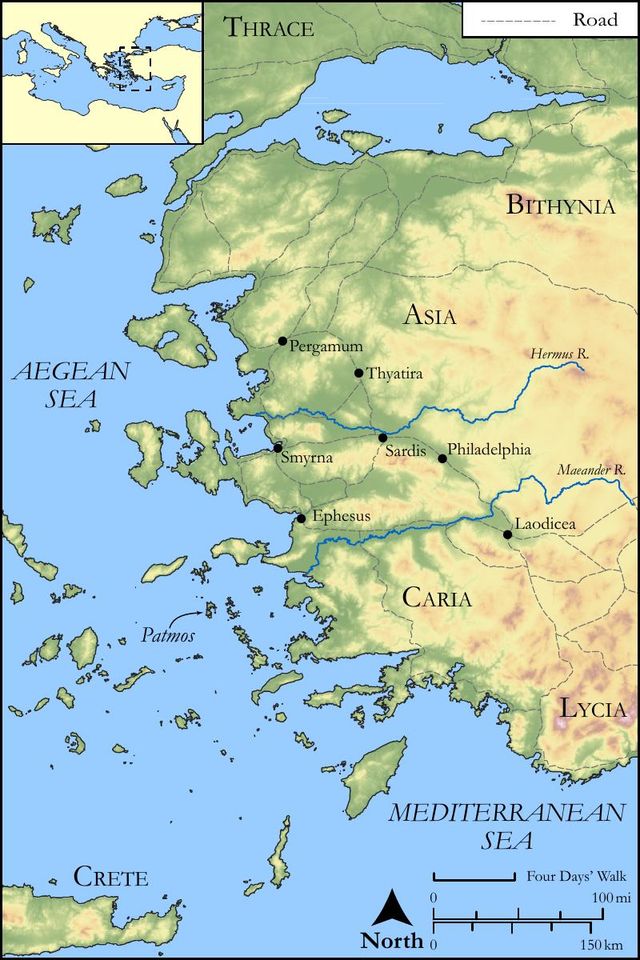
See on the biblical-era maps

Study this verse
Public-domain commentary
Matthew Henry
From his Commentary on the Whole Bible. Henry comments on passages, not single verses — this entry covers Revelation 5:6–14. His four-level outline is real structure in the source text, so it is rendered as structure.
Here, I. The apostle beholds this book taken into the hands of the Lord Jesus Christ, in order to its being unsealed and opened by him. Here Christ is described, 1. By his place and station: In the midst of the throne, and of the four beasts, and of the elders. He was on the same throne with the Father; he was nearer to him than either the elders or ministers of the churches. Christ, as man and Mediator, is subordinate to God the Father, but is nearer to him than all the creatures; for in him all the fulness of the Godhead dwells bodily. The ministers stand between God and the people. Christ stands as the Mediator between God and both ministers and people. 2. The form in which he appeared. Before he is called a lion; here he appears as a lamb slain. He is a lion to conquer Satan, a lamb to satisfy the justice of God. He appears with the marks of his sufferings upon him, to show that he interceded in heaven in the virtue of his satisfaction. He appears as a lamb, having seven horns and seven eyes, perfect power to execute all the will of God and perfect wisdom to understand it all and to do it in the most effectual manner; for he hath the seven Spirits of God, he has received the Holy Spirit without measure, in all perfection of light, and life, and power, by which he is able to teach and rule all parts of the earth. 3. He is described by his act and deed: He came, and took the book out of the right hand of him that sat on the throne (Rev 5:7), not by violence, nor by fraud, but he prevailed to do it (as Rev 5:5), he prevailed by his merit and worthiness, he did it by authority and by the Father's appointment. God very willingly and justly put the book of his eternal counsels into the hand of Christ, and Christ as readily and gladly took it into his hand; for he delights to reveal and to do the will of his Father.
II.The apostle observes the universal joy and thanksgiving that filled heaven and earth upon this transaction.
No sooner had Christ received this book out of the Father's hand than he received the applauses and adorations of angels and men, yea, of every creature. And, indeed, it is just matter of joy to all the world to see that God does not deal with men in a way of absolute power and strict justice, but in a way of grace and mercy through the Redeemer. He governs the world, not merely as a Creator and Lawgiver, but as our God and Saviour. All the world has reason to rejoice in this. The song of praise that was offered up to the Lamb on this occasion consists of three parts, one part sung by the church, another by the church and the angels, the third by every creature.
1.The church begins the doxology, as being more immediately concerned in it (Rev 5:8), the four living creatures, and the four-and-twenty elders, the Christian people, under their minister, lead up the chorus. Here observe,
(1.)The object of their worship - the Lamb, the Lord Jesus Christ; it is the declared will of God that all men should honour the Son as they honour the Father; for he has the same nature.
(2.)Their posture: They fell down before him, gave him not an inferior sort of worship, but the most profound adoration.
(3.)The instruments used in their adorations - harps and vials; the harps were the instruments of praise, the vials were full of odours or incense, which signify the prayers of the saints: prayer and praise should always go together.
(4.)The matter of their song: it was suited to the new state of the church, the gospel-state introduced by the Son of God. In this new song,
[1.]They acknowledge the infinite fitness and worthiness of the Lord Jesus for this great work of opening and executing the counsel and purposes of God (Rev 5:9): Thou art worthy to take the book, and to open the seals thereof, every way sufficient for the work and deserving the honour.
[2.]They mention the grounds and reasons of this worthiness; and though they do not exclude the dignity of his person as God, without which he had not been sufficient for it, yet they chiefly insist upon the merit of his sufferings, which he had endured for them; these more sensibly struck their souls with thankfulness and joy. Here, First, They mention his suffering: "Thou wast slain, slain as a sacrifice, thy blood was shed." Secondly, The fruits of his sufferings. 1. Redemption to God; Christ has redeemed his people from the bondage of sin, guilt, and Satan, redeemed them to God, set them at liberty to serve him and to enjoy him. 2. High exaltation: Thou hast made us to our God kings and priests, and we shall reign on the earth, Rev 5:10. Every ransomed slave is not immediately preferred to honour; he thinks it a great favour to be restored to liberty. But when the elect of God were made slaves by sin and Satan, in every nation of the world, Christ not only purchased their liberty for them, but the highest honour and preferment, made them kings and priests - kings, to rule over their own spirits, and to overcome the world, and the evil one; and he has made them priests, given them access to himself, and liberty to offer up spiritual sacrifices, and they shall reign on the earth; they shall with him judge the world at the great day.
2.The doxology, thus begun by the church, is carried on by the angels; they take the second part, in conjunction with the church, Rev 5:11. They are said to be innumerable, and to be the attendants on the throne of God and guardians to the church; though they did not need a Saviour themselves, yet they rejoice in the redemption and salvation of sinners, and they agree with the church in acknowledging the infinite merits of the Lord Jesus as dying for sinners, that he is worthy to receive power, and riches, and wisdom, and strength, and honour, and glory, and blessing.
(1.)He is worthy of that office and that authority which require the greatest power and wisdom, the greatest fund, all excellency, to discharge them aright; and,
(2.)He is worthy of all honour, and glory, and blessing, because he is sufficient for the office and faithful in it.
3.This doxology, thus begun by the church, and carried on by the angels, is resounded and echoed by the whole creation, Rev 5:13. Heaven and earth ring with the high praises of the Redeemer. The whole creation fares the better for Christ. By him all things consist; and all the creatures, had they sense and language, would adore that great Redeemer who delivers the creature from that bondage under which it groans, through the corruption of men, and the just curse denounced by the great God upon the fall; that part which (by a prosopopoeia) is made for the whole creation is a song of blessing, and honour, and glory, and power,
(1.)To him that sits on the throne, to God as God, or to God the Father, as the first person in the Trinity and the first in the economy of our salvation; and,
(2.)To the Lamb, as the second person in the Godhead and the Mediator of the new covenant. Not that the worship paid to the Lamb is of another nature, an inferior worship, for the very same honour and glory are in the same words ascribed to the Lamb and to him that sits on the throne, their essence being the same; but, their parts in the work of our salvation being distinct they are distinctly adored. We worship and glorify one and the same God for our creation and for our redemption.
We see how the church that began the heavenly anthem, finding heaven and earth join in the concert, closes all with their Amen, and end as they began, with a low prostration before the eternal and everlasting God. Thus we have seen this sealed book passing with great solemnity from the hand of the Creator into the hand of the Redeemer.
Historical interpretation
Eight Centuries of Reception
5 surviving comments on this verse. Each one is dated, so this reads as a timeline rather than a list.
Select a marker to jump to its quote. Markers stagger vertically where authors wrote within a few decades of each other.
And thou shalt receive the kingdom of heaven, thou who, whilst thou didst sojourn in this life, didst know the Celestial King. And thou shalt be a companion of the Deity, and a co-heir with Christ, no longer enslaved by lusts or passions, and never again wasted by disease. For thou hast become God: for whatever sufferings thou didst undergo while being a man, these He gave to thee, because thou wast of mortal mould, but whatever it is consistent with God to impart, these God has promised to bestow upon thee, because thou hast been deified, and begotten unto immortality. This constitutes the import of the proverb, "Know thyself; "i.e., discover God within thyself, for He has formed thee after His own image. For with the knowledge of self is conjoined the being an object of God's knowledge, for thou art called by the Deity Himself.
Christ wrote a new song by the harmonious truth of both Testaments. This he did when he, remaining the Word which was in the beginning, was born by a new sort of birth through the Virgin. This he did when he as God put on man in a new manner. This he did when he gave himself over to his killers by his own power. This he did when he was wondrously made alive from the dead and when at a time of his own choosing was ascended beyond the heavens. And this new song he bestowed upon all those who belong to the church which he acquired, that it might be sung continually, and that in this [the church] might rest secure as it awaits in hope the coming judge, that “we might walk in the newness of life.” As he said, “If any one wishes to be my disciple, let him deny himself and take up his cross and follow me.”
Through this passage it is revealed that the elders, both those in the Old Testament and those in the New Testament, were well-pleasing to God, and that on behalf of the whole world they bring forth a [hymn of] thanksgiving to the Lamb of God who was slain and redeemed us. It is a “new song,” which we have been taught to sing, who from every tribe and tongue have been freed from the antiquity of the letter and through the Spirit have received light. He says that these will rule the new earth, which the Lord promised to the humble.
And hast made us to our God a kingdom and priests, and we shall reign on the earth. The elect are kings, when, by restraining their bodies, it is as if they were reigning over a subjected earth with the law of virtue, which is why they affirm they have received a kingdom on earth too. They are priests because they offer themselves to God by chastising themselves every day, according to this: A sacrifice to God is an afflicted spirit. [Ps. 50:19]
And He made them kings and priests to our God, and they shall reign on the earth. Therefore, you are able also to understand the Scripture, for you are faithful servants of Christ, both kings and leaders of the churches; you are able to govern the passions rather than be governed by them; and as priests, you bring your own bodies "as a living, holy, and acceptable sacrifice to God," according to what is written. (Rom. 12:1)
Continue studying Revelation 5:10 across the web’s major study libraries — every link below opens this exact verse, chapter, or book on the destination site.
Read & Compare
 BibleGatewayThis verse in more than 200 translations and 70 languages.
 Bible.comThe YouVersion reader — hundreds of translations, reading plans, and highlights.
 ESV.orgCrossway's official English Standard Version reader.
 NET BibleThe NET translation with 60,000+ translators' notes on every rendering decision.
 STEP BibleTyndale House's free study tool — original text, vocabulary, and scholarly resources.
 BibliaLogos Bible Software's free web reader.
 USCCBThe New American Bible (Revised Edition) with the U.S. bishops' study notes.
Commentaries
 BibleHub CommentariesDozens of classic commentaries on this verse, gathered on one page.
 StudyLightMore than 100 commentary sets — the largest collection on the web.
 BibleRefPlain-English commentary on what this verse means, verse by verse.
 Enduring WordDavid Guzik's free commentary on this chapter, widely used by Bible teachers.
 Bible Study ToolsVerse commentary alongside Greek and Hebrew study aids.
Original Language & Research
- BibleHub InterlinearThe verse word by word — original language, transliteration, and English.
- BibleHub LexiconEvery word's original-language definition and Strong's entry.
 Blue Letter BibleDeep-study tools — Strong's numbers, concordance, and word studies.
 CNTR CollationThe earliest Greek manuscripts of this verse, collated letter by letter.
Sermons, Hymns & Audio


TrulyRandomVerse is not affiliated with these sites and doesn’t control their content. They’re linked because they’re genuinely useful.
Summary
Revelation 5:10 is a pivotal declaration within the heavenly throne room scene, celebrating the Lamb's worthiness to open the scroll. It articulates the profound new identity and future destiny of those redeemed by Christ's blood, proclaiming that God has transformed them into "kings and priests" who are destined to "reign on the earth." This verse encapsulates the eschatological hope and the Christ-purchased authority and access granted to believers, foreshadowing their co-regency with Christ in His coming kingdom.
Context
ShowHideLiterary Context
Revelation 5:10 is embedded within the climactic worship scene of Revelation 5, which immediately follows the majestic vision of God enthroned in Revelation 4. After a search for one worthy to open the seven-sealed scroll, the Lamb, Jesus Christ, is revealed as the only one qualified because He "was slain, and hast redeemed us to God by thy blood out of every kindred, and tongue, and people, and nation" (Revelation 5:9). Verse 10 is part of the "new song" sung by the four living creatures and the twenty-four elders, expressing the result of the Lamb's redemptive work: the transformation of the redeemed into a royal priesthood with a future reign. This declaration sets the stage for the unfolding of God's redemptive plan through the opening of the scroll.
Historical & Cultural Context
The audience of Revelation, likely believers in Asia Minor during a period of Roman imperial persecution (possibly under Domitian), would have keenly felt the oppressive power of earthly kings and the demands of the imperial cult. In this context, the declaration that they would be made "kings and priests" and "reign on the earth" offered profound counter-cultural hope and encouragement. It directly challenged the prevailing political and religious order, asserting God's ultimate sovereignty and the future vindication of His persecuted people. The concept of a "kingdom of priests" has roots in Exodus 19:6 and is echoed in Isaiah 61:6, signifying a people set apart for divine service and possessing unique access to God. John's vision reinterprets and expands this Old Testament promise through the lens of Christ's finished work.
Key Themes
ShowHideThis verse powerfully contributes to several overarching themes within Revelation and broader biblical theology. Foremost is the theme of Redemption and Atonement, as the status of "kings and priests" is directly attributed to the Lamb's sacrificial blood (Revelation 5:9). It highlights the theme of Divine Sovereignty and Kingdom, emphasizing that God's ultimate plan involves not just saving humanity but also empowering them to participate in His righteous rule. The dual identity of Royal Priesthood is central, affirming believers' direct access to God (priests) and their conferred authority (kings), a concept also found in 1 Peter 2:9. Finally, the explicit mention of reigning "on the earth" underscores the Eschatological Hope of a future, tangible kingdom where Christ and His redeemed co-rule, bringing about justice and righteousness in a restored creation, a hope further expounded in Revelation 20:6.
Exposition and Analysis
ShowHideKey Word Analysis
ShowHideThis verb signifies an active, deliberate act of creation or transformation. Here, it underscores God's sovereign agency through the Lamb in conferring a new status upon the redeemed. It's not something earned by human effort but a divine impartation, a making or constituting of a new reality for believers.
Derived from a word implying a "foundation of power," this term denotes a sovereign ruler. In the context of Revelation, it speaks to the authority and dominion that the redeemed will exercise in God's coming kingdom. This is a share in Christ's own kingship, indicating a future role of co-regency and administration in the divine government.
This word refers to one who mediates between God and humanity, offering sacrifices and interceding. For believers, it signifies direct access to God, the privilege of offering spiritual sacrifices (e.g., praise, service, prayer), and participating in God's redemptive work. It points to an intimate, unhindered relationship with the Divine, fulfilling the Old Testament ideal of a "kingdom of priests."
Verse Breakdown
ShowHide"And hast made us unto our God kings and priests"
This clause reveals the immediate and profound consequence of the Lamb's redemptive work. The "us" refers to those redeemed "by thy blood" (Revelation 5:9), signifying all believers from every nation. The verb "hast made" (KJV, past tense) indicates a completed action, a present reality of status conferred by God. This status is dual: "kings" implies authority, dominion, and a share in Christ's rule, while "priests" denotes direct access to God, the ability to serve Him, and to offer spiritual worship. This dual identity elevates believers to a position of immense privilege and responsibility before God.
"and we shall reign on the earth."
This second clause specifies the future outworking of the conferred status. The future tense "shall reign" points to an eschatological fulfillment, a time when the redeemed will actively participate in Christ's kingdom established on the earth. This reign is not merely spiritual but implies a tangible, administrative role in a restored world. It signifies the ultimate triumph of God's purposes, where His people, once persecuted and overlooked, will exercise righteous authority under Christ's supreme rule, reversing the effects of sin and Satan's dominion.
Literary Devices
ShowHideThe verse employs significant Symbolism, particularly in the titles "kings and priests." These are not merely descriptive but carry rich theological weight, drawing from Old Testament promises of a priestly kingdom (Exodus 19:6) and New Testament affirmations of believers' identity in Christ (1 Peter 2:9). The declaration also functions as a Prophetic Declaration, announcing a future reality (the reign on earth) that is guaranteed by the Lamb's finished work. There is also a subtle Contrast implied between the current suffering and neglect of believers (as understood by John's audience) and their glorious future of reigning authority.
Theological and Thematic Connections
ShowHideRevelation 5:10 profoundly articulates the eschatological hope and the present reality of the believer's identity in Christ. It underscores that our status as "kings and priests" is not earned but is a gracious gift, purchased by the sacrificial blood of the Lamb. This dual role signifies both our privileged access to God (priestly function) and our future participation in His sovereign rule (kingly function). The promise of reigning "on the earth" affirms God's commitment to the restoration of creation and His intention to share His dominion with His redeemed people, ultimately fulfilling His original purpose for humanity to exercise righteous stewardship. This verse also connects the Old Testament promises of a priestly kingdom to their New Testament fulfillment in Christ and His church, highlighting the continuity of God's redemptive plan.
Reflection and Application
ShowHideRevelation 5:10 offers immense encouragement and a clear vision for the believer's identity and destiny. It reminds us that our worth and purpose are not defined by earthly standards or temporary circumstances, but by the eternal decree of God, made possible through Christ's sacrifice. As "kings," we are called to exercise spiritual authority in our lives, over sin, and in our sphere of influence, living as ambassadors of God's kingdom. As "priests," we have direct, unhindered access to God's presence, empowered to offer Him worship, intercession, and lives of consecrated service. This future hope of reigning on the earth should inspire us to live with a kingdom mindset today, actively pursuing justice, righteousness, and the spread of the Gospel, knowing that our present faithfulness contributes to God's ultimate plan for a restored creation. This verse transforms our perspective on suffering and challenges, anchoring our hope in a glorious future where Christ's reign, and ours with Him, will be fully realized.
Questions for Reflection
ShowHideFAQ
ShowHideWho are 'us' in this verse?
ShowHideThe "us" in Revelation 5:10 refers to the redeemed people of God, those who have been purchased by the blood of the Lamb. As stated in the preceding verse, Revelation 5:9, they are gathered "out of every kindred, and tongue, and people, and nation." This signifies that the promise of being kings and priests, and reigning on the earth, is for all believers from all times and places, forming the universal church, the body of Christ.
When will believers reign on the earth?
ShowHideThe phrase "we shall reign on the earth" points to an eschatological fulfillment. While believers possess spiritual authority and a kingly identity now, the full, tangible reign is generally understood to occur in a future age. Many interpretations connect this reign with the millennial kingdom, as described in Revelation 20:4-6, where believers who participate in the first resurrection reign with Christ for a thousand years. Others see it extending into the new heavens and new earth, where God's people will forever dwell and serve Him in a restored creation (Revelation 21-22). Regardless of the precise timing, the verse unequivocally promises a future, literal reign on a renewed earth.
How are believers 'kings and priests' now?
ShowHideWhile the full manifestation of reigning on the earth is future, believers are already "kings and priests" in a spiritual and positional sense. As priests, we have direct access to God through Christ, no longer needing an earthly mediator (Hebrews 4:14-16). We are called to offer spiritual sacrifices of praise, worship, and service (Hebrews 13:15-16) and to intercede for others. As kings, we share in Christ's authority over sin and the powers of darkness (Colossians 1:13), are seated with Him in heavenly places (Ephesians 2:6), and are called to exercise dominion in our lives and spheres of influence as representatives of His kingdom. This present reality is a foretaste and guarantee of our future, more complete reign.
Christ-Centered Fulfillment
ShowHideRevelation 5:10 finds its ultimate fulfillment and meaning in the person and work of Jesus Christ. It is He who, as the Lamb slain, has purchased this exalted status for humanity. Christ Himself is the quintessential King, the King of kings and Lord of lords, and the ultimate High Priest, who has entered the heavenly sanctuary once for all to secure our access to God (Hebrews 4:14). Our identity as "kings and priests" is entirely derivative of His. We reign because He reigns, and we have access to God because He, as our High Priest, has opened the way. This verse beautifully illustrates the concept of believers being "in Christ," sharing in His victory, His authority, and His eternal ministry. Our future reign on the earth is not an independent dominion but a co-regency with the resurrected Lord, a participation in His established kingdom, reflecting His glory and extending His righteous rule throughout a renewed creation. Thus, Revelation 5:10 is a profound declaration of the church's destiny, wholly secured and defined by the Lamb who is worthy.