


Revelation 5:5
- καὶkaiAndG2532CONJConjunction
- εἷςheisoneG1520A-NSMAdjective Nominative Singular Masculine
- ἐκekofG1537PREPPreposition
- τῶνtōntheG3588T-GPMDefinite article Genitive Plural Masculine
- πρεσβυτέρωνpresbuterōneldersG4245N-GPMNoun Genitive Plural Masculine
- λέγειlegeisaysG3004V-PAI-3SVerb Present Active Indicative 3rd Singular
- μοι·moito meG3165P-1DSPersonal pronoun Dative 1st Singular
- μὴmēNotG3361PRT-NNegative Particle Negative
- κλαῖεklaiedo weepG2799V-PAM-2SVerb Present Active Imperative 2nd Singular
- ἰδοὺidouBeholdG2400INJInterjection
- ἐνίκησενenikēsenhas overcomeG3528V-AAI-3SVerb Aorist Active Indicative 3rd Singular
- ὁhotheG3588T-NSMDefinite article Nominative Singular Masculine
- λέωνleōnLionG3023N-NSMNoun Nominative Singular Masculine
- ὁhowhoG3588T-NSMDefinite article Nominative Singular Masculine
- ὢνōnis beingG1510V-PAP-NSMVerb Present Active Participle Nominative Singular Masculine
- ἐκekofG1537PREPPreposition
- τῆςtēstheG3588T-GSFDefinite article Genitive Singular Feminine
- φυλῆςphulēstribeG5443N-GSFNoun Genitive Singular Feminine
- ἸούδαIoudaof JudahG2455N-GSM-PNoun Genitive Singular Masculine Individual
- ἡhētheG3588T-NSFDefinite article Nominative Singular Feminine
- ῥίζαrhizarootG4491N-NSFNoun Nominative Singular Feminine
- ΔαυίδDauidof DavidG1138N-GSM-PNoun Genitive Singular Masculine Individual
- ἀνοῖξαιanoixaito openG455V-AANVerb Aorist Active Infinitive
- τὸtotheG3588T-ASNDefinite article Accusative Singular Neuter
- βιβλίονbiblionscrollG975N-ASNNoun Accusative Singular Neuter
- καὶkaiandG2532CONJConjunction
- λῦσαιlusaito untieG3089V-AANVerb Aorist Active Infinitive
- τὰςtastheG3588T-APFDefinite article Accusative Plural Feminine
- ἑπτὰheptasevenG2033A-NUIAdjective
- σφραγῖδαςsphragidassealsG4973N-APFNoun Accusative Plural Feminine
- αὐτοῦautouof itG846P-GSNPersonal pronoun Genitive Singular Neuter
English is a literal word-by-word gloss of the Greek, not the KJV's wording. Why?
This is the original text the KJV's translators worked from — each Greek word with its own literal English meaning in this verse, prepared by scholars at Tyndale House, Cambridge. The KJV translates whole sentences, not word by word, so its wording differs: one Greek word can become several English words, and the KJV may choose “charity” where the gloss reads “love”. Both are faithful — they answer different questions. For the KJV's own rendering, switch to the KJV text.
Details
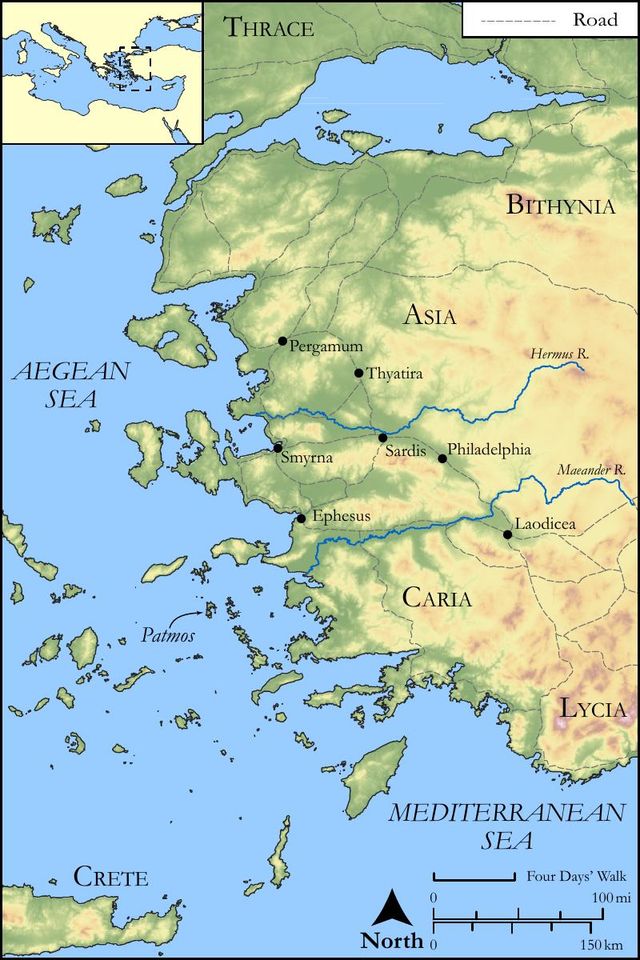
See on the biblical-era map

Study this verse
Public-domain commentary
Matthew Henry
From his Commentary on the Whole Bible. Henry comments on passages, not single verses — this entry covers Revelation 5:1–5. His two-level outline is real structure in the source text, so it is rendered as structure.
Hitherto the apostle had seen only the great God, the governor of all things, now,
I.He is favoured with a sight of the model and methods of his government, as they are all written down in a book which he holds in his hand; and this we are now to consider as shut up and sealed in the hand of God. Observe,
1.The designs and methods of divine Providence towards the church and the world are stated and fixed; they are resolved upon and agreed to, as that which is written in a book. The great design is laid, every part adjusted, all determined, and every thing passed into decree and made a matter of record. The original and first draught of this book is the book of God's decrees, laid up in his own cabinet, in his eternal mind: but there is a transcript of so much as was necessary to be known in the book of the scriptures in general, in the prophetical part of the scripture especially, and in this prophecy in particular.
2.God holds this book in his right hand, to declare the authority of the book, and his readiness and resolution to execute all the contents thereof, all the counsels and purposes therein recorded.
3.This book in the hand of God is shut up and sealed; it is known to none but himself, till he allows it to be opened. Known unto God, and to him alone, are all his works, from the beginning of the world; but it is his glory to conceal the matter as he pleases. The times and seasons, and their great events, he hath kept in his own hand and power.
4.It is sealed with seven seals. This tells us with what inscrutable secrecy the counsels of God are laid, how impenetrable by the eye and intellect of the creature; and also points us to seven several parts of this book of God's counsels. Each part seems to have its particular seal, and, when opened, discovers its proper events; these seven parts are not unsealed and opened at once, but successively, one scene of Providence introducing another, and explaining it, till the whole mystery of God's counsel and conduct be finished in the world.
II.He heard a proclamation made concerning this sealed book.
1.The crier was a strong angel; not that there are any weak ones among the angels in heaven, though there are many among the angels of the churches. This angel seems to come out, not only as a crier, but as a champion, with a challenge to any or all the creatures to try the strength of their wisdom in opening the counsels of God; and, as a champion, he cried with a loud voice, that every creature might hear.
2.The cry or challenge proclaimed was, "Who is worthy to open the book, and to loose the seals thereof? Rev 5:2. If there by any creature who thinks himself sufficient either to explain or execute the counsels of God, let him stand forth, and make the attempt." 3. None in heaven or earth could accept the challenge and undertake the task: none in heaven, none of the glorious holy angels, though before the throne of God, and the ministers of his providence; they with all their wisdom cannot dive into the decrees of God: none on earth, no man, the wisest or the best of men, none of the magicians and soothsayers, none of the prophets of God, any further than he reveals his mind to them: none under the earth, none of the fallen angels, none of the spirits of men departed, though they should return to our world, can open this book. Satan himself, with all his subtlety, cannot do it; the creatures cannot open it, nor look on it; they cannot read it. God only can do it.
III.He felt a great concern in himself about this matter:
the apostle wept much; it was a great disappointment to him. By what he had seen in him who sat upon the throne, he was very desirous to see and know more of his mind and will: this desire, when not presently gratified, filled him with sorrow, and fetched many tears from his eyes. Here observe,
1.Those who have seen most of God in this world are most desirous to see more; and those who have seen his glory desire to know his will.
2.Good men may be too eager and to hasty to look into the mysteries of divine conduct.
3.Such desires, not presently answered, turn to grief and sorrow. Hope deferred makes the heart sick.
IV.The apostle was comforted and encouraged to hope this sealed book would yet be opened. Here observe,
1.Who it was that gave John the hint: One of the elders. God had revealed it to his church. If angels do not refuse to learn from the church, ministers should not disdain to do it. God can make his people to instruct and inform their teachers when he pleases.
2.Who it was that would do the thing - the Lord Jesus Christ, called the lion of the tribe of Judah, according to his human nature, alluding to Jacob's prophecy (Gen 49:10), and the root of David according to his divine nature, though a branch of David according to the flesh. He who is a middle person, God and man, and bears the office of Mediator between God and man, is fit and worthy to open and execute all the counsels of God towards men. And this he does in his mediatorial state and capacity, as the root of David and the offspring of Judah, and as the King and head of the Israel of God; and he will do it, to the consolation and joy of all his people.
Historical interpretation
Eleven Centuries of Reception
16 surviving comments on this verse. Each one is dated, so this reads as a timeline rather than a list.
Select a marker to jump to its quote. Markers stagger vertically where authors wrote within a few decades of each other.
Now, as our Lord Jesus Christ, who is also God, was prophesied of under the figure of a lion, on account of His royalty and glory, in the same way have the Scriptures also aforetime spoken of Antichrist as a lion, on account of his tyranny and violence. For the deceiver seeks to liken himself in all things to the Son of God. Christ is a lion, so Antichrist is also a lion; Christ is a king, so Antichrist is also a king. The Saviour was manifested as a lamb; so he too, in like manner, will appear as a lamb, though within he is a wolf. The Saviour came into the World in the circumcision, and he will come in the same manner. The Lord sent apostles among all the nations, and he in like manner will send false apostles. The Saviour gathered together the sheep that were scattered abroad, and he in like manner will bring together a people that is scattered abroad. The Lord gave a seal to those who believed on Him, and he will give one like manner. The Saviour appeared in the form of man, and he too will come in the form of a man. The Saviour raised up and showed His holy flesh like a temple, and he will raise a temple of stone in Jerusalem.
"Lo, the Lion of the tribe of Judah, the root of David, hath prevailed." We read in Genesis that this lion of the tribe of Judah hath conquered, when the patriarch Jacob says, "Judah, thy brethren shall praise thee; thou hast lain down and slept, and hast risen up again as a lion, and as a lion's whelp." For He is called a lion for the overcoming of death; but for the suffering for men He was led as a lamb to the slaughter. But because He overcame death, and anticipated the duty of the executioner, He was called as it were slain. He therefore opens and seals again the testament, which He Himself had sealed. The legislator Moses intimating this, that it behoved Him to be sealed and concealed, even to the advent of His passion, veiled his face, and so spoke to the people; showing that the words of his announcement were veiled even to the advent of His time. For he himself, when he had read to the people, having taken the wool purpled with the blood of the calf, with water sprinkled the whole people, saying, "This is the blood of His testament who hath purified you." It should therefore be observed that the Man is accurately announced, and that all things combine into one. For it is not sufficient that that law is spoken of, but it is named as a testament. For no law is called a testament, nor is any thing else called a testament, save what persons make who are about to die. And whatever is within the testament is sealed, even to the day of the testator's death. Therefore it is with reason that it is only sealed by the Lamb slain, who, as it were a lion, has broken death in pieces, and has fulfilled what had been foretold; and has delivered man, that is, the flesh, from death, and has received as a possession the substance of the dying person, that is, of the human members; that as by one body all men had fallen under the obligation of its death, also by one body all believers should be born again unto life, and rise again. Reasonably, therefore, His face is opened and unveiled to Moses; and therefore He is called Apocalypse, Revelation. For now His book is unsealed-now the offered victims are perceived-now the fabrication of the priestly chrism; moreover the testimonies are openly understood.
In this one elder we recognize the whole body of the prophets, for their prophecies consoled the church as they foretold that Christ would come from the tribe of Judah and would redeem the world by his own blood. Of him it was foretold: “Judah is a lion’s whelp. For prey, my son, you have gone up. You lie in wait as a lion and as a lioness. Who will rouse him up?” Moreover, the same one is taught to be a lamb as well as a lion, for he assumed death with a devout innocence, even as he killed with power the death he had assumed. To death he had long ago truly issued threats, saying through Hosea, “I will be your death, O death, I will be your sting, O hades.” And through Isaiah, “Behold, the root of Jesse will rise for the salvation of the people. The nations will entreat him, and his sepulcher will be glorious.” For when anyone of the faithful individually and earnestly weeps for his or her own sins and recalls the promises of redemption “through the consolation of the Scriptures,” [that person] will recognize that he or she has the hope of eternal salvation. As I say, by one of the elders this is confirmed with a similar response. For this reason, he mentions what is past while he is also promising the future, because in the things of the past the Spirit shows future things by way of subtle hints.
behold the lion. the death of Christ marked the defeat and the triumph over the demons. In fact, our Lion had captured all the prey that the hostile lion had conquered after destroying and crushing the man. Then, by coming back from the underworld and ascending on high, he made slavery his captive. Therefore in his sleep the Lion won and defeated every evil and destroyed the one who had the power of death. (Blessing of the Patriarchs 1.6)
[Daniel 12:4] "But Thou, O Daniel, shut up the words and seal the book, even to the time appointed. Many shall pass over, and knowledge shall be manifold." He who had revealed manifold truth to Daniel now signifies that the things he has said are matters of secrecy, and he orders him to roll up the scroll containing his words and set a seal upon the book, with the result that many shall read it and inquire as to its fulfilment in history, differing in their opinions because of its great obscurity. And as for the statement, "Many shall pass over" or "go through," this indicates that it will be read by many people. For it is a familiar expression to say: "I have gone through a book," or, "I have passed through an historical account." Indeed this is the idea which Isaiah also expressed in regard to the obscurity of his own book: "And the sayings of that book shall be like the words of a book that is sealed. And if they shall give it to an illiterate man, saying, 'Read it,' he will reply, 'I do not know how to read.' But if they give it to a man who does know how to read and say, 'Read the book,' he will reply, 'I cannot read it, because it is sealed up'" (Isaiah 29:11-12). Also in the Revelation of John, there is a book seen which is sealed with seven seals inside and outside. And when no one proves able to break its seals, John says, "I wept sore; and a voice came to me, saying, 'Weep not: behold the Lion of the tribe of Judah, the Root of David, has prevailed to open the book and break its seals'" (Revelation 5:1-5). But that book can be opened by one who has learned the mysteries of Scripture and understands its hidden truths, and its words which seem dark because of the greatness of the secrets they contain. He it is who can interpret the parables and transmute the letter which killeth into the spirit which quickeneth.
[Daniel 7:9] "I beheld until thrones were set up, and the Ancient of days took His seat. His garment was as white as snow, and the hair of His head was like pure wool. His throne was composed of fiery flames and its wheels were set on fire. From before His presence there issued forth a rushing, fiery stream." We read something similar in John's Apocalypse: "After these things I was immediately in the Spirit, and lo, a throne was set up in heaven, and one was seated upon the throne; and He who sat upon it had the likeness of jasper and sardine stone, and there was a rainbow round about the throne like the appearance of emerald. Around the throne there were twenty-four other thrones, and upon the twenty-four thrones there sat twenty-four elders, clothed in shining garments; upon their heads was a golden crown, and lightning flashes issued from the throne, and voices and thunder. And in front of the throne there were seven torches of burning fire, which were the seven spirits of God. And in front of the throne lay a glassy sea like unto crystal." (Revelation 4:2-6) And so the many thrones which Daniel saw seem to me to be what John called the twenty-four thrones. And the Ancient of days is the One who, according to John sits alone upon His throne. Likewise the Son of man, who came unto the Ancient of days, is the same as He who, according to John, is called the Lion of the tribe of Judah, the Root of David, and the titles of that sort (Revelation 5:5). I imagine that these thrones are the ones of which the Apostle Paul says, "Whether thrones or dominions..." (Colossians 1:16). And in the Gospel we read, "Ye yourselves shall sit upon twelve thrones, judging the twelve tribes of Israel" (Matthew 19:28). And God is called the One who sits and who is the Ancient of days, in order that His character as eternal Judge might be indicated. His garment is shining white like the snow, and the hair of His head is like pure wool. The Savior also, when He was transfigured on the mount and assumed the glory of His divine majesty, appeared in shining white garments (Matthew 17:2). And as for the fact that His hair is compared to perfectly pure wool, the even-handedness and uprightness of His judgment is shown forth, a judgment which shows no partiality in its exercise. Moreover He is described as an elderly man, in order that the ripeness of His judgment may be established. His throne consists of fiery flames, in order that sinners may tremble before the severity of the torments, and also that the just may be saved, but so as by fire. The wheels of the throne are set aflame, or else it is the wheels of His chariot which are aflame. In Ezekiel also God is ushered on the scene seated in a four-horse chariot (Ezekiel 1:4-28), and everything pertaining to God is of a fiery consistency. In another place also a statement is made on this subject: "God is a consuming fire" (Deuteronomy 4:24), that we might know that wood, hay and stubble are going to burn up in the day of judgment. And in the Psalms we read: "Fire goeth before Him, and He shall set aflame all His enemies round about Him" (Psalm 97:3). A rushing, fiery stream proceeded from before Him in order that it might carry sinners to hell (Gehenna).
So the true victory of our Lord Jesus Christ was achieved when he rose again and ascended into heaven. Then was fulfilled what you heard when the Apocalypse was read, “The lion from the tribe of Judah has conquered.” It is he that is called a lion, he that is called a lamb. He is called a lion for courage, a lamb for innocence. A lion because unconquered, a lamb because gentle. And when this lamb was slain, he conquered by his death the lion “who prowls around seeking whom he may devour.” The devil, you see, is called a lion for his ferocity, not for any virtue. Thus the apostle Peter says we must be on the watch against temptations, “because your adversary the devil is prowling around seeking whom he may devour”; but he did say how he prowls around: “Like a roaring lion he is prowling around, seeking whom he may devour.” Who could avoid encountering the teeth of this lion, if the lion from the tribe of Judah had not conquered? Against the lion fights a lion, against the world a lamb. The devil was exultant when Christ died, and by that very death of Christ was the devil conquered. It’s as though he took the bait in a mousetrap. He was delighted at the death, as being the commander of death. What he delighted in, that’s where the trap was set for him. The mousetrap for the devil was the cross of the Lord. The bait he would be caught by, the death of the Lord. And our Lord Jesus Christ rose again.
“Like a sheep he was led to be slaughtered, and like a lamb in the presence of his shearer he was without voice, thus he did not open his mouth Who is this?.” Obviously the one about whom he goes on to say, “In humility his judgment was taken away. His generation, who shall relate?” I can see this model of such humility in a king of such power and authority. Because this one, who is like a lamb not opening its mouth in the presence of the shearer, is himself “the lion from the tribe of Judah.” Who is this, both lamb and lion? He endured death as a lamb; he devoured it as a lion. Who is this, both lamb and lion? Gentle and strong, lovable and terrifying, innocent and mighty, silent when he was being judged, roaring when he comes to judge. Or perhaps both in his passion lamb and lion, and also in his resurrection lamb and lion. Let us see him as a lamb in his passion. It was stated a moment ago: “Like a lamb in the presence of his shearer he was without voice, thus he did not open his mouth.” Let us see him as a lion in his passion; Jacob said, “You have gone up, lying down you have slept like a lion.” Let us see him as a lamb in his resurrection. The book of Revelation, when it was talking about the eternal glory of virgins, “They follow the lamb, it is said, wherever he goes.” The same book of Revelation says, what I mentioned just now, “The lion from the tribe of Judah has conquered, to open the book.” Why a lamb in his passion? Because he underwent death without being guilty of any iniquity. Why a lion in his passion? Because in being slain he slew death. Why a lamb in his resurrection? Because his innocence is everlasting. Why a lion in his resurrection? Because everlasting also is his might.
has prevailed to open the book. because He is the Creator of all things and the wonderful Sustainer of everything.
one of the ancients. this signifies the message of holy Scripture.
behold the lion. the lion has magnanimity; it has also ferocity; by its magnanimity then it represents the Lord. (Morals 5.21)
And one of the elders said to me: Weep not, etc. He is forbidden to weep, because the mystery that had long been hidden was already fulfilled in the passion of Christ, when He gave up the spirit and the veil of the temple was torn (Mark 15). To whom it is said: You are a lion’s cub, O Judah; you have gone up to the prey, my son (Gen. 49), etc. He follows and describes how and where the Lion of the tribe of Judah conquered.
And one of the ancients said to me: Weep not; behold the lion of the tribe of Juda, the root of David, hath prevailed to open the book, and to loose the seals thereof. By this ancient we understand the order of the prophets, by whose prophecies the Church was comforted, as in The sceptre shall not be taken away from Juda, nor a ruler from his thighs, till he come that is to be sent. [Gen. 49:10] Note also that Christ is here called a lion because he overcame the Devil, while in the following verse he is called a lamb because he redeemed the world by sacrificing himself. As for the root of David, it means the kin and son of David. Moreover it should be noted that in the words hath prevailed, he used the past for the future, as in They have dug my hands, etc. [Ps. 21:17]
Then one of the elders said to me, "Do not weep! Behold, the Lion from the tribe of Judah, the Root of David, has triumphed to open the seven seals of the little scroll." He said, He who has overcome our conqueror (the Devil), this one who opened the little scroll and the seals.
Who is the lion of the tribe of Judah, but certainly Christ, concerning whom the patriarch Jacob said: "He crouched like a lion and like a young lion; who will rouse him?" (Gen. 49:9) And that the Lord arose according to the flesh from Judah, the divine apostle testified, saying it is evident that our Lord Jesus Christ arose from Judah (Heb. 7:14); and one might marvel why he did not say "a rod from the root of Jesse," nor "a flower from the root," as Isaiah said (Isa. 11:1), but rather "the Root of David." He says this, showing that according to the human aspect, the rod was from the root of Jesse and David sprouting forth; but according to the divine aspect, the root itself is not only David, but of all visible and invisible creation, being the cause of all things, as has been stated before.
lion of the tribe of Juda, the root of David. That is, descending from the root of David according to the flesh, as it was prophesied in Is. 11, “A shoot shall come out from the stump of Jesse, and a branch shall grow out of his roots.
one of the ancients. Who this elder was is not said. Some say that he was Matthew, the evangelist.
Continue studying Revelation 5:5 across the web’s major study libraries — every link below opens this exact verse, chapter, or book on the destination site.
Read & Compare
 BibleGatewayThis verse in more than 200 translations and 70 languages.
 Bible.comThe YouVersion reader — hundreds of translations, reading plans, and highlights.
 ESV.orgCrossway's official English Standard Version reader.
 NET BibleThe NET translation with 60,000+ translators' notes on every rendering decision.
 STEP BibleTyndale House's free study tool — original text, vocabulary, and scholarly resources.
 BibliaLogos Bible Software's free web reader.
 USCCBThe New American Bible (Revised Edition) with the U.S. bishops' study notes.
Commentaries
 BibleHub CommentariesDozens of classic commentaries on this verse, gathered on one page.
 StudyLightMore than 100 commentary sets — the largest collection on the web.
 BibleRefPlain-English commentary on what this verse means, verse by verse.
 Enduring WordDavid Guzik's free commentary on this chapter, widely used by Bible teachers.
 Bible Study ToolsVerse commentary alongside Greek and Hebrew study aids.
Original Language & Research
- BibleHub InterlinearThe verse word by word — original language, transliteration, and English.
- BibleHub LexiconEvery word's original-language definition and Strong's entry.
 Blue Letter BibleDeep-study tools — Strong's numbers, concordance, and word studies.
 CNTR CollationThe earliest Greek manuscripts of this verse, collated letter by letter.
Sermons, Hymns & Audio


TrulyRandomVerse is not affiliated with these sites and doesn’t control their content. They’re linked because they’re genuinely useful.
Summary
Revelation 5:5 marks a pivotal moment in John's apocalyptic vision, transitioning from profound despair to triumphant hope. As John weeps over the apparent inability of anyone to open the divinely sealed scroll, an elder reassures him by identifying the sole worthy figure: Jesus Christ, who is powerfully described by two messianic titles – "the Lion of the tribe of Juda" and "the Root of David" – signifying His unique authority and victorious work in prevailing to unlock God's redemptive and judgmental plan for all creation.
Context
ShowHideLiterary Context
This verse serves as the immediate resolution to the dramatic tension established in the preceding verses of Revelation 5. In Revelation 5:1, John sees a scroll in the right hand of God, sealed with seven seals, representing God's sovereign plan for history and salvation. A mighty angel then issues a challenge in Revelation 5:2, asking who is worthy to open the scroll and look into it. The subsequent search, spanning heaven, earth, and under the earth, yields no one found worthy, leading to John's intense weeping in Revelation 5:4. It is at this moment of profound despondency that the elder speaks, introducing the victorious Lion-Lamb who alone possesses the credentials to execute God's will, thus shifting the narrative from crisis to Christ-centered triumph.
Historical & Cultural Context
The titles "Lion of the tribe of Juda" and "Root of David" are deeply rooted in Old Testament messianic expectation, resonating strongly with a Jewish audience. The "Lion of Judah" recalls Jacob's prophecy in Genesis 49:9-10, where Judah is depicted as a lion, symbolizing strength, royalty, and leadership, from whose lineage a ruler would come. This prophecy was understood to point to the Davidic dynasty and ultimately to the Messiah. The "Root of David" (or Root of Jesse, David's father) directly references prophecies in Isaiah 11:1 and Isaiah 11:10, which foretold a future ruler who would spring from David's line, bringing justice, peace, and serving as a banner for the nations. These titles would immediately signify to John and his contemporary readers the long-awaited Messiah, a figure of both royal authority and divine origin, capable of fulfilling God's covenant promises and executing His ultimate plan.
Key Themes
ShowHideThis verse powerfully contributes to several overarching themes within the book of Revelation and biblical theology. Firstly, it underscores the sovereignty and divine plan of God, emphasizing that despite apparent obstacles, God's purposes will be perfectly executed by the one He has appointed. Secondly, it highlights the unique worthiness and authority of Jesus Christ, presenting Him as the central figure in cosmic history, the only one capable of unveiling and enacting God's end-time purposes. This theme is immediately juxtaposed with the image of the Lamb in Revelation 5:6, revealing that Christ's worthiness stems from His redemptive sacrifice. Thirdly, the verse introduces the theme of triumph over despair, as John's weeping is met with a declaration of Christ's victory, assuring believers that ultimate victory belongs to God and His Messiah, even amidst tribulation. Finally, it reinforces the continuity of God's covenant promises, demonstrating how Old Testament prophecies about the Messiah's lineage and reign find their ultimate fulfillment in Jesus.
Exposition and Analysis
ShowHideKey Word Analysis
ShowHideThis term, a primary word for "lion," signifies power, majesty, and kingship. In the context of "the tribe of Juda," it directly alludes to Genesis 49:9-10, where Judah is prophesied to be a lion's whelp, from whom a scepter will not depart until Shiloh comes. Thus, the "Lion of the tribe of Juda" points to Christ's royal authority, His Davidic lineage, and His conquering power, embodying the fulfillment of ancient messianic expectations for a king who would rule with strength and justice.
This word, meaning "root" literally or figuratively, refers to origin, source, or foundation. When applied to "David," it connects to Old Testament prophecies, particularly Isaiah 11:1 and Isaiah 11:10, which speak of a "root of Jesse" (David's father) who would arise. This title emphasizes Christ's divine origin and His role as the source and sustainer of David's royal line, not merely a descendant. He is the very foundation from which the Davidic covenant springs and the one who gives it ultimate meaning and fulfillment.
Derived from the Greek word for victory (níkē), this verb means "to subdue, conquer, overcome, or get the victory." In this context, it signifies Christ's decisive and complete triumph over all obstacles, including sin, death, and the powers of darkness. His prevailing is what makes Him uniquely worthy to open the scroll and loose its seals. This victory was not achieved through earthly conquest but through His sacrificial death and glorious resurrection, which are further elaborated in the subsequent verses of Revelation 5.
Verse Breakdown
ShowHide"And one of the elders saith unto me, Weep not:"
This opening phrase immediately addresses John's profound despair, providing comfort and a turning point in the vision. The elder, likely representing the redeemed church or heavenly beings, serves as an interpreter and guide for John, reassuring him that the situation is not hopeless.
"behold, the Lion of the tribe of Juda, the Root of David,"
This is the core identification of the worthy one. "Behold" (Greek, idoú) draws John's attention to a significant revelation. The two titles are powerful messianic designations, affirming Jesus' identity as the prophesied King, embodying both the strength and royal lineage promised in the Old Testament.
"hath prevailed to open the book, and to loose the seven seals thereof."
This declares the reason for Christ's worthiness and the scope of His authority. His "prevailing" (Greek, nikáō) refers to His victory over sin and death through His crucifixion and resurrection. This triumph has granted Him the unique right and power to "open the book" (Greek, biblíon, a scroll) and "loose the seven seals" (Greek, sphragís, signets), thereby initiating the unfolding of God's sovereign plan for history, judgment, and redemption.
Literary Devices
ShowHideRevelation 5:5 is rich with Symbolism and Metaphor, primarily through the dual titles ascribed to Jesus. The "Lion of the tribe of Juda" is a powerful metaphor for Christ's kingly authority, strength, and conquering nature, drawing directly from the tribal emblem of Judah and its prophetic association with royalty in Genesis 49:9-10. Similarly, "the Root of David" functions as a metaphor and symbol for Christ's divine origin and His role as the source and fulfillment of the Davidic covenant, echoing prophecies in Isaiah 11:1 and Isaiah 11:10. The contrast between John's weeping and the elder's declaration of Christ's triumph creates dramatic irony and highlights the sudden shift from despair to hope. The "book" and "seven seals" are themselves potent symbols of God's sovereign plan and the hidden mysteries of His will, which only Christ can reveal and enact.
Theological and Thematic Connections
ShowHideRevelation 5:5 is a profound theological statement on the person and work of Jesus Christ, affirming His unique qualifications as the one mediating God's ultimate plan. It establishes that Christ's worthiness to execute divine judgment and redemption is rooted in His victorious life, sacrificial death, and glorious resurrection. He is not merely a powerful figure, but the fulfillment of centuries of messianic prophecy, embodying both the majestic power of a conquering king and the foundational lineage that connects Him to God's covenant promises. This verse sets the stage for the revelation of Christ as the Lamb who was slain, demonstrating that His triumph was achieved not through brute force, but through self-sacrificial love, making Him the only one capable of opening the scroll of destiny.
Reflection and Application
ShowHideRevelation 5:5 offers immense comfort and profound assurance to believers facing uncertainty, fear, or the apparent chaos of the world. In moments when we, like John, might weep over seemingly insurmountable problems or the unfolding of difficult global events, this verse powerfully reminds us that Jesus Christ, the majestic "Lion of the tribe of Juda" and the foundational "Root of David," has already prevailed. His victory is comprehensive, securing His authority over all history and the future. We are called to place our trust in His supreme worthiness and sovereign control, knowing that His ultimate triumph over all evil, sin, and despair is guaranteed. This truth allows us to live with hope, courage, and a deep sense of peace, understanding that God's perfect plan of salvation and justice will be accomplished through Christ, who holds the keys to all things.
This assurance is deepened when we reflect on the multifaceted nature of the One in whom we trust. The Lion who conquers is also the "Good Shepherd" who gives His life for the sheep (John 10:11) and the "Bishop of your souls" (1 Peter 2:25). When we feel spiritually depleted, we can turn to Him as the "Bread of Life" (John 6:35) and the "Fountain of Living Waters" (Jeremiah 17:13). In times of confusion, He is "The Way, the Truth & the Life" (John 14:6) and our "Wonderful Counsellor" (Isaiah 9:6). Even in our deepest darkness, we look to Him as "The Bright & Morning Star" (Revelation 22:16) and the "Dayspring from on high" (Luke 1:78-79) who guides our feet into peace. Our confidence is built not on a distant deity, but on the "Chief Cornerstone" (Ephesians 2:20) and the "Author & Finisher of Our Faith" (Hebrews 12:2).
Questions for Reflection
ShowHideFAQ
ShowHideWhat is the significance of Jesus being called "the Lion of the tribe of Juda" and "the Root of David"?
ShowHideThese two titles are profoundly significant messianic designations rooted in Old Testament prophecy. "The Lion of the tribe of Juda" connects Jesus to Genesis 49:9-10, where Jacob prophesies that a ruler will come from Judah's lineage, described as a lion. This signifies Jesus' royal authority, power, and conquering nature as the King of kings. "The Root of David" refers to prophecies in Isaiah 11:1 and Isaiah 11:10, which speak of a new shoot or root from the line of Jesse (David's father). This title emphasizes Jesus' divine origin, His role as the source and sustainer of David's royal line, and His fulfillment of God's covenant with David. Together, they powerfully affirm Jesus' identity as the long-awaited Messiah, who is both fully divine and fully human, with the authority to execute God's plan.
Christ-Centered Fulfillment
ShowHideRevelation 5:5 serves as a profound Christ-centered fulfillment of Old Testament prophecy and a central declaration of Christ's unique worthiness. The "Lion of the tribe of Juda" is a direct allusion to Genesis 49:9-10, where Jacob foretells a ruler from Judah's lineage. This prophecy finds its ultimate fulfillment in Jesus, the King who triumphs over all, not through earthly might but through His sacrificial love and resurrection. Similarly, "the Root of David" echoes prophecies from Isaiah 11:1 and Isaiah 11:10, identifying Jesus as the one who springs forth from David's lineage to establish an eternal kingdom. This is affirmed throughout the New Testament, where Jesus is consistently presented as the Son of David, the rightful heir to the throne (Matthew 1:1, Romans 1:3). His "prevailing" to open the scroll is not merely a symbolic act, but the direct consequence of His finished work on the cross and His resurrection, by which He conquered sin, death, and the grave (Colossians 2:15, Hebrews 2:14-15). Thus, the Lion of Judah, the Root of David, is ultimately the Lamb who was slain (Revelation 5:6), whose victory through sacrifice makes Him uniquely worthy to unveil and execute God's sovereign plan for all creation, culminating in His eternal reign (Philippians 2:9-11).