


Revelation 5:6
Bible text: King James Version (1769 Blayney text) · Public domain
Bible text: King James Version with Strong's numbers · Public domain
Bible text: Berean Standard Bible · Public domain
Bible text: American Standard Version (1901) · Public domain
Bible text: World English Bible, Messianic edition · Public domain
Bible text: Geneva Bible (1599) · Public domain
Bible text: Young's Literal Translation · Public domain
- καὶkaiAndG2532CONJConjunction
- εἶδονeidonI sawG1492V-2AAI-1SVerb 2nd Aorist Active Indicative 1st Singular
- καὶkaiandG2532CONJConjunction
- ἰδούidoubeholdG2400INJInterjection
- ἐνeninG1722PREPPreposition
- μέσῳmesō[the] midstG3319A-DSNAdjective Dative Singular Neuter
- τοῦtouof theG3588T-GSMDefinite article Genitive Singular Masculine
- θρόνουthronouthroneG2362N-GSMNoun Genitive Singular Masculine
- καὶkaiandG2532CONJConjunction
- τῶνtōnof theG3588T-GPNDefinite article Genitive Plural Neuter
- τεσσάρωνtessarōnfourG5064A-GPNAdjective Genitive Plural Neuter
- ζῴωνzōōnliving creaturesG2226N-GPNNoun Genitive Plural Neuter
- καὶkaiandG2532CONJConjunction
- ἐνeninG1722PREPPreposition
- μέσῳmesō[the] midstG3319A-DSNAdjective Dative Singular Neuter
- τῶνtōnof theG3588T-GPMDefinite article Genitive Plural Masculine
- πρεσβυτέρωνpresbuterōneldersG4245N-GPMNoun Genitive Plural Masculine
- ἀρνίονarniona LambG721N-NSNNoun Nominative Singular Neuter
- ἑστηκὸςhestēkosstandingG2476V-RAP-NSNVerb Perfect Active Participle Nominative Singular Neuter
- ὡςhōsasG5613PRTParticle or Disjunctive
- ἐσφαγμένονesphagmenonslainG4969V-RPP-NSNVerb Perfect Passive Participle Nominative Singular Neuter
- ἔχωνechōnhavingG2192V-PAP-NSMVerb Present Active Participle Nominative Singular Masculine
- κέραταkeratahornsG2768N-APNNoun Accusative Plural Neuter
- ἑπτὰheptasevenG2033A-NUIAdjective
- καὶkaiandG2532CONJConjunction
- ὀφθαλμοὺςophthalmouseyesG3788N-APMNoun Accusative Plural Masculine
- ἑπτὰheptasevenG2033A-NUIAdjective
- οἵoiwhichG3739R-NPMRelative pronoun Nominative Plural Masculine
- εἰσινeisinareG1510V-PAI-3PVerb Present Active Indicative 3rd Plural
- τὰtatheG3588T-NPNDefinite article Nominative Plural Neuter
- ἑπτὰheptasevenG2033A-NUIAdjective
- πνεύματαpneumataSpiritsG4151N-NPNNoun Nominative Plural Neuter
- τοῦtou<the>G3588T-GSMDefinite article Genitive Singular Masculine
- θεοῦtheouof GodG2316N-GSM-TNoun Genitive Singular Masculine Title
- τὰtawhichG3588T-NPNDefinite article Nominative Plural Neuter
- ἀπεσταλμένοιapestalmenoisent outG649V-RPP-NPMVerb Perfect Passive Participle Nominative Plural Masculine
- εἰςeisintoG1519PREPPreposition
- πᾶσανpasanallG3956A-ASFAdjective Accusative Singular Feminine
- τὴνtēntheG3588T-ASFDefinite article Accusative Singular Feminine
- γῆνgēnearthG1093N-ASFNoun Accusative Singular Feminine
English is a literal word-by-word gloss of the Greek, not the KJV's wording. Why?
This is the original text the KJV's translators worked from — each Greek word with its own literal English meaning in this verse, prepared by scholars at Tyndale House, Cambridge. The KJV translates whole sentences, not word by word, so its wording differs: one Greek word can become several English words, and the KJV may choose “charity” where the gloss reads “love”. Both are faithful — they answer different questions. For the KJV's own rendering, switch to the KJV text.
Details
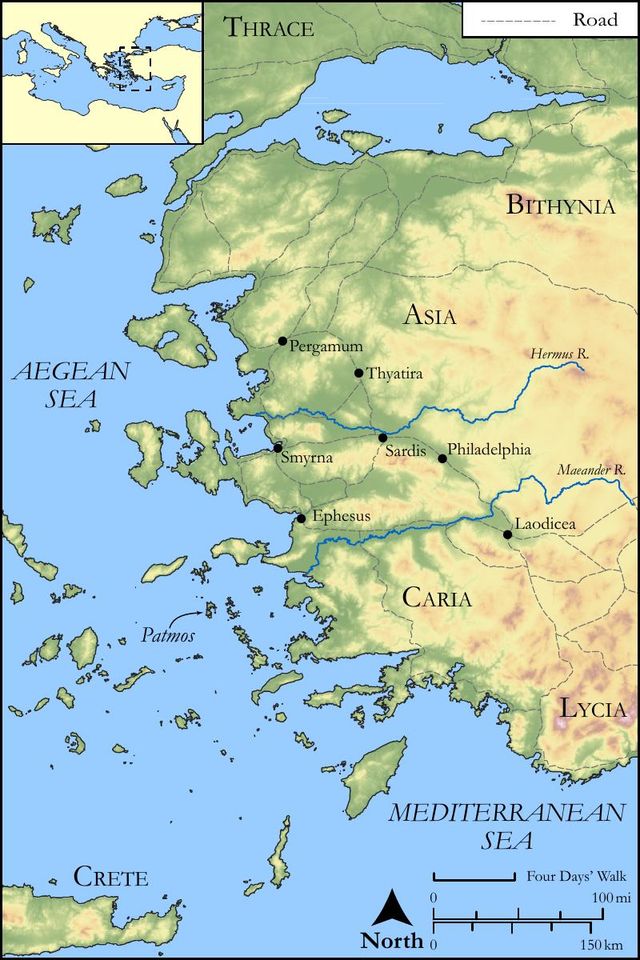
See on the biblical-era maps

Study this verse
Public-domain commentary
Matthew Henry
From his Commentary on the Whole Bible. Henry comments on passages, not single verses — this entry covers Revelation 5:6–14. His four-level outline is real structure in the source text, so it is rendered as structure.
Here, I. The apostle beholds this book taken into the hands of the Lord Jesus Christ, in order to its being unsealed and opened by him. Here Christ is described, 1. By his place and station: In the midst of the throne, and of the four beasts, and of the elders. He was on the same throne with the Father; he was nearer to him than either the elders or ministers of the churches. Christ, as man and Mediator, is subordinate to God the Father, but is nearer to him than all the creatures; for in him all the fulness of the Godhead dwells bodily. The ministers stand between God and the people. Christ stands as the Mediator between God and both ministers and people. 2. The form in which he appeared. Before he is called a lion; here he appears as a lamb slain. He is a lion to conquer Satan, a lamb to satisfy the justice of God. He appears with the marks of his sufferings upon him, to show that he interceded in heaven in the virtue of his satisfaction. He appears as a lamb, having seven horns and seven eyes, perfect power to execute all the will of God and perfect wisdom to understand it all and to do it in the most effectual manner; for he hath the seven Spirits of God, he has received the Holy Spirit without measure, in all perfection of light, and life, and power, by which he is able to teach and rule all parts of the earth. 3. He is described by his act and deed: He came, and took the book out of the right hand of him that sat on the throne (Rev 5:7), not by violence, nor by fraud, but he prevailed to do it (as Rev 5:5), he prevailed by his merit and worthiness, he did it by authority and by the Father's appointment. God very willingly and justly put the book of his eternal counsels into the hand of Christ, and Christ as readily and gladly took it into his hand; for he delights to reveal and to do the will of his Father.
II.The apostle observes the universal joy and thanksgiving that filled heaven and earth upon this transaction.
No sooner had Christ received this book out of the Father's hand than he received the applauses and adorations of angels and men, yea, of every creature. And, indeed, it is just matter of joy to all the world to see that God does not deal with men in a way of absolute power and strict justice, but in a way of grace and mercy through the Redeemer. He governs the world, not merely as a Creator and Lawgiver, but as our God and Saviour. All the world has reason to rejoice in this. The song of praise that was offered up to the Lamb on this occasion consists of three parts, one part sung by the church, another by the church and the angels, the third by every creature.
1.The church begins the doxology, as being more immediately concerned in it (Rev 5:8), the four living creatures, and the four-and-twenty elders, the Christian people, under their minister, lead up the chorus. Here observe,
(1.)The object of their worship - the Lamb, the Lord Jesus Christ; it is the declared will of God that all men should honour the Son as they honour the Father; for he has the same nature.
(2.)Their posture: They fell down before him, gave him not an inferior sort of worship, but the most profound adoration.
(3.)The instruments used in their adorations - harps and vials; the harps were the instruments of praise, the vials were full of odours or incense, which signify the prayers of the saints: prayer and praise should always go together.
(4.)The matter of their song: it was suited to the new state of the church, the gospel-state introduced by the Son of God. In this new song,
[1.]They acknowledge the infinite fitness and worthiness of the Lord Jesus for this great work of opening and executing the counsel and purposes of God (Rev 5:9): Thou art worthy to take the book, and to open the seals thereof, every way sufficient for the work and deserving the honour.
[2.]They mention the grounds and reasons of this worthiness; and though they do not exclude the dignity of his person as God, without which he had not been sufficient for it, yet they chiefly insist upon the merit of his sufferings, which he had endured for them; these more sensibly struck their souls with thankfulness and joy. Here, First, They mention his suffering: "Thou wast slain, slain as a sacrifice, thy blood was shed." Secondly, The fruits of his sufferings. 1. Redemption to God; Christ has redeemed his people from the bondage of sin, guilt, and Satan, redeemed them to God, set them at liberty to serve him and to enjoy him. 2. High exaltation: Thou hast made us to our God kings and priests, and we shall reign on the earth, Rev 5:10. Every ransomed slave is not immediately preferred to honour; he thinks it a great favour to be restored to liberty. But when the elect of God were made slaves by sin and Satan, in every nation of the world, Christ not only purchased their liberty for them, but the highest honour and preferment, made them kings and priests - kings, to rule over their own spirits, and to overcome the world, and the evil one; and he has made them priests, given them access to himself, and liberty to offer up spiritual sacrifices, and they shall reign on the earth; they shall with him judge the world at the great day.
2.The doxology, thus begun by the church, is carried on by the angels; they take the second part, in conjunction with the church, Rev 5:11. They are said to be innumerable, and to be the attendants on the throne of God and guardians to the church; though they did not need a Saviour themselves, yet they rejoice in the redemption and salvation of sinners, and they agree with the church in acknowledging the infinite merits of the Lord Jesus as dying for sinners, that he is worthy to receive power, and riches, and wisdom, and strength, and honour, and glory, and blessing.
(1.)He is worthy of that office and that authority which require the greatest power and wisdom, the greatest fund, all excellency, to discharge them aright; and,
(2.)He is worthy of all honour, and glory, and blessing, because he is sufficient for the office and faithful in it.
3.This doxology, thus begun by the church, and carried on by the angels, is resounded and echoed by the whole creation, Rev 5:13. Heaven and earth ring with the high praises of the Redeemer. The whole creation fares the better for Christ. By him all things consist; and all the creatures, had they sense and language, would adore that great Redeemer who delivers the creature from that bondage under which it groans, through the corruption of men, and the just curse denounced by the great God upon the fall; that part which (by a prosopopoeia) is made for the whole creation is a song of blessing, and honour, and glory, and power,
(1.)To him that sits on the throne, to God as God, or to God the Father, as the first person in the Trinity and the first in the economy of our salvation; and,
(2.)To the Lamb, as the second person in the Godhead and the Mediator of the new covenant. Not that the worship paid to the Lamb is of another nature, an inferior worship, for the very same honour and glory are in the same words ascribed to the Lamb and to him that sits on the throne, their essence being the same; but, their parts in the work of our salvation being distinct they are distinctly adored. We worship and glorify one and the same God for our creation and for our redemption.
We see how the church that began the heavenly anthem, finding heaven and earth join in the concert, closes all with their Amen, and end as they began, with a low prostration before the eternal and everlasting God. Thus we have seen this sealed book passing with great solemnity from the hand of the Creator into the hand of the Redeemer.
Historical interpretation
Eight Centuries of Reception
14 surviving comments on this verse. Each one is dated, so this reads as a timeline rather than a list.
Select a marker to jump to its quote. Markers stagger vertically where authors wrote within a few decades of each other.
Before the resplendent throne of Thy majesty, O Lord, and the exalted and sublime throne of Thy glory, and on the awful seat of the strength of Thy love and the propiatory altar which Thy will hath established, in the region of Thy pasture,
John also, the Lord's disciple, when beholding the sacerdotal and glorious advent of His kingdom, says in the Apocalypse. And after these things, seeing the same Lord in a second vision, he says: "For I saw in the midst of the throne, and of the four living creatures, and in the midst of the elders, a Lamb standing as it had been slain, having seven horns, and seven eyes, which are the seven spirits of God, sent forth into all the earth."
And they say that the seven eyes of the Lord "are the seven spirits resting on the rod that springs from the root of Jesse."
But if we examine the declaration about Jesus who is pointed out by John in the words, “This is the Lamb of God who takes away the sin of the world,” from the standpoint of the dispensation itself of the bodily sojourn of the Son of God in the life of humankind, we will assume that the lamb is none other than his humanity. For he “was led as a sheep to the slaughter, and was dumb as a lamb before its shearer,” saying, “I was as an innocent lamb being led to be sacrificed.” This is why in the Apocalypse, too, a little lamb is seen “standing as though slain.” This lamb, indeed, which was slain in accordance with certain secret reasons, has become the expiation of the whole world. In accordance with the Father’s love for humanity, he also submitted to slaughter on behalf of the world, purchasing us with his own blood from him who bought us when we had sold ourselves to sins.
That Christ is called a sheep and a lamb who was to be slain, and concerning the sacrament (mystery) of the passion. In Isaiah: "He was led as a sheep to the slaughter, and as a lamb before his shearer is dumb, so He opened not His mouth. In His humiliation His judgment was taken away: who shall relate His nativity? Because His life shall be taken away from the earth. By the transgressions of my people He was led to death; and I will give the wicked for His burial, and the rich themselves for His death; because He did no wickedness, nor deceits with His mouth. Wherefore He shall gain many, and shall divide the spoils of the strong; because His soul was delivered up to death, and He was counted among transgressors. And He bare the sins of many, and was delivered for their offences." Also in Jeremiah: "Lord, give me knowledge, and I shall know it: then I saw their meditations. I was led like a lamb without malice to the slaughter; against me they devised a device, saying, Come, let us cast the tree into His bread, and let us erase His life from the earth, and His name shall no more be a remembrance." Also in Exodus God said to Moses: "Let them take to themselves each man a sheep, through the houses of the tribes, a sheep without blemish, perfect, male, of a year old it shall be to you. Ye shall take it from the lambs and from the goats, and all the congregation of the synagogue of the children of Israel shall kill it in the evening; and they shall take of its blood, and shall place it upon the two posts, and upon the threshold in the houses, in the very houses in which they shall eat it. And they shall eat the flesh on the same night, roasted with fire; and they shall eat unleavened bread with bitter herbs. Ye shall not eat of them raw nor dressed in water, but roasted with fire; the head with the feet and the inward parts. Ye shall leave nothing of them to the morning; and ye shall not break a bone of it. But what of it shall be left to the morning shall be burnt with fire. But thus ye shall eat it; your loins girt, and your sandals on your feet, and your staff in your hands; and ye shall eat it in haste: for it is the Lord's passover." Also in the Apocalypse: "And I saw in the midst of the throne, and of the four living creatures, and in the midst of the elders, a Lamb standing as if slain, having seven horns and seven eyes, which are the seven spirits of God sent forth throughout all the earth. And He came and took the book from the right. hand of God, who sate on the throne. And when He had taken the book, the four living creatures and the four and twenty elders cast themselves before the Lamb, having every one of them harps and golden cups full of odours of supplications, which are the prayers of the saints; and they sang a new song, saying, Worthy art Thou, O Lord, to take the book, and to open its seals: for Thou wast slain, and hast redeemed us with Thy blood from every tribe, anti and people, and nation; and Thou hast made us a kingdom unto our God, and hast made us priests, and they shall reign upon the earth." Also in the Gospel: "On the next day John saw Jesus coming to him, and saith, Behold the Lamb of God, and behold Him that taketh away the sins of the world!"
"Lo, the Lion of the tribe of Judah, the root of David, hath prevailed." We read in Genesis that this lion of the tribe of Judah hath conquered, when the patriarch Jacob says, "Judah, thy brethren shall praise thee; thou hast lain down and slept, and hast risen up again as a lion, and as a lion's whelp." For He is called a lion for the overcoming of death; but for the suffering for men He was led as a lamb to the slaughter. But because He overcame death, and anticipated the duty of the executioner, He was called as it were slain. He therefore opens and seals again the testament, which He Himself had sealed. The legislator Moses intimating this, that it behoved Him to be sealed and concealed, even to the advent of His passion, veiled his face, and so spoke to the people; showing that the words of his announcement were veiled even to the advent of His time. For he himself, when he had read to the people, having taken the wool purpled with the blood of the calf, with water sprinkled the whole people, saying, "This is the blood of His testament who hath purified you." It should therefore be observed that the Man is accurately announced, and that all things combine into one. For it is not sufficient that that law is spoken of, but it is named as a testament. For no law is called a testament, nor is any thing else called a testament, save what persons make who are about to die. And whatever is within the testament is sealed, even to the day of the testator's death. Therefore it is with reason that it is only sealed by the Lamb slain, who, as it were a lion, has broken death in pieces, and has fulfilled what had been foretold; and has delivered man, that is, the flesh, from death, and has received as a possession the substance of the dying person, that is, of the human members; that as by one body all men had fallen under the obligation of its death, also by one body all believers should be born again unto life, and rise again. Reasonably, therefore, His face is opened and unveiled to Moses; and therefore He is called Apocalypse, Revelation. For now His book is unsealed-now the offered victims are perceived-now the fabrication of the priestly chrism; moreover the testimonies are openly understood.
Behold the seven horns of the Lamb, the seven eyes of God -the seven eyes are the seven spirits of the Lamb; seven torches burning before the throne of God seven golden candlesticks, seven young sheep, the seven women in Isaiah, the seven churches in Paul, seven deacons, seven angels, seven trumpets, seven seals to the book, seven periods of seven days with which Pentecost is completed, the seven weeks in Daniel, also the forty-three weeks in Daniel; with Noah, seven of all clean things in the ark; seven revenges of Cain, seven years for a debt to be acquitted, the lamp with seven orifices, seven pillars of wisdom in the house of Solomon.
The throne, the animals, the elders are all the church. For the church is in the midst, and he continues to describe the scene and says, “A lamb standing as though slain.” For as often as Christ is preached in the midst of the church as slain, so often is the same Lamb seen as though sacrificed for the fault of the world, since what is unknown is made known to the uninitiated and the memory of the faithful is formed by a pious worship. For whenever the church, which Christ has put on, mortifies herself to the world that she might live to God, the Lamb is said to be sacrificed, as though the Head for the body. And so it continues: “Having seven horns and seven eyes which are the seven spirits of God sent out into all the earth.” The variety of words teaches but one understanding, for the horns symbolize the most excellent gifts of the Holy Spirit by which Christ reigns throughout the world in his church. It continues, “which are the seven spirits of God.” For no one governs with a righteous prominence throughout the world or is especially glorified by the gift of the Holy Spirit spread abroad, except the church. As we know, seven signifies universality and completeness. And this is true, because the horns are upon the head, and so the exaltation of each church is rightly said to be placed upon Christ. For “upon this Rock I shall build my church,” which is as though he said, “I shall build you upon me.”
The throne, the animals, the elders and the Lamb as though slain are all the church together with her head. [The church] dies for Christ that she might live with Christ. The martyrs in the church may also be understood as the Lamb slain.
Here he showed even more clearly our Lord, Jesus Christ, whom he declares was not dead but was as though slain because of the suffering and the death which he had undergone. He says that he had seen this [Lamb] in the midst of the throne, that is, in power and in divine majesty. “And among the four living creatures.” This is because he is known in the fourfold order of the gospels. “And among the elders.” By this he indicates the chorus of the law and the prophets, or of the apostles. He testifies that he saw the Lamb there, not slain but as if slain, that is, even he who had conquered death and had trampled upon the passion. “And he had seven horns and seven eyes.” The horns symbolize power and strength. The number seven represents the condition of the world which he rules effectively and which he governs with great power. Moreover, he calls the seven eyes the seven spirits of God, and in this way speaks of the Holy Spirit who remains with our Lord, Jesus Christ, gloriously by the degrees of the seven virtues. Concerning him the apostle says: “We know that God was in Christ reconciling the world to himself.” And again: “The Spirit of him who raised Christ from the dead will also vivify our mortal bodies on account of his Spirit who dwells in you.” Since “their sound has gone out into the whole world,” he speaks of the Spirit as “those sent,” calling to mind the gifts of the Holy Spirit which have been abundantly spread throughout the entire earth.
Having seven horns and seven eyes. The Spirit in Christ is sevenfold, due to the eminence of power: compared to horns, due to the illumination of grace, to eyes.
And I saw in the midst of the throne ... a Lamb standing as if slain. The same Lord who is the Lamb by dying innocently, also became a lion by bravely overcoming death. Tyconius says the lamb represents the Church, which in Christ has received all power.
And I saw: and behold in the midst of the throne and of the four living creatures, and in the midst of the ancients, a Lamb standing as it were slain, having seven horns and seven eyes: which are the seven Spirits of God, sent forth into all the earth. As already said, the throne, the living creatures, and the ancients signify the Church, in the middle of which stands the Lamb, according to this: I will declare thy name to my brethren: in the midst of the church will I praise thee. [Ps. 21:23] As for what we read elsewhere, The Lord is round about his people, [Ps. 124:2] it is not incompatible, because he both presides in the middle where he rules and judges it, and goes round about it to protect and defend it. Now why do we read here that he is standing while we read above that he is sitting, if not because there were shown examination and kingdom, while here is shown assistance? Indeed sitting is the attitude of one reigning and judging, while standing is the attitude of one giving assistance. Note also that he is seen not slain, but as it were slain; for even though he was crucified due to weakness, he lives by the power of God. Alternatively, Christ is, not slain, but as it were slain, every time his limbs either mortify themselves voluntarily or endure persecutions so as to fill up in themselves those things that are wanting of the sufferings of Christ. [Cf. Col. 1:24] By the seven horns, as John himself has explained, is represented the Holy Spirit's sevenfold operation, which is demonstrated not only to have rested in the Head, but also to have illuminated the entire body, which is why in this passage the seven spirits of God are said to have been sent forth into all the earth. This sevenfold operation, which is symbolized by the horns because of its kingdom and strength, is also fittingly represented by the eyes because it illuminates the Church. Alternatively, by the horns, which rise above the flesh, we may also understand the more outstanding people in the Church, to whom it is said, You are not in the flesh, but in the spirit. [Rom. 8:9]
He says, And I saw, in the midst of the throne and around the throne, a Lamb standing as though it had been slain, having seven horns and seven eyes, which are the seven spirits of God sent out into all the earth. The Lord is called the Lamb because of His innocence and His role as the provider. Just as the lamb is a provider during the annual wool-shearing, so too the Lord "opens His hand and fills every living creature with good will." (Ps. 144:16) Thus, prophecy itself also calls him in this way, through Isaiah saying that "he was led like a sheep to the slaughter, and like a lamb before the shearer, silent," (Isa. 53:7) and through Jeremiah, saying, "I, he says, knew not that I was leading a harmless lamb to be sacrificed." (Jer. 11:19)
The lamb was not actually slain, but appeared as though it had been slain. For Christ overcame death by enduring it, and looted Hades of the souls held captive by it; thus, the death of Christ is not truly a permanent death, but a death brief in duration due to the resurrection. Since the Lord, after the resurrection, also bore the symbols of death, the marks of the nails (Jn. 20:25), the body made life-giving by His blood, as Isaiah says, speaking from the presence of the holy angels, "Why are your garments red, and your clothes like those of one treading in a winepress, full of the crushed grape?" (Isa. 63:2-3) Therefore, it appeared as though it had been slain in the vision of the apparition.
The seven horns testify to his great power, since the number seven, being perfect, signifies completeness, as has been said before; and the horns are a symbol of strength according to the prophet who says: "I will crush all the horns of the wicked, but the horn of the righteous shall be exalted," (Ps. 74:11) and the prophet Habakkuk "holds the horn in his hand." (Hab. 3:4)
The seven eyes, which are the seven spirits of God sent out into all the earth, are interpreted for us by Isaiah, who says that "a spirit of wisdom and understanding, a spirit of counsel and might, a spirit of knowledge and godliness, and a spirit filled with the fear of God shall rest upon him." (Isa. 11:2-3)
The spirits, that is, the spiritual gifts, were indeed sent to every person from God, yet no one accepted them as having labored briefly in their journey toward all, to find rest in Christ. And what happened was superior in both word and understanding. For the spirits that he himself sent down from above as God, he himself received them below as a man, since it was both this and that. To him belongs the glory forever and ever, Amen.
Continue studying Revelation 5:6 across the web’s major study libraries — every link below opens this exact verse, chapter, or book on the destination site.
Read & Compare
 BibleGatewayThis verse in more than 200 translations and 70 languages.
 Bible.comThe YouVersion reader — hundreds of translations, reading plans, and highlights.
 ESV.orgCrossway's official English Standard Version reader.
 NET BibleThe NET translation with 60,000+ translators' notes on every rendering decision.
 STEP BibleTyndale House's free study tool — original text, vocabulary, and scholarly resources.
 BibliaLogos Bible Software's free web reader.
 USCCBThe New American Bible (Revised Edition) with the U.S. bishops' study notes.
Commentaries
 BibleHub CommentariesDozens of classic commentaries on this verse, gathered on one page.
 StudyLightMore than 100 commentary sets — the largest collection on the web.
 BibleRefPlain-English commentary on what this verse means, verse by verse.
 Enduring WordDavid Guzik's free commentary on this chapter, widely used by Bible teachers.
 Bible Study ToolsVerse commentary alongside Greek and Hebrew study aids.
Original Language & Research
- BibleHub InterlinearThe verse word by word — original language, transliteration, and English.
- BibleHub LexiconEvery word's original-language definition and Strong's entry.
 Blue Letter BibleDeep-study tools — Strong's numbers, concordance, and word studies.
 CNTR CollationThe earliest Greek manuscripts of this verse, collated letter by letter.
Sermons, Hymns & Audio


TrulyRandomVerse is not affiliated with these sites and doesn’t control their content. They’re linked because they’re genuinely useful.
Summary
Revelation 5:6 presents John's profound vision of the Lamb, Jesus Christ, standing at the very center of heavenly authority. This Lamb, appearing "as it had been slain," yet paradoxically standing, is revealed as the sole worthy one to open the scroll of divine destiny. Endowed with seven horns signifying perfect power and seven eyes representing perfect knowledge, identified as the seven Spirits of God, the Lamb embodies the complete and universal reign of Christ, achieved through His redemptive sacrifice and empowered by the Holy Spirit's global mission.
Context
ShowHideLiterary Context
Revelation 5:6 serves as the climactic answer to the cosmic dilemma posed in the preceding verses. In Revelation 5:1-4, John weeps bitterly because no one in heaven or on earth is found worthy to open the seven-sealed scroll, which represents God's sovereign plan for redemption and judgment. This despair is immediately resolved in Revelation 5:5, where an elder reassures John, proclaiming that "the Lion of the tribe of Judah, the Root of David, has triumphed." This sets up a profound expectation for a powerful, conquering figure. However, when John looks, he sees not a fierce lion, but precisely what is described in Revelation 5:6, a "Lamb as it had been slain," which radically redefines the nature of triumph and authority in God's kingdom. This unexpected imagery underscores that Christ's victory is achieved through sacrificial atonement, not brute force, and His position "in the midst" signifies His ultimate centrality to God's plan.
Historical & Cultural Context
The imagery of the Lamb in Revelation 5:6 draws deeply from both Old Testament sacrificial systems and common ancient Near Eastern symbolism. The concept of a lamb offered for sacrifice was central to Israelite worship, most notably in the Passover narrative, where the blood of a lamb protected Israel from the angel of death. This established the lamb as a symbol of redemption and deliverance through substitutionary atonement. Furthermore, "horns" in ancient cultures, particularly in the Near East, were universal symbols of power, strength, and authority, often associated with kings and deities. The number "seven" held profound significance in Jewish thought, representing completeness, perfection, and divine fullness (e.g., seven days of creation, seven-branched menorah). John's audience, familiar with these symbols, would immediately grasp the profound theological implications of a "slain Lamb" possessing perfect power and knowledge, contrasting sharply with the earthly empires and their violent displays of power.
Key Themes
ShowHideThis verse is rich with several overarching themes crucial to the book of Revelation and biblical theology. Foremost is the theme of Christ's Redemptive Victory, emphasizing that His triumph over sin and death is achieved through His sacrificial death, not through earthly conquest, as foreshadowed in Isaiah 53:7. This paradox of a "slain Lamb" who is also the "Lion" highlights the unique nature of God's power. Another key theme is Divine Sovereignty and Authority, as the Lamb stands "in the midst of the throne," signifying His co-equality with God the Father and His supreme rule over all creation and history. The description of seven horns and seven eyes further underscores His Omnipotence and Omniscience. Finally, the identification of the seven eyes with "the seven Spirits of God sent forth into all the earth" powerfully introduces the theme of the Holy Spirit's Universal Mission and Fullness, demonstrating the Spirit's active role in executing God's purposes throughout the world, echoing prophecies like Zechariah 4:10.
Exposition and Analysis
ShowHideKey Word Analysis
ShowHideThis primary verb signifies a direct, immediate, and often revelatory act of seeing or perceiving. In the context of John's vision, it emphasizes that what he witnessed was not an imagined scene but a divine manifestation, a direct unveiling of spiritual reality. It implies a profound moment of recognition and understanding.
This diminutive form of "lamb" (ἀρήν) emphasizes tenderness, innocence, and vulnerability, yet paradoxically, it is the figure of ultimate power. The choice of "lambkin" over a more generic "lamb" highlights the sacrificial nature of Christ, drawing a direct link to the Passover lamb and the Suffering Servant of Isaiah, whose meekness paradoxically leads to triumph.
This verb means "to butcher," "to slaughter," or "to maim violently," often in the context of sacrifice. The perfect passive participle ("as it had been slain") indicates a completed action with ongoing effects. The Lamb's death was a definitive, violent act, but its power and redemptive efficacy continue eternally. The paradox is that this "slain" Lamb is standing, signifying resurrection and enduring victory.
Verse Breakdown
ShowHide"And I beheld, and, lo, in the midst of the throne and of the four beasts, and in the midst of the elders, stood a Lamb as it had been slain,"
John's vision shifts from the expectation of a conquering lion to the revelation of a sacrificial Lamb. The Lamb's position "in the midst of the throne" (God's seat of authority), "the four beasts" (representing creation's worship), and "the elders" (representing redeemed humanity/the church) signifies His absolute centrality, supreme authority, and the focal point of all heavenly worship and divine governance. The phrase "as it had been slain" powerfully conveys that Christ's victory and worthiness stem directly from His atoning death on the cross, yet His standing posture indicates His resurrection and ongoing, living power.
"having seven horns and seven eyes,"
These are symbolic attributes of the Lamb. "Horns" universally represent power, strength, and authority, especially kingly power. The number "seven" denotes completeness and perfection. Thus, "seven horns" symbolize the Lamb's perfect, absolute, and universal power and authority over all creation. "Eyes" symbolize knowledge, understanding, and insight. "Seven eyes" therefore signify perfect knowledge, omniscience, and divine perception, indicating that the Lamb sees and knows all things.
"which are the seven Spirits of God sent forth into all the earth."
This clause clarifies the meaning of the "seven eyes." They are explicitly identified as "the seven Spirits of God," a common Johannine phrase in Revelation (Revelation 1:4, Revelation 4:5). This refers to the Holy Spirit in His fullness, perfection, and manifold operations. The phrase "sent forth into all the earth" emphasizes the Holy Spirit's omnipresence and His active, universal mission in accomplishing God's redemptive and judgmental purposes throughout the world. This shows the intimate connection between the Lamb's authority and the Spirit's global work.
Literary Devices
ShowHideRevelation 5:6 is replete with powerful literary devices that amplify its theological message. Symbolism is paramount, with the "Lamb" representing Jesus Christ and His sacrificial atonement, while "horns" symbolize power and "eyes" symbolize knowledge. The number "seven" consistently functions as a symbol of completeness and perfection, applied to horns, eyes, and the Spirits of God, underscoring the absolute nature of Christ's power and omniscience, and the Holy Spirit's full activity. The most striking device is Paradox, evident in the description of the "Lamb as it had been slain" yet "stood." This juxtaposition of death and life, vulnerability and strength, highlights the unique nature of Christ's victory: His triumph over death was achieved through death, and His power is rooted in His sacrifice. This imagery also employs vivid Imagery, allowing the reader to visualize the Lamb's central position and His symbolic attributes, making the theological truths tangible and impactful. Finally, there is clear Allusion to Old Testament themes, particularly the Passover lamb (Exodus 12), the Suffering Servant (Isaiah 53), and prophetic descriptions of the Spirit (Zechariah 4:10), enriching the verse with layers of biblical meaning.
Theological and Thematic Connections
ShowHideRevelation 5:6 is a theological cornerstone, revealing the unique worthiness and authority of Jesus Christ, the Lamb of God. It profoundly redefines power, showing that true victory comes not through worldly might but through self-sacrificial love and atonement. The Lamb's position at the center of the throne signifies His co-equality with God the Father and His absolute sovereignty over all creation, history, and destiny. His seven horns and seven eyes underscore His perfect power and omniscience, demonstrating that He is fully capable of executing God's plan. The identification of the eyes with the seven Spirits of God highlights the inseparable unity and cooperative work within the Trinity, emphasizing the Holy Spirit's omnipresent and omniscient activity throughout the earth, empowered by the resurrected Lamb.
Reflection and Application
ShowHideRevelation 5:6 offers profound assurance and a powerful call to worship. In a world often characterized by chaos, injustice, and the apparent triumph of evil, this vision reminds us that ultimate authority rests not with earthly powers, but with the "Lamb as it had been slain." This means that God's plan is being unfolded by a Savior who understands suffering, who conquered through sacrifice, and who now reigns with perfect power and knowledge. We are called to place our trust in this Lamb, knowing that He sees all things, knows all things, and holds all power. Our hope is anchored in His finished work on the cross and His ongoing reign. This verse also reminds us that the Holy Spirit, in His fullness, is actively at work throughout the earth, guiding, empowering, and witnessing to Christ's reign, even in the darkest corners. This should inspire us to participate in His mission, knowing we are not alone.
Questions for Reflection
ShowHideFAQ
ShowHideWhy is Jesus depicted as a "Lamb as it had been slain" instead of a "Lion" as mentioned in the previous verse?
ShowHideThe shift from "Lion of the tribe of Judah" in Revelation 5:5 to "a Lamb as it had been slain" in Revelation 5:6 is a profound theological paradox, not a contradiction. The "Lion" symbolizes Christ's kingly power, conquering authority, and His fulfillment of Old Testament prophecy (e.g., Genesis 49:9-10). However, when John looks, he sees a "Lamb," which immediately evokes the sacrificial imagery of the Old Testament Passover lamb (e.g., Exodus 12) and the Suffering Servant of Isaiah 53. The phrase "as it had been slain" emphasizes that Christ's victory and worthiness to open the scroll are achieved not through brute force, but through His atoning death on the cross. His standing posture, despite being "slain," signifies His resurrection and ongoing triumph over death. Thus, He is both the conquering Lion (in His kingly authority) and the sacrificial Lamb (in His redemptive work), revealing the unique nature of God's power and salvation.
Christ-Centered Fulfillment
ShowHideRevelation 5:6 stands as a glorious Christ-centered fulfillment of God's redemptive plan, revealing Jesus as the ultimate worthy one. The "Lamb as it had been slain" is the direct fulfillment of countless Old Testament types and prophecies, from the innocent Passover lamb whose blood brought salvation, to the Suffering Servant who was led "like a lamb to the slaughter" for the sins of His people. This verse unequivocally declares that Jesus's atoning death on the cross, His crucifixion and resurrection, is the foundation of His cosmic authority and His ability to execute God's sovereign will. His position "in the midst of the throne" signifies His exaltation and co-equality with the Father, fulfilling prophecies of a Messiah who would reign forever. The "seven horns" represent His absolute, perfect power, a power demonstrated in His conquest over sin and death. The "seven eyes, which are the seven Spirits of God sent forth into all the earth," reveal His perfect knowledge and the active, omnipresent work of the Holy Spirit, whom Jesus promised to send to His disciples to continue His mission on earth. Thus, the vision of the Lamb in Revelation 5:6 encapsulates the entirety of Christ's redemptive work, His present reign, and the ongoing mission of the Spirit, all centered on His sacrificial triumph.