


Revelation 5:12
Bible text: King James Version (1769 Blayney text) · Public domain
Bible text: King James Version with Strong's numbers · Public domain
Bible text: Berean Standard Bible · Public domain
Bible text: American Standard Version (1901) · Public domain
Bible text: World English Bible, Messianic edition · Public domain
Bible text: Geneva Bible (1599) · Public domain
Bible text: Young's Literal Translation · Public domain
- λέγοντεςlegontessayingG3004V-PAP-NPMVerb Present Active Participle Nominative Plural Masculine
- φωνῇphōnēain a voiceG5456N-DSFNoun Dative Singular Feminine
- μεγάλῃ·megalēloudG3173A-DSFAdjective Dative Singular Feminine
- ἄξιόνaxionWorthyG514A-NSNAdjective Nominative Singular Neuter
- ἐστινestinisG1510V-PAI-3SVerb Present Active Indicative 3rd Singular
- τὸtotheG3588T-NSNDefinite article Nominative Singular Neuter
- ἀρνίονarnionLambG721N-NSNNoun Nominative Singular Neuter
- τὸtowhichG3588T-NSNDefinite article Nominative Singular Neuter
- ἐσφαγμένονesphagmenonslainG4969V-RPP-NSNVerb Perfect Passive Participle Nominative Singular Neuter
- λαβεῖνlabeinto receiveG2983V-2AANVerb 2nd Aorist Active Infinitive
- τὴνtēntheG3588T-ASFDefinite article Accusative Singular Feminine
- δύναμινdunaminpowerG1411N-ASFNoun Accusative Singular Feminine
- καὶkaiandG2532CONJConjunction
- πλοῦτονploutonrichesG4149N-ASMNoun Accusative Singular Masculine
- καὶkaiandG2532CONJConjunction
- σοφίανsophianwisdomG4678N-ASFNoun Accusative Singular Feminine
- καὶkaiandG2532CONJConjunction
- ἰσχὺνischunstrengthG2479N-ASFNoun Accusative Singular Feminine
- καὶkaiandG2532CONJConjunction
- τιμὴνtimēnhonorG5092N-ASFNoun Accusative Singular Feminine
- καὶkaiandG2532CONJConjunction
- δόξανdoxangloryG1391N-ASFNoun Accusative Singular Feminine
- καὶkaiandG2532CONJConjunction
- εὐλογίανeulogianblessing!G2129N-ASFNoun Accusative Singular Feminine
English is a literal word-by-word gloss of the Greek, not the KJV's wording. Why?
This is the original text the KJV's translators worked from — each Greek word with its own literal English meaning in this verse, prepared by scholars at Tyndale House, Cambridge. The KJV translates whole sentences, not word by word, so its wording differs: one Greek word can become several English words, and the KJV may choose “charity” where the gloss reads “love”. Both are faithful — they answer different questions. For the KJV's own rendering, switch to the KJV text.
Details
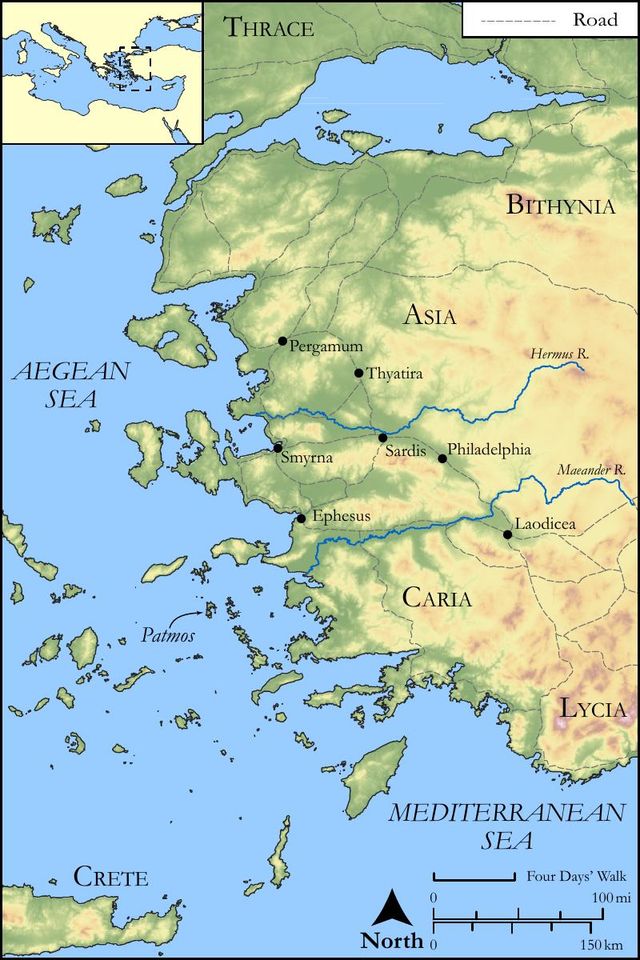
See on the biblical-era maps

Study this verse
Public-domain commentary
Matthew Henry
From his Commentary on the Whole Bible. Henry comments on passages, not single verses — this entry covers Revelation 5:6–14. His four-level outline is real structure in the source text, so it is rendered as structure.
Here, I. The apostle beholds this book taken into the hands of the Lord Jesus Christ, in order to its being unsealed and opened by him. Here Christ is described, 1. By his place and station: In the midst of the throne, and of the four beasts, and of the elders. He was on the same throne with the Father; he was nearer to him than either the elders or ministers of the churches. Christ, as man and Mediator, is subordinate to God the Father, but is nearer to him than all the creatures; for in him all the fulness of the Godhead dwells bodily. The ministers stand between God and the people. Christ stands as the Mediator between God and both ministers and people. 2. The form in which he appeared. Before he is called a lion; here he appears as a lamb slain. He is a lion to conquer Satan, a lamb to satisfy the justice of God. He appears with the marks of his sufferings upon him, to show that he interceded in heaven in the virtue of his satisfaction. He appears as a lamb, having seven horns and seven eyes, perfect power to execute all the will of God and perfect wisdom to understand it all and to do it in the most effectual manner; for he hath the seven Spirits of God, he has received the Holy Spirit without measure, in all perfection of light, and life, and power, by which he is able to teach and rule all parts of the earth. 3. He is described by his act and deed: He came, and took the book out of the right hand of him that sat on the throne (Rev 5:7), not by violence, nor by fraud, but he prevailed to do it (as Rev 5:5), he prevailed by his merit and worthiness, he did it by authority and by the Father's appointment. God very willingly and justly put the book of his eternal counsels into the hand of Christ, and Christ as readily and gladly took it into his hand; for he delights to reveal and to do the will of his Father.
II.The apostle observes the universal joy and thanksgiving that filled heaven and earth upon this transaction.
No sooner had Christ received this book out of the Father's hand than he received the applauses and adorations of angels and men, yea, of every creature. And, indeed, it is just matter of joy to all the world to see that God does not deal with men in a way of absolute power and strict justice, but in a way of grace and mercy through the Redeemer. He governs the world, not merely as a Creator and Lawgiver, but as our God and Saviour. All the world has reason to rejoice in this. The song of praise that was offered up to the Lamb on this occasion consists of three parts, one part sung by the church, another by the church and the angels, the third by every creature.
1.The church begins the doxology, as being more immediately concerned in it (Rev 5:8), the four living creatures, and the four-and-twenty elders, the Christian people, under their minister, lead up the chorus. Here observe,
(1.)The object of their worship - the Lamb, the Lord Jesus Christ; it is the declared will of God that all men should honour the Son as they honour the Father; for he has the same nature.
(2.)Their posture: They fell down before him, gave him not an inferior sort of worship, but the most profound adoration.
(3.)The instruments used in their adorations - harps and vials; the harps were the instruments of praise, the vials were full of odours or incense, which signify the prayers of the saints: prayer and praise should always go together.
(4.)The matter of their song: it was suited to the new state of the church, the gospel-state introduced by the Son of God. In this new song,
[1.]They acknowledge the infinite fitness and worthiness of the Lord Jesus for this great work of opening and executing the counsel and purposes of God (Rev 5:9): Thou art worthy to take the book, and to open the seals thereof, every way sufficient for the work and deserving the honour.
[2.]They mention the grounds and reasons of this worthiness; and though they do not exclude the dignity of his person as God, without which he had not been sufficient for it, yet they chiefly insist upon the merit of his sufferings, which he had endured for them; these more sensibly struck their souls with thankfulness and joy. Here, First, They mention his suffering: "Thou wast slain, slain as a sacrifice, thy blood was shed." Secondly, The fruits of his sufferings. 1. Redemption to God; Christ has redeemed his people from the bondage of sin, guilt, and Satan, redeemed them to God, set them at liberty to serve him and to enjoy him. 2. High exaltation: Thou hast made us to our God kings and priests, and we shall reign on the earth, Rev 5:10. Every ransomed slave is not immediately preferred to honour; he thinks it a great favour to be restored to liberty. But when the elect of God were made slaves by sin and Satan, in every nation of the world, Christ not only purchased their liberty for them, but the highest honour and preferment, made them kings and priests - kings, to rule over their own spirits, and to overcome the world, and the evil one; and he has made them priests, given them access to himself, and liberty to offer up spiritual sacrifices, and they shall reign on the earth; they shall with him judge the world at the great day.
2.The doxology, thus begun by the church, is carried on by the angels; they take the second part, in conjunction with the church, Rev 5:11. They are said to be innumerable, and to be the attendants on the throne of God and guardians to the church; though they did not need a Saviour themselves, yet they rejoice in the redemption and salvation of sinners, and they agree with the church in acknowledging the infinite merits of the Lord Jesus as dying for sinners, that he is worthy to receive power, and riches, and wisdom, and strength, and honour, and glory, and blessing.
(1.)He is worthy of that office and that authority which require the greatest power and wisdom, the greatest fund, all excellency, to discharge them aright; and,
(2.)He is worthy of all honour, and glory, and blessing, because he is sufficient for the office and faithful in it.
3.This doxology, thus begun by the church, and carried on by the angels, is resounded and echoed by the whole creation, Rev 5:13. Heaven and earth ring with the high praises of the Redeemer. The whole creation fares the better for Christ. By him all things consist; and all the creatures, had they sense and language, would adore that great Redeemer who delivers the creature from that bondage under which it groans, through the corruption of men, and the just curse denounced by the great God upon the fall; that part which (by a prosopopoeia) is made for the whole creation is a song of blessing, and honour, and glory, and power,
(1.)To him that sits on the throne, to God as God, or to God the Father, as the first person in the Trinity and the first in the economy of our salvation; and,
(2.)To the Lamb, as the second person in the Godhead and the Mediator of the new covenant. Not that the worship paid to the Lamb is of another nature, an inferior worship, for the very same honour and glory are in the same words ascribed to the Lamb and to him that sits on the throne, their essence being the same; but, their parts in the work of our salvation being distinct they are distinctly adored. We worship and glorify one and the same God for our creation and for our redemption.
We see how the church that began the heavenly anthem, finding heaven and earth join in the concert, closes all with their Amen, and end as they began, with a low prostration before the eternal and everlasting God. Thus we have seen this sealed book passing with great solemnity from the hand of the Creator into the hand of the Redeemer.
Historical interpretation
Four Centuries of Reception
4 surviving comments on this verse. Each one is dated, so this reads as a timeline rather than a list.
Select a marker to jump to its quote. Markers stagger vertically where authors wrote within a few decades of each other.
This is not said of his Godhead, in which are all the treasuries of wisdom, so that he should receive [wisdom]. Rather, this is said of his assumed manhood, that is, concerning his body, which is the church. Or, it might be said of his martyrs who were slain for his name. For the church receives all things in her Head, as the Scriptures say, “He has given us all things with him.” The Lamb himself receives, as he said in the Gospel, “All authority in heaven and on earth has been given to me.” However, he receives [this authority] according to his humanity, not according to his divinity.
From all beings, whether intelligent or sensible, whether living or simply existing in some way, God, as the Creator of all things, is glorified by words proper to their natures. Also praised is his only begotten and consubstantial Son who graciously renewed humankind and the creation that was made through him. And it is written that, as man, he received authority over all things in heaven and upon the earth.
And I saw, and I heard the voice of many angels round about the throne, and the living creatures, and the ancients. By saying that he heard the voice, he shows what kind of seeing this was; for he sees sounds and hears visions. Now if, as already said, the living creatures and the ancients are round about the throne, how can there be any angel round about the same throne, if not because those same living creatures and ancients are angels? About whom it is said, The angels of peace shall weep bitterly. [Is. 33:7] Though the heavenly military may also be understood by the name of angels; but whether it is about the latter or about the former, their countless multitude is shown when it is said after that, and the number of them was thousands of thousands, saying with a loud voice: The Lamb that was slain is worthy to receive power, and divinity, and wisdom, and strength, and honour, and glory, and benediction, and every creature, which is in heaven, and on the earth, and under the earth, and under the sea, and the things that are in it. The sea and the things that are in it represent this world. I heard all saying: To him that sitteth on the throne, and to the Lamb, benediction, and honour, and glory, and power, for ever and ever. Saying all, he means again those whom he said above the whole Church was made up of, that is the living creatures, the ancients, and the angels. In the one who sits and the Lamb, that is in the Father and the Son, according to the rule mentioned earlier, the Holy Spirit is also understood.
The song of the angels attributes seven different honors to Christ, indicating through the seven that Christ ought to be crowned with countless praises.
Continue studying Revelation 5:12 across the web’s major study libraries — every link below opens this exact verse, chapter, or book on the destination site.
Read & Compare
 BibleGatewayThis verse in more than 200 translations and 70 languages.
 Bible.comThe YouVersion reader — hundreds of translations, reading plans, and highlights.
 ESV.orgCrossway's official English Standard Version reader.
 NET BibleThe NET translation with 60,000+ translators' notes on every rendering decision.
 STEP BibleTyndale House's free study tool — original text, vocabulary, and scholarly resources.
 BibliaLogos Bible Software's free web reader.
 USCCBThe New American Bible (Revised Edition) with the U.S. bishops' study notes.
Commentaries
 BibleHub CommentariesDozens of classic commentaries on this verse, gathered on one page.
 StudyLightMore than 100 commentary sets — the largest collection on the web.
 BibleRefPlain-English commentary on what this verse means, verse by verse.
 Enduring WordDavid Guzik's free commentary on this chapter, widely used by Bible teachers.
 Bible Study ToolsVerse commentary alongside Greek and Hebrew study aids.
Original Language & Research
- BibleHub InterlinearThe verse word by word — original language, transliteration, and English.
- BibleHub LexiconEvery word's original-language definition and Strong's entry.
 Blue Letter BibleDeep-study tools — Strong's numbers, concordance, and word studies.
 CNTR CollationThe earliest Greek manuscripts of this verse, collated letter by letter.
Sermons, Hymns & Audio


TrulyRandomVerse is not affiliated with these sites and doesn’t control their content. They’re linked because they’re genuinely useful.
Summary
Revelation 5:12 captures a pivotal moment in John's vision of the heavenly throne room, where an innumerable multitude of angels joins the worship of the Lamb. With a resounding declaration, they proclaim the supreme worthiness of the Lamb, who was slain, to receive sevenfold perfection of divine attributes: power, riches, wisdom, strength, honour, glory, and blessing. This verse serves as a climactic affirmation of Christ's unparalleled authority and deservingness of ultimate adoration, stemming directly from His sacrificial work.
Context
ShowHideLiterary Context
Revelation 5:12 is embedded within the dramatic throne room scene of Revelation chapters 4 and 5. Chapter 4 establishes the majesty of God the Father, seated on His throne, receiving worship. Chapter 5 introduces a scroll sealed with seven seals, which no one in heaven or on earth is found worthy to open, leading to John's weeping. This tension is resolved by the appearance of "a Lamb standing, as though it had been slain" (Revelation 5:6). The immediate preceding verses (Revelation 5:8-10) describe the four living creatures and the twenty-four elders falling down in worship, singing a "new song" that extols the Lamb's redemptive work. Verse 11 then expands the chorus, introducing "myriads of myriads and thousands of thousands" of angels, whose collective voice culminates in the declaration of Revelation 5:12. This verse thus represents an escalation of the worship, moving from the elders and living creatures to the vast angelic host, before encompassing all creation in Revelation 5:13.
Historical & Cultural Context
The book of Revelation was written by John during a period of intense persecution of Christians, likely under the Roman Emperor Domitian (c. AD 95). Believers faced immense pressure to conform to imperial cult worship, which demanded allegiance to the emperor as divine. In this context, John's vision offers a profound counter-narrative, asserting the absolute sovereignty of God and the ultimate triumph of Christ over all earthly powers. The imagery of the Lamb, particularly "a Lamb as it had been slain," would resonate deeply with Jewish sacrificial traditions, where lambs were offered for sin, but also with the Christian understanding of Jesus as the ultimate Passover Lamb (1 Corinthians 5:7). The "loud voice" and vast numbers of worshipers are directed not, as the acclamations of Caesar's empire were, at an earthly potentate, but at the divine Lamb, setting the worthiness of the Lamb above every earthly claim and offering hope and assurance to the persecuted church that true power and authority belong to Christ alone.
Key Themes
ShowHideThis verse powerfully contributes to several overarching themes within Revelation and biblical theology. The most prominent is the Sovereignty and Worthiness of God and Christ. The entire throne room scene underscores that ultimate authority resides with the One on the throne and the Lamb. The Lamb's worthiness is explicitly tied to His sacrificial death ("that was slain"), highlighting the theme of Redemption through Sacrifice. This sacrificial act is the foundation for His right to receive all honor and power. The seven attributes listed (power, riches, wisdom, strength, honour, glory, and blessing) emphasize the Completeness and Perfection of Christ's Authority and Exaltation. This sevenfold declaration, often symbolizing divine completeness in biblical numerology, signifies that Christ is worthy of receiving all that is due to God. Furthermore, the escalating chorus of worship, culminating in this angelic declaration and expanding to all creation in Revelation 5:13, underscores the theme of Universal Worship and Recognition of Christ's Lordship, a future reality where every knee will bow (Philippians 2:10-11).
Exposition and Analysis
ShowHideKey Word Analysis
ShowHideG514 - This term denotes something deserving, suitable, or having the proper weight or value to receive a particular honor or recognition. In this context, it signifies that the Lamb possesses the inherent and demonstrated qualifications—specifically, His sacrificial death—to be the rightful recipient of the sevenfold acclamation that follows. It implies a moral and ontological fitness for such supreme honor.
G4969 - This verb literally means "to butcher" or "to slaughter," often used in the context of animal sacrifice. Its use here, in the perfect passive participle ("that was slain"), emphasizes the completed act of sacrifice and its enduring effects. It points directly to the crucifixion of Jesus, highlighting that His worthiness is not merely inherent in His divine nature but is profoundly established and demonstrated through His voluntary, atoning death as the ultimate sacrificial Lamb.
G1391 - Derived from a root meaning "to seem," "to appear," or "to think," dóxa refers to a manifestation of splendor, renown, or honor that is highly apparent and evokes praise. In a theological sense, it often signifies the visible manifestation of God's presence, majesty, and character. Here, it refers to the divine radiance, honor, and praise that the Lamb is supremely worthy to receive, reflecting His intrinsic divine nature and His achieved triumph through sacrifice.
Verse Breakdown
ShowHideThis comprehensive list signifies that the Lamb is worthy of all forms of dominion, resources, intellect, might, reverence, splendor, and worship.
Literary Devices
ShowHideRevelation 5:12 employs several powerful literary devices. Symbolism is paramount, with "the Lamb" serving as the central symbol for Jesus Christ, specifically highlighting His sacrificial nature ("that was slain"). The Lamb is not a fierce lion, though He is described as such in Revelation 5:5, but a vulnerable, slain victim, yet paradoxically the one who conquers. The phrase "loud voice" is a form of hyperbole, emphasizing the immense scale and overwhelming nature of the angelic chorus, conveying a sound that transcends earthly comprehension. The list of seven attributes—power, riches, wisdom, strength, honour, glory, and blessing—is a prime example of numerology, where the number seven signifies completeness, perfection, or divine fullness. This sevenfold enumeration also utilizes polysyndeton, the repeated use of the conjunction "and" between each item in the list. This stylistic choice creates a sense of accumulating grandeur and emphasizes the comprehensive, exhaustive nature of the attributes the Lamb is worthy to receive, rather than merely listing them. The cumulative effect is one of profound reverence and absolute affirmation of Christ's supreme worth.
Theological and Thematic Connections
ShowHideRevelation 5:12 stands as a profound theological statement, asserting the unique and unparalleled worthiness of Jesus Christ, the Lamb, whose sacrificial death is the foundation of His authority over all things and universal adoration. This worthiness is not merely a divine attribute but is intrinsically linked to His redemptive act on the cross, demonstrating that true power and glory are achieved through self-sacrifice and humble obedience. The sevenfold acclamation underscores the comprehensive nature of Christ's dominion and the perfect sufficiency of His work, establishing Him as the rightful recipient of all worship from all creation. This vision anticipates the ultimate consummation of God's plan, where Christ's reign will be universally acknowledged and celebrated, providing immense comfort and assurance to believers facing persecution, reminding them that their suffering Savior is the reigning Lord of all.
Reflection and Application
ShowHideRevelation 5:12 invites us to participate in the heavenly chorus, aligning our hearts and voices with the heavenly declaration of Christ's supreme worth. It challenges us to consider what we truly value and worship in our lives. If the Lamb, who was slain, is worthy to receive all power, riches, wisdom, strength, honour, glory, and blessing, then our lives should reflect this truth by placing Him at the center of our affections, allegiances, and aspirations. This verse reminds us that true authority and glory are not found in worldly might or possessions, but in the self-giving love exemplified by the Lamb. It calls us to trust in His perfect wisdom and strength, to find our true riches in Him, and to offer Him the honor and glory due His name. Our daily acts of worship, service, and obedience become a tangible response to this heavenly vision, a participation in the eternal adoration of the One who gave everything for us.
Questions for Reflection
ShowHideFAQ
ShowHideWhy is the Lamb described as "slain" but also "worthy" to receive so much?
ShowHideThe description of the Lamb as "slain" (Greek: esphagmenon) points directly to the crucifixion of Jesus Christ. This imagery emphasizes His sacrificial death, which atoned for the sins of humanity. Paradoxically, it is precisely because of this act of ultimate self-sacrifice and His subsequent resurrection that He is deemed "worthy" (áxios) to receive all power, riches, wisdom, strength, honour, glory, and blessing. His worthiness is not merely inherent in His divine nature (though that is true), but also powerfully demonstrated and established through His redemptive work. This highlights a core biblical truth: true exaltation in God's kingdom often follows humility and suffering, as seen in Philippians 2:8-9. The Lamb's sacrifice is the foundation for His unique authority and the universal worship He receives.
What is the significance of the seven attributes listed in the verse?
ShowHideThe list of seven attributes—power, riches, wisdom, strength, honour, glory, and blessing—is highly significant. In biblical numerology, the number seven frequently symbolizes completeness, perfection, or divine fullness. Therefore, this sevenfold declaration signifies that the Lamb is worthy to receive all forms of dominion, resources, intellect, might, reverence, splendor, and worship. It's an exhaustive and comprehensive list, indicating that nothing is withheld from Him. It underscores the absolute and total supremacy of Christ, who is fully equipped and fully deserving of every conceivable form of praise and authority, reflecting His position as the exalted Lord over all creation (Colossians 1:16-17).
Christ-Centered Fulfillment
ShowHideRevelation 5:12 offers a profound Christ-centered fulfillment, revealing the ultimate destiny and deservingness of Jesus Christ as the sacrificial Lamb. This vision is the culmination of God's redemptive plan, foreshadowed throughout the Old Testament sacrificial system, which pointed to the perfect, once-for-all sacrifice of Christ (Hebrews 9:11-14). The Lamb "that was slain" is none other than Jesus, who, through His death and resurrection, conquered sin and death, thereby establishing His unique worthiness to break the seals and execute God's sovereign plan. His receiving of "power, and riches, and wisdom, and strength, and honour, and glory, and blessing" is the New Testament affirmation of His exaltation to the right hand of God, where He reigns supreme over all things (Ephesians 1:20-22). This verse beautifully connects Christ's past suffering with His present reign and future universal acknowledgment, assuring believers that the one who humbled Himself to the point of death on a cross is the very one before whom every knee will ultimately bow and every tongue confess that He is Lord, to the glory of God the Father (Philippians 2:9-11). It is through this Christ, the Lamb, that humanity gains access to God's blessing and participates in His eternal kingdom (Revelation 1:5-6).