


1 Corinthians 5:7
Bible text: King James Version (1769 Blayney text) · Public domain
Bible text: King James Version with Strong's numbers · Public domain
Bible text: Berean Standard Bible · Public domain
Bible text: American Standard Version (1901) · Public domain
Bible text: World English Bible, Messianic edition · Public domain
Bible text: Geneva Bible (1599) · Public domain
Bible text: Young's Literal Translation · Public domain
- ἐκκαθάρατεekkatharatedo cleanse outG1571V-AAM-2PVerb Aorist Active Imperative 2nd Plural
- οὖνounthereforeG3767CONJConjunction
- τὴνtēntheG3588T-ASFDefinite article Accusative Singular Feminine
- παλαιὰνpalaianoldG3820A-ASFAdjective Accusative Singular Feminine
- ζύμηνzumēnleavenG2219N-ASFNoun Accusative Singular Feminine
- ἵναinathatG2443CONJConjunction
- ἦτεēteyou may beG1510V-PAS-2PVerb Present Active Subjunctive 2nd Plural
- νέονneona newG3501A-NSNAdjective Nominative Singular Neuter
- φύραμαphuramalumpG5445N-NSNNoun Nominative Singular Neuter
- καθώςkathōseven asG2531CONJConjunction
- ἐστεesteyou areG1510V-PAI-2PVerb Present Active Indicative 2nd Plural
- ἄζυμοι·azumoiunleavenedG106A-NPMAdjective Nominative Plural Masculine
- καὶkaiAlsoG2532CONJConjunction
- γὰρgarforG1063CONJConjunction
- τὸtotheG3588T-NSNDefinite article Nominative Singular Neuter
- πάσχαpaschaPassover lambG3957N-NSN-TNoun Nominative Singular Neuter Title
- ἡμῶνhēmōnof usG3165P-1GPPersonal pronoun Genitive 1st Plural
- ὑπὲρhuperforG5228PREPPreposition
- ἡμῶνhēmōnusG3165P-1GPPersonal pronoun Genitive 1st Plural
- ἐτύθηetuthēhas been sacrificedG2380V-API-3SVerb Aorist Passive Indicative 3rd Singular
- ΧριστόςChristosChristG5547N-NSM-TNoun Nominative Singular Masculine Title
English is a literal word-by-word gloss of the Greek, not the KJV's wording. Why?
This is the original text the KJV's translators worked from — each Greek word with its own literal English meaning in this verse, prepared by scholars at Tyndale House, Cambridge. The KJV translates whole sentences, not word by word, so its wording differs: one Greek word can become several English words, and the KJV may choose “charity” where the gloss reads “love”. Both are faithful — they answer different questions. For the KJV's own rendering, switch to the KJV text.
Details
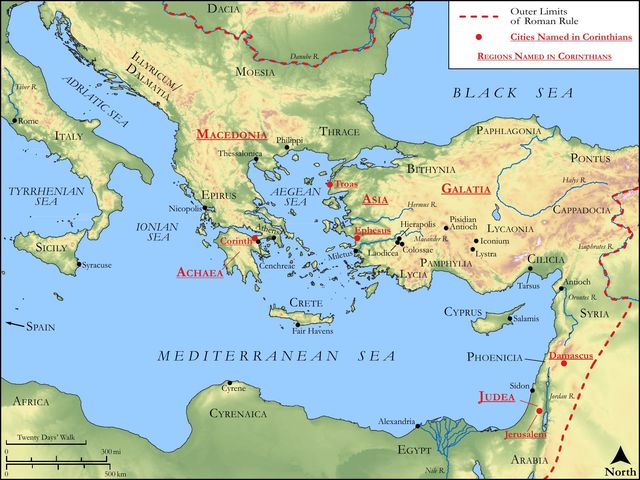
See on the biblical-era maps

Study this verse
Public-domain commentary
Matthew Henry
From his Commentary on the Whole Bible. Henry comments on passages, not single verses — this entry covers 1 Corinthians 5:7–8. His two-level outline is real structure in the source text, so it is rendered as structure.
Here the apostle exhorts them to purity, by purging out the old leaven. In this observe,
I.The advice itself, addressed either,
1.To the church in general; and so purging out the old leaven, that they might be a new lump, refers to the putting away from themselves that wicked person, Co1 5:13. Note, Christian churches should be pure and holy, and not bear such corrupt and scandalous members. They are to be unleavened, and should endure no such heterogeneous mixture to sour and corrupt them. Or,
2.To each particular member of the church. And so it implies that they should purge themselves from all impurity of heart and life, especially from this kind of wickedness, to which the Corinthians were addicted to a proverb. See the argument at the beginning. This old leaven was in a particular manner to be purged out, that they might become a new lump. Note, Christians should be careful to keep themselves clean, as well as purge polluted members out of their society. And they should especially avoid the sins to which they themselves were once most addicted, and the reigning vices of the places and the people where they live. They were also to purge themselves from malice and wickedness - all ill-will and mischievous subtlety. This is leaven that sours the mind to a great degree. It is not improbable that this was intended as a check to some who gloried in the scandalous behaviour of the offender, both out of pride and pique. Note, Christians should be careful to keep free from malice and mischief. Love is the very essence and life of the Christian religion. It is the fairest image of God, for God is love (Jo1 4:16), and therefore it is no wonder if it be the greatest beauty and ornament of a Christian. But malice is murder in its principles: He that hates his brother is a murderer (Jo1 3:15), he bears the image and proclaims him the offspring of him who was a murderer from the beginning, Joh 8:44. How hateful should every thing be to a Christian that looks like malice and mischief.
II.The reason with which this advice is enforced:
For Christ our passover is sacrificed for us, Co1 5:7. This is the great doctrine of the gospel. The Jews, after they had killed the passover, kept the feast of unleavened bread. So must we; not for seven days only, but all our days. We should die with our Saviour to sin, be planted into the likeness of his death by mortifying sin, and into the likeness of his resurrection by rising again to newness of life, and that internal and external. We must have new hearts and new lives. Note, The whole life of a Christian must be a feast of unleavened bread. His common conversation and his religious performances must be holy. He must purge out the old leaven, and keep the feast of unleavened bread of sincerity and truth. He must be without guilt in his conduct towards God and man. And the more there is of sincerity in our own profession, the less shall we censure that of others. Note, On the whole, The sacrifice of our Redeemer is the strongest argument with a gracious heart for purity and sincerity. How sincere a regard did he show to our welfare, in dying for us! and how terrible a proof was his death of the detestable nature of sin, and God's displeasure against it! Heinous evil, that could not be expiated but with the blood of the Son of God! And shall a Christian love the murderer of his Lord? God forbid.
Historical interpretation
Five Centuries of Reception
11 surviving comments on this verse. Each one is dated, so this reads as a timeline rather than a list.
Select a marker to jump to its quote. Markers stagger vertically where authors wrote within a few decades of each other.
This was first fulfilled in Syria; for "the disciples were called Christians at Antioch," when Paul and Peter were laying the foundations of the Church. Lay aside, therefore, the evil, the old, the corrupt leaven, and be ye changed into the new leaven of grace.
Wherefore also Plato says, in the second book of the Republic, "It is those that sacrifice not a sow, but some great and difficult sacrifice," who ought to inquire respecting God. And the apostle writes, "Christ our passover was sacrificed for us;"-a sacrifice hard to procure, in truth, the Son of God consecrated for us.
The unleavened bread was therefore, in the Creator's ordinance, a figure of us (Christians). "For even Christ our passover is sacrificed for us." But why is Christ our passover, if the passover be not a type of Christ, in the similitude of the blood which saves, and of the Lamb, which is Christ? Why does (the apostle) clothe us and Christ with symbols of the Creator's solemn rites, unless they had relation to ourselves? When, again, he warns us against fornication, he reveals the resurrection of the flesh.
Which prediction was thus also fulfilled, that "on the first day of unleavened bread" you slew Christ; and (that the prophecies might be fulfilled) the day hasted to make an "eventide,"-that is, to cause darkness, which was made at mid-day; and thus "your festive days God converted into grief, and your canticles into lamentation.
It does not matter that he also said, "For the destruction of the flesh, that the spirit may be saved in the day of the Lord," since both in the destruction of the flesh and in the saving of the spirit there is, on His part, judicial process; and when he bade "the wicked person be put away from the midst of them," he only mentioned what is a very frequently recurring sentence of the Creator. "Purge out the old leaven, that ye may be a new lump, as ye are unleavened." The unleavened bread was therefore, in the Creator's ordinance, a figure of us (Christians).
For in what respect, he says, would the one tittle require any substance such as leaven (derived) from without for the Lord's Passover, the eternal feast, which is given for generation upon generation?.
In other respects, however, these consent to all the traditions delivered to the Church by the Apostles.
To have remodelled the old man.
In the Passover season, so as to exhibit Himself as one destined to be sacrificed like a sheep, and to prove Himself the true Paschal-lamb, even as the apostle says, "Even Christ "who is God, "our passover was sacrificed for us."
That he who has attained to trust, having put off the former man, ought to regard only celestial and spiritual things, and to give no heed to the world which he has already renounced...
Also in the same place: "Love not the world, neither the things that are in the world. If any man loveth the world, the love of the Father is not in him. Because everything which is in the world is lust of the flesh, and lust of the eyes, and the ambition of this world, which is not of the Father, but of the lust of this world. And the world shall pass away with its lust. But he that doeth the will of God abideth for ever, even as God abideth for ever." Also in the first Epistle of Paul to the Corinthians: "Purge out the old leaven, that ye may be a new dough, as ye are unleavened. For also Christ our passover is sacrificed. Therefore let us celebrate the feast, not in the old leaven, nor in the leaven of malice and wickedness, but in the unleavened bread of sincerity and truth."
The voice of the warning apostle is, "Purge out the old leaven, that ye may be a new lump, as ye are unleavened; for even Christ our passover is sacrificed. Therefore let us keep the feast, not with old leaven, neither with the leaven of malice and wickedness, but with the unleavened bread of sincerity and truth." But are sincerity and truth preserved, when what is sincere is polluted by adulterous colours, and what is true is changed into a lie by the deceitful dyes of medicaments? Your Lord says, "Thou canst not make one hair white or black; " and you, in order to overcome the word of your Lord, will be more mighty than He, and stain your hair with a daring endeavour and with profane contempt. With evil presage of the future, you make a beginning to yourself already of flame-coloured hair; and sin (oh, wickedness!) with your head-that is, with the nobler part of your body! And although it is written of the Lord, "His head and His hair were white like wool or snow," you curse that whiteness and hate that hoariness which is like to the Lord's head.
The old leaven has a double meaning here. On the one hand, it refers to false teaching, just as Jesus warned his disciples to beware the leaven of the Pharisees. On the other hand, it also refers to the sin of fornication being dealt with here. Paul teaches that the passover is the sacrifice, and not the exodus, as some people think. The sacrifice comes first, and then it is possible to make the transition from the old life to the new. For this reason it is the cross that is the saving reality signified by the passover in the Old Testament.
"Purge out the old leaven," that is, this evil one. Not that he speaketh concerning this one only; rather he glances at others with him. For, "the old leaven" is not fornication only, but also sin of every kind. And he said not, "purge," but "purge out;" "cleanse with accuracy so that there be not so much as a remnant nor a shadow of that sort." In saying then, "purge out," he signifies that there was still iniquity among them. But in saying, "that ye may be a new lump, even as ye are unleavened," he affirms and declares that not over very many was the wickedness prevailing. But though he saith, "as ye are unleavened," he means it not as a fact that all were clean, but as to what sort of people you ought to be.
"For our Passover also hath been sacrificed for us, even Christ; wherefore let us keep the feast: not with old leaven, nor with the leaven of malice and wickedness, but with the unleavened bread of sincerity and truth." So also Christ called His doctrine Leaven. And further he himself dwells upon the metaphor, reminding them of an ancient history, and of the Passover and unleavened bread, and of their blessings both then and now, and their punishments and their plagues.
It is festival, therefore, the whole time in which we live. For though he said, "Let us keep the feast," not with a view to the presence of the Passover or of Pentecost did he say it; but as pointing out that the whole of time is a festival unto Christians, because of the excellency of the good things which have been given. For what hath not come to pass that is good? The Son of God was made man for thee; He freed thee from death; and called thee to a kingdom. Thou therefore who hast obtained and art still obtaining such things, how can it be less than thy duty to "keep the feast" all thy life? Let no one then be downcast about poverty, and disease, and craft of enemies. For it is a festival, even the whole of our time.
So that by means of this example also he mightily drives the fornicator out of the Church. For, saith he, so far from his presence profiting, he even doth harm, injuring the common estate of the body. For one knows not whence is the evil savor while the corrupt part is concealed, and so one imputes it to the whole. Wherefore he urges upon them strongly to "purge out the leaven, that ye may be," saith he, "a new lump, even as ye are unleavened."
"For our Passover hath been sacrificed for us even Christ." He said not, hath died, but more in point to the subject in hand, "hath been sacrificed." Seek not then unleavened bread of this kind, since neither hast thou a lamb of the same kind. Seek not leaven of this description, seeing that thine unleavened bread is not such as this.
Thus, in the case of material leaven, the unleavened might become leavened, but never the reverse; whereas here there is a chance of the direct contrary occurring. This however he has not plainly declared: and observe his good sense. In the former Epistle he gives the fornicator no hope of return, but orders that his whole life should be spent in repentance, lest he should make him less energetic through the promise. For he said not, "Deliver him up to Satan," that having repented he might be commended again unto the Church. But what saith he? "That he may be saved in the last day." For he conducts him on unto that time in order to make him full of anxiety. And what favors he intended him after the repentance, he reveals not, imitating his own Master. For as God saith, "Yet three days, and Nineveh shall be overthrown," and added not, "but if she repent she shall be saved:" so also he did not say here, "But if he repent worthily, we will 'confirm our love towards him.'" But he waits for him to do the work that so he may then receive the favor. For if he had said this at the beginning he might have set him free from the fear. Wherefore he not only does not so, but by the instance of leaven allows him not even a hope of return, but reserves him unto that day: "Purge out (so he says) the old leaven;" and, "let us not keep the feast with old leaven." But as soon as he had repented, he brought him in again with all earnestness.
But why does he call it "old?" Either because our former life was of this sort, or because that which is old is "ready to vanish away," and is unsavory and foul; which is the nature of sin.
Let its name be inquired into more carefully. Let the excellent preacher be consulted. Let us see what he declares concerning the estimation of Him. For he says: "For Christ our Passover has been sacrificed." If therefore Christ is the Passover, we must consider what the law says about the Passover, so that we may investigate more carefully whether these things seem to have been said about Christ.
Continue studying 1 Corinthians 5:7 across the web’s major study libraries — every link below opens this exact verse, chapter, or book on the destination site.
Read & Compare
 BibleGatewayThis verse in more than 200 translations and 70 languages.
 Bible.comThe YouVersion reader — hundreds of translations, reading plans, and highlights.
 ESV.orgCrossway's official English Standard Version reader.
 NET BibleThe NET translation with 60,000+ translators' notes on every rendering decision.
 STEP BibleTyndale House's free study tool — original text, vocabulary, and scholarly resources.
 BibliaLogos Bible Software's free web reader.
 USCCBThe New American Bible (Revised Edition) with the U.S. bishops' study notes.
Commentaries
 BibleHub CommentariesDozens of classic commentaries on this verse, gathered on one page.
 StudyLightMore than 100 commentary sets — the largest collection on the web.
 BibleRefPlain-English commentary on what this verse means, verse by verse.
 Enduring WordDavid Guzik's free commentary on this chapter, widely used by Bible teachers.
 Bible Study ToolsVerse commentary alongside Greek and Hebrew study aids.
Original Language & Research
- BibleHub InterlinearThe verse word by word — original language, transliteration, and English.
- BibleHub LexiconEvery word's original-language definition and Strong's entry.
 Blue Letter BibleDeep-study tools — Strong's numbers, concordance, and word studies.
 CNTR CollationThe earliest Greek manuscripts of this verse, collated letter by letter.
Sermons, Hymns & Audio


TrulyRandomVerse is not affiliated with these sites and doesn’t control their content. They’re linked because they’re genuinely useful.
Summary
First Corinthians 5:7 delivers a powerful injunction for the Christian community to actively rid itself of moral corruption, symbolized by "old leaven." This command is rooted in the profound theological truth that believers are already, by virtue of their union with Christ, a "new lump"—positionally pure and unleavened. The verse culminates in the foundational declaration that Christ Himself is our Passover sacrifice, a completed act that provides the basis for their new identity and the imperative for practical holiness.
Context
ShowHideLiterary Context
This verse stands as the climactic command within Paul's severe rebuke of the Corinthian church for their egregious tolerance of sexual immorality, specifically an incestuous relationship, as detailed in 1 Corinthians 5:1. Paul has just warned them in 1 Corinthians 5:6 that "a little leaven leaveneth the whole lump," setting up the metaphor that the presence of unaddressed sin can corrupt the entire body of believers. The instruction to "purge out" is therefore a direct application of this principle, demanding decisive action against sin to preserve the purity and witness of the church. The verse transitions from a stern warning about the pervasive nature of sin to the redemptive truth that undergirds the call to holiness.
Historical & Cultural Context
The imagery of "leaven" (ζύμη, zymē) and "unleavened" (ἄζυμος, ázymos) is deeply rooted in Jewish tradition, particularly the annual celebration of Passover. Before Passover, Jewish families meticulously cleansed their homes of all leaven, symbolizing the haste of their ancestors' departure from Egypt (where there was no time for bread to rise) and the removal of corruption or sin. This practice, commanded in passages like Exodus 12:15 and Deuteronomy 16:3, served as a powerful annual reminder of God's deliverance and the necessity of holiness in His presence. Paul leverages this well-understood cultural and religious practice to communicate a spiritual imperative to his largely Gentile, but culturally aware, Corinthian audience.
Key Themes
ShowHideThe verse powerfully contributes to several major themes present in 1 Corinthians and the broader New Testament. Firstly, it underscores the theme of Spiritual Purity and Holiness, emphasizing that the church, as God's redeemed community, must actively separate itself from sin and maintain a holy witness in the world. Secondly, it highlights the theme of Identity in Christ, asserting that believers are already "unleavened" in their spiritual standing before God due to Christ's work, making the call to "purge out" a call to live consistently with their new, pure identity in 2 Corinthians 5:17. Finally, and most profoundly, it introduces the theme of Christ as the Ultimate Passover Sacrifice, directly linking Jesus' atoning death to the Old Testament Passover lamb, whose blood secured deliverance for Israel. This connection reveals Christ as the fulfillment of the Old Covenant rituals, providing a once-for-all salvation that cleanses and redeems His people, as seen in Hebrews 9:26.
Exposition and Analysis
ShowHideKey Word Analysis
ShowHideThis verb, a compound of ek (out) and kathaírō (to cleanse), means "to cleanse thoroughly" or "to purify completely." It implies a deliberate, vigorous, and comprehensive removal of something undesirable. In this context, it is not a passive waiting for sin to disappear but an active, intentional expulsion of moral corruption from the community.
Derived from a root meaning "to boil up" or "ferment," zymē refers to fermented dough used to make bread rise. In Jewish and New Testament thought, it frequently symbolizes pervasive evil, corruption, or false doctrine due to its spreading nature. Here, it specifically represents the moral impurity and unrepentant sin tolerated within the Corinthian church.
This term directly references the Jewish festival commemorating the Israelites' deliverance from slavery in Egypt, marked by the sacrifice of a lamb. By identifying "Christ our Passover," Paul makes a profound theological statement, declaring Jesus as the ultimate fulfillment of this ancient ritual, whose sacrificial death secures deliverance from sin and spiritual death for believers.
This verb means "to sacrifice," "to immolate," or "to slay" for a ritual purpose. The perfect passive tense ("is sacrificed," etythē) emphasizes that Christ's sacrifice is a completed action with ongoing, permanent results. It highlights the definitive and efficacious nature of His atoning work, which has already secured the "unleavened" status of believers.
Verse Breakdown
ShowHide"Purge out therefore the old leaven"
This is a direct command (imperative mood) for the Corinthian believers to actively and thoroughly remove the moral corruption (symbolized by "old leaven") from their midst. The "old leaven" refers to the pervasive influence of sin, particularly the unrepentant immorality Paul has just addressed, which characterized their former, unregenerate lives. The "therefore" links this command to the preceding warning about the corrupting power of leaven.
"that ye may be a new lump, as ye are unleavened"
This clause explains the purpose and basis for the purging. The goal is for the church to manifest its true identity as a "new lump"—a fresh, uncorrupted community. The crucial phrase "as ye are unleavened" highlights their positional truth in Christ. Believers are already, by virtue of their union with Christ and His finished work, spiritually pure and set apart. The purging is not to become unleavened, but to live in accordance with their already established, redeemed, and holy status.
"For even Christ our passover is sacrificed for us"
This is the theological foundation for the entire command. The "For" (γάρ, gar) introduces the reason and motivation. Paul declares that Christ Himself is the true Passover Lamb, whose sacrificial death on the cross has already been accomplished ("is sacrificed"). This once-for-all sacrifice provides the ultimate cleansing and deliverance from sin, making believers inherently "unleavened" in God's sight and enabling them to live lives consistent with that new reality.
Literary Devices
ShowHidePaul masterfully employs several literary devices in this verse. The most prominent is Metaphor, where "leaven" serves as a vivid representation of sin and moral corruption. Just as a small amount of leaven permeates and transforms an entire batch of dough, so too can unaddressed sin corrupt an entire community. This metaphor is extended to describe the church as a "lump" of dough, which is to be "new" and "unleavened." Furthermore, the verse contains profound Symbolism, particularly in the identification of "Christ our passover." This is a direct Allusion to the Old Testament Passover event, where the sacrificial lamb's blood protected Israel from death. By equating Christ with the Passover lamb, Paul elevates Jesus' sacrifice to the ultimate act of redemption, fulfilling the Old Covenant type. The use of the perfect passive tense for "is sacrificed" (ἐτύθη, etythē) emphasizes the Completed Action with Enduring Results, highlighting the definitive and efficacious nature of Christ's atoning work.
Theological and Thematic Connections
ShowHideThis verse is a cornerstone for understanding Christian sanctification, both individual and corporate. It beautifully intertwines the indicative (what is true about us in Christ) with the imperative (what we are commanded to do). Because Christ has already accomplished our spiritual cleansing through His sacrifice, we are called to live out that reality. This means actively putting off the "old self" and its sinful practices and putting on the "new self" created in righteousness and holiness. The church, as the body of Christ, is therefore responsible for maintaining its purity, reflecting the holiness of its Head. This involves not only personal repentance but also, when necessary, corporate discipline to protect the integrity and witness of the community. The identification of Christ as "our Passover" establishes Him as the definitive fulfillment of Old Testament sacrificial systems, providing the ultimate and perfect atonement for sin.
Reflection and Application
ShowHideFirst Corinthians 5:7 calls believers to a radical commitment to purity, both personally and corporately. It challenges us to confront the "old leaven" in our lives—those lingering sinful patterns, attitudes, or compromises that contradict our identity in Christ. This isn't about earning salvation, but about living consistently with the profound truth that we have already been made "unleavened" by Christ's sacrifice. For the church, it means taking seriously the call to be a holy community, not tolerating unrepentant sin that could corrupt the whole. This requires discernment, courage, and a deep love for God's honor and the spiritual well-being of fellow believers. It reminds us that our positional holiness in Christ demands practical holiness in our daily walk, reflecting the glorious reality of our redemption.
Questions for Reflection
ShowHideFAQ
ShowHideWhy does Paul use the imagery of "leaven" to represent sin?
ShowHidePaul uses "leaven" because of its well-understood properties and its significant symbolic meaning in Jewish tradition. Leaven (fermented dough) has the characteristic of permeating and expanding throughout an entire batch of dough, causing it to rise. Similarly, sin, if left unchecked, has a pervasive and corrupting influence that can spread throughout an individual's life or an entire community. In the Old Testament, particularly during the Passover, the removal of all leaven from homes symbolized purity and separation from the old life of bondage in Egypt, making it a fitting metaphor for the active removal of moral corruption within the Christian community, as seen in Exodus 12:15.
What does it mean that believers "are unleavened"? Is this a command or a statement of fact?
ShowHideThe phrase "as ye are unleavened" (καθὼς ἔστε ἄζυμοι, kathōs este ázymoi) is primarily a statement of fact, an indicative truth about the believer's new identity in Christ. By virtue of their union with Christ and His completed work, believers are positionally holy and pure in God's sight—they are already "unleavened." The preceding command to "purge out therefore the old leaven" is the imperative, calling them to live out this established reality. It's a call to practical holiness that flows from their positional holiness, urging them to align their conduct with their true spiritual status in Ephesians 4:22-24.
Christ-Centered Fulfillment
ShowHideThe declaration "For even Christ our passover is sacrificed for us" is the theological bedrock upon which the entire command for purity rests. This statement reveals Christ as the ultimate fulfillment of the Old Testament Passover, transforming a historical event and ritual into a profound spiritual reality. Just as the blood of the Passover lamb protected Israel from the angel of death in Egypt, so the shed blood of Jesus, the Lamb of God, secures eternal deliverance from the penalty and power of sin for all who believe, as proclaimed by John the Baptist in John 1:29. His sacrifice is not merely a parallel but the very culmination of all previous sacrifices, a once-for-all atonement that perfectly cleanses and consecrates His people, rendering them "unleavened" in God's sight (Hebrews 9:12). Therefore, the call to "purge out the old leaven" is a call to live consistently with the new, pure identity that Christ has already secured for us through His redemptive work, walking in the newness of life that His resurrection provides (Romans 6:4).